FlagGAM: Rule-Basis Generalized Additive Models for Explainable Tabular Prediction
Pith reviewed 2026-06-28 23:26 UTC · model grok-4.3
The pith
FlagGAM builds sparse univariate rule bases that limit AUROC drop under missing values and noise.
A machine-rendered reading of the paper's core claim, the machinery that carries it, and where it could break.
Core claim
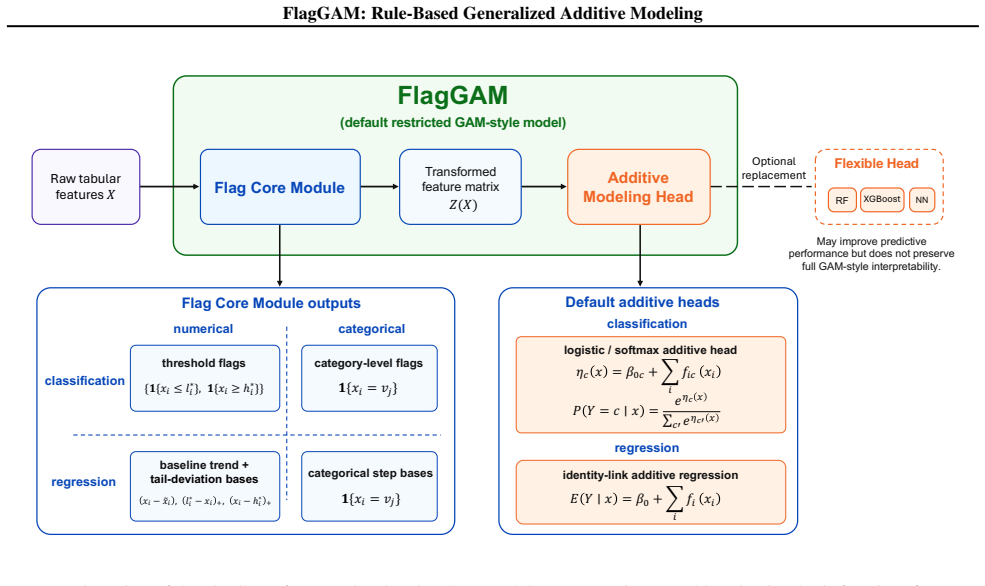
FlagGAM converts numerical and categorical variables into sparse univariate bases (threshold flags, category flags, tail-deviation bases, and categorical step functions) through a Flag Core Module. These bases are combined by a default additive head that behaves as a restricted generalized additive model, while the retained basis matrix also supports optional flexible heads. On clean benchmarks the additive form stays close to modern additive and rule-based methods for classification and improves on global linear models for regression; under missingness and numerical noise the same additive form records the smallest mean AUROC degradation across the three tested classification datasets.
What carries the argument
The Flag Core Module, which maps each input variable to a small collection of sparse, human-readable univariate flag bases that are then used for both additive prediction and rule inspection.
If this is right
- Additive FlagGAM remains competitive with modern additive and rule-based baselines on clean classification tasks.
- It outperforms global linear models on regression benchmarks while preserving interpretability.
- Flexible heads raise absolute accuracy and approach tree-based performance while still operating over the learned rule bases.
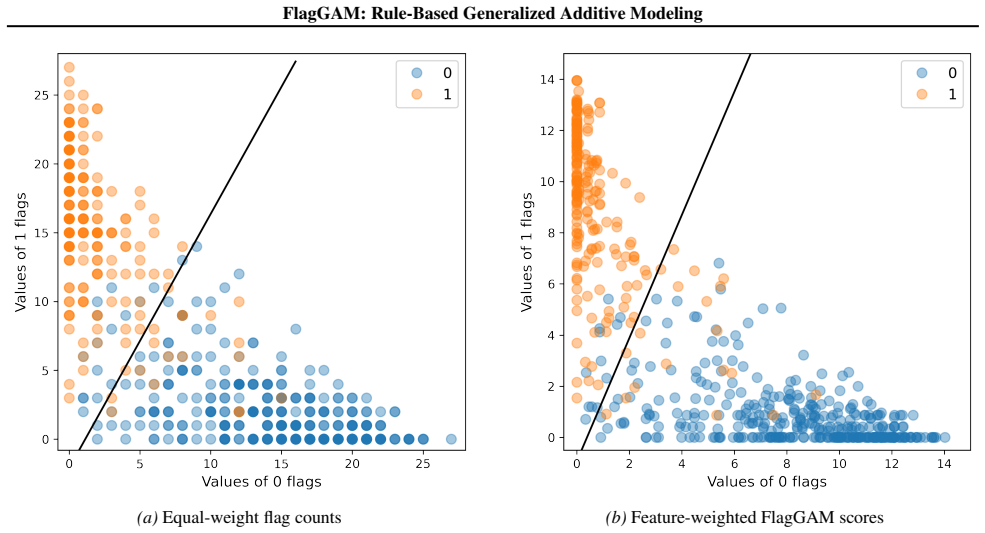
- The retained sparse basis matrix enables feature-specific weighting and mixed-type handling without retraining the core rules.
Where Pith is reading between the lines
- The same univariate bases could be tested for stability under distribution shift or adversarial perturbations beyond the missingness and noise examined.
- Domains that require audit trails may adopt the readable flags even when flexible heads are used for final decisions.
- The separation of base construction from the head suggests a route to transfer the bases to new tasks or data modalities without rebuilding rules from scratch.
Load-bearing premise
The sparse univariate flag bases already capture the predictive information that matters, so interactions or more complex transformations are not required for the observed robustness.
What would settle it
Finding a larger mean AUROC degradation for FlagGAM than for the compared baselines on the same three datasets (or additional ones) when the same missingness and noise patterns are applied would falsify the central robustness claim.
Figures
read the original abstract
Tabular applications often require inspectable prediction rules and stable behavior when records are incomplete. We propose FlagGAM, a rule-basis framework that separates feature-level rule construction from prediction. A Flag Core Module converts numerical and categorical variables into sparse, human-readable univariate bases: threshold flags, category-level flags, tail-deviation bases, and categorical step functions. A default additive head combines these bases as a restricted GAM-style predictor, while the retained sparse rule-basis matrix supports mixed-type classification and regression, feature-specific weighting, and optional flexible heads. On clean benchmarks, additive FlagGAM stays close to modern additive and rule-based baselines on classification and improves over global linear modeling on regression, while remaining less flexible than tree-based predictors. Its clearest advantage appears under deployment-time perturbations: across three classification datasets, FlagGAM has the smallest mean AUROC degradation under missingness and numerical noise. Flexible heads improve absolute accuracy and approach strong tree-based baselines, but should be interpreted as nonlinear predictors over learned rule bases. These results support FlagGAM as a constrained additive rule-basis model for applications that need readable rules and stable behavior with incomplete inputs.
Editorial analysis
A structured set of objections, weighed in public.
Referee Report
Summary. The paper introduces FlagGAM, a rule-basis framework that uses a Flag Core Module to convert tabular features into sparse univariate bases (threshold flags, category flags, tail-deviation, step functions) and combines them via a default additive GAM-style head (with optional flexible heads) for explainable classification and regression. It reports competitive performance versus additive and rule-based baselines on clean benchmarks, improvement over linear models on regression, and the smallest mean AUROC degradation under missingness and numerical noise across three classification datasets.
Significance. If the robustness result holds under proper controls, FlagGAM would offer a constrained, human-readable rule-basis approach that balances interpretability with stability on incomplete inputs, providing a useful alternative to trees for deployment settings where perturbations are common.
major comments (3)
- [Abstract] Abstract: the central claim of smallest mean AUROC degradation under missingness and numerical noise is presented without any mention of statistical significance testing, variance across runs, or exact perturbation protocols (e.g., missingness mechanism or noise distribution), leaving the comparative robustness assertion without verifiable support.
- [Method] Method (Flag Core Module description): the construction of sparse univariate flag bases is described at a high level but no criteria, hyperparameters, or selection procedure for thresholds, tail-deviation, or step functions are given; this is load-bearing for the claim that the additive combination remains stable when interactions would otherwise amplify degradation.
- [Experiments] Experiments: no ablations or synthetic controls are referenced that isolate whether the univariate flag assumption holds or fails when the data-generating process contains feature interactions disrupted by missingness or noise, which directly tests the skeptic's concern about the robustness advantage.
minor comments (2)
- Notation for the retained sparse rule-basis matrix and its use with flexible heads could be made more precise to distinguish the additive case from the nonlinear-over-rules case.
- [Abstract] The abstract states 'across three classification datasets' but does not name them or reference the corresponding table/figure; adding this would improve traceability.
Simulated Author's Rebuttal
We thank the referee for the constructive feedback, which identifies opportunities to strengthen the verifiability of our robustness claims, the reproducibility of the Flag Core Module, and the isolation of the univariate assumption. We address each major comment below and outline the planned revisions.
read point-by-point responses
-
Referee: [Abstract] Abstract: the central claim of smallest mean AUROC degradation under missingness and numerical noise is presented without any mention of statistical significance testing, variance across runs, or exact perturbation protocols (e.g., missingness mechanism or noise distribution), leaving the comparative robustness assertion without verifiable support.
Authors: We agree that the abstract would benefit from additional qualifiers to make the robustness claim immediately verifiable. In the revised manuscript we will expand the abstract to briefly reference the perturbation protocols (MCAR missingness and additive noise, as detailed in the Experiments section), state that results are reported as means with variance across runs, and note that paired statistical tests were used to assess significance. This addresses the concern while preserving abstract length. revision: yes
-
Referee: [Method] Method (Flag Core Module description): the construction of sparse univariate flag bases is described at a high level but no criteria, hyperparameters, or selection procedure for thresholds, tail-deviation, or step functions are given; this is load-bearing for the claim that the additive combination remains stable when interactions would otherwise amplify degradation.
Authors: The manuscript presents the Flag Core Module at a conceptual level to focus on the separation of rule construction from the additive head. To improve reproducibility and directly support the stability claim, we will add explicit criteria, selection procedures, and hyperparameter values (including quantile-based thresholds, standard-deviation multiples for tail deviation, and cross-validation for step count and sparsity) to the main Methods section in the revision. revision: yes
-
Referee: [Experiments] Experiments: no ablations or synthetic controls are referenced that isolate whether the univariate flag assumption holds or fails when the data-generating process contains feature interactions disrupted by missingness or noise, which directly tests the skeptic's concern about the robustness advantage.
Authors: We acknowledge that targeted synthetic controls would more directly address concerns about interaction amplification under perturbation. The current evaluation emphasizes real tabular benchmarks; however, we will add a controlled synthetic experiment in the revised manuscript that varies interaction strength and perturbation levels to isolate the contribution of the univariate flag basis to observed robustness. revision: yes
Circularity Check
No circularity in derivation; empirical evaluation on external benchmarks
full rationale
The paper presents FlagGAM as a new framework with a Flag Core Module producing univariate bases (threshold flags, category flags, etc.) fed into an additive GAM-style head. All performance claims, including smallest mean AUROC degradation under missingness and noise on three classification datasets, are supported solely by empirical results on external benchmarks rather than any internal derivation, equation, or fitted parameter that reduces to a self-defined quantity. No self-citations, uniqueness theorems, or ansatzes are invoked in a load-bearing way within the provided text, and the method is explicitly positioned as a constrained additive model evaluated externally.
Axiom & Free-Parameter Ledger
Reference graph
Works this paper leans on
-
[1]
doi:10.1609/aaai.v35i8.16826. Becker, B. and Kohavi, R. Adult. UCI Machine Learning Repository,
-
[2]
Chang, C.-H., Caruana, R., and Goldenberg, A
doi:10.1080/10556789208805504. Chang, C.-H., Caruana, R., and Goldenberg, A. NODE- GAM: Neural generalized additive model for inter- pretable deep learning. InInternational Conference on Learning Representations,
-
[3]
XGBoost: A Scalable Tree Boosting System
doi:10.1145/2939672.2939785. Cleveland Clinic. Platelet count (PLT): Nor- mal range, test results and meaning. https: //my.clevelandclinic.org/health/ diagnostics/21782-platelet-count,
-
[4]
doi:10.1080/10691898.2011.11889627. Friedman, J. H. Multivariate adaptive regression splines.The Annals of Statistics, 19(1):1–67,
-
[5]
doi:10.1214/aos/1176347963. Friedman, J. H. and Popescu, B. E. Predictive learning via rule ensembles.The Annals of Applied Statistics, 2(3): 916–954,
-
[6]
Grinsztajn, L., Oyallon, E., and Varoquaux, G
doi:10.1214/07-AOAS148. Grinsztajn, L., Oyallon, E., and Varoquaux, G. Why do tree-based models still outperform deep learning on typ- ical tabular data? InAdvances in Neural Information Processing Systems, volume 35, pp. 507–520,
-
[7]
doi:10.1080/01621459.1987.10478440. Hofmann, H. Statlog (german credit data). UCI Machine Learning Repository,
-
[8]
U.S. National Library of Medicine. Nori, H., Jenkins, S., Koch, P., and Caruana, R. InterpretML: A unified framework for machine learning interpretability. arXiv preprint arXiv:1909.09223,
-
[9]
doi:10.1111/liv.13317. Ribeiro, M. T., Singh, S., and Guestrin, C. “why should i trust you?” explaining the predictions of any classifier. InProceedings of the 22nd ACM SIGKDD International Conference on Knowledge Discovery and Data Mining, pp. 1135–1144,
-
[10]
doi:10.1145/2939672.2939778. Rudin, C. Stop explaining black box machine learning models for high stakes decisions and use interpretable models instead.Nature Machine Intelligence, 1(5):206– 215,
-
[11]
Sheth, M., Gerovitch, A., Welsch, R., and Markuzon, N
doi:10.1038/s42256-019-0048-x. Sheth, M., Gerovitch, A., Welsch, R., and Markuzon, N. The univariate flagging algorithm (UFA): An interpretable approach for predictive modeling.PLOS ONE, 14(10): e0223161,
-
[12]
doi:10.1371/journal.pone.0223161. Smith, J. W., Everhart, J. E., Dickson, W. C., Knowler, W. C., and Johannes, R. S. Using the ADAP learning algorithm to forecast the onset of diabetes mellitus. InProceedings of the Annual Symposium on Computer Application in Medical Care, pp. 261–265,
-
[13]
doi:10.1016/j.patcog.2021.108192. 11
discussion (0)
Sign in with ORCID, Apple, or X to comment. Anyone can read and Pith papers without signing in.