Trainable Quantum Spectral Models for Partial Differential Equations
Pith reviewed 2026-06-28 22:24 UTC · model grok-4.3
The pith
Trainable quantum spectral models learn inverse differential operators in spectral basis to outperform computational-basis variational circuits on linear PDEs.
A machine-rendered reading of the paper's core claim, the machinery that carries it, and where it could break.
Core claim
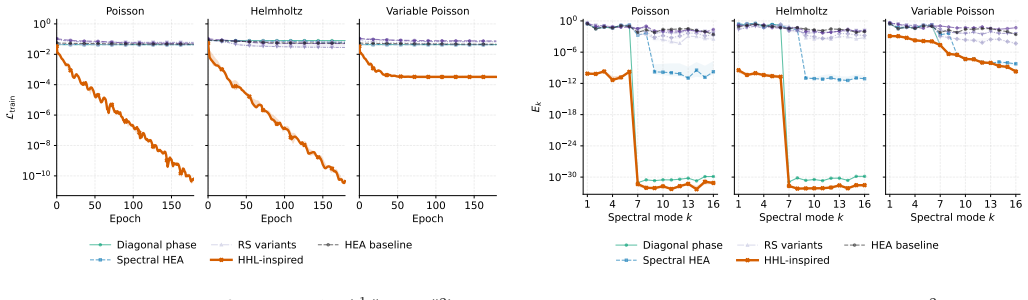
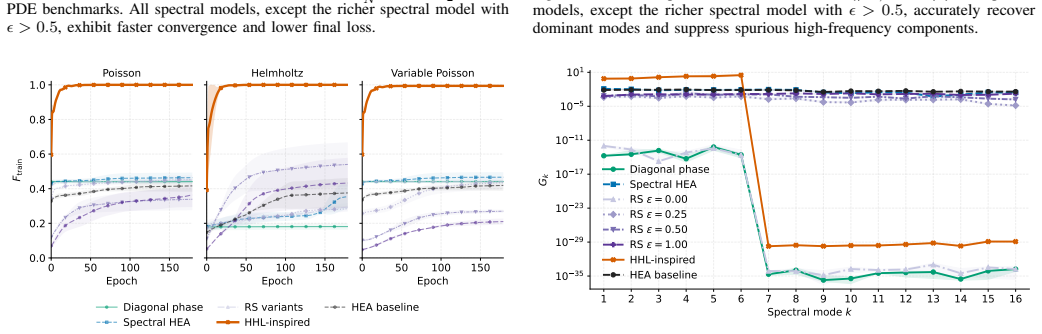
The paper claims that trainable quantum spectral models, ranging from near-diagonal operators to fully parameterized unitaries controlled by a mixer parameter ε, achieve optimal performance at intermediate ε values around 0.5. Architectures inspired by the inverse step of the HHL algorithm converge fastest with high fidelity. Numerical experiments demonstrate that these spectral-basis models outperform standard variational quantum circuits acting in the computational basis through faster training, stable gradients, and superior accuracy in recovering the solution spectrum, particularly via stronger suppression of high-frequency artifacts.
What carries the argument
The trainable quantum spectral model that approximates the inverse differential operator via parameterized unitaries in the spectral representation, with a mixer parameter ε that interpolates between purely diagonal and fully mixing behaviors.
If this is right
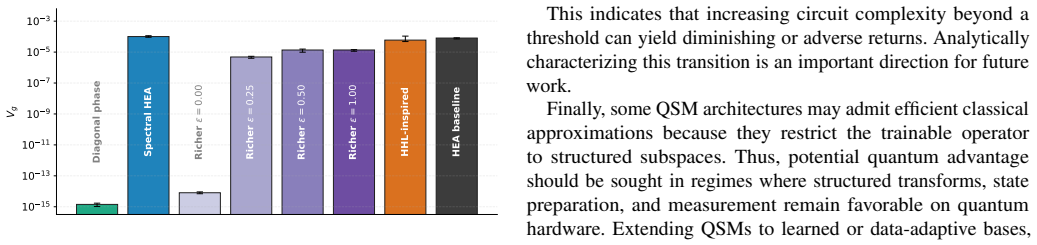
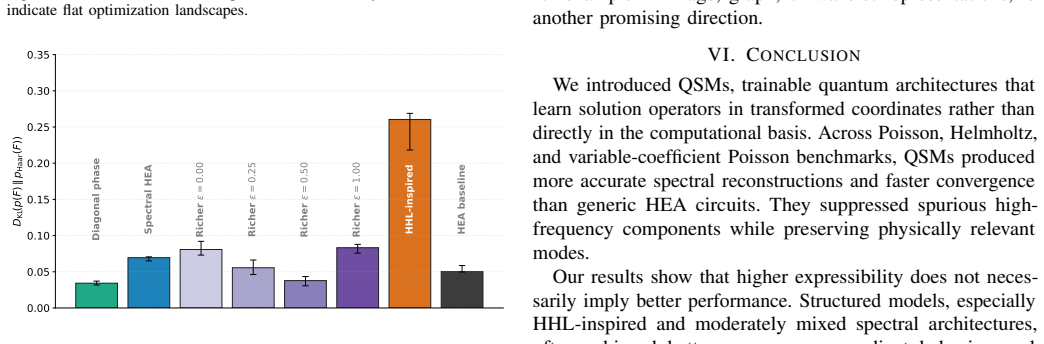
- An intermediate regime around ε ≈ 0.5 provides the best tradeoff between expressibility and trainability across the architectures studied.
- HHL-inspired spectral models achieve the fastest training convergence while maintaining high solution fidelity.
- Spectral-basis operations recover the reference solution spectrum more accurately than computational-basis circuits by suppressing spurious high-frequency components.
- These performance gains persist even when the differential operator is not exactly diagonal in the chosen spectral basis.
- Trainable operations in the spectral basis produce more stable gradients during optimization than direct computational-basis approaches.
Where Pith is reading between the lines
- The ε-parameterized interpolation between diagonal and mixing unitaries could be tested on other linear operators beyond Poisson and Helmholtz to check if the intermediate-regime optimum generalizes.
- The observed suppression of high-frequency modes suggests the method may naturally favor smooth solutions, which could be verified on problems where solution regularity is known a priori.
- Embedding the inverse operator in spectral form may reduce the circuit depth needed for a given accuracy, offering a route to scale the approach without increasing qubit count.
Load-bearing premise
That a suitable spectral representation exists in which the inverse differential operator can be effectively learned or approximated by the quantum circuit architectures considered.
What would settle it
A side-by-side numerical run on the same variable-coefficient Poisson or Helmholtz equation where the spectral-basis models show no improvement in convergence speed, gradient stability, or high-frequency suppression compared to computational-basis variational circuits would falsify the claimed advantage.
Figures

read the original abstract
This work studies trainable quantum spectral models (QSMs) for solving linear partial differential equations (PDEs). Instead of learning solutions directly in physical space, QSMs learn the inverse differential operator in a spectral representation, embedding prior knowledge of the equation's natural basis. We systematically study the expressibility and trainability of several QSM architectures, ranging from near-diagonal to fully parameterized unitaries. In particular, we introduce a family of richer spectral models that interpolate between purely diagonal operators and fully mixing unitaries through a parameterized mixer controlled by $\epsilon$. Our results reveal an intermediate regime, typically around $\epsilon \approx 0.5$, where models achieve the best tradeoff between expressibility and trainability. Beyond this threshold, increased circuit complexity degrades convergence without improving accuracy. Among the architectures considered, models inspired by the inverse step of the Harrow-Hassidim-Lloyd (HHL) algorithm achieve the fastest training convergence while maintaining high solution fidelity. Numerical experiments on the (variable-coefficient) Poisson and Helmholtz equations show that trainable operations in the spectral basis outperform standard variational quantum circuits acting directly in the computational basis. These advantages appear through faster convergence, more stable gradients, and more accurate recovery of the reference solution spectrum, particularly through stronger suppression of spurious high-frequency components, even when the operator is not exactly diagonal in the chosen spectral basis. Our results identify operator-aware spectral representations as a promising route toward trainable and physically grounded quantum methods for scientific computing.
Editorial analysis
A structured set of objections, weighed in public.
Referee Report
Summary. The paper introduces trainable quantum spectral models (QSMs) for linear PDEs that learn the inverse differential operator in a chosen spectral basis rather than directly in the computational basis. It examines a range of architectures from near-diagonal operators to fully parameterized unitaries, including a family of models with a parameterized mixer controlled by ε that interpolates between diagonal and mixing regimes. The central numerical claim is that an intermediate regime (typically ε≈0.5) and HHL-inspired architectures yield the best expressibility-trainability tradeoff, and that these spectral models outperform standard VQCs on variable-coefficient Poisson and Helmholtz equations via faster convergence, more stable gradients, and improved recovery of the reference spectrum with stronger high-frequency suppression, even when the operator is not exactly diagonal.
Significance. If the numerical results are reproducible and the advantages generalize, the work provides concrete evidence that embedding prior knowledge of a problem's natural spectral basis can improve trainability and physical fidelity of quantum solvers for scientific computing tasks. The identification of a sweet spot in the ε-parameterized family and the comparison to HHL-inspired circuits are useful contributions to the design space of variational quantum methods for PDEs.
major comments (2)
- [Abstract / Numerical Experiments] Abstract and numerical-experiments section: the headline claim that advantages persist 'even when the operator is not exactly diagonal' is load-bearing for the robustness conclusion, yet no quantitative measure (e.g., Frobenius norm of off-diagonal blocks, maximum coefficient variation, or distance to the chosen basis) is supplied to bound how far from diagonal the operator may deviate before the reported gains disappear.
- [Numerical Experiments] Numerical-experiments section: the reported outperformance in convergence speed, gradient stability, and high-frequency suppression rests on specific circuit implementations and hyperparameter choices for the variable-coefficient cases; without explicit statements of the precise ansatz depths, optimizer settings, data-exclusion criteria, and error-bar computation, it is not possible to verify that the advantages are not artifacts of the chosen instances.
minor comments (2)
- Define the precise action of the ε-controlled mixer on the spectral basis states and state whether ε is fixed or annealed during training.
- Add a short table or plot quantifying the deviation from diagonality for the variable-coefficient operators used in the Poisson and Helmholtz tests.
Simulated Author's Rebuttal
We thank the referee for the constructive comments, which help improve the clarity and reproducibility of the manuscript. We address each major comment below.
read point-by-point responses
-
Referee: [Abstract / Numerical Experiments] Abstract and numerical-experiments section: the headline claim that advantages persist 'even when the operator is not exactly diagonal' is load-bearing for the robustness conclusion, yet no quantitative measure (e.g., Frobenius norm of off-diagonal blocks, maximum coefficient variation, or distance to the chosen basis) is supplied to bound how far from diagonal the operator may deviate before the reported gains disappear.
Authors: We agree that a quantitative measure of deviation from diagonality would strengthen the robustness claim. In the revised manuscript we will add the Frobenius norm of the off-diagonal blocks (and, where relevant, the maximum coefficient variation) for the variable-coefficient Poisson and Helmholtz operators in the chosen spectral basis, together with a short discussion of how far the operators deviate while the reported advantages remain visible. revision: yes
-
Referee: [Numerical Experiments] Numerical-experiments section: the reported outperformance in convergence speed, gradient stability, and high-frequency suppression rests on specific circuit implementations and hyperparameter choices for the variable-coefficient cases; without explicit statements of the precise ansatz depths, optimizer settings, data-exclusion criteria, and error-bar computation, it is not possible to verify that the advantages are not artifacts of the chosen instances.
Authors: We acknowledge that the current manuscript lacks sufficient implementation detail for independent verification. In the revised version we will explicitly state the ansatz depths for each architecture, the optimizer (including learning-rate schedule and convergence tolerance), any data-exclusion criteria, and the procedure used to compute error bars (typically over independent random seeds). revision: yes
Circularity Check
No significant circularity; claims rest on numerical experiments
full rationale
The paper introduces QSM architectures (near-diagonal to epsilon-parameterized mixers to HHL-inspired) as explicit design choices, then reports empirical outcomes from training and testing on variable-coefficient Poisson and Helmholtz equations. Performance metrics (convergence speed, gradient stability, spectral accuracy) are measured directly from simulations rather than derived from any equation that reduces to the inputs by construction. The embedding of spectral prior knowledge is stated as an assumption and is tested under controlled non-diagonality; no self-citation chain, fitted-parameter renaming, or uniqueness theorem is invoked to support the central outperformance claim. The derivation chain is therefore self-contained against external benchmarks.
Axiom & Free-Parameter Ledger
axioms (1)
- standard math Standard assumptions of variational quantum algorithms and quantum circuit expressibility apply to the spectral models.
invented entities (1)
-
Parameterized mixer controlled by ε in spectral models
no independent evidence
Reference graph
Works this paper leans on
-
[1]
High-order quantum algorithm for solving linear differential equations,
D. W. Berry, “High-order quantum algorithm for solving linear differential equations,”Journal of Physics A: Mathematical and Theoretical, vol. 47, no. 10, pp. 1–14, 2014
2014
-
[2]
D. W. Berry, A. M. Childs, A. Ostrander, and G. Wang, “Quantum algorithm for linear differential equations with exponentially improved dependence on precision,”Communications in Mathematical Physics, vol. 356, no. 3, pp. 1057–1081, 2017. [Online]. Available: http://arxiv.org/abs/1701.03684
work page internal anchor Pith review Pith/arXiv arXiv 2017
-
[3]
Quantum algorithm for solving linear differential equations: Theory and experiment,
T. Xin, S. Wei, J. Cui, J. Xiao, I. Arrazola, L. Lamata, X. Kong, D. Lu, E. Solano, and G. Long, “Quantum algorithm for solving linear differential equations: Theory and experiment,”Physical Review A, vol. 101, no. 3, pp. 1–13, 2020
2020
-
[4]
High-precision quantum algorithms for partial differential equations,
A. M. Childs, J.-P. Liu, and A. Ostrander, “High-precision quantum algorithms for partial differential equations,”Quantum, vol. 5, p. 574, Nov
-
[5]
Available: https://doi.org/10.22331/q-2021-11-10-574
[Online]. Available: https://doi.org/10.22331/q-2021-11-10-574
-
[6]
Improved quantum algorithms for linear and nonlinear differential equations,
H. Krovi, “Improved quantum algorithms for linear and nonlinear differential equations,”arXiv preprint, pp. 12–15, 2022. [Online]. Available: http://arxiv.org/abs/2202.01054
-
[7]
Quantum algorithm for linear systems of equations,
A. W. Harrow, A. Hassidim, and S. Lloyd, “Quantum algorithm for linear systems of equations,”Phys. Rev. Lett., vol. 103, p. 150502, Oct
-
[8]
http://dx.doi.org/10.1103/PhysRevLett
[Online]. Available: https://link.aps.org/doi/10.1103/PhysRevLett. 103.150502
-
[9]
S. Aaronson, “Read the fine print,”Nature Physics, vol. 11, no. 4, pp. 291–293, 2015. [Online]. Available: https://doi.org/10.1038/nphys3272
-
[10]
Quantum spectral methods for differential equations,
A. M. Childs and J.-P. Liu, “Quantum spectral methods for differential equations,”Communications in Mathematical Physics, vol. 375, no. 2, pp. 1427–1457, 2020. [Online]. Available: https: //doi.org/10.1007/s00220-020-03699-z
-
[11]
The effect of data encoding on the expressive power of variational quantum machine learning models,
M. Schuld, R. Sweke, and J. J. Meyer, “The effect of data encoding on the expressive power of variational quantum machine learning models,”Physical Review A, 2020. [Online]. Available: https://journals.aps.org/pra/abstract/10.1103/PhysRevA.103.032430
-
[12]
One qubit as a universal approximant,
A. P ´erez-Salinas, D. L ´opez-N´u˜nez, A. Garc ´ıa-S´aez, P. Forn-D´ıaz, and J. I. Latorre, “One qubit as a universal approximant,”Physical Review A,
-
[13]
Available: https://journals.aps.org/pra/abstract/10.1103/ PhysRevA.104.012405
[Online]. Available: https://journals.aps.org/pra/abstract/10.1103/ PhysRevA.104.012405
-
[14]
Out of tune: Demystifying noise-effects on quantum fourier models,
M. Franz, M. Strobl, L. Chaichenets, E. Kuehn, A. Streit, and W. Mauerer, “Out of tune: Demystifying noise-effects on quantum fourier models,”
-
[15]
Available: https://arxiv.org/abs/2506.09527
[Online]. Available: https://arxiv.org/abs/2506.09527
-
[16]
Fourier fingerprints of ansatzes in quantum machine learning,
M. Strobl, M. E. Sahin, L. van der Horst, E. Kuehn, A. Streit, and B. Jaderberg, “Fourier fingerprints of ansatzes in quantum machine learning,” 2025. [Online]. Available: https://arxiv.org/abs/2508.20868
-
[17]
Barren plateaus in quantum neural network training landscapes,
J. R. McClean, S. Boixo, V . N. Smelyanskiy, R. Babbush, and H. Neven, “Barren plateaus in quantum neural network training landscapes,”Nature Communications, 2018
2018
-
[18]
Cost function dependent barren plateaus in shallow parametrized quantum circuits,
M. Cerezo, A. Sone, T. V olkoff, L. Cincio, and P. J. Coles, “Cost function dependent barren plateaus in shallow parametrized quantum circuits,” Nature Communications, 2021
2021
-
[19]
Noise-induced barren plateaus in variational quantum algorithms,
S. Wang, E. Fontana, M. Cerezo, K. Sharma, A. Sone, L. Cincio, and P. J. Coles, “Noise-induced barren plateaus in variational quantum algorithms,” Nature Communications, 2021
2021
-
[20]
A lie algebraic theory of barren plateaus for deep parameterized quantum circuits,
M. Ragone, B. N. Bakalov, F. Sauvage, A. F. Kemper, C. Ortiz Marrero, M. Larocca, and M. Cerezo, “A lie algebraic theory of barren plateaus for deep parameterized quantum circuits,”Nature Communications, vol. 15, no. 1, p. 7172, 2024. [Online]. Available: https://doi.org/10. 1038/s41467-024-49909-3
2024
-
[21]
and Cincio, Lukasz and McClean, Jarrod R
M. Larocca, S. Thanasilp, S. Wang, K. Sharma, J. Biamonte, P. J. Coles, L. Cincio, J. R. McClean, Z. Holmes, and M. Cerezo, “Barren plateaus in variational quantum computing,”Nature Reviews Physics, vol. 7, no. 4, pp. 174–189, 2025. [Online]. Available: https://doi.org/10.1038/s42254-025-00813-9
-
[22]
Variational quantum algorithms for nonlinear problems,
M. Lubasch, J. Joo, P. Moinier, M. Kiffner, and D. Jaksch, “Variational quantum algorithms for nonlinear problems,”Physical Review A, vol. 101, no. 1, Jan. 2020. [Online]. Available: http://dx.doi.org/10.1103/PhysRevA.101.010301
-
[23]
Variational quantum algorithm for the poisson equation,
H.-L. Liu, Y .-S. Wu, L.-C. Wan, S.-J. Pan, S.-J. Qin, F. Gao, and Q.-Y . Wen, “Variational quantum algorithm for the poisson equation,” Phys. Rev. A, vol. 104, p. 022418, Aug 2021. [Online]. Available: https://link.aps.org/doi/10.1103/PhysRevA.104.022418
-
[24]
Solving nonlinear differential equations with differentiable quantum circuits,
O. Kyriienko, A. E. Paine, and V . E. Elfving, “Solving nonlinear differential equations with differentiable quantum circuits,”Phys. Rev. A, vol. 103, p. 052416, May 2021. [Online]. Available: https://link.aps.org/doi/10.1103/PhysRevA.103.052416
-
[25]
Quantum physics informed neural networks for multi-variable partial differential equations,
G. Panichi, S. Corli, and E. Prati, “Quantum physics informed neural networks for multi-variable partial differential equations,” 2025. [Online]. Available: https://arxiv.org/abs/2503.12244
-
[26]
J. Hunout, S. Laizet, and L. Iannucci, “Variational quantum algorithm based on lagrange polynomial encoding to solve differential equations ,” Physical Review A, vol. 111, no. 6, Jun. 2025. [Online]. Available: http://dx.doi.org/10.1103/PhysRevA.111.062404
-
[27]
Solving nonlinear pdes with quantum neural networks: A variational approach to the bratu equation,
N. Cheimarios, “Solving nonlinear pdes with quantum neural networks: A variational approach to the bratu equation,” 2026. [Online]. Available: https://arxiv.org/abs/2601.04372
-
[28]
F. Y . Leong, D. E. Koh, W.-B. Ewe, and J. F. Kong, “Variational quantum simulation of partial differential equations: applications in colloidal transport,”International Journal of Numerical Methods for Heat and Fluid Flow, vol. 33, no. 11, p. 3669–3690, 2023. [Online]. Available: http://dx.doi.org/10.1108/HFF-05-2023-0265
-
[29]
Nonlinear dynamics as a ground-state solution on quantum computers,
A. J. Pool, A. D. Somoza, C. Mc Keever, M. Lubasch, and B. Horstmann, “Nonlinear dynamics as a ground-state solution on quantum computers,” Physical Review Research, vol. 6, no. 3, Sep. 2024. [Online]. Available: http://dx.doi.org/10.1103/PhysRevResearch.6.033257
discussion (0)
Sign in with ORCID, Apple, or X to comment. Anyone can read and Pith papers without signing in.