Revisiting Unidentified Charged-Hadron Fragmentation Functions with Modern COMPASS SIDIS Multiplicities
Pith reviewed 2026-06-28 21:52 UTC · model grok-4.3
The pith
Modern COMPASS SIDIS multiplicities can be consistently described with SIA data and yield charge-separated constraints on light-quark and antiquark fragmentation functions.
A machine-rendered reading of the paper's core claim, the machinery that carries it, and where it could break.
Core claim
The modern COMPASS multiplicities can be consistently described together with the SIA data and provide important charge-separated constraints on the light-quark and antiquark FFs. The comparison between the NLO and NNLO extractions indicates a stable quark-sector determination, while the gluon FF remains less directly constrained in the present SIA+SIDIS analysis.
What carries the argument
Global QCD fit of unidentified charged-hadron fragmentation functions to SIA and modern COMPASS SIDIS multiplicities performed at NLO and NNLO.
If this is right
- The quark-sector determination of the fragmentation functions remains stable between NLO and NNLO.
- The gluon fragmentation function stays less directly constrained by the SIA plus SIDIS combination.
- Modern COMPASS SIDIS multiplicities are important for precision studies of unidentified charged-hadron fragmentation.
- Future global fragmentation function determinations will incorporate this updated charge-separated input.
Where Pith is reading between the lines
- The charge-separated light-quark constraints could sharpen predictions for identified hadron yields in proton-proton collisions at colliders.
- Adding data sensitive to gluon fragmentation, such as from heavy-flavor production, would likely reduce the current uncertainty on the gluon FF.
- The public LHAPDF replicas enable direct testing of the extracted functions against upcoming measurements without refitting.
Load-bearing premise
The chosen parametrization and perturbative orders are sufficient to absorb all relevant higher-order and non-perturbative effects without introducing biases that would alter the extracted flavor-separated FFs.
What would settle it
A clear mismatch between the predicted multiplicities from the extracted FFs and new independent experimental data from other processes or facilities.
Figures

read the original abstract
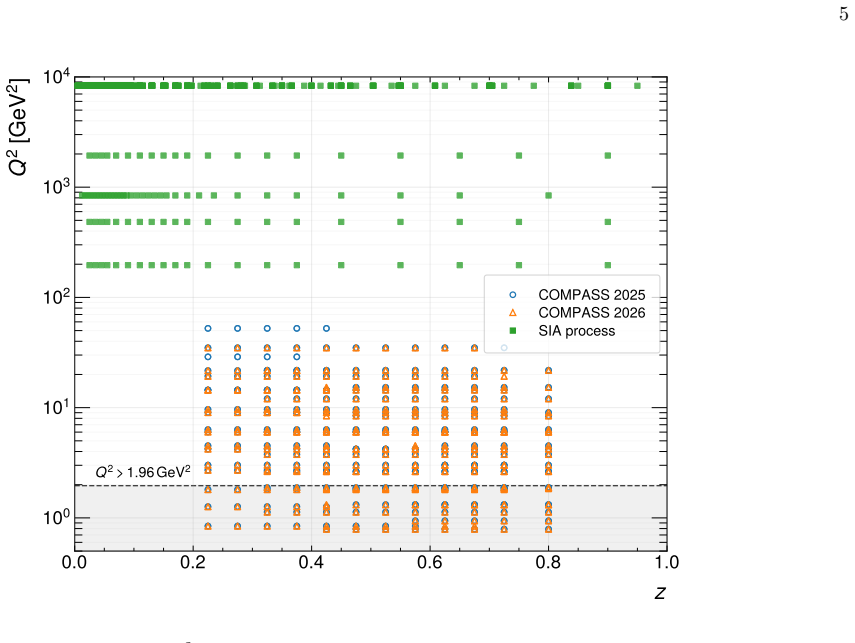
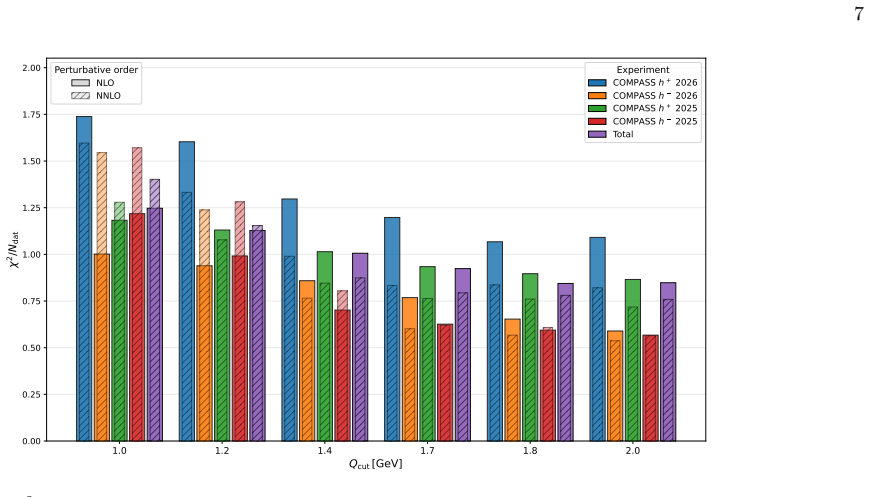
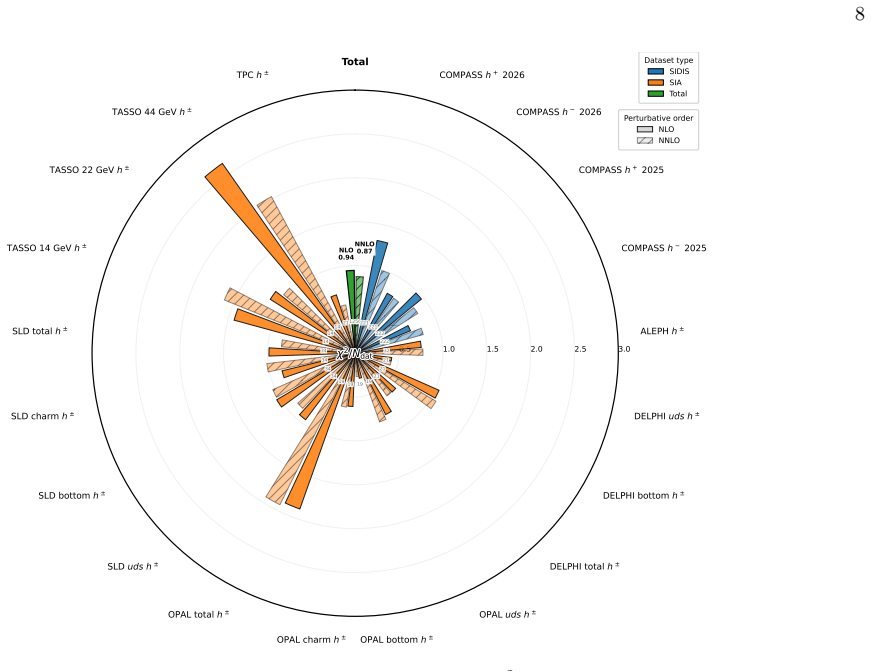
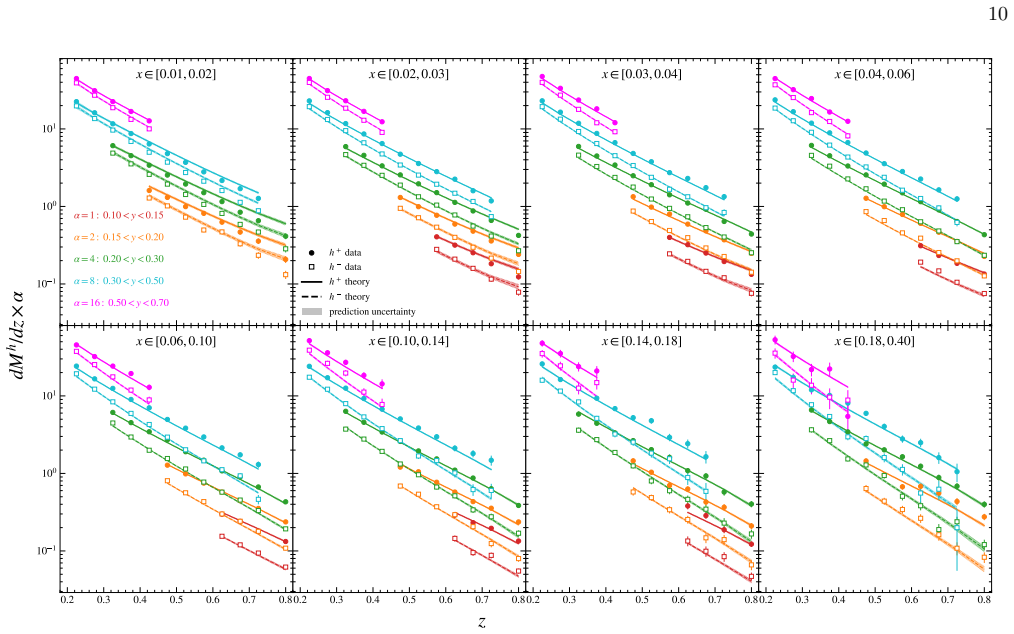
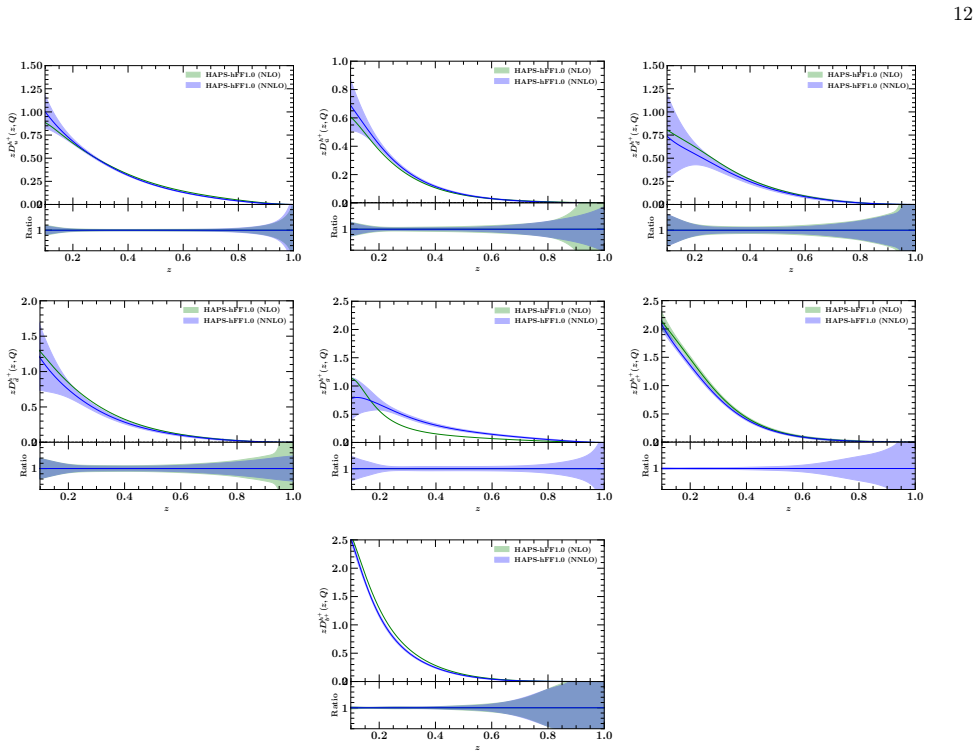
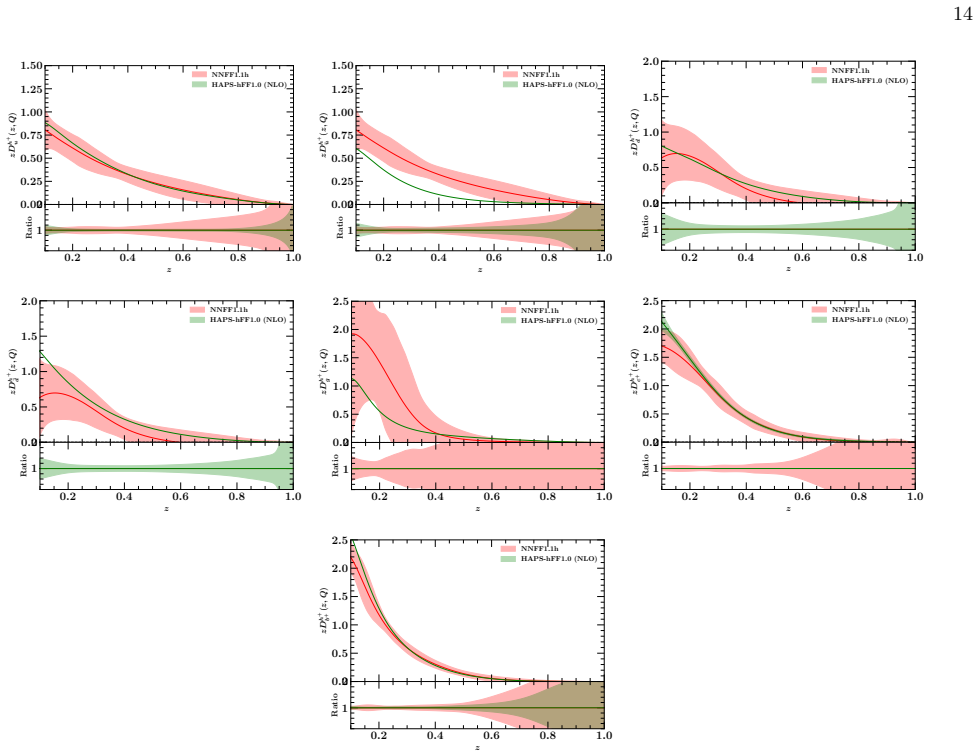
We present \texttt{HAPS-hFF1.0}, a new global QCD analysis of unidentified charged-hadron fragmentation functions (FFs) using single-inclusive electron-positron annihilation (SIA) data together with the modern COMPASS semi-inclusive deep-inelastic scattering (SIDIS) multiplicities. The COMPASS input consists of the 2025 proton-target measurement and the revised isoscalar-target multiplicities provided in the COMPASS addendum 2026. The extraction is performed at both next-to-leading order (NLO) and next-to-next-to-leading order (NNLO), allowing us to study the perturbative stability of the QCD fit and the impact of the updated SIDIS information on the flavor structure of the FFs. We find that the modern COMPASS multiplicities can be consistently described together with the SIA data and provide important charge-separated constraints on the light-quark and antiquark FFs. The comparison between the NLO and NNLO extractions indicates a stable quark-sector determination, while the gluon FF remains less directly constrained in the present SIA+SIDIS analysis. Our results highlight the importance of the modern COMPASS SIDIS multiplicities for precision studies of unidentified charged-hadron fragmentation and for future global FF determinations. The resulting \texttt{HAPS-hFF1.0} replicas are publicly available in standard LHAPDF format.
Editorial analysis
A structured set of objections, weighed in public.
Referee Report
Summary. The manuscript presents HAPS-hFF1.0, a new global QCD analysis of unidentified charged-hadron fragmentation functions extracted from SIA data combined with the 2025 COMPASS proton-target SIDIS multiplicities and the 2026 revised isoscalar-target multiplicities. Fits are performed at both NLO and NNLO to examine perturbative stability and the impact of the updated SIDIS input on the flavor structure. The central claim is that the modern COMPASS multiplicities are consistently described together with SIA data, supplying important charge-separated constraints on light-quark and antiquark FFs, while the quark sector remains stable between orders and the gluon FF is less directly constrained; the resulting replicas are released in LHAPDF format.
Significance. If the fit quality and stability claims hold, the work supplies an updated FF set that incorporates recent experimental input and demonstrates the value of modern SIDIS multiplicities for charge separation. The public release of replicas in standard LHAPDF format is a concrete strength that facilitates community use and further global analyses.
Simulated Author's Rebuttal
We thank the referee for the positive assessment of our manuscript and the recommendation to accept. The report contains no major comments requiring response.
Circularity Check
No significant circularity detected
full rationale
This is a standard global QCD fit of fragmentation functions to external SIA and COMPASS SIDIS multiplicity data. The central claim (consistent description and charge-separated constraints) is obtained by minimizing a chi-squared function against independent experimental measurements; no equation or result reduces by construction to a prior self-citation, fitted input renamed as prediction, or self-definitional loop. The NLO/NNLO comparison and public LHAPDF replicas are outputs of the fit, not inputs that presuppose the final flavor structure.
Axiom & Free-Parameter Ledger
Reference graph
Works this paper leans on
-
[1]
J. Gao, X. Shen, H. Xing, Y. Zhao and B. Zhou, “Frag- mentation Functions of Charged Hadrons at Next-to- Next-to-Leading Order and Constraints on the Proton Parton Distribution Functions,” Phys. Rev. Lett.135, no.4, 041902 (2025), arXiv:2502.17837 [hep-ph]
arXiv 2025
-
[2]
Simul- taneous Determination of Fragmentation Functions and Test on Momentum Sum Rule,
J. Gao, C. Liu, X. Shen, H. Xing and Y. Zhao, “Simul- taneous Determination of Fragmentation Functions and Test on Momentum Sum Rule,” Phys. Rev. Lett.132, no.26, 26 (2024), arXiv:2401.02781 [hep-ph]
arXiv 2024
-
[3]
Global analysis of fragmentation functions to charged hadrons with high-precision data from the LHC,
J. Gao, C. Liu, X. Shen, H. Xing and Y. Zhao, “Global analysis of fragmentation functions to charged hadrons with high-precision data from the LHC,” Phys. Rev. D 110, no.11, 114019 (2024), arXiv:2407.04422 [hep-ph]
arXiv 2024
-
[4]
Pion and kaon fragmen- tation functions at next-to-next-to-leading order,
R. Abdul Khaleket al.[MAP (Multi-dimensional Analy- ses of Partonic distributions)], “Pion and kaon fragmen- tation functions at next-to-next-to-leading order,” Phys. Lett. B834, 137456 (2022), arXiv:2204.10331 [hep-ph]
arXiv 2022
-
[5]
I. Borsa, R. Sassot, D. de Florian, M. Stratmann and W. Vogelsang, “Towards a Global QCD Analysis of Frag- mentation Functions at Next-to-Next-to-Leading Order Accuracy,” Phys. Rev. Lett.129, no.1, 012002 (2022), arXiv:2202.05060 [hep-ph]
arXiv 2022
-
[6]
R. A. Khaleket al.[MAP (Multi-dimensional Analyses of Partonic distributions)], “Determination of unpolar- ized pion fragmentation functions using semi-inclusive deep-inelastic-scattering data,” Phys. Rev. D104, no.3, 034007 (2021) arXiv:2105.08725 [hep-ph]
arXiv 2021
-
[7]
Simultaneous Monte Carlo analysis of parton densities and fragmentation functions,
E. Moffatet al.[Jefferson Lab Angular Momentum (JAM)], “Simultaneous Monte Carlo analysis of parton densities and fragmentation functions,” Phys. Rev. D 104, no.1, 016015 (2021) arXiv:2101.04664 [hep-ph]
arXiv 2021
-
[8]
Factor- ization of Hard Processes in QCD,
J. C. Collins, D. E. Soper and G. F. Sterman, “Factor- ization of Hard Processes in QCD,” Adv. Ser. Direct. High Energy Phys.5, 1-91 (1989) arXiv:hep-ph/0409313 [hep-ph]
Pith/arXiv arXiv 1989
-
[9]
Parton Distribution and 15 Decay Functions,
J. C. Collins and D. E. Soper, “Parton Distribution and 15 Decay Functions,” Nucl. Phys. B194, 445-492 (1982)
1982
-
[10]
S. Albino, B. A. Kniehl and G. Kramer, ‘AKK Up- date: Improvements from New Theoretical Input and Experimental Data,” Nucl. Phys. B803, 42-104 (2008) arXiv:0803.2768 [hep-ph]
Pith/arXiv arXiv 2008
-
[11]
Precision QCD with the Electron-Ion Collider,
C. Alexandrou, M. Arratia, E. C. Aschenauer, A. Avkhadiev, P. V. Balachandran, V. Bertone, I. Borsa, M. Cerutti, X. Chu and W. Cosyn,et al.“Precision QCD with the Electron-Ion Collider,” arXiv:2604.04765 [hep- ph]
-
[12]
Science Require- ments and Detector Concepts for the Electron-Ion Col- lider: EIC Yellow Report,
R. Abdul Khalek, A. Accardi, J. Adam, D. Adamiak, W. Akers, M. Albaladejo, A. Al-bataineh, M. G. Alex- eev, F. Ameli and P. Antonioli,et al.“Science Require- ments and Detector Concepts for the Electron-Ion Col- lider: EIC Yellow Report,” Nucl. Phys. A1026, 122447 (2022) arXiv:2103.05419 [physics.ins-det]
Pith/arXiv arXiv 2022
-
[13]
Global analysis of fragmentation functions for protons and charged hadrons,
D. de Florian, R. Sassot and M. Stratmann, “Global analysis of fragmentation functions for protons and charged hadrons,” Phys. Rev. D76, 074033 (2007) arXiv:0707.1506 [hep-ph]
Pith/arXiv arXiv 2007
-
[14]
M. Soleymaninia, M. Goharipour and H. Khanpour, “First QCD analysis of charged hadron fragmentation functions and their uncertainties at next-to-next-to- leading order,” Phys. Rev. D98, no.7, 074002 (2018) arXiv:1805.04847 [hep-ph]
Pith/arXiv arXiv 2018
-
[15]
Simultaneous extraction of fragmen- tation functions of light charged hadrons with mass corrections,
M. Soleymaninia, M. Goharipour, H. Khanpour and H. Spiesberger, “Simultaneous extraction of fragmen- tation functions of light charged hadrons with mass corrections,” Phys. Rev. D103, no.5, 054045 (2021) arXiv:2008.05342 [hep-ph]
arXiv 2021
-
[16]
Improved constraints on pion frag- mentation functions from simulated electron-ion col- lider data,
M. Soleymaninia, H. Khanpour, M. Azizi and H. Hashamipour, “Improved constraints on pion frag- mentation functions from simulated electron-ion col- lider data,” Phys. Rev. D112, no.5, 054032 (2025) doi:10.1103/gm92-w63j arXiv:2503.16053 [hep-ph]
-
[17]
Global analysis of fragmentation functions to light neutral hadrons,
J. Gao, C. Liu, M. Li, X. Shen, H. Xing, Y. Zhao and Y. Zhou, “Global analysis of fragmentation functions to light neutral hadrons,” Phys. Rev. D112, no.5, 5 (2025) doi:10.1103/t5ds-vvc4 arXiv:2503.21311 [hep-ph]
-
[18]
Charged hadron fragmentation functions from collider data
V. Bertoneet al.[NNPDF], “Charged hadron frag- mentation functions from collider data,” Eur. Phys. J. C78, no.8, 651 (2018) [erratum: Eur. Phys. J. C 84, no.2, 155 (2024)] doi:10.1140/epjc/s10052-018-6130- 4 arXiv:1807.03310 [hep-ph]
work page internal anchor Pith review Pith/arXiv arXiv doi:10.1140/epjc/s10052-018-6130- 2018
-
[19]
Charged hadron fragmentation functions at high en- ergy colliders,
I. Borsa, M. Stratmann, D. de Florian and R. Sassot, “Charged hadron fragmentation functions at high en- ergy colliders,” Phys. Rev. D109, no.5, 052004 (2024) doi:10.1103/PhysRevD.109.052004 arXiv:2311.17768 [hep-ph]
-
[20]
Neural network QCD analysis of charged hadron fragmentation functions in the presence of SIDIS data,
M. Soleymaninia, H. Hashamipour and H. Khan- pour, “Neural network QCD analysis of charged hadron fragmentation functions in the presence of SIDIS data,” Phys. Rev. D105, no.11, 114018 (2022) doi:10.1103/PhysRevD.105.114018 arXiv:2202.10779 [hep-ph]
-
[21]
G. D. Alexeevet al.[COMPASS], “Multiplicities of posi- tive and negative pions, kaons, and unidentified hadrons from deep-inelastic scattering of muons off a liquid hy- drogen target,” Phys. Rev. D112, no.1, 012002 (2025) doi:10.1103/q4rb-bhcg arXiv:2410.12005 [hep-ex]
-
[22]
G. D. Alexeevet al.[COMPASS], “Addendum to multiplicities of charged pions, kaons and uniden- tified charged hadrons on an isoscalar target mea- sured by COMPASS Collaboration,” Phys. Lett. B 875, 140266 (2026) doi:10.1016/j.physletb.2026.140266 arXiv:2512.23727 [hep-ex]
-
[23]
C. Adolphet al.[COMPASS], “Multiplicities of charged pions and charged hadrons from deep-inelastic scat- tering of muons off an isoscalar target,” Phys. Lett. B764, 1-10 (2017) doi:10.1016/j.physletb.2016.09.042 arXiv:1604.02695 [hep-ex]
work page internal anchor Pith review Pith/arXiv arXiv doi:10.1016/j.physletb.2016.09.042 2017
-
[24]
Multiplicities of charged kaons from deep-inelastic muon scattering off an isoscalar target
C. Adolphet al.[COMPASS], “Multiplicities of charged kaons from deep-inelastic muon scattering off an isoscalar target,” Phys. Lett. B767, 133-141 (2017) doi:10.1016/j.physletb.2017.01.053 arXiv:1608.06760 [hep-ex]
work page internal anchor Pith review Pith/arXiv arXiv doi:10.1016/j.physletb.2017.01.053 2017
-
[25]
MapCollaboration/MontBlanc: A Code for the Deter- mination of Collinear Distributions,
R. A. Khalek, V. Bertone, A. Khoudli and E. R. Nocera, “MapCollaboration/MontBlanc: A Code for the Deter- mination of Collinear Distributions,”https://github. com/MapCollaboration/MontBlanc
-
[26]
NNLO QCD corrections to unpolarized and polarized SIDIS,
S. Goyal, R. N. Lee, S. O. Moch, V. Pathak, N. Rana and V. Ravindran, “NNLO QCD corrections to unpolarized and polarized SIDIS,” Phys. Rev. D 111, no.9, 9 (2025) doi:10.1103/PhysRevD.111.094007 [arXiv:2412.19309 [hep-ph]]
-
[27]
Semi- Inclusive Deep-Inelastic Scattering at Next-to-Next-to- Leading Order in QCD,
L. Bonino, T. Gehrmann and G. Stagnitto, “Semi- Inclusive Deep-Inelastic Scattering at Next-to-Next-to- Leading Order in QCD,” Phys. Rev. Lett.132, no.25, 251901 (2024) doi:10.1103/PhysRevLett.132.251901 [arXiv:2401.16281 [hep-ph]]
-
[28]
Next-to-Next-to-Leading Order QCD Corrections to Semi-Inclusive Deep-Inelastic Scatter- ing,
S. Goyal, S. O. Moch, V. Pathak, N. Rana and V. Ravindran, “Next-to-Next-to-Leading Order QCD Corrections to Semi-Inclusive Deep-Inelastic Scatter- ing,” Phys. Rev. Lett.132, no.25, 251902 (2024) doi:10.1103/PhysRevLett.132.251902 [arXiv:2312.17711 [hep-ph]]
-
[29]
Neutral and charged current semi- inclusive deep-inelastic scattering at NNLO QCD,
L. Bonino, T. Gehrmann, M. L”ochner, K. Sch”onwald and G. Stagnitto, “Neutral and charged current semi- inclusive deep-inelastic scattering at NNLO QCD,” JHEP10, 016 (2025) doi:10.1007/JHEP10(2025)016 [arXiv:2506.19926 [hep-ph]]
-
[30]
Approx- imate NNLO QCD corrections to semi-inclusive DIS,
M. Abele, D. de Florian and W. Vogelsang, “Approx- imate NNLO QCD corrections to semi-inclusive DIS,” Phys. Rev. D104, no.9, 094046 (2021) doi:10.1103/PhysRevD.104.094046 [arXiv:2109.00847 [hep-ph]]
-
[31]
V. Bertoneet al.[NNPDF], “A determination of the fragmentation functions of pions, kaons, and pro- tons with faithful uncertainties,” Eur. Phys. J. C 77, no.8, 516 (2017) doi:10.1140/epjc/s10052-017-5088-y [arXiv:1706.07049 [hep-ph]]
work page internal anchor Pith review Pith/arXiv arXiv doi:10.1140/epjc/s10052-017-5088-y 2017
-
[32]
Processes Involving Fragmentation Functions Beyond the Leading Order in QCD,
G. Altarelli, R. K. Ellis, G. Martinelli and S. Y. Pi, “Processes Involving Fragmentation Functions Beyond the Leading Order in QCD,” Nucl. Phys. B160, 301- 329 (1979) doi:10.1016/0550-3213(79)90062-2
-
[33]
One-Particle Inclusive Processes in Deeply Inelastic Lepton-Nucleon Scattering
D. Graudenz, “One particle inclusive processes in deeply inelastic lepton - nucleon scattering,” Nucl. Phys. B 432, 351-376 (1994) doi:10.1016/0550-3213(94)90606-8 [arXiv:hep-ph/9406274 [hep-ph]]
work page internal anchor Pith review Pith/arXiv arXiv doi:10.1016/0550-3213(94)90606-8 1994
-
[34]
Next-to-Next- to-Leading Order Evolution of Non-Singlet Frag- mentation Functions,
A. Mitov, S. Moch and A. Vogt, “Next-to-Next- to-Leading Order Evolution of Non-Singlet Frag- mentation Functions,” Phys. Lett. B638, 61-67 (2006) doi:10.1016/j.physletb.2006.05.005 [arXiv:hep- ph/0604053 [hep-ph]]
-
[35]
On Third-Order Timelike Splitting Functions and Top-Mediated Higgs Decay into Hadrons
S. Moch and A. Vogt, “On third-order timelike splitting functions and top-mediated Higgs decay into hadrons,” Phys. Lett. B659, 290-296 (2008) doi:10.1016/j.physletb.2007.10.069 [arXiv:0709.3899 16 [hep-ph]]
work page internal anchor Pith review Pith/arXiv arXiv doi:10.1016/j.physletb.2007.10.069 2008
-
[36]
On the Next-to-Next-to-Leading Order Evolution of Flavour-Singlet Fragmentation Functions
A. A. Almasy, S. Moch and A. Vogt, “On the Next-to-Next-to-Leading Order Evolution of Flavour- Singlet Fragmentation Functions,” Nucl. Phys. B 854, 133-152 (2012) doi:10.1016/j.nuclphysb.2011.08.028 [arXiv:1107.2263 [hep-ph]]
work page internal anchor Pith review Pith/arXiv arXiv doi:10.1016/j.nuclphysb.2011.08.028 2012
-
[37]
Reference results for time-like evolution up to $\mathcal{O}(\alpha_s^3)$
V. Bertone, S. Carrazza and E. R. Nocera, “Reference re- sults for time-like evolution up toO α3 s ,” JHEP03, 046 (2015) doi:10.1007/JHEP03(2015)046 [arXiv:1501.00494 [hep-ph]]
work page internal anchor Pith review Pith/arXiv arXiv doi:10.1007/jhep03(2015)046 2015
-
[38]
P. J. Rijken and W. L. van Neerven, “Higher order QCD corrections to the transverse and longitudinal frag- mentation functions in electron - positron annihilation,” Nucl. Phys. B487, 233-282 (1997) doi:10.1016/S0550- 3213(96)00669-4 [arXiv:hep-ph/9609377 [hep-ph]]
work page internal anchor Pith review Pith/arXiv arXiv doi:10.1016/s0550- 1997
-
[39]
$O(\alpha_s^2)$ Contributions to the longitudinal fragmentation function in $e^+\,e^-$ annihilation
P. J. Rijken and W. L. van Neerven, “O (alpha- s**2) contributions to the longitudinal fragmenta- tion function in e+ e- annihilation,” Phys. Lett. B 386, 422-428 (1996) doi:10.1016/0370-2693(96)00898-2 [arXiv:hep-ph/9604436 [hep-ph]]
work page internal anchor Pith review Pith/arXiv arXiv doi:10.1016/0370-2693(96)00898-2 1996
-
[40]
O (alpha-s**2) contributions to the asymmetric fragmentation function in e+ e- annihilation,
P. J. Rijken and W. L. van Neerven, “O (alpha-s**2) contributions to the asymmetric fragmentation function in e+ e- annihilation,” Phys. Lett. B392, 207-215 (1997) doi:10.1016/S0370-2693(96)01529-8 [arXiv:hep- ph/9609379 [hep-ph]]
-
[41]
Ceres Solver,
S. Agarwal, K. Mierle and others, “Ceres Solver,”http: //ceres-solver.org
-
[42]
On the deriva- tives of feed-forward neural networks,
R. Abdul Khalek and V. Bertone, “On the deriva- tives of feed-forward neural networks,” [arXiv:2005.07039 [physics.comp-ph]]
arXiv 2005
-
[43]
Charged Pion, Kaon, Proton and anti-Proton Production in High-Energy e+ e- Annihilation,
R. Brandeliket al.[TASSO], “Charged Pion, Kaon, Proton and anti-Proton Production in High-Energy e+ e- Annihilation,” Phys. Lett. B94, 444-449 (1980) doi:10.1016/0370-2693(80)90915-6
-
[44]
Jet Production and Frag- mentation in e+ e- Annihilation at 12-GeV to 43-GeV,
M. Althoffet al.[TASSO], “Jet Production and Frag- mentation in e+ e- Annihilation at 12-GeV to 43-GeV,” Z. Phys. C22, 307-340 (1984) doi:10.1007/BF01547419
-
[45]
Charged Multiplic- ity Distributions and Correlations in e+ e- Annihila- tion at PETRA Energies,
W. Braunschweiget al.[TASSO], “Charged Multiplic- ity Distributions and Correlations in e+ e- Annihila- tion at PETRA Energies,” Z. Phys. C45, 193 (1989) doi:10.1007/BF01674450
-
[46]
Charged hadron inclusive cross-sections and fractions ine +e− annihilia- tion √s= 29 GeV,
H. Aiharaet al.[TPC/Two Gamma], “Charged hadron inclusive cross-sections and fractions ine +e− annihilia- tion √s= 29 GeV,” Phys. Rev. Lett.61, 1263 (1988) doi:10.1103/PhysRevLett.61.1263
-
[47]
Inclusive pi+-, K+- and (p, anti-p) differential cross-sections at the Z resonance,
D. Buskulicet al.[ALEPH], “Inclusive pi+-, K+- and (p, anti-p) differential cross-sections at the Z resonance,” Z. Phys. C66, 355-366 (1995) doi:10.1007/BF01556360
-
[48]
P. Abreuet al.[DELPHI], “pi+-, K+-, p and anti-p pro- duction in Z0 —>q anti-q, Z0 —>b anti-b, Z0 —> u anti-u, d anti-d, s anti-s,” Eur. Phys. J. C5, 585-620 (1998) doi:10.1007/s100529800989
-
[49]
Measurement of the production rates of charged hadrons in e+ e- annihilation at the Z0,
R. Akerset al.[OPAL], “Measurement of the production rates of charged hadrons in e+ e- annihilation at the Z0,” Z. Phys. C63, 181-196 (1994) doi:10.1007/BF01411010
-
[50]
Production ofπ +,π −, K +,K −, p and ¯ p in Light (uds),candbJets fromZ 0 Decays,
K. Abeet al.[SLD], “Production ofπ +,π −, K +,K −, p and ¯ p in Light (uds),candbJets fromZ 0 Decays,” Phys. Rev. D69, 072003 (2004) doi:10.1103/PhysRevD.69.072003 [arXiv:hep- ex/0310017 [hep-ex]]
-
[51]
Particle identification with COM- PASS RICH-1,
P. Abbon, M. Alexeev, H. Angerer, G. Baum, R. Birsa, P. Bordalo, F. Bradamante, A. Bressan, M. Chiosso and P. Ciliberti,et al.“Particle identification with COM- PASS RICH-1,” Nucl. Instrum. Meth. A631, 26-39 (2011) doi:10.1016/j.nima.2010.11.106
-
[52]
Radiative Corrections to Deep Inelastic Scatter- ing,
A. A. Akhundov, D. Bardin, L. Kalinovskaya and T. Rie- mann, “Radiative Corrections to Deep Inelastic Scatter- ing,” Fortsch. Phys.44, 373 (1996)
1996
-
[53]
The RHIC Spin Program: Achievements and Future Opportuni- ties,
E. C. Aschenauer, A. Bazilevsky, K. Boyle, K. O. Eyser, R. Fatemi, C. Gagliardi, M. Grosse-Perdekamp, J. La- joie, Z. Kang and Y. Kovchegov,et al.“The RHIC Spin Program: Achievements and Future Opportuni- ties,” [arXiv:1304.0079 [nucl-ex]]
-
[54]
HEPGEN - generator for hard exclusive leptoproduction,
A. Sandacz and P. Sznajder, “HEPGEN - generator for hard exclusive leptoproduction,” [arXiv:1207.0333 [hep- ph]]
-
[55]
Interplay of Threshold Resummation and Hadron Mass Corrections in Deep Inelastic Processes
A. Accardi, D. P. Anderle and F. Ringer, “Interplay of Threshold Resummation and Hadron Mass Correc- tions in Deep Inelastic Processes,” Phys. Rev. D91, no.3, 034008 (2015) doi:10.1103/PhysRevD.91.034008 [arXiv:1411.3649 [hep-ph]]
work page internal anchor Pith review Pith/arXiv arXiv doi:10.1103/physrevd.91.034008 2015
-
[56]
Hadron mass corrections in semi-inclusive deep-inelastic scattering
J. V. Guerrero, J. J. Ethier, A. Accardi, S. W. Casper and W. Melnitchouk, “Hadron mass corrections in semi- inclusive deep-inelastic scattering,” JHEP09, 169 (2015) doi:10.1007/JHEP09(2015)169 [arXiv:1505.02739 [hep- ph]]
work page internal anchor Pith review Pith/arXiv arXiv doi:10.1007/jhep09(2015)169 2015
-
[57]
Kinematics of Current Region Fragmentation in Semi-Inclusive Deeply Inelastic Scattering
M. Boglione, J. Collins, L. Gamberg, J. O. Gonzalez- Hernandez, T. C. Rogers and N. Sato, “Kine- matics of Current Region Fragmentation in Semi- Inclusive Deeply Inelastic Scattering,” Phys. Lett. B 766, 245-253 (2017) doi:10.1016/j.physletb.2017.01.021 [arXiv:1611.10329 [hep-ph]]
work page internal anchor Pith review Pith/arXiv arXiv doi:10.1016/j.physletb.2017.01.021 2017
-
[58]
Mapping the Kinematical Regimes of Semi-Inclusive Deep Inelastic Scattering,
M. Boglione, A. Dotson, L. Gamberg, S. Gordon, J. O. Gonzalez-Hernandez, A. Prokudin, T. C. Rogers and N. Sato, “Mapping the Kinematical Regimes of Semi-Inclusive Deep Inelastic Scattering,” JHEP10, 122 (2019) doi:10.1007/JHEP10(2019)122 [arXiv:1904.12882 [hep-ph]]
-
[59]
Public grids ofHAPS-hFF1.0,
HAPS Collaboration, “Public grids ofHAPS-hFF1.0,” GitHub repository,https://github.com/ HAPS-Collaboration/HAPS-hFF1.0
-
[60]
R. Aaijet al.[LHCb], “Measurement of charged-hadron distributions in heavy-flavor jets in proton-proton col- lisions at √s= 13 TeV,” JHEP04, 029 (2026), [arXiv:2511.10216 [hep-ex]]
Pith/arXiv arXiv 2026
discussion (0)
Sign in with ORCID, Apple, or X to comment. Anyone can read and Pith papers without signing in.