(Non-)Traversable Quantum Phase Transitions
Pith reviewed 2026-06-28 21:52 UTC · model grok-4.3
The pith
Some quantum phase transitions allow finite counterdiabatic driving to connect phases while others require divergent amplitudes due to infinite geometric distance
A machine-rendered reading of the paper's core claim, the machinery that carries it, and where it could break.
Core claim
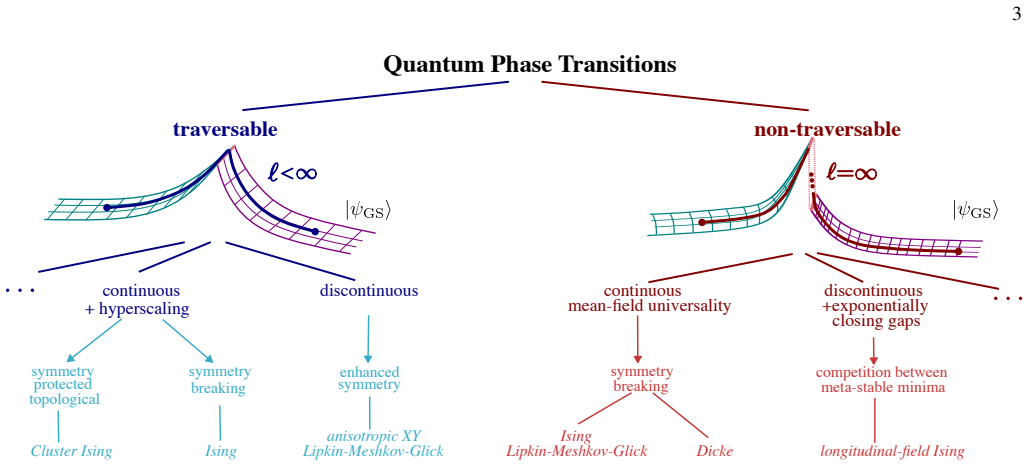
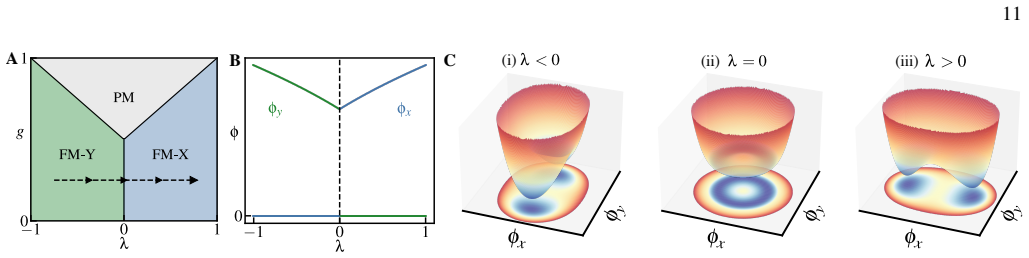
Quantum phase transitions fall into traversable and nontraversable classes according to the geometric distance separating the two ground states. Traversable transitions have finite distance in the thermodynamic limit so that exact counterdiabatic driving connects them with finite amplitudes and frequencies; examples include symmetry-breaking transitions obeying hyperscaling and discontinuous transitions with enhanced continuous symmetry. Nontraversable transitions have infinite distance requiring divergent amplitudes and frequencies even with nonlocal driving; examples include continuous transitions with mean-field universality and discontinuous transitions arising from competition between m
What carries the argument
The geometric distance in the ground-state manifold, which determines whether counterdiabatic driving schedules connecting the two phases remain finite in the thermodynamic limit
If this is right
- Symmetry-breaking transitions obeying hyperscaling fall into the traversable class
- Discontinuous transitions with an enhanced continuous symmetry are traversable
- Continuous transitions exhibiting mean-field universality are nontraversable
- Discontinuous transitions arising from the competition between metastable minima are nontraversable
- The classification has direct implications for the complexity of state preparation and adiabatic quantum computation
Where Pith is reading between the lines
- The geometric criterion may allow identification of transitions where dynamical state preparation can avoid divergences without relying on local observables
- This classification could extend the analysis of adiabatic protocols to cases where standard order parameters are absent
- Further examination of the distance measure might reveal connections to other dynamical bounds in many-body systems
Load-bearing premise
That the geometric distance in the ground-state manifold can be meaningfully defined and that explicit counterdiabatic driving schedules exist and remain finite for the traversable class in the thermodynamic limit
What would settle it
An explicit counterdiabatic schedule for a symmetry-breaking transition obeying hyperscaling that diverges in amplitude or frequency in the thermodynamic limit would falsify the traversable assignment for that transition
Figures
read the original abstract
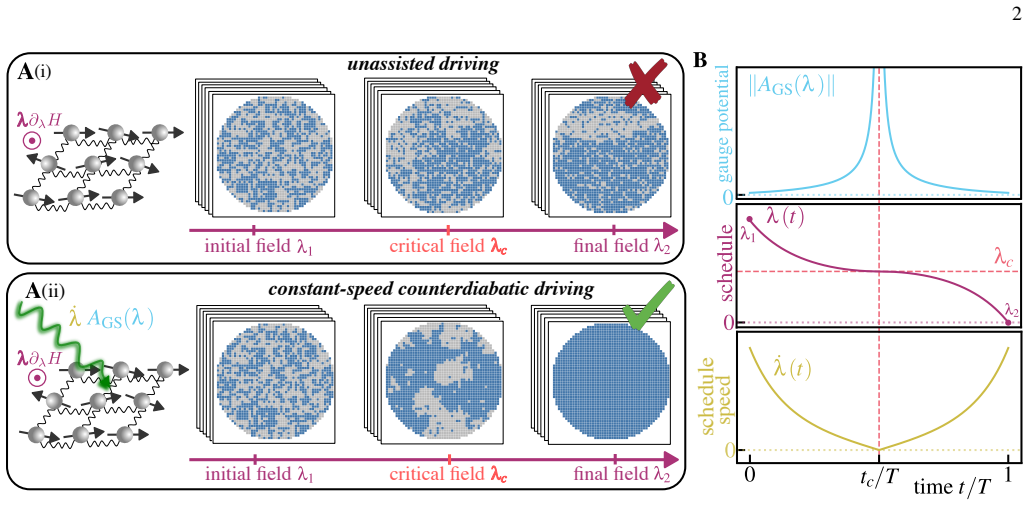
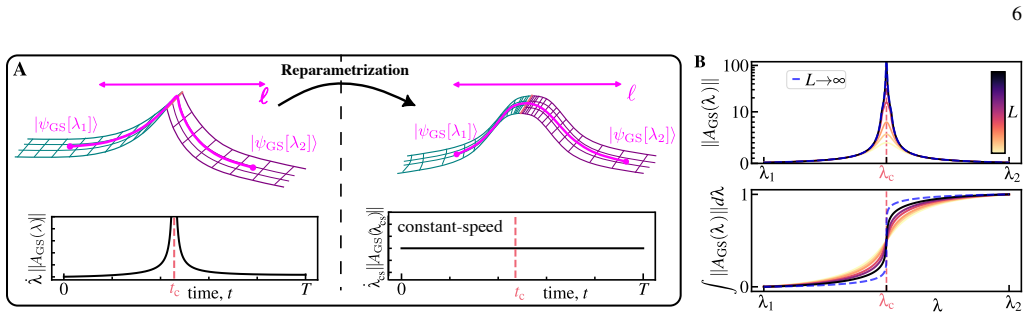
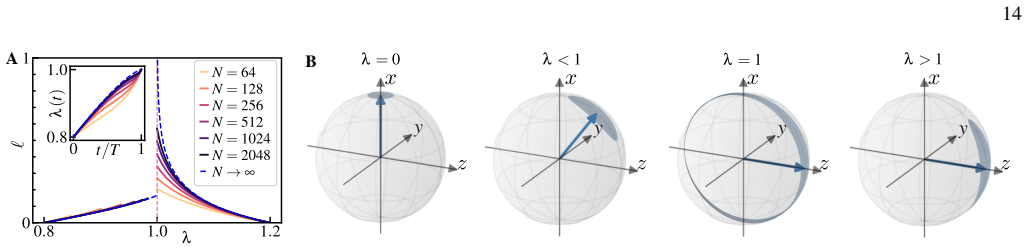
Quantum phase transitions manifest as an abrupt change in the ground state of a many-body system; yet it is an open question whether this sudden change necessarily precludes a continuous dynamical connection between the two phases. We introduce a classification of quantum phase transitions based on this geometric aspect of the ground-state manifold, that differs from known classifications. By leveraging the framework of counterdiabatic driving, we explicitly construct schedules that dynamically connect one phase to another. This strategy allows us to uncover a large class of quantum phase transitions, where the states on both sides are separated only by a finite geometric distance in the thermodynamic limit. We term such transitions traversable, since exact counterdiabatic driving links the two phases via a finite dynamical protocol in the thermodynamic limit. We show that multiple known transitions fall into this class -- e.g., symmetry-breaking transitions obeying hyperscaling and discontinuous transitions with an enhanced continuous symmetry. We further show the existence of quantum phase transitions that cannot be crossed dynamically even with the help of nonlocal counterdiabatic driving, as they would require divergent amplitudes and frequencies. Geometrically, these nontraversable transitions correspond to an infinite distance separating the two phases of matter; we show that the class comprises continuous transitions exhibiting mean-field universality, and discontinuous transitions arising from the competition between metastable minima. Our geometric classification goes beyond the known taxonomy, is independent of local order parameters and renormalization group fixed points, and has direct implications for the complexity of state preparation and adiabatic quantum computation.
Editorial analysis
A structured set of objections, weighed in public.
Referee Report
Summary. The manuscript introduces a geometric classification of quantum phase transitions (QPTs) into traversable and nontraversable types, based on whether the ground states on either side of the transition are separated by finite or infinite distance in the ground-state manifold. Leveraging counterdiabatic driving (CD), it constructs finite dynamical protocols connecting phases for traversable transitions (e.g., symmetry-breaking transitions obeying hyperscaling and certain discontinuous transitions with enhanced symmetry) in the thermodynamic limit, while showing that nontraversable transitions (e.g., continuous mean-field transitions and discontinuous transitions from competing metastable minima) require divergent CD amplitudes and frequencies. The classification is presented as independent of renormalization-group fixed points and local order parameters, with implications for state preparation and adiabatic quantum computation.
Significance. If the central claims hold, the work provides a new operational classification of QPTs grounded in dynamical connectability via CD, offering a perspective distinct from standard RG and order-parameter taxonomies. Strengths include the explicit use of the CD framework to make the geometric distance concrete and the identification of concrete example classes on each side of the divide; this could inform complexity of state preparation in quantum many-body systems.
major comments (2)
- [classification and counterdiabatic driving framework] § on counterdiabatic driving framework and classification: the central claim that traversable transitions admit finite CD protocols in the thermodynamic limit rests on the geometric distance being finite and the resulting schedules remaining bounded; without explicit verification that the distance measure does not reduce to a quantity already fixed by the same CD construction, the independence from existing classifications is not yet load-bearing.
- [examples] Examples section (symmetry-breaking and mean-field cases): the assignment of hyperscaling transitions to the traversable class and mean-field transitions to the nontraversable class requires explicit computation of the geometric distance (or CD amplitudes) for at least one representative model in each category to confirm the finite/divergent distinction holds in the thermodynamic limit.
minor comments (2)
- [introduction] Notation for the geometric distance and CD schedules should be introduced with a clear equation reference early in the manuscript to avoid ambiguity when comparing to standard fidelity or Berry-phase quantities.
- [abstract] The abstract states that the classification 'goes beyond the known taxonomy'; a brief comparison table or paragraph contrasting the new classes with RG universality classes would improve readability.
Simulated Author's Rebuttal
We thank the referee for their careful reading and constructive comments. We address each major point below, clarifying the independence of our geometric measure and agreeing to strengthen the examples with explicit computations.
read point-by-point responses
-
Referee: [classification and counterdiabatic driving framework] § on counterdiabatic driving framework and classification: the central claim that traversable transitions admit finite CD protocols in the thermodynamic limit rests on the geometric distance being finite and the resulting schedules remaining bounded; without explicit verification that the distance measure does not reduce to a quantity already fixed by the same CD construction, the independence from existing classifications is not yet load-bearing.
Authors: The geometric distance is defined independently via the integral of the quantum geometric tensor (Fubini-Study metric) over the ground-state manifold, a standard construct from quantum information geometry that depends only on ground-state overlaps and requires no reference to driving protocols. Counterdiabatic driving is applied afterward to give this distance an operational interpretation: finite distance implies the existence of bounded CD schedules connecting the phases in finite time in the thermodynamic limit. The construction is therefore not circular. We will add a short subsection in the methods explicitly stating this separation and citing the relevant quantum geometry literature. revision: yes
-
Referee: [examples] Examples section (symmetry-breaking and mean-field cases): the assignment of hyperscaling transitions to the traversable class and mean-field transitions to the nontraversable class requires explicit computation of the geometric distance (or CD amplitudes) for at least one representative model in each category to confirm the finite/divergent distinction holds in the thermodynamic limit.
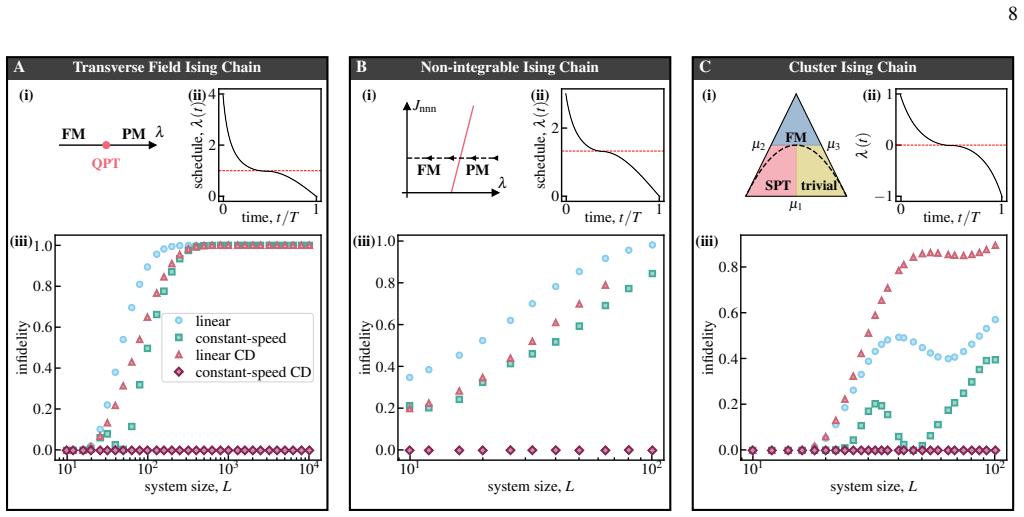
Authors: We agree that explicit verification for concrete models would make the finite-versus-infinite distinction more compelling. While the current arguments rely on general scaling properties of the geometric tensor (finite for hyperscaling symmetry-breaking transitions, divergent for mean-field cases), we will add explicit calculations in the revised examples section: the 1D transverse-field Ising model (hyperscaling, finite distance via exact solution) and the infinite-range mean-field Ising model (divergent distance). These computations will be performed in the thermodynamic limit using known ground-state fidelities. revision: yes
Circularity Check
No significant circularity detected
full rationale
The paper defines a geometric classification of QPTs via distance in the ground-state manifold and uses counterdiabatic driving to construct explicit finite protocols for the traversable class in the thermodynamic limit. This definition and the resulting separation into traversable/nontraversable classes are introduced as a new taxonomy independent of RG fixed points or local order parameters. No quoted equations or steps in the provided abstract reduce a claimed prediction or result to a fitted parameter, self-citation chain, or definitional tautology; the framework is presented as self-contained with external examples and explicit constructions that do not collapse by construction to the inputs.
Axiom & Free-Parameter Ledger
Reference graph
Works this paper leans on
-
[1]
Notice that we have already used an anisotropic version of this model in Sec
Lipkin-Meshkov-Glick model As a prototypical, infinitely correlated model we now con- sider the Lipkin-Meshkov-Glick (LMG) Hamiltonian 𝐻(𝜆)=− 2 𝐿 𝑆2 𝑥 −2𝜆𝑆 𝑧,(35) where𝑆 𝑎 = Í𝐿 𝑖=1 𝜎𝑎 𝑖 represents the total spin operator along direction𝑎=𝑥, 𝑦, 𝑧for an system composed of of𝐿spins- 1/2. Notice that we have already used an anisotropic version of this model i...
2048
-
[2]
allup”state,denoted by |⇑⟩ (𝜆>0), to a perturbatively-dressed “all down
Dicke model of superradiance As a second example of a mean-field phase transition, we consider the Dicke model [85], which describes a system of 𝐿two-level atoms interacting with a single monochromatic electromagneticradiationcavitymode. TheHamiltonianreads as 𝐻=𝜔 𝑐𝑎†𝑎+𝜔 𝑠𝑆𝑧 − 𝜆√ 𝐿 (𝑎+𝑎 †) (𝑆+ +𝑆 −),(41) where𝜔 𝑐 is the photon frequency,𝜔𝑠 is the atomic e...
-
[3]
Integrable Ising chain Fermionic representation.The integrable transverse- field Ising Hamiltonian, Eq. (15), can be Jordan-Wigner- transformed to fermionic operators as [144] 𝐻=− ∑︁ 𝑗 h 𝑐† 𝑗 𝑐† 𝑗+1 +𝑐 † 𝑗 𝑐 𝑗+1 −𝑐 𝑗 𝑐† 𝑗+1 −𝑐 𝑗 𝑐 𝑗+1 −2𝑔𝑐 † 𝑗 𝑐 𝑗 i −𝐿𝑔,(A1) where the periodic boundary conditions fix𝑐𝑗+𝐿 =−𝑐 𝑗 (even fermionic number sector). By translatio...
-
[4]
Cluster Ising chain Fermionic representation.Using the same momentum- spacebasisofthetransverse-fieldIsingchain,theclusterIsing Hamiltonian reads 𝐻=2 ∑︁ 𝑘>0 𝜓† 𝑘 (𝜇 2 cos𝑘+𝜇 3 cos 2𝑘−𝜇 1)𝜏 𝑧 − (𝜇 2 sin𝑘+𝜇 3 sin 2𝑘)𝜏 𝑥 𝜓𝑘 .(A25) One can check that the AGP for the path in Eq. (21) reads 𝐴GS (𝜆)=− ∑︁ 𝑘>0 sin𝑘 1+𝜆 2 + (𝜆 2 −1)cos𝑘 𝜓† 𝑘 𝜏 𝑦𝜓𝑘 .(A26) Adiabatic ...
-
[5]
Here, we show instead that it is possibletoobtaintheconstant-speedparametrizationalsofully numerically
Non-integrable transverse-field Ising chain As stated in the main text, the treatment of the integrable TFIC hinged upon the knowledge of the exact expressions for the ground-state AGP. Here, we show instead that it is possibletoobtaintheconstant-speedparametrizationalsofully numerically. In order to reach large system sizes, we decided to use tensor netw...
-
[6]
Anisotropic XY Lipkin-Meshkov-Glick model We consider the LMG Hamiltonian in Eq. (24). Following [82], in the𝐿≫1limit, we can study the first order quantum corrections by means of an Holstein-Primakoff representation of spin operators. First of all we perform a rotation of the spin operators, that brings the𝑧axis along the semiclassical magnetization. © ...
-
[7]
1− 1/2−𝜆 2 √︁ 𝜆(𝜆−1) # + O (𝐿 −2)(A62a) 2⟨𝑆 𝑥⟩ 𝐿 = 2⟨𝑆 𝑦⟩ 𝐿 =0(A62b) 4⟨𝑆 2 𝑧⟩ 𝐿2 =1+ 1 𝐿
Ising Lipkin-Meshkov-Glick model We consider the Ising Lipkin-Meshkov-Glick Hamiltonian in Eq. (35). Following [82], in the𝐿≫1limit, we can study the first order quantum corrections by means of an Holstein- Primakoff representation of spin operators. First of all we performarotationofthespinoperatorsaroundthe𝑦axis,that brings the𝑧axis along the semiclassi...
-
[8]
They are solutions to the equation [5] L2(𝐴) + L (𝜕 𝜆𝐻)=0,(C1) whereL (·)=𝑖[𝐻(𝜆),·]istheLiouvilliansuperoperator
Full adiabatic gauge potential Adiabatic gauge potentials𝐴are not gauge-invariant ob- jects. They are solutions to the equation [5] L2(𝐴) + L (𝜕 𝜆𝐻)=0,(C1) whereL (·)=𝑖[𝐻(𝜆),·]istheLiouvilliansuperoperator. Dif- ferentgaugechoicescorrespondtoaddingorsubtracting,from afixedsolution,termsthatcommutewiththeHamiltonian;this makes the kernel ofLnontrivial andL...
-
[9]
For gapped systems, the GS Kato AGP has a finite Hilbert- Schmidt norm density
Ground-state adiabatic gauge potentials Inthemaintext,wediscussedthat,forgappedlocalHamil- tonians, one can define counterdiabatic driving in the thermo- dynamic limit, using the ground-state AGP: 𝐴K GS (𝜆)= 1 𝑖 [𝜕𝜆ΠGS [𝜆],Π GS [𝜆]](C4) =−𝑖 ∑︁ 𝑛>0 |𝑛[𝜆] ⟩ ⟨𝑛[𝜆] | 𝜕𝜆𝐻(𝜆) |0[𝜆] ⟩ ⟨0[𝜆] | 𝐸𝑛 (𝜆) −𝐸 0 (𝜆) +h.c., withΠ GS [𝜆]the projector onto the ground-state...
-
[10]
P. W. Anderson, More is different: broken symmetry and the nature of the hierarchical structure of science., Science177, 393 (1972)
1972
-
[11]
M. E. Fisher, Renormalization group theory: Its basis and formulation in statistical physics, Rev. Mod. Phys.70, 653 (1998)
1998
-
[12]
Goldenfeld,Lectures on phase transitions and the renor- malization group(CRC Press, 2018)
N. Goldenfeld,Lectures on phase transitions and the renor- malization group(CRC Press, 2018)
2018
-
[13]
Sachdev,Quantum Phase Transitions, 2nd ed
S. Sachdev,Quantum Phase Transitions, 2nd ed. (Cambridge University Press, 2011)
2011
-
[14]
Kolodrubetz, D
M. Kolodrubetz, D. Sels, P. Mehta, and A. Polkovnikov, Ge- ometry and non-adiabatic response in quantum and classical systems, Phys. Rep.697, 1 (2017)
2017
-
[15]
Rep.838, 1 (2020)
A.Carollo,D.Valenti,andB.Spagnolo,Geometryofquantum phase transitions, Phys. Rep.838, 1 (2020)
2020
-
[16]
Střeleček and P
J. Střeleček and P. Cejnar, Quantum geometry in many-body systemswithprecursorsofcriticality,Phys.Rev.A111,012211 (2025)
2025
-
[17]
T. W. B. Kibble, Topology of cosmic domains and strings, J. Phys. A9, 1387 (1976); T. Kibble, Some implications of a cosmological phase transition, Phys. Rep.67, 183 (1980)
1976
-
[18]
W.H.Zurek,Cosmologicalexperimentsinsuperfluidhelium?, Nature317, 505 (1985)
1985
-
[19]
W.H.Zurek,U.Dorner,andP.Zoller,Dynamicsofaquantum phase transition, Phys. Rev. Lett.95, 105701 (2005)
2005
-
[20]
A.delCampoandW.H.Zurek,Universalityofphasetransition dynamics: Topological defects from symmetry breaking, Intl. J. Mod. Phys. A29, 1430018 (2014)
2014
-
[21]
Bäuerle, Y
C. Bäuerle, Y. M. Bunkov, S. N. Fisher, H. Godfrin, and G. R. Pickett, Laboratory simulation of cosmic string formation in theearlyuniverseusingsuperfluid3he,Nature382,332(1996)
1996
-
[22]
Ducci, P
S. Ducci, P. L. Ramazza, W. González-Viñas, and F. T. Arec- chi,Orderparameterfragmentationafterasymmetry-breaking transition, Phys. Rev. Lett.83, 5210 (1999)
1999
-
[23]
Carmi, E
R. Carmi, E. Polturak, and G. Koren, Observation of sponta- neousfluxgenerationinamulti-josephson-junctionloop,Phys. Rev. Lett.84, 4966 (2000)
2000
-
[24]
S. C. Chae, N. Lee, Y. Horibe, M. Tanimura, S. Mori, B. Gao, S.Carr,andS.-W.Cheong,Directobservationoftheprolifera- tion of ferroelectric loop domains and vortex-antivortex pairs, Phys. Rev. Lett.108, 167603 (2012)
2012
-
[25]
Phys.9, 656 (2013)
G.Lamporesi,S.Donadello,S.Serafini,F.Dalfovo,andG.Fer- rari, Spontaneous creation of kibble–zurek solitons in a bose– einstein condensate, Nat. Phys.9, 656 (2013)
2013
-
[26]
Deutschländer, P
S. Deutschländer, P. Dillmann, G. Maret, and P. Keim, Kib- ble–zurek mechanism in colloidal monolayers, Proc. Natl. Acad. Sci. (USA)112, 6925 (2015)
2015
-
[27]
Demirplak and S
M. Demirplak and S. A. Rice, Adiabatic Population Transfer with Control Fields, J. Phys. Chem. A107, 9937 (2003); As- sistedAdiabaticPassageRevisited,J.Phys.Chem.B109,6838 (2005); Ontheconsistency,extremal,andglobalpropertiesof counterdiabatic fields, J. Chem. Phys.129, 154111 (2008)
2003
-
[28]
M. V. Berry, Transitionless quantum driving, J. Phys. A42, 365303 (2009)
2009
-
[29]
Jarzynski, Generating shortcuts to adiabaticity in quantum and classical dynamics, Phys
C. Jarzynski, Generating shortcuts to adiabaticity in quantum and classical dynamics, Phys. Rev. A88, 040101(R) (2013)
2013
-
[30]
Kolodrubetz, V
M. Kolodrubetz, V. Gritsev, and A. Polkovnikov, Classifying and measuring geometry of a quantum ground state manifold, Phys. Rev. B88, 064304 (2013)
2013
-
[31]
del Campo, M
A. del Campo, M. M. Rams, and W. H. Zurek, Assisted finite- rate adiabatic passage across a quantum critical point: Exact solution for the quantum ising model, Phys. Rev. Lett.109, 115703 (2012)
2012
-
[32]
K.Takahashi,Transitionlessquantumdrivingforspinsystems, Phys. Rev. E87, 062117 (2013)
2013
-
[33]
Grabarits, F
A. Grabarits, F. Balducci, and A. del Campo, Fighting expo- nentiallysmallgapsbycounterdiabaticdriving,PRXQuantum 7, 010322 (2026)
2026
-
[34]
Sels and A
D. Sels and A. Polkovnikov, Minimizing irreversible losses in quantum systems by local counterdiabatic driving, Proc. Natl. Acad. Sci. USA114, E3909 (2017)
2017
-
[35]
R.Holtzman,O.Raz,andC.Jarzynski,Shortcutstoadiabatic- ity across a separatrix, Phys. Rev. Lett.134, 157201 (2025)
2025
-
[36]
P. W. Anderson, Infrared catastrophe in fermi gases with local scatteringpotentials,Phys.Rev.Lett.18,1049(1967); Ground state of a magnetic impurity in a metal, Phys. Rev.164, 352 (1967)
1967
-
[37]
J.P.ProvostandG.Vallee,Riemannianstructureonmanifolds of quantum states, Commun. Math. Phys.76, 289 (1980)
1980
-
[38]
J.AnandanandY.Aharonov,Geometryofquantumevolution, Phys. Rev. Lett.65, 1697 (1990)
1990
-
[39]
Chruściński and A
D. Chruściński and A. Jamiołkowski,Geometric phases in classical and quantum mechanics(Springer, Boston, MA, 2004)
2004
-
[40]
J. E. Avron and A. Elgart, Adiabatic theorem without a gap condition, Commun. Math. Phys.203, 445 (1999)
1999
-
[41]
S.Teufel,Adiabatic Perturbation Theory in Quantum Dynam- ics(Springer Berlin, 2003)
2003
-
[42]
Marzlin and B
K.-P. Marzlin and B. C. Sanders, Inconsistency in the appli- cation of the adiabatic theorem, Phys. Rev. Lett.93, 160408 (2004)
2004
-
[43]
M. H. S. Amin, Consistency of the adiabatic theorem, Phys. Rev. Lett.102, 220401 (2009)
2009
-
[44]
Albash and D
T. Albash and D. A. Lidar, Adiabatic quantum computation, Rev. Mod. Phys.90, 015002 (2018)
2018
-
[45]
X.Chen,A.Ruschhaupt,S.Schmidt,A.delCampo,D.Guéry- Odelin,andJ.G.Muga,Fastoptimalfrictionlessatomcooling in harmonic traps: Shortcut to adiabaticity, Phys. Rev. Lett. 104, 063002 (2010)
2010
-
[46]
Guéry-Odelin, A
D. Guéry-Odelin, A. Ruschhaupt, A. Kiely, E. Torrontegui, S. Martínez-Garaot, and J. G. Muga, Shortcuts to adiabatic- ity: Concepts, methods, andapplications,Rev.Mod.Phys.91, 045001 (2019)
2019
-
[47]
C. W. Duncan, P. M. Poggi, M. Bukov, N. T. Zinner, and S. Campbell, Taming quantum systems: A tutorial for using shortcuts-to-adiabaticity, quantum optimal control, and rein- forcement learning, PRX Quantum6, 040201 (2025)
2025
-
[48]
del Campo, Shortcuts to adiabaticity by counterdiabatic driving, Phys
A. del Campo, Shortcuts to adiabaticity by counterdiabatic driving, Phys. Rev. Lett.111, 100502 (2013)
2013
-
[49]
P.W.Claeys,M.Pandey,D.Sels,andA.Polkovnikov,Floquet- Engineering Counterdiabatic Protocols in Quantum Many- Body Systems, Phys. Rev. Lett.123, 090602 (2019)
2019
-
[50]
Takahashi and A
K. Takahashi and A. del Campo, Shortcuts to adiabaticity in krylov space, Phys. Rev. X14, 011032 (2024)
2024
-
[51]
Morawetz and A
S. Morawetz and A. Polkovnikov, Universal counterdiabatic driving in krylov space, PRX Quantum6, 040320 (2025)
2025
-
[52]
J. R. Finžgar, S. Notarnicola, M. Cain, M. D. Lukin, and D.Sels,Counterdiabaticdrivingwithperformanceguarantees, Phys. Rev. Lett.135, 180602 (2025)
2025
-
[53]
Improving Variational Counterdiabatic Driving with Weighted Actions and Computer Algebra
N. Ohga and T. Hatomura, Improving variational counter- diabatic driving with weighted actions and computer algebra (2025), arXiv:2505.18367 [quant-ph]. 27
work page internal anchor Pith review Pith/arXiv arXiv 2025
-
[54]
Partial Reversibility and Counterdiabatic Driving in Nearly Integrable Systems
R. Banerjee, S. Khamnei, A. Polkovnikov, and S. Morawetz, Partial reversibility and counterdiabatic driving in nearly inte- grable systems, arXiv preprint arXiv:2602.22317 (2026)
work page internal anchor Pith review arXiv 2026
-
[55]
Roland and N
J. Roland and N. J. Cerf, Quantum search by local adiabatic evolution, Phys. Rev. A65, 042308 (2002)
2002
-
[56]
H.Saberi,T.Opatrný,K.Mølmer,andA.delCampo,Adiabatic tracking of quantum many-body dynamics, Phys. Rev. A90, 060301 (2014)
2014
-
[57]
T.Kato,OntheAdiabaticTheoremofQuantumMechanics,J. Phys. Soc. Japan5, 435 (1950)
1950
-
[58]
M. B. Hastings and X.-G. Wen, Quasiadiabatic continuation of quantum states: The stability of topological ground-state degeneracy and emergent gauge invariance, Phys. Rev. B72, 045141 (2005)
2005
-
[59]
T. J. Osborne, Simulating adiabatic evolution of gapped spin systems,PhysicalReviewA—Atomic,Molecular,andOptical Physics75, 032321 (2007)
2007
-
[60]
M.B.Hastings,Localityinquantumsystems,QuantumTheory from Small to Large Scales95, 171 (2010)
2010
-
[61]
Bachmann, S
S. Bachmann, S. Michalakis, B. Nachtergaele, and R. Sims, Automorphic equivalence within gapped phases of quantum latticesystems,CommunicationsinMathematicalPhysics309, 835 (2012)
2012
-
[62]
G.Passarelli,V.Cataudella,R.Fazio,andP.Lucignano,Coun- terdiabatic driving in the quantum annealing of the𝑝-spin model: A variational approach, Phys. Rev. Res.2, 013283 (2020)
2020
-
[63]
D. Sen, K. Sengupta, and S. Mondal, Defect Production in NonlinearQuenchacrossaQuantumCriticalPoint,Phys.Rev. Lett.101, 016806 (2008)
2008
-
[64]
Barankov and A
R. Barankov and A. Polkovnikov, Optimal Nonlinear Pas- sage Through a Quantum Critical Point, Phys. Rev. Lett.101, 076801 (2008)
2008
-
[65]
Cardy,Scaling and Renormalization in Statistical Physics, Cambridge Lecture Notes in Physics (Cambridge University Press, 1996)
J. Cardy,Scaling and Renormalization in Statistical Physics, Cambridge Lecture Notes in Physics (Cambridge University Press, 1996)
1996
-
[66]
A. T. Rezakhani, W.-J. Kuo, A. Hamma,et al., Quantum Adi- abatic Brachistochrone, Phys. Rev. Lett.103, 080502 (2009)
2009
-
[67]
Grabarits, F
A. Grabarits, F. Balducci, B. C. Sanders, and A. del Campo, Nonadiabatic quantum optimization for crossing quantum phase transitions, Phys. Rev. A111, 012215 (2025)
2025
-
[68]
M. M. Rams, P. Sierant, O. Dutta, P. Horodecki, and J. Za- krzewski,Atthelimitsofcriticality-basedquantummetrology: Apparent super-heisenberg scaling revisited, Phys. Rev. X8, 021022 (2018)
2018
-
[69]
Zhang and X
Y. Zhang and X. Yuan, Quantum algorithms for fidelity sus- ceptibility: From quantum criticality to metrology, Phys. Rev. Lett.136, 080604 (2026)
2026
-
[70]
T.Gorin,T.Prosen,T.H.Seligman,andM.Žnidarič,Dynam- ics of loschmidt echoes and fidelity decay, Physics Reports 435, 33 (2006)
2006
- [71]
-
[72]
Molignini, A
P. Molignini, A. G. Celades, R. Chitra, and W. Chen, Crossdi- mensionaluniversalityclassesinstaticandperiodicallydriven kitaev models, Phys. Rev. B103, 184507 (2021)
2021
-
[73]
Fläschner, B
N. Fläschner, B. S. Rem, M. Tarnowski, D. Vogel, D.-S. Lüh- mann, K. Sengstock, and C. Weitenberg, Experimental recon- structionoftheberrycurvatureinafloquetblochband,Science 352, 1091 (2016)
2016
-
[74]
Phys.13, 545 (2017)
M.Wimmer,H.M.Price,I.Carusotto,andU.Peschel,Exper- imental measurement of the berry curvature from anomalous transport, Nat. Phys.13, 545 (2017)
2017
-
[75]
Commun.9, 916 (2018)
T.T.LuuandH.J.Wörner,Measurementoftheberrycurvature of solids using high-harmonic spectroscopy, Nat. Commun.9, 916 (2018)
2018
-
[76]
Campos Venuti and P
L. Campos Venuti and P. Zanardi, Quantum critical scaling of the geometric tensors, Phys. Rev. Lett.99, 095701 (2007)
2007
-
[77]
De Grandi and A
C. De Grandi and A. Polkovnikov, Adiabatic perturbation the- ory: Fromlandau–zenerproblemtoquenchingthroughaquan- tum critical point, inQuantum Quenching, Annealing and Computation(Springer, 2010) pp. 75–114
2010
-
[78]
A. F. Albuquerque, F. Alet, C. Sire, and S. Capponi, Quan- tum critical scaling of fidelity susceptibility, Phys. Rev. B81, 064418 (2010)
2010
-
[79]
Codebases , 4 (2022)
M.Fishman,S.R.White,andE.M.Stoudenmire,TheITensor Software Library for Tensor Network Calculations, SciPost Phys. Codebases , 4 (2022)
2022
-
[80]
Haegeman, J
J. Haegeman, J. I. Cirac, T. J. Osborne, I. Pižorn, H. Ver- schelde, and F. Verstraete, Time-dependent variational princi- ple for quantum lattices, Phys. Rev. Lett.107, 070601 (2011)
2011
discussion (0)
Sign in with ORCID, Apple, or X to comment. Anyone can read and Pith papers without signing in.