Equilibrium Gibbs Bifurcations of Bardeen-AdS Black Holes at Fixed Pressure
Pith reviewed 2026-06-29 20:37 UTC · model grok-4.3
The pith
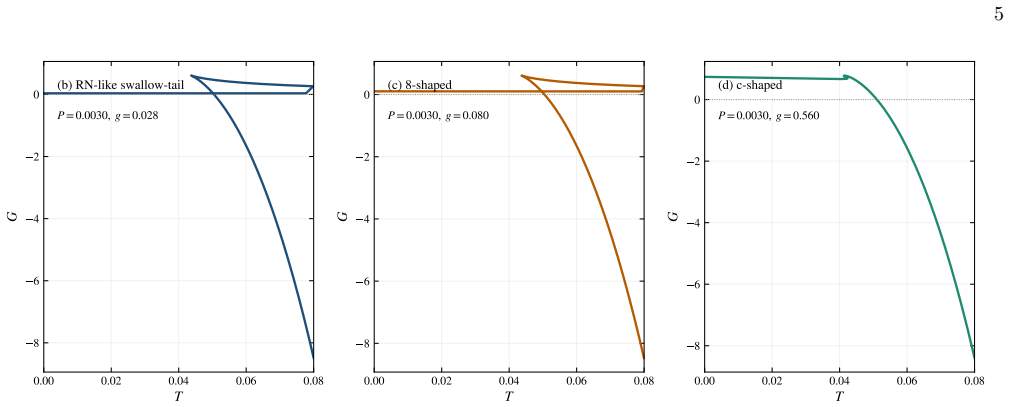
Bardeen-AdS black holes at fixed pressure pass through three successive Gibbs curve topologies as the regularization scale increases.
A machine-rendered reading of the paper's core claim, the machinery that carries it, and where it could break.
Core claim
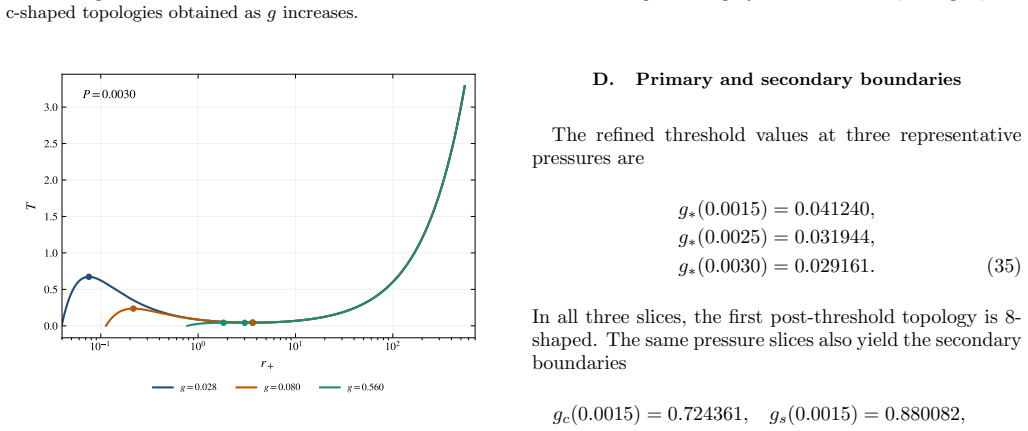
In the direct horizon convention, the fixed-pressure Gibbs curve of the four-dimensional Bardeen-AdS black hole passes through an intermediate sequence between the Reissner-Nordstrom-AdS swallow-tail class and the single-branch regime as the regularization scale is increased. The deformation is resolved into three boundaries: g star of P, where the RN-AdS-like topology is lost; g c of P, where the c-shaped sector begins; and g s of P, where the positive-temperature multibranch structure terminates. These boundaries are controlled by the dimensionless combination 8 pi P g squared, accounting for their inverse-square-root pressure dependence and giving an analytic value for the final single-br
What carries the argument
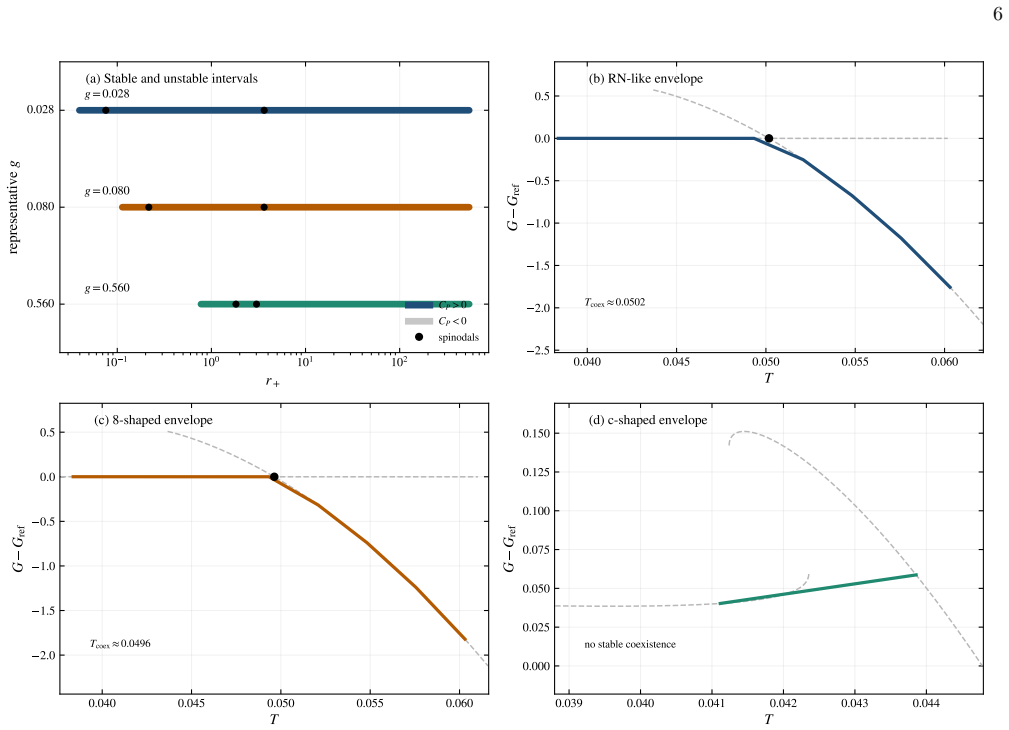
The fixed-pressure on-shell Gibbs curve, classified by turning points and self-intersections, then subjected to local heat-capacity filtering to construct the lower envelope over stable branches.
If this is right
- Stable small/large black hole coexistence survives the first topology change at g star of P.
- The c-shaped regime that appears after g c of P contains no stable crossing between branches.
- All three boundaries scale inversely with the square root of pressure because they depend only on the combination 8 pi P g squared.
- The final single-branch boundary g s of P admits an exact analytic expression obtained from the reduced-variable analysis.
Where Pith is reading between the lines
- The single controlling dimensionless ratio may produce analogous three-boundary sequences in other families of regular AdS black holes that share the same scaling.
- Numerical or analog simulations of horizon thermodynamics could check whether the inverse-square-root pressure dependence persists when the regularization is implemented by other means.
Load-bearing premise
That local heat-capacity filtering followed by construction of the lower Gibbs envelope over stable branches correctly identifies the equilibrium thermodynamics.
What would settle it
A direct computation of the Gibbs curve at fixed pressure that shows the number or location of turning points and self-intersections changing at values of g different from those predicted by the 8 pi P g squared boundaries.
Figures


read the original abstract
In the direct horizon convention, the fixed-pressure Gibbs curve of the four-dimensional Bardeen-AdS black hole passes through an intermediate sequence between the Reissner-Nordstrom-AdS swallow-tail class and the single-branch regime as the regularization scale is increased. The on-shell curve is classified by its turning points and self-intersections, followed by local heat-capacity filtering and construction of the lower Gibbs envelope over stable branches. The deformation is resolved into three boundaries: g_*(P), where the RN-AdS-like topology is lost; g_c(P), where the c-shaped sector begins; and g_s(P), where the positive-temperature multibranch structure terminates. A reduced-variable analysis shows that these boundaries are controlled by the dimensionless combination 8 pi P g^2, accounting for their inverse-square-root pressure dependence and giving an analytic value for the final single-branch boundary. The equilibrium construction further shows that stable small/large coexistence can survive the first topology change, whereas the representative c-shaped regime has no stable crossing. Within the direct convention, these results define a Gibbs bifurcation structure for Bardeen-AdS thermodynamics.
Editorial analysis
A structured set of objections, weighed in public.
Referee Report
Summary. The manuscript analyzes the fixed-pressure Gibbs free energy curves of four-dimensional Bardeen-AdS black holes in the direct horizon convention. As the regularization scale g increases, the on-shell curve deforms from an RN-AdS swallowtail topology through an intermediate c-shaped sector to a single-branch regime. The authors classify curves by turning points and self-intersections, apply local heat-capacity filtering, and construct the lower Gibbs envelope over stable branches to identify equilibrium structures. This resolves the deformation into three boundaries g_*(P), g_c(P), and g_s(P). A reduced-variable analysis demonstrates that these boundaries are governed by the dimensionless combination 8πP g², explaining their inverse-square-root pressure dependence and yielding an analytic value for the terminal single-branch boundary g_s(P). The construction indicates that stable small/large coexistence survives the first topology change, while the c-shaped regime lacks stable crossings.
Significance. If the equilibrium construction holds, the results provide a detailed map of thermodynamic bifurcations for regular black holes in AdS, extending RN-AdS swallowtail analyses to include regularization effects. The reduced-variable scaling that produces an analytic boundary for the single-branch regime is a clear strength, offering falsifiable, parameter-controlled predictions rather than numerical fits. This framework could guide phase-transition studies in other regularized gravity models.
major comments (1)
- [Abstract (method description)] The central claims (identification of g_*(P), g_c(P), g_s(P); survival of stable coexistence after the first topology change; absence of stable crossing in the c-shaped regime) rest on the procedure of local heat-capacity filtering followed by construction of the lower Gibbs envelope over stable branches. The manuscript asserts this defines the equilibrium Gibbs bifurcations in the direct horizon convention but supplies no derivation showing why the filtered lower envelope corresponds to global thermodynamic equilibrium (as opposed to a local or metastable selection). This assumption is load-bearing for the reduced-variable analysis and the analytic boundary.
Simulated Author's Rebuttal
We thank the referee for the careful reading of the manuscript and the substantive comment on the thermodynamic foundation of the equilibrium construction. We address the point directly below.
read point-by-point responses
-
Referee: [Abstract (method description)] The central claims (identification of g_*(P), g_c(P), g_s(P); survival of stable coexistence after the first topology change; absence of stable crossing in the c-shaped regime) rest on the procedure of local heat-capacity filtering followed by construction of the lower Gibbs envelope over stable branches. The manuscript asserts this defines the equilibrium Gibbs bifurcations in the direct horizon convention but supplies no derivation showing why the filtered lower envelope corresponds to global thermodynamic equilibrium (as opposed to a local or metastable selection). This assumption is load-bearing for the reduced-variable analysis and the analytic boundary.
Authors: The procedure follows the standard construction in extended black-hole thermodynamics: at fixed pressure the global equilibrium configuration is the one of lowest Gibbs free energy among the locally stable branches (those with C_P > 0). This is the direct analogue of the Maxwell equal-area rule and the lower-envelope construction used for RN-AdS swallowtails; it selects the global minimum of the appropriate thermodynamic potential and excludes both unstable (C_P < 0) and metastable branches. The manuscript applies this established rule without re-deriving it from first principles. We agree that an explicit statement of the underlying thermodynamic principle, together with a reference to the canonical literature on AdS black-hole phase transitions, would strengthen the presentation. We will therefore add a short paragraph in the methods section (and a corresponding sentence in the abstract) that recalls why the filtered lower envelope corresponds to global equilibrium. revision: yes
Circularity Check
No circularity: boundaries derived from model equations and topology
full rationale
The paper classifies the on-shell Gibbs curve by its turning points and self-intersections, applies local heat-capacity filtering, and constructs the lower envelope over stable branches as an explicit procedure. The three boundaries g_*(P), g_c(P), g_s(P) are located from this topology, and the reduced-variable analysis identifies control by the dimensionless combination 8πPg² directly from the Bardeen-AdS equations, producing an analytic value for the single-branch termination. No step reduces by construction to a fitted input, self-citation chain, or renamed ansatz; the equilibrium identification is a defined convention applied to the model's outputs rather than a tautological re-expression of the inputs.
Axiom & Free-Parameter Ledger
free parameters (1)
- regularization scale g
axioms (2)
- domain assumption The Bardeen metric provides a valid regular black hole solution in AdS spacetime
- domain assumption Local heat-capacity sign correctly identifies thermodynamically stable branches
Reference graph
Works this paper leans on
-
[1]
RN- AdS-like
Thus the turning-point structure is tied directly to local thermodynamic stability. At fixed (T, P, g), the globally preferred equilibrium configuration is determined by the lower envelope of the stable branches. We define Geq(T;P, g) = min i Gi(T;P, g),(20) where the minimum is taken only over branches with CP >0. In the implementation, the positive- tem...
-
[2]
S. W. Hawking and D. N. Page, Communications in Mathematical Physics87, 577 (1983)
1983
-
[3]
A. Chamblin, R. Emparan, C. V. Johnson, and R. C. Myers, Physical Review D60, 064018 (1999), arXiv:hep- th/9902170
-
[4]
A. Chamblin, R. Emparan, C. V. Johnson, and R. C. Myers, Physical Review D60, 104026 (1999), arXiv:hep- th/9904197
-
[5]
P-V criticality of charged AdS black holes
D. Kubizˇ n´ ak and R. B. Mann, Journal of High Energy Physics2012, 33 (2012), arXiv:1205.0559
work page internal anchor Pith review Pith/arXiv arXiv 2012
-
[6]
Black hole chemistry: thermodynamics with Lambda
D. Kubizˇ n´ ak, R. B. Mann, and M. Teo, Classical and Quantum Gravity34, 063001 (2017), arXiv:1608.06147
work page internal anchor Pith review Pith/arXiv arXiv 2017
-
[7]
J. M. Bardeen, Non-singular general relativistic grav- itational collapse (1968), proceedings of GR5, Tbilisi, USSR, p. 174
1968
-
[8]
The Bardeen Model as a Nonlinear Magnetic Monopole
E. Ay´ on-Beato and A. Garc´ ıa, Physics Letters B493, 149 (2000), arXiv:gr-qc/0009077
work page internal anchor Pith review Pith/arXiv arXiv 2000
- [9]
- [10]
-
[11]
Y. Guo and Y.-G. Miao, Nuclear Physics B980, 115839 (2022), arXiv:2107.01866
-
[12]
Corrected form of the first law of thermodynamics for regular black holes
M.-S. Ma and R. Zhao, Classical and Quantum Gravity 31, 245014 (2014), arXiv:1411.0833
work page internal anchor Pith review Pith/arXiv arXiv 2014
-
[13]
F. Simovic and I. Soranidis, Physical Review D109, 044029 (2024), arXiv:2309.09439
-
[14]
Critical phenomena of regular black holes in anti-de Sitter space-time
Z.-Y. Fan, European Physical Journal C77, 266 (2017), arXiv:1609.04489
work page internal anchor Pith review Pith/arXiv arXiv 2017
- [15]
-
[16]
Ladghami, B
Y. Ladghami, B. Asfour, A. Bouali, A. Errahmani, and T. Ouali, Physics Letters B864, 139418 (2025)
2025
- [17]
-
[18]
Construction of Regular Black Holes in General Relativity
Z.-Y. Fan and X. Wang, Physical Review D94, 124027 (2016), arXiv:1610.02636
work page internal anchor Pith review Pith/arXiv arXiv 2016
-
[19]
J. Tao, Y. Wang, X. Liu, and M. Yang, Continuous knowledge metabolism: Generating scientific hypothe- ses from evolving literature (2026), arXiv:2604.12243 [cs.CL]
work page internal anchor Pith review Pith/arXiv arXiv 2026
discussion (0)
Sign in with ORCID, Apple, or X to comment. Anyone can read and Pith papers without signing in.