Chirality routing non-polaritonic vacuum correlations in Landau polaritons
Pith reviewed 2026-06-28 21:12 UTC · model grok-4.3
The pith
An exact chiral charge routes the dominant vacuum correlations and entanglement into the opposite polarization in Landau polaritons.
A machine-rendered reading of the paper's core claim, the machinery that carries it, and where it could break.
Core claim
In a multimode Hopfield model of Landau polaritons, an exact chiral charge routes the dominant anomalous correlations, squeezing, and cavity-matter entanglement into the opposite polarization. Parameters drawn from experiment show this hidden sector correlates the cyclotron resonance with finite momentum magnetoplasmons through Gaussian discord, while pairwise matter-matter entanglement remains absent. The model predicts a polarization anisotropy of dressed vacuum electric field fluctuations as a signature of this chiral routing.
What carries the argument
The exact chiral charge in the multimode Hopfield model, which routes the vacuum correlations to the non-polaritonic polarization.
If this is right
- The dominant anomalous correlations and squeezing reside in the opposite polarization from the bright polariton modes.
- Cavity-matter entanglement is routed into the non-bright polarization channel.
- The cyclotron resonance correlates with finite-momentum magnetoplasmons via Gaussian discord.
- Pairwise matter-matter entanglement is absent.
- Dressed vacuum electric field fluctuations exhibit polarization anisotropy.
Where Pith is reading between the lines
- Chirality may act as a symmetry principle to organize ultrastrong coupling vacua in other physical platforms.
- Quantum information tools such as discord can reveal salient hidden properties in similar light-matter systems.
- Measuring the predicted anisotropy in vacuum fluctuations provides a concrete experimental test of the routing mechanism.
- The absence of matter-matter entanglement suggests that correlations are mediated primarily through the cavity field in this setup.
Load-bearing premise
The multimode Hopfield model with parameters extracted from a real Landau-polariton experiment faithfully captures the location and strength of the vacuum correlations, including the existence and exactness of the chiral charge.
What would settle it
An experimental measurement showing no polarization anisotropy in the dressed vacuum electric field fluctuations or the presence of significant pairwise matter-matter entanglement would falsify the chiral routing of the dominant correlations.
Figures

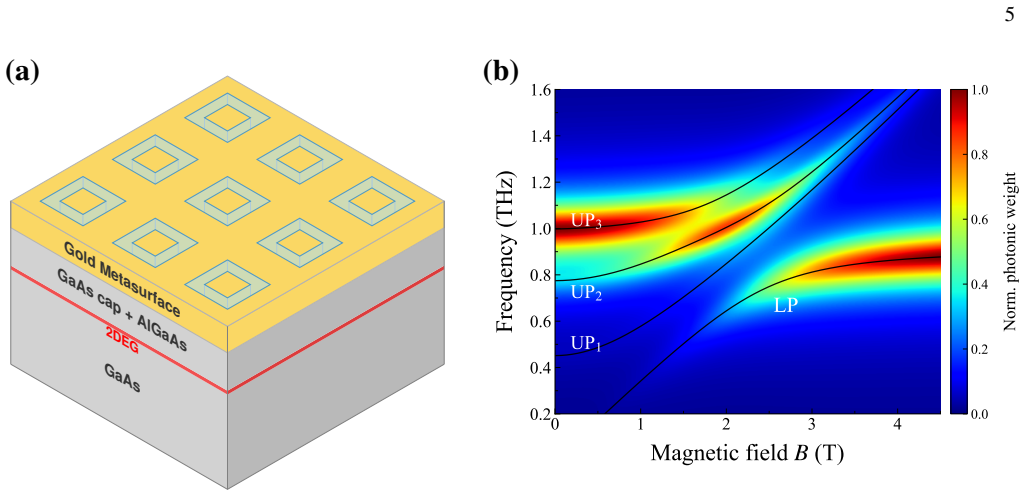
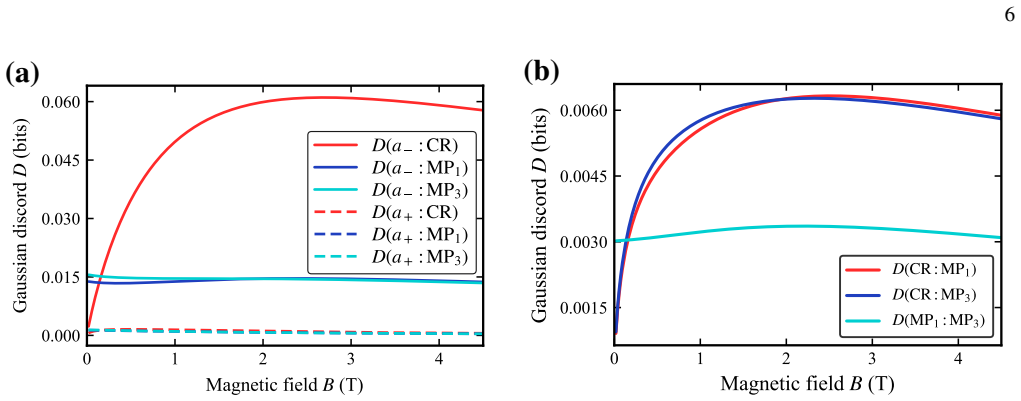
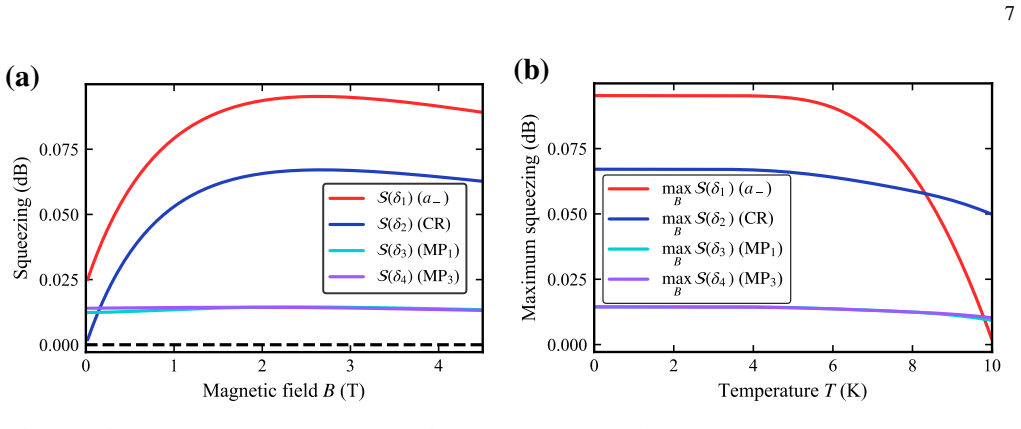

read the original abstract
Ultrastrong coupling between matter and cavity vacuum fields can turn the electromagnetic vacuum into a structured quantum environment, thereby opening passive routes for modifying and manipulating material properties. Recent work has identified light--matter entanglement as an important ingredient in these property changes, which raises the question of where the relevant vacuum correlations actually reside. Landau polaritons provide chiral ultrastrong coupling systems in which one circular cavity polarization forms the bright polariton branches. Here, using a quantum information approach, we show that an exact chiral charge in a multimode Hopfield model routes the dominant anomalous correlations, squeezing, and cavity--matter entanglement into the opposite polarization. We find that, using parameters extracted from a multimode Landau polariton system, this hidden sector correlates the cyclotron resonance with finite momentum magnetoplasmons through Gaussian discord, while pairwise matter--matter entanglement remains absent. We further predict a polarization anisotropy of dressed vacuum electric field fluctuations as a signature of this chiral routing. These results identify chirality as a symmetry principle for organizing ultrastrong coupling vacua and show that quantum information tools provide a powerful framework for revealing the salient properties of Landau polaritons.
Editorial analysis
A structured set of objections, weighed in public.
Referee Report
Summary. The paper claims that an exact chiral charge operator in a multimode Hopfield model for Landau polaritons routes the dominant anomalous correlations, squeezing, and cavity-matter entanglement exclusively into the opposite circular polarization. Using parameters extracted from a real multimode Landau-polariton experiment, the vacuum state exhibits Gaussian discord between the cyclotron resonance and finite-momentum magnetoplasmons but no pairwise matter-matter entanglement; a polarization anisotropy in dressed vacuum electric-field fluctuations is predicted as an observable signature.
Significance. If the central claim holds, the work supplies a symmetry principle (chirality) for organizing ultrastrong-coupling vacua and demonstrates that quantum-information diagnostics (Gaussian discord, entanglement measures) can isolate non-polaritonic correlations that are otherwise hidden. The use of experimentally extracted parameters strengthens relevance to existing Landau-polariton platforms.
major comments (2)
- [Model and Hamiltonian] The manuscript does not supply the explicit multimode Hopfield Hamiltonian or the definition of the chiral charge operator, so it is impossible to verify the claimed exact commutation relation that is load-bearing for the routing result.
- [Parameter extraction and numerical results] It is not demonstrated that the experimentally extracted parameters preserve the exact commutation of the chiral charge with the Hamiltonian; any deviation would render the routing approximate rather than exact, undermining the central claim.
minor comments (1)
- [Introduction] Notation for the circular polarizations and the chiral charge should be introduced with an explicit equation rather than only in the abstract.
Simulated Author's Rebuttal
We thank the referee for their positive evaluation of the work's significance and for the constructive major comments. We address each point below and will revise the manuscript to improve clarity and verifiability.
read point-by-point responses
-
Referee: The manuscript does not supply the explicit multimode Hopfield Hamiltonian or the definition of the chiral charge operator, so it is impossible to verify the claimed exact commutation relation that is load-bearing for the routing result.
Authors: We agree that the explicit multimode Hopfield Hamiltonian and the definition of the chiral charge operator are not presented in the manuscript. This omission prevents direct verification of the exact commutation [H, Q_chiral] = 0 that underpins the routing claim. In the revised version we will add the full Hamiltonian (standard multimode form with cyclotron resonance, finite-momentum magnetoplasmons, and two circular cavity modes) together with the definition of Q_chiral (difference in photon number between circular polarizations plus the corresponding matter term) and an explicit proof of the commutation relation, most likely in a new appendix. revision: yes
-
Referee: It is not demonstrated that the experimentally extracted parameters preserve the exact commutation of the chiral charge with the Hamiltonian; any deviation would render the routing approximate rather than exact, undermining the central claim.
Authors: The parameters are obtained by fitting the measured polariton dispersion to the multimode Hopfield model, which is constructed so that the light-matter interaction couples exclusively to one circular polarization; the commutation therefore holds exactly by the algebraic structure of the model for any parameter set consistent with this symmetry. Nevertheless, the referee is correct that this preservation is not explicitly demonstrated for the fitted values. We will add a short verification (numerical check of the commutator or an analytic argument) in the revision to confirm that the extracted parameters introduce no symmetry-breaking terms. revision: yes
Circularity Check
Experimentally extracted parameters used to compute reported correlations and 'predict' anisotropy
specific steps
-
fitted input called prediction
[Abstract]
"using parameters extracted from a multimode Landau polariton system, this hidden sector correlates the cyclotron resonance with finite momentum magnetoplasmons through Gaussian discord, while pairwise matter--matter entanglement remains absent. We further predict a polarization anisotropy of dressed vacuum electric field fluctuations as a signature of this chiral routing."
The anomalous correlations, Gaussian discord, and entanglement are obtained by plugging experimentally extracted parameters into the model; the subsequent 'prediction' of anisotropy is therefore a direct output of those same fitted values rather than an independent test.
full rationale
The paper computes vacuum correlations, squeezing, and entanglement using a multimode Hopfield model whose parameters are taken directly from a real Landau-polariton experiment. It then presents the resulting chiral routing and a polarization anisotropy as findings. This matches the 'fitted input called prediction' pattern because the location and strength of the correlations are determined by the fitted inputs rather than derived independently from first principles. No self-citation chain or self-definitional operator is exhibited in the provided text, and the Hopfield model itself is standard, so the circularity is partial and limited to the use of experimental parameters. The central claim of an 'exact chiral charge' cannot be checked for constructional equivalence without the explicit Hamiltonian and charge definition.
Axiom & Free-Parameter Ledger
free parameters (1)
- parameters extracted from multimode Landau polariton system
axioms (1)
- domain assumption The multimode Hopfield model accurately represents the Landau polariton system including its chiral properties
invented entities (1)
-
exact chiral charge
no independent evidence
Reference graph
Works this paper leans on
-
[1]
Forn-D´ıaz, L
P. Forn-D´ıaz, L. Lamata, E. Rico, J. Kono, and E. Solano, Ultrastrong coupling regimes of light-matter interaction, Rev. Mod. Phys.91, 025005 (2019)
2019
-
[2]
A. F. Kockum, A. Miranowicz, S. De Liberato, S. Savasta, and F. Nori, Ultrastrong coupling between light and matter, Nat. Rev. Phys.1, 19 (2019)
2019
-
[3]
Sch ¨afer, M
C. Sch ¨afer, M. Ruggenthaler, V . Rokaj, and A. Rubio, Rel- evance of the quadratic diamagnetic and self-polarization terms in cavity quantum electrodynamics, ACS Photonics 7, 975 (2020)
2020
-
[4]
J. J. Hopfield, Theory of the contribution of excitons to the complex dielectric constant of crystals, Phys. Rev.112, 1555 (1958)
1958
-
[5]
Ciuti, G
C. Ciuti, G. Bastard, and I. Carusotto, Quantum vacuum properties of the intersubband cavity polariton field, Phys. Rev. B72, 115303 (2005)
2005
-
[6]
De Liberato, Virtual photons in the ground state of a dis- sipative system, Nat
S. De Liberato, Virtual photons in the ground state of a dis- sipative system, Nat. Commun.8, 1465 (2017)
2017
-
[7]
Ashhab and F
S. Ashhab and F. Nori, Qubit-oscillator systems in the ultrastrong-coupling regime and their potential for prepar- ing nonclassical states, Phys. Rev. A81, 042311 (2010)
2010
-
[8]
Hotter, A
C. Hotter, A. Miranowicz, and K. Gietka, Quantum metrol- ogy in the ultrastrong coupling regime of light-matter in- teractions: Leveraging virtual excitations without extracting them, Phys. Rev. Lett.135, 100802 (2025)
2025
-
[9]
Baydin, H
A. Baydin, H. Zhu, M. Bamba, K. Hazzard, and J. Kono, Perspective on the quantum vacuum in matter, Opt. Mater. Express15, 1833 (2025)
2025
-
[10]
De Liberato, C
S. De Liberato, C. Ciuti, and I. Carusotto, Quantum vacuum radiation spectra from a semiconductor microcavity with a time-modulated vacuum rabi frequency, Phys. Rev. Lett.98, 103602 (2007)
2007
-
[11]
Stassi, A
R. Stassi, A. Ridolfo, O. Di Stefano, M. J. Hartmann, and S. Savasta, Spontaneous conversion from virtual to real pho- tons in the ultrastrong-coupling regime, Phys. Rev. Lett. 110, 243601 (2013)
2013
-
[12]
Cirio, S
M. Cirio, S. D. Liberato, N. Lambert, and F. Nori, Ground state electroluminescence, Physical Review Letters116, 113601 (2016)
2016
-
[13]
Cirio, N
M. Cirio, N. Shammah, N. Lambert, S. De Liberato, and F. Nori, Multielectron ground state electroluminescence, Phys. Rev. Lett.122, 190403 (2019)
2019
-
[14]
Falci, A
G. Falci, A. Ridolfo, P. G. Di Stefano,et al., Ultrastrong coupling probed by coherent population transfer, Sci. Rep. 9, 9249 (2019)
2019
-
[15]
Ridolfo, J
A. Ridolfo, J. Rajendran, L. Giannelli,et al., Probing ultra- strong light–matter coupling in open quantum systems, Eur. Phys. J. Spec. Top.230, 941 (2021)
2021
-
[16]
Bartolo and C
N. Bartolo and C. Ciuti, Vacuum-dressed cavity magneto- transport of a two-dimensional electron gas, Phys. Rev. B 98, 205301 (2018)
2018
-
[17]
G. L. Paravicini-Bagliani, F. Appugliese, E. Richter, F. Val- morra, J. Keller, M. Beck, N. Bartolo, C. R ¨ossler, T. Ihn, K. Ensslin, C. Ciuti, G. Scalari, and J. Faist, Magneto- transport controlled by landau polariton states, Nature Physics15, 186 (2019)
2019
-
[18]
Appugliese, J
F. Appugliese, J. Enkner, G. L. Paravicini-Bagliani, M. Beck, C. Reichl, W. Wegscheider, G. Scalari, C. Ciuti, and J. Faist, Breakdown of topological protection by cav- ity vacuum fields in the integer quantum hall effect, Science 375, 1030 (2022)
2022
-
[19]
Benea-Chelmus, F
I.-C. Benea-Chelmus, F. F. Settembrini, G. Scalari, and J. Faist, Electric field correlation measurements on the elec- tromagnetic vacuum state, Nature568, 202 (2019)
2019
-
[20]
Scalari, C
G. Scalari, C. Maissen, D. Tur ˇcinkov´a, D. Hagenm ¨uller, S. De Liberato, C. Ciuti, C. Reichl, D. Schuh, W. Wegschei- der, M. Beck, and J. Faist, Ultrastrong coupling of the cy- clotron transition of a 2d electron gas to a thz metamaterial, Science335, 1323 (2012)
2012
-
[21]
Zhang, M
Q. Zhang, M. Lou, X. Li, J. L. Reno, W. Pan, J. D. Wat- son, M. J. Manfra, and J. Kono, Collective non-perturbative coupling of 2d electrons with high-quality-factor terahertz cavity photons, Nat. Phys.12, 1005 (2016)
2016
-
[22]
Keller, G
J. Keller, G. Scalari, S. Cibella, X. Li, R. Zhao, G. Paravicini-Bagliani, J. Kono, and J. Faist, Landau po- laritons in highly nonparabolic two-dimensional gases in the ultrastrong coupling regime, Phys. Rev. B101, 075301 (2020)
2020
-
[23]
Mornhinweg, L
J. Mornhinweg, L. K. Diebel, M. Halbhuber, M. Prager, J. Riepl, T. Inzenhofer, D. Bougeard, R. Huber, C. Lange, et al., Mode-multiplexing deep-strong light-matter cou- pling, Nat. Commun.15, 1847 (2024)
2024
-
[24]
S. R. Endo, D. Kim, S. Liang, G. Lee, S. Kim, A. Covarrubias-Morales, M. Seo, M. J. Manfra, D. Lee, M. Bamba, and J. Kono, Cavity-mediated coupling between local and nonlocal modes in landau polaritons, Nanophoton- ics14, 4647 (2025)
2025
-
[25]
Z. A. VanOrman, W. R. Kitzmann, A. P. M. Repo- nen,et al., Chiral light–matter interactions in solution- processable semiconductors, Nature Reviews Chemistry9, 208 (2025)
2025
-
[26]
F. Tay, S. Sanders, A. Baydin,et al., Terahertz chi- ral photonic-crystal cavities for dirac gap engineering in graphene, Nature Communications16, 5270 (2025)
2025
-
[27]
Andberger, L
J. Andberger, L. Graziotto, L. Sacchi, M. Beck, G. Scalari, and J. Faist, Terahertz chiral subwavelength cavities break- ing time-reversal symmetry via ultrastrong light-matter in- teraction, Phys. Rev. B109, L161302 (2024)
2024
-
[28]
L. Yang, G. Cardoso, T. H. Hansson, and Q.-D. Jiang, Quan- tum hall effect in a chiral cavity, Phys. Rev. B113, 045109 (2026)
2026
-
[29]
X. Li, M. Bamba, Q. Zhang,et al., Vacuum bloch–siegert shift in landau polaritons with ultra-high cooperativity, Na- ture Photonics12, 324 (2018)
2018
-
[30]
Weedbrook, S
C. Weedbrook, S. Pirandola, R. Garc ´ıa-Patr´on, N. J. Cerf, T. C. Ralph, J. H. Shapiro, and S. Lloyd, Gaussian quantum 13 information, Rev. Mod. Phys.84, 621 (2012)
2012
-
[31]
A. Ferraro, S. Olivares, and M. G. A. Paris, Gaussian states in continuous variable quantum information (2005), arXiv:quant-ph/0503237 [quant-ph]
Pith/arXiv arXiv 2005
-
[32]
S. L. Braunstein and P. van Loock, Quantum information with continuous variables, Rev. Mod. Phys.77, 513 (2005)
2005
-
[33]
Eisert and M
J. Eisert and M. B. Plenio, Introduction to the basics of entanglement theory in continuous-variable systems, Int. J. Quant. Inf.1, 479 (2003)
2003
-
[34]
S. L. Braunstein and H. J. Kimble, Teleportation of contin- uous quantum variables, Phys. Rev. Lett.80, 869 (1998)
1998
-
[35]
Lloyd and S
S. Lloyd and S. L. Braunstein, Quantum computation over continuous variables, Phys. Rev. Lett.82, 1784 (1999)
1999
-
[36]
N. C. Menicucci, P. van Loock, M. Gu, C. Weedbrook, T. C. Ralph, and M. A. Nielsen, Universal quantum computation with continuous-variable cluster states, Phys. Rev. Lett.97, 110501 (2006)
2006
-
[37]
J. I. Latorre and A. Riera, A short review on entanglement in quantum spin systems, Journal of Physics A: Mathematical and Theoretical42, 504002 (2009)
2009
-
[38]
Osterloh, L
A. Osterloh, L. Amico, G. Falci, and R. Fazio, Scaling of entanglement close to a quantum phase transition, Nature 416, 608 (2002)
2002
-
[39]
T. J. Osborne and M. A. Nielsen, Entanglement in a simple quantum phase transition, Physical Review A66, 032110 (2002)
2002
-
[40]
Vidal, J
G. Vidal, J. I. Latorre, E. Rico, and A. Kitaev, Entanglement in quantum critical phenomena, Physical Review Letters90, 227902 (2003)
2003
-
[41]
Amico, R
L. Amico, R. Fazio, A. Osterloh, and V . Vedral, Entangle- ment in many-body systems, Reviews of Modern Physics 80, 517 (2008)
2008
-
[42]
Mzaouali and M
Z. Mzaouali and M. E. Baz, Long range quantum coherence, quantum & classical correlations in heisenberg xx chain, Physica A: Statistical Mechanics and its Applications518, 119 (2019)
2019
-
[43]
Mzaouali, S
Z. Mzaouali, S. Campbell, and M. E. Baz, Discrete and generalized phase space techniques in critical quantum spin chains, Physics Letters A383, 125932 (2019)
2019
-
[44]
K. E. Hawary, M. Azzouz, M. E. Baz, S. Deffner, B. Gardas, and Z. Mzaouali, Navigating the phase diagram of quantum many-body systems in phase space, Physical Review E110, 014120 (2024)
2024
-
[45]
Abaach, Z
S. Abaach, Z. Mzaouali, and M. E. Baz, Long distance en- tanglement and high-dimensional quantum teleportation in the fermi–hubbard model, Scientific Reports13, 964 (2023)
2023
-
[46]
Mzaouali, R
Z. Mzaouali, R. Puebla, J. Goold, M. El Baz, and S. Camp- bell, Work statistics and symmetry breaking in an excited- state quantum phase transition, Phys. Rev. E103, 032145 (2021)
2021
-
[47]
Zhang and S
J. Zhang and S. L. Braunstein, Continuous-variable gaussian analog of cluster states, Phys. Rev. A73, 032318 (2006)
2006
-
[48]
N. C. Menicucci, S. T. Flammia, and P. van Loock, Graph- ical calculus for gaussian pure states, Phys. Rev. A83, 042335 (2011)
2011
-
[49]
F. Mivehvar, Driven-dissipative landau polaritons: Two highly nonlinearly coupled quantum harmonic oscil- lators, Physical Review Letters136, 093602 (2026), arXiv:2509.12321 [cond-mat.str-el]
arXiv 2026
-
[50]
Enkner, L
J. Enkner, L. Graziotto, D. Boric ¸i, and et al., Tunable vacuum-field control of fractional and integer quantum hall phases, Nature641, 884 (2025)
2025
-
[51]
Mahmoodian, Chiral light-matter interaction beyond the rotating-wave approximation, Phys
S. Mahmoodian, Chiral light-matter interaction beyond the rotating-wave approximation, Phys. Rev. Lett.123, 133603 (2019)
2019
-
[52]
Scheel and D.-G
S. Scheel and D.-G. Welsch, Entanglement generation and degradation by passive optical devices, Phys. Rev. A64, 063811 (2001)
2001
-
[53]
M. S. Kim, W. Son, V . Buˇzek, and P. L. Knight, Entangle- ment by a beam splitter: Nonclassicality as a prerequisite for entanglement, Phys. Rev. A65, 032323 (2002)
2002
-
[54]
Xiang-bin, Theorem for the beam-splitter entangler, Phys
W. Xiang-bin, Theorem for the beam-splitter entangler, Phys. Rev. A66, 024303 (2002)
2002
-
[55]
Maissen, G
C. Maissen, G. Scalari, F. Valmorra, M. Beck, J. Faist, S. Cibella, R. Leoni, C. Reichl, C. Charpentier, and W. Wegscheider, Ultrastrong coupling in the near field of complementary split-ring resonators, Phys. Rev. B90, 205309 (2014)
2014
-
[56]
Rajabali, S
S. Rajabali, S. Markmann, E. J ¨ochl, M. Beck, H. Li, V . Mailaender, M. V olkmann, U. Schade, G. Scalari, M. Ra- jabali, and J. Faist, An ultrastrongly coupled single terahertz meta-atom, Nature Communications13, 2528 (2022)
2022
-
[57]
Ollivier and W
H. Ollivier and W. H. Zurek, Quantum discord: A mea- sure of the quantumness of correlations, Phys. Rev. Lett.88, 017901 (2001)
2001
-
[58]
Henderson and V
L. Henderson and V . Vedral, Classical, quantum and total correlations, Journal of Physics A: Mathematical and Gen- eral34, 6899 (2001)
2001
-
[59]
Adesso and A
G. Adesso and A. Datta, Quantum versus classical cor- relations in gaussian states, Phys. Rev. Lett.105, 030501 (2010)
2010
-
[60]
Giorda and M
P. Giorda and M. G. A. Paris, Gaussian quantum discord, Phys. Rev. Lett.105, 020503 (2010)
2010
-
[61]
F. J. Garcia-Vidal, C. Ciuti, and T. W. Ebbesen, Manipu- lating matter by strong coupling to vacuum fields, Science 373, eabd0336 (2021)
2021
-
[62]
Sch ¨afer, J
C. Sch ¨afer, J. Flick, E. Ronca, P. Narang, and A. Rubio, Shining light on the microscopic resonant mechanism re- sponsible for cavity-mediated chemical reactivity, Nature Communications13, 7817 (2022)
2022
-
[63]
D. Kim, J. Hou, G. Lee,et al., Multimode phonon- polaritons in lead-halide perovskites in the ultrastrong cou- pling regime, Nat. Commun.16, 8658 (2025)
2025
-
[64]
F. Tay, A. Mojibpour, S. Sanders,et al., Multimode ultra- strong coupling in three-dimensional photonic-crystal cavi- ties, Nat. Commun.16, 3603 (2025)
2025
-
[65]
H. Liu, F. Troisi, H. H ¨ubener, S. Latini, and A. Ru- bio, Cavity-mediated electron-electron interactions: Renor- malizing dirac states in graphene, Science Advances11, eadz1855 (2025)
2025
-
[66]
G ¨uhne and G
O. G ¨uhne and G. T´oth, Entanglement detection, Physics Re- ports474, 1 (2009)
2009
-
[67]
Passetti, C
G. Passetti, C. J. Eckhardt, M. A. Sentef, and D. M. Kennes, Cavity light-matter entanglement through quantum fluctua- tions, Phys. Rev. Lett.131, 023601 (2023)
2023
-
[68]
Schlawin, D
F. Schlawin, D. M. Kennes, and M. A. Sentef, Cavity quan- tum materials, Applied Physics Reviews9, 011312 (2022)
2022
-
[69]
I.-T. Lu, D. Shin, M. K. Svendsen, S. Latini, H. H ¨ubener, M. Ruggenthaler, and A. Rubio, Cavity engineering of solid-state materials without external driving, Adv. Opt. Photon.17, 441 (2025). 14
2025
-
[70]
Miao and G
Q. Miao and G. S. Agarwal, Polaritonic ultrastrong cou- pling: Quantum entanglement in the ground state, Phys. Rev. Res.5, 033136 (2023)
2023
-
[71]
Y .-q. Liu, S. Sun, Y .-j. Yang, Z. Liu, X. Zhao, Z. Zhu, W. Liu, and C.-s. Yu, Quantum entanglement and einstein-podolsky-rosen steering in ultrastrongly light- matter-coupled systems, Phys. Rev. A111, 052437 (2025)
2025
-
[72]
N. C. Menicucci, S. T. Flammia, and O. Pfister, One-way quantum computing in the optical frequency comb, Phys. Rev. Lett.101, 130501 (2008)
2008
-
[73]
N. C. Menicucci, S. T. Flammia, H. Zaidi, and O. Pfister, Ul- tracompact generation of continuous-variable cluster states, Phys. Rev. A76, 010302(R) (2007)
2007
-
[74]
Roushan, C
P. Roushan, C. Neill, A. Megrant,et al., Chiral ground-state currents of interacting photons in a synthetic magnetic field, Nature Physics13, 146 (2017)
2017
-
[75]
Dareau, Y
A. Dareau, Y . Meng, P. Schneeweiss, and A. Rauschen- beutel, Observation of ultrastrong spin-motion coupling for cold atoms in optical microtraps, Phys. Rev. Lett.121, 253603 (2018)
2018
-
[76]
D. M. Meekhof, C. Monroe, B. E. King, W. M. Itano, and D. J. Wineland, Generation of nonclassical motional states of a trapped atom, Phys. Rev. Lett.76, 1796 (1996)
1996
-
[77]
Vermersch, T
B. Vermersch, T. Ramos, P. Hauke, and P. Zoller, Implemen- tation of chiral quantum optics with rydberg and trapped-ion setups, Phys. Rev. A93, 063830 (2016)
2016
-
[78]
Colpa, Diagonalization of the quadratic boson hamilto- nian, Physica A: Statistical Mechanics and its Applications 93, 327 (1978)
J. Colpa, Diagonalization of the quadratic boson hamilto- nian, Physica A: Statistical Mechanics and its Applications 93, 327 (1978)
1978
-
[79]
Simon, Peres-horodecki separability criterion for contin- uous variable systems, Phys
R. Simon, Peres-horodecki separability criterion for contin- uous variable systems, Phys. Rev. Lett.84, 2726 (2000)
2000
-
[80]
L.-M. Duan, G. Giedke, J. I. Cirac, and P. Zoller, Insepara- bility criterion for continuous variable systems, Phys. Rev. Lett.84, 2722 (2000). 15 Supplemental Material: Chirality routing non-polaritonic vacuum correlations in Landau polaritons Ayoub El-Amrani1,∗, Zakaria Mzaouali2,3, Houssam Sabri1, Herschel Rabitz4, Abdelouahed El Fatimy1, and Dukhyung ...
2000
discussion (0)
Sign in with ORCID, Apple, or X to comment. Anyone can read and Pith papers without signing in.