Magnesium Silicate Clouds in the Atmosphere of HD 209458b from a Rule-Based Tree-Structured Data Reduction
Pith reviewed 2026-06-28 19:57 UTC · model grok-4.3
The pith
Amorphous Mg2SiO4 clouds best explain the 5-12 micron spectrum of HD 209458b.
A machine-rendered reading of the paper's core claim, the machinery that carries it, and where it could break.
Core claim
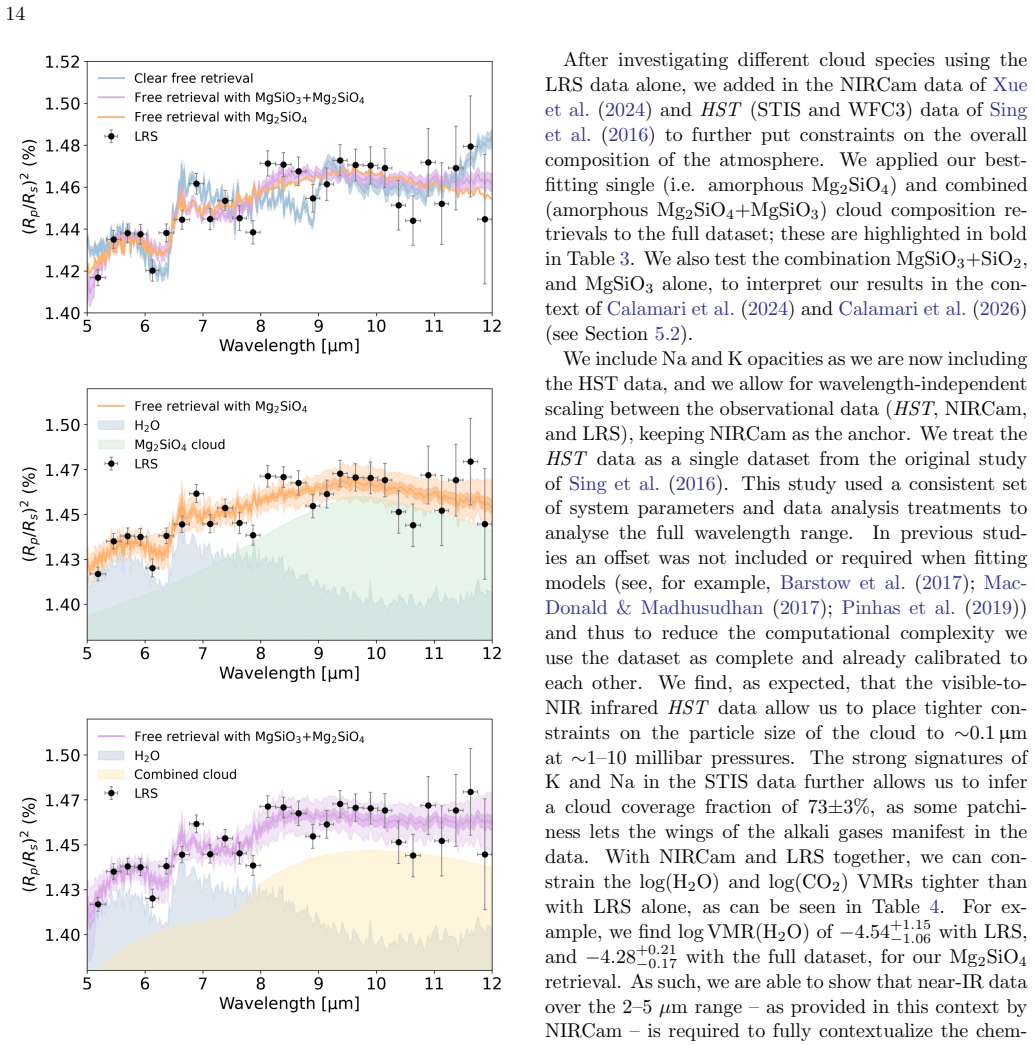
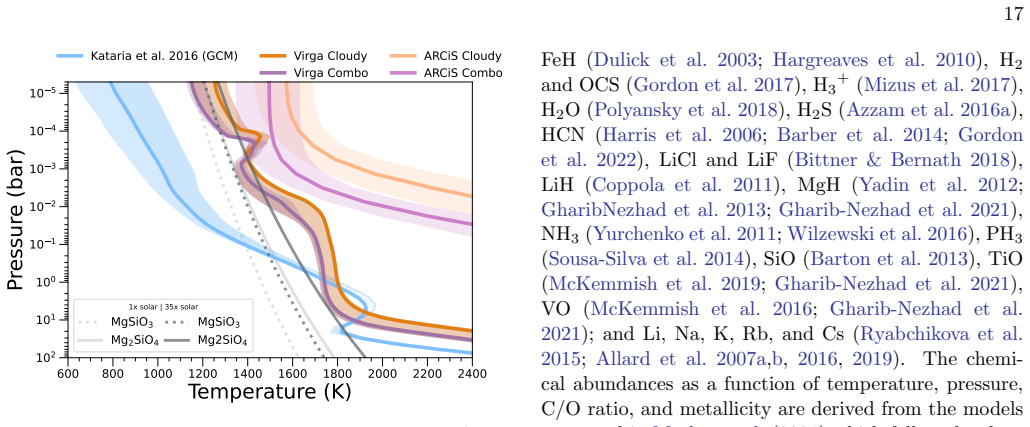
The observations indicate the presence of magnesium silicates, most likely Mg2SiO4 or a mixture of Mg2SiO4 and MgSiO3. Amorphous Mg2SiO4 clouds explain the LRS data to high significance over a clear atmosphere (Delta ln(Z)=16.63) or gray cloud atmosphere (Delta ln(Z)=22.26). Particle sizes are approximately 0.1 microns and the clouds sit at pressures of roughly 1-10 millibar.
What carries the argument
The rule-based tree-structured data reduction that identifies key decisions and incorporates uncertainties, paired with ARCiS free retrievals and PICASO+Virga self-consistent forward models that attribute the spectrum to magnesium silicate clouds.
If this is right
- Silicate clouds are a dominant atmospheric component of hot Jupiters.
- The precise silicate species can help constrain atmospheric chemistry and formation conditions.
- Particle size and cloud pressure become better constrained once mid-infrared data are combined with optical and near-infrared observations.
- Magnesium silicates can mute spectral features across multiple wavelength ranges.
Where Pith is reading between the lines
- The same cloud composition may appear in other hot Jupiters observed at similar wavelengths.
- The tree-structured reduction approach could be applied to other JWST datasets with comparable decision uncertainties.
- Laboratory optical constants for amorphous Mg2SiO4 at hot-Jupiter temperatures would provide an independent test of the fit.
Load-bearing premise
The atmospheric models correctly capture all relevant opacities and structure without missing species or unaccounted degeneracies when linking the spectrum to magnesium silicates.
What would settle it
Retrievals that assign higher evidence to a different condensate species, or new spectra that lack the specific absorption features attributed to Mg2SiO4, would falsify the central attribution.
Figures






read the original abstract
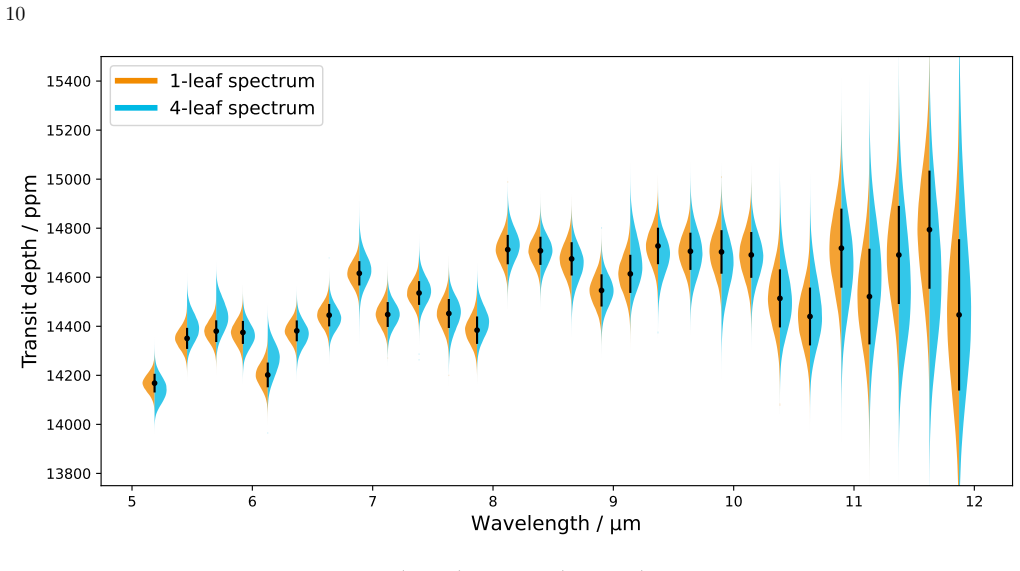
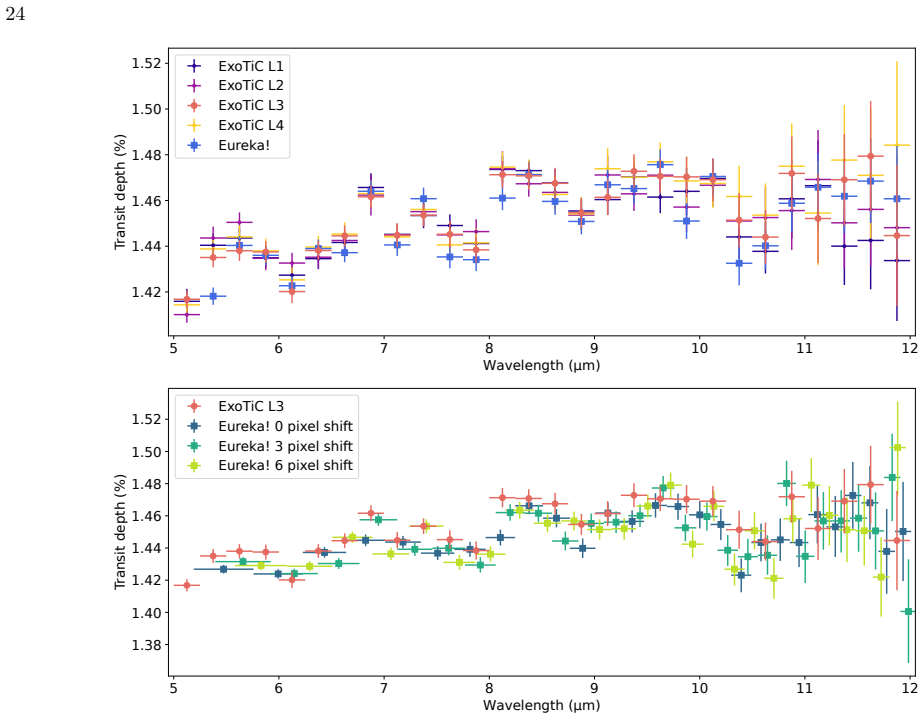
HD 209458b is the canonical hot Jupiter: the first to have its atmosphere measured and the first to hint at the role of aerosols in exoplanet atmospheres through the muting of Na absorption signatures in the optical. Here we present JWST MIRI/LRS transmission observations of HD 209458b from 5-12 microns, directly measuring the absorption signatures of its clouds for the first time. The observations indicate the presence of magnesium silicates, most likely Mg2SiO4 or a mixture of Mg2SiO4 and MgSiO3. We also present a new methodology to reduce observational data, whereby the analysis is formulated as a rule-based model with a tree structure, enabling key decisions to be identified and uncertain decisions to be incorporated into subsequent modeling. With this data reduction, and using a combination of ARCiS free retrievals and PICASO+Virga self consistent forward models, we are able to show that amorphous Mg2SiO4 clouds explain the LRS data to high significance over either a clear (Delta ln(Z)=16.63) or gray cloud atmosphere (Delta ln(Z)=22.26). By combining the LRS dataset with archival JWST NIRCam and HST optical and near-infrared observations, we are able to more robustly constrain the properties of the magnesium silicate condensates, finding particle sizes of approximately 0.1 microns and atmospheric pressures of the clouds of roughly 1-10 millibar. Our results add to the growing detections of silicate clouds as a dominant atmospheric component of hot Jupiters, with the exact silicate species contextualizing the atmospheric chemistry and potentially formation conditions of these planets.
Editorial analysis
A structured set of objections, weighed in public.
Referee Report
Summary. The manuscript reports new JWST MIRI/LRS transmission spectroscopy of HD 209458b (5–12 μm), claiming the first direct detection of magnesium silicate cloud absorption features. Using a novel rule-based tree-structured data reduction pipeline together with ARCiS free retrievals and PICASO+Virga self-consistent forward models, the authors find that amorphous Mg₂SiO₄ (or Mg₂SiO₄+MgSiO₃) clouds are strongly preferred over clear or gray-cloud models (Δln(Z) = 16.63 and 22.26, respectively). When combined with archival NIRCam and HST data, the analysis constrains cloud particle sizes to ~0.1 μm and deck pressures to 1–10 mbar.
Significance. If the underlying opacity tables and atmospheric assumptions hold, the quantitative Bayesian evidence ratios provide a statistically grounded addition to the growing body of silicate-cloud detections in hot Jupiters. The rule-based data-reduction framework, if fully documented, could offer a reproducible alternative to conventional pipelines.
major comments (2)
- [§4] Abstract and §4 (ARCiS/PICASO+Virga modeling): the reported Δln(Z) values favoring Mg₂SiO₄ are load-bearing for the central claim, yet the manuscript provides no explicit comparison of the adopted silicate refractive indices or Mie/T-matrix implementations against independent laboratory optical constants or alternative codes for the 8–12 μm region; this leaves open the possibility that the evidence ratios are partly driven by model-specific opacity assumptions rather than the LRS data alone.
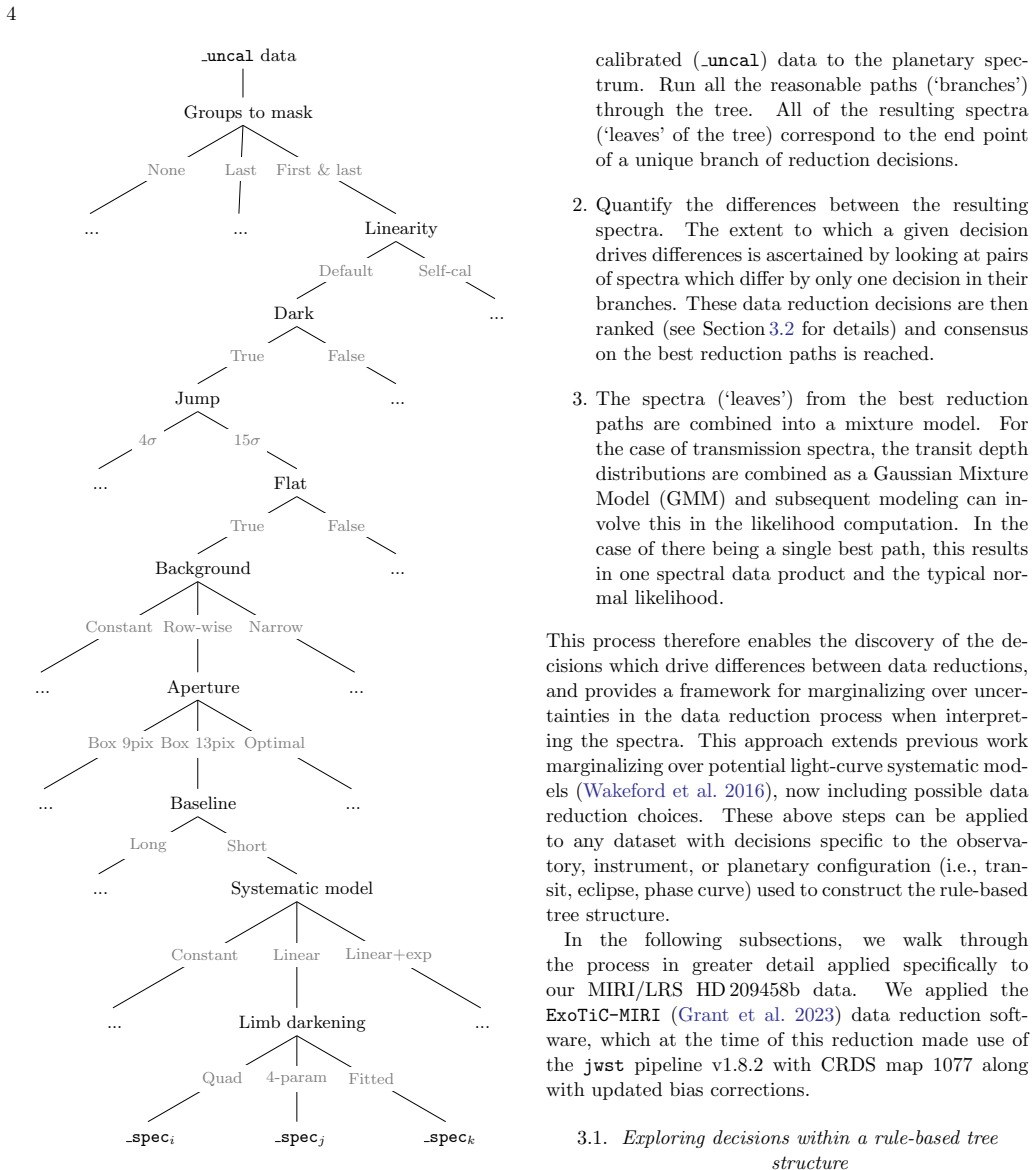
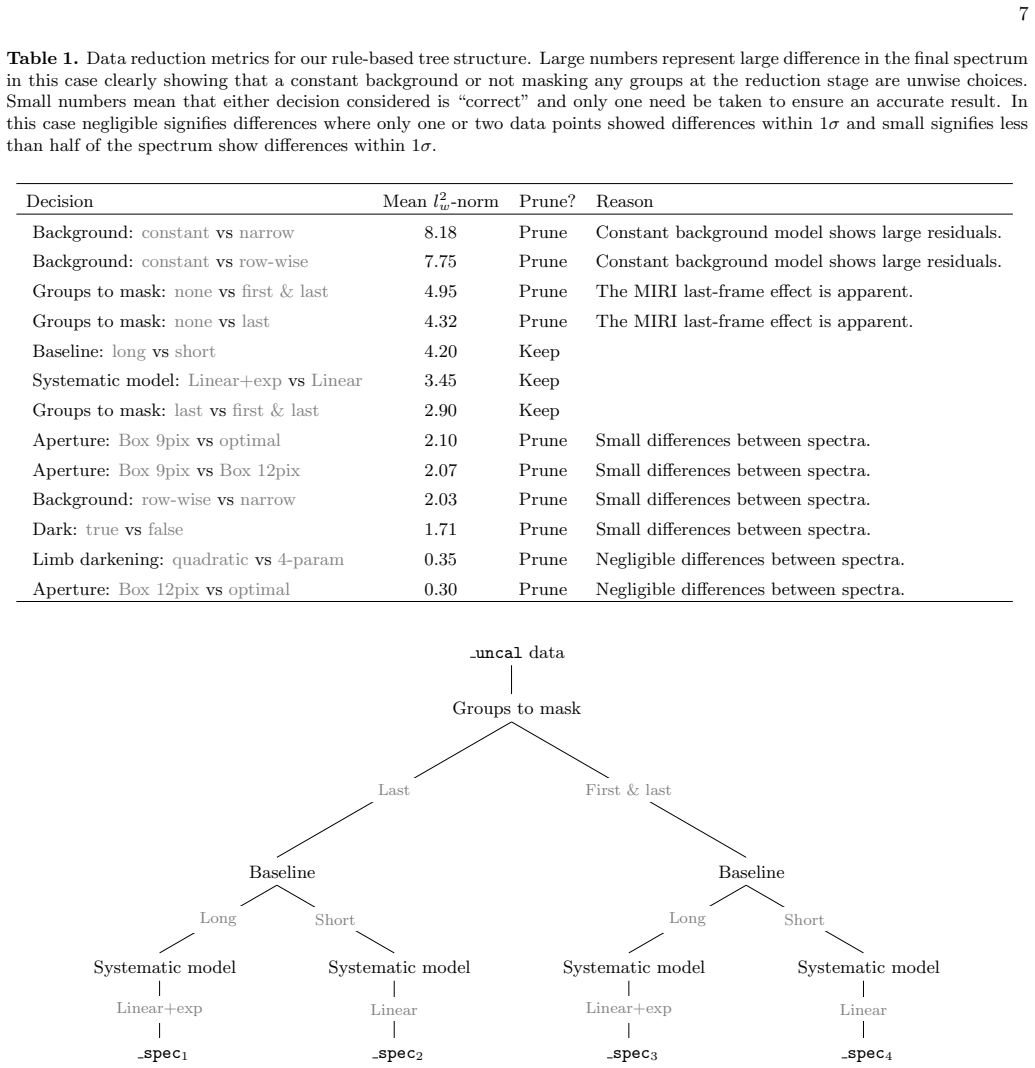
- [§3] §3 (data reduction): the tree-structured rule-based reduction is presented as enabling identification of key decisions, but the specific decision rules, branching criteria, and quantitative tests for robustness against alternative reduction paths are not supplied, preventing assessment of whether the extracted 5–12 μm spectrum contains reduction-induced artifacts that could mimic the reported silicate feature.
minor comments (1)
- Figure captions and text should explicitly state the wavelength range and resolution of the LRS data used in each retrieval to allow direct comparison with the plotted models.
Simulated Author's Rebuttal
We thank the referee for their constructive comments, which help clarify the presentation of our results. We address each major comment below and will revise the manuscript to incorporate the requested details.
read point-by-point responses
-
Referee: [§4] Abstract and §4 (ARCiS/PICASO+Virga modeling): the reported Δln(Z) values favoring Mg₂SiO₄ are load-bearing for the central claim, yet the manuscript provides no explicit comparison of the adopted silicate refractive indices or Mie/T-matrix implementations against independent laboratory optical constants or alternative codes for the 8–12 μm region; this leaves open the possibility that the evidence ratios are partly driven by model-specific opacity assumptions rather than the LRS data alone.
Authors: We agree that explicit validation of the opacity assumptions would strengthen the central claim. In the revised manuscript we will add a dedicated subsection (or appendix) that (i) cites the specific laboratory-derived refractive indices adopted for amorphous Mg₂SiO₄ and MgSiO₃, (ii) compares them to independent optical-constant datasets in the 8–12 μm window, and (iii) reports a limited sensitivity test using an alternative Mie-scattering implementation to quantify any effect on the reported Δln(Z) values. revision: yes
-
Referee: [§3] §3 (data reduction): the tree-structured rule-based reduction is presented as enabling identification of key decisions, but the specific decision rules, branching criteria, and quantitative tests for robustness against alternative reduction paths are not supplied, preventing assessment of whether the extracted 5–12 μm spectrum contains reduction-induced artifacts that could mimic the reported silicate feature.
Authors: We acknowledge that the current §3 description is insufficiently detailed for independent verification. In the revision we will expand §3 to include (i) the complete decision tree with explicit branching criteria, (ii) the quantitative robustness metrics obtained when alternative reduction paths are followed, and (iii) a direct comparison of the final 5–12 μm spectrum against spectra produced by those alternative paths, thereby demonstrating that the silicate feature is not an artifact of the chosen reduction sequence. revision: yes
Circularity Check
No significant circularity; derivation applies standard codes to new data.
full rationale
The paper's central result is obtained by fitting established external codes (ARCiS free retrievals, PICASO+Virga forward models) to new JWST MIRI/LRS observations and computing Bayes factors (Delta ln(Z)) between clear, gray-cloud, and Mg2SiO4-cloud models on the same dataset. No step reduces a claimed prediction to a quantity defined by the same fit, no load-bearing self-citation chain is invoked to justify uniqueness or ansatzes, and the optical constants and model assumptions are treated as independent inputs rather than derived from the target spectrum. The derivation is therefore self-contained against external benchmarks.
Axiom & Free-Parameter Ledger
free parameters (2)
- cloud particle size =
approximately 0.1 microns
- cloud deck pressure =
1-10 millibar
axioms (1)
- domain assumption ARCiS and PICASO+Virga models accurately represent cloud opacities and transmission spectra for magnesium silicates
Reference graph
Works this paper leans on
-
[1]
Photochemical hazes can trace the C/O ratio in exoplanet atmospheres. arXiv e-prints , keywords =. doi:10.48550/arXiv.2301.01093 , archivePrefix =. 2301.01093 , primaryClass =
-
[2]
MIRI Last Frame Effect
-
[3]
Kurucz CD-Rom , volume=
ATLAS9 Stellar Atmosphere Programs and 2km/s grid , author=. Kurucz CD-Rom , volume=. 1993 , publisher=
1993
-
[4]
Limb darkening coefficients , author=
The Stagger-grid: A grid of 3D stellar atmosphere models-IV. Limb darkening coefficients , author=. Astronomy & Astrophysics , volume=. 2015 , publisher=
2015
-
[5]
Astropy: Community Python library for astronomy
-
[6]
The Journal of Open Source Software , keywords =
emcee v3: A Python ensemble sampling toolkit for affine-invariant MCMC. The Journal of Open Source Software , keywords =. doi:10.21105/joss.01864 , archivePrefix =. 1911.07688 , primaryClass =
-
[7]
Condensation Clouds in Substellar Atmospheres with Virga. arXiv e-prints , keywords =. doi:10.48550/arXiv.2508.15102 , archivePrefix =. 2508.15102 , primaryClass =
-
[8]
JWST Noise Floor. I. Random Error Sources in JWST NIRCam Time Series. , keywords =. doi:10.3847/1538-3881/abb811 , archivePrefix =. 2010.03564 , primaryClass =
-
[9]
The in-flight noise performance of the JWST/NIRSpec detector system. Space Telescopes and Instrumentation 2022: Optical, Infrared, and Millimeter Wave , year = 2022, editor =. doi:10.1117/12.2629545 , archivePrefix =. 2208.12686 , primaryClass =
-
[10]
Analysis of a JWST NIRSpec Lab Time Series: Characterizing Systematics, Recovering Exoplanet Transit Spectroscopy, and Constraining a Noise Floor. , keywords =. doi:10.3847/2041-8213/ac5b6f , archivePrefix =. 2203.04173 , primaryClass =
-
[11]
A Metal-poor Atmosphere with a Hot Interior for a Young Sub-Neptune Progenitor: JWST/NIRSpec Transmission Spectrum of V1298 Tau b. , keywords =. doi:10.3847/1538-3881/adec89 , archivePrefix =. 2507.08837 , primaryClass =
-
[12]
Charles R. Harris and K. Jarrod Millman and St. Array programming with. 2020 , month = sep, journal =. doi:10.1038/s41586-020-2649-2 , publisher =
-
[13]
and Haberland, Matt and Reddy, Tyler and Cournapeau, David and Burovski, Evgeni and Peterson, Pearu and Weckesser, Warren and Bright, Jonathan and
Virtanen, Pauli and Gommers, Ralf and Oliphant, Travis E. and Haberland, Matt and Reddy, Tyler and Cournapeau, David and Burovski, Evgeni and Peterson, Pearu and Weckesser, Warren and Bright, Jonathan and. Nature Methods , year =
-
[14]
Hunter, J. D. , Title =. Computing in Science & Engineering , Volume =
-
[15]
doi:10.5281/zenodo.6702671 , url =
The pandas development team , title =. doi:10.5281/zenodo.6702671 , url =
-
[16]
The Astropy Project: Building an inclusive, open-science project and status of the v2.0 core package
The Astropy Project: Building an Open-science Project and Status of the v2.0 Core Package. , keywords =. doi:10.3847/1538-3881/aabc4f , archivePrefix =. 1801.02634 , primaryClass =
work page internal anchor Pith review Pith/arXiv arXiv doi:10.3847/1538-3881/aabc4f
-
[17]
Astropy: A Community Python Package for Astronomy
Astropy: A community Python package for astronomy. , keywords =. 2013. doi:10.1051/0004-6361/201322068 , archivePrefix =. 1307.6212 , primaryClass =
work page internal anchor Pith review Pith/arXiv arXiv doi:10.1051/0004-6361/201322068 2013
-
[18]
0) of the Core Package , author=
The Astropy Project: Sustaining and Growing a Community-oriented Open-source Project and the Latest Major Release (v5. 0) of the Core Package , author=. The Astrophysical Journal , volume=. 2022 , publisher=
2022
-
[19]
Hoyer, S. and J. Hamman , journal =. xarray:. 2017 , publisher =. doi:10.5334/jors.148 , url =
-
[20]
Hoyer, Stephan and Roos, Maximilian and Joseph, Hamman and Magin, Justus and Cherian, Deepak and Fitzgerald, Clark and Hauser, Mathias and Fujii, Keisuke and Maussion, Fabien and Imperiale, Guido and Clark, Spencer and Kleeman, Alex and Nicholas, Thomas and Kluyver, Thomas and Westling, Jimmy and Munroe, James and Amici, Alessandro and Barghini, Aureliana...
-
[21]
2015, Publications of the Astronomical Society of the Pacific, 127, 1161, doi: 10.1086/683602
batman: BAsic Transit Model cAlculatioN in Python. , keywords =. doi:10.1086/683602 , archivePrefix =. 1507.08285 , primaryClass =
work page internal anchor Pith review Pith/arXiv arXiv doi:10.1086/683602
-
[22]
K2-18b Does Not Meet the Standards of Evidence for Life. , keywords =. doi:10.3847/1538-3881/ae0338 , archivePrefix =. 2508.05961 , primaryClass =
-
[23]
The JWST weather report from the nearest brown dwarfs II: consistent variability mechanisms over 7 months revealed by 1 14 m NIRSpec + MIRI monitoring of WISE 1049AB. , keywords =. doi:10.1093/mnras/staf737 , archivePrefix =. 2505.00794 , primaryClass =
-
[24]
The JWST weather report from the nearest brown dwarfs I: multiperiod JWST NIRSpec + MIRI monitoring of the benchmark binary brown dwarf WISE 1049AB. , keywords =. doi:10.1093/mnras/stae1602 , archivePrefix =. 2407.09194 , primaryClass =
-
[25]
A Panchromatic Characterization of the Evening and Morning Atmosphere of WASP-107 b: Composition and Cloud Variations, and Insight into the Effect of Stellar Contamination. , keywords =. doi:10.3847/1538-3881/addf38 , archivePrefix =. 2505.13602 , primaryClass =
-
[26]
A warm Neptune's methane reveals core mass and vigorous atmospheric mixing. , keywords =. doi:10.1038/s41586-024-07395-z , archivePrefix =. 2405.11027 , primaryClass =
-
[27]
2022, Research Notes of the American Astronomical Society, 6, 155, doi: 10.3847/2515-5172/ac8676
Chemical Abundances for 25 JWST Exoplanet Host Stars with KeckSpec. Research Notes of the American Astronomical Society , keywords =. doi:10.3847/2515-5172/ac8676 , archivePrefix =. 2207.13662 , primaryClass =
-
[28]
Predicting Cloud Conditions in Substellar Mass Objects Using Ultracool Dwarf Companions. , keywords =. doi:10.3847/1538-4357/ad1f6d , archivePrefix =. 2401.11038 , primaryClass =
-
[29]
Low-temperature single crystal reflection spectra of forsterite. , keywords =. doi:10.1111/j.1365-2966.2006.10594.x , adsurl =
-
[30]
Neglected Silicon Dioxide Polymorphs as Clouds in Substellar Atmospheres. , keywords =. doi:10.3847/2041-8213/ad72e7 , archivePrefix =. 2408.00698 , primaryClass =
-
[31]
doi:10.5281/zenodo.6600976 , url =
Lupu, Roxana and Freedman, Richard and Gharib-Nezhad, Ehsan and Molliere, Paul , title =. doi:10.5281/zenodo.6600976 , url =
-
[32]
The HUSTLE Program: The UV to Near-infrared HST WFC3/UVIS G280 Transmission Spectrum of WASP-127b. , keywords =. doi:10.3847/1538-3881/ad8dde , archivePrefix =. 2410.17368 , primaryClass =
-
[33]
The Sonora Substellar Atmosphere Models. IV. Elf Owl: Atmospheric Mixing and Chemical Disequilibrium with Varying Metallicity and C/O Ratios. arXiv e-prints , keywords =. doi:10.48550/arXiv.2402.00756 , archivePrefix =. 2402.00756 , primaryClass =
-
[34]
The rotation--vibration spectrum of hot SO2 , author=
ExoMol molecular line lists--XIV. The rotation--vibration spectrum of hot SO2 , author=. Monthly Notices of the Royal Astronomical Society , volume=. 2016 , publisher=
2016
-
[35]
arXiv e-prints , keywords =
PICASO 3.0: A One-Dimensional Climate Model for Giant Planets and Brown Dwarfs. arXiv e-prints , keywords =
-
[36]
arXiv e-prints , keywords =
Identification of carbon dioxide in an exoplanet atmosphere. arXiv e-prints , keywords =
-
[37]
Rothman, L. S. and I. E. Gordon and Y. Babikov and A. Barbe and D. Chris Benner and P. F. Bernath and M. Birk and L. Bizzocchi and V. Boudon and L. R. Brown and A. Campargue and K. Chance and E. A. Cohen and L. H. Coudert and V. M. Devi and B. J. Drouin and A. Fayt and J.-M. Flaud and R. R. Gamache and J. J. Harrison and J.-M. Hartmann and C. Hill and J. ...
2013
-
[38]
Vibrational transition moments of CH$_4$ from first principles
Vibrational transition moments of CH _ 4 from first principles. Journal of Molecular Spectroscopy , keywords =. doi:10.1016/j.jms.2013.05.014 , archivePrefix =. 1302.1720 , primaryClass =
work page internal anchor Pith review Pith/arXiv arXiv doi:10.1016/j.jms.2013.05.014 2013
-
[39]
Yurchenko, Sergei N. and Tennyson, Jonathan , title = ". Monthly Notices of the Royal Astronomical Society , volume =. 2014 , month =. doi:10.1093/mnras/stu326 , url =
-
[40]
Rothman, L. S. and I. E. Gordon and R. J. Barber and H. Dothe and R. R. Gamache and A. Goldman and V. I. Perevalov and S. A. Tashkun and J. Tennyson , title=. Journal of Quantitative Spectroscopy and Radiative Transfer , volume=. 2010 , doi=
2010
-
[41]
Line lists for H\_2O, CO\_2, O\_3, N\_2O, CO, CH\_4, and O\_2
HITRAN2016: Part I. Line lists for H\_2O, CO\_2, O\_3, N\_2O, CO, CH\_4, and O\_2. 72nd International Symposium on Molecular Spectroscopy , year = 2017, month = jun, eid =. doi:10.15278/isms.2017.TJ08 , adsurl =
-
[42]
ExoMol molecular line lists XX: a comprehensive line list for H$_3^+$
ExoMol molecular line lists - XX. A comprehensive line list for H3+ , journal =. 2017 , month =. doi:10.1093/mnras/stx502 , archivePrefix =. 1704.04096 , primaryClass =
work page internal anchor Pith review Pith/arXiv arXiv doi:10.1093/mnras/stx502 2017
-
[43]
, archivePrefix = "arXiv", eprint =
New H _ 2 Collision-induced Absorption and NH _ 3 Opacity and the Spectra of the Coolest Brown Dwarfs. , archivePrefix = "arXiv", eprint =. doi:10.1088/0004-637X/750/1/74 , adsurl =
-
[44]
Rosseland and Planck Mean Opacities of a Zero-Metallicity Gas. , keywords =. doi:10.1086/191580 , adsurl =
-
[45]
Journal of Physics B: Atomic and Molecular Physics (1968-1987) , volume=
The free-free absorption coefficient of the negative pion of molecular hydrogen , author=. Journal of Physics B: Atomic and Molecular Physics (1968-1987) , volume=. 1980 , publisher=
1968
-
[46]
Journal of Physics B: Atomic and Molecular Physics , abstract =
K L Bell and K A Berrington , title =. Journal of Physics B: Atomic and Molecular Physics , abstract =. doi:10.1088/0022-3700/20/4/019 , url =
-
[47]
, keywords =
Continuous absorption by the negative hydrogen ion reconsidered. , keywords =
-
[48]
ExoMol molecular line lists XXX: a complete high-accuracy line list for water
ExoMol molecular line lists XXX: a complete high-accuracy line list for water. , keywords =. doi:10.1093/mnras/sty1877 , archivePrefix =. 1807.04529 , primaryClass =
work page internal anchor Pith review Pith/arXiv arXiv doi:10.1093/mnras/sty1877
-
[49]
Azzam, Ala'a A. A. and Tennyson, Jonathan and Yurchenko, Sergei N. and Naumenko, Olga V. , title = ". Monthly Notices of the Royal Astronomical Society , volume =. 2016 , month =. doi:10.1093/mnras/stw1133 , url =
-
[50]
Improved HCN/HNC linelist, model atmospheres and synthetic spectra for WZ Cas. , keywords =. doi:10.1111/j.1365-2966.2005.09960.x , archivePrefix =. astro-ph/0512363 , primaryClass =
-
[51]
ExoMol line lists III: An improved hot rotation-vibration line list for HCN and HNC
ExoMol line lists - III. An improved hot rotation-vibration line list for HCN and HNC. , keywords =. doi:10.1093/mnras/stt2011 , archivePrefix =. 1311.1328 , primaryClass =
work page internal anchor Pith review Pith/arXiv arXiv doi:10.1093/mnras/stt2011
-
[52]
The HITRAN2020 molecular spectroscopic database. , keywords =. doi:10.1016/j.jqsrt.2021.107949 , adsurl =
-
[53]
VizieR Online Data Catalog , keywords =
VizieR Online Data Catalog: Line lists for X ^ 1 \ Sigma\ ^ + LiF and LiCl (. VizieR Online Data Catalog , keywords =
-
[54]
Radiative cooling functions for primordial molecules. , keywords =. doi:10.1111/j.1365-2966.2011.18723.x , archivePrefix =. 1103.2957 , primaryClass =
-
[55]
ExoMol line lists - I. The rovibrational spectrum of BeH, MgH and CaH in the X ^ 2 ^ + state. , keywords =. doi:10.1111/j.1365-2966.2012.21367.x , archivePrefix =. 1204.0137 , primaryClass =
-
[56]
Einstein A coefficients for rovibronic lines of the A ^ 2 X ^ 2 ^ + and B' ^ 2 ^ + X ^ 2 ^ + transitions of MgH. , keywords =. doi:10.1093/mnras/stt510 , adsurl =
-
[57]
EXOPLINES: Molecular Absorption Cross-section Database for Brown Dwarf and Giant Exoplanet Atmospheres. , keywords =. doi:10.3847/1538-4365/abf504 , archivePrefix =. 2104.00264 , primaryClass =
-
[58]
Rovibrational Line Lists for Nine Isotopologues of the CO Molecule in the X ^ 1 ^ + Ground Electronic State. , keywords =. doi:10.1088/0067-0049/216/1/15 , adsurl =
-
[59]
Xinchuan Huang and Robert R. Gamache and Richard S. Freedman and David W. Schwenke and Timothy J. Lee. Reliable infrared line lists for 13 CO2 isotopologues up to E′=18,000cm−1 and 1500K, with line shape parameters. Journal of Quantitative Spectroscopy and Radiative Transfer. 2014. doi:https://doi.org/10.1016/j.jqsrt.2014.05.015
-
[60]
Burrows, A. and R. S. Ram and P. Bernath and C. M. Sharp and J. A. Milsom , title=. The Astrophysical Journal , volume=. 2002 , doi=
2002
-
[61]
T Ryabchikova and N Piskunov and R L Kurucz and H C Stempels and U Heiter and Yu Pakhomov and P S Barklem , title =. Physica Scripta , abstract =. doi:10.1088/0031-8949/90/5/054005 , url =
-
[62]
Journal of the Optical Society of America B Optical Physics , keywords =
Lifetimes, transition probabilities, and level energies in Fe i. Journal of the Optical Society of America B Optical Physics , keywords =. doi:10.1364/JOSAB.8.001185 , adsurl =
-
[63]
Iron through Nickel
Atomic transition probabilities. Iron through Nickel. Journal of Physical and Chemical Reference Data , year = 1988, month = jan, volume =
1988
-
[64]
, keywords =
Fe I oscillator strengths of lines of astrophysical interest. , keywords =
-
[65]
Line Intensities and Molecular Opacities of the FeH $F^4\Delta_i-X^4\Delta_i$ Transition
Line Intensities and Molecular Opacities of the FeH F ^ 4 _ i -X ^ 4 _ i Transition. , keywords =. doi:10.1086/376791 , archivePrefix =. astro-ph/0305162 , primaryClass =
work page internal anchor Pith review Pith/arXiv arXiv doi:10.1086/376791
-
[66]
High-resolution 1.6 m Spectra of FeH in M and L Dwarfs. , keywords =. doi:10.1088/0004-6256/140/4/919 , adsurl =
-
[67]
, keywords =
Fe I oscillator strengths for lines with excitation energies between 3 and 7eV. , keywords =
-
[68]
Yurchenko, S. N. and Barber, R. J. and Tennyson, J. , title = ". Monthly Notices of the Royal Astronomical Society , volume =. 2011 , month =. doi:10.1111/j.1365-2966.2011.18261.x , url =
-
[69]
Jonas S. Wilzewski and Iouli E. Gordon and Roman V. Kochanov and Christian Hill and Laurence S. Rothman , keywords =. H2, He, and CO2 line-broadening coefficients, pressure shifts and temperature-dependence exponents for the HITRAN database. Part 1: SO2, NH3, HF, HCl, OCS and C2H2 , journal =. 2016 , issn =. doi:https://doi.org/10.1016/j.jqsrt.2015.09.003 , url =
-
[70]
F., Tennyson, J., & Yurchenko, S
Sousa-Silva, Clara and Al-Refaie, Ahmed F. and Tennyson, Jonathan and Yurchenko, Sergei N. , title = ". Monthly Notices of the Royal Astronomical Society , volume =. 2014 , month =. doi:10.1093/mnras/stu2246 , url =
-
[71]
ExoMol line lists II: The ro-vibrational spectrum of SiO
ExoMol line lists - II. The ro-vibrational spectrum of SiO. , keywords =. doi:10.1093/mnras/stt1105 , archivePrefix =. 1307.2300 , primaryClass =
work page internal anchor Pith review Pith/arXiv arXiv doi:10.1093/mnras/stt1105
-
[72]
K., Masseron, T., Hoeijmakers, H
ExoMol molecular line lists - XXXIII. The spectrum of Titanium Oxide. , keywords =. doi:10.1093/mnras/stz1818 , archivePrefix =. 1905.04587 , primaryClass =
-
[73]
ExoMol line lists XVIII. The high temperature spectrum of VO
ExoMol line lists - XVIII. The high-temperature spectrum of VO. , keywords =. doi:10.1093/mnras/stw1969 , archivePrefix =. 1609.06120 , primaryClass =
work page internal anchor Pith review Pith/arXiv arXiv doi:10.1093/mnras/stw1969
-
[74]
F., Spiegelman, F., & Kielkopf, J
K-H _ 2 line shapes for the spectra of cool brown dwarfs. , keywords =. doi:10.1051/0004-6361/201628270 , adsurl =
-
[75]
European Physical Journal D , keywords =
Impact broadening of alkali lines in brown dwarfs. European Physical Journal D , keywords =. doi:10.1140/epjd/e2007-00230-6 , adsurl =
-
[76]
K-H_2 Quasi-molecular absorption detected in the T-dwarf epsilon Indi Ba
K-H _ 2 quasi-molecular absorption detected in the T-dwarf Indi Ba. , keywords =. doi:10.1051/0004-6361:20078362 , archivePrefix =. 0709.1192 , primaryClass =
work page internal anchor Pith review Pith/arXiv arXiv doi:10.1051/0004-6361:20078362
-
[77]
F., Spiegelman, F., Leininger, T., & Mollière, P
New study of the line profiles of sodium perturbed by H _ 2. , keywords =. doi:10.1051/0004-6361/201935593 , archivePrefix =. 1908.01989 , primaryClass =
-
[78]
Rapid calculation of radiative heating rates and photodissociation rates in inhomogeneous multiple scattering atmospheres. , keywords =. doi:10.1029/JD094iD13p16287 , adsurl =
-
[79]
The thermal structure of Titan's atmosphere. , keywords =. doi:10.1016/0019-1035(89)90160-7 , adsurl =
-
[80]
Thermal Structure of Uranus' Atmosphere. , keywords =. doi:10.1006/icar.1998.6071 , adsurl =
discussion (0)
Sign in with ORCID, Apple, or X to comment. Anyone can read and Pith papers without signing in.