An AI-ready, Polarized Electron-Positron Collision Dataset
Pith reviewed 2026-06-28 19:29 UTC · model grok-4.3
The pith
A dataset of 660,000 polarized electron-positron collisions from the SLD experiment is now available in modern formats.
A machine-rendered reading of the paper's core claim, the machinery that carries it, and where it could break.
Core claim
The central claim is the presentation of an AI-ready dataset from the SLD experiment consisting of approximately 660,000 reconstructed events collected with a highly polarized electron beam at sqrt(s) ≈ 91.2 GeV, translated from legacy formats with the help of AI agents and accompanied by a corpus of newly digitized documentation.
What carries the argument
The AI-assisted translation of legacy data formats into modern widely-used file formats that preserves the original physics content and reconstruction quality.
If this is right
- The dataset allows machine learning models to be trained and tested on real polarized collider data.
- It enables new physics analyses that leverage both the original polarization and modern computational tools.
- The digitized documentation supports detailed studies of the original reconstruction methods.
- This provides a benchmark dataset for AI applications in high-energy physics with known beam polarization.
Where Pith is reading between the lines
- Releasing other legacy datasets in similar AI-ready forms could broaden the scope of training data available for particle physics AI models.
- The approach of using AI for data format translation might be applied to convert data from additional historical experiments.
- Validation of the dataset against original publications could lead to improved methods for ensuring fidelity in data modernization projects.
Load-bearing premise
The translation of the data from legacy formats to modern ones by AI agents maintains the accuracy and completeness of the original physics measurements and event reconstruction.
What would settle it
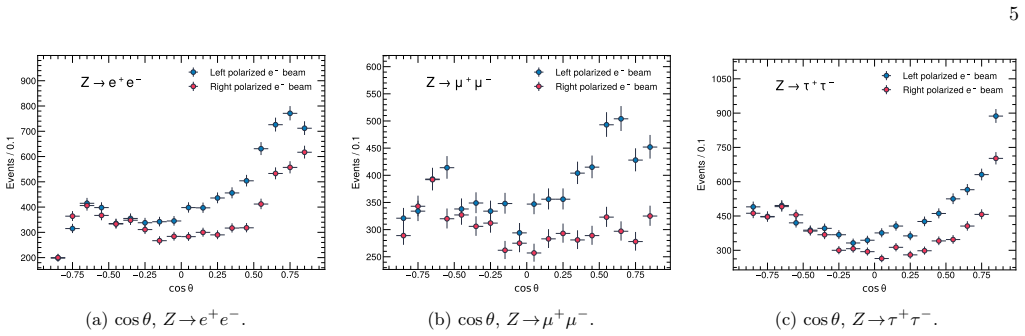
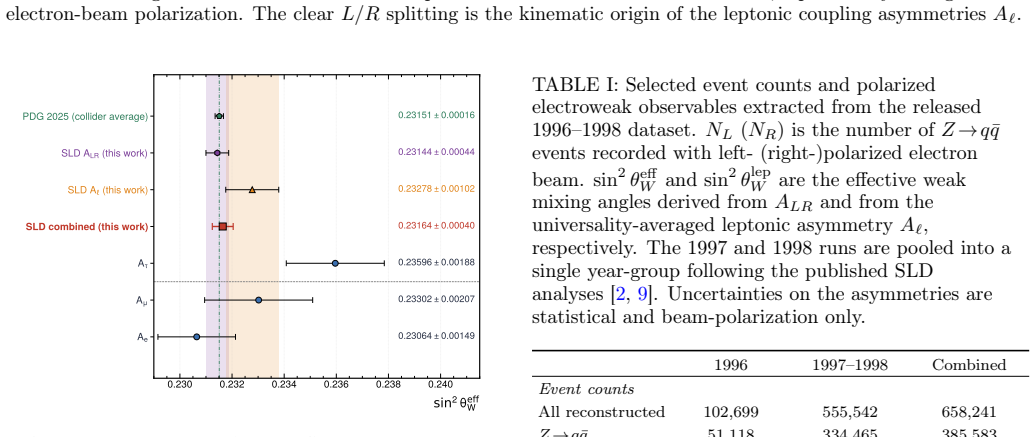
Performing the same physics analysis, such as measuring the left-right asymmetry, on the new dataset and obtaining results consistent with the original SLD publications would support the claim; inconsistency would falsify it.
Figures

read the original abstract
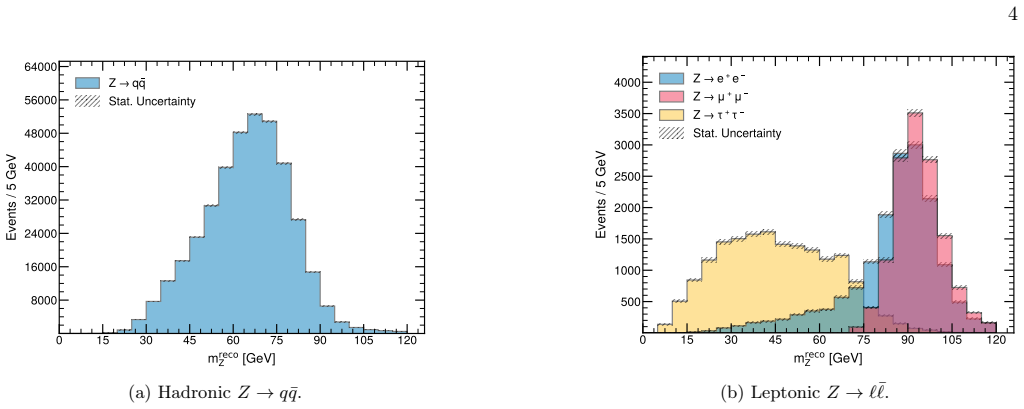
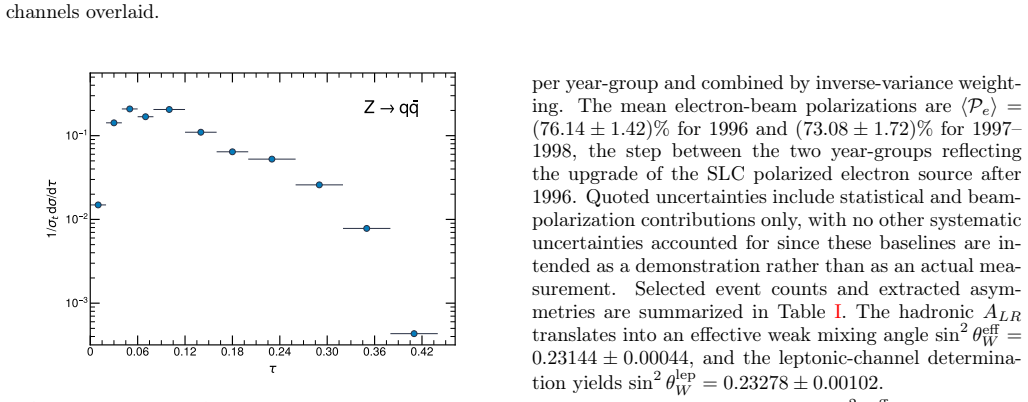
We present a modernized, AI-ready release of reconstructed data from the SLD experiment at the SLAC Linear Collider (SLC). The dataset comprises approximately 660{,}000 reconstructed events collected at $\sqrt{s}\approx 91.2$~GeV with a highly polarized electron beam from 1996--1998. The data have been translated from legacy formats into modern, widely-used file formats with the help of AI agents. The release also includes a corpus of newly digitized SLD internal documentation. We describe the contents of both components and provide physics validation demonstrations along with illustrations of their utility for physics and machine learning research in particle physics.
Editorial analysis
A structured set of objections, weighed in public.
Referee Report
Summary. The manuscript presents a modernized, AI-ready release of approximately 660,000 reconstructed events from the SLD experiment at the SLC, collected at √s ≈ 91.2 GeV with a highly polarized electron beam during 1996–1998. The data have been translated from legacy formats to modern file formats using AI agents, accompanied by a corpus of newly digitized SLD internal documentation; the paper describes the dataset contents and provides physics validation demonstrations for use in particle physics and machine learning research.
Significance. If the AI-assisted translation is demonstrated to preserve the original reconstruction fidelity without introducing unquantified systematics, the release would provide a rare publicly available polarized e⁺e⁻ dataset at the Z pole, enabling new AI/ML studies on polarization observables and legacy data revival that are otherwise inaccessible due to outdated formats.
major comments (1)
- [Abstract and validation section] Abstract and validation section: The central claim that the released dataset is 'AI-ready' and retains the original physics content rests on the fidelity of the AI-driven format translation, yet the described physics validation demonstrations do not include quantitative event-by-event comparisons (e.g., matching of track parameters, calorimeter clusters, thrust, or acollinearity) against the original SLD DST or micro-DST records; without such metrics, any systematic offsets introduced by the AI agents remain unquantified and undermine usability for precision analyses.
minor comments (1)
- [Abstract] The abstract uses non-standard comma formatting in '660{,}000'; adopt conventional scientific notation such as 660000 or 6.6×10^5.
Simulated Author's Rebuttal
We thank the referee for the constructive feedback emphasizing the need to rigorously demonstrate fidelity of the AI-assisted translation. We address the single major comment below.
read point-by-point responses
-
Referee: [Abstract and validation section] Abstract and validation section: The central claim that the released dataset is 'AI-ready' and retains the original physics content rests on the fidelity of the AI-driven format translation, yet the described physics validation demonstrations do not include quantitative event-by-event comparisons (e.g., matching of track parameters, calorimeter clusters, thrust, or acollinearity) against the original SLD DST or micro-DST records; without such metrics, any systematic offsets introduced by the AI agents remain unquantified and undermine usability for precision analyses.
Authors: We agree that event-by-event quantitative comparisons to the original SLD DST/micro-DST records would provide the strongest possible evidence that no systematic offsets were introduced during translation. However, the legacy reconstruction chain and original data formats are no longer executable on modern systems, precluding such direct matching. The existing validation instead demonstrates consistency of key physics observables (thrust, acollinearity, lepton identification) with published SLD results and Monte Carlo expectations. We will revise the validation section and abstract to (i) add quantitative distribution-level comparisons (means, widths, and efficiencies) against historical SLD publications for track parameters and calorimeter clusters, and (ii) explicitly state the limitations on event-by-event fidelity metrics. This is a partial revision. revision: partial
- Direct event-by-event matching to original SLD DST records, which is impossible due to inaccessibility of the legacy reconstruction software.
Circularity Check
Data release paper contains no derivations, predictions, or fitted quantities
full rationale
The manuscript is a data-release note describing translation of legacy SLD files into modern formats with AI assistance and supplying validation demonstrations. No equations, parameter fits, or predictive claims appear that could reduce to their own inputs by construction. The central assertion (fidelity of the translated dataset) is supported by external validation steps rather than by self-referential definitions or self-citations. Consequently the circularity score is 0.
Axiom & Free-Parameter Ledger
Reference graph
Works this paper leans on
-
[2]
SLC Design Group,SLC Design Handbook, Tech. Rep. SLAC-R-714, SLAC National Accelerator Laboratory, 1984. [2]SLDCollaboration, K. Abe et al.,A High precision measurement of the left-rightZboson cross-section asymmetry,Phys. Rev. Lett.84(2000) 5945–5949, [hep-ex/0004026]
work page internal anchor Pith review Pith/arXiv arXiv 1984
-
[3]
SLD Collaboration,SLD Design Report, Tech. Rep. SLAC-R-273, SLAC National Accelerator Laboratory, 1984. [4]SLDCollaboration, K. Abe et al.,Design and performance of the SLD vertex detector: A 307 Mpixel tracking system,Nucl. Instrum. Meth. A400(1997) 287–343
1984
- [4]
-
[5]
SLD reconstructed mini-DSTs from the 1996–1997 SLC runs
C. L. Cheng, B. Nachman, A. S. Mete, T. Hobbs, and S. Corrodi, “SLD reconstructed mini-DSTs from the 1996–1997 SLC runs.” Zenodo dataset, 2026. https://zenodo.org/records/19925960
-
[6]
jazelle_reader: A Python toolkit for translating SLD Jazelle binaries to AI-friendly formats
C. L. Cheng, “jazelle_reader: A Python toolkit for translating SLD Jazelle binaries to AI-friendly formats.” https://github.com/HEP-KE/jazelle_reader, 2026
2026
-
[7]
An improved direct measurement of leptonic coupling asymmetries with polarized Z bosons
J. Pivarski et al., “Awkward Array: Manipulating JSON-like data with NumPy-like idioms.” Zenodo, 2024. [9]SLDCollaboration, K. Abe et al.,An improved direct measurement of leptonic coupling asymmetries with polarizedZbosons,Phys. Rev. Lett.86(2001) 1162–1166, [hep-ex/0010015]
work page internal anchor Pith review Pith/arXiv arXiv 2024
-
[8]
Farhi,A QCD Test for Jets,Phys
E. Farhi,A QCD Test for Jets,Phys. Rev. Lett.39 (1977) 1587–1588. [11]Particle Data GroupCollaboration, S. Navas et al., Review of particle physics,Phys. Rev. D110(2024), no. 3 030001
1977
- [9]
-
[10]
Catani, Y
S. Catani, Y. L. Dokshitzer, M. Olsson, G. Turnock, and B. R. Webber,New clustering algorithm for multi-jet cross sections ine +e− annihilation,Phys. Lett. B269(1991) 432–438
1991
- [11]
-
[12]
H1 Collaboration,Long-term data preservation and analysis at H1,EPJ Web Conf.251(2021) 02001
2021
- [13]
-
[14]
van der Maaten and G
L. van der Maaten and G. Hinton,Visualizing data using t-SNE,Journal of Machine Learning Research9 (2008) 2579–2605
2008
-
[15]
Marker: Fast and highly accurate pdf to markdown/json
V. Paruchuri, “Marker: Fast and highly accurate pdf to markdown/json.” https://github.com/datalab-to/marker, 2023
2023
-
[16]
C. Auer, M. Lysak, A. Nassar, M. Dolfi, N. Livathinos, P. Vagenas, C. B. Ramis, M. Omenetti, F. Lindlbauer, K. Dinkla, L. Mishra, Y. Kim, S. Gupta, R. T. de Lima, V. Weber, L. Morin, I. Meijer, V. Kuropiatnyk, and P. W. J. Staar,Docling technical report,arXiv preprint arXiv:2408.09869(2024)
-
[17]
Nougat: Neural Optical Understanding for Academic Documents
L. Blecher, G. Cucurull, T. Scialom, and R. Stojnic, Nougat: Neural optical understanding for academic documents,arXiv preprint arXiv:2308.13418(2023)
work page internal anchor Pith review Pith/arXiv arXiv 2023
-
[18]
Azure ai document intelligence
Microsoft, “Azure ai document intelligence.” https://learn.microsoft.com/en-us/azure/ ai-services/document-intelligence/, 2024
2024
-
[19]
Accessed: March 29, 2025
Anthropic,Model context protocol, 2024. Accessed: March 29, 2025
2024
discussion (0)
Sign in with ORCID, Apple, or X to comment. Anyone can read and Pith papers without signing in.