CHAM-net: A Contrastive Hierarchical Adaptive Meta-network for Robust Global Methane Flux Prediction
Pith reviewed 2026-06-28 23:06 UTC · model grok-4.3
The pith
CHAM-net uses a hierarchical encoder-decoder conditioned on historical site data to capture site-specific methane dynamics and outperform prior methods.
A machine-rendered reading of the paper's core claim, the machinery that carries it, and where it could break.
Core claim
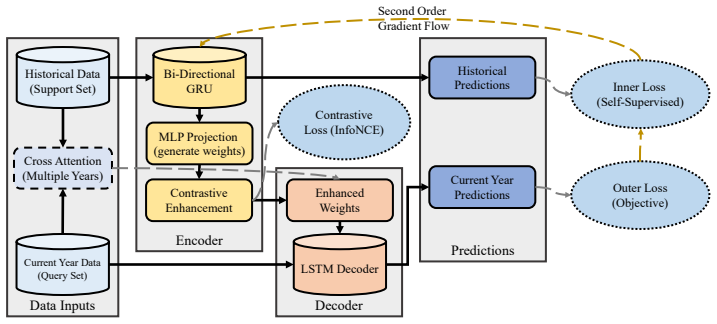
CHAM-net is a contrastive hierarchical adaptive meta-network whose encoder extracts site-specific characteristics from historical context and dynamically conditions the decoder to generate methane emission and consumption predictions, thereby addressing the failure of prior methods to capture cross-year evolutionary dynamics and site heterogeneity.
What carries the argument
The hierarchical encoder-decoder architecture that captures site-specific characteristics from historical data and conditions the decoder for final predictions.
If this is right
- More accurate global predictions of both methane emission and consumption across varied sites and time periods.
- Explicit modeling of site-specific traits and cross-year changes without reliance on extra input variables.
- Superior normalized root mean square error and R-squared performance relative to all tested baseline methods.
- Consistent gains on both simulated data and real observational records.
Where Pith is reading between the lines
- The same historical-conditioning approach could transfer to flux prediction for other trace gases that exhibit similar spatial and temporal variability.
- Datasets with extended multi-year records at individual sites would likely amplify the benefit of the encoder's dynamic conditioning.
- The contrastive element in the architecture may help separate distinct ecosystem response patterns for more targeted decoder adaptation.
Load-bearing premise
The hierarchical encoder-decoder architecture conditioned on historical context captures the relevant site-specific characteristics and cross-year dynamics without needing additional explicit environmental drivers or post-hoc adjustments.
What would settle it
CHAM-net failing to achieve lower nRMSE than standard machine learning baselines on an independent set of global observational methane flux measurements from new sites or years.
Figures


read the original abstract
Methane is a potent greenhouse gas that significantly contributes to global warming. However, accurately estimating global methane emissions and consumption remains challenging due to the complex interactions among environmental drivers that may vary across spatial and temporal scales. Prior data-driven methods often overlook the inherent spatiotemporal heterogeneity of ecosystems, failing to explicitly capture site-specific characteristics and cross-year evolutionary dynamics. To address these issues, we propose the Contrastive Hierarchical Adaptive Meta-network (CHAM-net), a novel framework that explicitly learns from historical context to capture site-specific dynamics. CHAM-net employs a hierarchical encoder-decoder architecture, in which the encoder captures site-specific characteristics from historical data and then dynamically conditions the decoder to generate the final prediction. Experimental results demonstrate that CHAM-net consistently outperforms all baseline methods on both simulation and observational datasets for methane emission and consumption, achieving nRMSE values as low as 0.43 and 0.88 with corresponding R2 scores up to 0.97 and 0.68 for emission prediction.
Editorial analysis
A structured set of objections, weighed in public.
Referee Report
Summary. The manuscript proposes CHAM-net, a Contrastive Hierarchical Adaptive Meta-network for global methane flux prediction. It uses a hierarchical encoder-decoder architecture in which the encoder extracts site-specific characteristics from historical data to dynamically condition the decoder, aiming to capture spatiotemporal heterogeneity without additional explicit environmental drivers. The central claim is that CHAM-net consistently outperforms all baselines on both simulation and observational datasets, achieving nRMSE values as low as 0.43 and 0.88 with R² scores up to 0.97 and 0.68 for emission prediction.
Significance. If the performance improvements can be shown to arise specifically from the hierarchical conditioning mechanism and to generalize under distribution shift, the framework would offer a useful advance in data-driven modeling of methane emissions and consumption. The emphasis on learning site-specific dynamics from historical context alone could reduce reliance on hand-crafted drivers in biogeochemical applications, provided the experimental evidence supports the attribution of gains.
major comments (2)
- [Abstract] Abstract: The reported nRMSE (0.43/0.88) and R² (0.97/0.68) values are presented without any accompanying information on baseline definitions, dataset sizes, cross-validation strategy, error bars, or checks for data leakage. These omissions are load-bearing for the outperformance claim, as the metrics cannot be interpreted or reproduced without them.
- [Architecture description] Architecture description (hierarchical encoder-decoder): The assumption that historical context alone suffices for the encoder to capture all relevant site-specific and cross-year dynamics is untested. No ablation that removes the conditioning step, no comparison against a non-hierarchical model given the identical historical window, and no analysis of performance under distribution shift between training and test years/sites are supplied. Without these controls it is impossible to attribute the numerical gains to the proposed mechanism rather than model capacity or other factors.
minor comments (1)
- [Abstract] Abstract: 'R2' should be written as R² to follow standard mathematical notation.
Simulated Author's Rebuttal
We thank the referee for the constructive feedback on our manuscript. We address each major comment point-by-point below, providing the strongest honest defense supported by the current work while noting where revisions will strengthen the paper.
read point-by-point responses
-
Referee: [Abstract] Abstract: The reported nRMSE (0.43/0.88) and R² (0.97/0.68) values are presented without any accompanying information on baseline definitions, dataset sizes, cross-validation strategy, error bars, or checks for data leakage. These omissions are load-bearing for the outperformance claim, as the metrics cannot be interpreted or reproduced without them.
Authors: We agree that the abstract would benefit from greater self-containment. In the revised version we will expand the abstract to briefly define the baselines (standard ML and DL models such as RF, LSTM, and Transformer variants), note the dataset composition (simulation and observational methane flux records across global sites), and reference the evaluation protocol (site- and year-stratified cross-validation). Dataset sizes, standard deviations across runs, and explicit data-leakage safeguards (temporal and spatial hold-outs) are already detailed in the Methods and supplementary material; we will add concise parenthetical summaries of these elements and include error bars on the headline metrics. revision: yes
-
Referee: [Architecture description] Architecture description (hierarchical encoder-decoder): The assumption that historical context alone suffices for the encoder to capture all relevant site-specific and cross-year dynamics is untested. No ablation that removes the conditioning step, no comparison against a non-hierarchical model given the identical historical window, and no analysis of performance under distribution shift between training and test years/sites are supplied. Without these controls it is impossible to attribute the numerical gains to the proposed mechanism rather than model capacity or other factors.
Authors: The manuscript already demonstrates outperformance against multiple non-hierarchical baselines and uses temporal and spatial cross-validation that implicitly tests generalization across years and sites. Nevertheless, we recognize that dedicated controls would more cleanly isolate the contribution of the hierarchical conditioning. In the revision we will add: (i) an ablation that removes the encoder-to-decoder conditioning while retaining the historical window, (ii) a head-to-head comparison against a non-hierarchical model given identical historical input, and (iii) a targeted distribution-shift analysis (performance stratified by training-test year or site dissimilarity). These additions will allow direct attribution of gains to the proposed mechanism. revision: yes
Circularity Check
No circularity; standard empirical ML evaluation on external benchmarks
full rationale
The paper proposes a hierarchical encoder-decoder architecture (CHAM-net) and reports its empirical performance (nRMSE, R2) on simulation and observational methane datasets. No derivation, equation, or claim reduces by construction to its own inputs; the central results are benchmark comparisons against baselines, not self-referential predictions or self-citation chains. The evaluation uses external data sources, satisfying the self-contained criterion.
Axiom & Free-Parameter Ledger
free parameters (1)
- Network weights and hyperparameters
Reference graph
Works this paper leans on
-
[1]
Structure and Interpretation of Computer Programs
Harold Abelson and Gerald Jay Sussman and Julie Sussman. Structure and Interpretation of Computer Programs. 1985
1985
-
[2]
IEEE transactions on pattern analysis and machine intelligence , volume=
Meta-learning in neural networks: A survey , author=. IEEE transactions on pattern analysis and machine intelligence , volume=. 2021 , publisher=
2021
-
[3]
Visual Information Extraction with Lixto
Robert Baumgartner and Georg Gottlob and Sergio Flesca. Visual Information Extraction with Lixto. Proceedings of the 27th International Conference on Very Large Databases. 2001
2001
-
[4]
Brachman and James G
Ronald J. Brachman and James G. Schmolze. An overview of the KL-ONE knowledge representation system. Cognitive Science. 1985
1985
-
[5]
Complexity results for nonmonotonic logics
Georg Gottlob. Complexity results for nonmonotonic logics. Journal of Logic and Computation. 1992
1992
-
[6]
Hypertree Decompositions and Tractable Queries
Georg Gottlob and Nicola Leone and Francesco Scarcello. Hypertree Decompositions and Tractable Queries. Journal of Computer and System Sciences. 2002
2002
-
[7]
Levesque
Hector J. Levesque. Foundations of a functional approach to knowledge representation. Artificial Intelligence. 1984
1984
-
[8]
Levesque
Hector J. Levesque. A logic of implicit and explicit belief. Proceedings of the Fourth National Conference on Artificial Intelligence. 1984
1984
-
[9]
On the compilability and expressive power of propositional planning formalisms
Bernhard Nebel. On the compilability and expressive power of propositional planning formalisms. Journal of Artificial Intelligence Research. 2000
2000
-
[10]
Neural computation , volume=
Long short-term memory , author=. Neural computation , volume=. 1997 , publisher=
1997
-
[11]
Advances in neural information processing systems , volume=
Attention is all you need , author=. Advances in neural information processing systems , volume=
-
[12]
The Twelfth International Conference on Learning Representations,
Yong Liu and Tengge Hu and Haoran Zhang and Haixu Wu and Shiyu Wang and Lintao Ma and Mingsheng Long , title =. The Twelfth International Conference on Learning Representations,. 2024 , url =
2024
-
[13]
Liu and Schahram Dustdar , title =
Shizhan Liu and Hang Yu and Cong Liao and Jianguo Li and Weiyao Lin and Alex X. Liu and Schahram Dustdar , title =. The Tenth International Conference on Learning Representations,. 2022 , url =
2022
-
[14]
A Time Series is Worth 64 Words: Long-term Forecasting with Transformers
Yuqi Nie and Nam H. Nguyen and Phanwadee Sinthong and Jayant Kalagnanam , title =. CoRR , volume =. 2022 , url =. doi:10.48550/ARXIV.2211.14730 , eprinttype =. 2211.14730 , timestamp =
work page internal anchor Pith review Pith/arXiv arXiv doi:10.48550/arxiv.2211.14730 2022
-
[15]
TSMixer: An all-MLP Architecture for Time Series Forecasting , journal =
Si. TSMixer: An all-MLP Architecture for Time Series Forecasting , journal =. 2023 , url =. doi:10.48550/ARXIV.2303.06053 , eprinttype =. 2303.06053 , timestamp =
-
[16]
Zhang and Jun Zhou , title =
Shiyu Wang and Haixu Wu and Xiaoming Shi and Tengge Hu and Huakun Luo and Lintao Ma and James Y. Zhang and Jun Zhou , title =. The Twelfth International Conference on Learning Representations,. 2024 , url =
2024
-
[17]
Proceedings of the 31st ACM SIGKDD Conference on Knowledge Discovery and Data Mining V
Duet: Dual clustering enhanced multivariate time series forecasting , author=. Proceedings of the 31st ACM SIGKDD Conference on Knowledge Discovery and Data Mining V. 1 , pages=
-
[18]
Proceedings of the AAAI Conference on Artificial Intelligence , volume=
Unlocking the power of lstm for long term time series forecasting , author=. Proceedings of the AAAI Conference on Artificial Intelligence , volume=
-
[19]
arXiv preprint arXiv:2505.18355 , year=
X-MethaneWet: A Cross-scale Global Wetland Methane Emission Benchmark Dataset for Advancing Science Discovery with AI , author=. arXiv preprint arXiv:2505.18355 , year=
-
[20]
2014 , publisher=
Climate change 2013: the physical science basis: Working Group I contribution to the Fifth assessment report of the Intergovernmental Panel on Climate Change , author=. 2014 , publisher=
2013
-
[21]
Ecosystem Health and Sustainability , volume=
Global methane and nitrous oxide emissions from terrestrial ecosystems due to multiple environmental changes , author=. Ecosystem Health and Sustainability , volume=. 2015 , publisher=
2015
-
[22]
Proceedings of the National Academy of Sciences , volume=
Emerging role of wetland methane emissions in driving 21st century climate change , author=. Proceedings of the National Academy of Sciences , volume=. 2017 , publisher=
2017
-
[23]
Global Biogeochemical Cycles , volume=
Methane fluxes between terrestrial ecosystems and the atmosphere at northern high latitudes during the past century: A retrospective analysis with a process-based biogeochemistry model , author=. Global Biogeochemical Cycles , volume=. 2004 , publisher=
2004
-
[24]
Global Biogeochemical Cycles , volume=
Response of global soil consumption of atmospheric methane to changes in atmospheric climate and nitrogen deposition , author=. Global Biogeochemical Cycles , volume=. 2013 , publisher=
2013
-
[25]
Agricultural and Forest Meteorology , volume=
Gap-filling eddy covariance methane fluxes: Comparison of machine learning model predictions and uncertainties at FLUXNET-CH4 wetlands , author=. Agricultural and Forest Meteorology , volume=. 2021 , publisher=
2021
-
[26]
Global Change Biology , volume=
Gap-filling approaches for eddy covariance methane fluxes: A comparison of three machine learning algorithms and a traditional method with principal component analysis , author=. Global Change Biology , volume=. 2020 , publisher=
2020
-
[27]
Environmental Research Communications , volume=
Machine learning for accurate methane concentration predictions: short-term training, long-term results , author=. Environmental Research Communications , volume=. 2023 , publisher=
2023
-
[28]
Journal of Environmental Management , volume=
Dispersion based recurrent neural network model for methane monitoring in Albertan tailings ponds , author=. Journal of Environmental Management , volume=. 2025 , publisher=
2025
-
[29]
Earth's Future , volume=
Quantifying global wetland methane emissions with in situ methane flux data and machine learning approaches , author=. Earth's Future , volume=. 2024 , publisher=
2024
-
[30]
ACM Computing Surveys , volume=
Integrating scientific knowledge with machine learning for engineering and environmental systems , author=. ACM Computing Surveys , volume=. 2022 , publisher=
2022
-
[31]
arXiv preprint arXiv:2403.15989 , year=
Knowledge-guided machine learning: Current trends and future prospects , author=. arXiv preprint arXiv:2403.15989 , year=
-
[32]
Nature communications , volume=
Knowledge-guided machine learning can improve carbon cycle quantification in agroecosystems , author=. Nature communications , volume=. 2024 , publisher=
2024
-
[33]
ACM/IMS Transactions on Data Science , volume=
Physics-guided machine learning for scientific discovery: An application in simulating lake temperature profiles , author=. ACM/IMS Transactions on Data Science , volume=. 2021 , publisher=
2021
-
[34]
Matthes, Jaclyn and Sturtevant, Cove and Oikawa, Patty and Chamberlain, Samuel and Szutu, Daphne and Ortiz, Ariane and Verfaillie, Joseph and Baldocchi, Dennis , title =. 2018 , publisher =. doi:10.18140/FLX/1669685 , url =
-
[35]
Koebsch, Franziska and Jurasinski, Gerald , title =. 2018 , publisher =. doi:10.18140/FLX/1669634 , url =
-
[36]
Bohrer, Gil and Morin, Timothy , title =. 2015 , publisher =. doi:10.18140/FLX/1669689 , url =
-
[37]
Lohila, Annalea and Aurela, Mika and Tuovinen, Juha-Pekka and Laurila, Tuomas and Hatakka, Juha and Rainne, Juuso and M. 2010 , publisher =. doi:10.18140/FLX/1669638 , url =
-
[38]
Empirical Evaluation of Gated Recurrent Neural Networks on Sequence Modeling
Empirical evaluation of gated recurrent neural networks on sequence modeling , author=. arXiv preprint arXiv:1412.3555 , year=
work page internal anchor Pith review Pith/arXiv arXiv
-
[39]
International conference on machine learning , pages=
Model-agnostic meta-learning for fast adaptation of deep networks , author=. International conference on machine learning , pages=. 2017 , organization=
2017
-
[40]
Earth System Science Data Discussions , volume=
FLUXNET-CH4: A global, multi-ecosystem dataset and analysis of methane seasonality from freshwater wetlands , author=. Earth System Science Data Discussions , volume=. 2021 , publisher=
2021
-
[41]
Gaussian Error Linear Units (GELUs)
Gaussian Error Linear Units (Gelus) , author=. arXiv preprint arXiv:1606.08415 , year=
work page internal anchor Pith review Pith/arXiv arXiv
-
[42]
Earth System Science Data , volume=
Global methane budget 2000--2020 , author=. Earth System Science Data , volume=. 2025 , publisher=
2000
-
[43]
Environmental science & policy , volume=
Beyond CO2 equivalence: The impacts of methane on climate, ecosystems, and health , author=. Environmental science & policy , volume=. 2022 , publisher=
2022
-
[44]
Environmental Research Letters , volume=
Acting rapidly to deploy readily available methane mitigation measures by sector can immediately slow global warming , author=. Environmental Research Letters , volume=. 2021 , publisher=
2021
-
[45]
Environmental Research: Climate , volume=
A roadmap to achieve the global methane pledge , author=. Environmental Research: Climate , volume=. 2023 , publisher=
2023
-
[46]
Communications Earth & Environment , volume=
Improved global wetland carbon isotopic signatures support post-2006 microbial methane emission increase , author=. Communications Earth & Environment , volume=. 2022 , publisher=
2006
-
[47]
Nature Communications , volume=
Recent methane surges reveal heightened emissions from tropical inundated areas , author=. Nature Communications , volume=. 2024 , publisher=
2024
-
[48]
Proceedings of the National Academy of Sciences , volume=
Inverse modeling of 2010--2022 satellite observations shows that inundation of the wet tropics drove the 2020--2022 methane surge , author=. Proceedings of the National Academy of Sciences , volume=. 2024 , publisher=
2010
-
[49]
Global Biogeochemical Cycles , volume=
Global uptake of atmospheric methane by soil from 1900 to 2100 , author=. Global Biogeochemical Cycles , volume=. 2021 , publisher=
1900
-
[50]
0): a process-based model to quantify global uptake of atmospheric methane by soil , author=
Soil Methanotrophy Model (MeMo v1. 0): a process-based model to quantify global uptake of atmospheric methane by soil , author=. Geoscientific Model Development , volume=. 2018 , publisher=
2018
-
[51]
2017 , eprint=
Adam: A Method for Stochastic Optimization , author=. 2017 , eprint=
2017
-
[52]
Schmid, Hans and Klatt, Janina , title =. 2014 , publisher =. doi:10.18140/FLX/1669635 , url =
-
[53]
2024 IEEE International Conference on Data Mining (ICDM) , pages=
Adaptive process-guided learning: An application in predicting lake do concentrations , author=. 2024 IEEE International Conference on Data Mining (ICDM) , pages=. 2024 , organization=
2024
-
[54]
Proceedings of the AAAI Conference on Artificial Intelligence , volume=
Physics-guided foundation model for scientific discovery: An application to aquatic science , author=. Proceedings of the AAAI Conference on Artificial Intelligence , volume=
discussion (0)
Sign in with ORCID, Apple, or X to comment. Anyone can read and Pith papers without signing in.