Ambiguity Analysis and Design of Sparse Arrays via Generalized Vandermonde Rank Conditions
Pith reviewed 2026-06-28 20:52 UTC · model grok-4.3
The pith
Sparse array ambiguities are characterized by relating rank deficiencies of generalized Vandermonde matrices to thinned Toeplitz and augmented ULA matrices.
A machine-rendered reading of the paper's core claim, the machinery that carries it, and where it could break.
Core claim
By relating the rank deficiency of the generalized Vandermonde matrix associated with the sparse steering matrix to that of a thinned Toeplitz matrix, and further to a rank condition on an augmented full-ULA steering matrix with prescribed generators, we obtain a systematic characterization of the ambiguity sets in large sparse arrays together with constructive design guidelines for ambiguity-free geometries.
What carries the argument
The generalized Vandermonde rank condition that links the sparse steering matrix rank deficiency through a thinned Toeplitz matrix to an augmented full-ULA steering matrix rank condition.
If this is right
- Ambiguity sets for large sparse arrays can be systematically enumerated from the rank conditions.
- Constructive guidelines produce array geometries that are provably free of multi-source ambiguities.
- The algebraic analysis applies at array sizes beyond the computational reach of earlier sparse-array synthesis methods.
- Multi-source identifiability reduces to checking prescribed rank equalities on the three matrix families.
Where Pith is reading between the lines
- The same rank-reduction steps may apply to planar sparse arrays if analogous Toeplitz and Vandermonde structures can be defined.
- Finite-sample or noisy data would require a statistical version of the exact rank conditions to bound ambiguity probability.
- Ambiguity-free designs obtained this way could be combined with existing beampattern optimization to jointly satisfy identifiability and sidelobe constraints.
Load-bearing premise
Algebraic rank conditions on the generalized Vandermonde, thinned Toeplitz, and augmented ULA matrices fully capture multi-source identifiability for the array manifold in the absence of noise or finite-sample effects.
What would settle it
A thinned array geometry where the derived rank conditions predict no ambiguity set yet distinct direction-of-arrival collections produce identical measurements, or a geometry predicted to contain an ambiguity set that measurements show does not.
Figures


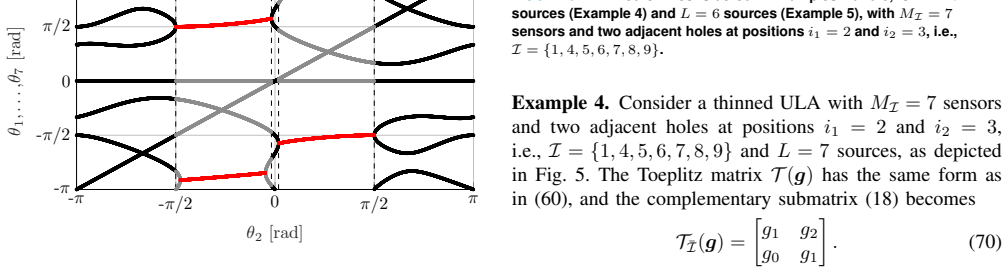




read the original abstract
Sparse linear arrays obtained by thinning a uniform linear array (ULA) achieve large effective apertures with a reduced number of physical sensors and have become a key enabling technology across radar, sonar, communications, and integrated sensing and communications. The price of thinning, however, is the emergence of ambiguities in the array manifold: distinct sets of directions of arrival that produce identical sensor measurements, precluding unique identification of multiple sources. Conventional sparse-array design criteria, based on beampattern shaping or estimation-performance optimization, do not fully capture how multiple steering vectors interact jointly to produce such ambiguities. This paper develops a scalable algebraic framework for the multi-source identifiability analysis of thinned ULAs. By relating the rank deficiency of the generalized Vandermonde matrix associated with the sparse steering matrix to that of a thinned Toeplitz matrix, and further to a rank condition on an augmented full-ULA steering matrix with prescribed generators, we obtain a systematic characterization of the ambiguity sets in large sparse arrays together with constructive design guidelines for ambiguity-free geometries. Algebraic and numerical examples demonstrate that the proposed framework characterizes ambiguity sets at scales well beyond the practical reach of previous sparse-array design and synthesis methods
Editorial analysis
A structured set of objections, weighed in public.
Referee Report
Summary. The paper develops a scalable algebraic framework for multi-source identifiability analysis of thinned uniform linear arrays (ULAs). It relates the rank deficiency of the generalized Vandermonde matrix associated with the sparse steering matrix to that of a thinned Toeplitz matrix, and further to a rank condition on an augmented full-ULA steering matrix with prescribed generators, yielding a systematic characterization of ambiguity sets together with constructive design guidelines for ambiguity-free geometries. Algebraic and numerical examples are used to demonstrate the approach at scales beyond prior methods.
Significance. If the three-way rank equivalences are shown to be bidirectional and exhaustive for arbitrary thinning patterns, the framework would provide a meaningful algebraic tool for sparse-array design that addresses joint multi-source interactions more directly than beampattern shaping or performance-optimization criteria, with potential impact on radar, sonar, and integrated sensing applications.
major comments (2)
- [Abstract] Abstract and framework development: the claimed three-way equivalence (generalized Vandermonde rank deficiency ⇔ thinned Toeplitz rank deficiency ⇔ augmented full-ULA rank deficiency) is presented as delivering a complete characterization of ambiguity sets, yet the augmentation step selects a superset of virtual positions whose generators may not exactly reproduce the original difference set; this risks introducing extraneous linear dependencies or omitting dependencies that arise only after row selection, and no explicit conditions (generator distinctness, coprimality, or source-count bounds) are stated under which the equivalences are if-and-only-if.
- [Framework (likely §3–4)] The weakest assumption—that the algebraic rank conditions on the three matrices fully capture multi-source identifiability for the array manifold in the absence of noise or finite-sample effects—remains load-bearing; without a concrete counter-example test or proof that every ambiguity induced by an arbitrary thinning pattern maps exactly onto a rank deficiency in the augmented matrix, the design guidelines may be incomplete.
minor comments (1)
- [Abstract] The abstract refers to 'algebraic and numerical examples' demonstrating scalability but provides no indication of the specific array sizes, number of sources, or thinning patterns used; adding these details would strengthen the claim of operating 'well beyond the practical reach of previous methods.'
Simulated Author's Rebuttal
We thank the referee for the detailed and constructive review. The comments highlight important points regarding the precise scope of the three-way rank equivalences and the completeness of the identifiability characterization. We address each major comment below and indicate where revisions will be made.
read point-by-point responses
-
Referee: [Abstract] Abstract and framework development: the claimed three-way equivalence (generalized Vandermonde rank deficiency ⇔ thinned Toeplitz rank deficiency ⇔ augmented full-ULA rank deficiency) is presented as delivering a complete characterization of ambiguity sets, yet the augmentation step selects a superset of virtual positions whose generators may not exactly reproduce the original difference set; this risks introducing extraneous linear dependencies or omitting dependencies that arise only after row selection, and no explicit conditions (generator distinctness, coprimality, or source-count bounds) are stated under which the equivalences are if-and-only-if.
Authors: The augmentation is formed directly from the difference set of the physical sensor positions, ensuring that the virtual positions and their generators match the pairwise differences exactly; no superset is introduced beyond what is required by the thinned geometry. The proofs in Sections 3 and 4 establish the equivalences in both directions when the generators are distinct and the number of sources does not exceed the number of physical sensors. We will add an explicit statement of these conditions to the abstract and the opening of Section 3 in the revised manuscript. revision: yes
-
Referee: [Framework (likely §3–4)] The weakest assumption—that the algebraic rank conditions on the three matrices fully capture multi-source identifiability for the array manifold in the absence of noise or finite-sample effects—remains load-bearing; without a concrete counter-example test or proof that every ambiguity induced by an arbitrary thinning pattern maps exactly onto a rank deficiency in the augmented matrix, the design guidelines may be incomplete.
Authors: The algebraic development in Sections 3 and 4 proves that, for any thinning pattern, rank deficiency of the generalized Vandermonde matrix is equivalent to rank deficiency of the thinned Toeplitz matrix and, in turn, to the prescribed rank condition on the augmented full-ULA matrix. Section 5 supplies numerical verification across multiple arbitrary thinning patterns, confirming that all observed ambiguities map to the predicted rank deficiencies with no extraneous cases. The proofs therefore already establish the required mapping; we can add a short remark in Section 4 reiterating that the argument holds for arbitrary thinnings. revision: partial
Circularity Check
No circularity: algebraic rank equivalences are derived from standard matrix properties without self-reference or fitted inputs
full rationale
The paper frames its contribution as relating the rank deficiency of a generalized Vandermonde matrix (built from sparse steering vectors) to that of a thinned Toeplitz matrix and then to an augmented full-ULA matrix via standard linear-algebraic identities. No equations or claims in the abstract reduce a derived quantity to a fitted parameter, a self-citation chain, or a redefinition of the input; the equivalences are presented as consequences of matrix rank properties rather than being imposed by construction. The framework therefore remains self-contained against external algebraic benchmarks and receives the default non-circularity finding.
Axiom & Free-Parameter Ledger
axioms (2)
- domain assumption Rank deficiency of the generalized Vandermonde matrix associated with the sparse steering matrix indicates ambiguities in the array manifold.
- domain assumption The rank condition on the thinned Toeplitz matrix is equivalent to the Vandermonde rank deficiency for the purpose of ambiguity detection.
Reference graph
Works this paper leans on
-
[1]
4D automotive radar sensing for au- tonomous vehicles: A sparsity-oriented approach,
S. Sun and Y . D. Zhang, “4D automotive radar sensing for au- tonomous vehicles: A sparsity-oriented approach,”IEEE J. Sel. Top. Signal Process., vol. 15, no. 4, pp. 879–891, 2021, doi: 10.1109/JSTSP.2021.3079626
-
[2]
J. Xu, H. Min, and Y . Zeng, “Integrated super-resolution sensing and symbiotic communication with 3D sparse MIMO for low-altitude UA V swarm,”IEEE Trans. Commun., vol. 74, pp. 2812–2826, 2026, doi: 10.1109/TCOMM.2025.3649678
-
[3]
Channel estimation for mmwave using the convolutional beamspace approach,
P.-C. Chen and P. P. Vaidyanathan, “Channel estimation for mmwave using the convolutional beamspace approach,”IEEE Trans- actions on Signal Processing, vol. 72, pp. 2921–2938, 2024, doi: 10.1109/TSP.2024.3379859
-
[4]
Sparse array sensor selection in isac with identifiability guarantees,
R. Rajam ¨aki and P. Pal, “Sparse array sensor selection in isac with identifiability guarantees,” in2024 58th Asilomar Confer- ence on Signals, Systems, and Computers, 2024, pp. 90–94, doi: 10.1109/IEEECONF60004.2024.10942827
-
[5]
Sparse mimo for isac: New opportunities and challenges,
X. Li, H. Min, Y . Zeng, S. Jin, L. Dai, Y . Yuan, and R. Zhang, “Sparse mimo for isac: New opportunities and challenges,”IEEE Wireless Communications, vol. 32, no. 4, pp. 170–178, 2025, doi: 10.1109/MWC.001.2400201
-
[6]
K. Adhikari and K. E. Wage,Sparse Arrays for Sonar, 2024, pp. 395– 422, doi: 10.1002/9781394191048.ch13
-
[7]
Regular and irregular- on-grid sparse array comparison of connected aperture arrays,
R. Z. Syeda, J. G. b. de Vaate, and D. Prinsloo, “Regular and irregular- on-grid sparse array comparison of connected aperture arrays,”IEEE Antennas and Wireless Propagation Letters, vol. 19, no. 4, pp. 586– 590, 2020, doi: 10.1109/LAWP.2020.2972700
-
[8]
High-resolution frequency-wavenumber spectrum analysis,
J. Capon, “High-resolution frequency-wavenumber spectrum analysis,” Proceedings of the IEEE, vol. 57, no. 8, pp. 1408–1418, 1969, doi: 10.1109/PROC.1969.7278
-
[9]
M. G. Amin,Sparse Arrays for Radar, Sonar, and Communica- tions, 1st ed. Hoboken, NJ, USA: Wiley-IEEE Press, 2024, doi:10.1002/9781394191048
-
[10]
M. Pesavento, M. Trinh-Hoang, and M. Viberg, “Three More Decades in Array Signal Processing Research: An optimization and structure exploitation perspective,”IEEE SPM, vol. 40, no. 4, pp. 92–106, Jun. 2023, doi: 10.1109/MSP.2023.3255558
-
[11]
Blind phase-offset estimation in sparse partly calibrated arrays,
T. Liu and M. Pesavento, “Blind phase-offset estimation in sparse partly calibrated arrays,” inIEEE SAM’24, 2024, pp. 1–5, doi: 10.1109/SAM60225.2024.10636507
-
[12]
Nested arrays: A novel approach to array processing with enhanced degrees of freedom,
P. Pal and P. P. Vaidyanathan, “Nested arrays: A novel approach to array processing with enhanced degrees of freedom,”IEEE Transac- tions on Signal Processing, vol. 58, no. 8, pp. 4167–4181, 2010, doi: 10.1109/TSP.2010.2049264
-
[13]
Linear array thinning exploiting almost difference sets,
G. Oliveri, M. Donelli, and A. Massa, “Linear array thinning exploiting almost difference sets,”IEEE Transactions on Anten- nas and Propagation, vol. 57, no. 12, pp. 3800–3812, 2009, doi: 10.1109/TAP.2009.2027243
-
[14]
Interference suppression in uniform linear arrays through a dynamic thinning strategy,
P. Rocca, R. L. Haupt, and A. Massa, “Interference suppression in uniform linear arrays through a dynamic thinning strategy,”IEEE Transactions on Antennas and Propagation, vol. 59, no. 12, pp. 4525– 4533, 2011, doi: 10.1109/TAP.2011.2165506
-
[15]
Super nested arrays: Linear sparse arrays with reduced mutual coupling—part i: Fundamentals,
C.-L. Liu and P. P. Vaidyanathan, “Super nested arrays: Linear sparse arrays with reduced mutual coupling—part i: Fundamentals,”IEEE Transactions on Signal Processing, vol. 64, no. 15, pp. 3997–4012, 2016, doi: 10.1109/TSP.2016.2558159
-
[16]
——, “Super nested arrays: Linear sparse arrays with reduced mu- tual coupling—part ii: High-order extensions,”IEEE Transactions on Signal Processing, vol. 64, no. 16, pp. 4203–4217, 2016, doi: 10.1109/TSP.2016.2558167
-
[17]
Analysis and design of optimum sparse array configurations for adaptive beamforming,
X. Wang, M. Amin, and X. Cao, “Analysis and design of optimum sparse array configurations for adaptive beamforming,”IEEE Trans- actions on Signal Processing, vol. 66, no. 2, pp. 340–351, 2018, doi: 10.1109/TSP.2017.2760279
-
[18]
Sparse linear arrays for direction-of-arrival estimation: A tutorial overview,
X. Li, M. Jin, X.-T. Meng, B.-X. Cao, F.-G. Yan, M. S. Greco, and F. Gini, “Sparse linear arrays for direction-of-arrival estimation: A tutorial overview,”IEEE Aerospace and Electronic Systems Magazine, pp. 1–25, 2025, doi: 10.1109/MAES.2025.3527917
-
[19]
Multi-signal ambiguity in direction-of- arrival estimation,
B. Friedlander, “Multi-signal ambiguity in direction-of- arrival estimation,” in2023 57th Asilomar Conference on Signals, Systems, and Computers, 2023, pp. 1259–1263, doi: 10.1109/IEEECONF59524.2023.10477080
-
[20]
Identifiability and manifold ambiguity in DOA estimation for nonuniform linear antenna arrays,
Y . Abramovich, N. Spencer, and A. Gorokhov, “Identifiability and manifold ambiguity in DOA estimation for nonuniform linear antenna arrays,” inProc. IEEE ICASSP’99, vol. 5, Mar. 1999, pp. 2845–2848 vol.5, doi: 10.1109/ICASSP.1999.761355
-
[21]
Compact genetic algorithm based on roulette selection operator for synthesizing thinned arrays,
H. Zhao, Y .-L. Ban, and J.-W. Lian, “Compact genetic algorithm based on roulette selection operator for synthesizing thinned arrays,” in2023 International Applied Computational Electromagnetics Soci- ety Symposium (ACES-China), 2023, pp. 1–3, doi: 10.23919/ACES- China60289.2023.10249750. 18
-
[22]
Sparse antenna array design methodologies: A review,
P. Wu, Y .-H. Liu, Z.-Q. Zhao, and Q.-H. Liu, “Sparse antenna array design methodologies: A review,”Journal of Electronic Sci- ence and Technology, vol. 22, no. 3, p. 100276, 2024, doi: 10.1016/j.jnlest.2024.100276
-
[23]
Audiocomposer: Towards fine-grained audio generation with natural language descriptions,
I. van der Werf, G. Leus, and R. Rajam ¨aki, “Jointly optimal array geometries and waveforms in active sensing: New insights into array design via the cram ´er-rao bound,” inProc. IEEE ICASSP’25, 2025, pp. 1–5, doi: 10.1109/ICASSP49660.2025.10890202
-
[24]
C. A. Kokke, M. Coutino, L. Anitori, R. Heusdens, and G. Leus, “Sensor selection for angle of arrival estimation based on the two- target Cram´er-Rao bound,” inProc. IEEE ICASSP’23, 2023, pp. 1–5, doi: 10.1109/ICASSP49357.2023.10094942
-
[25]
Cognitive antenna selec- tion for automotive radar using Bobrovsky-Zakai bound,
J. Tabrikian, O. Isaacs, and I. Bilik, “Cognitive antenna selec- tion for automotive radar using Bobrovsky-Zakai bound,”IEEE J. Sel. Top. Signal Process., vol. 15, no. 4, pp. 892–903, 2021, doi: 10.1109/JSTSP.2021.3071586
-
[26]
On unique localization of multiple sources by passive sensor arrays,
M. Wax and I. Ziskind, “On unique localization of multiple sources by passive sensor arrays,”Proc. IEEE TASSP, vol. 37, no. 7, pp. 996– 1000, Jul. 1989, doi: 10.1109/29.32277
-
[27]
Modeling and estimation of ambigui- ties in linear arrays,
A. Manikas and C. Proukakis, “Modeling and estimation of ambigui- ties in linear arrays,”IEEE Transactions on Signal Processing, vol. 46, no. 8, pp. 2166–2179, Aug. 1998, doi: 10.1109/78.705428
-
[28]
Y . Abramovich, V . Gaitsgory, and N. Spencer, “Stability of manifold ambiguity resolution in DOA estimation with nonuniform linear an- tenna arrays,” inProc. IEEE ICASSP’00, vol. 5, Jun. 2000, pp. 3117– 3120, doi: 10.1109/ICASSP.2000.861197
-
[29]
Manikas,Differential Geometry in Array Process- ing
A. Manikas,Differential Geometry in Array Process- ing. London: Imperial College Press, 2004, doi: https://dl.acm.org/doi/10.5555/1096871.1096873
-
[30]
An extended ambiguity criterion for array design,
N. Dowlut, “An extended ambiguity criterion for array design,” inSen- sor Array and Multichannel Signal Processing Workshop Proceedings, 2002, 2002, pp. 189–193, doi: 10.1109/SAM.2002.1191026
-
[31]
Ambiguities in doa estimation with linear arrays,
F. Matter, T. Fischer, M. Pesavento, and M. E. Pfetsch, “Ambiguities in doa estimation with linear arrays,”IEEE TSP, vol. 70, pp. 4395–4407, 2022, doi: 10.1109/TSP.2022.3200548
-
[32]
Generalized vandermonde determinants,
E. R. Heineman, “Generalized vandermonde determinants,”Transac- tions of the American Mathematical Society, vol. 31, no. 3, pp. 464– 476, 1929, doi: 10.1090/S0002-9947-1929-1501494-2
-
[33]
A Generalized Van- dermonde Determinant,
M. W. Buck, R. A. Coley, and D. P. Robbins, “A Generalized Van- dermonde Determinant,”Journal of Algebraic Combinatorics, vol. 1, no. 2, pp. 105–109, Sep. 1992, doi: 10.1023/A:1022468019197
-
[34]
Generalized vandermonde deter- minants,
H. P. Schlickewei and C. Viola, “Generalized vandermonde deter- minants,”Acta Arithmetica, vol. 95, no. 2, pp. 123–137, 2000, doi: 10.4064/aa-95-2-123-137
-
[35]
Compressed sensing off the grid,
G. Tang, B. N. Bhaskar, P. Shah, and B. Recht, “Compressed sensing off the grid,”IEEE Transactions on Information Theory, vol. 59, no. 11, pp. 7465–7490, 2013, doi: 10.1109/TIT.2013.2277451
-
[36]
Identification of parametric underspread linear systems and super-resolution radar,
W. U. Bajwa, K. Gedalyahu, and Y . C. Eldar, “Identification of parametric underspread linear systems and super-resolution radar,” IEEE Transactions on Signal Processing, vol. 59, no. 6, pp. 2548– 2561, 2011, doi: 10.1109/TSP.2011.2114657
-
[37]
A survey on In- dustrial Internet of Things: A cyber-physical systems perspective,
S. Mulleti, H. Zhang, and Y . C. Eldar, “Learning to sam- ple: Data-driven sampling and reconstruction of fri signals,” IEEE Access, vol. 11, pp. 71 048–71 062, 2023, doi: 10.1109/AC- CESS.2023.3293637
work page doi:10.1109/ac- 2023
-
[38]
S. Foucart and H. Rauhut,A Mathematical Introduction to Com- pressive Sensing., ser. Applied and Numerical Harmonic Analysis. Birkh¨auser, 2013, doi: 10.1007/978-0-8176-4948-7
-
[39]
Compressive sampling using annihilating filter-based low-rank interpolation,
J. C. Ye, J. M. Kim, K. H. Jin, and K. Lee, “Compressive sampling using annihilating filter-based low-rank interpolation,”IEEE Transac- tions on Information Theory, vol. 63, no. 2, pp. 777–801, 2017, doi: 10.1109/TIT.2016.2629078
-
[40]
Systematic mds erasure codes based on vandermonde matrices,
J. Lacan and J. Fimes, “Systematic mds erasure codes based on vandermonde matrices,”IEEE Communications Letters, vol. 8, no. 9, pp. 570–572, 2004, doi: 10.1109/LCOMM.2004.833807
-
[41]
Sparse polynomial inter- polation: sparse recovery, super-resolution, or Prony?
C. Josz, J. B. Lasserre, and B. Mourrain, “Sparse polynomial inter- polation: sparse recovery, super-resolution, or Prony?”Adv. Comput. Math., vol. 45, no. 3, pp. 1401–1437, Jun. 2019, doi: 10.1007/s10444- 019-09672-2
-
[42]
Polynomial-exponential decomposition from moments,
B. Mourrain, “Polynomial-exponential decomposition from moments,” Found. Comput. Math., vol. 18, no. 6, pp. 1435–1492, Dec. 2018, doi: 10.1007/s10208-017-9372-x
-
[43]
A joint criterion for reachability and observability of nonuniformly sampled discrete systems,
A. F ´uster-Sabater, “A joint criterion for reachability and observability of nonuniformly sampled discrete systems,”IEEE Trans. Autom. Con- trol, vol. 36, no. 11, pp. 1281–1284, Nov. 1991, doi: 10.1109/9.100938
-
[44]
Vandermonde-subspace frequency division multiplexing for two-tiered cognitive radio networks,
L. S. Cardoso, M. Kobayashi, F. R. P. Cavalcanti, and M. Debbah, “Vandermonde-subspace frequency division multiplexing for two-tiered cognitive radio networks,”IEEE Transactions on Communications, vol. 61, no. 6, pp. 2212–2220, 2013, doi: 10.1109/TCOMM.2013.042313.120109
-
[45]
Redundant filterbank precoders and equalizers. i. unification and optimal designs,
A. Scaglione, G. Giannakis, and S. Barbarossa, “Redundant filterbank precoders and equalizers. i. unification and optimal designs,”IEEE Transactions on Signal Processing, vol. 47, no. 7, pp. 1988–2006, 1999, doi: 10.1109/78.771047
-
[46]
Maximum likelihood methods for direction-of-arrival estimation,
P. Stoica and K. Sharman, “Maximum likelihood methods for direction-of-arrival estimation,”IEEE Transactions on Acoustics, Speech, and Signal Processing, vol. 38, no. 7, pp. 1132–1143, 1990, doi: 10.1109/29.57542
-
[47]
Identifiability results for blind beam- forming in incoherent multipath with small delay spread,
N. Sidiropoulos and X. Liu, “Identifiability results for blind beam- forming in incoherent multipath with small delay spread,”IEEE Transactions on Signal Processing, vol. 49, no. 1, pp. 228–236, 2001, doi: 10.1109/78.890366
-
[48]
R. A. Horn and C. R. Johnson,Matrix Analysis, 2nd ed. Cambridge; New York: Cambridge University Press, 2013, doi: 10.1017/CBO9781139020411
-
[49]
S. S. A. Yuan, X. Chen, C. Huang, and W. E. I. Sha, “Effects of mutual coupling on degree of freedom and antenna efficiency in holographic mimo communications,”IEEE Open Journal of Antennas and Propa- gation, vol. 4, pp. 237–244, 2023, doi: 10.1109/OJAP.2023.3245667
-
[50]
Advances in crosstalk reduction techniques for ultrasonic transducer arrays,
A. Boujenoui, N. El Atlas, A. Bybi, H. Reskal, and L. Elmaimouni, “Advances in crosstalk reduction techniques for ultrasonic transducer arrays,”Sensors, vol. 25, no. 24, 2025, doi: 10.3390/s25247666
-
[51]
2d unitary esprit for efficient 2D parameter estimation,
M. Haardt, M. Zoltowski, C. Mathews, and J. Nossek, “2d unitary esprit for efficient 2D parameter estimation,” in1995 International Conference on Acoustics, Speech, and Signal Processing, vol. 3, 1995, pp. 2096–2099 vol.3, doi: 10.1109/ICASSP.1995.478488
-
[52]
Direction finding in partly calibrated sensor arrays composed of multiple subarrays,
M. Pesavento, A. Gershman, and K. Wong, “Direction finding in partly calibrated sensor arrays composed of multiple subarrays,”IEEE Transactions on Signal Processing, vol. 50, no. 9, pp. 2103–2115, 2002, doi: 10.1109/TSP.2002.801929. 19
discussion (0)
Sign in with ORCID, Apple, or X to comment. Anyone can read and Pith papers without signing in.