Impact of Future Dihadron Production Measurements on the Transversity Distributions and Tensor Charges of the Nucleon
Pith reviewed 2026-06-28 21:28 UTC · model grok-4.3
The pith
Future dihadron data from Jefferson Lab will shrink transversity PDF uncertainties at intermediate-to-large x while the EIC constrains the full x range and tests small-x behavior.
A machine-rendered reading of the paper's core claim, the machinery that carries it, and where it could break.
Core claim
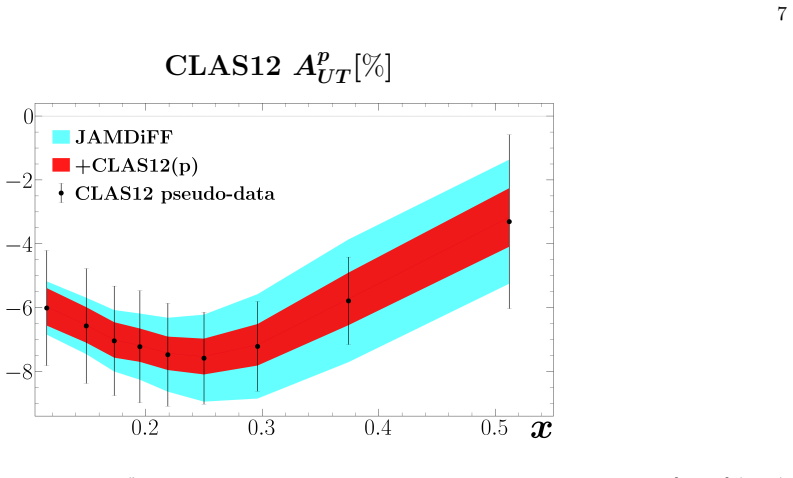
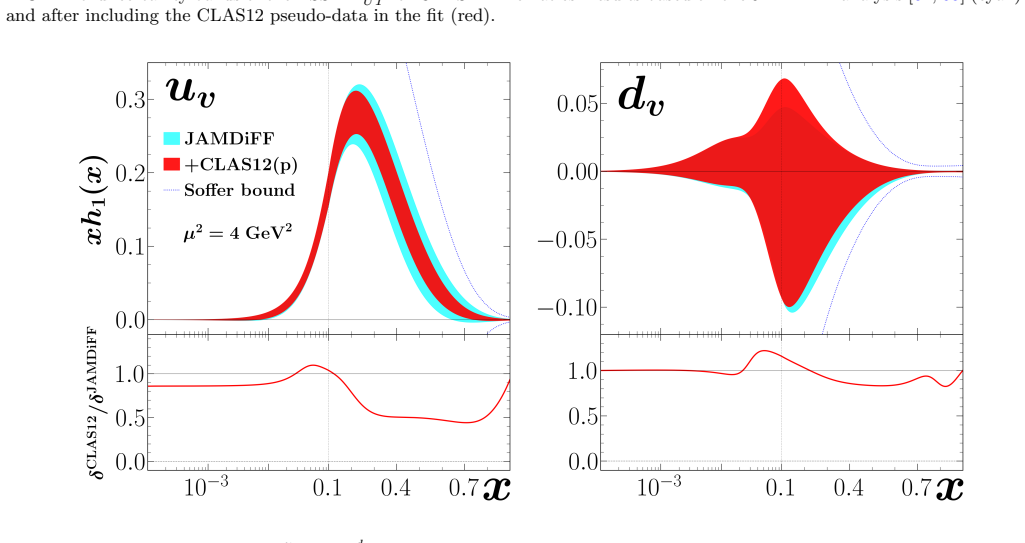
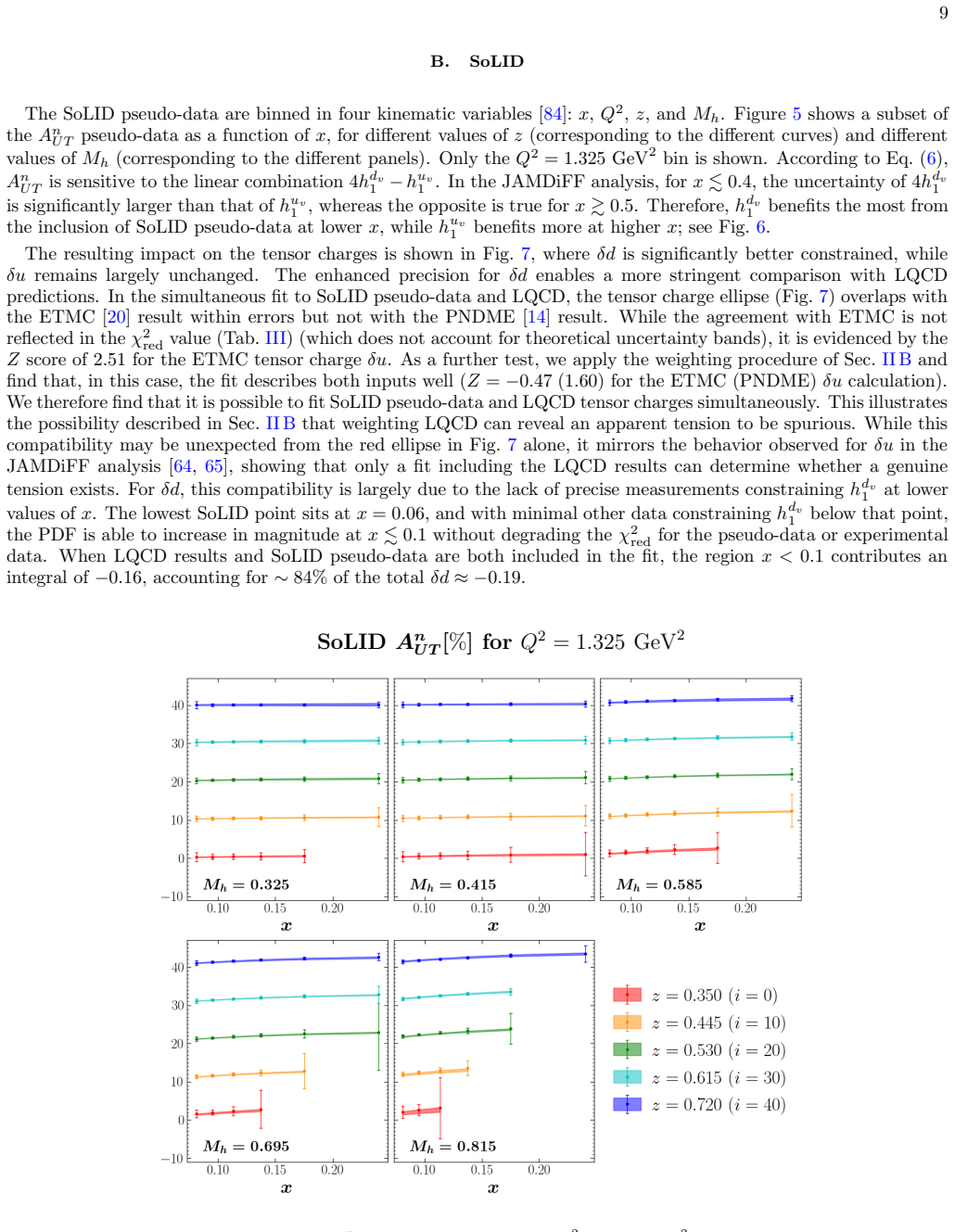
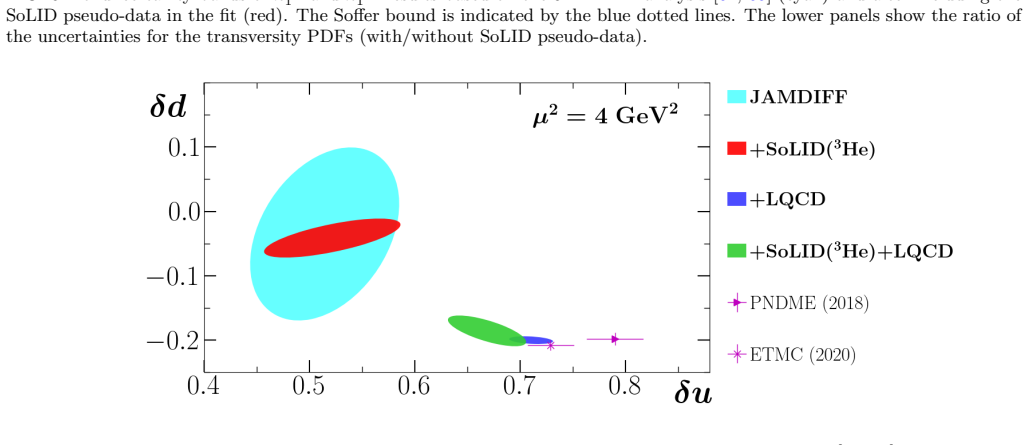
Including projected CLAS12 and SoLID data reduces uncertainties on the transversity PDFs primarily in the intermediate-to-large x region, while ePIC data at the EIC provide strong constraints over the entire x range and enable the first experimental check of the predicted small-x behavior; the same data sets also narrow the uncertainty bands on the isovector and isoscalar tensor charges, with compatibility or tension to lattice results depending on the precise values obtained.
What carries the argument
The JAMDiFF global analysis framework that incorporates dihadron fragmentation functions and existing experimental data to extract transversity PDFs from semi-inclusive deep-inelastic scattering measurements.
If this is right
- Reduced uncertainties at large x from Jefferson Lab data will improve extractions of the nucleon's tensor charges from experimental observables.
- EIC coverage across all x will allow direct comparison of measured transversity distributions against small-x theoretical predictions.
- Comparison of the extracted tensor charges with lattice QCD results will either confirm consistency or reveal tension depending on the final measured values.
- The same future data sets can be used to test the isovector and isoscalar combinations of the tensor charges separately.
Where Pith is reading between the lines
- If the projected uncertainty reductions hold, global fits could begin to discriminate between different models of quark orbital motion inside the nucleon.
- A confirmed small-x behavior from EIC data would constrain the role of gluon contributions or evolution effects in transversity distributions.
- Tension with lattice results on tensor charges could point to higher-order corrections needed in either the experimental analysis or the lattice calculations.
Load-bearing premise
The generated pseudo-data correctly reproduce the statistical and systematic precision that the real CLAS12, SoLID, and ePIC measurements will deliver and the analysis framework accurately describes the dihadron production process without missing biases.
What would settle it
Actual CLAS12 or SoLID data that show substantially different precision or systematic effects from the pseudo-data, or measured transversity distributions at small x that deviate from the predicted behavior once EIC data arrive.
Figures





read the original abstract
We assess the impact of future measurements of dihadron production in semi-inclusive deep-inelastic scattering from the CLAS12 and proposed SoLID experiments at Jefferson Lab, as well as from the ePIC experiment at the future Electron-Ion Collider (EIC), on the transversity parton distribution functions (PDFs) and the corresponding tensor charges of the nucleon. To this end, we generate pseudo-data for these experiments for a proton target (CLAS12 and ePIC) and a $^3$He target (SoLID and ePIC), and we include these pseudo-data in the JAMDiFF global analysis of existing experimental dihadron data. We find that future data from Jefferson Lab will significantly reduce uncertainties in the transversity PDFs in the region of intermediate-to-large quark momentum fractions $x$, while the EIC will provide strong constraints across the entire range of $x$, allowing for the first experimental test of the predicted small-$x$ behavior of the transversity PDFs. In discussing the reduction of uncertainties in the tensor charges, we also compare the results from the data analyses with those from lattice QCD, highlighting scenarios in which compatibility or tension between the two would arise.
Editorial analysis
A structured set of objections, weighed in public.
Referee Report
Summary. The manuscript assesses the impact of future dihadron production measurements in SIDIS from CLAS12 and SoLID at Jefferson Lab (proton and 3He targets) and ePIC at the EIC on transversity PDFs and nucleon tensor charges. Pseudo-data are generated for these experiments and incorporated into the existing JAMDiFF global analysis of dihadron data; the central findings are that JLab data will significantly reduce transversity uncertainties at intermediate-to-large x while EIC data will constrain the full x range (enabling a first experimental test of predicted small-x behavior) and that the resulting tensor-charge extractions can be compared to lattice QCD to identify compatibility or tension scenarios.
Significance. If the projections hold, the work supplies concrete, quantitative guidance on how near-term JLab and EIC data will tighten transversity constraints and on the experimental conditions under which lattice-experiment agreement or discrepancy for the tensor charges would emerge. The approach of augmenting an existing global fit with pseudo-data is standard in PDF phenomenology and the explicit lattice comparison adds a useful bridge between the two communities.
major comments (1)
- [Pseudo-data generation and fit procedure (likely §3–4)] The central projections for uncertainty reduction rest on the fidelity of the generated pseudo-data (statistical and systematic precisions for CLAS12, SoLID, and ePIC) and on the absence of unaccounted biases in the JAMDiFF dihadron framework. The manuscript should include explicit sensitivity tests (e.g., inflating systematic uncertainties by factors of 1.5–2 or varying higher-twist contributions) to demonstrate that the quoted reductions remain robust; without such tests the claimed improvements at intermediate-to-large x and the “first experimental test” of small-x behavior are not yet load-bearing.
minor comments (2)
- [Methods] Clarify the precise kinematic cuts and acceptance modeling used when generating the pseudo-data for the 3He target in SoLID and ePIC; the current description leaves open whether nuclear corrections are applied consistently with the proton case.
- [Results] Add a short table or figure comparing the present JAMDiFF uncertainty bands with and without the pseudo-data at representative x values (e.g., x=0.1, 0.3, 0.6) so that the magnitude of the improvement is immediately visible.
Simulated Author's Rebuttal
We thank the referee for the positive evaluation of our work and the constructive major comment. We address the point on sensitivity tests for the pseudo-data below.
read point-by-point responses
-
Referee: [Pseudo-data generation and fit procedure (likely §3–4)] The central projections for uncertainty reduction rest on the fidelity of the generated pseudo-data (statistical and systematic precisions for CLAS12, SoLID, and ePIC) and on the absence of unaccounted biases in the JAMDiFF dihadron framework. The manuscript should include explicit sensitivity tests (e.g., inflating systematic uncertainties by factors of 1.5–2 or varying higher-twist contributions) to demonstrate that the quoted reductions remain robust; without such tests the claimed improvements at intermediate-to-large x and the “first experimental test” of small-x behavior are not yet load-bearing.
Authors: We agree that explicit sensitivity tests would strengthen the manuscript. In the revised version we will add a dedicated subsection (or appendix) performing two sets of tests: (i) inflating all systematic uncertainties on the pseudo-data by a factor of 2, and (ii) varying the higher-twist contributions within the range allowed by the existing JAMDiFF fit. These additional fits confirm that the qualitative conclusions—significant uncertainty reduction at intermediate-to-large x from JLab data and across the full x range from EIC data—remain robust, although the quantitative size of the reductions is modestly affected. We will also briefly note that the JAMDiFF framework has already been validated against existing data in prior publications, which limits the scope for unaccounted biases in the present projections. revision: yes
Circularity Check
No circularity: standard pseudo-data impact projection on existing global fit
full rationale
The paper generates pseudo-data for future CLAS12, SoLID, and ePIC measurements based on assumed experimental precisions, then augments the existing JAMDiFF global analysis of current dihadron data to project uncertainty reductions on transversity PDFs and tensor charges. This forward projection does not reduce any claimed result to a quantity already fitted to the same data by construction, nor does it rely on self-definitional relations, fitted inputs renamed as predictions, or load-bearing self-citations that close the derivation chain. The central claims rest on external modeling assumptions (pseudo-data fidelity and JAMDiFF mechanism) that are independent of the paper's own equations and can be falsified by actual future measurements. No steps match the enumerated circularity patterns.
Axiom & Free-Parameter Ledger
Reference graph
Works this paper leans on
-
[1]
PDFs. It describes the distribution of transversely polarized quarks (of flavorq) in a transversely polarized nucleon, providing essential information on the spin structure of the nucleon in quantum chromodynamics (QCD) [2, 3]. The first moment of the transversity PDFs defines the corresponding tensor charges, δq(µ) = Z 1 0 dx hqv 1 (x;µ),(1) whereh qv 1 ...
Pith/arXiv arXiv 2026
-
[2]
low” and “high
For ¯uand ¯dquark flavors we assume the relation between the antiquark transversity PDFsh ¯u 1 =−h ¯d 1 motivated by large-Nc arguments [90]. All other sea quark transversities are assumed to be vanishing motivated by the lattice QCD studies [14, 17, 20] of tensor charges. Furthermore, the DiFFH ∢π +π−/u 1 is extracted, together with the (unpolarized) DiF...
-
[3]
J. P. Ralston and D. E. Soper, Nucl. Phys. B152, 109 (1979)
1979
-
[4]
V. Barone, A. Drago, and P. G. Ratcliffe, Phys. Rept.359, 1 (2002), arXiv:hep-ph/0104283 [hep-ph]
Pith/arXiv arXiv 2002
-
[5]
C. Lorc´ e, A. Metz, B. Pasquini, and P. Schweitzer (2025) arXiv:2507.12664 [hep-ph]
arXiv 2025
-
[6]
Herczeg, Prog
P. Herczeg, Prog. Part. Nucl. Phys.46, 413 (2001)
2001
-
[7]
J. Erler and M. J. Ramsey-Musolf, Prog. Part. Nucl. Phys.54, 351 (2005), arXiv:hep-ph/0404291
Pith/arXiv arXiv 2005
-
[8]
N. Severijns, M. Beck, and O. Naviliat-Cuncic, Rev. Mod. Phys.78, 991 (2006), arXiv:nucl-ex/0605029
Pith/arXiv arXiv 2006
-
[9]
V. Cirigliano, S. Gardner, and B. Holstein, Prog. Part. Nucl. Phys.71, 93 (2013), arXiv:1303.6953 [hep-ph]
Pith/arXiv arXiv 2013
-
[10]
A. Courtoy, S. Baeßler, M. Gonz´ alez-Alonso, and S. Liuti, Phys. Rev. Lett.115, 162001 (2015), arXiv:1503.06814 [hep-ph]
Pith/arXiv arXiv 2015
-
[11]
M. Gonz´ alez-Alonso, O. Naviliat-Cuncic, and N. Severijns, Prog. Part. Nucl. Phys.104, 165 (2019), arXiv:1803.08732 [hep-ph]
Pith/arXiv arXiv 2019
-
[12]
M. Pospelov and A. Ritz, Annals Phys.318, 119 (2005), arXiv:hep-ph/0504231
Pith/arXiv arXiv 2005
-
[13]
N. Yamanaka, B. K. Sahoo, N. Yoshinaga, T. Sato, K. Asahi, and B. P. Das, Eur. Phys. J. A53, 54 (2017), arXiv:1703.01570 [hep-ph]
Pith/arXiv arXiv 2017
-
[14]
T. Liu, Z. Zhao, and H. Gao, Phys. Rev. D97, 074018 (2018), arXiv:1704.00113 [hep-ph]
Pith/arXiv arXiv 2018
-
[15]
R. Gupta, Y.-C. Jang, B. Yoon, H.-W. Lin, V. Cirigliano, and T. Bhattacharya, Phys. Rev. D98, 034503 (2018), arXiv:1806.09006 [hep-lat]
Pith/arXiv arXiv 2018
-
[16]
R. Gupta, B. Yoon, T. Bhattacharya, V. Cirigliano, Y.-C. Jang, and H.-W. Lin, Phys. Rev. D98, 091501 (2018), arXiv:1808.07597 [hep-lat]
Pith/arXiv arXiv 2018
-
[17]
N. Yamanaka, S. Hashimoto, T. Kaneko, and H. Ohki (JLQCD), Phys. Rev. D98, 054516 (2018), arXiv:1805.10507 [hep-lat]
Pith/arXiv arXiv 2018
-
[18]
N. Hasan, J. Green, S. Meinel, M. Engelhardt, S. Krieg, J. Negele, A. Pochinsky, and S. Syritsyn, Phys. Rev. D99, 114505 (2019), arXiv:1903.06487 [hep-lat]
Pith/arXiv arXiv 2019
-
[19]
C. Alexandrou, S. Bacchio, M. Constantinou, J. Finkenrath, K. Hadjiyiannakou, K. Jansen, G. Koutsou, and A. Vaquero Aviles-Casco, Phys. Rev. D102, 054517 (2020), arXiv:1909.00485 [hep-lat]
arXiv 2020
- [20]
- [21]
-
[22]
C. Alexandrou, M. Constantinou, K. Hadjiyiannakou, K. Jansen, and F. Manigrasso, Phys. Rev. D104, 054503 (2021), arXiv:2106.16065 [hep-lat]
arXiv 2021
-
[23]
S. Park, R. Gupta, B. Yoon, S. Mondal, T. Bhattacharya, Y.-C. Jang, B. Jo´ o, and F. Winter (Nucleon Matrix Elements (NME)), Phys. Rev. D105, 054505 (2022), arXiv:2103.05599 [hep-lat]
arXiv 2022
- [24]
-
[25]
G. S. Bali, S. Collins, S. Heybrock, M. L¨ offler, R. R¨ odl, W. S¨ oldner, and S. Weish¨ aupl (RQCD), Phys. Rev. D108, 034512 (2023), arXiv:2305.04717 [hep-lat]
arXiv 2023
-
[26]
R. E. Smailet al.(QCDSF/UKQCD/CSSM), Phys. Rev. D108, 094511 (2023), arXiv:2304.02866 [hep-lat]
arXiv 2023
-
[27]
X. Gao, A. D. Hanlon, S. Mukherjee, P. Petreczky, Q. Shi, S. Syritsyn, and Y. Zhao, Phys. Rev. D109, 054506 (2024), arXiv:2310.19047 [hep-lat]
arXiv 2024
-
[28]
D. Djukanovic, G. von Hippel, H. B. Meyer, K. Ottnad, and H. Wittig, Phys. Rev. D109, 074507 (2024), arXiv:2402.03024 [hep-lat]
arXiv 2024
-
[29]
C. Alexandrou, S. Bacchio, J. Finkenrath, C. Iona, G. Koutsou, Y. Li, and G. Spanoudes, Phys. Rev. D111, 054505 (2025), arXiv:2412.01535 [hep-lat]
arXiv 2025
-
[30]
J.-H. Wang, Z.-C. Hu, X. Ji, X. Jiang, Y. Su, P. Sun, and Y.-B. Yang (CLQCD), (2025), arXiv:2511.02326 [hep-lat]
arXiv 2025
-
[31]
H.-x. He and X.-D. Ji, Phys. Rev. D52, 2960 (1995), arXiv:hep-ph/9412235
Pith/arXiv arXiv 1995
-
[32]
V. Barone, T. Calarco, and A. Drago, Phys. Lett. B390, 287 (1997), arXiv:hep-ph/9605434
Pith/arXiv arXiv 1997
-
[33]
P. Schweitzer, D. Urbano, M. V. Polyakov, C. Weiss, P. V. Pobylitsa, and K. Goeke, Phys. Rev. D64, 034013 (2001), arXiv:hep-ph/0101300
Pith/arXiv arXiv 2001
-
[34]
L. P. Gamberg and G. R. Goldstein, Phys. Rev. Lett.87, 242001 (2001), arXiv:hep-ph/0107176. 16
Pith/arXiv arXiv 2001
-
[35]
B. Pasquini, M. Pincetti, and S. Boffi, Phys. Rev. D72, 094029 (2005), arXiv:hep-ph/0510376
Pith/arXiv arXiv 2005
-
[36]
M. Wakamatsu, Phys. Lett. B653, 398 (2007), arXiv:0705.2917 [hep-ph]
Pith/arXiv arXiv 2007
- [37]
-
[38]
N. Yamanaka, T. M. Doi, S. Imai, and H. Suganuma, Phys. Rev. D88, 074036 (2013), arXiv:1307.4208 [hep-ph]
Pith/arXiv arXiv 2013
-
[39]
M. Pitschmann, C.-Y. Seng, C. D. Roberts, and S. M. Schmidt, Phys. Rev. D91, 074004 (2015), arXiv:1411.2052 [nucl-th]
Pith/arXiv arXiv 2015
-
[40]
S.-S. Xu, C. Chen, I. C. Cloet, C. D. Roberts, J. Segovia, and H.-S. Zong, Phys. Rev. D92, 114034 (2015), arXiv:1509.03311 [nucl-th]
Pith/arXiv arXiv 2015
-
[41]
Q.-W. Wang, S.-X. Qin, C. D. Roberts, and S. M. Schmidt, Phys. Rev. D98, 054019 (2018), arXiv:1806.01287 [nucl-th]
Pith/arXiv arXiv 2018
-
[42]
L. Liu, L. Chang, and Y.-X. Liu, Phys. Rev. D99, 074013 (2019), arXiv:1902.10917 [nucl-th]
Pith/arXiv arXiv 2019
-
[43]
J. C. Collins, Nucl. Phys. B396, 161 (1993), arXiv:hep-ph/9208213
Pith/arXiv arXiv 1993
-
[44]
M. Anselmino, M. Boglione, U. D’Alesio, A. Kotzinian, F. Murgia, A. Prokudin, and C. Turk, Phys. Rev. D75, 054032 (2007), arXiv:hep-ph/0701006
Pith/arXiv arXiv 2007
-
[45]
M. Anselmino, M. Boglione, U. D’Alesio, A. Kotzinian, F. Murgia, A. Prokudin, and S. Melis, Nucl. Phys. B Proc. Suppl. 191, 98 (2009), arXiv:0812.4366 [hep-ph]
Pith/arXiv arXiv 2009
-
[46]
M. Anselmino, M. Boglione, U. D’Alesio, S. Melis, F. Murgia, and A. Prokudin, Phys. Rev. D87, 094019 (2013), arXiv:1303.3822 [hep-ph]
Pith/arXiv arXiv 2013
-
[47]
M. Anselmino, M. Boglione, U. D’Alesio, J. O. Gonzalez Hernandez, S. Melis, F. Murgia, and A. Prokudin, Phys. Rev. D 92, 114023 (2015), arXiv:1510.05389 [hep-ph]
Pith/arXiv arXiv 2015
-
[48]
Z.-B. Kang, A. Prokudin, P. Sun, and F. Yuan, Phys. Rev. D93, 014009 (2016), arXiv:1505.05589 [hep-ph]
Pith/arXiv arXiv 2016
-
[49]
H.-W. Lin, W. Melnitchouk, A. Prokudin, N. Sato, and H. Shows, Phys. Rev. Lett.120, 152502 (2018), arXiv:1710.09858 [hep-ph]
Pith/arXiv arXiv 2018
-
[50]
U. D’Alesio, C. Flore, and A. Prokudin, Phys. Lett. B803, 135347 (2020), arXiv:2001.01573 [hep-ph]
arXiv 2020
-
[51]
J. Cammarota, L. Gamberg, Z.-B. Kang, J. A. Miller, D. Pitonyak, A. Prokudin, T. C. Rogers, and N. Sato (Jefferson Lab Angular Momentum), Phys. Rev. D102, 054002 (2020), arXiv:2002.08384 [hep-ph]
arXiv 2020
-
[52]
L. Gamberg, M. Malda, J. A. Miller, D. Pitonyak, A. Prokudin, and N. Sato (Jefferson Lab Angular Momentum (JAM), Jefferson Lab Angular Momentum), Phys. Rev. D106, 034014 (2022), arXiv:2205.00999 [hep-ph]
arXiv 2022
- [53]
-
[54]
C. Zeng, H. Dong, T. Liue, P. Sun, and Y. Zhao, (2024), arXiv:2412.18324 [hep-ph]
arXiv 2024
-
[55]
J. C. Collins, S. F. Heppelmann, and G. A. Ladinsky, Nucl. Phys. B420, 565 (1994), arXiv:hep-ph/9305309
Pith/arXiv arXiv 1994
-
[56]
R. L. Jaffe, X.-m. Jin, and J. Tang, Phys. Rev. Lett.80, 1166 (1998), arXiv:hep-ph/9709322
Pith/arXiv arXiv 1998
-
[57]
A. Bianconi, S. Boffi, R. Jakob, and M. Radici, Phys. Rev. D62, 034008 (2000), arXiv:hep-ph/9907475
Pith/arXiv arXiv 2000
-
[58]
M. Radici, R. Jakob, and A. Bianconi, Phys. Rev. D65, 074031 (2002), arXiv:hep-ph/0110252
Pith/arXiv arXiv 2002
-
[59]
A. Bacchetta and M. Radici, Phys. Rev. D67, 094002 (2003), arXiv:hep-ph/0212300
Pith/arXiv arXiv 2003
-
[60]
A. Bacchetta, F. A. Ceccopieri, A. Mukherjee, and M. Radici, Phys. Rev. D79, 034029 (2009), arXiv:0812.0611 [hep-ph]
Pith/arXiv arXiv 2009
-
[61]
A. Bacchetta, A. Courtoy, and M. Radici, Phys. Rev. Lett.107, 012001 (2011), arXiv:1104.3855 [hep-ph]
Pith/arXiv arXiv 2011
-
[62]
A. Bacchetta, A. Courtoy, and M. Radici, JHEP03, 119 (2013), arXiv:1212.3568 [hep-ph]
Pith/arXiv arXiv 2013
-
[63]
M. Radici, A. Courtoy, A. Bacchetta, and M. Guagnelli, JHEP05, 123 (2015), arXiv:1503.03495 [hep-ph]
Pith/arXiv arXiv 2015
-
[64]
M. Radici, A. M. Ricci, A. Bacchetta, and A. Mukherjee, Phys. Rev. D94, 034012 (2016), arXiv:1604.06585 [hep-ph]
Pith/arXiv arXiv 2016
-
[65]
M. Radici and A. Bacchetta, Phys. Rev. Lett.120, 192001 (2018), arXiv:1802.05212 [hep-ph]
Pith/arXiv arXiv 2018
-
[66]
C. Cocuzza, A. Metz, D. Pitonyak, A. Prokudin, N. Sato, and R. Seidl (JAM), Phys. Rev. Lett.132, 091901 (2024), arXiv:2306.12998 [hep-ph]
arXiv 2024
-
[67]
C. Cocuzza, A. Metz, D. Pitonyak, A. Prokudin, N. Sato, and R. Seidl (Jefferson Lab Angular Momentum (JAM)), Phys. Rev. D109, 034024 (2024), arXiv:2308.14857 [hep-ph]
arXiv 2024
-
[68]
A. Courtoy, A. Bacchetta, M. Radici, and A. Bianconi, Phys. Rev. D85, 114023 (2012), arXiv:1202.0323 [hep-ph]
Pith/arXiv arXiv 2012
-
[69]
D. Pitonyak, C. Cocuzza, A. Metz, A. Prokudin, and N. Sato, Phys. Rev. Lett.132, 011902 (2024), arXiv:2305.11995 [hep-ph]
arXiv 2024
-
[70]
T. C. Rogers, M. Radici, A. Courtoy, and T. Rainaldi, Phys. Rev. D111, 056001 (2025), arXiv:2412.12282 [hep-ph]
arXiv 2025
-
[71]
D. Pitonyak, C. Cocuzza, A. Metz, A. Prokudin, and N. Sato, Phys. Rev. D113, 038901 (2026), arXiv:2502.15817 [hep-ph]
arXiv 2026
- [72]
-
[73]
A. Metz and A. Vossen, Prog. Part. Nucl. Phys.91, 136 (2016), arXiv:1607.02521 [hep-ex]
Pith/arXiv arXiv 2016
-
[74]
Z.-B. Kang, K. Lee, D. Y. Shao, and F. Zhao, JHEP03, 153 (2024), arXiv:2310.15159 [hep-ph]
arXiv 2024
- [75]
-
[76]
M.-S. Gao, Z.-B. Kang, W. Li, and D. Y. Shao, Phys. Rev. Lett.136, 151902 (2026), arXiv:2509.15809 [hep-ph]
Pith/arXiv arXiv 2026
-
[77]
Q.-H. Cao, Z. Yu, C. P. Yuan, S.-T. Zhang, and H. X. Zhu, JHEP02, 244 (2026), [Erratum: JHEP 04, 206 (2026)], arXiv:2509.18892 [hep-ph]
arXiv 2026
-
[78]
Z.-B. Kang, A. Metz, D. Pitonyak, and C. Zhang, (2026), arXiv:2604.28131 [hep-ph]
Pith/arXiv arXiv 2026
-
[79]
A. Vossenet al.(Belle), Phys. Rev. Lett.107, 072004 (2011), arXiv:1104.2425 [hep-ex]
Pith/arXiv arXiv 2011
-
[80]
R. Seidlet al.(Belle), Phys. Rev. D96, 032005 (2017), arXiv:1706.08348 [hep-ex]
Pith/arXiv arXiv 2017
discussion (0)
Sign in with ORCID, Apple, or X to comment. Anyone can read and Pith papers without signing in.