Individually tunable Si/SiGe quantum dot operating voltages via gate-biased illumination
Pith reviewed 2026-06-28 18:41 UTC · model grok-4.3
The pith
Gate-biased near-infrared illumination shifts trapped charges to tune each quantum dot's operating voltage independently.
A machine-rendered reading of the paper's core claim, the machinery that carries it, and where it could break.
Core claim
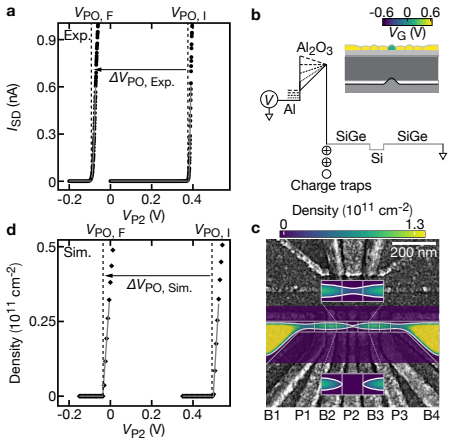
Illumination with near-infrared light while gate voltages are applied produces a controllable, repeatable, and gate-selective shift in the nanoscale trapped charge distribution at the oxide-semiconductor interface; this shift moves the operating voltages of individual gates without changing measured charge noise, as shown by tuning a triple quantum dot to uniform small voltages in the (1,1,1) state.
What carries the argument
Gate-biased illumination that modifies the trapped charge distribution at the interface to adjust each gate's effective potential.
If this is right
- Operating voltages on separate gates can be adjusted individually and made more uniform.
- The same illumination protocol can be applied gate-by-gate to reach a target charge configuration such as (1,1,1) with smaller voltages.
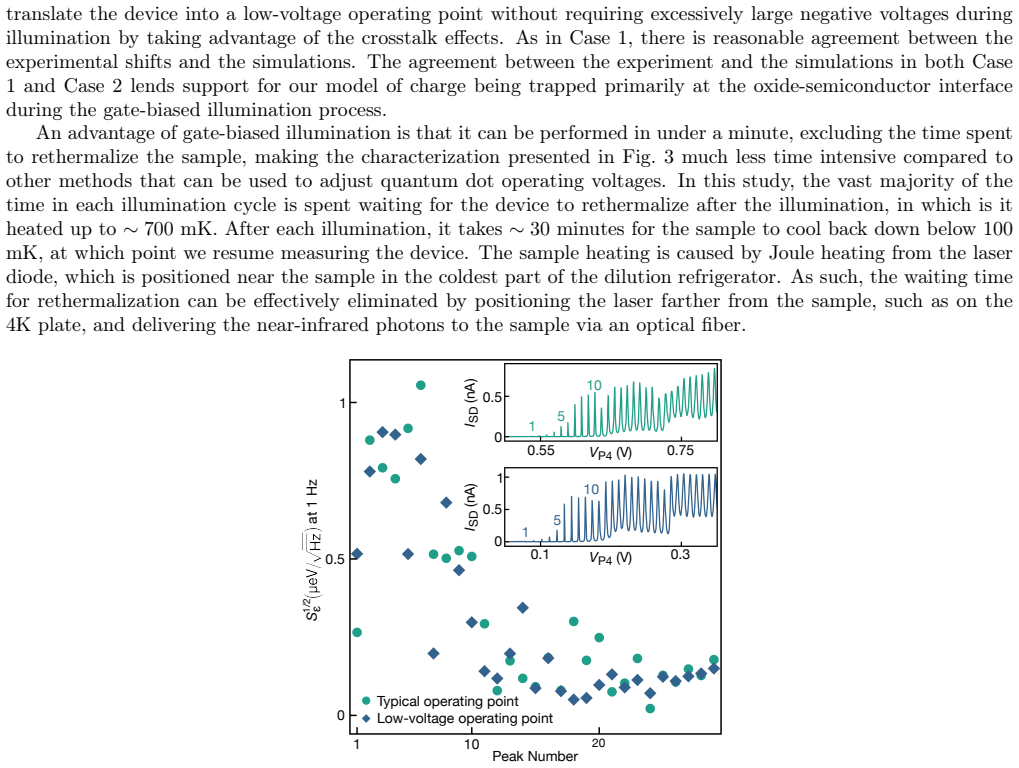
- Charge noise spectra remain unchanged after the voltage shifts are performed.
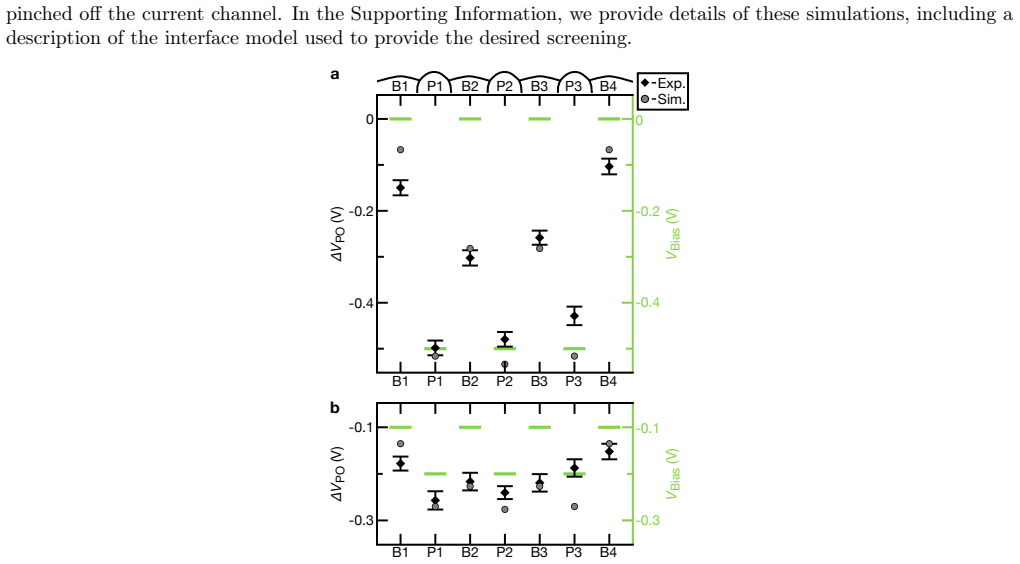
- Self-consistent Schrödinger-Poisson simulations reproduce the observed voltage shifts from redistribution of interface charge.
Where Pith is reading between the lines
- The same protocol might reduce the spread of operating voltages in larger linear or 2D arrays of dots.
- If the charge redistribution is stable over time, periodic recalibration with light could maintain uniformity without continuous voltage adjustments.
- The method may extend to other semiconductor-oxide systems where interface traps limit voltage uniformity.
Load-bearing premise
Illumination with near-infrared light while gate voltages are applied produces a controllable, repeatable, and selective shift in trapped charge without adding new noise sources or instability.
What would settle it
Repeated illumination cycles under different gate bias patterns produce no distinguishable shifts in the measured operating voltages, or charge noise increases after the illumination step.
Figures

read the original abstract
Semiconductor quantum dot qubits often require very different voltages on each gate to bring them to a correct operating point. Here, we present a method by which one can controllably and repeatably alter the nanoscale trapped charge distribution at an oxide-semiconductor interface. We demonstrate this method on a Si/SiGe quantum dot device, and we find that the operating voltages can be controlled and made much more uniform. The method relies on illumination with near-infrared light in the presence of applied gate voltages, and it enables the tuning of the device operating point on a gate-by-gate basis. We present an explanation of the underlying physics using self-consistent Schr\"odinger-Poisson simulations. As an application of this method, we tune a triple quantum dot to have uniform and small operating voltages in the (1,1,1) charge configuration. Importantly, we show that shifting the operating voltages in this way does not change the measured charge noise.
Editorial analysis
A structured set of objections, weighed in public.
Referee Report
Summary. The paper introduces a method to individually tune the operating voltages of gates in Si/SiGe quantum dot devices by illuminating with near-infrared light while applying gate biases. This modifies the trapped charge at the interface in a controllable way. The authors demonstrate the method on a triple quantum dot device, achieving uniform small operating voltages in the (1,1,1) charge state, supported by Schrödinger-Poisson simulations. They also show that this tuning does not affect the measured charge noise.
Significance. This technique could be significant for scaling up semiconductor-based quantum dot qubits by simplifying the tuning process for multi-dot systems. The ability to make operating voltages more uniform without increasing noise is a valuable contribution if the results are robust. The simulations help explain the underlying mechanism involving charge redistribution.
major comments (2)
- [Experimental demonstration] The claim that charge noise is unchanged after the illumination procedure is central to the application. The manuscript should specify the measurement conditions, number of repetitions, and any statistical analysis used to conclude that the noise is unaffected (e.g., in the section describing the (1,1,1) configuration tuning).
- [Simulations] The Schrödinger-Poisson simulations are used to explain the physics. It would strengthen the paper to compare the simulated voltage shifts quantitatively with the experimental observations to validate the model.
minor comments (2)
- Ensure that all figures have clear labels and captions that allow the reader to understand the data without referring to the main text.
- The abstract mentions 'much more uniform'; consider providing quantitative metrics for the uniformity improvement in the main text.
Simulated Author's Rebuttal
We thank the referee for their positive assessment and constructive comments on our manuscript. We address each major comment below and will incorporate revisions to strengthen the paper.
read point-by-point responses
-
Referee: [Experimental demonstration] The claim that charge noise is unchanged after the illumination procedure is central to the application. The manuscript should specify the measurement conditions, number of repetitions, and any statistical analysis used to conclude that the noise is unaffected (e.g., in the section describing the (1,1,1) configuration tuning).
Authors: We agree that additional details on the noise measurements will improve clarity. In the revised manuscript, we will expand the relevant section to specify the measurement conditions (including bias points and temperature), the number of repetitions performed, and the statistical analysis (e.g., standard deviation across traces) used to conclude that charge noise is unaffected. revision: yes
-
Referee: [Simulations] The Schrödinger-Poisson simulations are used to explain the physics. It would strengthen the paper to compare the simulated voltage shifts quantitatively with the experimental observations to validate the model.
Authors: We thank the referee for this suggestion. The current simulations provide a qualitative explanation of the charge redistribution mechanism. In the revision, we will add a quantitative comparison between the simulated gate voltage shifts and the experimentally observed shifts for the tuned gates, including a table or plot of the values to validate the model. revision: yes
Circularity Check
No significant circularity identified
full rationale
The paper reports an experimental demonstration of gate-biased near-IR illumination to controllably shift interface trapped charge and thereby tune quantum-dot operating voltages on a per-gate basis. The central results (uniform (1,1,1) operating points in a triple-dot device, unchanged charge noise) are presented as direct measurements rather than as outputs of any derivation chain. Schrödinger-Poisson simulations are invoked only for mechanistic explanation, not as a predictive model whose parameters are fitted to the target data. No equations, fitted-input predictions, self-citation load-bearing steps, or ansatz smuggling appear in the reported argument. The work is therefore self-contained against external experimental benchmarks.
Axiom & Free-Parameter Ledger
axioms (1)
- domain assumption Self-consistent Schrödinger-Poisson simulations accurately capture the physics of light-induced trapped charge redistribution at the oxide-semiconductor interface.
Reference graph
Works this paper leans on
-
[1]
Single- electron operations in a foundry-fabricated array of quantum dots.Nat
(1) Ansaloni, F.; Chatterjee, A.; Bohuslavskyi, H.; Bertrand, B.; Hutin, L.; Vinet, M.; Kuemmeth, F. Single- electron operations in a foundry-fabricated array of quantum dots.Nat. Commun.2020,11, 6399, DOI: 10.1038/s41467-020-20280-3. (2) Zwerver, A. M. J. et al. Qubits made by advanced semiconductor manufacturing.Nat. Electron.2022,5, 184–190, DOI:10.103...
-
[2]
Gardner, G. C.; Manfra, M. J.; Reilly, D. J. A cryogenic CMOS chip for generating control signals for multiple qubits.Nat. Electron.2021,4, 64–70, DOI:10.1038/s41928-020-00528-y. (10) Park, J.-S. et al. 13.1 A fully integrated cryo-CMOS SoC for qubit control in quantum computers capable of state manipulation, readout and high-speed gate pulsing of spin qu...
-
[3]
Alibart, F.; Pioro-Ladrière, M.; Drouin, D. Memristor-based cryogenic programmable DC sources for scalable in situ quantum-dot control.IEEE Trans. Electron Devices2023,70, 1989–1995, DOI:10.1109/ted.2023. 3244133. (12) Schreckenberg, L.; Otten, R.; Vliex, P.; Xue, R.; Tu, J.-S.; Seidler, I.; Trellenkamp, S.; Schreiber, L. R.; Bluhm, H.; van Waasen, S. SiG...
-
[4]
Voinigescu, S.; Reilly, D. J.; Dzurak, A. S. CMOS compatibility of semiconductor spin qubits.Nat. Rev. Electr. Eng.2026,3, 300–315, DOI:10.1038/s44287-026-00283-w. (15) Vandersypen, L. M. K.; Bluhm, H.; Clarke, J. S.; Dzurak, A. S.; Ishihara, R.; Morello, A.; Reilly, D. J
-
[5]
Schreiber, L. R.; Veldhorst, M. Interfacing spin qubits in quantum dots and donors–hot, dense, and coherent. Npj Quantum Inf.2017,3, 1–10, DOI:10.1038/s41534-017-0038-y. (16) Veldhorst, M.; Eenink, H. G. J.; Yang, C. H.; Dzurak, A. S. Silicon CMOS architecture for a spin-based quantum computer.Nat. Commun.2017,8, 1766, DOI:10.1038/s41467-017-01905-6. (17)...
-
[6]
Otten, R.; Seidler, I.; Xue, R.; Schreiber, L. R.; Bluhm, H. The SpinBus architecture for scaling spin qubits with electron shuttling.Nat. Commun.2024,15, 4977, DOI:10.1038/s41467-024-49182-4. (18) Meyer, M.; Déprez, C.; van Abswoude, T. R.; Meijer, I. N.; Liu, D.; Wang, C.-A.; Karwal, S.; Oosterhout, S
-
[7]
W.; Scappucci, G.; Veldhorst, M
Borsoi, F.; Sammak, A.; Hendrickx, N. W.; Scappucci, G.; Veldhorst, M. Electrical control of uniformity in quantum dot devices.Nano Lett.2023,23, 2522–2529, DOI:10.1021/acs.nanolett.2c04446. 11 (19) Meyer, M.; Déprez, C.; Meijer, I. N.; Unseld, F. K.; Karwal, S.; Sammak, A.; Scappucci, G.; Vandersypen, L. M. K.; Veldhorst, M. Single-electron occupation in...
-
[8]
Collard, P.; Salis, G.; Fuhrer, A.; Hendrickx, N. W. Impact of interface traps on charge noise and low-density transport properties in Ge/SiGe heterostructures.Commun. Mater.2024,5, 151, DOI:10.1038/s43246- 024-00563-8. (21) Ferrero, J.; Koch, T.; Vogel, S.; Schroller, D.; Adam, V.; Xue, R.; Seidler, I.; Schreiber, L. R.; Bluhm, H
-
[9]
Noise reduction by bias cooling in gated Si/SixGe1−xquantum dots.Appl
Wernsdorfer, W. Noise reduction by bias cooling in gated Si/SixGe1−xquantum dots.Appl. Phys. Lett.2024, 124, 204002, DOI:10.1063/5.0206632. (22) Diebel, L. K.; Zinkl, L. G.; Hötzinger, A.; Reichmann, F.; Lisker, M.; Yamamoto, Y.; Bougeard, D. Impact of biased cooling on the operation of undoped silicon quantum well field-effect devices.AIP Adv.2025,15, 03...
-
[10]
Edge, L. F.; Coppersmith, S. N.; Eriksson, M. A. Fabrication process and failure analysis for robust quantum dots in silicon.Nanotechnology2020,31, 505001, DOI:10.1088/1361-6528/abb559. (26) Saku, T. S. T.; Muraki, K. M. K.; Hirayama, Y. H. Y. High-Mobility Two-Dimensional Electron Gas in an Undoped Heterostructure: Mobility Enhancement after Illumination...
-
[11]
Quantum repeaters based on concatenated bosonic and discrete-variable quantum codes,
Mongillo, M.; Wan, D.; Govoreanu, B.; Radu, I. P.; Li, R.; Van Dorpe, P.; De Greve, K. Low charge noise quantum dots with industrial CMOS manufacturing.NPJ Quantum Inf.2024,10, 70, DOI:10.1038/s41534- 024-00864-3. (33) Connors, E. J.; Nelson, J. J.; Qiao, H.; Edge, L. F.; Nichol, J. M. Low-frequency charge noise in Si/SiGe quantum dots.Phys. Rev. B.2019,1...
-
[12]
Friesen, M.; Eriksson, M. A.; Zwolak, J. P. Bootstrapping, autonomous testing, and initialization system for Si/SixGe1−x multi-quantum-dot devices.Phys. Rev. Appl.2026,25, 014043, DOI:10.1103/vbtg-fws9. (35) Bian, X.; Briggs, G. A. D.; Mol, J. A. Parallel refreshed cryogenic charge-locking array with low power dissi- pation.arXiv [quant-ph]2024, DOI:10.48...
discussion (0)
Sign in with ORCID, Apple, or X to comment. Anyone can read and Pith papers without signing in.