Lattice Boltzmann Methods for Compressible (Magneto)hydrodynamics
Pith reviewed 2026-06-28 18:32 UTC · model grok-4.3
The pith
A lattice Boltzmann scheme decouples MHD transport into independent local operations via Strang splitting.
A machine-rendered reading of the paper's core claim, the machinery that carries it, and where it could break.
Core claim
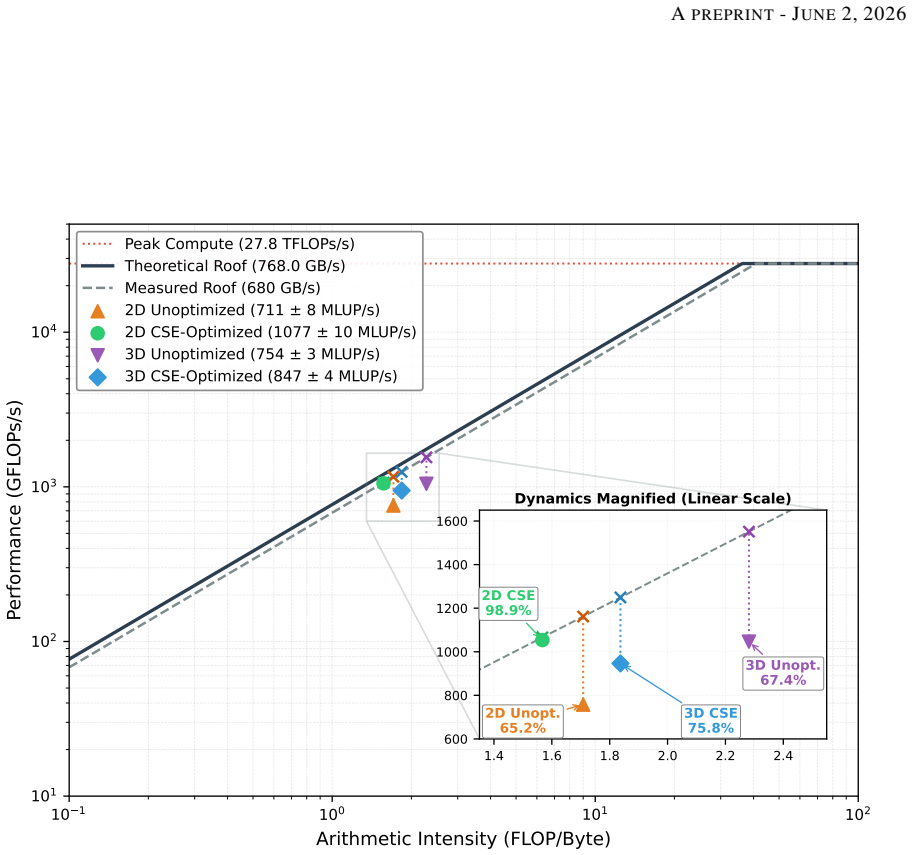
By exploiting the algorithmic structure of kinetic formulations to separately transport all state variables of Strang-splitted conservation equations alongside their characteristics, the authors obtain a novel class of LBM schemes that solve a wide range of transport equation systems through decoupled, fully local operations. The approach is shown to discretize ideal compressible and resistive incompressible MHD systems while reaching up to 98.9 percent of hardware roofline performance in a platform-transparent implementation.
What carries the argument
Strang splitting of conservation equations combined with independent kinetic transport of each state variable along its characteristics, which produces decoupled fully local operations.
If this is right
- The scheme simulates both ideal compressible MHD and resistive incompressible MHD systems.
- It recovers hydrodynamic limits including the compressible Euler and incompressible Navier-Stokes equations.
- Implementation within a multi-physics framework reaches up to 98.9 percent of hardware roofline performance.
- The method supports dynamic solid geometries, shifting magnetic fields, and fluid-structure interaction.
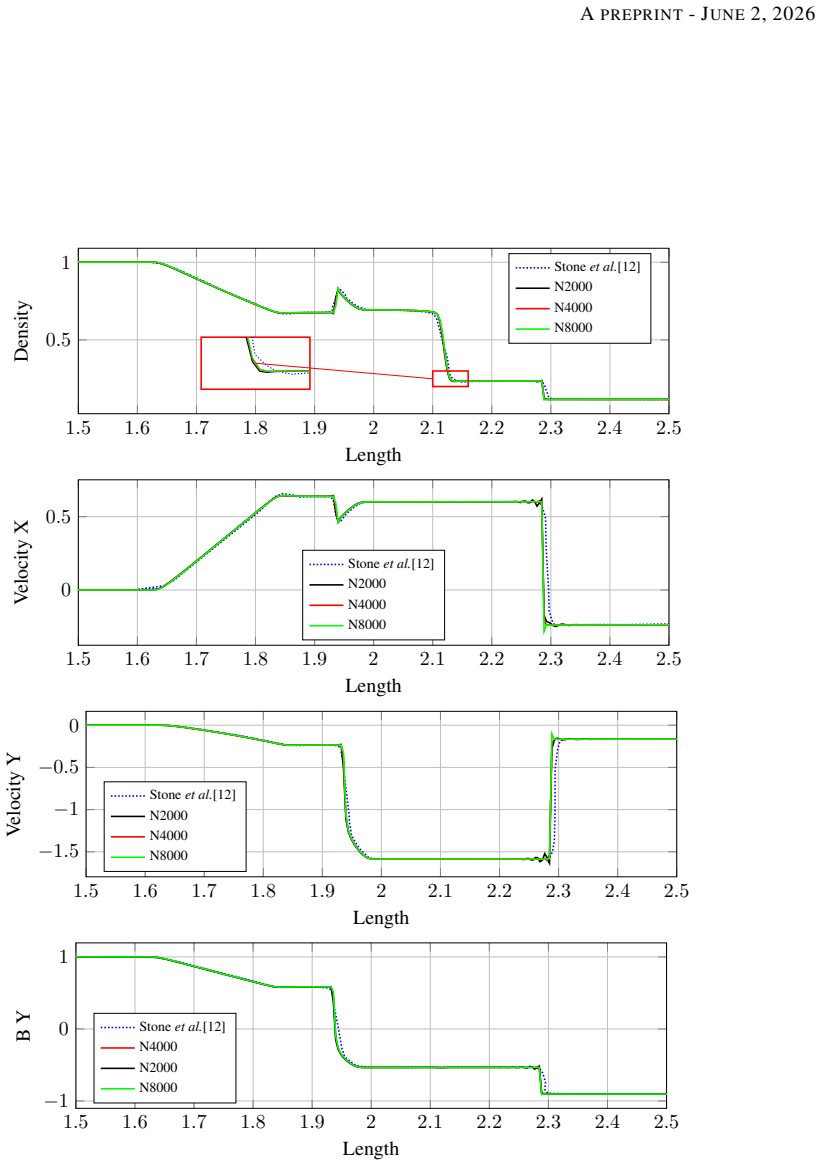
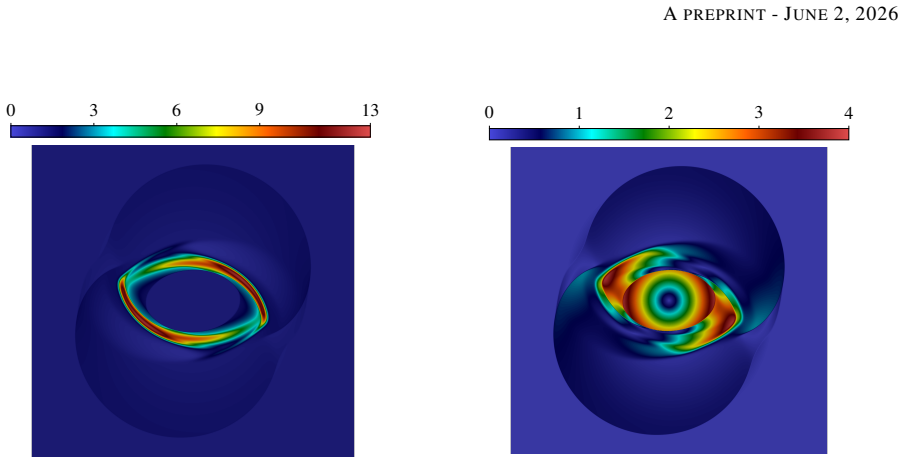
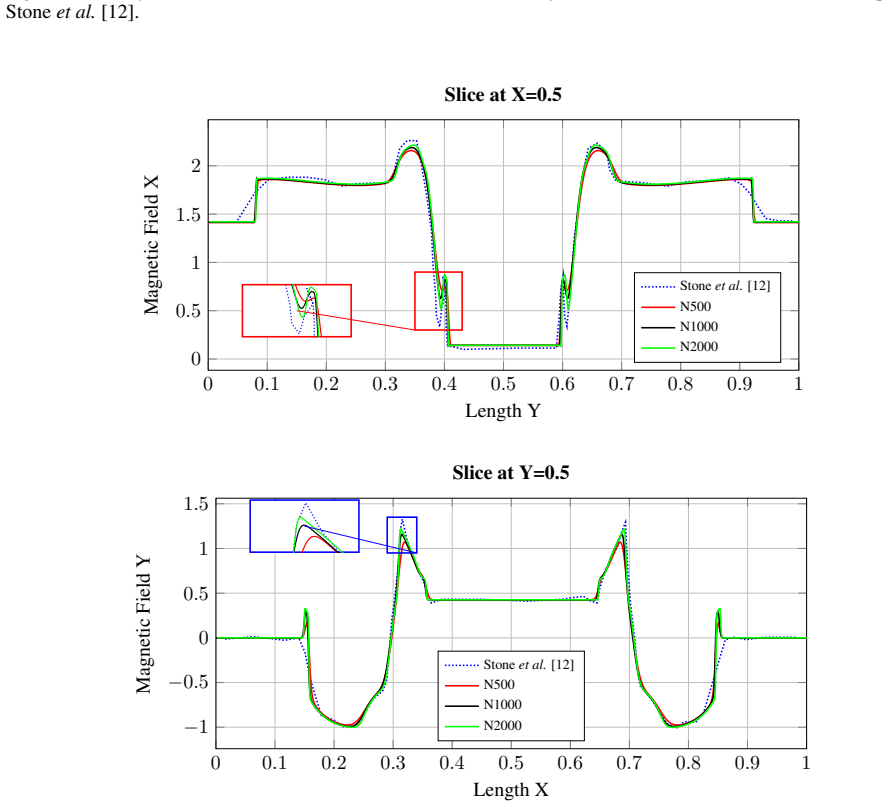
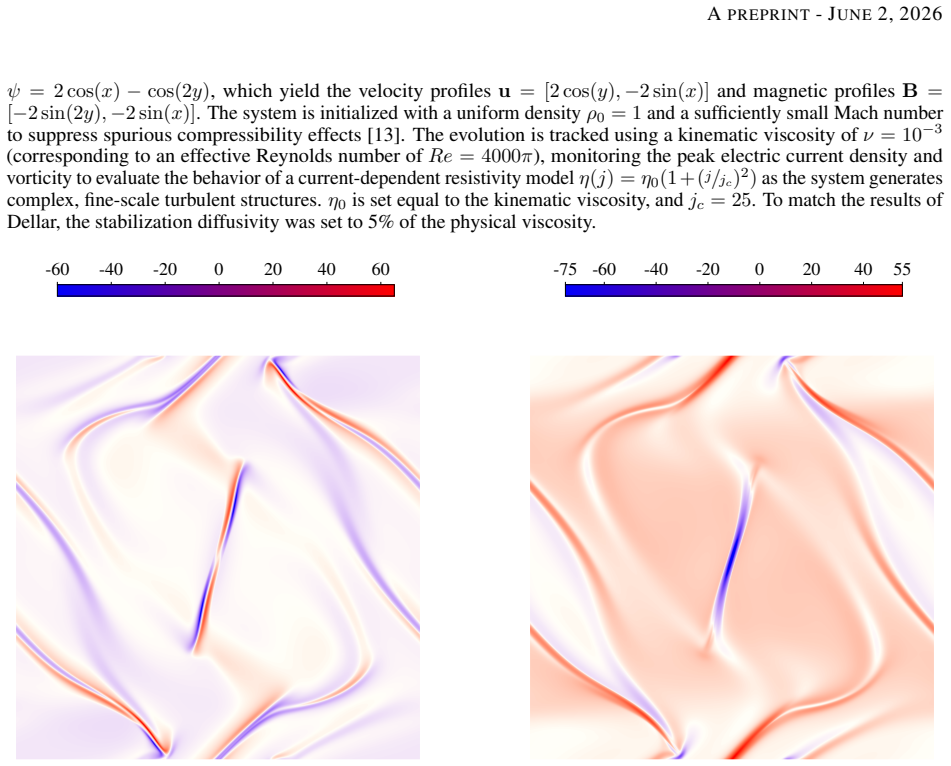
- Validation succeeds against established incompressible and compressible MHD benchmarks at multiple resolutions.
Where Pith is reading between the lines
- The fully local operations could reduce communication overhead in large-scale parallel simulations of MHD turbulence.
- Similar splitting strategies might apply directly to other tightly coupled multiphysics systems such as reactive flows or plasma models.
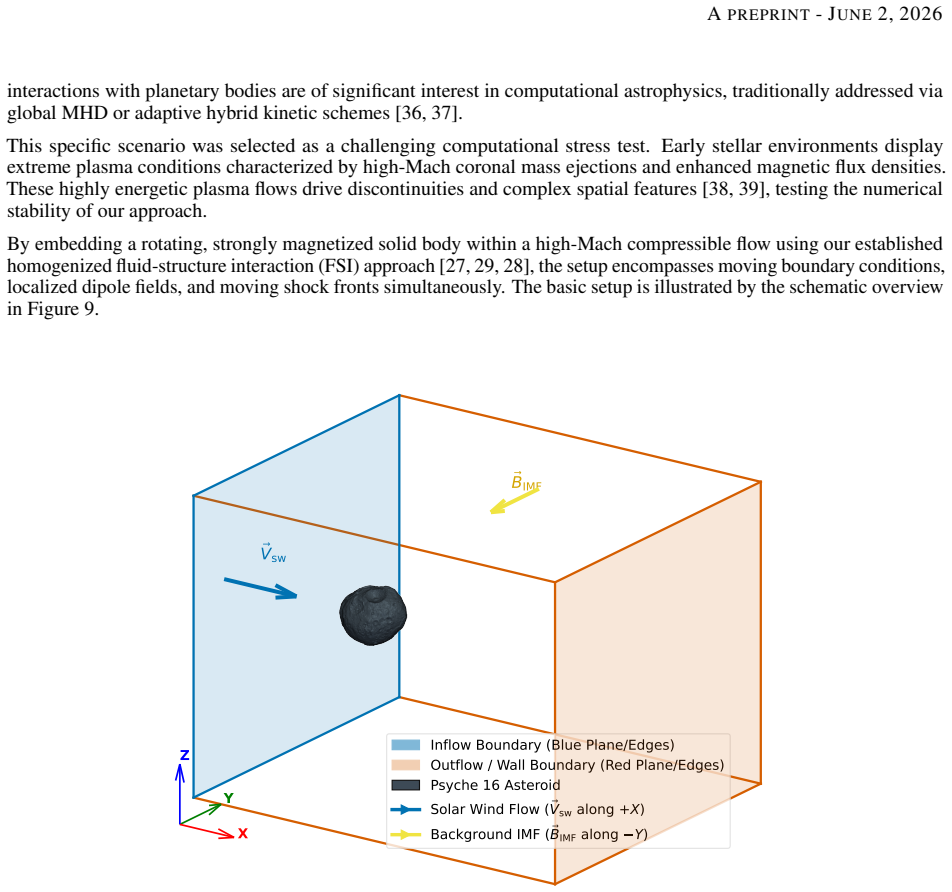
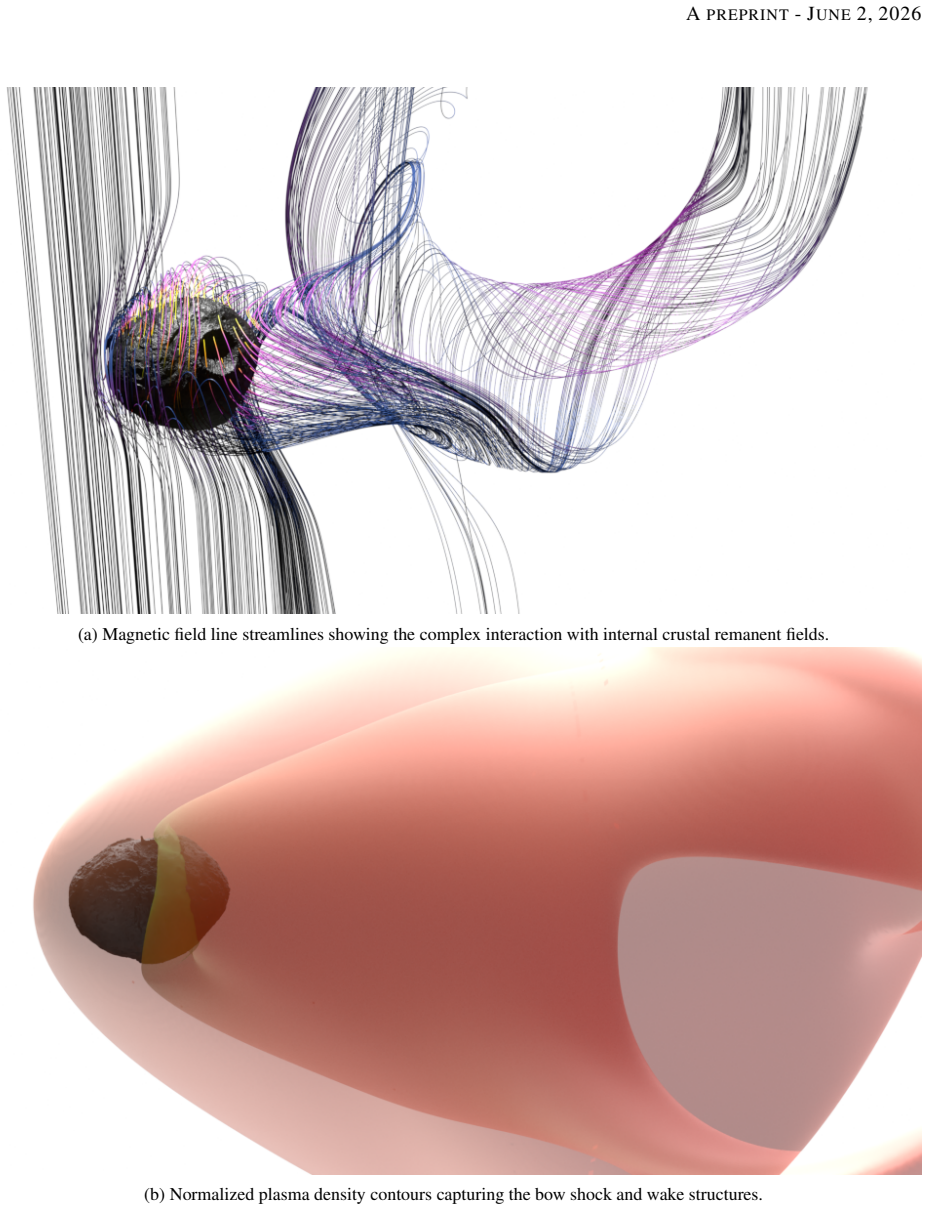
- The asteroid demonstration indicates the framework can handle moving boundaries and time-varying magnetic fields in a single consistent scheme.
- Long-time conservation properties could be tested by extending the method to periodic or closed-domain MHD problems.
Load-bearing premise
Strang splitting followed by independent kinetic transport of each variable preserves the original coupled MHD physics without significant errors or extra coupling terms.
What would settle it
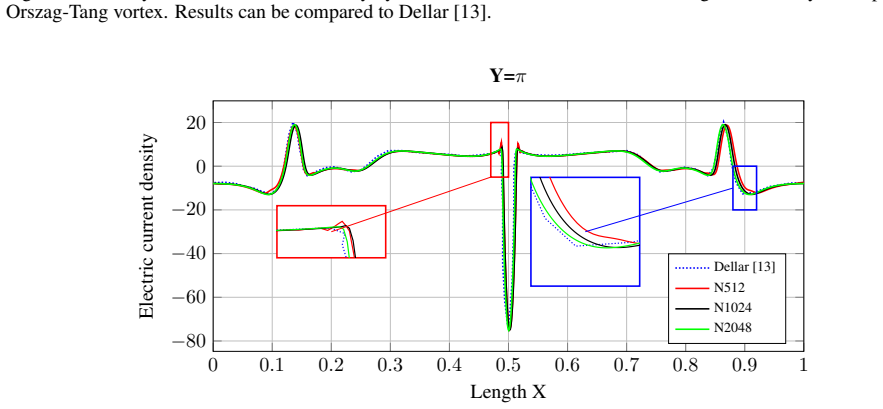
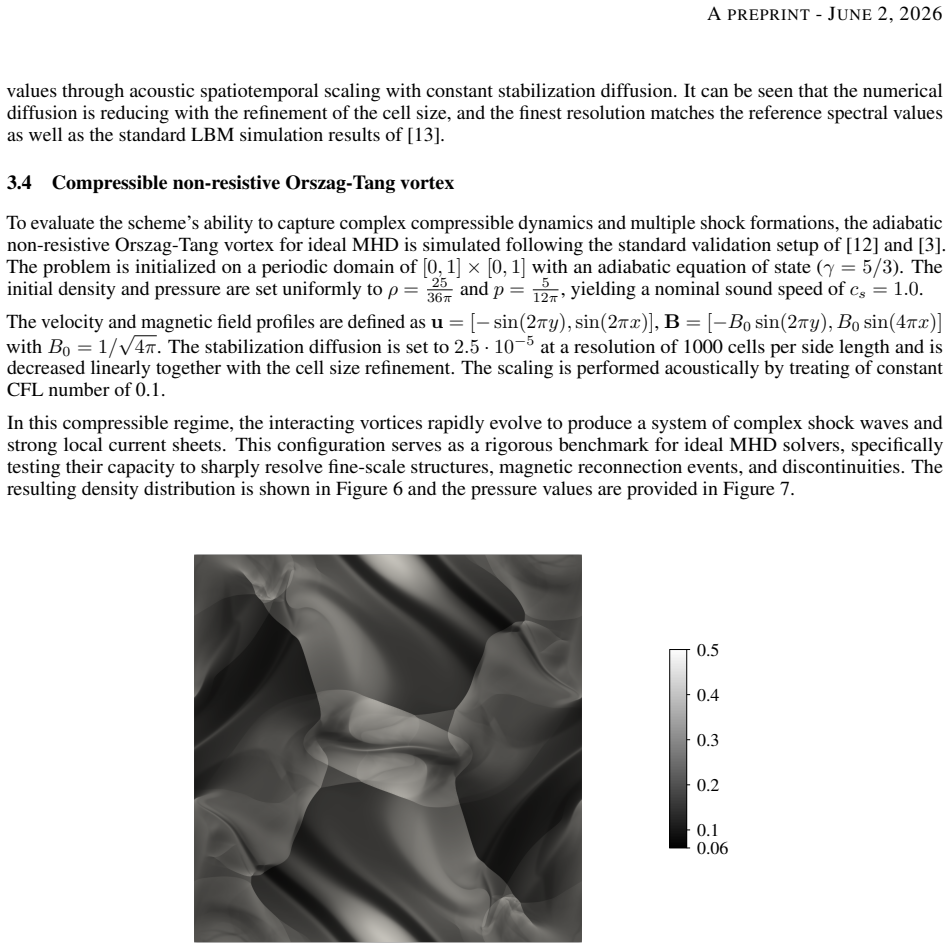
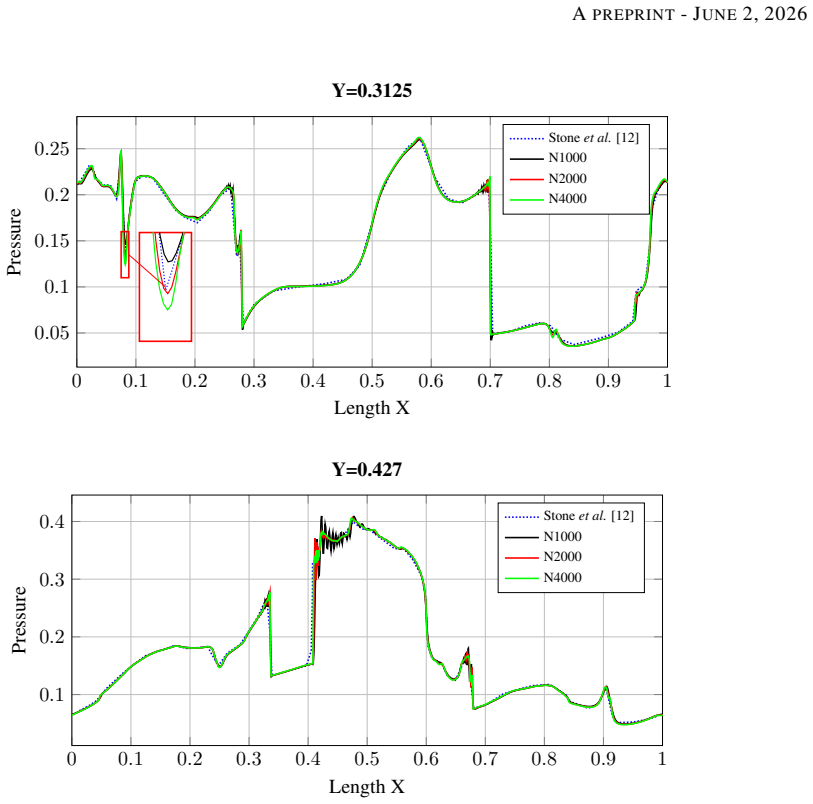
Compare results of the method on the Orszag-Tang vortex test case against a reference solution from a high-resolution finite-volume MHD code and check for differences in magnetic field structure or total energy conservation beyond numerical tolerance.
Figures
read the original abstract
The simulation of magnetohydrodynamic (MHD) flows presents a highly complex, tightly coupled transport problem that poses severe numerical and computational demands. Towards this, we propose a novel class of Lattice Boltzmann Methods (LBM) schemes capable of solving a wide range of transport equation systems with high computational efficiency and scalability. Our approach exploits the algorithmic structure of kinetic formulations to separately transport all state variables of Strang-splitted conservation equations alongside their characteristics, yielding decoupled, fully local operations. To demonstrate the capability of this framework on complex, numerically demanding multiphysics interactions, we apply it to these MHD flows. Specifically, we discretize ideal compressible and resistive incompressible MHD systems, which naturally encompass hydrodynamic limits such as the compressible Euler and incompressible Navier-Stokes equations. Rigorous performance analysis of the implementation within the platform-transparent multi-physics framework OpenLB demonstrates up to 98.9\% of the hardware roofline. We validate our approach against established incompressible and compressible MHD benchmarks across multiple resolutions. Finally, we simulate a moving, surface-resolved magnetized asteroid modeled after 16 Psyche in a supersonic early solar wind flow. This showcases the framework's advanced support for dynamic solid geometries, shifting magnetic fields, and fluid-structure interaction.
Editorial analysis
A structured set of objections, weighed in public.
Referee Report
Summary. The manuscript proposes a novel class of Lattice Boltzmann Methods for transport equation systems that uses Strang splitting of the conservation laws followed by independent, fully local kinetic transport of each state variable (density, momentum, energy, B) along its own characteristics. The framework is applied to ideal compressible MHD and resistive incompressible MHD (recovering Euler and Navier-Stokes limits), implemented in OpenLB with reported roofline performance up to 98.9%, validated on standard incompressible and compressible MHD benchmarks at multiple resolutions, and demonstrated on a 3D fluid-structure interaction problem involving a surface-resolved magnetized asteroid in supersonic solar wind.
Significance. If the decoupled Strang-split kinetic scheme accurately reproduces the cross-coupling terms (Lorentz force, induction) without additional operators, the approach would offer a computationally efficient and highly scalable route to large-scale MHD simulations, particularly those involving complex moving geometries. The explicit performance analysis and the dynamic-geometry demonstration are concrete strengths that would be of interest to the computational fluid dynamics community.
major comments (2)
- [§3] §3 (Discretization of MHD systems): The central claim that 'no additional coupling terms' are required rests on the assertion that independent streaming plus collision recovers the MHD cross terms (v·∇B, B·∇v, J×B). No a-priori truncation-error estimate for the Strang splitting applied to the induction and momentum equations is provided, nor is it shown how the collision operator restores the missing instantaneous couplings at the discrete level. This is load-bearing for the MHD claims because Alfvén-wave propagation and divergence preservation are sensitive to splitting lag.
- [§4.2] §4.2 (Validation benchmarks): While convergence against established MHD test cases is reported, the manuscript does not quantify the splitting-induced phase-speed or divergence errors (e.g., via a dedicated table of L2 errors versus splitting time-step size). Without this, it is difficult to assess whether the observed agreement is due to the kinetic formulation or to sufficiently small splitting steps.
minor comments (3)
- [Figure 7] Figure 7 (asteroid simulation): the surface mesh resolution and the magnetic Reynolds number used in the run should be stated explicitly so that the fluid-structure interaction result can be reproduced.
- Notation: the symbol for the magnetic field is sometimes B and sometimes b; a single consistent symbol (and its units) should be used throughout.
- [§5] The performance roofline analysis in §5 would benefit from a brief statement of the arithmetic intensity assumed for the decoupled streaming step.
Simulated Author's Rebuttal
We thank the referee for their constructive comments. We address each major point below, indicating where revisions will be made to clarify the Strang-split kinetic scheme.
read point-by-point responses
-
Referee: [§3] §3 (Discretization of MHD systems): The central claim that 'no additional coupling terms' are required rests on the assertion that independent streaming plus collision recovers the MHD cross terms (v·∇B, B·∇v, J×B). No a-priori truncation-error estimate for the Strang splitting applied to the induction and momentum equations is provided, nor is it shown how the collision operator restores the missing instantaneous couplings at the discrete level. This is load-bearing for the MHD claims because Alfvén-wave propagation and divergence preservation are sensitive to splitting lag.
Authors: The Strang splitting is performed on the continuous conservation laws, separating advection from sources. Each resulting equation is discretized via LBM, with collision operators explicitly incorporating the local MHD sources (Lorentz force, induction contributions) at every step. This restores the cross-couplings discretely through collision rather than additional streaming. While the manuscript does not contain a formal a-priori truncation-error estimate, consistency follows from the kinetic recovery of the target equations and is supported by the reported benchmarks. We will add a short discussion of the expected splitting error order in the revised §3. revision: partial
-
Referee: [§4.2] §4.2 (Validation benchmarks): While convergence against established MHD test cases is reported, the manuscript does not quantify the splitting-induced phase-speed or divergence errors (e.g., via a dedicated table of L2 errors versus splitting time-step size). Without this, it is difficult to assess whether the observed agreement is due to the kinetic formulation or to sufficiently small splitting steps.
Authors: We agree that explicit quantification of splitting-induced errors would strengthen the validation. We will add results from a dedicated test (circularly polarized Alfvén wave) in which the splitting time-step size is varied, together with a table of L2 errors for phase speed and magnetic divergence. revision: yes
Circularity Check
No circularity: algorithmic proposal rests on independent structure, not self-referential reduction.
full rationale
The manuscript proposes a new LBM class via Strang splitting of conservation laws followed by independent kinetic transport of each state variable. No equations, fitted parameters, or predictions are shown that reduce by construction to inputs (e.g., no fitted ratio renamed as prediction, no self-citation chain invoked as uniqueness theorem). The central claim is an algorithmic construction whose validity is asserted to be demonstrated by benchmarks; it does not contain the enumerated circular patterns. This is the common honest outcome for a methods paper whose derivation chain is self-contained against external validation.
Axiom & Free-Parameter Ledger
axioms (1)
- domain assumption Strang splitting of conservation equations is valid and enables decoupled transport for MHD systems
Reference graph
Works this paper leans on
-
[1]
A unified gas kinetic scheme for continuum and rarefied flows v: Multiscale and multi-component plasma transport.Communications in Computational Physics, 22(5):1175–1223, 2017
Chang Liu and Kun Xu. A unified gas kinetic scheme for continuum and rarefied flows v: Multiscale and multi-component plasma transport.Communications in Computational Physics, 22(5):1175–1223, 2017
2017
-
[2]
High-order upwind schemes for multidimensional magnetohydrodynam- ics.The Astrophysical Journal, 530(1):508–524, 2000
Pasquale Londrillo and Luca Del Zanna. High-order upwind schemes for multidimensional magnetohydrodynam- ics.The Astrophysical Journal, 530(1):508–524, 2000
2000
-
[3]
Astrophysical weighted particle magnetohydrodynamics.Monthly Notices of the Royal Astronomical Society, 414(1):129–154, 2011
Evghenii Gaburov and Keigo Nitadori. Astrophysical weighted particle magnetohydrodynamics.Monthly Notices of the Royal Astronomical Society, 414(1):129–154, 2011
2011
-
[4]
The Lattice Boltzmann Method: Principles and Practice
Timm Krueger, Halim Kusumaatmaja, Alexandr Kuzmin, Orest Shardt, Goncalo Silva, and Erlend Magnus Viggen. The Lattice Boltzmann Method: Principles and Practice. Graduate Texts in Physics. Springer, 2016
2016
-
[5]
Gauthier Wissocq, Yongle Liu, and Rémi Abgrall. A positive- and bound-preserving vectorial lattice boltzmann method in two dimensions.arXiv preprint arXiv:2411.15001, 2024
-
[6]
Simulation of strong nonlinear waves with vectorial lattice Boltzmann schemes.International Journal of Modern Physics C, 25(12):1441014, 2014
François Dubois. Simulation of strong nonlinear waves with vectorial lattice Boltzmann schemes.International Journal of Modern Physics C, 25(12):1441014, 2014. 12 pages
2014
-
[7]
On the kinetic theory of rarefied gases.Communications on Pure and Applied Mathematics, 2(4):331–407, 1949
Harold Grad. On the kinetic theory of rarefied gases.Communications on Pure and Applied Mathematics, 2(4):331–407, 1949
1949
-
[8]
Regularization of grad’s 13 moment equations: Derivation and linear analysis.Physics of Fluids, 15(9):2668–2680, 09 2003
Henning Struchtrup and Manuel Torrilhon. Regularization of grad’s 13 moment equations: Derivation and linear analysis.Physics of Fluids, 15(9):2668–2680, 09 2003
2003
-
[9]
On the construction and comparison of difference schemes.SIAM Journal on Numerical Analysis, 5(3):506–517, 1968
Gilbert Strang. On the construction and comparison of difference schemes.SIAM Journal on Numerical Analysis, 5(3):506–517, 1968
1968
-
[10]
Lattice boltzmann for linear elastodynamics: Peri- odic problems and dirichlet boundary conditions.Computer Methods in Applied Mechanics and Engineering, 433:117469, 2025
Oliver Boolakee, Martin Geier, and Laura De Lorenzis. Lattice boltzmann for linear elastodynamics: Peri- odic problems and dirichlet boundary conditions.Computer Methods in Applied Mechanics and Engineering, 433:117469, 2025
2025
-
[11]
Modeling of nonequilibrium effects in a compressible plasma based on the lattice boltzmann method.Physics of Plasmas, 31(9):093902, 2024
Haoyu Huang, Ke Jin, Kai Li, and Xiaojing Zheng. Modeling of nonequilibrium effects in a compressible plasma based on the lattice boltzmann method.Physics of Plasmas, 31(9):093902, 2024
2024
-
[12]
Stone, Thomas A
James M. Stone, Thomas A. Gardiner, Peter Teuben, John F. Hawley, and Jacob B. Simon. Athena: A new code for astrophysical mhd.The Astrophysical Journal Supplement Series, 178(1):137, sep 2008
2008
-
[13]
Paul J. Dellar. Lattice boltzmann magnetohydrodynamics with current-dependent resistivity.Journal of Computa- tional Physics, 237:115–131, 2013
2013
-
[14]
Krause, Adrian Kummerländer, Samuel J
Mathias J. Krause, Adrian Kummerländer, Samuel J. Avis, Halim Kusumaatmaja, Davide Dapelo, Fabian Klemens, Maximilian Gaedtke, Nicolas Hafen, Albert Mink, Robin Trunk, Jan E. Marquardt, Marie Luise Maier, Marc Haussmann, and Stephan Simonis. Openlb—open source lattice boltzmann code.Computers & Mathematics with Applications, 81:258–288, 2021
2021
-
[15]
Adrian Kummerländer, Márcio Dorn, Martin Frank, and Mathias J. Krause. Implicit propagation of directly addressed grids in Lattice Boltzmann Methods.Concurrency and Computation: Practice and Experience, 35(8):e7509, 2023
2023
-
[16]
Adrian Kummerländer, Fedor Bukreev, Leonardo Dorneles, Marcio Dorn, Shota Ito, and Mathias J. Krause. A hardware abstraction for exascale lattice boltzmann simulations: Rotor-resolved wind farms on aurora and lumi, 2026
2026
-
[17]
Adrian Kummerländer, Fedor Bukreev, Dennis Teutscher, Márcio Dorn, and Mathias J. Krause. Optimization of single node load balancing for Lattice Boltzmann Method on heterogeneous high performance computers.Journal of Parallel and Distributed Computing, 206, 2025
2025
-
[18]
P. L. Bhatnagar, E. P. Gross, and M. Krook. A model for collision processes in gases. i. small amplitude processes in charged and neutral one-component systems.Phys. Rev., 94:511–525, May 1954
1954
-
[19]
Lattice boltzmann method with regularized pre-collision distribution functions
Jonas Latt and Bastien Chopard. Lattice boltzmann method with regularized pre-collision distribution functions. Math. Comput. Simul., 72(2–6):165–168, September 2006
2006
-
[20]
Ginzburg, D
I. Ginzburg, D. d’Humières, and A. Kuzmin. Two-relaxation-time lattice boltzmann scheme: About parametriza- tion, velocity, pressure and mixed boundary conditions.Communications in Computational Physics, 3(2):427–478, Mar. 2018
2018
-
[21]
P. V . Coveney, S. Succi, Dominique d’Humières, Irina Ginzburg, Manfred Krafczyk, Pierre Lallemand, and Li-Shi Luo. Multiple–relaxation–time lattice boltzmann models in three dimensions.Philosophical Transactions of the Royal Society A: Mathematical, Physical and Engineering Sciences, 360(1792):437–451, 03 2002. 16 APREPRINT- JUNE2, 2026
2002
-
[22]
Discrete lattice effects on the forcing term in the lattice boltzmann method.Phys
Zhaoli Guo, Chuguang Zheng, and Baochang Shi. Discrete lattice effects on the forcing term in the lattice boltzmann method.Phys. Rev. E, 65:046308, Apr 2002
2002
-
[23]
Zhenhua Chai and T. S. Zhao. Lattice boltzmann model for the convection-diffusion equation.Phys. Rev. E, 87:063309, Jun 2013
2013
-
[24]
Megala Anandan and S. V . Raghurama Rao. On lattice boltzmann methods based on vector-kinetic models for hyperbolic partial differential equations.Computers & Fluids, 280:106348, 2024
2024
-
[25]
Stability analysis of the vectorial lattice-boltzmann method, 2024
Kévin Guillon, Romane Hélie, and Philippe Helluy. Stability analysis of the vectorial lattice-boltzmann method, 2024
2024
-
[26]
Powell, Philip L
Kenneth G. Powell, Philip L. Roe, Timur J. Linde, Tamas I. Gombosi, and Darren L. De Zeeuw. A solution- adaptive upwind scheme for ideal magnetohydrodynamics.Journal of Computational Physics, 154(2):284–309, 1999
1999
-
[27]
Krause, Fabian Klemens, Thomas Henn, Robin Trunk, and Hermann Nirschl
Mathias J. Krause, Fabian Klemens, Thomas Henn, Robin Trunk, and Hermann Nirschl. Particle flow simulations with homogenised lattice boltzmann methods.Particuology, 34:1–13, 2017
2017
-
[28]
Adrian Kummerländer, B. Tur, M. Haase, Fedor Bukreev, M. Döllinger, Mathias J. Krause, and S. Kniesburges. Efficient fluid structure interaction simulation of vocal fold oscillations using a homogenized Lattice Boltzmann Method.Computer Methods in Applied Mechanics and Engineering, 457:119009, 2026
2026
-
[29]
Krause, and Fedor Bukreev
Adrian Kummerländer, Shota Ito, Maximilian Schecher, Davide Dapelo, Stephan Simonis, Mathias J. Krause, and Fedor Bukreev. Efficient wall-modelled large eddy simulation of rotors using homogenized Lattice Boltzmann Methods.International Journal of Numerical Methods for Heat & Fluid Flow, 2026
2026
-
[30]
A penalization method to take into account obstacles in incompressible viscous flows.Numerische Mathematik, 81(4):497–520, February 1999
Philippe Angot, Charles-Henri Bruneau, and Pierre Fabrie. A penalization method to take into account obstacles in incompressible viscous flows.Numerische Mathematik, 81(4):497–520, February 1999
1999
-
[31]
An upwind differencing scheme for the equations of ideal magnetohydrodynamics.Journal of Computational Physics, 75(2):400–422, 1988
M Brio and C.C Wu. An upwind differencing scheme for the equations of ideal magnetohydrodynamics.Journal of Computational Physics, 75(2):400–422, 1988
1988
-
[32]
Krause, Adrian Kummerländer, Samuel J
Mathias J. Krause, Adrian Kummerländer, Samuel J. Avis, Halim Kusumaatmaja, Davide Dapelo, Fabian Klemens, Maximilian Gaedtke, Nicolas Hafen, Albert Mink, Robin Trunk, Jan E. Marquardt, Marie-Luise Maier, Marc Haussmann, and Stephan Simonis. Openlb—open source lattice boltzmann code.Computers & Mathematics with Applications, 2021
2021
-
[33]
Smith, Mateusz Paprocki, Ondˇrej ˇCertík, Sergey B
Aaron Meurer, Christopher P. Smith, Mateusz Paprocki, Ondˇrej ˇCertík, Sergey B. Kirpichev, Matthew Rocklin, AMiT Kumar, Sergiu Ivanov, Jason K. Moore, Sartaj Singh, Thilina Rathnayake, Sean Vig, Brian E. Granger, Richard P. Muller, Francesco Bonazzi, Harsh Gupta, Shivam Vats, Fredrik Johansson, Fabian Pedregosa, Matthew J. Curry, Andy R. Terrel, Štˇepán ...
2017
-
[34]
Shepard, Katherine De Kleer, Saverio Cambioni, Patrick A
Michael K. Shepard, Katherine De Kleer, Saverio Cambioni, Patrick A. Taylor, Anne K. Virkki, Edgard G. Rívera-Valentin, Carolina Rodriguez Sanchez-Vahamonde, Luisa Fernanda Zambrano-Marin, Christopher Magri, David Dunham, John Moore, and Maria Camarca. Asteroid 16 Psyche: Shape, Features, and Global Map.The Planetary Science Journal, 2(4):125, August 2021
2021
-
[35]
Asteroid Psyche 3D Model and Geometry
NASA Science. Asteroid Psyche 3D Model and Geometry. https://science.nasa.gov/solar-system/ asteroids/16-psyche/, 2025. Accessed: 2026-05-28
2025
-
[36]
Joachim Müller, Sven Simon, Uwe Motschmann, Josef Schüle, Karl-Heinz Glassmeier, and Gavin J. Pringle. A.I.K.E.F.: Adaptive hybrid model for space plasma simulations.Computer Physics Communications, 182(4):946– 966, April 2011
2011
-
[37]
Mejnertsen, J
L. Mejnertsen, J. P. Eastwood, H. Hietala, S. J. Schwartz, and J. P. Chittenden. Global MHD Simulations of the Earth’s Bow Shock Shape and Motion Under Variable Solar Wind Conditions.Journal of Geophysical Research: Space Physics, 123(1):259–271, January 2018
2018
-
[38]
Exner, D
W. Exner, D. Heyner, L. Liuzzo, U. Motschmann, D. Shiota, K. Kusano, and T. Shibayama. Coronal mass ejection hits mercury: A.I.K.E.F. hybrid-code results compared to MESSENGER data.Planetary and Space Science, 153:89–99, April 2018
2018
-
[39]
Koenders, K
C. Koenders, K. H. Glassmeier, I. Richter, H. Ranocha, and U. Motschmann. Dynamical features and spatial structures of the plasma interaction region of 67P/Churyumov–Gerasimenko and the solar wind.Planetary and Space Science, 105:101–116, January 2015
2015
-
[40]
Baptiste, Cristobal Rodero, Steven E
José Marín, Tiffany M.G. Baptiste, Cristobal Rodero, Steven E. Williams, Steven A. Niederer, and Ignacio García-Fernández. Sciblend: Advanced data visualization workflows within blender.Computers & Graphics, 130:104264, 2025. 17
2025
discussion (0)
Sign in with ORCID, Apple, or X to comment. Anyone can read and Pith papers without signing in.