Structure, Composition, and High-Field Superconductivity in Metal-Rich η-Carbide-Type Compounds
Pith reviewed 2026-06-28 17:49 UTC · model grok-4.3
The pith
η-carbide-type compounds include bulk superconductors with Tc up to 10 K and upper critical fields up to 30 T that violate the Pauli limit.
A machine-rendered reading of the paper's core claim, the machinery that carries it, and where it could break.
Core claim
η-carbide-type compounds have recently emerged as a diverse class of materials in the study of superconductivity. Several members have been found to be bulk superconductors with transition temperatures up to Tc ≈ 10 K and upper critical fields as high as μ0 Hc2(0) ≈ 30 T. The pronounced violation of the weak-coupling Pauli limit in many of these crystallographically high-symmetry materials is noteworthy.
What carries the argument
The η-carbide crystal structure, which hosts complex metallic bonding and high crystallographic symmetry that together shape the superconducting response.
If this is right
- Transition-metal composition can be varied systematically to tune Tc and Hc2 within the η-carbide family.
- High crystallographic symmetry does not preclude strong Pauli-limit violation, implying pairing mechanisms that remain robust against orbital and spin effects.
- Synthetic routes must overcome challenges in carbon or oxygen stoichiometry to access new members with potentially higher critical fields.
- Electronic-structure calculations can now be used to predict additional η-carbide superconductors before synthesis.
Where Pith is reading between the lines
- The same structural motif may appear in other metal-rich carbides or nitrides, offering a route to extend the family beyond the four compounds already measured.
- Comparison with other high-symmetry intermetallics could clarify whether the observed Pauli violation is tied to the specific bonding geometry of the η-carbide lattice.
- If the high Hc2 values prove intrinsic, these compounds become test cases for theories of superconductivity that operate near or beyond the conventional Pauli bound.
Load-bearing premise
The reviewed literature accurately identifies these phases as bulk superconductors whose measured Tc and Hc2 values reflect intrinsic properties rather than sample-dependent effects or measurement artifacts.
What would settle it
A specific-heat measurement on one of the cited compounds that shows no anomaly at the reported Tc, or a magnetization study that finds only surface superconductivity, would falsify the claim of intrinsic bulk high-field superconductivity.
Figures



read the original abstract
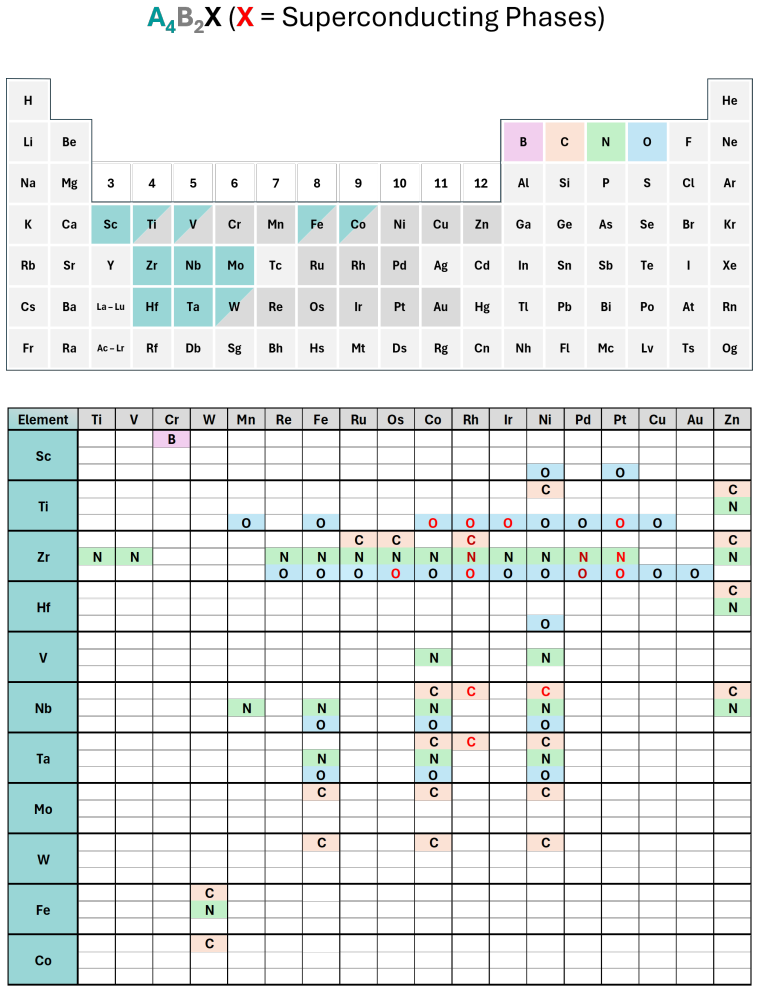
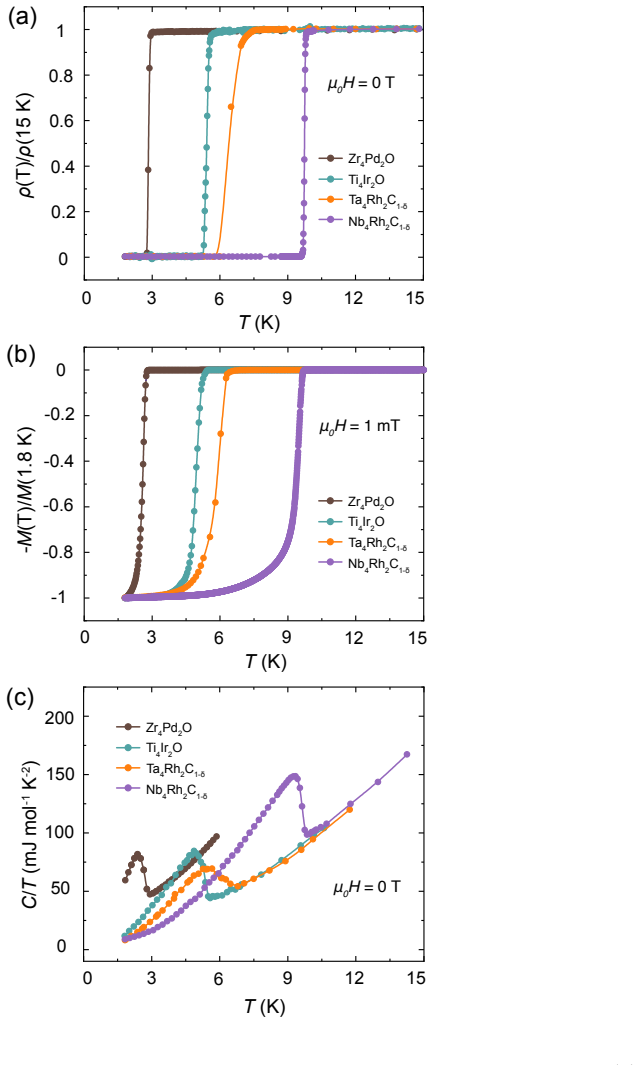
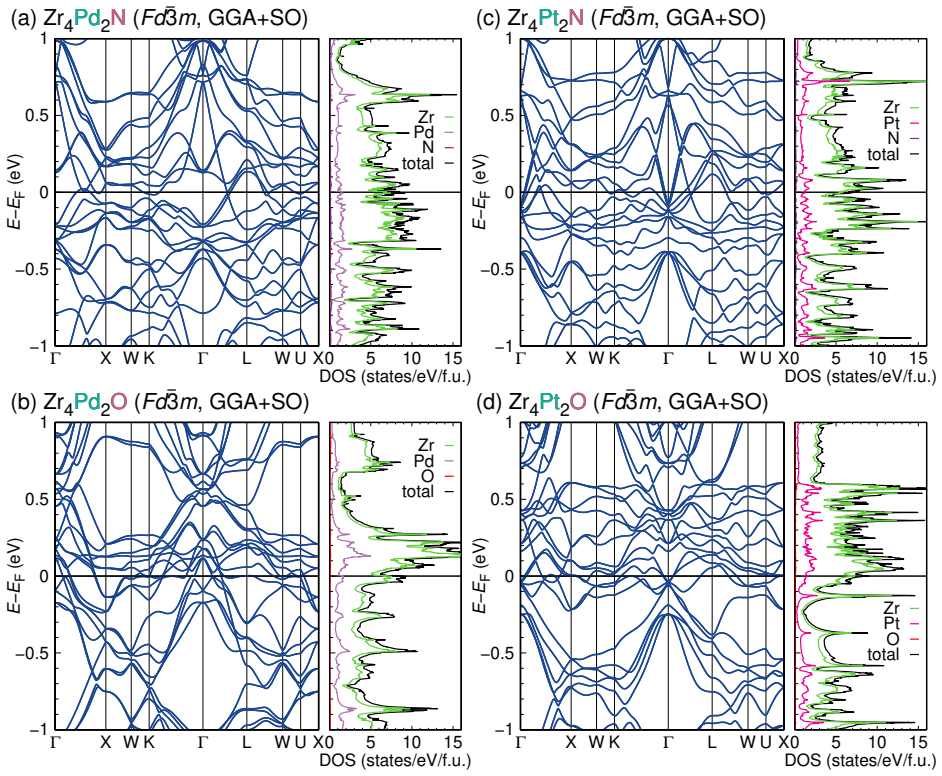
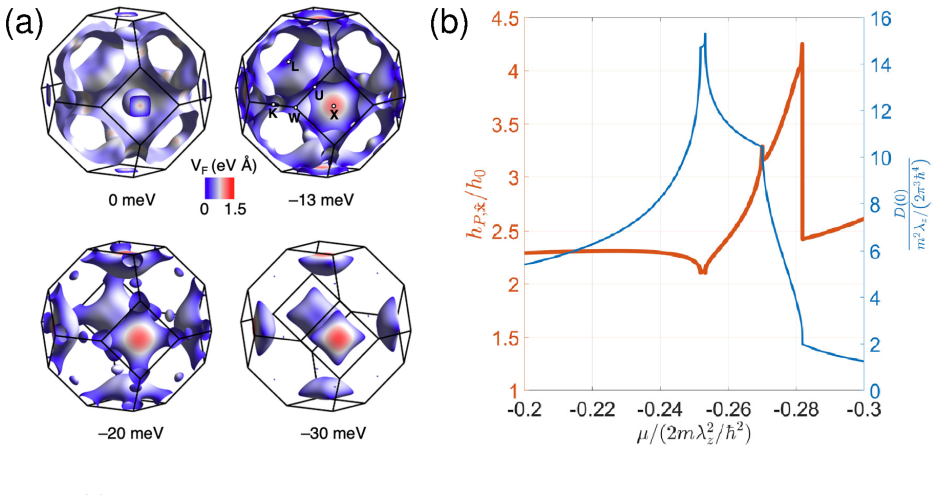
$\mathrm{\eta}$-Carbide-type compounds have recently emerged as a diverse class of materials in the study of superconductivity. These phases contribute to a growing family of metal-rich quantum materials that exhibit unusual superconducting properties emerging from complex metallic bonding. Several members of the $\mathrm{\eta}$-carbide-type phases have been found to be bulk superconductors -- such as Nb$_4$Rh$_2$C$_{1-\delta}$, Ta$_4$Rh$_2$C$_{1-\delta}$, Ti$_4$Ir$_2$O$_{1-\delta}$, and Ti$_4$Co$_2$O$_{1-\delta}$ -- with transition temperatures up to $T_{\rm c} \approx$ 10 K and upper critical fields as high as $\mu_0 H_{\rm c2}(0) \approx$ 30 T. Whereas the transition temperatures may fall within the range typical for intermetallic superconductors, the pronounced violation of the weak-coupling Pauli limit in many of these crystallographically high-symmetry materials is noteworthy. Here, we review recent progress on superconducting $\mathrm{\eta}$-carbide-type phases, emphasizing how crystal symmetry, synthetic challenges, transition-metal composition, and electronic structure govern their superconducting properties. Furthermore, we outline open questions and future directions, including the possible discovery of new $\mathrm{\eta}$-carbide-type materials.
Editorial analysis
A structured set of objections, weighed in public.
Referee Report
Summary. This review paper summarizes recent progress on superconducting η-carbide-type phases, focusing on their structure, composition, and high-field properties. It states that several members, including Nb₄Rh₂C₁₋δ, Ta₄Rh₂C₁₋δ, Ti₄Ir₂O₁₋δ, and Ti₄Co₂O₁₋δ, are bulk superconductors with Tc up to ≈10 K and μ₀Hc₂(0) up to ≈30 T, with pronounced violations of the weak-coupling Pauli limit in high-symmetry materials. The manuscript discusses the roles of crystal symmetry, synthetic challenges, transition-metal composition, and electronic structure, while outlining open questions and future directions.
Significance. If the reviewed literature holds, the paper offers a timely overview of an emerging class of metal-rich superconductors exhibiting high upper critical fields, which may help consolidate knowledge and guide synthesis efforts in intermetallic quantum materials. The explicit highlighting of Pauli-limit violations in crystallographically simple phases is a useful observation for the superconductivity community.
major comments (1)
- [Abstract] Abstract, paragraph on specific compounds: the central claim that Nb₄Rh₂C₁₋δ, Ta₄Rh₂C₁₋δ, Ti₄Ir₂O₁₋δ, and Ti₄Co₂O₁₋δ are bulk superconductors with the stated Tc and μ₀Hc₂(0) values reflecting intrinsic properties is presented as established fact drawn from prior work, but the manuscript provides no discussion or citation of the specific criteria (e.g., specific-heat anomaly size, shielding fraction, or comparison of resistivity vs. magnetization transitions) used to establish bulk behavior versus possible filamentary or impurity contributions in these metal-rich phases.
Simulated Author's Rebuttal
We thank the referee for their careful reading of the manuscript and for the constructive comment on the presentation of bulk superconductivity claims. We address the point below and will make the requested revision.
read point-by-point responses
-
Referee: [Abstract] Abstract, paragraph on specific compounds: the central claim that Nb₄Rh₂C₁₋δ, Ta₄Rh₂C₁₋δ, Ti₄Ir₂O₁₋δ, and Ti₄Co₂O₁₋δ are bulk superconductors with the stated Tc and μ₀Hc₂(0) values reflecting intrinsic properties is presented as established fact drawn from prior work, but the manuscript provides no discussion or citation of the specific criteria (e.g., specific-heat anomaly size, shielding fraction, or comparison of resistivity vs. magnetization transitions) used to establish bulk behavior versus possible filamentary or impurity contributions in these metal-rich phases.
Authors: We agree that the abstract states the bulk nature of superconductivity in these compounds without explicitly summarizing the experimental criteria used to establish it. Although the cited original works contain the relevant data (specific-heat jumps, shielding fractions, and comparisons of resistive and magnetic transitions), the review manuscript itself does not discuss or cite these criteria in one place. We will revise the abstract and add a concise paragraph (or footnote) in the introduction that summarizes the key evidence from the literature for bulk behavior in each of the four compounds, thereby addressing the concern directly. revision: yes
Circularity Check
Review paper presents no derivations or predictions; claims rest on cited literature
full rationale
This manuscript is a literature review summarizing prior experimental reports on η-carbide superconductors. It contains no equations, no new fits, no predictions derived from models, and no derivation chain that could reduce to its own inputs. All numerical claims (Tc ≈ 10 K, μ0Hc2(0) ≈ 30 T, Pauli-limit violation) are explicitly attributed to earlier publications on specific compounds. Because no load-bearing step equates a claimed result to a fitted parameter or self-citation by construction, the circularity score is 0.
Axiom & Free-Parameter Ledger
Reference graph
Works this paper leans on
-
[1]
Jack and K
D. Jack and K. Jack, Invited review: carbides and nitrides in steel, Materials Science and Engineering 11, 1 (1973)
1973
-
[2]
Taylor and K
A. Taylor and K. Sachs, A new complex eta-carbide, Nature 169, 411 (1952)
1952
-
[3]
Hirotsu and S
Y. Hirotsu and S. Nagakura, Crystal structure and morphology of the carbide precipitated from martensitic high carbon steel during the first stage of tempering, Acta Metallurgica 20, 645 (1972)
1972
-
[4]
Takeda, A metallographic investigation of the ternary alloys of the iron-tungsten-carbon system
S. Takeda, A metallographic investigation of the ternary alloys of the iron-tungsten-carbon system. I. On the carbides in tungsten steels, Tech. Rept. Tohuku Imp. Univ. 9, 483 (1930). 25
1930
-
[5]
Takeda, A metallographic investigation of the ternary alloys of the iron-tungsten-carbon system
S. Takeda, A metallographic investigation of the ternary alloys of the iron-tungsten-carbon system. II. Transformation and constitution of tungsten steels, Tech. Rept. Tohuku Imp. Univ. 9, 627 (1930)
1930
-
[6]
Takeda, A metallographic investigation of the ternary alloys of the iron-tungsten-carbon system
S. Takeda, A metallographic investigation of the ternary alloys of the iron-tungsten-carbon system. III. The equilibrium diagram of the Fe–W–C system, Tech. Rept. Tohuku Imp. Univ. 10, 42 (1931)
1931
-
[7]
Takeda, A metallographic study of the action of the cementing materials for cemented tungsten carbide, Science Rept Tohoku Univ, Honda Anniv , 864 (1936)
S. Takeda, A metallographic study of the action of the cementing materials for cemented tungsten carbide, Science Rept Tohoku Univ, Honda Anniv , 864 (1936)
1936
-
[8]
Daeves, Grenzen der L¨ oslichkeit f¨ ur Kohlenstoff in tern¨ aren St¨ ahlen
K. Daeves, Grenzen der L¨ oslichkeit f¨ ur Kohlenstoff in tern¨ aren St¨ ahlen. II. Das System Chrom- Eisen-Kohlenstoff, Z. Allg. Anorg. Chem. 118, 67 (1921)
1921
-
[9]
Adelsk¨ old, A
V. Adelsk¨ old, A. Sundelin, and A. Westgren, Carbide in kohlenstoffhaltigen legierungen von wolfram und molybd¨ an mit chrom, mangan, eisen, kobalt und nickel, Zeitschrift f¨ ur anorgan- ische und allgemeine Chemie 212, 401 (1933)
1933
-
[10]
Nohara, Metal-rich compounds: A new platform for superconductivity research, JPSJ News Comments 21 (2024)
M. Nohara, Metal-rich compounds: A new platform for superconductivity research, JPSJ News Comments 21 (2024)
2024
-
[11]
C. R. Weinberger and G. B. Thompson, Review of phase stability in the group IVB and VB transition-metal carbides, J. Am. Ceram. Soc. 101, 4401 (2018)
2018
-
[12]
Schwarz, Band structure and chemical bonding in transition metal carbides and nitrides, CRC Crit
K. Schwarz, Band structure and chemical bonding in transition metal carbides and nitrides, CRC Crit. Rev. Solid State Mater. Sci. 13, 211 (1987)
1987
-
[13]
Giorgi, E
A. Giorgi, E. Szklarz, E. Storms, A. L. Bowman, and B. Matthias, Effect of composition on the superconducting transition temperature of tantalum carbide and niobium carbide, Phys. Rev. 125, 837 (1962)
1962
-
[14]
Simon, Superconductivity and chemistry, Angew
A. Simon, Superconductivity and chemistry, Angew. Chem. Int. Ed. 36, 1788 (1997)
1997
-
[15]
Kobayashi, K
K. Kobayashi, K. Horigane, R. Horie, and J. Akimitsu, Superconductivity of carbides, in Physics and Chemistry of Carbon-Based Materials: Basics and Applications (Springer, 2019) pp. 149–209
2019
-
[16]
T. E. Weller, M. Ellerby, S. S. Saxena, R. P. Smith, and N. T. Skipper, Superconductivity in the intercalated graphite compounds C 6Yb and C 6Ca, Nat. Phys. 1, 39 (2005)
2005
-
[17]
Mazin, Intercalant-driven superconductivity in YbC6 and CaC6, Phys
I. Mazin, Intercalant-driven superconductivity in YbC6 and CaC6, Phys. Rev. Lett. 95, 227001 (2005). 26
2005
-
[18]
A. Y. Ganin, Y. Takabayashi, Y. Z. Khimyak, S. Margadonna, A. Tamai, M. J. Rosseinsky, and K. Prassides, Bulk superconductivity at 38 K in a molecular system, Nat. Mater. 7, 367 (2008)
2008
-
[19]
A. Y. Ganin, Y. Takabayashi, P. Jegliˇ c, D. Arˇ con, A. Potoˇ cnik, P. J. Baker, Y. Ohishi, M. T. McDonald, M. D. Tzirakis, A. McLennan, et al., Polymorphism control of superconductivity and magnetism in Cs 3C60 close to the Mott transition, Nature 466, 221 (2010)
2010
-
[20]
H. Stadelmaier, Metal-rich metal-metalloid phases, in Developments in the Structural Chem- istry of Alloy Phases: Based on a symposium sponsored by the Committee on Alloy Phases of the Institute of Metals Division, the Metallurgical Society, American Institute of Mining, Metallurgical and Petroleum Engineers, Cleveland, Ohio, October, 1967 (Springer, 1969...
1967
-
[21]
Ku, Effect of composition on the superconductivity of the E9 3 phase in the ternary Nb–Rh–C system, Physica B+C 135, 417 (1985)
H. Ku, Effect of composition on the superconductivity of the E9 3 phase in the ternary Nb–Rh–C system, Physica B+C 135, 417 (1985)
1985
-
[22]
L. Shi, K. Ma, B. Ruan, N. Wang, J. Hou, P. Shan, P. Yang, J. Sun, G. Chen, Z. Ren, et al., Nonmonotonic superconducting transition temperature and large bulk modulus in the alloy superconductor Nb4Rh2C1– δ, Phys. Rev. B 110, 214520 (2024)
2024
-
[23]
K. Ma, K. Gornicka, R. Lef` evre, Y. Yang, H. M. Rønnow, H. O. Jeschke, T. Klimczuk, and F. O. von Rohr, Superconductivity with high upper critical field in the cubic centrosymmetric η-carbide Nb4Rh2C1– δ, ACS Materials Au 1, 55 (2021)
2021
- [24]
-
[25]
Nowotny, Crystal chemistry of complex carbides and related compounds, Angew
H. Nowotny, Crystal chemistry of complex carbides and related compounds, Angew. Chem. Int. Ed. 11, 906 (1972)
1972
-
[26]
Nyman, S
H. Nyman, S. Andersson, B. G. Hyde, and M. O’Keeffe, The pyrochlore structure and its relatives, J. Solid State Chem. 26, 123 (1978)
1978
-
[27]
K. S. Weil and P. N. Kumta, Synthesis of a new ternary nitride, Fe 4W2N, with a unique η-carbide structure, J. Solid State Chem. 134, 302 (1997)
1997
-
[28]
Mueller and H
M. Mueller and H. W. Knott, The crystal structures of Ti 2Cu, Ti2Ni, Ti4Ni2O, and Ti4Cu2O, Trans. Metall. Soc. AIME 227, 674 (1963)
1963
-
[29]
Westgren, Complex chromium and iron carbides, Nature 132, 480 (1933)
A. Westgren, Complex chromium and iron carbides, Nature 132, 480 (1933). 27
1933
-
[30]
K. Ma, R. Lef` evre, K. Gornicka, H. O. Jeschke, X. Zhang, Z. Guguchia, T. Klimczuk, and F. O. von Rohr, Group-9 transition-metal suboxides adopting the filled-Ti 2Ni structure: A class of superconductors exhibiting exceptionally high upper critical fields, Chem. Mater. 33, 8722 (2021)
2021
-
[31]
Souissi, M
M. Souissi, M. H. F. Sluiter, T. Matsunaga, M. Tabuchi, M. J. Mills, and R. Sahara, Effect of mixed partial occupation of metal sites on the phase stability of γ-Cr23– xFexC6 (x = 0-3) carbides, Sci. Rep. 8, 7279 (2018)
2018
-
[32]
Westgren and G
A. Westgren and G. Phragm´ en, R¨ ontgenanalyse der Systeme Wolfram-Kohlenstoff und Molybd¨ an-Kohlenstoff, Z. Allg. Anorg. Chem.156, 27 (1926)
1926
-
[33]
T. Waki, S. Terazawa, Y. Tabata, F. Oba, C. Michioka, K. Yoshimura, S. Ikeda, H. Kobayashi, K. Ohoyama, and H. Nakamura, Non-Fermi-liquid behavior on an iron-based itinerant electron magnet Fe3Mo3N, J. Phys. Soc. Jpn. 79, 043701 (2010)
2010
-
[34]
T. Waki, S. Terazawa, T. Yamazaki, Y. Tabata, K. Sato, A. Kondo, K. Kindo, M. Yokoyama, Y. Takahashi, and H. Nakamura, Interplay between quantum criticality and geometric frus- tration in Fe3Mo3N with stella quadrangula lattice, Europhys. Lett. 94, 37004 (2011)
2011
-
[35]
J. M. Vandenberg, B. T. Matthias, E. Corenzwit, and H. Barz, Superconductivity of a new metastable phase of scandium-chromium, J. Solid State Chem. 18, 395 (1976)
1976
-
[36]
Ruan, M.-H
B.-B. Ruan, M.-H. Zhou, Q.-S. Yang, Y.-D. Gu, M.-W. Ma, G.-F. Chen, and Z.-A. Ren, Superconductivity with a violation of Pauli limit and evidences for multigap in η-carbide type Ti4Ir2O, Chin. Phys. Lett. 39, 027401 (2022)
2022
-
[37]
Karlsson, Metallic oxides with the structure of high-speed steel carbide, Nature 168, 558 (1951)
N. Karlsson, Metallic oxides with the structure of high-speed steel carbide, Nature 168, 558 (1951)
1951
-
[38]
Toth, Transition metal carbides and nitrides (Elsevier, 2014)
L. Toth, Transition metal carbides and nitrides (Elsevier, 2014)
2014
-
[39]
Kuo, The formation of η carbides, Acta Metall
K. Kuo, The formation of η carbides, Acta Metall. 1, 301 (1953)
1953
-
[40]
Bojarski and J
Z. Bojarski and J. Leciejewicz, Neutron diffraction study of the crystal structures of eta-phase iron–tungsten carbides., Arch. Hutnictwa 12, 255 (1967)
1967
-
[41]
Jeitschko, H
W. Jeitschko, H. Holleck, H. Nowotny, and F. Benesovsky, Phasen mit aufgef¨ ulltem Ti2Ni-typ, Monatsh. Chem. 95, 1004 (1964)
1964
-
[42]
Parthe, W
E. Parthe, W. Jeitschko, and V. Sadagopan, A neutron diffraction study of the Nowotny phase Mo45Si3C41, Acta Cryst. 19, 1031 (1965). 28
1965
-
[43]
L. Shi, K. Ma, J. Hou, P. Ying, N. Wang, X. Xiang, P. Yang, X. Yu, H. Gou, J. Sun, Y. Uwatoko, F. O. von Rohr, X. Zhou, B. Wang, and J. Cheng, Synergetic enhancement of hardness and toughness in new superconductors Ti 2Co and Ti 4Co2O, Chin. Phys. Lett. 42, 067302 (2025)
2025
-
[44]
L. E. Toth, Transition Metal Carbides and Nitrides, edited by J. L. Margrave (Academic Press Inc. (London), London, England, 1971)
1971
-
[45]
M. V. Nevitt, J. W. Downey, R. A. Morris, A further study of Ti 2Ni-type phases containing titanium, zirconium or hafnium, Trans. Metall. Soc. AIME 218, 1019 (1960)
1960
-
[46]
P. S. Rudman, J. Stringer, and R. I. Jaffee, Phase stability in metals and alloys , Vol. 1 (McGraw-Hill, 1967)
1967
-
[47]
Ku and D
H. Ku and D. Johnston, New superconducting ternary transition metal compounds with the E93-type structure, Chin. J. Phys. 22, 59 (1984)
1984
-
[48]
Holleck and F
H. Holleck and F. Th¨ ummler, Tern¨ are Komplex-carbide, -nitride und -oxide mit teilweise aufgef¨ ullter Ti2Ni-Struktur, Monatsh. Chem. 98, 133 (1967)
1967
-
[49]
Holleck, H and Th¨ ummler, F, Untersuchungen ¨ uber die Bildung von nichtmetallstabilisierten zirkonreichen ¨Ubergangsmetallphasen, J. Nucl. Mater. 23, 88 (1967)
1967
-
[50]
Kotyk and H
M. Kotyk and H. H. Stadelmaier, Study of filled Ti 2Ni-type phases with hafnium, tantalum, and tungsten, Metall. Trans. 1, 899 (1970)
1970
-
[51]
K. Ma, S. L´ opez-Paz, K. Gornicka, H. O. Jeschke, T. Klimczuk, and F. O. von Rohr, Discovery of the type-II superconductor Ta4Rh2C1– δ with a high upper critical field, Phys. Rev. Res. 7, 023147 (2025)
2025
-
[52]
Ma, Superconductors with an η-carbide type structure: a class of superconductors exhibiting exceptionally high upper critical fields , Ph.D
K. Ma, Superconductors with an η-carbide type structure: a class of superconductors exhibiting exceptionally high upper critical fields , Ph.D. thesis, University of Zurich, Zurich (2022)
2022
-
[53]
H. Liu, X. Liang, Y. Liu, C. Fan, B. Wen, and L. Zhang, Crystal structure of Ti 4Ni2C, IUCrdata 9, x240043 (2024)
2024
-
[54]
J. S. Cantrell, R. C. Bowman, Jr, and A. J. Maeland, X-ray diffraction, neutron scattering and NMR studies of hydrides formed by Ti 4Pd2O and Zr 4Pd2O, J. Alloys Compd. 330-332, 191 (2002)
2002
-
[55]
C. B. Pollock and H. H. Stadelmaier, The eta carbides in the Fe-W-C and Co-W-C systems, Metall. Trans. 1, 767 (1970). 29
1970
-
[56]
I. Y. Zavaliy, Effect of oxygen content on hydrogen storage capacity of Zr-based η-phases, J. Alloys Compd. 291, 102 (1999)
1999
-
[57]
A. A. Lavrentyev, B. V. Gabrelian, P. N. Shkumat, E. I. Kopylova, I. Y. Nikiforov, I. Y. Zavaliy, A. K. Sinelnichenko, and O. Y. Khyzhun, Electronic properties of ZrMO ( M = Fe, Co, Ni) in- termetallic compounds: first-principles APW+LO calculations and X-ray photoelectron spec- troscopy data, Chem. Met. Alloys 6, 150 (2013)
2013
-
[58]
Mackay, G
R. Mackay, G. J. Miller, and H. F. Franzen, New oxides of the filled-Ti 2Ni type structure, J. Alloys Compd. 204, 109 (1994)
1994
-
[59]
S. R. Leonard, B. S. Snyder, L. Brewer, and A. M. Stacy, Structure determinations of two new ternary oxides: Ti3PdO and Ti4Pd2O, J. Solid State Chem. 92, 39 (1991)
1991
-
[60]
Watanabe, A
Y. Watanabe, A. Miura, C. Moriyoshi, A. Yamashita, and Y. Mizuguchi, Observation of superconductivity and enhanced upper critical field of η-carbide-type oxide Zr 4Pd2O, Sci. Rep. 13, 22458 (2023)
2023
-
[61]
K. Ma, J. Lago, and F. O. von Rohr, Superconductivity in theη-carbide-type oxides Zr4Rh2Ox, J. Alloys Compd. 796, 287 (2019)
2019
-
[62]
C. K. Poole, H. A. Farach, and R. J. Creswick, Handbook of superconductivity (Elsevier, 1999)
1999
-
[63]
B. T. Matthias, T. H. Geballe, and V. B. Compton, Superconductivity, Rev. Mod. Phys. 35, 1 (1963)
1963
-
[64]
Rotella, H
F. Rotella, H. Flotow, D. Gruen, and J. Jorgensen, Deuterium site occupation in the oxygen- stabilized η-carbides Zr 3V3ODx. I. Preparation and neutron powder diffraction, J. Chem. Phys. 79, 4522 (1983)
1983
-
[65]
T. Waki, T. Inoue, Y. Tabata, and H. Nakamura, Superconductivity in η-carbide-type ox- ide Zr 3V3O, Talk presented at the Japan Society of Powder and Powder Metallurgy Spring Meeting (2012), May 24, 2012
2012
-
[66]
D. Das, K. Ma, J. Jaroszynski, V. Sazgari, T. Klimczuk, F. O. von Rohr, and Z. Guguchia, Ti4Ir2O: A time reversal invariant fully gapped unconventional superconductor, Phys. Rev. B 110, 174507 (2024)
2024
-
[67]
A. M. Clogston, Upper limit for the critical field in hard superconductors, Phys. Rev. Lett. 9, 266 (1962)
1962
-
[68]
Maki, Effect of pauli paramagnetism on magnetic properties of high-field superconductors, Phys
K. Maki, Effect of pauli paramagnetism on magnetic properties of high-field superconductors, Phys. Rev. 148, 362 (1966). 30
1966
-
[69]
Kirshenbaum, P
K. Kirshenbaum, P. Syers, A. Hope, N. Butch, J. Jeffries, S. Weir, J. Hamlin, M. Maple, Y. Vohra, and J. Paglione, Pressure-induced unconventional superconducting phase in the topological insulator Bi 2Se3, Phys. Rev. Lett. 111, 087001 (2013)
2013
-
[70]
Tinkham, Introduction to superconductivity (Courier Corporation, 2004)
M. Tinkham, Introduction to superconductivity (Courier Corporation, 2004)
2004
-
[71]
Altarawneh, N
M. Altarawneh, N. Harrison, G. Li, L. Balicas, P. Tobash, F. Ronning, and E. Bauer, Super- conducting pairs with extreme uniaxial anisotropy in URu 2Si2, Phys. Rev. Lett. 108, 066407 (2012)
2012
-
[72]
Norman, Magnetic quantization and the upper critical field of superconductors, Phys
M. Norman, Magnetic quantization and the upper critical field of superconductors, Phys. Rev. B 42, 6762 (1990)
1990
-
[73]
K. Yoshimura, T.-C. Hsieh, H. Ma, D. V. Chichinadze, S. Zou, M. Stuckert, D. Graf, R. Nowell, M. A. Karim, D. Kozawa, et al. , g-factor enhanced upper critical field in superconducting PdTe2 due to quantum confinement, arXiv preprint arXiv:2508.07547 (2025)
-
[74]
J. J. Kinnunen, J. E. Baarsma, J.-P. Martikainen, and P. T¨ orm¨ a, The Fulde–Ferrell–Larkin– Ovchinnikov state for ultracold fermions in lattice and harmonic potentials: a review, Rep. Prog. Phys. 81, 046401 (2018)
2018
-
[75]
H. Wu, T. Shishidou, M. Weinert, and D. F. Agterberg, Large critical fields in superconducting Ti4Ir2O from spin-orbit coupling, Phys. Rev. B 111, 184506 (2025)
2025
-
[76]
Mao, X.-J
H.-K. Mao, X.-J. Chen, Y. Ding, B. Li, and L. Wang, Solids, liquids, and gases under high pressure, Rev. Mod. Phys. 90, 015007 (2018)
2018
-
[77]
L. Shi, B. Ruan, P. Yang, N. Wang, P. Shan, Z. Liu, J. Sun, Y. Uwatoko, G. Chen, Z. Ren, et al., Pressure-driven evolution of upper critical field and Fermi surface reconstruction in the strong-coupling superconductor Ti 4Ir2O, Phys. Rev. B 107, 174525 (2023)
2023
-
[78]
L. Shi, K. Ma, B. Ruan, Z. Wang, P. Yang, Z. Ren, J. Sun, G. Li, F. O. von Rohr, B. Wang, et al. , Two distinct superconducting regimes in ti4co2o under pressures, arXiv preprint arXiv:2605.01893 (2026)
work page internal anchor Pith review Pith/arXiv arXiv 2026
-
[79]
Ilyasov, A
A. Ilyasov, A. Ryzhkin, and V. Ilyasov, Electronic structure and chemical bond in carbides crystallizing in the Fe–W–C system, J. Struct. Chem. 49, 795 (2008)
2008
-
[80]
Suetin, I
D. Suetin, I. Shein, and A. Ivanovskii, Structural, electronic and magnetic properties of η carbides (Fe3W3C, Fe6W6C, Co3W3C and Co6W6C) from first principles calculations, Physica B 404, 3544 (2009). 31
2009
discussion (0)
Sign in with ORCID, Apple, or X to comment. Anyone can read and Pith papers without signing in.