Improving the resolution of double white dwarf systems with spaceborne gravitational wave observatories using a robust astrophysical prior
Pith reviewed 2026-06-28 16:28 UTC · model grok-4.3
The pith
Incorporating an astrophysical prior on white dwarf masses into iterative extraction resolves 7.3 percent more double white dwarf binaries in LISA data.
A machine-rendered reading of the paper's core claim, the machinery that carries it, and where it could break.
Core claim
The incorporation of the astrophysical prior into the iterative GBSIEVER pipeline increases the number of confidently resolved sources by approximately 7.3% for LISA-only data and 14.6% for the LISA-Taiji network, while also improving parameter estimation accuracy across multiple realistic DWD population realizations including the low-frequency confusion-dominated regime.
What carries the argument
The astrophysical prior linking the gravitational wave frequency f with its time derivative ḟ based on the mass limits of detached white dwarfs, integrated into the iterative GBSIEVER source extraction algorithm.
If this is right
- The number of confidently resolved double white dwarf sources increases by about 7.3% for LISA and 14.6% for the network.
- Parameter estimation accuracy for the resolved sources improves.
- The improvement holds in the low-frequency confusion-dominated regime.
- The gains are consistent across multiple realistic DWD population realizations.
Where Pith is reading between the lines
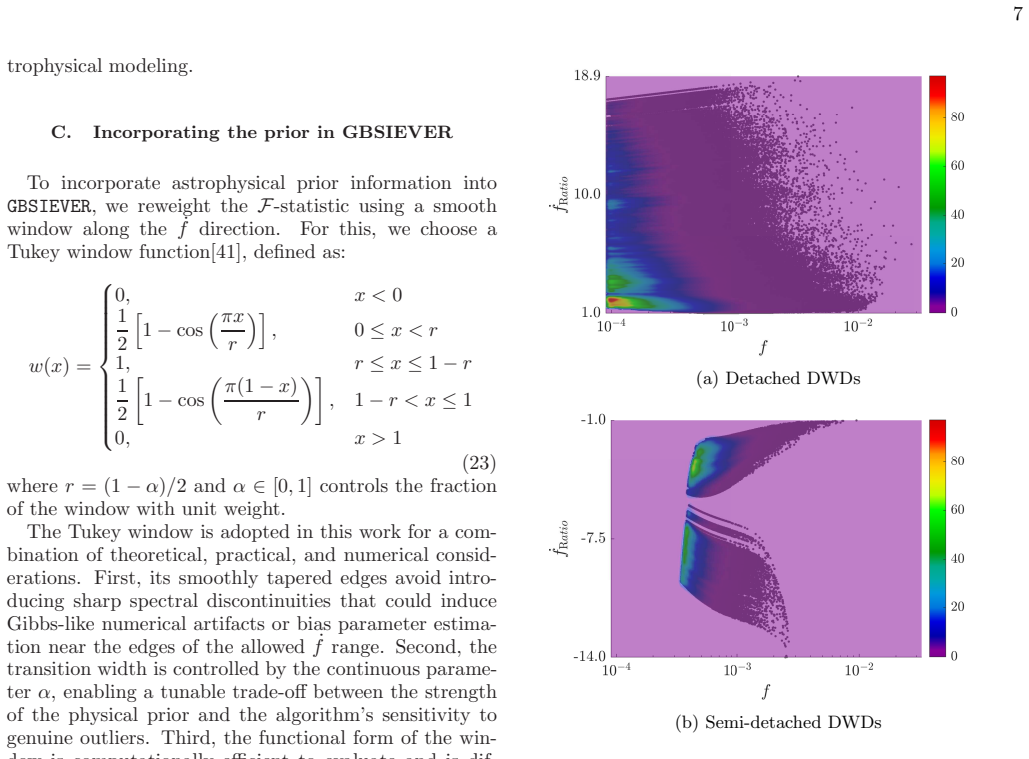
- Similar astrophysical priors could be developed for other types of gravitational wave sources to enhance iterative methods.
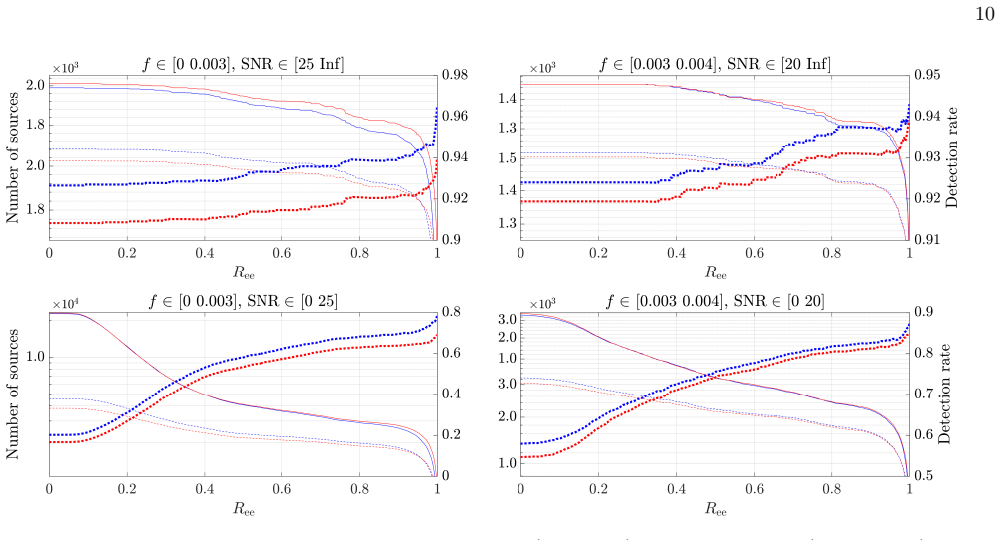
- Using this approach might allow iterative pipelines to approach the performance of more computationally intensive global fit methods.
- Real data analysis for LISA could benefit from validating the prior against observed populations.
Load-bearing premise
The prior derived from the mass limits of detached white dwarfs that links the GW signal frequency f with its time derivative ḟ is both accurate for the sources present and correctly implemented inside the iterative extraction algorithm without introducing bias.
What would settle it
Running the GBSIEVER pipeline with and without the prior on identical simulated datasets and counting the difference in the number of sources that exceed the detection threshold.
Figures




read the original abstract
Resolving the crowded population of double white dwarf (DWD) binaries in data from spaceborne gravitational wave (GW) observatories (e.g., LISA, Taiji) remains a major analysis challenge. Comparable performance on addressing this problem has been achieved with two main approaches: global fit, in which resolvable sources are estimated simultaneously from the data, and iterative, where sources are estimated one at a time and subtracted out from the data. While the latter is computationally efficient, methods developed under this approach have traditionally followed a frequentist framework that ignores astrophysical priors. This work incorporates a strong astrophysical prior, derived from the mass limits of detached white dwarfs and linking the GW signal frequency $f$ with its time derivative $\dot{f}$, into the iterative $\mathtt{GBSIEVER}$ pipeline. Applied to simulated LISA and LISA-Taiji network data, the method increases the number of confidently resolved sources by ${\approx}7.3\%$ (LISA-only) and ${\approx}14.6\%$ (network), respectively, and improves parameter estimation accuracy. The improvement persists across multiple realistic DWD population realizations, including in the low-frequency confusion-dominated regime, demonstrating the robustness and practical utility of astrophysically informed priors in iterative source extraction.
Editorial analysis
A structured set of objections, weighed in public.
Referee Report
Summary. The manuscript describes the incorporation of an astrophysical prior, based on detached white dwarf mass limits linking GW frequency f and its derivative ḏ, into the iterative GBSIEVER pipeline for resolving double white dwarf binaries in LISA and LISA-Taiji data. It reports an increase in the number of confidently resolved sources by ~7.3% (LISA) and ~14.6% (network), along with improved parameter estimation, with the gains persisting across multiple population realizations even in the confusion-dominated regime.
Significance. This result, if validated, underscores the advantage of using independent astrophysical priors in iterative GW source extraction algorithms. It provides a computationally efficient alternative to global fits for improving source resolution in dense populations, which is relevant for the data analysis of upcoming space-based gravitational wave detectors. The multi-realization testing adds credibility to the robustness claim.
major comments (1)
- [Methods section on prior implementation] The description of how the f-ḏ prior is integrated into the iterative extraction algorithm lacks detail on whether it is applied as a multiplicative factor in the likelihood or as a constraint on parameter space, and whether it affects the detection threshold or residual subtraction. This is critical to verify that the reported percentage gains are not due to changes in the algorithm's behavior beyond the prior information.
minor comments (2)
- [Abstract] The abstract mentions 'robust astrophysical prior' but does not specify the exact mass limits used; this should be clarified for reproducibility.
- [Figure captions] Ensure that all figures showing resolved sources include error bars or confidence intervals to support the accuracy improvement claim.
Simulated Author's Rebuttal
We thank the referee for their positive summary, significance assessment, and recommendation of minor revision. We address the single major comment below and will incorporate the requested clarification in the revised manuscript.
read point-by-point responses
-
Referee: [Methods section on prior implementation] The description of how the f-ḏ prior is integrated into the iterative extraction algorithm lacks detail on whether it is applied as a multiplicative factor in the likelihood or as a constraint on parameter space, and whether it affects the detection threshold or residual subtraction. This is critical to verify that the reported percentage gains are not due to changes in the algorithm's behavior beyond the prior information.
Authors: We agree that additional detail is warranted. In the current implementation, the astrophysical prior (derived from detached white-dwarf mass limits) is applied as a multiplicative factor directly in the likelihood function used by GBSIEVER; this acts as a soft constraint on the joint (f, ḟ) parameter space during each iterative source search. The prior does not alter the detection threshold, the stopping criterion, or the residual-subtraction procedure itself. The reported gains therefore originate solely from improved parameter estimation and consequent reduction in subtraction residuals. We will revise the Methods section to include the explicit likelihood modification, a short algorithmic description, and confirmation that no other algorithmic parameters were changed, thereby removing any ambiguity about the source of the improvement. revision: yes
Circularity Check
No circularity: prior is external astrophysical input
full rationale
The paper derives its central improvement claim from applying an external prior (white-dwarf mass limits linking f and ḏ) to simulated data inside the GBSIEVER pipeline. This prior is not fitted to the GW observations under analysis, nor is any prediction or uniqueness result reduced by construction to the same data or to a self-citation chain. The reported percentage gains are empirical outcomes of that external constraint, leaving the derivation self-contained against independent benchmarks.
Axiom & Free-Parameter Ledger
axioms (1)
- domain assumption The relation between GW frequency f and its derivative ḏ for detached double white dwarfs is accurately captured by the mass limits of white dwarfs.
Reference graph
Works this paper leans on
-
[1]
The observable frequency range is divided into overlapping bands of 0.02 mHz width, with sources accepted only from a cen- tral 0.01 mHz acceptance zone within each band
Frequency-domain partitioning and computational efficiency To manage computational complexity while maintain- ing detection sensitivity, the algorithm implements a frequency-domain partitioning strategy. The observable frequency range is divided into overlapping bands of 0.02 mHz width, with sources accepted only from a cen- tral 0.01 mHz acceptance zone wi...
-
[2]
Iterative Source Extraction The iterative extraction process follows a systematic protocol designed to handle source confusion and over- lapping effects:
-
[3]
Initialization: Begin with the full dataset {¯yI} containing all sources plus noise and partition it into narrow frequency bins
-
[4]
Single source optimization : For iteration m in each frequency bin, maximize the F -statistic over the intrinsic parameter space to obtain ˆθint,m
-
[5]
Signal reconstruction : Construct the full pa- rameter estimate ˆθm by combining intrinsic and extrinsic parameters
-
[6]
Residual update : Update the data by subtract- ing the estimated source: ¯yI m+1 = ¯yI m − ¯sI ( ˆθm). (11)
-
[7]
T ermination rule: Terminate when the signal-to- noise ratio of newly detected sources falls below a threshold or when a maximum number of iterations is reached
-
[8]
Each dataset undergoes two independent analyses: • Primary search : Standard parameter ranges op- timized for computational efficiency
Cross-Validation and False Positive Mitigation A critical component of GBSIEVER is its extended-range cross-validation framework. Each dataset undergoes two independent analyses: • Primary search : Standard parameter ranges op- timized for computational efficiency. • Secondary search : an extended search over a broader ˙f range to probe parameter degeneraci...
-
[9]
25, and ρ0 as the reference stellar density
Source positions are drawn from the smooth Galac- tic density model [36] ρ(x,y,z ) =ρ0 [ Ae − r2/R 2 b + (1 − A)e− u/R d sech2(z/Z d) ] , (13) with r = √ x2 +y2 +z2, u = √ x2 +y2, Rb = 500 pc, Rd = 2500 pc, Zd = 300 pc, A = 0. 25, and ρ0 as the reference stellar density. After sam- pling, positions are transformed from the Galactic center to the solar sys...
-
[10]
[37], intrinsic parameters are treated as independent of spatial position
Following Ref. [37], intrinsic parameters are treated as independent of spatial position. We construct a bivariate kernel density estimate using a Gaussian kernel with a grid size of 200 × 200 for log 10f and ˙fRatio from the LDC catalog. This yields a smooth surrogate distribution that reduces sampling noise while preserving the empirical correlations
-
[11]
( 13) and the KDE, producing a list of spatial locations accompanied by ( f, ˙f ) pairs for each binary
The affine-invariant gwmcmc ensemble sampler [38] is then used to draw joint samples from Eq. ( 13) and the KDE, producing a list of spatial locations accompanied by ( f, ˙f ) pairs for each binary. This approach respects the physically allowed ( f, ˙f ) en- velope even in sparsely populated regions of the parameter space
-
[12]
(14) By combining this with ˙f given by Eq
Waveform amplitudes are evaluated using A = 2(GM)5/3 c4dL (πf )2/3. (14) By combining this with ˙f given by Eq. ( 16), the chirp mass term can be eliminated, yielding the fol- lowing alternative representation: A = 5c ˙f 48π 2f 3dL . (15) For semi-detached systems, we apply a correction factor calibrated to the LDC catalog so that mass- transfer binaries ...
-
[13]
This ensures that the synthetic catalog reproduces the polarization and inclination statistics assumed in the challenge data
Extrinsic angles are sampled from uniform distribu- tions: cos ι ∈ [− 1, 1], φ 0 ∈ [0, 2π ), and ψ ∈ [0, 2π ). This ensures that the synthetic catalog reproduces the polarization and inclination statistics assumed in the challenge data. To further align the synthetic catalogs with the LDC realization, we construct oversampled source banks and apply a stra...
-
[14]
yields: Mmin = (0. 14 × 0. 14)3/5 (0. 28)1/5 M⊙ ≈ 0. 12M⊙, (18) Conversely, the maximum chirp mass is achieved when m1 =m2 = 1. 4M⊙ : Mmax = (1. 4 × 1. 4)3/5 (2. 8)1/5 M⊙ ≈ 1. 22M⊙, (19) These bounds yield the physically allowed chirp mass range M ∈ [0. 12, 1. 22]M⊙ . Substituting into Eq. ( 16) gives the corresponding constraints on ˙f : ˙fmin(f ) = 96 5...
-
[15]
Figure 2 shows that both the positive and negative branches of ˙f remain confined to relatively narrow bands
The physical constraints on M, coupled with the radiation-reaction relation ˙f ∝ f 11/3M5/3, impose well-defined upper and lower limits on ˙f for each f . Figure 2 shows that both the positive and negative branches of ˙f remain confined to relatively narrow bands. At a given frequency, these bands can be characterized by four key values: the minimum and max...
2073
-
[16]
39% to 95 . 52%. These trends indicate that the prior is most effective in confusion-dominated regimes where degeneracies in ˙f previously increased false associations and reduced catalog purity. The prior reduces the number of reported candidates by 1. 1% while increasing confirmed sources by 208 (2 . 0% relative gain) and raising the overall detection rate from
-
[17]
46% with the Main configuration
79% to 87 . 46% with the Main configuration. When the Ree thresholds are retuned to match the baseline global detection rate, the prior yields 903 additional reported sources and 760 additional confirmed detec- tions. This suggests that the primary effect of the prior is to suppress spurious candidates. Because the post- prior catalog is cleaner, the relaxed...
2043
-
[18]
8: Two-dimensional kernel density estimates of the LDC catalog (left column) and the synthetic catalog (right column)
50%, demonstrating that the prior preserves catalog 13 FIG. 8: Two-dimensional kernel density estimates of the LDC catalog (left column) and the synthetic catalog (right column). Top panels show the joint distribution in the frequency–amplitude plane (log 10f, log10 A), and bottom panels show the corresponding sky localization distribution (λ, β ). The co...
2073
-
[19]
90% and raising the block 1 detection rate to 69 . 55%. The prior adds 87, 90, and 99 confirmed sources in catalogs 1, 2, and 3 respectively, with corresponding detection-rate gains of 4. 4, 4. 6, and 4. 6 percentage points. In all cases, the improvement is dominated by block 1, where detection rates rise to approximately 75%–76%, 14 LDC Ree Identified Repo...
-
[20]
Laser Interferometer Space Antenna
P. Amaro-Seoane, H. Audley, S. Babak, J. Baker, E. Ba- rausse, P. Bender, E. Berti, P. Binetruy, M. Born, D. Bor- toluzzi, et al. , arXiv preprint arXiv:1702.00786 (2017)
work page internal anchor Pith review Pith/arXiv arXiv 2017
-
[21]
Ruan, Z.-K
W.-H. Ruan, Z.-K. Guo, R.-G. Cai, and Y.-Z. Zhang, International Journal of Modern Physics A 35, 2050075 (2020)
2020
-
[22]
Luo, L.-S
J. Luo, L.-S. Chen, H.-Z. Duan, Y.-G. Gong, S. Hu, J. Ji, Q. Liu, J. Mei, V. Milyukov, M. Sazhin, et al. , Classical and Quantum Gravity 33, 035010 (2016)
2016
-
[23]
G. Nelemans, L. R. Yungelson, and S. F. Porte- gies Zwart, Astron. Astrophys. 375, 890 (2001) , arXiv:astro-ph/0105221
work page internal anchor Pith review Pith/arXiv arXiv 2001
-
[24]
Galactic Binaries as Sources of Gravitational Waves
G. Nelemans, AIP Conf. Proc. 686, 263 (2003) , arXiv:astro-ph/0310800
work page internal anchor Pith review Pith/arXiv arXiv 2003
-
[25]
Korol, S
V. Korol, S. Toonen, A. Klein, V. Belokurov, F. Vin- cenzo, R. Buscicchio, D. Gerosa, C. Moore, E. Roebber, E. Rossi, et al. , Astronomy & Astrophysics 638, A153 (2020)
2020
-
[26]
Huang, Y.-M
S.-J. Huang, Y.-M. Hu, V. Korol, P.-C. Li, Z.- C. Liang, Y. Lu, H.-T. Wang, S. Yu, and J. Mei, Phys. Rev. D 102, 063021 (2020)
2020
-
[27]
Astrophysics with the Laser Interferometer Space Antenna
P. Amaro-Seoane, J. Andrews, M. A. Sedda, A. Askar, R. Balasov, I. Bartos, et al. , arXiv preprint arXiv:2203.06016 (2022)
work page internal anchor Pith review Pith/arXiv arXiv 2022
-
[28]
Buscicchio, A
R. Buscicchio, A. Klein, V. Korol, F. Di Renzo, C. J. Moore, D. Gerosa, and A. Carzaniga, The European Physical Journal C 85, 887 (2025)
2025
-
[29]
Report on the second Mock LISA Data Challenge
S. Babak, J. G. Baker, M. J. Benacquista, N. J. Cornish, J. Crowder, C. Cutler, et al. (Mock LISA Data Challenge Task Force), Class. Quant. Grav. 25, 114037 (2008) , arXiv:0711.2667 [gr-qc]
work page internal anchor Pith review Pith/arXiv arXiv 2008
-
[30]
K. A. Arnaud, S. Babak, J. G. Baker, M. J. Benacquista, N. J. Cornish, C. Cutler, L. Finn, S. Larson, T. Litten- berg, E. Porter, et al. , Classical and Quantum Gravity 24, S551 (2007)
2007
-
[31]
Babak, J
S. Babak, J. G. Baker, M. J. Benacquista, N. J. Cor- nish, J. Crowder, S. L. Larson, E. Plagnol, E. K. Porter, M. Vallisneri, A. Vecchio, et al. , Classical and Quantum Gravity 25, 184026 (2008)
2008
-
[32]
The Mock LISA Data Challenges: from Challenge 3 to Challenge 4
S. Babak, J. G. Baker, M. J. Benacquista, N. J. Cornish, et al. (Mock LISA Data Challenge Task Force), Class. Quant. Grav. 27, 084009 (2010) , arXiv:0912.0548 [gr-qc]
work page internal anchor Pith review Pith/arXiv arXiv 2010
-
[33]
Baghi, arXiv preprint arXiv:2204.12142 (2022)
Q. Baghi, arXiv preprint arXiv:2204.12142 (2022)
-
[34]
Z. Ren, T. Zhao, Z. Cao, Z.-K. Guo, W.-B. Han, H.-B. Jin, and Y.-L. Wu, Frontiers of Physics 18, 64302 (2023)
2023
-
[35]
M. Du, P. Wang, Z. Luo, W.-B. Han, X. Zhang, X. Chen, Z. Cao, Y. Zhang, H. Wang, X. Peng, et al. , Sci- ence China Physics, Mechanics & Astronomy 69, 249501 16 (2026)
2026
-
[36]
T. B. Littenberg, Phys. Rev. D 84, 063009 (2011)
2011
-
[37]
T. B. Littenberg, N. J. Cornish, K. Lackeos, and T. Rob- son, Physical Review D 101, 123021 (2020)
2020
-
[38]
T. B. Littenberg and N. J. Cornish, Physical review D 107, 063004 (2023)
2023
-
[39]
S. H. Strub, L. Ferraioli, C. Schmelzbach, S. C. St¨ ahler, and D. Giardini, Physical Review D 106, 062003 (2022)
2022
-
[40]
S. H. Strub, L. Ferraioli, C. Schmelzbach, S. C. St¨ ahler, and D. Giardini, Physical Review D 108, 103018 (2023)
2023
- [41]
-
[42]
Zhang, S
X.-H. Zhang, S. D. Mohanty, X.-B. Zou, and Y.-X. Liu, Phys. Rev. D 104, 024023 (2021)
2021
-
[43]
Zhang, S.-D
X.-H. Zhang, S.-D. Zhao, S. D. Mohanty, and Y.-X. Liu, Physical Review D 106, 102004 (2022)
2022
-
[44]
Krolak, M
A. Krolak, M. Tinto, and M. Vallisneri, Physical Review D 70, 022003 (2004)
2004
-
[45]
Kennedy and R
J. Kennedy and R. Eberhart (1995)
1995
-
[46]
P. J. Green, Biometrika 82, 711 (1995)
1995
-
[47]
Kilic, C
M. Kilic, C. A. Prieto, W. R. Brown, and D. Koester, The Astrophysical Journal 660, 1451 (2007)
2007
-
[48]
H. Yuan, Z. Li, Z. Bai, Y. Dong, M. Wang, S. Yu, X. Chen, Y. Zhao, Y. Chu, and H. Zhang, The Astro- nomical Journal 165, 119 (2023)
2023
-
[49]
Chandrasekhar, Astrophysical Journal, vol
S. Chandrasekhar, Astrophysical Journal, vol. 74, p. 81 74, 81 (1931)
1931
-
[50]
Zhao, X.-H
S.-D. Zhao, X.-H. Zhang, S. D. Mohanty, M. J. Ful- lana i Alfonso, Y.-X. Liu, and Q.-Y. Xie, Universe 11, 248 (2025)
2025
-
[51]
Zhang, S
X.-H. Zhang, S. D. Mohanty, S. Valluri, S.-D. Zhao, Q.- Y. Xie, and Y.-X. Liu, Universe 11, 313 (2025)
2025
-
[52]
Tinto and S
M. Tinto and S. V. Dhurandhar, Living Reviews in Rel- ativity 17, 1 (2014)
2014
-
[53]
Nelemans, L
G. Nelemans, L. R. Yungelson, S. P. Zwart, and F. Ver- bunt, Astronomy & Astrophysics 365, 491 (2001)
2001
-
[54]
Nelemans, S
G. Nelemans, S. P. Zwart, F. Verbunt, and L. Yungelson, Astronomy & Astrophysics 368, 939 (2001)
2001
-
[55]
M. R. Adams, N. J. Cornish, and T. B. Littenberg, Phys- ical Review D 86, 124032 (2012)
2012
-
[56]
J. A. Edlund, M. Tinto, A. Kr´ olak, and G. Nelemans, Classical and Quantum Gravity 22, S913 (2005)
2005
-
[57]
Goodman and J
J. Goodman and J. Weare, Communications in applied mathematics and computational science 5, 65 (2010)
2010
-
[58]
S.-d. Zhao, S. Mohanty, X.-H. Zhang, and Y.-X. Liu, 10.5281/zenodo.20362982 (2026)
-
[59]
K. A. Postnov and L. R. Yun- gelson, Living Rev. Rel. 17, 3 (2014) , arXiv:1403.4754 [astro-ph.HE]
work page internal anchor Pith review Pith/arXiv arXiv 2014
-
[60]
F. J. Harris, Proceedings of the IEEE 66, 51 (1978)
1978
discussion (0)
Sign in with ORCID, Apple, or X to comment. Anyone can read and Pith papers without signing in.