Trajectories of Critical Unstable Qubits in and on the Bloch Sphere
Pith reviewed 2026-06-28 16:34 UTC · model grok-4.3
The pith
Critical unstable qubits follow explicit geometric trajectories on the Bloch sphere revealing stationary points.
A machine-rendered reading of the paper's core claim, the machinery that carries it, and where it could break.
Core claim
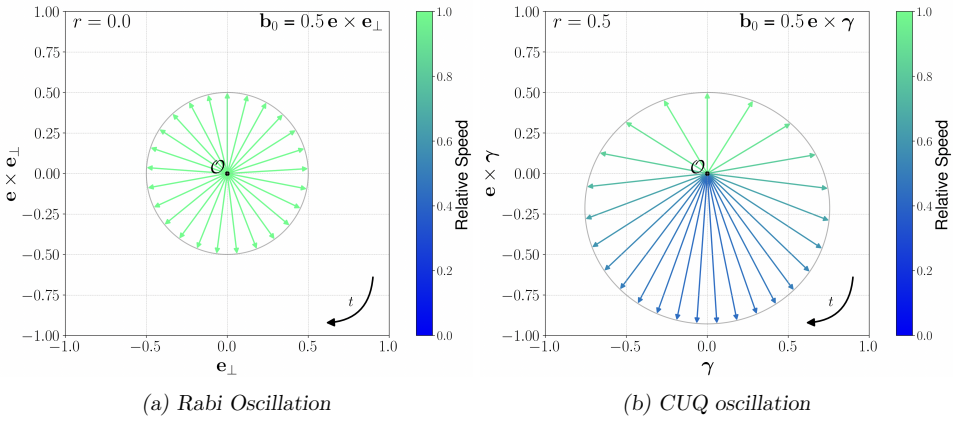
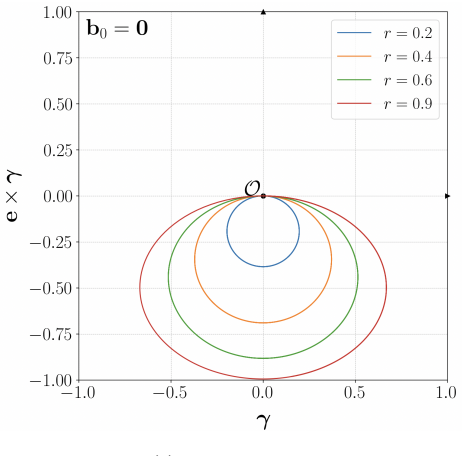
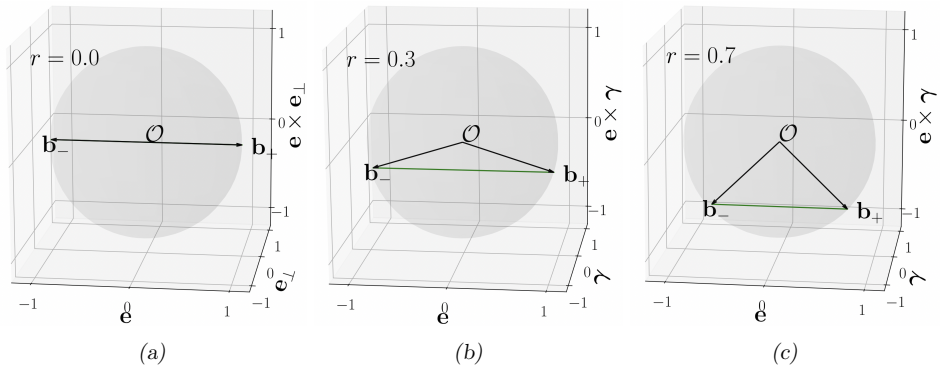
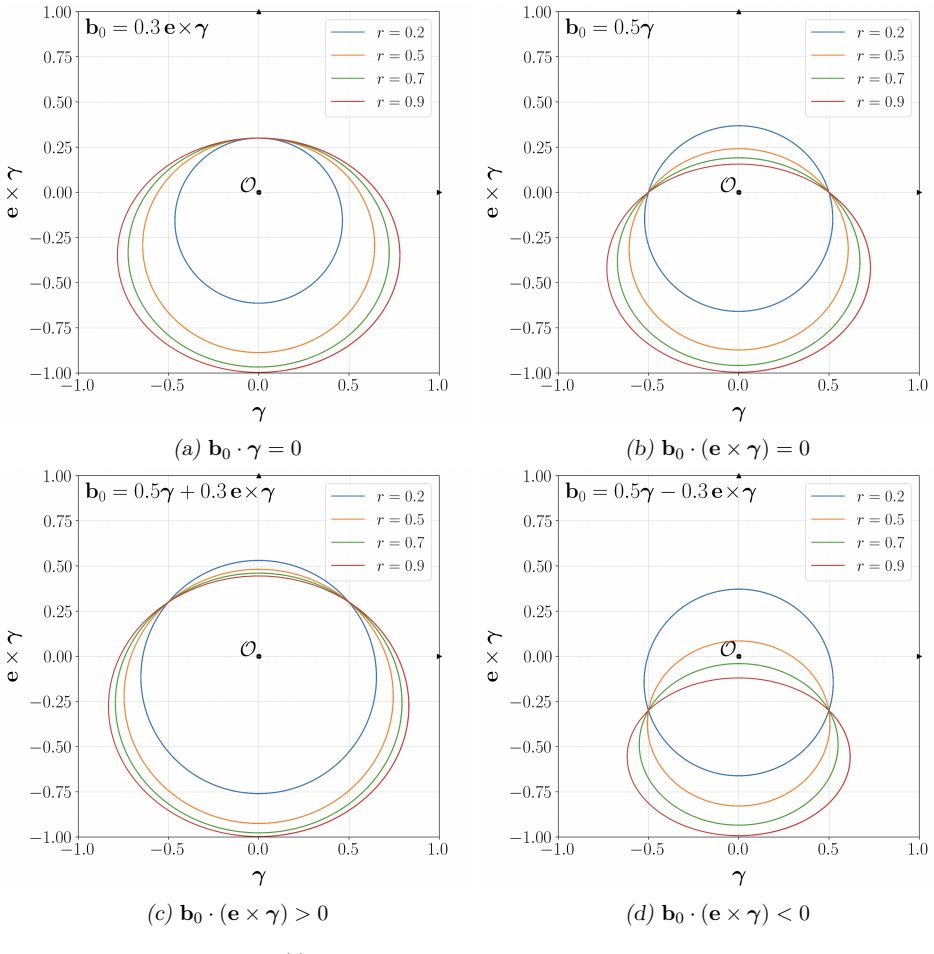
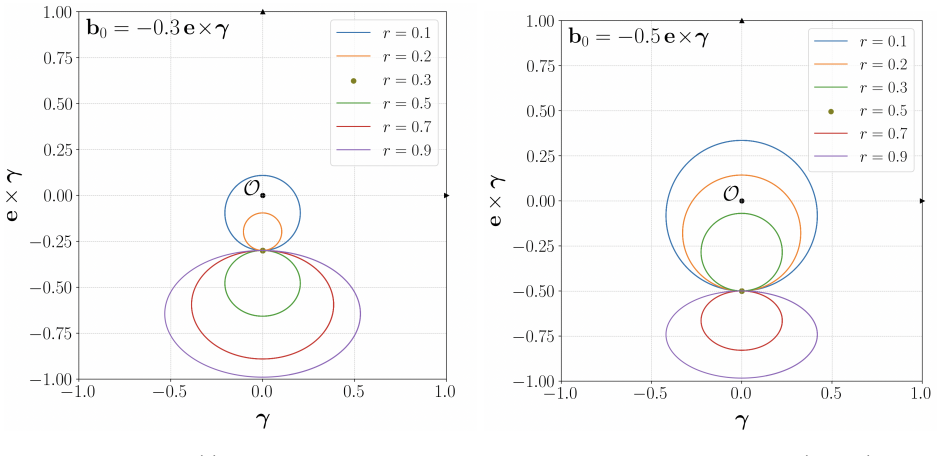
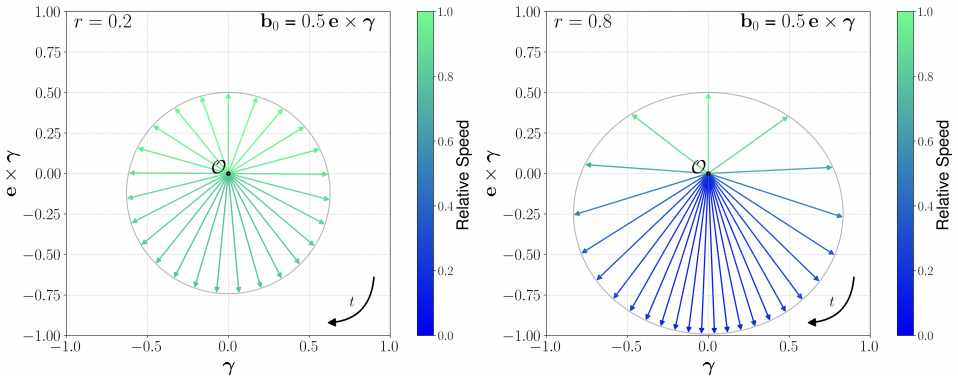
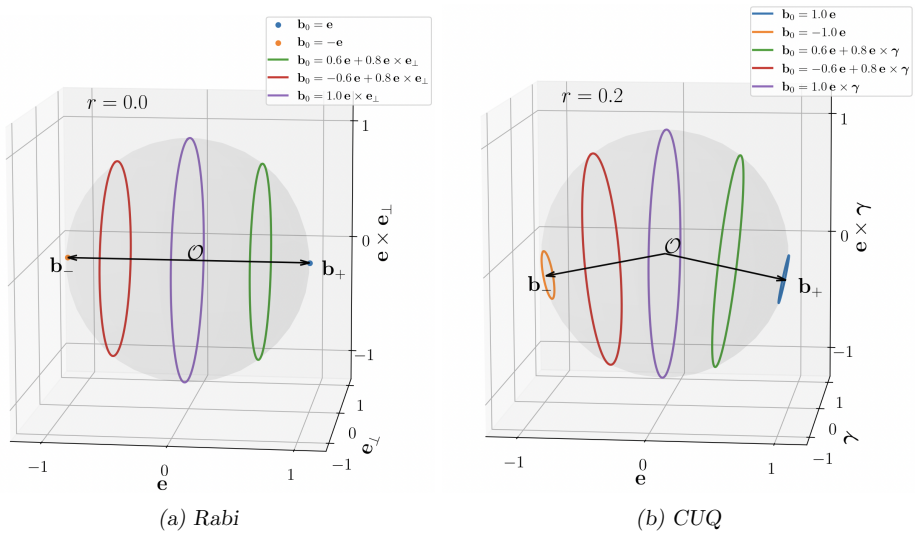
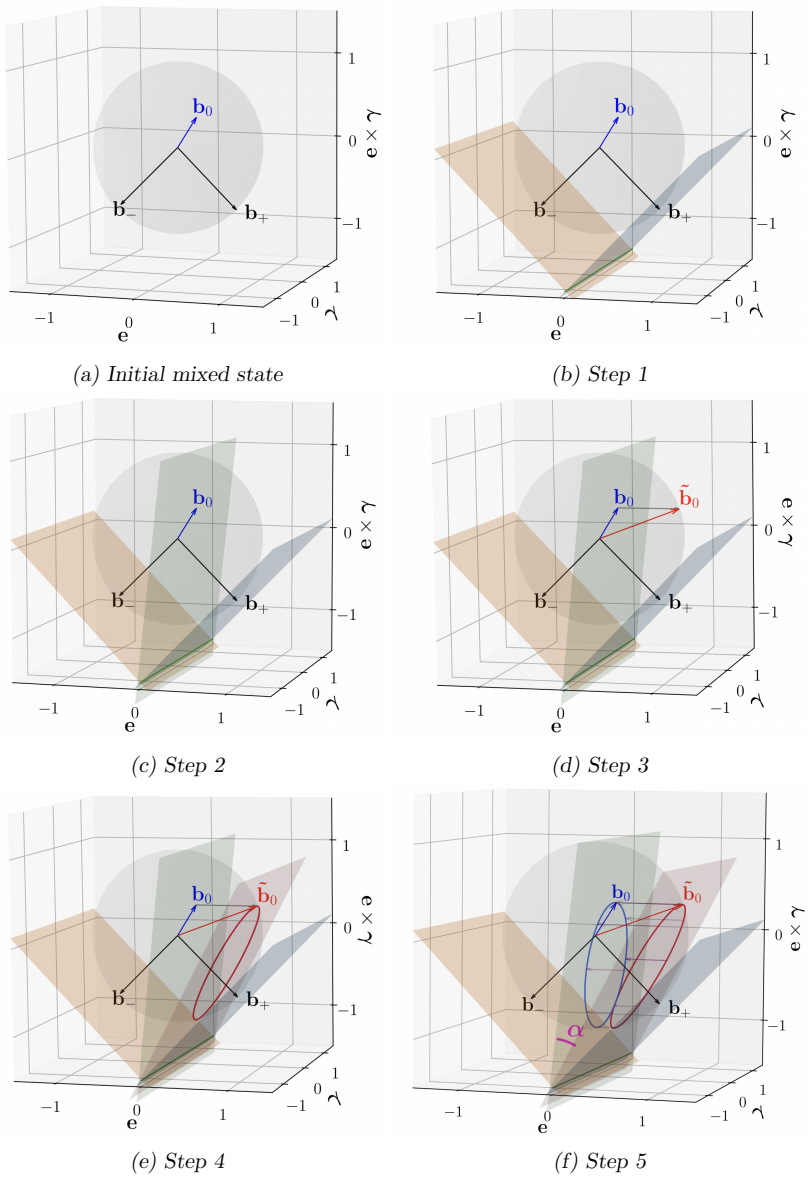
In an appropriately defined co-decaying frame, critical unstable qubits exhibit indefinite anharmonic oscillations between two states and coherence-decoherence oscillations of mixed states. Explicit geometric constructions obtain the trajectories of pure and mixed CUQs in and on the Bloch sphere, identifying stationary points at which the states do not evolve in time.
What carries the argument
The Bloch vector and its time evolution under the density-matrix formalism for CUQs, together with geometric constructions that trace the vector's paths.
If this is right
- Trajectories of pure and mixed CUQs can be constructed geometrically inside and on the Bloch sphere.
- Stationary points exist where the quantum state does not evolve with time in the co-decaying frame.
- Mixed states undergo coherence-decoherence oscillations distinct from Hermitian Rabi behavior.
- The findings bear on particle cosmology and quantum simulations of non-Hermitian Hamiltonians.
Where Pith is reading between the lines
- The geometric constructions may simplify numerical modeling of non-Hermitian two-level dynamics in open systems.
- Analog quantum simulators could test whether the predicted stationary points remain fixed under controlled decay.
- Connections to cosmological models of unstable particles could be explored by mapping the Bloch trajectories to field evolution equations.
Load-bearing premise
The co-decaying frame is defined such that the claimed anharmonic oscillations and stationary points appear as described.
What would settle it
Direct computation or measurement of the Bloch vector at the constructed stationary points to check whether it remains constant over time in the co-decaying frame.
Figures



read the original abstract
We extend previous studies on a novel class of unstable two-level systems which were called Critical Unstable Qubits (CUQs). In an appropriately defined co-decaying frame, the CUQs exhibit striking phenomena of indefinite anharmonic oscillations between two states and coherence-decoherence oscillations of mixed states. These features are distinct from the usual Rabi oscillations observed in the Hermitian counterpart of two-level systems, which are harmonic and preserve the coherence of the quantum state. We employ the density matrix formalism to study these phenomena for mixed states and delve into the nature of the trajectory traversed by these states in the Bloch sphere by studying the time evolution of the Bloch vector that describes the quantum state of the unstable qubit. In particular, we provide for the first time explicit geometric constructions to obtain trajectories of both pure and mixed CUQs in and on the Bloch sphere. This enables us to identify the stationary points of CUQs, at which the states do not evolve in time in the co-decaying frame. The potential implications of our findings for particle cosmology and quantum simulations of non-Hermitian Hamiltonians are discussed.
Editorial analysis
A structured set of objections, weighed in public.
Referee Report
Summary. The manuscript extends prior work on Critical Unstable Qubits (CUQs) by employing the density matrix formalism to analyze their time evolution in a co-decaying frame. It claims to supply the first explicit geometric constructions for the trajectories of both pure and mixed CUQs on and inside the Bloch sphere, identifies stationary points at which the states cease to evolve, and contrasts the resulting indefinite anharmonic and coherence-decoherence oscillations with the harmonic, coherence-preserving Rabi oscillations of the Hermitian case. Potential implications for particle cosmology and quantum simulations of non-Hermitian Hamiltonians are noted.
Significance. If the claimed geometric constructions are rigorously derived and reproducible, the work supplies a concrete visualization tool for non-Hermitian qubit dynamics that is absent from the Hermitian literature. The identification of stationary points in the co-decaying frame constitutes a falsifiable geometric prediction that could be tested in quantum simulations.
minor comments (2)
- The abstract states that the co-decaying frame is 'appropriately defined' but does not restate its explicit transformation rule or the non-Hermitian Hamiltonian used; a one-sentence reminder in the introduction would aid readers who have not consulted the cited prior studies.
- Figure captions (if present) should explicitly label which curves correspond to pure versus mixed states and which points are the newly identified stationary points.
Simulated Author's Rebuttal
We thank the referee for the positive summary, significance assessment, and recommendation of minor revision for our manuscript on Critical Unstable Qubits. No specific major comments were listed in the report.
Circularity Check
No significant circularity identified
full rationale
The paper's central contribution consists of new explicit geometric constructions for CUQ trajectories on the Bloch sphere, derived from the density matrix formalism and the time evolution of the Bloch vector. These constructions are presented as novel extensions that allow identification of stationary points in the co-decaying frame. Although the work references prior studies on CUQs and the co-decaying frame, the abstract and claims do not reduce the new geometric results to definitions or fits from those priors by construction. No load-bearing step equates a prediction or first-principles result to its own inputs via self-citation chains, ansatzes, or renaming. The derivation chain remains self-contained with independent content.
Axiom & Free-Parameter Ledger
Reference graph
Works this paper leans on
-
[1]
I. I. Rabi,Space Quantization in a Gyrating Magnetic Field,Phys. Rev.51(1937), no. 8 652
1937
-
[2]
Weisskopf and E
V. Weisskopf and E. Wigner,Berechnung der nat¨ urlichen linienbreite auf grund der diracschen lichttheorie,Zeitschrift f¨ ur Physik63(Jan, 1930) 54–73
1930
-
[3]
T. D. Lee, R. Oehme, and C.-N. Yang,Remarks on Possible Noninvariance Under Time Reversal and Charge Conjugation,Phys. Rev.106(1957) 340–345
1957
-
[4]
Pilaftsis,Resonant CP violation induced by particle mixing in transition amplitudes, Nucl
A. Pilaftsis,Resonant CP violation induced by particle mixing in transition amplitudes, Nucl. Phys. B504(1997) 61–107, [hep-ph/9702393]
Pith/arXiv arXiv 1997
-
[5]
D. Karamitros, T. McKelvey, and A. Pilaftsis,Quantum coherence of critical unstable two-level systems,Phys. Rev. D108(2023), no. 1 016006, [arXiv:2212.06031]
arXiv 2023
-
[6]
D. Karamitros, T. McKelvey, and A. Pilaftsis,Critical unstable qubits: An application to the B0B¯0 meson system,Phys. Rev. D111(2025), no. 9 096020, [arXiv:2502.15625]
arXiv 2025
-
[7]
W. D. Heiss,The physics of exceptional points,J. Phys. A45(2012) 444016, [arXiv:1210.7536]
Pith/arXiv arXiv 2012
-
[8]
D. C. Brody and E.-M. Graefe,Mixed-State Evolution in the Presence of Gain and Loss, Phys. Rev. Lett.109(2012), no. 23 230405, [arXiv:1208.5297]
Pith/arXiv arXiv 2012
-
[9]
A. Sergi and K. G. Zloshchastiev,Non-Hermitian quantum dynamics of a two-level system and models of dissipative environments,Int. J. Mod. Phys. B27(2013) 1350163, [arXiv:1207.4877]
Pith/arXiv arXiv 2013
-
[10]
K. Kawabata, Y. Ashida, and M. Ueda,Information Retrieval and Criticality in Parity-Time-Symmetric Systems,Phys. Rev. Lett.119(2017), no. 19 190401, [arXiv:1705.04628]
Pith/arXiv arXiv 2017
-
[11]
Kowalski and J
K. Kowalski and J. Rembieli´ nski,Integrable nonlinear evolution of the qubit,Annals of Physics411(2019) 167955
2019
-
[12]
J. Rembieli´ nski and P. Caban,Nonlinear extension of the quantum dynamical semigroup, Quantum5(2021) 420, [arXiv:2003.09170]
arXiv 2021
-
[13]
C. M. Bender, S. Boettcher, and P. Meisinger,PT symmetric quantum mechanics,J. Math. Phys.40(1999) 2201–2229, [quant-ph/9809072]. 34
Pith/arXiv arXiv 1999
-
[14]
C. M. Bender and S. Boettcher,Real spectra in nonHermitian Hamiltonians having PT symmetry,Phys. Rev. Lett.80(1998) 5243–5246, [physics/9712001]
Pith/arXiv arXiv 1998
-
[15]
C. M. Bender,Making sense of non-Hermitian Hamiltonians,Rept. Prog. Phys.70 (2007) 947, [hep-th/0703096]
Pith/arXiv arXiv 2007
-
[16]
A. K. Alok, S. Banerjee, N. R. S. Chundawat, and S. U. Sankar,Probing quantum decoherence at Belle II and LHCb,JHEP05(2024) 124, [arXiv:2402.02470]
arXiv 2024
- [17]
-
[18]
Rembieli´ nski and J
J. Rembieli´ nski and J. Ciborowski,On nonlinear description of neutrino flavour evolution in solar matter,Annals Phys.458(2023) 169481
2023
-
[19]
Kowalski,Linear and integrable nonlinear evolution of the qutrit,Quant
K. Kowalski,Linear and integrable nonlinear evolution of the qutrit,Quant. Inf. Proc.19 (2020), no. 5 145, [arXiv:2006.10322]
arXiv 2020
-
[20]
Moiseyev,Non-Hermitian Quantum Mechanics
N. Moiseyev,Non-Hermitian Quantum Mechanics. Cambridge University Press, 2011
2011
-
[21]
D. Karamitros, T. McKelvey, and A. Pilaftsis,Varying entropy degrees of freedom effects in low-scale leptogenesis,Phys. Rev. D109(2024), no. 5 055007, [arXiv:2310.03703]
arXiv 2024
- [22]
- [23]
-
[24]
E. Koukoutsis, P. Papagiannis, K. Hizanidis, A. K. Ram, G. Vahala, O. Amaro, L. I. Inigo Gamiz, and D. Vallis,Quantum Implementation of Non-unitary Operations with Biorthogonal Representations,Quant. Inf. Comput.25(2025), no. 2 141–155, [arXiv:2410.22505]
arXiv 2025
-
[25]
A. Jebraeilli and M. R. Geller,Quantum simulation of a qubit with a non-Hermitian Hamiltonian,Phys. Rev. A111(2025), no. 3 032211, [arXiv:2502.13910]
arXiv 2025
-
[26]
D. C. Brody,Biorthogonal quantum mechanics,J. Phys. A47(2013), no. 3 035305, [arXiv:1308.2609]
Pith/arXiv arXiv 2013
-
[27]
D. H. Carlson,On real eigenvalues of complex matrices,Pacific Journal of Mathematics 15(1965) 1119–1129. 35
1965
discussion (0)
Sign in with ORCID, Apple, or X to comment. Anyone can read and Pith papers without signing in.