The Murchison Widefield Array Phase III upgrade: Sensitivity Doubled, Number of Baselines Quadrupled, Flexibility Enhanced, and EoR Observations Optimised
Pith reviewed 2026-06-28 13:05 UTC · model grok-4.3
The pith
The Murchison Widefield Array Phase III upgrade doubles sensitivity by enabling full correlation of all 256 antenna tiles.
A machine-rendered reading of the paper's core claim, the machinery that carries it, and where it could break.
Core claim
The new digital receivers complement the existing ones such that the MWA now supports the full correlation of all 256 antenna tiles, releasing the prior constraint of correlating only 128 tiles at a time.
What carries the argument
The new fleet of digital receivers integrated with the MWAX correlator, which enables processing all 256 tiles.
Load-bearing premise
The new digital receivers integrate successfully with the existing receivers and MWAX correlator to deliver the performance gains without failures or losses.
What would settle it
If measurements after the upgrade show that the sensitivity remains the same as before or the number of usable baselines does not increase, the claim of doubled sensitivity and quadrupled baselines would be falsified.
Figures






read the original abstract
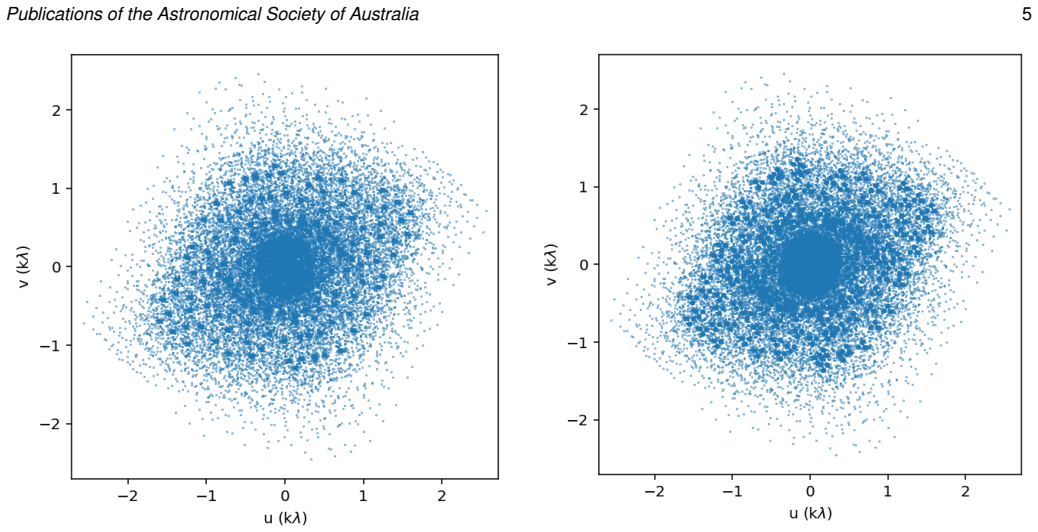
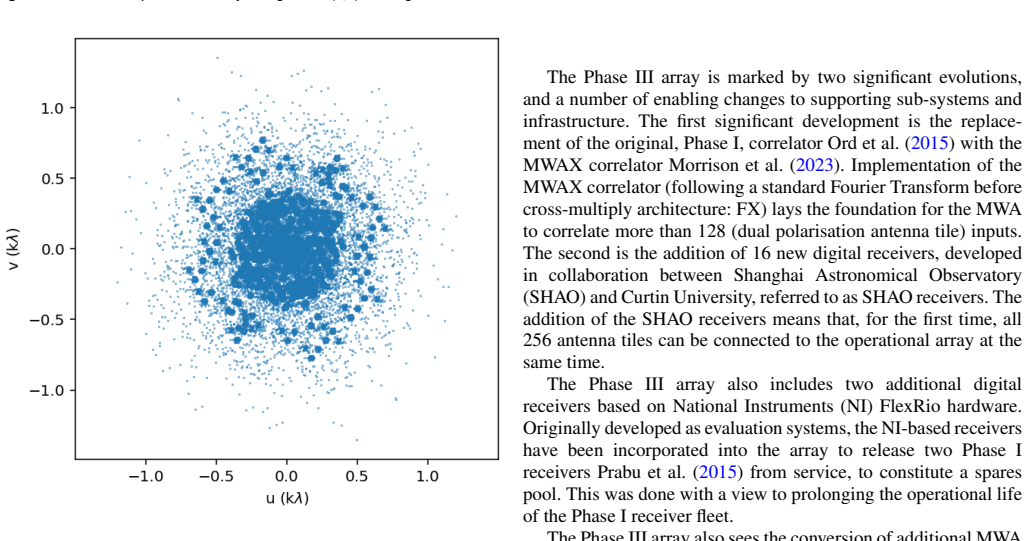
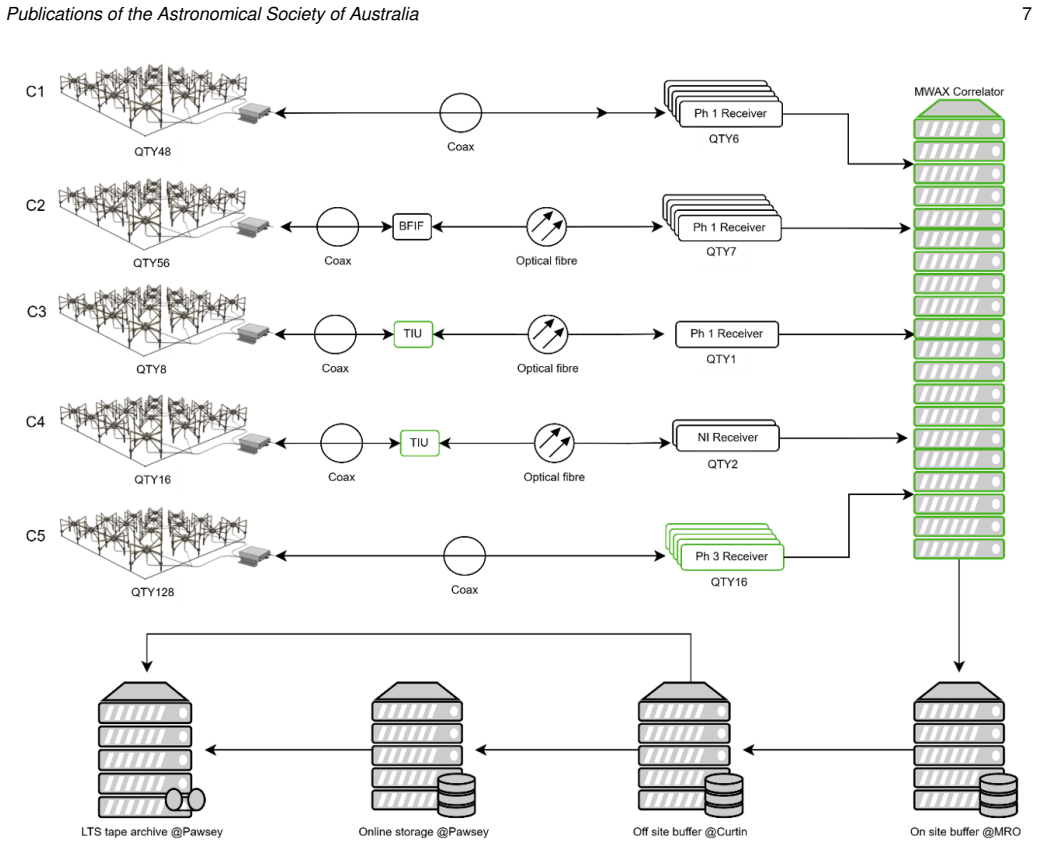
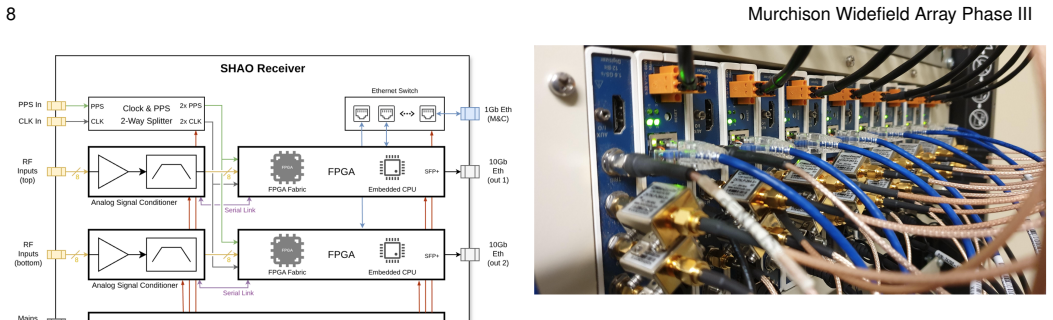
We describe the latest iteration of upgrades (designated Phase III) to the Murchison Widefield Array (MWA), in the fourth paper in a series that covers the evolution of the telescope from design concept to initial operational facility, and through two major upgrades. As part of the Phase III upgrade of the MWA, we report the completion of work to design, build, and deploy a new fleet of digital receivers that further optimise the MWA for Epoch of Reionisation observations. These receivers complement existing receivers, such that the MWA now supports the full correlation of all 256 antenna tiles currently in the array. This step releases the MWA from the prior constraint of having to correlate only 128 of the 256 tiles at any given time, which means that the maximum instantaneous sensitivity of the MWA is doubled and the maximum number of interferometric baselines is approximately quadrupled. The upgrade is fundamentally enabled by the new MWAX correlator and various other improvements to the MWA sub-systems. In this paper we describe the new digital receivers and the other improvements that result in the Phase III system. A range of operational benefits arise from the upgrade and scientific flexibility is increased. We also comment on the transition from the MWA to the SKA-Low facility near the end of the decade, including a description of some unique science opportunities utilising joint MWA/SKA-Low data during the Science Verification phase of the SKA-Low Array Assembly 2 (AA2) period.
Editorial analysis
A structured set of objections, weighed in public.
Referee Report
Summary. The manuscript describes the Phase III upgrade to the Murchison Widefield Array (MWA), reporting the completion of new digital receivers that complement existing ones to enable full correlation of all 256 antenna tiles. This removes the prior limit of correlating only 128 tiles, doubling maximum instantaneous sensitivity and approximately quadrupling the number of baselines. The upgrade is enabled by the MWAX correlator and other subsystem improvements; the paper also covers resulting operational benefits, increased flexibility for Epoch of Reionisation observations, and prospects for joint MWA/SKA-Low data during the SKA-Low AA2 Science Verification phase.
Significance. If the upgrade has been successfully deployed as described, the removal of the 128-tile correlation constraint provides a direct and substantial increase in MWA performance for EoR science, with the quadrupled baseline count improving uv-coverage and sensitivity on relevant scales. The work also supplies engineering documentation useful for the community and outlines a practical bridge to SKA-Low operations.
major comments (1)
- [Abstract] Abstract and main text: the central claim that the upgrade is complete and delivers doubled sensitivity plus quadrupled baselines is presented without any supporting on-sky measurements, system-temperature verification, baseline-count validation, or error analysis from the integrated MWAX + new-receiver system. This evidence is load-bearing for the performance assertions.
Simulated Author's Rebuttal
We thank the referee for their careful review and constructive feedback on our manuscript describing the MWA Phase III upgrade. We address the single major comment below.
read point-by-point responses
-
Referee: [Abstract] Abstract and main text: the central claim that the upgrade is complete and delivers doubled sensitivity plus quadrupled baselines is presented without any supporting on-sky measurements, system-temperature verification, baseline-count validation, or error analysis from the integrated MWAX + new-receiver system. This evidence is load-bearing for the performance assertions.
Authors: The performance figures quoted in the abstract and main text follow directly from the change in the number of correlated tiles (128 to 256). The number of baselines increases exactly from C(128,2) to C(256,2), a factor of approximately four; the instantaneous sensitivity doubles because twice as many tiles now contribute to every observation. These are deterministic consequences of array size and do not require on-sky data to state as the new maximum capability. The new receivers were designed and tested to match the system temperature of the existing fleet. We agree, however, that empirical on-sky validation, baseline verification, and error analysis of the integrated MWAX + receiver system would strengthen the performance claims. Because the present manuscript is an engineering description of the upgrade deployment, we will revise the abstract and relevant sections to make explicit that the quoted gains are the calculated maximum values based on tile count, and we will add a brief statement that detailed on-sky verification is planned for a follow-up publication. revision: yes
Circularity Check
No circularity; purely descriptive engineering report with direct claims
full rationale
The manuscript is a factual report on completed hardware deployment and integration. The central claims (full 256-tile correlation now supported, doubling sensitivity and quadrupling baselines) follow directly from the stated design change and reported success with the MWAX correlator; no equations, fitted parameters, predictions, or self-referential derivations appear. Self-citations to prior papers in the series are present but not load-bearing for the upgrade description. No steps reduce to inputs by construction.
Axiom & Free-Parameter Ledger
Reference graph
Works this paper leans on
-
[1]
The Murchison Widefield Array: the Square Kilometre Array Precursor at low radio frequencies
The Murchison Widefield Array: The Square Kilometre Array Precursor at Low Radio Frequencies. PASA , keywords =. doi:10.1017/pasa.2012.007 , archivePrefix =. 1206.6945 , primaryClass =
work page internal anchor Pith review Pith/arXiv arXiv doi:10.1017/pasa.2012.007 2012
-
[2]
LOFAR: The LOw-Frequency ARray
LOFAR: The LOw-Frequency ARray. Astronomy and Astrophysics , keywords =. doi:10.1051/0004-6361/201220873 , archivePrefix =. 1305.3550 , primaryClass =
work page internal anchor Pith review Pith/arXiv arXiv doi:10.1051/0004-6361/201220873
-
[3]
and Hall, Peter J
Dewdney, Peter E. and Hall, Peter J. and Schilizzi, Richard T. and Lazio, T. Joseph L. W. , journal=. The Square Kilometre Array , year=
-
[4]
Science with ASKAP - the Australian Square Kilometre Array Pathfinder
Science with ASKAP. The Australian square-kilometre-array pathfinder. Experimental Astronomy , keywords =. doi:10.1007/s10686-008-9124-7 , archivePrefix =. 0810.5187 , primaryClass =
work page internal anchor Pith review Pith/arXiv arXiv doi:10.1007/s10686-008-9124-7
-
[5]
System overview and performance characteristics
Apertif: Phased array feeds for the Westerbork Synthesis Radio Telescope. System overview and performance characteristics. Astronomy and Astrophysics , keywords =. doi:10.1051/0004-6361/202141739 , archivePrefix =. 2109.14234 , primaryClass =
-
[6]
Cosmology at Low Frequencies: The 21 cm Transition and the High-Redshift Universe
Cosmology at low frequencies: The 21 cm transition and the high-redshift Universe. Physics Reports , keywords =. doi:10.1016/j.physrep.2006.08.002 , archivePrefix =. astro-ph/0608032 , primaryClass =
work page internal anchor Pith review Pith/arXiv arXiv doi:10.1016/j.physrep.2006.08.002 2006
-
[7]
Science with the Murchison Widefield Array
Science with the Murchison Widefield Array. PASA , keywords =. doi:10.1017/pas.2013.009 , archivePrefix =. 1212.5151 , primaryClass =
work page internal anchor Pith review Pith/arXiv arXiv doi:10.1017/pas.2013.009 2013
-
[8]
Science with the Murchison Widefield Array: Phase I results and Phase II opportunities. PASA , keywords =. doi:10.1017/pasa.2019.41 , archivePrefix =. 1910.02895 , primaryClass =
-
[9]
The Murchison Widefield Array: Design Overview. IEEE Proceedings , keywords =. doi:10.1109/JPROC.2009.2017564 , archivePrefix =. 0903.1828 , primaryClass =
-
[10]
The Phase II Murchison Widefield Array: Design Overview
The Phase II Murchison Widefield Array: Design overview. PASA , keywords =. doi:10.1017/pasa.2018.37 , archivePrefix =. 1809.06466 , primaryClass =
work page internal anchor Pith review Pith/arXiv arXiv doi:10.1017/pasa.2018.37 2018
-
[11]
Schilizzi, Richard T. and Ekers, Ronald D. and Dewdney, Peter E. and Crosby, Philip. Introduction. The Square Kilometre Array: A Science Mega-Project in the Making, 1990-2012. 2024. doi:10.1007/978-3-031-51374-9_1
-
[12]
Characterization of the ionosphere above the Murchison Radio Observatory using the Murchison Widefield Array. MNRAS , keywords =. doi:10.1093/mnras/stx1797 , archivePrefix =. 1707.04978 , primaryClass =
work page internal anchor Pith review Pith/arXiv arXiv doi:10.1093/mnras/stx1797
-
[13]
DiFX: A Software Correlator for Very Long Baseline Interferometry Using Multiprocessor Computing Environments. PASP , keywords =. doi:10.1086/513572 , archivePrefix =. astro-ph/0702141 , primaryClass =
work page internal anchor Pith review Pith/arXiv arXiv doi:10.1086/513572
-
[14]
Experimental Astronomy , keywords =
Cots Correlator Platform. Experimental Astronomy , keywords =. doi:10.1007/s10686-005-2864-8 , adsurl =
-
[15]
The Murchison Widefield Array Correlator
The Murchison Widefield Array Correlator. PASA , keywords =. doi:10.1017/pasa.2015.5 , archivePrefix =. 1501.05992 , primaryClass =
work page internal anchor Pith review Pith/arXiv arXiv doi:10.1017/pasa.2015.5 2015
-
[16]
A Digital-Receiver for the Murchison Widefield Array
A digital-receiver for the MurchisonWidefield Array. Experimental Astronomy , keywords =. doi:10.1007/s10686-015-9444-3 , archivePrefix =. 1502.05015 , primaryClass =
work page internal anchor Pith review Pith/arXiv arXiv doi:10.1007/s10686-015-9444-3
-
[17]
A GPU based real-time software correlation system for the Murchison Widefield Array prototype
A GPU-based Real-time Software Correlation System for the Murchison Widefield Array Prototype. PASP , keywords =. doi:10.1086/605334 , archivePrefix =. 0906.1887 , primaryClass =
work page internal anchor Pith review Pith/arXiv arXiv doi:10.1086/605334
-
[18]
The High Time and Frequency Resolution Capabilities of the Murchison Widefield Array
The High Time and Frequency Resolution Capabilities of the Murchison Widefield Array. PASA , keywords =. doi:10.1017/pasa.2015.6 , archivePrefix =. 1501.05723 , primaryClass =
work page internal anchor Pith review Pith/arXiv arXiv doi:10.1017/pasa.2015.6 2015
-
[19]
MWAX: A new correlator for the Murchison Widefield Array. PASA , keywords =. doi:10.1017/pasa.2023.15 , archivePrefix =. 2303.11557 , primaryClass =
-
[20]
Monthly Notices of the Royal Astronomical Society , volume =
Kolopanis, Matthew and Pober, Jonathan C and Jacobs, Daniel C and McGraw, Samantha , title =. Monthly Notices of the Royal Astronomical Society , volume =. 2023 , month =. doi:10.1093/mnras/stad845 , url =
-
[21]
Improved source catalogue for the EoR 0 field
The MWA long baseline Epoch of reionisation survey I. Improved source catalogue for the EoR 0 field. PASA , keywords =. doi:10.1017/pasa.2021.50 , archivePrefix =. 2110.08400 , primaryClass =
-
[22]
A new layout optimization technique for interferometric arrays, applied to the Murchison Widefield Array. MNRAS , keywords =. doi:10.1111/j.1365-2966.2012.20878.x , archivePrefix =. 1203.1293 , primaryClass =
-
[23]
A 189 MHz, 2400 deg ^ 2 Polarization Survey with the Murchison Widefield Array 32-element Prototype. ApJ , keywords =. doi:10.1088/0004-637X/771/2/105 , archivePrefix =. 1305.6047 , primaryClass =
work page internal anchor Pith review Pith/arXiv arXiv doi:10.1088/0004-637x/771/2/105
-
[24]
A survey for transients and variables with the Murchison Widefield Array 32-tile prototype at 154 MHz. MNRAS , keywords =. doi:10.1093/mnras/stt2200 , archivePrefix =. 1311.2989 , primaryClass =
work page internal anchor Pith review Pith/arXiv arXiv doi:10.1093/mnras/stt2200
-
[25]
Interferometric imaging with the 32 element Murchison Wide-field Array
Interferometric Imaging with the 32 Element Murchison Wide-Field Array. PASP , keywords =. doi:10.1086/657160 , archivePrefix =. 1010.1733 , primaryClass =
work page internal anchor Pith review Pith/arXiv arXiv doi:10.1086/657160
-
[26]
Low-frequency Imaging of Fields at High Galactic Latitude with the Murchison Widefield Array 32 Element Prototype. ApJ , keywords =. doi:10.1088/0004-637X/755/1/47 , archivePrefix =. 1203.5790 , primaryClass =
work page internal anchor Pith review Pith/arXiv arXiv doi:10.1088/0004-637x/755/1/47
-
[27]
First Spectroscopic Imaging Observations of the Sun at Low Radio Frequencies with the Murchison Widefield Array Prototype. ApJ Letters , keywords =. doi:10.1088/2041-8205/728/2/L27 , archivePrefix =. 1101.0620 , primaryClass =
work page internal anchor Pith review Pith/arXiv arXiv doi:10.1088/2041-8205/728/2/l27 2041
-
[28]
The Murchison Widefield Array Commissioning Survey: A Low-Frequency Catalogue of 14 110 Compact Radio Sources over 6 100 Square Degrees. PASA , keywords =. doi:10.1017/pasa.2014.40 , archivePrefix =. 1410.0790 , primaryClass =
work page internal anchor Pith review Pith/arXiv arXiv doi:10.1017/pasa.2014.40 2014
-
[29]
FAIR standards for astronomical data. arXiv e-prints , keywords =. doi:10.48550/arXiv.2203.10710 , archivePrefix =. 2203.10710 , primaryClass =
-
[30]
Optimising NGAS for the MWA Archive
Optimising NGAS for the MWA Archive. Experimental Astronomy , keywords =. doi:10.1007/s10686-013-9354-1 , archivePrefix =. 1308.6083 , primaryClass =
work page internal anchor Pith review Pith/arXiv arXiv doi:10.1007/s10686-013-9354-1
-
[31]
GaLactic and Extragalactic All-sky Murchison Widefield Array (GLEAM) survey - I. A low-frequency extragalactic catalogue. MNRAS , keywords =. doi:10.1093/mnras/stw2337 , archivePrefix =. 1610.08318 , primaryClass =
work page internal anchor Pith review Pith/arXiv arXiv doi:10.1093/mnras/stw2337
-
[32]
GLEAM: The GaLactic and Extragalactic All-sky MWA survey
GLEAM: The GaLactic and Extragalactic All-Sky MWA Survey. PASA , keywords =. doi:10.1017/pasa.2015.26 , archivePrefix =. 1505.06041 , primaryClass =
work page internal anchor Pith review Pith/arXiv arXiv doi:10.1017/pasa.2015.26 2015
-
[33]
GaLactic and Extragalactic All-sky Murchison Widefield Array survey eXtended (GLEAM-X) I: Survey description and initial data release. PASA , keywords =. doi:10.1017/pasa.2022.17 , archivePrefix =. 2204.12762 , primaryClass =
-
[34]
GaLactic and Extragalactic All-sky Murchison Widefield Array eXtended (GLEAM-X) survey II: Second Data Release. PASA , keywords =. doi:10.1017/pasa.2024.57 , archivePrefix =. 2406.06921 , primaryClass =
-
[35]
A radio transient with unusually slow periodic emission. Nature , keywords =. doi:10.1038/s41586-021-04272-x , archivePrefix =. 2503.08033 , primaryClass =
-
[36]
A long-period radio transient active for three decades. Nature , keywords =. doi:10.1038/s41586-023-06202-5 , archivePrefix =. 2503.08036 , primaryClass =
-
[37]
GaLactic and Extragalactic All-sky Murchison Widefield Array (GLEAM) survey II: Galactic plane 345 < l < 67 , 180 < l < 240. PASA , keywords =. doi:10.1017/pasa.2019.37 , archivePrefix =. 1911.08127 , primaryClass =
-
[38]
Scientific Reports , year = 2018, month =
Low Altitude Solar Magnetic Reconnection, Type III Solar Radio Bursts, and X-ray Emissions. Scientific Reports , year = 2018, month =. doi:10.1038/s41598-018-19195-3 , adsurl =
-
[39]
Deep multiredshift limits on Epoch of Reionization 21 cm power spectra from four seasons of Murchison Widefield Array observations. MNRAS , keywords =. doi:10.1093/mnras/staa414 , archivePrefix =. 2002.02575 , primaryClass =
-
[40]
First Season MWA EoR Power Spectrum Results at Redshift 7
First Season MWA EoR Power spectrum Results at Redshift 7. ApJ , keywords =. doi:10.3847/1538-4357/833/1/102 , archivePrefix =. 1608.06281 , primaryClass =
work page internal anchor Pith review Pith/arXiv arXiv doi:10.3847/1538-4357/833/1/102
-
[41]
Overcoming real-world obstacles in 21 cm power spectrum estimation: A method demonstration and results from early Murchison Widefield Array data. Phys. Rev. D , keywords =. doi:10.1103/PhysRevD.89.023002 , archivePrefix =. 1304.4229 , primaryClass =
work page internal anchor Pith review Pith/arXiv arXiv doi:10.1103/physrevd.89.023002
-
[42]
Spectral Flattening at Low Frequencies in Crab Giant Pulses
Spectral Flattening at Low Frequencies in Crab Giant Pulses. ApJ , keywords =. doi:10.3847/1538-4357/aa8bba , archivePrefix =. 1709.03651 , primaryClass =
work page internal anchor Pith review Pith/arXiv arXiv doi:10.3847/1538-4357/aa8bba
-
[43]
Real-time imaging of density ducts between the plasmasphere and ionosphere
Real-time imaging of density ducts between the plasmasphere and ionosphere. Geophysical Research Letters , keywords =. doi:10.1002/2015GL063699 , archivePrefix =. 1504.06470 , primaryClass =
work page internal anchor Pith review Pith/arXiv arXiv doi:10.1002/2015gl063699
-
[44]
First results from AAVS 0.5: A prototype array for next-generation radio astronomy. 2013 International Conference on Electromagnetics in Advanced Applications (ICEAA , year = 2013, month =. doi:10.1109/ICEAA.2013.6632250 , adsurl =
-
[45]
IEEE Transactions on Antennas and Propagation , keywords =
Characterization of a Low-Frequency Radio Astronomy Prototype Array in Western Australia. IEEE Transactions on Antennas and Propagation , keywords =. doi:10.1109/TAP.2015.2487504 , archivePrefix =. 1510.01515 , primaryClass =
-
[46]
The Engineering Development Array: A Low Frequency Radio Telescope Utilising SKA Precursor Technology. PASA , keywords =. doi:10.1017/pasa.2017.27 , archivePrefix =. 1707.03499 , primaryClass =
work page internal anchor Pith review Pith/arXiv arXiv doi:10.1017/pasa.2017.27 2017
-
[47]
The Aperture Array Verification System 1: System overview and early commissioning results. A&A , keywords =. doi:10.1051/0004-6361/202040086 , archivePrefix =. 2110.03217 , primaryClass =
-
[48]
Journal of Astronomical Telescopes, Instruments, and Systems , keywords =
Engineering Development Array 2: design, performance, and lessons from an SKA-Low prototype station. Journal of Astronomical Telescopes, Instruments, and Systems , keywords =. doi:10.1117/1.JATIS.8.1.011010 , archivePrefix =. 2112.00908 , primaryClass =
-
[49]
Journal of Astronomical Telescopes, Instruments, and Systems , keywords =
Characterization of the SKA1-Low prototype station Aperture Array Verification System 2. Journal of Astronomical Telescopes, Instruments, and Systems , keywords =. doi:10.1117/1.JATIS.8.1.011014 , archivePrefix =. 2109.11983 , primaryClass =
-
[50]
Cobalt: A GPU-based correlator and beamformer for LOFAR
Cobalt: A GPU-based correlator and beamformer for LOFAR. Astronomy and Computing , keywords =. doi:10.1016/j.ascom.2018.04.006 , archivePrefix =. 1801.04834 , primaryClass =
work page internal anchor Pith review Pith/arXiv arXiv doi:10.1016/j.ascom.2018.04.006 2018
-
[51]
The Murchison Widefield Array Enters Adolescence: A Personal Review of the Early Years of Operations. Galaxies , keywords =. doi:10.3390/galaxies13050107 , archivePrefix =. 2509.08361 , primaryClass =
-
[52]
Calibration database for the Murchison Widefield Array All-Sky Virtual Observatory. PASA , keywords =. doi:10.1017/pasa.2020.17 , archivePrefix =. 2005.02041 , primaryClass =
-
[53]
SIGPROC: Pulsar Signal Processing Programs
-
[54]
Hydrogen Epoch of Reionization Array (HERA) Phase II Deployment and Commissioning. PASP , keywords =. doi:10.1088/1538-3873/ad3122 , archivePrefix =. 2401.04304 , primaryClass =
-
[55]
MeerKAT Science: On the Pathway to the SKA , year = 2016, month = jan, eid =
The MeerKAT Radio Telescope. MeerKAT Science: On the Pathway to the SKA , year = 2016, month = jan, eid =. doi:10.22323/1.277.0001 , adsurl =
-
[56]
The upgraded GMRT: opening new windows on the radio Universe. Current Science , year = 2017, month = aug, volume =. doi:10.18520/cs/v113/i04/707-714 , adsurl =
-
[57]
NenUFAR: Instrument description and science case. 2015 International Conference on Antenna Theory and Techniques (ICATT , year = 2015, month = jun, eid =. doi:10.1109/ICATT.2015.7136773 , adsurl =
-
[58]
Advanced Maui Optical and Space Surveillance Technologies Conference , year = 2010, editor =
The Long Wavelength Array (LWA): A Large HF/VHF Array for Solar Physics, Ionospheric Science, and Solar Radar. Advanced Maui Optical and Space Surveillance Technologies Conference , year = 2010, editor =
2010
-
[59]
What is the SKA-Low sensitivity for your favourite radio source?. PASA , keywords =. doi:10.1017/pasa.2021.63 , archivePrefix =. 2204.05873 , primaryClass =
-
[60]
GaLactic and extragalactic all-sky Murchison Widefield Array survey eXtended (GLEAM-X) III: Galactic plane. PASA , keywords =. doi:10.1017/pasa.2025.10094 , adsurl =
-
[61]
and Null, Dev and Trott, Cathryn M
Jordan, Christopher H. and Null, Dev and Trott, Cathryn M. and LB Line, Jack and Chege, J. Kariuki and Lynch, Christene R. and Nunhokee, Chuneeta D. and Sleap, Greg and Wayth, Randall B. , booktitle=. MWA\_HYPERDRIVE: Next generation calibration software for the Murchison Widefield Array radio telescope , year=
-
[62]
CHIPS: The Cosmological HI Power Spectrum Estimator
CHIPS: The Cosmological H I Power Spectrum Estimator. ApJ , keywords =. doi:10.3847/0004-637X/818/2/139 , archivePrefix =. 1601.02073 , primaryClass =
work page internal anchor Pith review Pith/arXiv arXiv doi:10.3847/0004-637x/818/2/139
-
[63]
Limits on the 21 cm Power Spectrum at z = 6.5 7.0 from Murchison Widefield Array Observations. ApJ , keywords =. doi:10.3847/1538-4357/adda45 , archivePrefix =. 2505.09097 , primaryClass =
-
[64]
Canadian Hydrogen Intensity Mapping Experiment (CHIME) Pathfinder
Canadian Hydrogen Intensity Mapping Experiment (CHIME) pathfinder. Ground-based and Airborne Telescopes V , year = 2014, editor =. doi:10.1117/12.2054950 , archivePrefix =. 1406.2288 , primaryClass =
work page internal anchor Pith review Pith/arXiv arXiv doi:10.1117/12.2054950 2014
-
[65]
Radio Sources in the NCP Region Observed with the 21 Centimeter Array
Radio Sources in the NCP Region Observed with the 21 Centimeter Array. ApJ , keywords =. doi:10.3847/0004-637X/832/2/190 , archivePrefix =. 1602.06624 , primaryClass =
work page internal anchor Pith review Pith/arXiv arXiv doi:10.3847/0004-637x/832/2/190
-
[66]
Ground-based and Airborne Telescopes VI , year = 2016, editor =
Design and analysis of a large cylinder antenna array in Tianlai. Ground-based and Airborne Telescopes VI , year = 2016, editor =. doi:10.1117/12.2232570 , adsurl =
-
[67]
MWA tied-array processing I: Calibration and beamformation. PASA , keywords =. doi:10.1017/pasa.2019.17 , archivePrefix =. 1905.01826 , primaryClass =
-
[68]
and Sarma, V.V
Satav, Sandeep M. and Sarma, V.V. Rama , booktitle=. MIL-STD-461 F - A study report , year=
discussion (0)
Sign in with ORCID, Apple, or X to comment. Anyone can read and Pith papers without signing in.