Interaction between vapor bubbles during flow boiling heat transfer in microchannels
Pith reviewed 2026-06-28 13:12 UTC · model grok-4.3
The pith
In microchannel flow boiling, trailing vapor bubbles reduce leading bubble growth because they absorb heat through vaporization.
A machine-rendered reading of the paper's core claim, the machinery that carries it, and where it could break.
Core claim
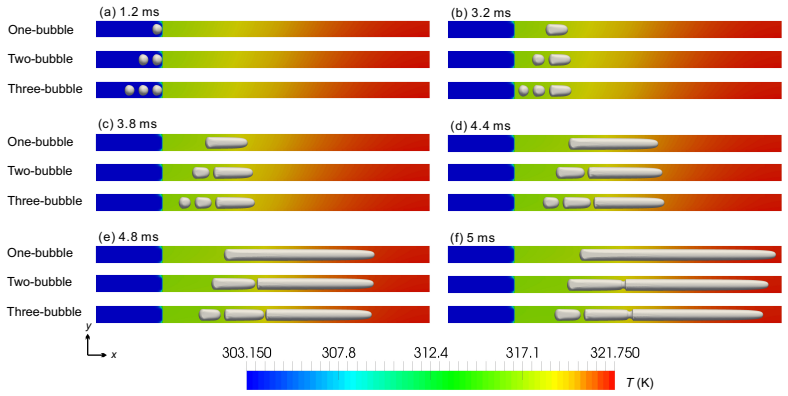
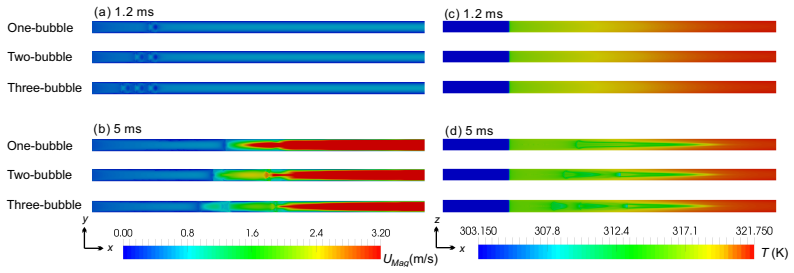
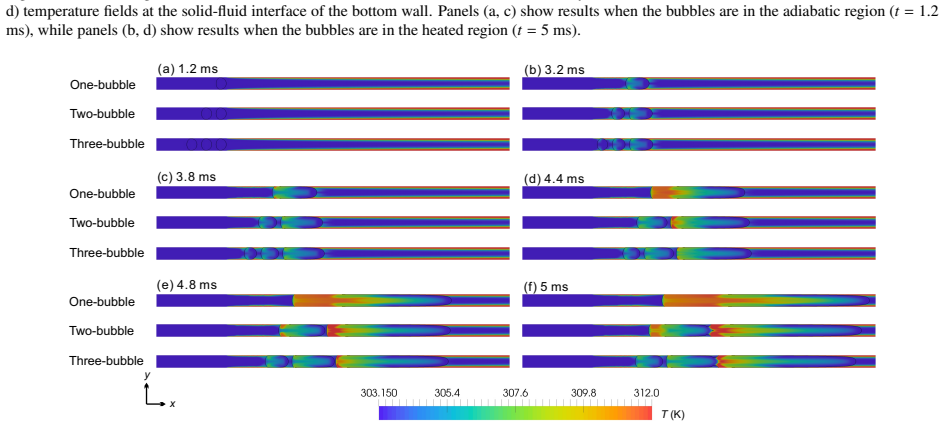
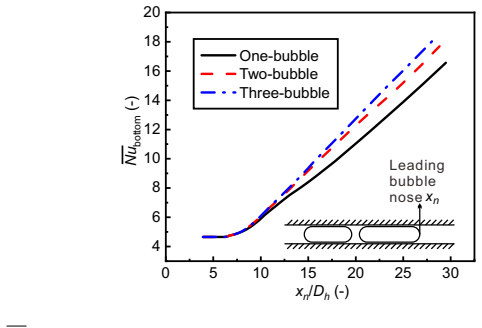
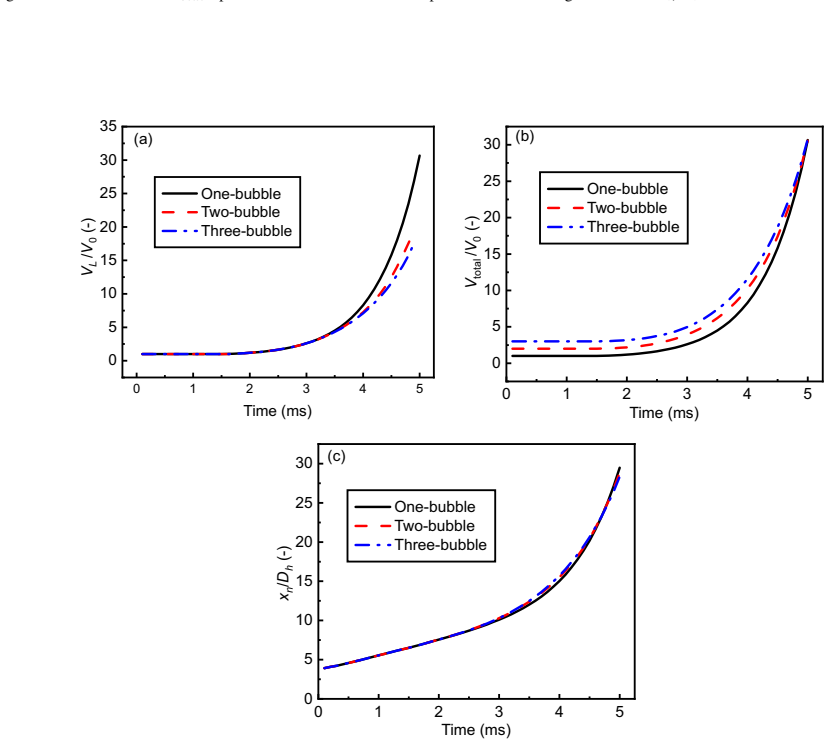
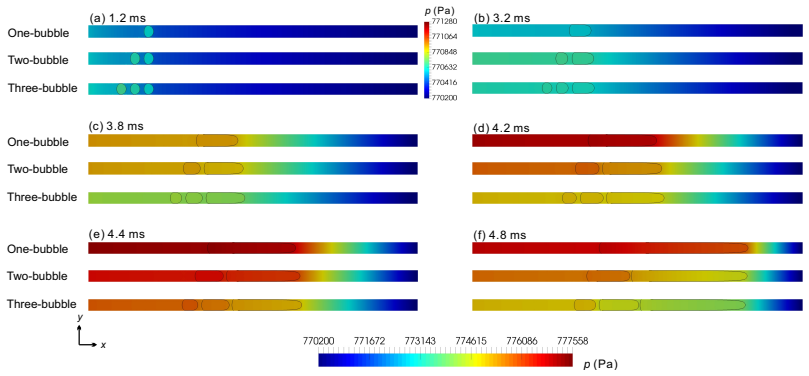
For the same initial size and position of the leading bubble, its final size in a single-bubble microchannel exceeds the size reached by the leading bubble when multiple bubbles are present, because vaporization at the rear bubbles absorbs heat. When the initial volume ratio of the leading bubble to the rear bubble is reduced, the leading bubble grows even smaller downstream because it contacts less of the superheated layer. Raising the Reynolds number produces modestly larger bubbles upstream since the bubbles reach the superheated fluid sooner, while increasing bottom-wall thickness raises upstream wall temperature by conduction and thereby speeds bubble growth and advances coalescence.
What carries the argument
Numerical simulation of the coupled heat transfer, phase change, and fluid flow around multiple vapor bubbles, used to isolate the effect of heat absorption by rear bubbles on leading-bubble growth.
If this is right
- The leading bubble grows smaller as the number of trailing bubbles increases because of heat absorption at the rear sites.
- A smaller initial volume ratio between leading and rear bubbles produces a smaller leading bubble downstream due to reduced contact with the superheated layer.
- Higher Reynolds number yields slightly larger bubbles upstream because the bubbles encounter superheated fluid earlier.
- Thicker bottom walls raise upstream wall temperature by conduction, increasing bubble growth rates and advancing coalescence.
Where Pith is reading between the lines
- The heat-competition mechanism could reduce net heat-removal rate in densely nucleating regimes compared with sparse nucleation.
- Spacing or nucleation-site control might be used to tune the balance between bubble growth and coalescence in cooling designs.
- The same interaction is likely to appear in other confined phase-change flows where multiple interfaces draw from a shared thermal boundary layer.
Load-bearing premise
The numerical model accurately captures the coupled heat transfer, phase change, and fluid flow physics without discretization or modeling errors large enough to change the reported bubble-interaction effects.
What would settle it
Side-by-side experimental images or volume measurements of the leading bubble in single-bubble versus multi-bubble flow boiling runs that match the simulated initial sizes, positions, Reynolds numbers, and wall thicknesses.
Figures




read the original abstract
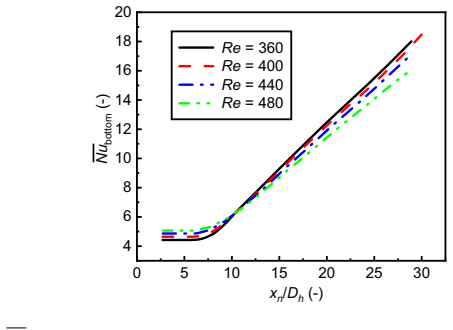
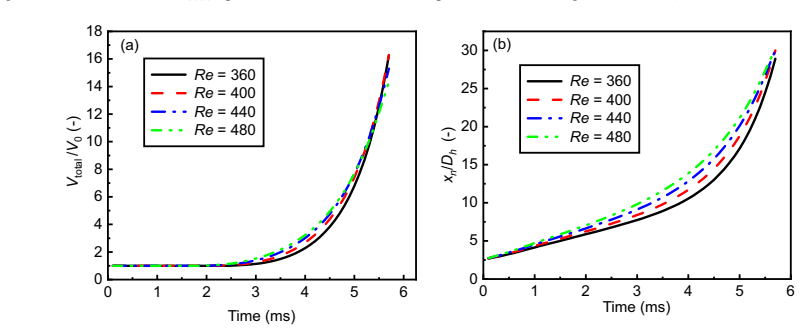
Microchannel flow boiling is an efficient cooling solution for high-power-density miniaturized systems. Many studies on microchannel flow boiling focused on the dynamics of single vapor bubbles, while neglecting the interaction between bubbles, which is important in relevant applications. Here, numerical simulations are carried out to study the interaction between multiple vapor bubbles in microchannel flow boiling. The results show that for different numbers of bubbles in the microchannels with the same initial size and position of leading bubbles, the bubble size in a single-bubble microchannel is larger compared to the leading bubble of multiple-bubble cases because of heat absorption by the vaporization at the rear bubbles. As the initial volume ratio between the leading bubble and the rear bubble decreases, the leading bubble size in the downstream becomes smaller because of the reduced contact with the superheated thermal boundary layer. With increasing the Reynolds number, both the leading and the trailing bubbles increase slightly in size in the upstream of the heated region, because the bubbles at higher Reynolds number move faster and firstly get in contact with the superheated fluid. The increase in the bottom wall thickness increases the growth rate of the multiple bubble sizes with earlier bubble coalescence because of the higher upstream wall temperature by heat conduction in the solid wall.
Editorial analysis
A structured set of objections, weighed in public.
Referee Report
Summary. The paper reports numerical simulations of vapor bubble interactions during flow boiling in microchannels. It claims that, for fixed initial leading-bubble size and position, the leading bubble grows larger in single-bubble cases than in multi-bubble cases because rear bubbles absorb heat via vaporization; additional parametric trends are reported for initial volume ratio, Reynolds number, and bottom-wall thickness, including earlier coalescence at larger wall thickness.
Significance. If the numerical model is shown to be free of significant discretization or constitutive errors, the work would supply concrete mechanistic insight into multi-bubble heat-transfer coupling that is currently missing from the predominantly single-bubble literature, with direct relevance to microchannel cooling design.
major comments (2)
- [Abstract/Results] Abstract and Results: the central claim that rear-bubble vaporization reduces leading-bubble growth rests entirely on the numerical data, yet the manuscript supplies no experimental validation, mesh-independence study, or boundary-condition verification; without these the reported interaction mechanism cannot be assessed for numerical artifact.
- [Numerical Methods] Numerical Methods (assumed section describing the solver): no information is given on the phase-change model (e.g., sharp-interface vs. diffuse), the treatment of the solid-fluid conjugate heat transfer, or the time-step and spatial discretization criteria; these choices directly affect whether the reported Reynolds-number and wall-thickness trends are physically reliable.
minor comments (2)
- [Abstract] Abstract: the long sentence describing Reynolds-number effects is difficult to parse; splitting it would improve clarity.
- [Results] The manuscript does not state the initial bubble shapes or the precise definition of 'bubble size' used for the reported comparisons.
Simulated Author's Rebuttal
We thank the referee for the constructive comments on our numerical study of vapor bubble interactions in microchannel flow boiling. We address each major comment below.
read point-by-point responses
-
Referee: [Abstract/Results] Abstract and Results: the central claim that rear-bubble vaporization reduces leading-bubble growth rests entirely on the numerical data, yet the manuscript supplies no experimental validation, mesh-independence study, or boundary-condition verification; without these the reported interaction mechanism cannot be assessed for numerical artifact.
Authors: Our work is a purely numerical investigation intended to provide mechanistic insight into multi-bubble coupling that is difficult to resolve experimentally. We agree that mesh-independence and boundary-condition verification are essential for credibility and will add these studies (including grid convergence plots and domain-size checks) to the revised manuscript. Experimental validation lies outside the current scope. revision: partial
-
Referee: [Numerical Methods] Numerical Methods (assumed section describing the solver): no information is given on the phase-change model (e.g., sharp-interface vs. diffuse), the treatment of the solid-fluid conjugate heat transfer, or the time-step and spatial discretization criteria; these choices directly affect whether the reported Reynolds-number and wall-thickness trends are physically reliable.
Authors: We apologize for the insufficient detail. The revised manuscript will expand the Numerical Methods section to specify the sharp-interface phase-change model (volume-of-fluid with explicit mass transfer), the conjugate heat-transfer treatment at the solid-fluid interface, and the chosen time-step and spatial discretization criteria together with convergence checks. revision: yes
- Experimental validation of the reported bubble-interaction mechanism
Circularity Check
No significant circularity
full rationale
The paper reports outcomes from direct numerical simulations of multi-bubble flow boiling without any analytical derivation chain, fitted parameters, or self-citations that reduce claims to inputs by construction. All reported trends (bubble-size differences due to heat absorption, Reynolds-number effects, wall-thickness effects) are stated as simulation results rather than predictions derived from prior equations or ansatzes within the work. No load-bearing step matches any of the enumerated circularity patterns.
Axiom & Free-Parameter Ledger
Reference graph
Works this paper leans on
-
[1]
O. A. Odumosu, H. Xu, T. Wang, Z. Che, Growth of elongated vapor bubbles during flow boiling heat transfer in wavy microchannels, Applied Thermal Engineering 223 (2023) 119987.doi:10.1016/j.applthermaleng. 2023.119987
-
[3]
X. Zhang, Y . Zhang, C. Yang, J. Liu, B. Liu, Z. Zhou, Study of flow and heat transfer performance of nanofluids in curved microchannels with different curvatures, Numerical Heat Transfer, Part A: Applications (2024).doi: 10.1080/10407782.2024.2321520. 18
-
[4]
C. Baldassari, M. Marengo, Flow boiling in microchannels and microgravity, Progress in Energy and Combustion Science 39 (1) (2013) 1–36.doi:10.1016/j.pecs.2012.10.001
-
[5]
S. S. Bertsch, E. A. Groll, S. V . Garimella, Review and comparative analysis of studies on saturated flow boiling in small channels, Nanoscale and Microscale Thermophysical Engineering 12 (3) (2008) 187–227.doi:10. 1080/15567260802317357
2008
-
[6]
S. V . Garimella, C. B. Sobhan, Transport in microchannels - a critical review, Annual Review of Heat Transfer 13 (2003) 1–50.doi:10.1615/annualrevheattransfer.v13.30
-
[7]
Z. Guo, D. Fletcher, B. Haynes, A review of computational modelling of flow boiling in microchannels, The Journal of Computational Multiphase Flows 6 (2) (2014) 79–110.doi:10.1260/1757-482x.6.2.79
-
[8]
T. Harirchian, S. V . Garimella, Boiling heat transfer and flow regimes in microchannels—a comprehensive understanding, Journal of Electronic Packaging 133 (1) (2011) 011001.doi:10.1115/1.4002721
-
[9]
S. T. Kadam, I. Hassan, R. Kumar, M. A. Rahman, Bubble dynamics in microchannel: An overview of the state-of-the-art, Meccanica 56 (3) (2021) 481–513.doi:10.1007/s11012-020-01300-4
-
[10]
M. M. Nahar, B. Ma, K. Guye, Q. H. Chau, J. Padilla, M. Iyengar, D. Agonafer, Review article: Microscale evaporative cooling technologies for high heat flux microelectronics devices: Background and recent advances, Applied Thermal Engineering 194 (2021) 117109.doi:10.1016/j.applthermaleng.2021.117109
-
[11]
J. R. Thome, Boiling in microchannels: a review of experiment and theory, International Journal of Heat and Fluid Flow 25 (2) (2004) 128–139.doi:10.1016/j.ijheatfluidflow.2003.11.005
-
[13]
S. Gedupudi, Y . Q. Zu, T. G. Karayiannis, D. B. R. Kenning, Y . Y . Yan, Confined bubble growth during flow boiling in a mini/micro-channel of rectangular cross-section part i: Experiments and 1-d modelling, International Journal of Thermal Sciences 50 (3) (2011) 250–266.doi:10.1016/j.ijthermalsci.2010.09.001
-
[14]
S. Halon, Z. Krolicki, R. Revellin, B. Zajaczkowski, Heat transfer characteristics of flow boiling in a micro channel array with various inlet geometries, International Journal of Heat and Mass Transfer 187 (2022) 122549. doi:10.1016/j.ijheatmasstransfer.2022.122549
-
[15]
R. Kumar, G. Singh, D. Mikielewicz, Effect of asymmetric fluid flow distribution on flow boiling in a microchannel heat sink – an experimental investigation, Applied Thermal Engineering 213 (2022) 118710. doi:10.1016/j.applthermaleng.2022.118710
-
[18]
Y . Zhang, J. Wang, W. Liu, Z. Liu, Heat transfer and pressure drop characteristics of r134a flow boiling in the parallel/tandem microchannel heat sinks, Energy Conversion and Management 148 (2017) 1082–1095.doi: 10.1016/j.enconman.2017.06.067
-
[19]
S. Zhou, B. Shu, Z. Yu, Y . Huang, Y . Zhang, Experimental study and mechanism analysis of the flow boiling and heat transfer characteristics in microchannels with different surface wettability, Micromachines 12 (8) (2021) 881.doi:10.3390/mi12080881. 19
-
[20]
Y . Luo, W. Li, K. Zhou, K. Sheng, S. Shao, Z. Zhang, J. Du, W. J. Minkowycz, Three-dimensional numerical simulation of saturated annular flow boiling in a narrow rectangular microchannel, International Journal of Heat and Mass Transfer 149 (2020) 119246.doi:10.1016/j.ijheatmasstransfer.2019.119246
-
[21]
A. Mukherjee, S. G. Kandlikar, Z. J. Edel, Numerical study of bubble growth and wall heat transfer during flow boiling in a microchannel, International Journal of Heat and Mass Transfer 54 (15-16) (2011) 3702–3718. doi:10.1016/j.ijheatmasstransfer.2011.01.030
-
[22]
R. Zhuan, W. Wang, Flow pattern of boiling in micro-channel by numerical simulation, International Journal of Heat and Mass Transfer 55 (5) (2012) 1741–1753.doi:10.1016/j.ijheatmasstransfer.2011.11.029
-
[23]
A. Ferrari, M. Magnini, J. R. Thome, Numerical analysis of slug flow boiling in square microchannels, International Journal of Heat and Mass Transfer 123 (2018) 928–944.doi: 10.1016/j.ijheatmasstransfer.2018.03.012
-
[24]
M. Magnini, O. K. Matar, Numerical study of the impact of the channel shape on microchannel boiling heat transfer, International Journal of Heat and Mass Transfer 150 (2020) 119322.doi:10.1016/j. ijheatmasstransfer.2020.119322
work page doi:10.1016/j 2020
-
[25]
M. Magnini, B. Pulvirenti, J. R. Thome, Numerical investigation of hydrodynamics and heat transfer of elongated bubbles during flow boiling in a microchannel, International Journal of Heat and Mass Transfer 59 (2013) 451– 471.doi:10.1016/j.ijheatmasstransfer.2012.12.010
-
[26]
Z. Guo, B. S. Haynes, D. F. Fletcher, Numerical simulation of annular flow boiling in microchannels, The Journal of Computational Multiphase Flows 8 (1) (2016) 61–82.doi:10.1177/1757482X16634205
-
[27]
A. Priy, I. Ahmad, M. K. Khan, M. Pathak, Bubble interaction and heat transfer characteristics of microchannel flow boiling with single and multiple cavities, Journal of Thermal Science and Engineering Applications 16 (6) (2024) 061010.doi:10.1115/1.4065187
-
[28]
A. Widyatama, M. Venter, D. Orejon, K. Sefiane, Experimental investigation of bubble dynamics and flow patterns during flow boiling in high aspect ratio microchannels with the effect of flow orientation, International Journal of Thermal Sciences 189 (2023) 108238.doi:10.1016/j.ijthermalsci.2023.108238
-
[29]
Q. Liu, B. Palm, Numerical study of bubbles rising and merging during convective boiling in micro-channels, Applied Thermal Engineering 99 (2016) 1141–1151.doi:10.1016/j.applthermaleng.2016.01.116
-
[30]
L. Consolini, J. R. Thome, A heat transfer model for evaporation of coalescing bubbles in micro-channel flow, International Journal of Heat and Fluid Flow 31 (1) (2010) 115–125.doi:10.1016/j.ijheatfluidflow. 2009.10.005
-
[31]
M. Magnini, B. Pulvirenti, J. R. Thome, Numerical investigation of the influence of leading and sequential bubbles on slug flow boiling within a microchannel, International Journal of Thermal Sciences 71 (2013) 36–52. doi:10.1016/j.ijthermalsci.2013.04.018
-
[32]
Q. Liu, W. Wang, B. Palm, C. Wang, X. Jiang, On the dynamics and heat transfer of bubble train in micro- channel flow boiling, International Communications in Heat and Mass Transfer 87 (2017) 198–203.doi: 10.1016/j.icheatmasstransfer.2017.07.002
-
[33]
L. Lombaard, M. A. Moghimi, P. Valluri, J. P. Meyer, Interaction between multiple bubbles in microchannel flow boiling and the effects on heat transfer, International Communications in Heat and Mass Transfer 129 (2021) 105703.doi:10.1016/j.icheatmasstransfer.2021.105703
-
[34]
H. Scheufler, J. Roenby, Twophaseflow: A framework for developing two phase flow solvers in openfoam, OpenFOAM Journal 3 (2023) 200–224.doi:10.51560/ofj.v3.80. 20
-
[35]
J. U. Brackbill, D. B. Kothe, C. Zemach, A continuum method for modeling surface tension, Journal of Computational Physics 100 (2) (1992) 335–354.doi:10.1016/0021-9991(92)90240-y
-
[36]
S. Hardt, F. Wondra, Evaporation model for interfacial flows based on a continuum-field representation of the source terms, Journal of Computational Physics 227 (11) (2008) 5871–5895.doi:10.1016/j.jcp.2008.02. 020
-
[37]
Scriven, On the dynamics of phase growth, Chemical Engineering Science 10 (1) (1959) 1–13.doi:10
L. Scriven, On the dynamics of phase growth, Chemical Engineering Science 10 (1) (1959) 1–13.doi:10. 1016/0009-2509(59)80019-1. 21
1959
discussion (0)
Sign in with ORCID, Apple, or X to comment. Anyone can read and Pith papers without signing in.