Probing the dark axion portal via J/psi decays at BESIII and STCF
Pith reviewed 2026-06-28 14:01 UTC · model grok-4.3
The pith
Existing BESIII data can exclude previously unexplored regions of the dark axion portal parameter space via mono-photon J/ψ decays.
A machine-rendered reading of the paper's core claim, the machinery that carries it, and where it could break.
Core claim
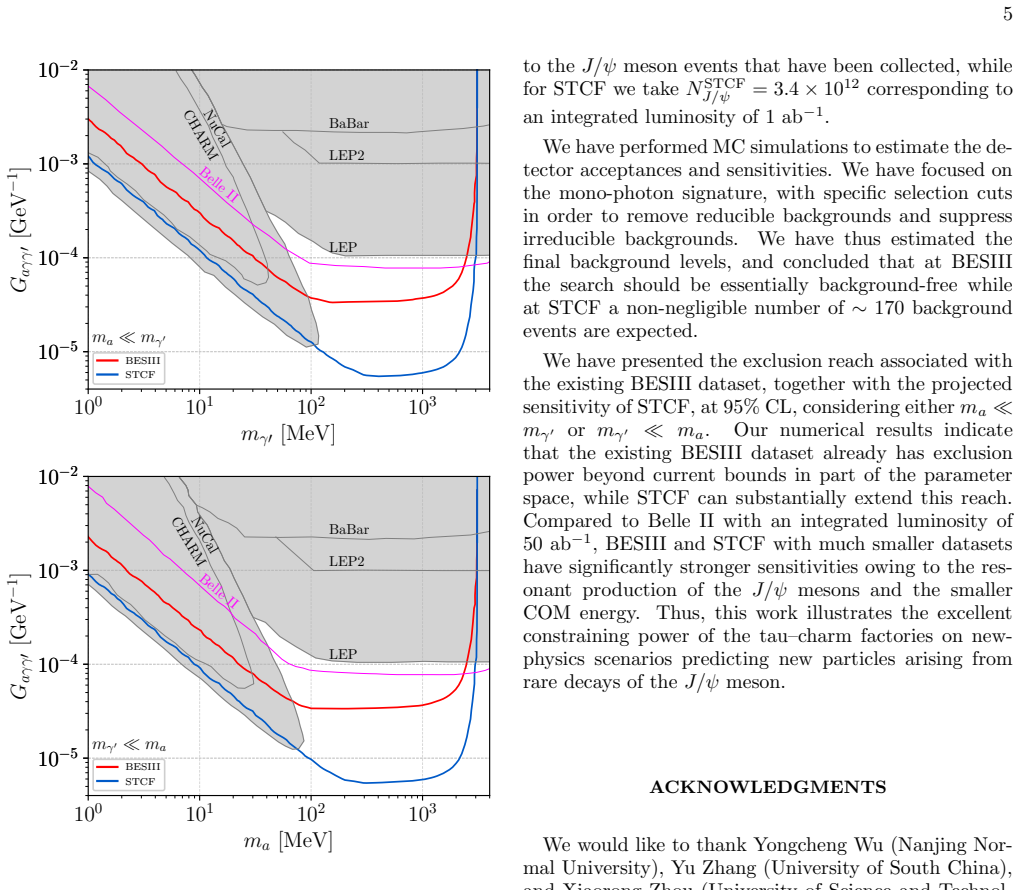
In the dark axion portal, the decay J/ψ → a γ' produces a mono-photon signature that can be used to set limits on the coupling G_aγγ'. Simulations indicate that the BESIII dataset can exclude new areas in the coupling-mass plane, and STCF can improve the sensitivity by about an order of magnitude.
What carries the argument
The mono-photon final state from J/ψ decays to axionlike particle and dark photon, serving as the probe for the portal coupling across mass values.
If this is right
- The existing BESIII dataset has exclusion sensitivity to new regions of the dark axion portal parameter space.
- The future STCF can improve the sensitivity by roughly an order of magnitude.
- The reach is calculated as a function of the ALP and dark photon masses.
- Background events are included in the sensitivity estimates.
Where Pith is reading between the lines
- This mono-photon search could be extended to other vector meson decays for additional coverage of the parameter space.
- The results provide a benchmark for comparing with direct dark photon or ALP searches at different facilities.
- Accurate background modeling is crucial, suggesting that data-driven methods could refine the projections.
Load-bearing premise
The Monte Carlo simulations correctly capture signal efficiencies, background rates, and detector response for the mono-photon final state in J/ψ decays at both BESIII and STCF.
What would settle it
Searching for mono-photon events in the existing BESIII J/ψ dataset and finding event counts consistent with background expectations in the mass ranges where sensitivity is claimed would support the exclusion reach; a significant excess would indicate either new physics or underestimated backgrounds.
Figures

read the original abstract
Large numbers of $J/\psi$ mesons can be resonantly produced at BESIII and STCF at the center-of-mass energy $\sqrt{s}=3.097$ GeV. Such $J/\psi$ mesons may undergo rare decays into an axionlike particle (ALP) $a$ and a dark photon $\gamma'$ in the theoretical framework of the dark axion portal. In this work, we investigate the exclusion reach of the existing BESIII dataset together with the projected sensitivity of STCF, focusing on the mono-photon signature. We perform Monte Carlo simulations and estimate the exclusion reach in the portal coupling $G_{a\gamma\gamma'}$ as a function of the ALP and dark-photon masses, taking background events into account. Our results indicate that the existing BESIII dataset already has exclusion sensitivity to previously unexplored regions of the dark axion portal parameter space, while the future STCF can further improve the sensitivity by roughly an order of magnitude.
Editorial analysis
A structured set of objections, weighed in public.
Referee Report
Summary. The paper claims that Monte Carlo simulations of J/ψ → a γ' decays (with mono-photon signature) at √s=3.097 GeV show that the existing BESIII dataset already excludes previously unexplored regions of the dark axion portal parameter space in G_aγγ' as a function of m_a and m_γ', while the projected STCF luminosity improves the sensitivity by roughly an order of magnitude, with backgrounds included in the MC.
Significance. If the MC projections are reliable, the work would set new limits on a light dark-sector portal model using existing and near-future e+e- data, complementing other ALP and dark-photon searches.
major comments (2)
- [Abstract / Monte Carlo section] Abstract and method description: the central exclusion-reach claim rests on the accuracy of the simulated background rate (after all selection cuts) in the mono-photon channel. No details are provided on background modeling choices (e.g., radiative J/ψ decays, beam-related photons, mis-ID rates), systematic uncertainties, or validation against data, which directly affects both the BESIII and STCF projections.
- [Results / sensitivity plots] The mass-dependent efficiency and kinematic acceptance enter the limit-setting procedure; any mismatch between MC and reality in these quantities would propagate to the quoted sensitivity curves in G_aγγ'.
minor comments (2)
- [Introduction] Clarify the precise definition of the portal coupling G_aγγ' and its relation to the underlying Lagrangian parameters.
- [Simulation setup] Add a table or explicit statement of the assumed integrated luminosities for BESIII and STCF.
Simulated Author's Rebuttal
We thank the referee for the detailed and constructive report. The comments correctly identify areas where additional methodological detail is needed to support the Monte Carlo-based projections. We will revise the manuscript to address these points.
read point-by-point responses
-
Referee: [Abstract / Monte Carlo section] Abstract and method description: the central exclusion-reach claim rests on the accuracy of the simulated background rate (after all selection cuts) in the mono-photon channel. No details are provided on background modeling choices (e.g., radiative J/ψ decays, beam-related photons, mis-ID rates), systematic uncertainties, or validation against data, which directly affects both the BESIII and STCF projections.
Authors: We agree that the current manuscript lacks sufficient detail on background modeling. In the revised version we will expand the Monte Carlo section to describe the modeling of radiative J/ψ decays, beam-related photons, and particle mis-identification rates. We will also add a dedicated paragraph on the systematic uncertainties assigned to the background rate after selection cuts and on any cross-checks performed against existing BESIII data samples. These additions will apply to both the existing-data and STCF projections. revision: yes
-
Referee: [Results / sensitivity plots] The mass-dependent efficiency and kinematic acceptance enter the limit-setting procedure; any mismatch between MC and reality in these quantities would propagate to the quoted sensitivity curves in G_aγγ'.
Authors: We acknowledge that the quoted sensitivity depends on the accuracy of the mass-dependent efficiencies and acceptances obtained from simulation. In the revision we will include a short discussion of possible sources of mismatch between MC and data (e.g., photon reconstruction efficiency, angular resolution) together with a conservative estimate of the associated uncertainty on the exclusion contours. This will be presented alongside the main sensitivity curves. revision: yes
Circularity Check
No circularity in Monte Carlo-based sensitivity projections
full rationale
The paper estimates exclusion reach for the dark axion portal via Monte Carlo simulations of J/ψ → a γ' decays and background modeling at BESIII and STCF. These are forward projections of experimental sensitivity as a function of masses and coupling G_aγγ', not theoretical derivations or fits that reduce to the input parameters by construction. No self-definitional steps, fitted inputs renamed as predictions, or load-bearing self-citations appear in the provided text. The method relies on external simulation assumptions for efficiencies and backgrounds, which are independent of the target parameter space and do not create a closed loop. This is a standard phenomenological sensitivity study with no reduction of the claimed results to the inputs.
Axiom & Free-Parameter Ledger
axioms (2)
- standard math J/ψ production cross-section and decay branching ratios at sqrt(s) = 3.097 GeV follow known resonance properties
- domain assumption Monte Carlo tools accurately model signal acceptance and background processes for the mono-photon signature
invented entities (1)
-
ALP a and dark photon γ' in the dark axion portal
no independent evidence
Reference graph
Works this paper leans on
-
[1]
R. E. Shrock, Phys. Lett. B96, 159 (1980)
1980
-
[2]
R. E. Shrock, Phys. Rev. D24, 1232 (1981)
1981
-
[3]
R. E. Shrock, Phys. Rev. D24, 1275 (1981)
1981
-
[4]
D. O’Connell, M. J. Ramsey-Musolf, and M. B. Wise, Phys. Rev. D75, 037701 (2007), arXiv:hep-ph/0611014
Pith/arXiv arXiv 2007
-
[5]
J. D. Wells, , 283 (2008), arXiv:0803.1243 [hep-ph]
Pith/arXiv arXiv 2008
-
[6]
C. Bird, P. Jackson, R. V. Kowalewski, and M. Pospelov, Phys. Rev. Lett.93, 201803 (2004), arXiv:hep-ph/0401195
Pith/arXiv arXiv 2004
-
[7]
M. Pospelov, A. Ritz, and M. B. Voloshin, Phys. Lett. B662, 53 (2008), arXiv:0711.4866 [hep-ph]
Pith/arXiv arXiv 2008
-
[8]
G. Krnjaic, Phys. Rev. D94, 073009 (2016), arXiv:1512.04119 [hep-ph]
Pith/arXiv arXiv 2016
-
[9]
I. Boiarska, K. Bondarenko, A. Boyarsky, V. Gorkavenko, M. Ovchynnikov, and A. Sokolenko, JHEP11, 162 (2019), arXiv:1904.10447 [hep-ph]
arXiv 2019
-
[10]
L. B. Okun, Sov. Phys. JETP56, 502 (1982)
1982
-
[11]
Galison and A
P. Galison and A. Manohar, Phys. Lett. B136, 279 (1984)
1984
-
[12]
Holdom, Phys
B. Holdom, Phys. Lett. B166, 196 (1986)
1986
-
[13]
C. Boehm and P. Fayet, Nucl. Phys. B683, 219 (2004), arXiv:hep-ph/0305261
Pith/arXiv arXiv 2004
-
[14]
M. Pospelov, Phys. Rev. D80, 095002 (2009), arXiv:0811.1030 [hep-ph]. 3 As mentioned in Sec. I, we ignore theZ-boson contributions to the signal process in this work since we study low-energye +e− collider experiments BESIII and STCF. 4 We note, however, in Ref. [64], a factor of 4 is missing in its Eq. (7) for the expression of the matrix element ofJ/ψ→γν¯ν
Pith/arXiv arXiv 2009
-
[15]
D. Curtin, R. Essig, S. Gori, and J. Shelton, JHEP02, 157 (2015), arXiv:1412.0018 [hep-ph]
Pith/arXiv arXiv 2015
-
[16]
R. D. Peccei and H. R. Quinn, Phys. Rev. Lett.38, 1440 (1977)
1977
-
[17]
R. D. Peccei and H. R. Quinn, Phys. Rev. D16, 1791 (1977)
1977
-
[18]
Witten, Phys
E. Witten, Phys. Lett. B149, 351 (1984)
1984
-
[19]
J. P. Conlon, JHEP05, 078 (2006), arXiv:hep- th/0602233
arXiv 2006
-
[20]
N. Arkani-Hamed, L. Motl, A. Nicolis, and C. Vafa, JHEP06, 060 (2007), arXiv:hep-th/0601001
Pith/arXiv arXiv 2007
-
[21]
A. Arvanitaki, S. Dimopoulos, S. Dubovsky, N. Kaloper, and J. March-Russell, Phys. Rev. D81, 123530 (2010), arXiv:0905.4720 [hep-th]
Pith/arXiv arXiv 2010
-
[22]
M. Cicoli, M. Goodsell, and A. Ringwald, JHEP10, 146 (2012), arXiv:1206.0819 [hep-th]
Pith/arXiv arXiv 2012
-
[23]
K. Kaneta, H.-S. Lee, and S. Yun, Phys. Rev. Lett.118, 101802 (2017), arXiv:1611.01466 [hep-ph]
Pith/arXiv arXiv 2017
-
[24]
K. Kaneta, H.-S. Lee, and S. Yun, Phys. Rev. D95, 115032 (2017), arXiv:1704.07542 [hep-ph]
Pith/arXiv arXiv 2017
-
[25]
E. Broadberry, S. Das, A. Hook, and G. Mar- ques Tavares, JHEP03, 215 (2025), arXiv:2408.03370 [hep-ph]
arXiv 2025
-
[26]
P. W. Graham, D. E. Kaplan, and S. Rajendran, Phys. Rev. Lett.115, 221801 (2015), arXiv:1504.07551 [hep- ph]
Pith/arXiv arXiv 2015
-
[27]
K. Choi, H. Kim, and T. Sekiguchi, Phys. Rev. D95, 075008 (2017), arXiv:1611.08569 [hep-ph]
Pith/arXiv arXiv 2017
- [28]
-
[29]
P. deNiverville and H.-S. Lee, Phys. Rev. D100, 055017 (2019), arXiv:1904.13061 [hep-ph]. 7
arXiv 2019
-
[30]
A. S. Zhevlakov, D. V. Kirpichnikov, and V. E. Lyubovitskij, Phys. Rev. D106, 035018 (2022), arXiv:2204.09978 [hep-ph]
arXiv 2022
-
[31]
S. N. Gninenko, N. V. Krasnikov, V. E. Lyubovitskij, S. Kuleshov, A. S. Zhevlakov, I. V. Voronchikhin, and D. V. Kirpichnikov, (2026), arXiv:2602.11405 [hep-ph]
arXiv 2026
-
[32]
P. deNiverville, H.-S. Lee, and M.-S. Seo, Phys. Rev. D 98, 115011 (2018), arXiv:1806.00757 [hep-ph]
Pith/arXiv arXiv 2018
-
[33]
O. E. Kalashev, A. Kusenko, and E. Vitagliano, Phys. Rev. D99, 023002 (2019), arXiv:1808.05613 [hep-ph]
Pith/arXiv arXiv 2019
-
[34]
P. Deniverville, H.-S. Lee, and Y.-M. Lee, Phys. Rev. D 103, 075006 (2021), arXiv:2011.03276 [hep-ph]
arXiv 2021
-
[35]
A. Hook, G. Marques-Tavares, and C. Ristow, JHEP06, 167 (2021), arXiv:2105.06476 [hep-ph]
arXiv 2021
-
[36]
A. Hook, G. Marques-Tavares, and C. Ristow, JHEP05, 086 (2024), arXiv:2306.13135 [hep-ph]
arXiv 2024
-
[37]
H. Hong, U. Min, M. Son, and T. You, JHEP03, 155 (2024), arXiv:2310.19544 [hep-ph]
arXiv 2024
-
[38]
K. Jod lowski, Phys. Rev. D108, 115017 (2023), arXiv:2305.05710 [hep-ph]
arXiv 2023
-
[39]
Jod lowski, JHEP08, 022 (2025), arXiv:2411.19196 [hep-ph]
K. Jod lowski, JHEP08, 022 (2025), arXiv:2411.19196 [hep-ph]
arXiv 2025
- [40]
-
[41]
Y. Shen, J. Tang, L. Wang, Y. Wu, and L. Yang, (2026), arXiv:2603.24050 [hep-ph]
arXiv 2026
-
[42]
M. Ablikimet al.(BESIII), Nucl. Instrum. Meth. A614, 345 (2010), arXiv:0911.4960 [physics.ins-det]
Pith/arXiv arXiv 2010
-
[43]
M. Achasovet al., Front. Phys. (Beijing)19, 14701 (2024), arXiv:2303.15790 [hep-ex]
arXiv 2024
-
[44]
X.-C. Aiet al., Nucl. Sci. Tech.36, 242 (2025), arXiv:2509.11522 [physics.acc-ph]
arXiv 2025
- [45]
-
[46]
Brambillaet al.(Quarkonium Working Group), (2004), 10.5170/CERN-2005-005, arXiv:hep- ph/0412158
N. Brambillaet al.(Quarkonium Working Group), (2004), 10.5170/CERN-2005-005, arXiv:hep- ph/0412158
-
[47]
Navaset al.(Particle Data Group), Phys
S. Navaset al.(Particle Data Group), Phys. Rev. D110, 030001 (2024)
2024
-
[48]
M. Ablikimet al.(BESIII), Phys. Rev. D96, 112008 (2017), arXiv:1707.05178 [hep-ex]
Pith/arXiv arXiv 2017
- [49]
-
[50]
Y. Zhang, W.-T. Zhang, M. Song, X.-A. Pan, Z.-M. Niu, and G. Li, Phys. Rev. D100, 115016 (2019), arXiv:1907.07046 [hep-ph]
arXiv 2019
-
[51]
Z. Liu and Y. Zhang, Phys. Rev. D99, 015004 (2019), arXiv:1808.00983 [hep-ph]
Pith/arXiv arXiv 2019
-
[52]
D. M. Asneret al., Int. J. Mod. Phys. A24, S1 (2009), arXiv:0809.1869 [hep-ex]
Pith/arXiv arXiv 2009
-
[53]
Y. Meng, N. Li, C. Liu, H. Yan, K.-L. Zhang, and X.-Z. Zhang, (2026), arXiv:2601.18209 [hep-lat]
arXiv 2026
-
[54]
M. Ablikimet al.(BESIII), Chin. Phys. C46, 074001 (2022), arXiv:2111.07571 [hep-ex]
arXiv 2022
-
[55]
S. N. Gninenko, Phys. Rev. D85, 055027 (2012), arXiv:1112.5438 [hep-ph]
Pith/arXiv arXiv 2012
-
[56]
S. N. Gninenko, Phys. Lett. B713, 244 (2012), arXiv:1204.3583 [hep-ph]
Pith/arXiv arXiv 2012
-
[57]
Blumleinet al., Z
J. Blumleinet al., Z. Phys. C51, 341 (1991)
1991
-
[58]
J. Blumlein and J. Brunner, Phys. Lett. B701, 155 (2011), arXiv:1104.2747 [hep-ex]
Pith/arXiv arXiv 2011
-
[59]
B. Aubertet al.(BaBar), in34th International Con- ference on High Energy Physics(2008) arXiv:0808.0017 [hep-ex]
Pith/arXiv arXiv 2008
-
[60]
Akerset al.(OPAL), Z
R. Akerset al.(OPAL), Z. Phys. C65, 47 (1995)
1995
-
[61]
Abreuet al.(DELPHI), Z
P. Abreuet al.(DELPHI), Z. Phys. C74, 577 (1997)
1997
-
[62]
J. Abdallahet al.(DELPHI), Eur. Phys. J. C38, 395 (2005), arXiv:hep-ex/0406019
Pith/arXiv arXiv 2005
-
[63]
G. Hao, Y. Jia, C.-F. Qiao, and P. Sun, JHEP02, 057 (2007), arXiv:hep-ph/0612173
Pith/arXiv arXiv 2007
- [64]
discussion (0)
Sign in with ORCID, Apple, or X to comment. Anyone can read and Pith papers without signing in.