Quasi-bound States of Scalar field inside the Dyonic Kerr-Sen Black Hole
Pith reviewed 2026-06-28 13:49 UTC · model grok-4.3
The pith
Quasi-bound scalar states in dyonic Kerr-Sen black holes grow exponentially when their real frequency is positive, destabilizing regions with closed timelike curves.
A machine-rendered reading of the paper's core claim, the machinery that carries it, and where it could break.
Core claim
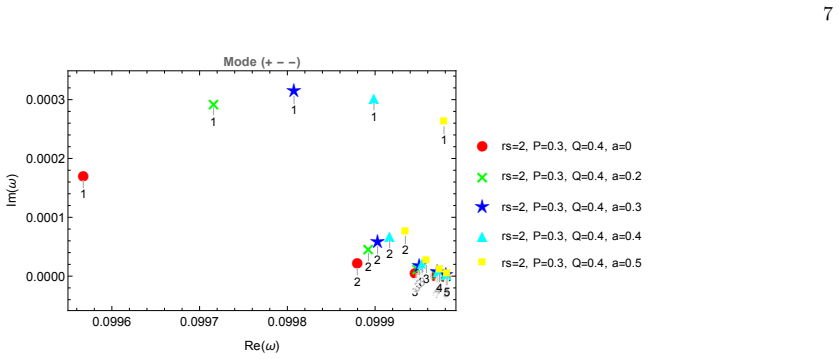
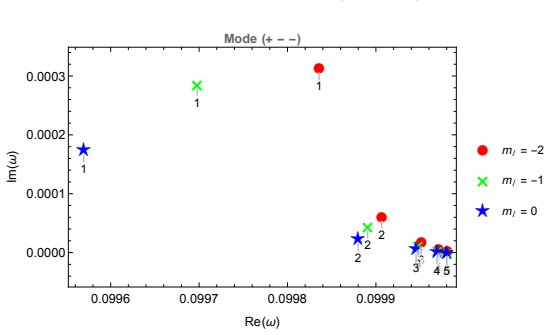
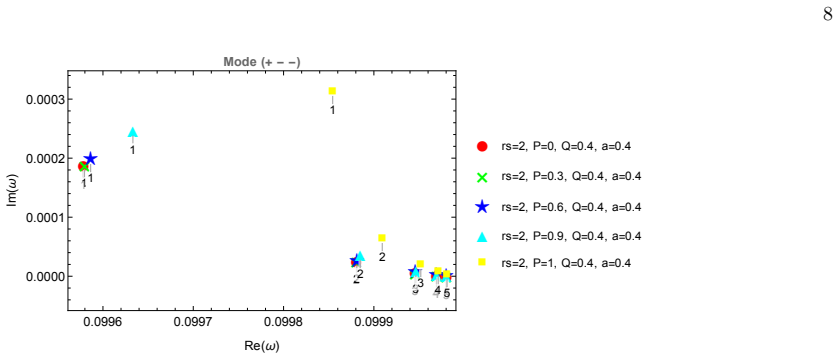
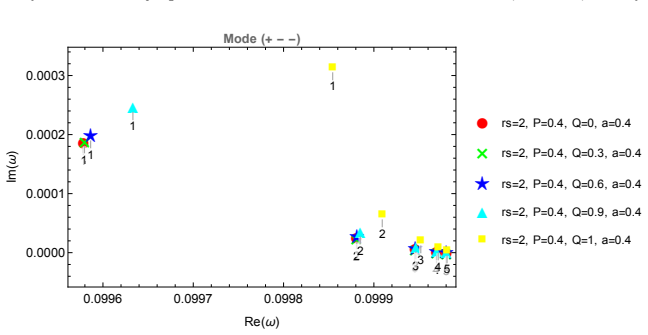
Exact radial solutions are confluent Heun functions in ingoing Eddington-Finkelstein coordinates; regularity at infinity forces series truncation and thereby quantizes the quasi-stationary frequencies. The resulting spectrum splits into spin-charge insensitive and dependent branches, exhibits co/counter-rotating asymmetry, and shifts systematically with electric and magnetic charges. Every physical branch obeys the rule that positive real frequency implies positive imaginary part (exponential growth) while negative real frequency implies decay, and purely imaginary modes lack any propagating component.
What carries the argument
Confluent Heun functions obtained after separation in horizon-regular ingoing Eddington-Finkelstein coordinates, with truncation of their series at spatial infinity supplying the exact quantization condition on the complex frequency.
If this is right
- The spectrum contains both spin-charge insensitive and explicitly dependent branches.
- Co-rotating and counter-rotating configurations display systematic asymmetry from angular-momentum coupling.
- Electric and magnetic charges produce uniform shifts across the entire spectrum.
- Purely imaginary modes carry no oscillatory phase and therefore cannot propagate along closed timelike curves.
Where Pith is reading between the lines
- The same truncation procedure could be applied to other rotating charged black-hole metrics that possess inner horizons.
- The reported instability supplies a concrete mechanism that could be checked against linear perturbation analyses of the same background.
- If the growth persists for other field spins, the result would extend the destabilization argument beyond scalars.
Load-bearing premise
Truncating the confluent Heun series at spatial infinity supplies the complete quantization condition on the frequency without any further boundary conditions imposed at the inner horizons or in the closed-timelike-curve region.
What would settle it
Direct numerical evaluation of the imaginary part for the lowest positive-real-frequency root obtained from the Heun truncation condition; a negative value would contradict the reported sign rule.
Figures

read the original abstract
We found sets of exact analytic quasi-stationary states of a massive scalar field in a dyonic Kerr-Sen black hole~(DKSBH) background in the maximally extended spacetime region. A central novelty is the use of horizon-regular ingoing Eddington-Finkelstein coordinates, which enables a direct and unambiguous imposition of the ingoing boundary condition at the horizon. The exact radial solutions are in the form of confluent Heun functions. Imposing regularity at spatial infinity enforces a series truncation condition, yielding an exact quantization of the quasi-stationary frequencies. The spectrum exhibits a rich multi-branch structure, which we show splits into two distinct classes: modes that are insensitive to the black hole spin and charges and modes that explicitly depend on them. We uncover a clear asymmetry between co-rotating and counter-rotating configurations, driven by the spin-angular momentum coupling, as well as a systematic shift of the spectrum induced by electric and magnetic charges. The physical branches exhibit a universal behavior: modes with positive real frequency possess positive imaginary parts and therefore grow exponentially in time, whereas modes with negative real frequency are damped and decay. This suggests that positive-energy excitations in the region behind the outer horizon including the inner region of the inner horizon which contains the closed-timelike-curve, exponentially destabilize the background spacetime, supporting Hawking's chronology protection conjecture. In addition, the purely imaginary modes contain no oscillatory component and hence do not propagate through the spacetime, preventing traveling excitations along closed timelike curves and remaining consistent with the conjecture.
Editorial analysis
A structured set of objections, weighed in public.
Referee Report
Summary. The paper derives exact analytic quasi-stationary frequencies for a massive scalar field in the dyonic Kerr-Sen black hole using confluent Heun functions. Ingoing boundary conditions are imposed at the outer horizon via horizon-regular Eddington-Finkelstein coordinates; regularity at spatial infinity is enforced by truncating the Heun series, producing a discrete multi-branch spectrum. The authors report that positive-Re(ω) modes have positive Im(ω) (exponential growth) while negative-Re(ω) modes are damped, interpreting this as destabilization of the region behind the outer horizon (including the CTC-containing inner region of the inner horizon) and support for Hawking's chronology protection conjecture. Purely imaginary modes are noted to lack oscillatory propagation.
Significance. If the boundary conditions are fully justified, the work supplies exact, parameter-free quantization conditions via Heun truncation and an explicit sign correlation between Re(ω) and Im(ω) that directly links to chronology protection. The horizon-regular coordinate choice and separation into spin/charge-insensitive versus dependent branches constitute clear technical strengths.
major comments (1)
- [quantization condition via Heun truncation (abstract and radial solution section)] The central claim that positive-Re(ω) modes exponentially destabilize the CTC region rests on the spectrum obtained solely from the series-truncation condition at spatial infinity after imposing the ingoing condition at the outer horizon. The manuscript must demonstrate that analytic continuation of these truncated solutions through the inner horizon satisfies the required regularity or radiation conditions in the CTC patch; otherwise the reported sign correlation between Re(ω) and Im(ω) is not guaranteed to hold for physical modes in the maximally extended manifold.
Simulated Author's Rebuttal
We thank the referee for the careful reading of our manuscript and the constructive comments provided. We respond to the major comment below.
read point-by-point responses
-
Referee: [quantization condition via Heun truncation (abstract and radial solution section)] The central claim that positive-Re(ω) modes exponentially destabilize the CTC region rests on the spectrum obtained solely from the series-truncation condition at spatial infinity after imposing the ingoing condition at the outer horizon. The manuscript must demonstrate that analytic continuation of these truncated solutions through the inner horizon satisfies the required regularity or radiation conditions in the CTC patch; otherwise the reported sign correlation between Re(ω) and Im(ω) is not guaranteed to hold for physical modes in the maximally extended manifold.
Authors: The exact solutions are given by confluent Heun functions, which by definition admit analytic continuation throughout the complex plane (with appropriate branch cuts). The radial equation itself is the same in all regions of the maximally extended manifold, and the coordinate choice allows extension across the outer horizon. The truncation condition at spatial infinity and the ingoing condition at the outer horizon fix the global solution, whose continuation to the region inside the inner horizon (including the CTC patch) is uniquely determined. The frequency quantization and the resulting sign correlation between Re(ω) and Im(ω) therefore apply to these globally defined modes. We do not believe additional explicit verification of regularity conditions in the CTC patch is required, as the instability is manifested by the exponential growth in time for positive-Re(ω) modes. revision: no
Circularity Check
No circularity: frequencies obtained directly from wave equation plus boundary conditions
full rationale
The derivation separates the Klein-Gordon equation in the given metric, expresses the radial solution as a confluent Heun function after imposing the ingoing condition at the outer horizon in EF coordinates, and obtains the discrete spectrum solely by enforcing series termination at spatial infinity. The reported correlation between the signs of Re(ω) and Im(ω) is an emergent property of the resulting eigenvalues rather than a definitional input or fitted parameter. No self-citations, uniqueness theorems, or ansatzes from prior work appear as load-bearing steps that reduce the claimed result to its own assumptions by construction.
Axiom & Free-Parameter Ledger
axioms (2)
- domain assumption The background spacetime is described by the dyonic Kerr-Sen metric.
- standard math The scalar field obeys the Klein-Gordon equation in curved spacetime.
Reference graph
Works this paper leans on
-
[1]
This transformation makes the singular structure of the differential equation manifest atz= 0 andz= 1, corresponding to the inner and outer horizons, respec- tively. In terms of the new coordinatez, the radial equation becomes z(z−1)∂ 2 z R(z)− (1−2z) + 2i δr n a2 −k 2 + (r− +zδ r)(r− +zδ r −2d) ω−am l o ∂zR(z) − h m2 n −k 2 + (r− +zδ r)(r− +zδ r −2d) o −...
-
[2]
This behavior indicates that the mode remains regular at r=r − and corresponds to a purely ingoing wave in the near-horizon region
Near-inner-horizon behavior In the vicinity of the inner horizonr=r −, correspond- ing toz→0, the radial solution behaves as R(z)∼z 1 2 (β±+β+).(54) For theβ − branch, we obtain Rβ−(z)∼z 1 2 (β−+β+) =z 0,(55) which is finite and non-oscillatory at the inner horizon. This behavior indicates that the mode remains regular at r=r − and corresponds to a purely...
-
[3]
For theγ + branch, the solution reduces to Rγ+(z)∼(z−1) 0,(59) which is finite and non-oscillatory
Near-outer-horizon behavior In the vicinity of the outer (event) horizonr=r +, corresponding toz→1, the radial solution behaves as R(z)∼(z−1) 1 2 (γ±−γ+).(57) For theγ − branch, we find Rγ−(z)∼(z−1) −γ+ ,(58) which represents an oscillatory mode corresponding to outgoing radiation at the event horizon. For theγ + branch, the solution reduces to Rγ+(z)∼(z−...
-
[4]
new universe
Inside the new universe At spatial infinity (r→ −∞), the radial solution ex- hibits the asymptotic behavior R(r→ −∞)∼e 1 2 α±z.(60) In the maximally extended spacetime, the limitr→ −∞is interpreted as a second asymptotically flat exte- rior region, corresponding to a “new universe” connected through the black hole interior. In this second universe, we req...
-
[5]
For the branch (α +, β+, γ+), we obtain −(m2 −2ω 2)rs 2 √ m2 −ω 2 + i δr 2aml −(r 2 s −2r 2 D)ω =−n.(62) This relation depends explicitly on the rotation pa- rameteraand the total charge scaler D, show- ing that both rotation and electromagnetic charges directly influence the energy and stability of the scalar field. 9
-
[6]
For the branch (α +, β+, γ−), we find −(m2 −2ω 2)rs 2 √ m2 −ω 2 +ir sω=−n.(63) This branch is independent ofa,Q, andP, indi- cating that the corresponding modes are governed purely by the scalar mass and the overall gravita- tional scale set by the black hole
-
[7]
For the branch (α +, β−, γ+), we obtain −(m2 −2ω 2)rs 2 √ m2 −ω 2 −ir sω=−n.(64) This branch is also independent of rotation and charges, but differs in the sign of the imaginary term, which controls whether the mode decays or grows
-
[8]
− α2 4 + 1 2 −η x + 1 4 − β2 4 x2 + − 1 2 +δ+η x−1 + 1 4 − γ2 4 (x−1) 2 # Y= 0.(B8) Accordingly, the transformed solutionY(x) is Y(x) =e 1 2 αx(x−1) 1 2 (γ+1)
Finally, for the branch (α +, β−, γ−), we obtain −(m2 −2ω 2)rs 2 √ m2 −ω 2 − i δr 2aml −(r 2 s −2r 2 D)ω =−n,(65) where we have used the identity 2d−2r − −δ r =−r s.(66) Since we can castδ r = 2 s rs 2 − r2 D rs 2 −a 2, all of the quasi-stationary states above depend only onr s, a, mand the charge length scaler D. Each quantization condition yields a quar...
1992
-
[9]
M. P. Hobson, G. P. Efstathiou, and A. N. Lasenby, Gen- eral relativity: An introduction for physicists (2006)
2006
-
[10]
C. M. Will, The Confrontation between General Rela- tivity and Experiment, Living Rev. Rel.17, 4 (2014), arXiv:1403.7377 [gr-qc]
Pith/arXiv arXiv 2014
-
[11]
B. P. Abbottet al.(LIGO Scientific, Virgo), GW170817: Observation of Gravitational Waves from a Binary Neu- tron Star Inspiral, Phys. Rev. Lett.119, 161101 (2017), arXiv:1710.05832 [gr-qc]
Pith/arXiv arXiv 2017
-
[12]
B. Abbott and et.al., Gwtc-1: A gravitational-wave tran- sient catalog of compact binary mergers observed by ligo and virgo during the first and second observing runs, Physical Review X9, 10.1103/physrevx.9.031040 (2019)
-
[13]
E. H. T. C. et.al., First sagittarius a* event horizon tele- scope results. vi. testing the black hole metric, The As- trophysical Journal Letters930, L17 (2022)
2022
-
[14]
J. W. Moffat, Scalar–tensor–vector gravity theory, Jour- nal of Cosmology and Astroparticle Physics2006(03), 004–004
-
[15]
J. W. MOFFAT, A modified gravity and its consequences for the solar system, astrophysics and cosmology, Inter- national Journal of Modern Physics D16, 2075–2090 (2007)
2075
-
[16]
Clifton, P
T. Clifton, P. G. Ferreira, A. Padilla, and C. Skordis, Modified gravity and cosmology, Physics Reports513, 1–189 (2012)
2012
-
[17]
Papantonopoulos, ed.,Proceedings of the 7th Aegean Summer School : Beyond Einstein’s theory of gravity
E. Papantonopoulos, ed.,Proceedings of the 7th Aegean Summer School : Beyond Einstein’s theory of gravity. Modifications of Einstein’s Theory of Gravity at Large Distances.: Paros, Greece, September 23-28, 2013, Vol. 892 (2015)
2013
-
[18]
Petrov,Introduction to Modified Gravity(Springer In- ternational Publishing, 2020)
A. Petrov,Introduction to Modified Gravity(Springer In- ternational Publishing, 2020)
2020
-
[19]
Sen, Rotating charged black hole solution in heterotic string theory, Physical Review Letters69, 1006–1009 (1992)
A. Sen, Rotating charged black hole solution in heterotic string theory, Physical Review Letters69, 1006–1009 (1992)
1992
-
[20]
Banerjee, B
I. Banerjee, B. Mandal, and S. SenGupta, Implications of einstein–maxwell dilaton–axion gravity from the black hole continuum spectrum, Monthly Notices of the Royal Astronomical Society500, 481–492 (2020)
2020
-
[21]
D. Wu, S.-Q. Wu, P. Wu, and H. Yu, Aspects of the dyonic kerr-sen-black hole and its ultraspinning version, Physical Review D103, 10.1103/physrevd.103.044014 (2021)
-
[22]
R. P. Kerr, Gravitational field of a spinning mass as an example of algebraically special metrics, Phys. Rev. Lett. 11, 237 (1963)
1963
-
[23]
D. Senjaya, P. Burikham, and T. Harko, The exact rela- tivistic scalar quasibound states of the dyonic Kerr–Sen black hole: quantized energy, and Hawking radiation, Eur. Phys. J. C84, 857 (2024), arXiv:2405.15219 [gr-qc]
arXiv 2024
-
[24]
T. Bunyaratavej, P. Burikham, and D. Senjaya, Re- 14 visiting chronology protection conjecture in the Dyonic Kerr–Sen black hole spacetime, Eur. Phys. J. C85, 270 (2025), arXiv:2408.06023 [gr-qc]
arXiv 2025
-
[25]
Press and S
W. Press and S. Teukolsky, Perturbations of a rotating black hole. ii. dynamical stability of the kerr metric, The Astrophysical Journal185, 649 (1973)
1973
-
[26]
Berti, V
E. Berti, V. Cardoso, and M. Casals, Eigenvalues and eigenfunctions of spin-weighted spheroidal harmonics in four and higher dimensions, Phys. Rev. D73, 024013 (2006)
2006
-
[27]
Berti, V
E. Berti, V. Cardoso, and M. Casals, Erratum: Eigenval- ues and eigenfunctions of spin-weighted spheroidal har- monics in four and higher dimensions [phys. rev. d 73, 024013 (2006)], Phys. Rev. D73, 109902 (2006)
2006
-
[28]
H. T. Cho, A. S. Cornell, J. Doukas, and W. Naylor, Asymptotic iteration method for spheroidal harmonics of higher-dimensional Kerr-(A)dS black holes, Phys. Rev. D 80, 064022 (2009), arXiv:0904.1867 [gr-qc]
Pith/arXiv arXiv 2009
-
[29]
Hod, Eigenvalue spectrum of the spheroidal harmonics: A uniform asymptotic analysis, Phys
S. Hod, Eigenvalue spectrum of the spheroidal harmonics: A uniform asymptotic analysis, Phys. Lett. B746, 365 (2015), arXiv:1506.04148 [gr-qc]
Pith/arXiv arXiv 2015
-
[30]
S. Ponglertsakul and B. Gwak, Massive scalar per- turbations on Myers-Perry–de Sitter black holes with a single rotation, Eur. Phys. J. C80, 1023 (2020), arXiv:2007.16108 [gr-qc]
arXiv 2020
-
[31]
Ronveaux,Heun’s Differential Equations, 1st ed
A. Ronveaux,Heun’s Differential Equations, 1st ed. (Clarendon Press, 1995)
1995
-
[32]
P. P. Fiziev, Novel relations and new properties of con- fluent heun’s functions and their derivatives of arbitrary order, Journal of Physics A: Mathematical and Theoret- ical43, 035203 (2009)
2009
-
[33]
S. W. Hawking, The Chronology protection conjecture, Phys. Rev. D46, 603 (1992)
1992
-
[34]
H.-a. Shinkai and S. A. Hayward, Fate of the first traversible wormhole: Black-hole collapse or inflation- ary expansion, Physical Review D66, 10.1103/phys- revd.66.044005 (2002)
-
[35]
I. D. Novikov and D. I. Novikov, Collapse of a Wormhole and its Transformation into Black Holes, J. Exp. Theor. Phys.129, 495 (2019)
2019
-
[36]
R. F. B. Frank W. J. Olver, Daniel W. Lozier and C. W. Clark,NIST Handbook of Mathematical Functions, 1st ed. (Cambridge University Press, 2010)
2010
-
[37]
G. F. Simmons,Differential equations with application and historical notes, 2nd ed. (Tata Mcgraw hill,, New delhi, 1991)
1991
discussion (0)
Sign in with ORCID, Apple, or X to comment. Anyone can read and Pith papers without signing in.