Effective dynamics of a homogeneous and isotropic universe with quantum curvature
Pith reviewed 2026-06-28 13:40 UTC · model grok-4.3
The pith
Adding a scalar curvature term to the LQC Hamiltonian produces a quantum bounce at lower volume while preserving symmetry and key qualitative features.
A machine-rendered reading of the paper's core claim, the machinery that carries it, and where it could break.
Core claim
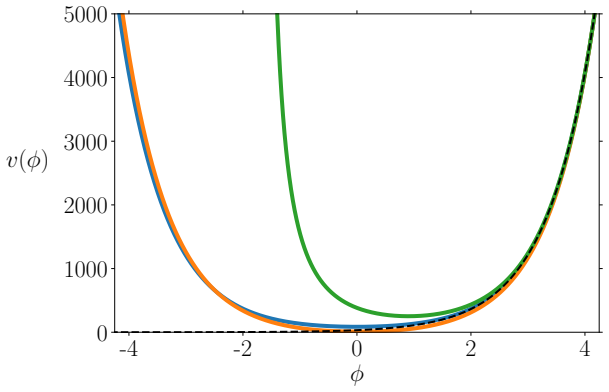
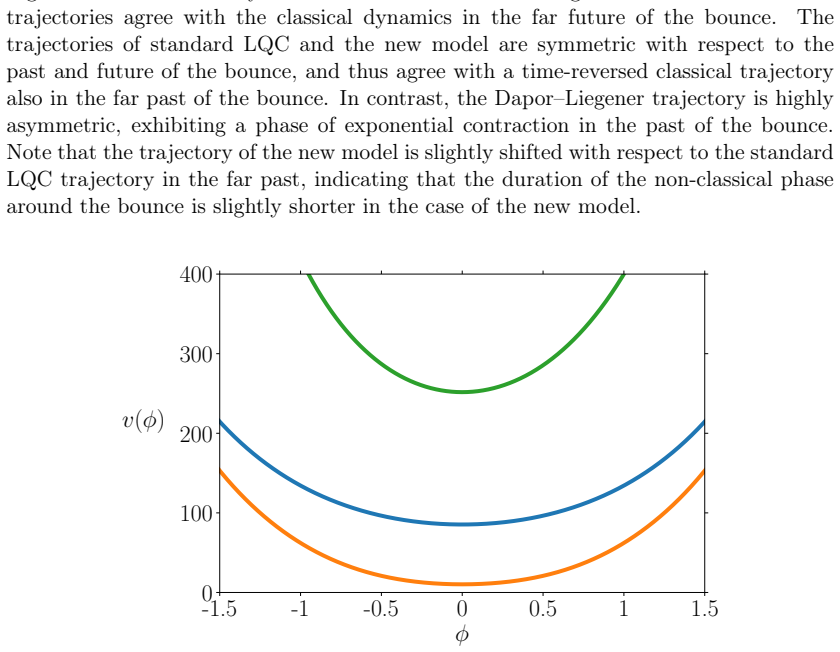
The effective dynamics of the new model is not identical to standard LQC but all the key features of the dynamics are qualitatively reproduced. The classical cosmological singularity is resolved by a quantum bounce and the effective dynamics trajectory as a function of time is symmetric around the bounce; however, in comparison with the standard LQC scenario the bounce takes place at a significantly lower value of the volume.
What carries the argument
The added Lorentzian term in the homogeneous isotropic LQC Hamiltonian, whose explicit form is taken from the scalar curvature operator of the one-vertex quantum-reduced loop gravity model.
If this is right
- The classical big-bang singularity is replaced by a quantum bounce at positive volume.
- The scale-factor evolution remains symmetric under time reversal about the bounce.
- All main qualitative properties of standard LQC dynamics survive the addition of the curvature term.
- The volume at which the bounce occurs is substantially smaller than the volume obtained in the unmodified model.
Where Pith is reading between the lines
- Alternative regularizations of the curvature operator can shift the energy scale of the bounce without destroying its existence or symmetry.
- The model supplies a concrete way to vary the bounce scale while staying inside the effective-dynamics framework, which may be useful for matching post-bounce expansion histories.
- Because the modification is motivated by a larger quantum gravity construction, the same curvature term could be tested in slightly inhomogeneous settings to check whether the bounce remains stable.
Load-bearing premise
The heuristic argument based on the form of an operator representing the scalar curvature in the one-vertex model of quantum-reduced loop gravity supplies the correct expression for the Lorentzian term to be added to the homogeneous and isotropic LQC Hamiltonian.
What would settle it
An explicit derivation of the modified effective Friedmann equation whose solutions either fail to bounce or produce a minimum volume equal to or larger than the standard LQC value.
Figures

read the original abstract
We consider the effective dynamics of a new, tentative model of a homogeneous and isotropic universe in loop quantum cosmology. The new model consists of modifying the standard Hamiltonian of loop quantum cosmology by adding a Lorentzian term corresponding to the scalar curvature of the spatial manifold. The expression of the new Lorentzian term is motivated by a heuristic argument based on the form of an operator representing the scalar curvature in the one-vertex model of quantum-reduced loop gravity. The effective dynamics of the new model is not identical to standard LQC but all the key features of the dynamics are qualitatively reproduced. The classical cosmological singularity is resolved by a "quantum bounce" and the effective dynamics trajectory as a function of time is symmetric around the bounce; however, in comparison with the standard LQC scenario the bounce takes place at a significantly lower value of the volume.
Editorial analysis
A structured set of objections, weighed in public.
Referee Report
Summary. The paper proposes a tentative modification to the standard LQC Hamiltonian constraint by adding a Lorentzian term whose form is motivated by a heuristic argument based on the scalar-curvature operator in the one-vertex model of quantum-reduced loop gravity. It claims that the resulting effective dynamics qualitatively reproduces the main features of standard LQC (singularity resolution by a quantum bounce, time-reversal symmetry of the trajectory) while shifting the bounce to a significantly lower volume.
Significance. If the heuristic reduction is shown to be controlled and the effective dynamics are independently verified, the work would supply a concrete alternative LQC model whose lower bounce volume could have distinct phenomenological implications. At present the significance is limited because the central physical claim depends on an un-derived operator choice whose correctness in the homogeneous-isotropic sector is not demonstrated.
major comments (2)
- [Model definition / heuristic motivation] The section introducing the Lorentzian term (the paragraph following the abstract statement of the model): the added term is introduced solely via a heuristic motivated by the one-vertex model; no explicit reduction, projection, or regularization argument is supplied showing why this operator is the appropriate Lorentzian contribution in the homogeneous isotropic sector. This assumption is load-bearing for the reported lower-volume bounce and for the claim that all key LQC features are reproduced.
- [Effective dynamics / bounce analysis] The section presenting the effective dynamics and the bounce: the abstract asserts that the trajectory is symmetric around the bounce and that the bounce occurs at lower volume than in standard LQC, yet no explicit effective Hamiltonian, no derivation of the modified Friedmann equation, and no numerical checks or plots are referenced. Without these, the qualitative-reproduction claim cannot be verified and the quantitative shift in bounce volume remains unconfirmed.
minor comments (1)
- [Hamiltonian construction] Notation for the new Lorentzian term should be introduced with an equation number and clearly distinguished from the standard Euclidean term already present in LQC.
Simulated Author's Rebuttal
We thank the referee for the careful reading and the constructive comments. We address the two major comments point by point below, indicating planned revisions where appropriate. The manuscript is presented as a tentative, heuristic construction, and we will make this explicit in the revision.
read point-by-point responses
-
Referee: [Model definition / heuristic motivation] The section introducing the Lorentzian term (the paragraph following the abstract statement of the model): the added term is introduced solely via a heuristic motivated by the one-vertex model; no explicit reduction, projection, or regularization argument is supplied showing why this operator is the appropriate Lorentzian contribution in the homogeneous isotropic sector. This assumption is load-bearing for the reported lower-volume bounce and for the claim that all key LQC features are reproduced.
Authors: We agree that the Lorentzian term is introduced via a heuristic argument drawn from the one-vertex model of quantum-reduced loop gravity, as stated in the manuscript. No explicit reduction, projection, or regularization from the full theory to the homogeneous-isotropic sector is provided, and the work does not claim such a derivation. This is an inherent limitation of the present tentative model. In the revised manuscript we will expand the relevant section to state the heuristic character more clearly and to discuss possible future routes toward a controlled reduction. revision: partial
-
Referee: [Effective dynamics / bounce analysis] The section presenting the effective dynamics and the bounce: the abstract asserts that the trajectory is symmetric around the bounce and that the bounce occurs at lower volume than in standard LQC, yet no explicit effective Hamiltonian, no derivation of the modified Friedmann equation, and no numerical checks or plots are referenced. Without these, the qualitative-reproduction claim cannot be verified and the quantitative shift in bounce volume remains unconfirmed.
Authors: We acknowledge that the current presentation of the effective dynamics would benefit from greater explicitness. In the revision we will supply the explicit form of the modified Hamiltonian constraint, derive the corresponding effective Friedmann equation, and include numerical plots that demonstrate both the symmetry of the trajectory and the shift of the bounce volume relative to standard LQC. revision: yes
Circularity Check
No significant circularity; heuristic input openly declared as model definition.
full rationale
The paper presents a tentative model whose central modification—the Lorentzian term—is explicitly introduced via a heuristic argument drawn from the one-vertex model rather than derived within the homogeneous-isotropic sector. The effective dynamics are then computed directly from the resulting Hamiltonian; the reported bounce location, time-reversal symmetry, and qualitative LQC features therefore follow from that chosen input by standard effective-equation methods. No step equates a claimed first-principles prediction to its own fitted or self-defined input, no uniqueness theorem is invoked to close a self-citation loop, and the abstract and description label the construction as heuristic and tentative. The derivation chain is therefore self-contained once the heuristic term is accepted as the model definition.
Axiom & Free-Parameter Ledger
free parameters (1)
- Coefficient or scaling of the added Lorentzian term
axioms (1)
- domain assumption The heuristic operator form from the one-vertex model of quantum-reduced loop gravity supplies the appropriate Lorentzian term for the homogeneous isotropic LQC Hamiltonian.
Reference graph
Works this paper leans on
-
[1]
A. Ashtekar and P. Singh,Loop quantum cosmology: A status report, Class. Quant. Grav.28, 213001 (2011), arXiv:1108.0893 [gr-qc]
Pith/arXiv arXiv 2011
-
[2]
I. Agullo and P. Singh,Loop Quantum Cosmology, inLoop Quantum Gravity: The First 30 Years, edited by A. Ashtekar and J. Pullin (World Scientific, 2017), arXiv:1612.01236 [gr-qc]
Pith/arXiv arXiv 2017
- [3]
-
[4]
A. Ashtekar, T. Pawłowski and P. Singh,Quantum nature of the big bang: An analytical and numerical investigation, Phys. Rev. D73, 124038 (2006), arXiv:gr- qc/0604013
arXiv 2006
-
[5]
A. Ashtekar, T. Pawłowski and P. Singh,Quantum nature of the big bang: Improved dynamics, Phys. Rev. D74, 084003 (2006), arXiv:gr-qc/0607039
Pith/arXiv arXiv 2006
-
[6]
V. Taveras,Corrections to the Friedmann equations from LQG for a universe with a free scalar field, Phys. Rev. D78, 064072 (2008), arXiv:0807.3325 [gr-qc]
Pith/arXiv arXiv 2008
-
[7]
Y. Ding, Y. Ma and J. Yang,Effective scenario of loop quantum cosmology, Phys. Rev. Lett.102, 051301 (2009), arXiv:0808.0990 [gr-qc]. 12
Pith/arXiv arXiv 2009
-
[8]
Mäkinen,On the dynamics of single-vertex states in quantum-reduced loop grav- ity, Class
I. Mäkinen,On the dynamics of single-vertex states in quantum-reduced loop grav- ity, Class. Quant. Grav.42, 095013 (2025), arXiv:2412.01375 [gr-qc]
arXiv 2025
-
[9]
I. Mäkinen,Time evolution of semiclassical states in the one-vertex model of quantum-reduced loop gravity, arXiv:2604.00999 [gr-qc]
-
[10]
I. Mäkinen, H. Sahlmann and W. Sherif,Emergent Thiemann coherent states in the near-kernel sector of quantum reduced loop gravity, arXiv:2605.18625 [gr-qc]
-
[11]
Lewandowski and I
J. Lewandowski and I. Mäkinen,Scalar curvature operator for models of loop quan- tum gravity on a cubical graph, Phys. Rev. D106, 046013 (2022), arXiv:2110 . 10667 [gr-qc]
2022
-
[12]
J. Lewandowski and I. Mäkinen,Scalar curvature operator for quantum-reduced loop gravity, Phys. Rev. D107, 126017 (2023), arXiv:2211.04826 [gr-qc]
arXiv 2023
-
[13]
A. Dapor and K. Liegener,Cosmological effective Hamiltonian from full loop quan- tum gravity dynamics, Phys. Lett. B785, 506 (2018), arXiv:1706.09833 [gr-qc]
Pith/arXiv arXiv 2018
-
[14]
M. Assanioussi, A. Dapor, K. Liegener and T. Pawłowski,Emergent de Sitter epoch of the quantum cosmos from loop quantum cosmology, Phys. Rev. Lett.121, 081303 (2018), arXiv:1801.00768 [gr-qc]
Pith/arXiv arXiv 2018
-
[15]
M. Assanioussi, A. Dapor, K. Liegener and T. Pawłowski,Emergent de Sitter epoch of the loop quantum cosmos: A detailed analysis, Phys. Rev. D100, 084003 (2019), arXiv:1906.05315 [gr-qc]
arXiv 2019
-
[16]
Thiemann,Quantum spin dynamics (QSD), Class
T. Thiemann,Quantum spin dynamics (QSD), Class. Quant. Grav.15, 839 (1998), arXiv:gr-qc/9606089
Pith/arXiv arXiv 1998
-
[17]
E.AlesciandF.Cianfrani,A new perspective on cosmology in loop quantum gravity, EPL104, 10001 (2013), arXiv:1210.4504 [gr-qc]
Pith/arXiv arXiv 2013
-
[18]
E. Alesci and F. Cianfrani,Quantum-reduced loop gravity: Cosmology, Phys. Rev. D87, 083521 (2013), arXiv:1301.2245 [gr-qc]
Pith/arXiv arXiv 2013
-
[19]
E. Alesci, F. Cianfrani and C. Rovelli,Quantum-reduced loop-gravity: Relation with the full theory, Phys. Rev. D88, 104001 (2013), arXiv:1309.6304 [gr-qc]
Pith/arXiv arXiv 2013
-
[20]
E.AlesciandF.Cianfrani,Quantum reduced loop gravity and the foundation of loop quantum cosmology, Int. J. Mod. Phys. D25, 1642005 (2016), arXiv:1602.05475 [gr-qc]
Pith/arXiv arXiv 2016
-
[21]
I. Mäkinen,Operators of quantum-reduced loop gravity from the perspective of full loop quantum gravity, Phys. Rev. D102, 106010 (2020), arXiv:2004.00309 [gr-qc]
arXiv 2020
-
[22]
Mäkinen,Master constraint approach to quantum-reduced loop gravity, Class
I. Mäkinen,Master constraint approach to quantum-reduced loop gravity, Class. Quant. Grav.41, 125010 (2024), arXiv:2311.16648 [gr-qc]
arXiv 2024
-
[23]
M. Assanioussi, J. Lewandowski and I. Mäkinen,New scalar constraint operator for loop quantum gravity, Phys. Rev. D92, 044042 (2015), arXiv:1506.00299 [gr-qc]
Pith/arXiv arXiv 2015
-
[24]
M. Assanioussi, J. Lewandowski and I. Mäkinen,Time evolution in deparametrized models of loop quantum gravity,Phys.Rev.D96,024043(2017),arXiv:1702.01688 [gr-qc]
Pith/arXiv arXiv 2017
-
[25]
J. Yang and Y. Ma,New Hamiltonian constraint operator for loop quantum gravity, Phys. Lett. B751, 343 (2015), arXiv:1507.00986 [gr-qc]. 13
Pith/arXiv arXiv 2015
-
[26]
A. Dapor and K. Liegener,Cosmological coherent state expectation values in loop quantum gravity I. Isotropic kinematics, Class. Quant. Grav.35, 135011 (2018), arXiv:1710.04015 [gr-qc]
arXiv 2018
- [27]
-
[28]
Agullo,Primordial power spectrum from the Dapor–Liegener model of loop quan- tum cosmology, Gen
I. Agullo,Primordial power spectrum from the Dapor–Liegener model of loop quan- tum cosmology, Gen. Rel. Grav.50, 91 (2018), arXiv:1805.11356 [gr-qc]
Pith/arXiv arXiv 2018
-
[29]
de Haro,The Dapor–Liegener model of loop quantum cosmology: A dynamical analysis, Eur
J. de Haro,The Dapor–Liegener model of loop quantum cosmology: A dynamical analysis, Eur. Phys. J. C78, 926 (2018), arXiv:1806.08926 [gr-qc]
Pith/arXiv arXiv 2018
-
[30]
L. C. Gomar, A. García-Quismondo and G. A. Mena Marugán,Primordial per- turbations in the Dapor–Liegener model of hybrid loop quantum cosmology, Phys. Rev. D102, 083524 (2020), arXiv:2002.01262 [gr-qc]
arXiv 2020
-
[31]
A. García-Quismondo, G. A. Mena Marugán and G. S. Pérez,The time-dependent mass of cosmological perturbations in loop quantum cosmology: Dapor–Liegener regularization, Class. Quant. Grav.37, 195003 (2020), arXiv:2006.09781 [gr-qc]
arXiv 2020
-
[32]
J. Yang, Y. Ding and Y. Ma,Alternative quantization of the Hamiltonian in loop quantum cosmology II: Including the Lorentz term, Phys. Lett. B682, 1 (2009), arXiv:0904.4379 [gr-qc]. 14
Pith/arXiv arXiv 2009
discussion (0)
Sign in with ORCID, Apple, or X to comment. Anyone can read and Pith papers without signing in.