Escape of Water- and Metal-enriched Atmospheres from compact Hot mini-Neptunes with CHAIN
Pith reviewed 2026-06-28 12:51 UTC · model grok-4.3
The pith
Higher water and metal abundances reduce mass loss rates from hot mini-Neptune atmospheres at high enrichments.
A machine-rendered reading of the paper's core claim, the machinery that carries it, and where it could break.
Core claim
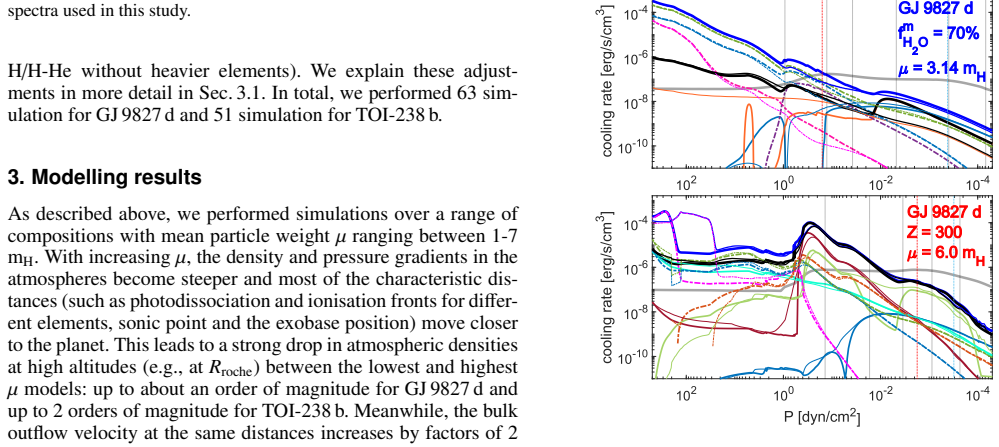
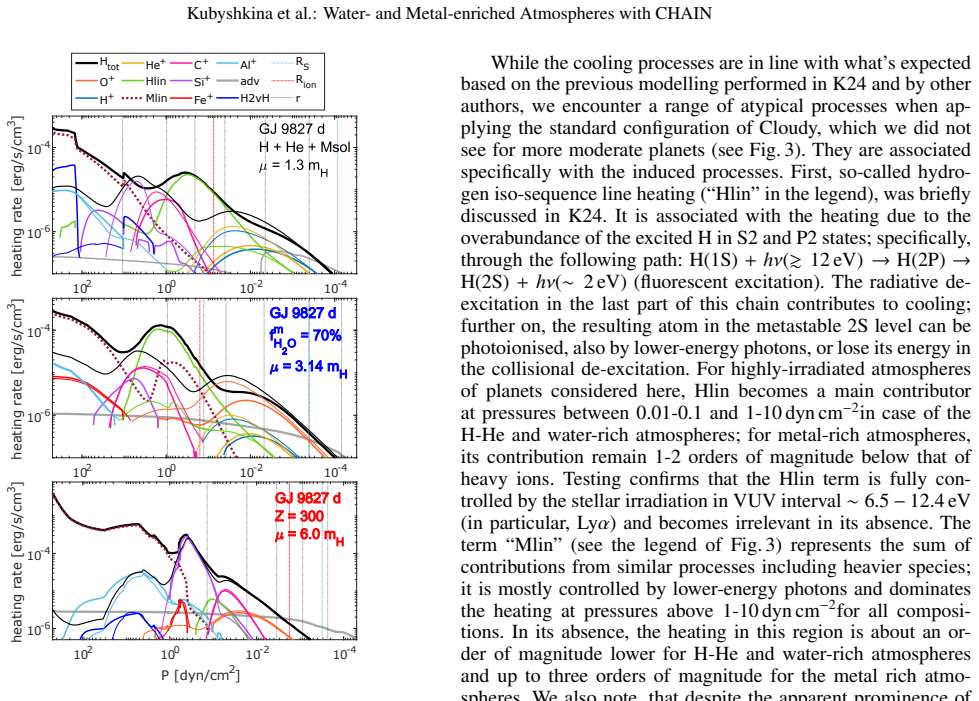
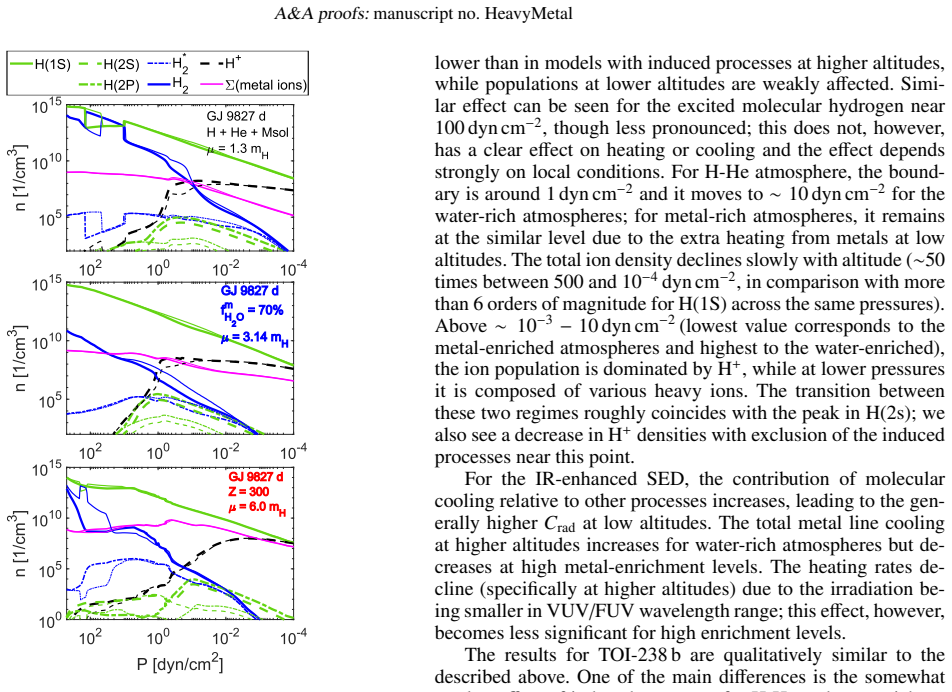
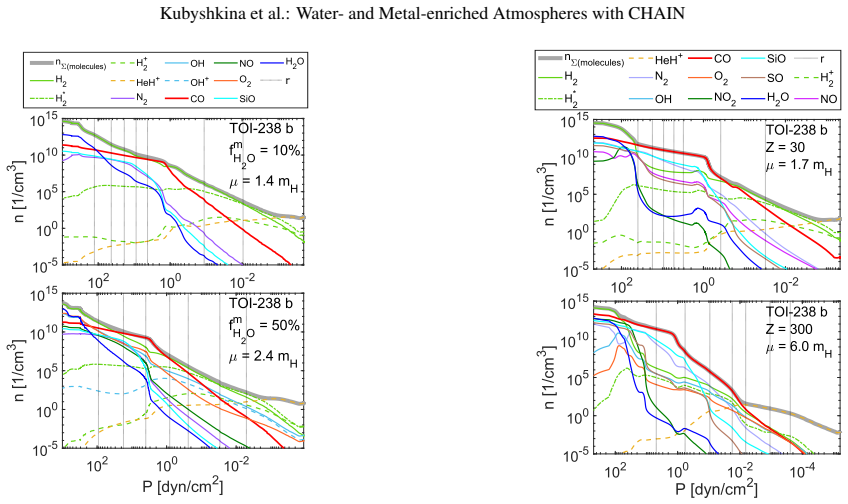
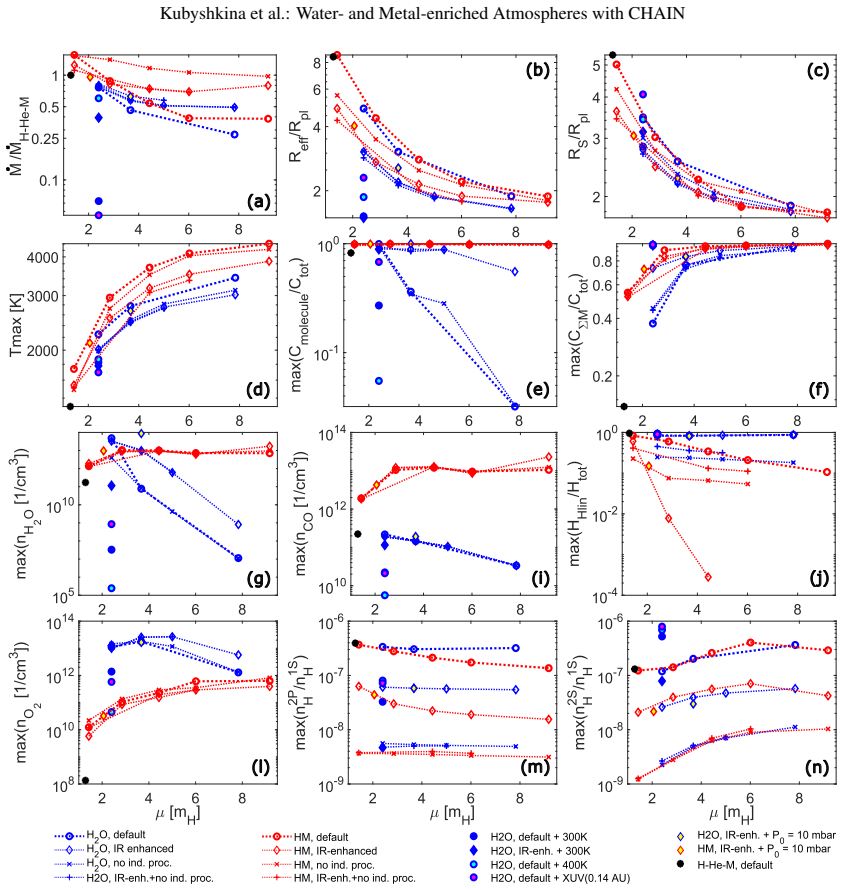
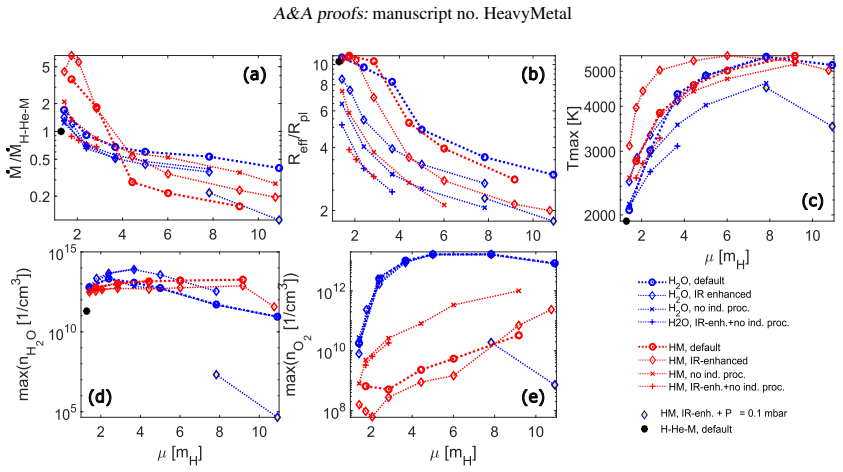
An increase in water/metal abundance leads both to the increase in atmospheric cooling rates due to metal line cooling and molecular cooling processes and the increase in heating due to metal line heating and metal ions. Due to the increase in cooling and the mean particle weight, atmospheric mass loss drops significantly at high water/metal fractions, while at low enrichment levels mass loss rates are similar to H/He atmospheres. For the same mean particle weight, escape from water-rich atmospheres is generally lower, implying that atmospheres with initially high water fraction are more stable and that the metal/H ratio increases with time.
What carries the argument
The CHAIN upper-atmosphere model, which calculates photochemistry, energy balance, and hydrodynamic escape for varying atmospheric compositions.
If this is right
- Mass loss rates remain comparable to solar-metallicity H/He cases at low enrichments but fall sharply above 50% water or 100x solar metals.
- Water-rich atmospheres exhibit lower escape than metal-rich ones at equal mean molecular weight.
- Initially water-rich atmospheres persist longer against hydrodynamic loss.
- Preferential loss of hydrogen drives the atmospheric metal-to-hydrogen ratio upward over time, hastening the end of escape.
Where Pith is reading between the lines
- Observed compositions of evolved mini-Neptunes may appear more metal-enriched than their formation values because of this selective escape.
- Population-level studies of sub-Neptune radii and densities could be affected by composition-dependent lifetime differences.
- Time-dependent models that update composition as escape proceeds would be needed to track the full evolutionary path.
Load-bearing premise
The CHAIN model, calibrated on hydrogen-helium atmospheres, accurately describes photochemistry and energy balance when applied to water- and metal-dominated mixtures.
What would settle it
Measurement of a higher-than-predicted mass-loss rate or a lower-than-expected metal enrichment on a confirmed water-rich sub-Neptune like GJ 9827 d.
Figures



read the original abstract
Recent observations reveal that atmospheric compositions of close-in sub-Neptunes are diverse and can differ strongly from pure H/He-dominated. We assess the possibility of modelling metal-rich and water-rich atmospheres with CHAIN model. We evaluate the major differences between the upper atmosphere photochemistry of such atmospheres compared to H/He, and the impact on atmospheric mass loss rates. We employ CHAIN to model upper atmospheres of two warm and hot sub-Neptune-like planets which were suggested to host possibly water-/metal-rich atmospheres: GJ 9827 d and TOI-238 b. For each planet, we consider a range of compositions between H/He atmospheres with solar metallicities to highly metal- and/or water-rich atmospheres and evaluate how our predictions change with increasing metal/water fractions. We find that for considered sub-Neptunes (1) an increase in water/metal abundance leads both to the increase in atmospheric cooling rates (due to the metal line cooling and molecular cooling processes) and the increase in heating (metal line heating in dense atmospheric layers and metals' ions); (2) due to the increase in cooling and the mean particle weight of the atmosphere, the atmospheric mass loss drops significantly at high water/metal fractions (water mass fractions of >=50% or metal enrichment over 100 times solar), while at low enrichment levels mass loss rates are similar to those of H/He atmospheres with solar abundances or slightly higher; (3) for the same atmospheric mean particle weight, the escape from water-rich atmospheres is generally lower. In the context of atmospheric evolution, it implies that the atmospheres with initially high water fraction in the atmosphere are more stable. Furthermore, due to the preferential escape of H, the atmospheric metal/H ratio is expected to increase significantly with time, leading to the earlier cessation of the hydrodynamic escape.
Editorial analysis
A structured set of objections, weighed in public.
Referee Report
Summary. The paper applies the CHAIN upper-atmosphere code to two sub-Neptunes (GJ 9827 d and TOI-238 b) across a grid of compositions ranging from solar-metallicity H/He to water mass fractions ≥50 % and metal enrichments >100× solar. It reports that higher water/metal content simultaneously boosts metal-line and molecular cooling as well as certain heating terms, yet the net effect—combined with increased mean molecular weight—is a sharp drop in hydrodynamic mass-loss rates once those enrichment thresholds are crossed; at lower enrichments the rates remain comparable to or slightly above solar-H/He values. The work further notes that preferential H escape will drive the metal/H ratio upward over time, implying earlier cessation of escape for initially water-rich envelopes.
Significance. If the numerical results hold, the study supplies a concrete mechanism by which water- or metal-rich sub-Neptune atmospheres can resist hydrodynamic escape, offering a possible explanation for the observed compositional diversity and for the apparent stability of high-mean-molecular-weight envelopes. The finding that mass-loss rates are lower for water-rich than for H/He atmospheres at the same mean molecular weight is a falsifiable prediction that could be tested against future transmission or escape observations.
major comments (2)
- [§2, §3] §2 (model description) and §3 (application to GJ 9827 d / TOI-238 b): the CHAIN photochemical network, opacity tables, and energy-balance modules were previously calibrated on H/He envelopes; the manuscript provides no re-validation, cross-code comparison, or sensitivity tests for the altered mean molecular weights, ion chemistry, and dominant coolants that appear once water mass fraction ≥50 % or metals exceed 100× solar. Because the reported mass-loss suppression rests on the precise balance between enhanced cooling and any additional heating, an unquantified extrapolation constitutes a load-bearing uncertainty.
- [Results] Results section (figures showing mass-loss vs. enrichment): no convergence tests, grid-resolution studies, or error estimates on the hydrodynamic escape rates are reported. Without these, it is impossible to judge whether the claimed threshold (water ≥50 % or metals >100× solar) is robust to modest changes in the cooling/heating rates.
minor comments (2)
- [Abstract] The abstract states directional trends but supplies neither the numerical mass-loss values nor the precise definition of “metal enrichment factor” used in the grid; adding one sentence with these quantities would improve clarity.
- [Throughout] Notation for mean molecular weight and the water mass fraction should be defined once at first use and used consistently thereafter.
Simulated Author's Rebuttal
We thank the referee for the constructive report and the opportunity to improve the manuscript. The two major comments correctly identify gaps in validation and numerical testing that were not addressed in the original submission. We will revise the paper to incorporate additional discussion, sensitivity tests, and convergence checks as detailed below.
read point-by-point responses
-
Referee: [§2, §3] §2 (model description) and §3 (application to GJ 9827 d / TOI-238 b): the CHAIN photochemical network, opacity tables, and energy-balance modules were previously calibrated on H/He envelopes; the manuscript provides no re-validation, cross-code comparison, or sensitivity tests for the altered mean molecular weights, ion chemistry, and dominant coolants that appear once water mass fraction ≥50 % or metals exceed 100× solar. Because the reported mass-loss suppression rests on the precise balance between enhanced cooling and any additional heating, an unquantified extrapolation constitutes a load-bearing uncertainty.
Authors: We agree that the original CHAIN validation focused on H/He cases and that explicit checks for high-enrichment regimes are needed. The code already incorporates metal and water species via its photochemical network and opacity tables, but we did not quantify how changes in mean molecular weight and dominant coolants affect the heating-cooling balance. In revision we will add a new paragraph in §2 describing the relevant extensions, reference prior applications of similar codes to metal-rich atmospheres, and include a limited sensitivity study varying the strength of metal-line cooling and heating terms by ±20 % to show the resulting variation in mass-loss rates remains within the reported trends. revision: yes
-
Referee: [Results] Results section (figures showing mass-loss vs. enrichment): no convergence tests, grid-resolution studies, or error estimates on the hydrodynamic escape rates are reported. Without these, it is impossible to judge whether the claimed threshold (water ≥50 % or metals >100× solar) is robust to modest changes in the cooling/heating rates.
Authors: We acknowledge the absence of convergence and resolution tests in the submitted manuscript. The hydrodynamic solver in CHAIN uses a fixed spatial grid and adaptive time-stepping inherited from earlier H/He studies. For the revision we will add a short methods subsection and an appendix figure showing results from doubling/halving the grid resolution for a subset of models (solar, 50 % water, and 100× metal cases). These tests indicate mass-loss rates change by <10 %, supporting stability of the reported thresholds. We will also report the numerical tolerances used and note that full error propagation from all input parameters is beyond the present scope but will be addressed in follow-up work. revision: yes
Circularity Check
No significant circularity; results are numerical outputs from model application
full rationale
The paper derives its central claims (mass-loss suppression at high water/metal fractions) from running the CHAIN code on input grids of composition for GJ 9827 d and TOI-238 b. These are forward-model outputs of the photochemical-hydrodynamic equations under varying mean molecular weight and opacity sources, not algebraic reductions or re-labelings of fitted quantities. The model itself is treated as an established external tool; no equation in the provided text equates a reported prediction back to a calibration parameter by construction, and no self-citation is invoked to forbid alternative treatments. The derivation chain therefore remains self-contained against external benchmarks.
Axiom & Free-Parameter Ledger
free parameters (2)
- water mass fraction
- metal enrichment factor
axioms (1)
- domain assumption CHAIN model photochemistry and energy balance remain accurate for water- and metal-rich mixtures
Reference graph
Works this paper leans on
-
[1]
Planetary evolution with atmospheric photoevaporation. II. Fitting the slope of the radius valley by combining boil-off and XUV-driven escape. , keywords =. doi:10.1051/0004-6361/202142205 , archivePrefix =. 2307.02566 , primaryClass =
-
[2]
A window for water-hydrogen demixing on warm metal-rich sub-Neptunes. arXiv e-prints , keywords =. doi:10.48550/arXiv.2512.01805 , archivePrefix =. 2512.01805 , primaryClass =
-
[3]
Evolution of Steam Worlds: Energetic Aspects. , keywords =. doi:10.3847/1538-4357/add935 , archivePrefix =. 2412.17945 , primaryClass =
-
[4]
Escaping Helium and a Highly Muted Spectrum Suggest a Metal-enriched Atmosphere on Sub-Neptune GJ 3090 b from JWST Transit Spectroscopy. , keywords =. doi:10.3847/2041-8213/add010 , archivePrefix =. 2504.20428 , primaryClass =
-
[5]
Comptes Rendus Geoscience , year = 2007, month = nov, volume =
The split fate of the early Earth, Mars, Venus, and Moon. Comptes Rendus Geoscience , year = 2007, month = nov, volume =. doi:10.1016/j.crte.2007.09.006 , adsurl =
-
[6]
Spectrally resolved helium absorption from the extended atmosphere of a warm Neptune-mass exoplanet. Science , keywords =. doi:10.1126/science.aat5879 , archivePrefix =. 1812.02189 , primaryClass =
-
[7]
A remnant planetary core in the hot-Neptune desert. , keywords =. doi:10.1038/s41586-020-2421-7 , archivePrefix =. 2003.10314 , primaryClass =
-
[8]
Thermal Tides in Fluid Extrasolar Planets. , keywords =. doi:10.1088/0004-637X/714/1/1 , archivePrefix =. 0912.2313 , primaryClass =
-
[9]
The JADE code: Coupling secular exoplanetary dynamics and photo-evaporation. , keywords =. doi:10.1051/0004-6361/202039452 , archivePrefix =. 2103.02627 , primaryClass =
-
[10]
HAT-P-11b: A Super-Neptune Planet Transiting a Bright K Star in the Kepler Field. , keywords =. doi:10.1088/0004-637X/710/2/1724 , archivePrefix =. 0901.0282 , primaryClass =
-
[11]
Evolutionary models for cool brown dwarfs and extrasolar giant planets. The case of HD 209458. , keywords =. doi:10.1051/0004-6361:20030252 , archivePrefix =. astro-ph/0302293 , primaryClass =
-
[12]
Inflating Hot Jupiters with Ohmic Dissipation. , keywords =. doi:10.1088/2041-8205/714/2/L238 , archivePrefix =. 1002.3650 , primaryClass =
-
[13]
Using FU Orionis Outbursts to Constrain Self-regulated Protostellar Disk Models. , keywords =. doi:10.1086/174206 , archivePrefix =. astro-ph/9312015 , primaryClass =
-
[14]
Atmospheric Retrieval for Super-Earths: Uniquely Constraining the Atmospheric Composition with Transmission Spectroscopy. , keywords =. doi:10.1088/0004-637X/753/2/100 , archivePrefix =. 1203.4018 , primaryClass =
-
[15]
A sub-Neptune exoplanet with a low-metallicity methane-depleted atmosphere and Mie-scattering clouds. Nature Astronomy , keywords =. doi:10.1038/s41550-019-0800-5 , archivePrefix =. 1907.00449 , primaryClass =
-
[16]
Water Vapor and Clouds on the Habitable-zone Sub-Neptune Exoplanet K2-18b. , keywords =. doi:10.3847/2041-8213/ab59dc , archivePrefix =. 1909.04642 , primaryClass =
-
[17]
JWST Reveals CH _4 , CO _2 , and H _2 O in a Metal-rich Miscible Atmosphere on a Two-Earth-Radius Exoplanet. arXiv e-prints , keywords =. doi:10.48550/arXiv.2403.03325 , archivePrefix =. 2403.03325 , primaryClass =
-
[18]
Experimental Astronomy , keywords =
The CHEOPS mission. Experimental Astronomy , keywords =. doi:10.1007/s10686-020-09679-4 , archivePrefix =. 2009.11633 , primaryClass =
-
[19]
Revised Radii of Kepler Stars and Planets Using Gaia Data Release 2. , keywords =. doi:10.3847/1538-4357/aada83 , archivePrefix =. 1805.00231 , primaryClass =
-
[20]
The GJ1214 Super-Earth System: Stellar Variability, New Transits, and a Search for Additional Planets. , keywords =. doi:10.1088/0004-637X/736/1/12 , archivePrefix =. 1012.0518 , primaryClass =
-
[21]
Revised planetary and stellar parameters from optical to near-infrared transit photometry
Warm ice giant GJ 3470b - II. Revised planetary and stellar parameters from optical to near-infrared transit photometry. , keywords =. doi:10.1093/mnras/stu1199 , archivePrefix =. 1406.6437 , primaryClass =
-
[22]
Three-dimensional Gas Dynamic Simulation of the Interaction between the Exoplanet WASP-12b and its Host Star. , keywords =. doi:10.1088/0004-637X/764/1/19 , archivePrefix =. 1212.2779 , primaryClass =
-
[23]
Bland-Hawthorn, J and van Breugel, W and Gillingham, P R , journal =
-
[24]
On the Tidal Inflation of Short-Period Extrasolar Planets. , keywords =. doi:10.1086/318667 , adsurl =
-
[25]
Constraining stellar rotation and planetary atmospheric evolution of a dozen systems hosting sub-Neptunes and super-Earths. , keywords =. doi:10.1051/0004-6361/202142010 , archivePrefix =. 2110.09106 , primaryClass =
-
[26]
Characterising TOI-732 b and c: New insights into the M-dwarf radius and density valley. , keywords =. doi:10.1051/0004-6361/202348180 , archivePrefix =. 2311.12577 , primaryClass =
-
[27]
Detected with HARPS velocimetry
A hot Uranus transiting the nearby M dwarf GJ 3470. Detected with HARPS velocimetry. Captured in transit with TRAPPIST photometry. , keywords =. doi:10.1051/0004-6361/201219623 , archivePrefix =. 1206.5307 , primaryClass =
-
[28]
A giant impact as the likely origin of different twins in the Kepler-107 exoplanet system. Nature Astronomy , keywords =. doi:10.1038/s41550-018-0684-9 , archivePrefix =. 1902.01316 , primaryClass =
-
[29]
No excess of cold Jupiters in small planet systems
Cold Jupiters and improved masses in 38 Kepler and K2 small planet systems from 3661 HARPS-N radial velocities. No excess of cold Jupiters in small planet systems. , keywords =. doi:10.1051/0004-6361/202346211 , archivePrefix =. 2304.05773 , primaryClass =
-
[30]
HARPS-N radial velocities confirm the low densities of the Kepler-9 planets. , keywords =. doi:10.1093/mnras/stz181 , archivePrefix =. 1901.05471 , primaryClass =
-
[31]
ELODIE metallicity-biased search for transiting Hot Jupiters. II. A very hot Jupiter transiting the bright K star HD 189733. , keywords =. doi:10.1051/0004-6361:200500201 , archivePrefix =. astro-ph/0510119 , primaryClass =
-
[32]
Atmospheric escape from HD 189733b observed in H I Lyman- : detailed analysis of HST/STIS September 2011 observations. , keywords =. doi:10.1051/0004-6361/201220533 , archivePrefix =. 1301.6030 , primaryClass =
-
[33]
A Mirage or an Oasis? Water Vapor in the Atmosphere of the Warm Neptune TOI-674 b. , keywords =. doi:10.3847/1538-3881/ac8b7e , archivePrefix =. 2201.04197 , primaryClass =
-
[34]
A radius valley between migrated steam worlds and evaporated rocky cores. Nature Astronomy , keywords =. doi:10.1038/s41550-023-02183-7 , archivePrefix =. 2401.04380 , primaryClass =
-
[35]
Water-rich sub-Neptunes and rocky super Earths around different Stars: Radii shaped by Volatile Partitioning, Formation, and Evolution. arXiv e-prints , keywords =. doi:10.48550/arXiv.2411.16879 , archivePrefix =. 2411.16879 , primaryClass =
-
[36]
A Neptune-Mass Planet Orbiting the Nearby M Dwarf GJ 436. , keywords =. doi:10.1086/425173 , archivePrefix =. astro-ph/0408587 , primaryClass =
-
[37]
The Multiplanet System TOI-421. , keywords =. doi:10.3847/1538-3881/aba124 , archivePrefix =. 2004.10095 , primaryClass =
-
[38]
A Multiwavelength Look at the GJ 9827 System: No Evidence of Extended Atmospheres in GJ 9827b and d from HST and CARMENES Data. , keywords =. doi:10.3847/1538-3881/abdb2f , archivePrefix =. 2101.06277 , primaryClass =
-
[39]
The effects of magnetic fields on observational signatures of atmospheric escape in exoplanets: Double tail structures. , keywords =. doi:10.1093/mnras/stab2947 , archivePrefix =. 2110.05200 , primaryClass =
-
[40]
Hot planetary winds near a star: dynamics, wind-wind interactions, and observational signatures. , keywords =. doi:10.1093/mnras/stw3307 , archivePrefix =. 1604.08532 , primaryClass =
-
[41]
Atmospheric Evolution on Inhabited and Lifeless Worlds
-
[42]
Atmospheric characterization of the ultra-hot Jupiter MASCARA-2b/KELT-20b. Detection of CaII, FeII, NaI, and the Balmer series of H (H , H , and H ) with high-dispersion transit spectroscopy. , keywords =. doi:10.1051/0004-6361/201935623 , archivePrefix =. 1905.12491 , primaryClass =
-
[43]
, year = 1970, month = jan, volume =
Spectral line formation in Wolf-Rayet envelopes. , year = 1970, month = jan, volume =. doi:10.1093/mnras/149.2.111 , adsurl =
-
[44]
XUV-driven mass loss from extrasolar giant planets orbiting active stars. , keywords =. doi:10.1016/j.icarus.2014.12.012 , archivePrefix =. 1412.3380 , primaryClass =
-
[45]
Evolutionary Analysis of Gaseous Sub-Neptune-mass Planets with MESA. , keywords =. doi:10.3847/0004-637X/831/2/180 , archivePrefix =. 1603.06596 , primaryClass =
-
[46]
The Evolution of Solar Flux from 0.1 nm to 160 m: Quantitative Estimates for Planetary Studies. , keywords =. doi:10.1088/0004-637X/757/1/95 , adsurl =
-
[47]
Detection of Planetary Transits Across a Sun-like Star. , keywords =. doi:10.1086/312457 , archivePrefix =. astro-ph/9911436 , primaryClass =
-
[48]
A super-Earth transiting a nearby low-mass star. , keywords =. doi:10.1038/nature08679 , archivePrefix =. 0912.3229 , primaryClass =
-
[49]
Mesa Isochrones and Stellar Tracks (MIST). I. Solar-scaled Models. , keywords =. doi:10.3847/0004-637X/823/2/102 , archivePrefix =. 1604.08592 , primaryClass =
-
[50]
Kepler-18b, c, and d: A System of Three Planets Confirmed by Transit Timing Variations, Light Curve Validation, Warm-Spitzer Photometry, and Radial Velocity Measurements. , keywords =. doi:10.1088/0067-0049/197/1/7 , archivePrefix =. 1110.0820 , primaryClass =
-
[51]
Space-weather-driven Variations in Ly Absorption Signatures of Exoplanet Atmospheric Escape: MHD Simulations and the Case of AU Mic b. , keywords =. doi:10.3847/1538-4357/ac78e4 , archivePrefix =. 2205.08900 , primaryClass =
-
[52]
Spitzer/MIPS 24 m Observations of HD 209458b: Three Eclipses, Two and a Half Transits, and a Phase Curve Corrupted by Instrumental Sensitivity Variations. , keywords =. doi:10.1088/0004-637X/752/2/81 , archivePrefix =. 1202.1562 , primaryClass =
-
[53]
Aerosol Constraints on the Atmosphere of the Hot Saturn-mass Planet WASP-49b. , keywords =. doi:10.3847/1538-4357/aa9019 , archivePrefix =. 1710.02427 , primaryClass =
-
[54]
Near-ultraviolet Transmission Spectroscopy of HD 209458b: Evidence of Ionized Iron Beyond the Planetary Roche Lobe. , keywords =. doi:10.3847/1538-3881/ab6a0b , archivePrefix =. 2001.03126 , primaryClass =
-
[55]
The Oblique Orbit of WASP-107b from K2 Photometry. , keywords =. doi:10.3847/1538-3881/aa65d1 , archivePrefix =. 1702.04734 , primaryClass =
-
[56]
Electron Energy Deposition in a Gas Mixture of Atomic and Molecular Hydrogen and Helium. , keywords =. doi:10.1086/313267 , adsurl =
-
[57]
TOI-421 b: A Hot Sub-Neptune with a Haze-free, Low Mean Molecular Weight Atmosphere. , keywords =. doi:10.3847/2041-8213/adcd76 , archivePrefix =. 2501.01498 , primaryClass =
-
[58]
Evolution of the Exoplanet Size Distribution: Forming Large Super-Earths Over Billions of Years. , keywords =. doi:10.3847/1538-3881/abf439 , archivePrefix =. 2011.09894 , primaryClass =
-
[59]
Detection of Ionized Calcium in the Atmosphere of the Ultra-hot Jupiter WASP-76b. , keywords =. doi:10.3847/2041-8213/ac2513 , archivePrefix =. 2109.04373 , primaryClass =
-
[60]
Lack of Inflated Radii for Kepler Giant Planet Candidates Receiving Modest Stellar Irradiation. , keywords =. doi:10.1088/0067-0049/197/1/12 , archivePrefix =. 1110.6180 , primaryClass =
-
[61]
CHIANTI - an atomic database for emission lines. , keywords =. doi:10.1051/aas:1997368 , adsurl =
-
[62]
CHIANTI - an atomic database for emission lines. IX. Ionization rates, recombination rates, ionization equilibria for the elements hydrogen through zinc and updated atomic data. , keywords =. doi:10.1051/0004-6361/200911712 , adsurl =
-
[63]
The Magellan/PFS Exoplanet Search: a 55-d period dense Neptune transiting the bright (V = 8.6) star HD 95338. , keywords =. doi:10.1093/mnras/staa1724 , archivePrefix =. 2003.10319 , primaryClass =
-
[64]
A generalized Bayesian inference method for constraining the interiors of super Earths and sub-Neptunes. , keywords =. doi:10.1051/0004-6361/201628708 , archivePrefix =. 1609.03908 , primaryClass =
-
[65]
TESS Delivers Its First Earth-sized Planet and a Warm Sub-Neptune. , keywords =. doi:10.3847/2041-8213/ab12ed , archivePrefix =. 1901.00051 , primaryClass =
-
[66]
The Geneva stellar evolution code. , keywords =. doi:10.1007/s10509-007-9511-y , adsurl =
-
[67]
Unveiling the internal structure and formation history of the three planets transiting HIP 29442 (TOI-469) with CHEOPS. , keywords =. doi:10.1051/0004-6361/202450472 , archivePrefix =. 2406.18653 , primaryClass =
-
[68]
Searching for hot water world candidates with CHEOPS: Refining the radii and analysing the internal structures and atmospheric lifetimes of TOI-238 b and TOI-1685 b. , keywords =. doi:10.1051/0004-6361/202453325 , archivePrefix =. 2502.07887 , primaryClass =
-
[69]
A giant comet-like cloud of hydrogen escaping the warm Neptune-mass exoplanet GJ 436b. , keywords =. doi:10.1038/nature14501 , archivePrefix =. 1506.07541 , primaryClass =
-
[70]
Reviews of Modern Physics , year = 1982, month = oct, volume =
Physical characteristics of astronomical masers. Reviews of Modern Physics , year = 1982, month = oct, volume =. doi:10.1103/RevModPhys.54.1225 , adsurl =
-
[71]
Roche lobe effects on the atmospheric loss from ``Hot Jupiters''. , keywords =. doi:10.1051/0004-6361:20066929 , archivePrefix =. astro-ph/0612729 , primaryClass =
-
[72]
Extreme hydrodynamic atmospheric loss near the critical thermal escape regime. , keywords =. doi:10.1093/mnras/stv130 , archivePrefix =. 1506.06592 , primaryClass =
-
[73]
EUV-driven mass-loss of protoplanetary cores with hydrogen-dominated atmospheres: the influences of ionization and orbital distance. , keywords =. doi:10.1093/mnras/stw935 , archivePrefix =. 1601.00452 , primaryClass =
-
[74]
Effect of stellar wind induced magnetic fields on planetary obstacles of non-magnetized hot Jupiters. , keywords =. doi:10.1093/mnras/stx1471 , archivePrefix =. 1708.01594 , primaryClass =
-
[75]
Modification of the radioactive heat budget of Earth-like exoplanets by the loss of primordial atmospheres. , keywords =. doi:10.1093/mnras/stac3168 , archivePrefix =. 2209.14691 , primaryClass =
-
[76]
Hydrodynamical interaction of stellar and planetary winds: effects of charge exchange and radiation pressure on the observed Ly absorption. , keywords =. doi:10.1093/mnras/stz1725 , archivePrefix =. 1907.04933 , primaryClass =
-
[77]
, year = 1998, month = jul, volume =
CLOUDY 90: Numerical Simulation of Plasmas and Their Spectra. , year = 1998, month = jul, volume =. doi:10.1086/316190 , adsurl =
doi:10.1086/316190 1998
-
[78]
, year = 2003, month = jan, volume =
Quantitative Spectroscopy of Photoionized Clouds. , year = 2003, month = jan, volume =. doi:10.1146/annurev.astro.41.011802.094836 , adsurl =
Pith/arXiv arXiv doi:10.1146/annurev.astro.41.011802.094836 2003
-
[79]
, keywords =
The 2013 Release of Cloudy. , keywords =
2013
-
[80]
, keywords =
The 2017 Release Cloudy. , keywords =
2017
discussion (0)
Sign in with ORCID, Apple, or X to comment. Anyone can read and Pith papers without signing in.