Redshift Duality with Pantheon+SH0ES in a Planck-anchored Flat ΛCDM Framework: Implications for Hubble Tension and Observational Inference
Pith reviewed 2026-06-28 13:15 UTC · model grok-4.3
The pith
A hybrid redshift model with a quantum line-of-sight contribution recovers the Planck Hubble constant from Pantheon+SH0ES data.
A machine-rendered reading of the paper's core claim, the machinery that carries it, and where it could break.
Core claim
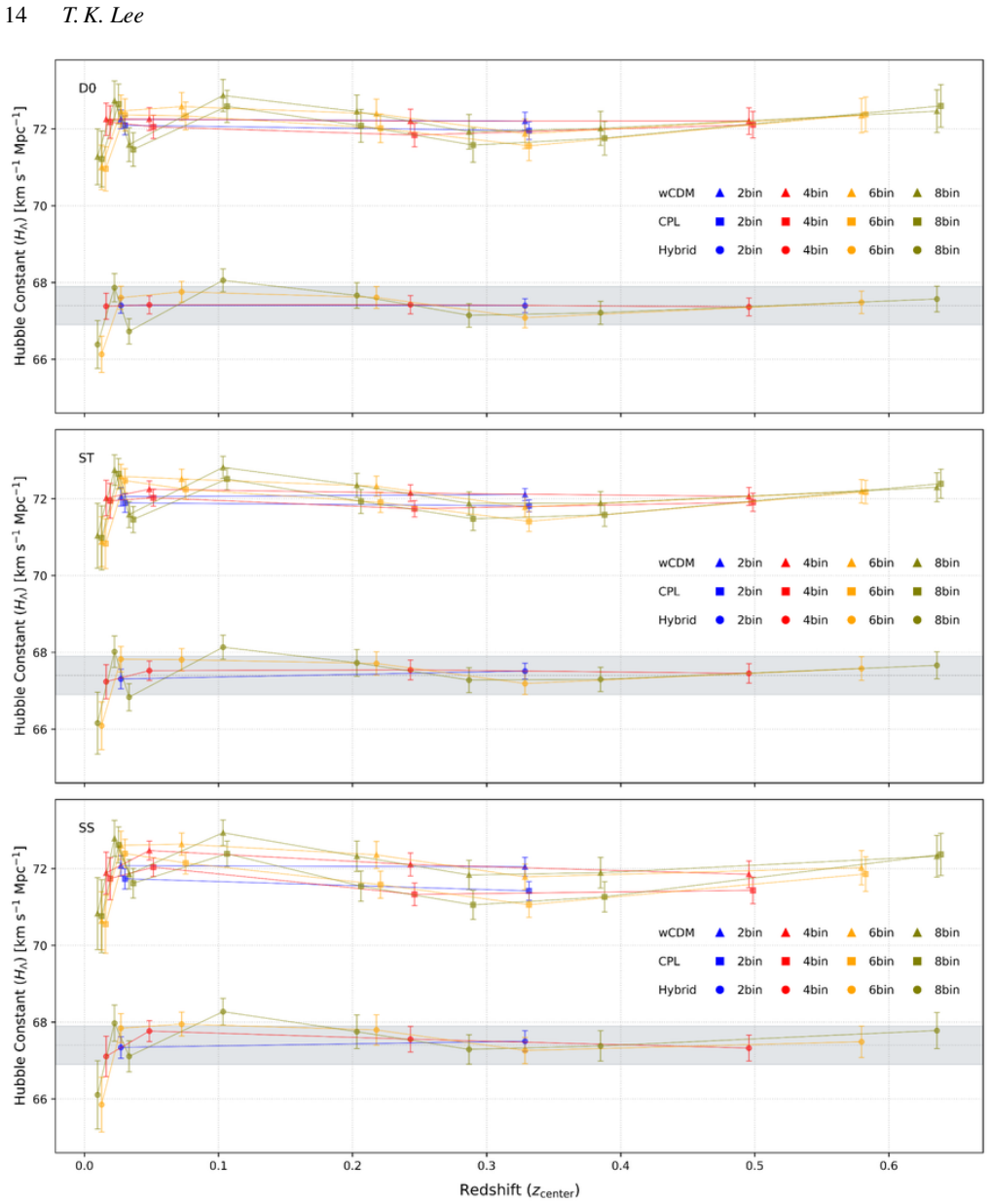
Fitting the hybrid redshift duality model to Pantheon+SH0ES recovers the metric-expansion Hubble constant H_Λ to a value consistent with the Planck baseline of 67.4 km s^{-1} Mpc^{-1} within ≲0.33σ, while restoring constancy of H_Λ across redshift bins.
What carries the argument
The redshift duality: observed redshift as the sum of the metric-expansion component and an additional line-of-sight quantum term from cumulative photon energy conversion to effective mass as a function of path length and frequency.
If this is right
- The inferred Hubble parameter remains constant across redshift bins.
- Re-inferred cosmological quantities exhibit trends that may reduce anomalies reported for high-redshift galaxies.
- Observational inference can retain a Planck-anchored flat Lambda CDM baseline.
- Redshift duality becomes a candidate adjustment in the processing of supernova data.
Where Pith is reading between the lines
- The frequency and path-length dependence of the quantum term could be checked with multi-band observations of the same objects at different distances.
- The framework offers a way to adjust distance inferences that might connect to reported tensions in high-redshift galaxy data without altering the expansion history itself.
- Applying the same duality correction to other distance indicators such as baryon acoustic oscillations would provide an independent consistency test.
Load-bearing premise
An additional quantum contribution to redshift from cumulative photon energy conversion into effective mass exists and can be modeled as a function of path length and frequency without contradicting standard metric expansion.
What would settle it
A re-analysis of Pantheon+SH0ES that still shows Hubble-parameter drift across redshift bins after the hybrid correction is applied, or a direct measurement of photon propagation showing no frequency-dependent energy loss matching the proposed conversion rate.
Figures

read the original abstract
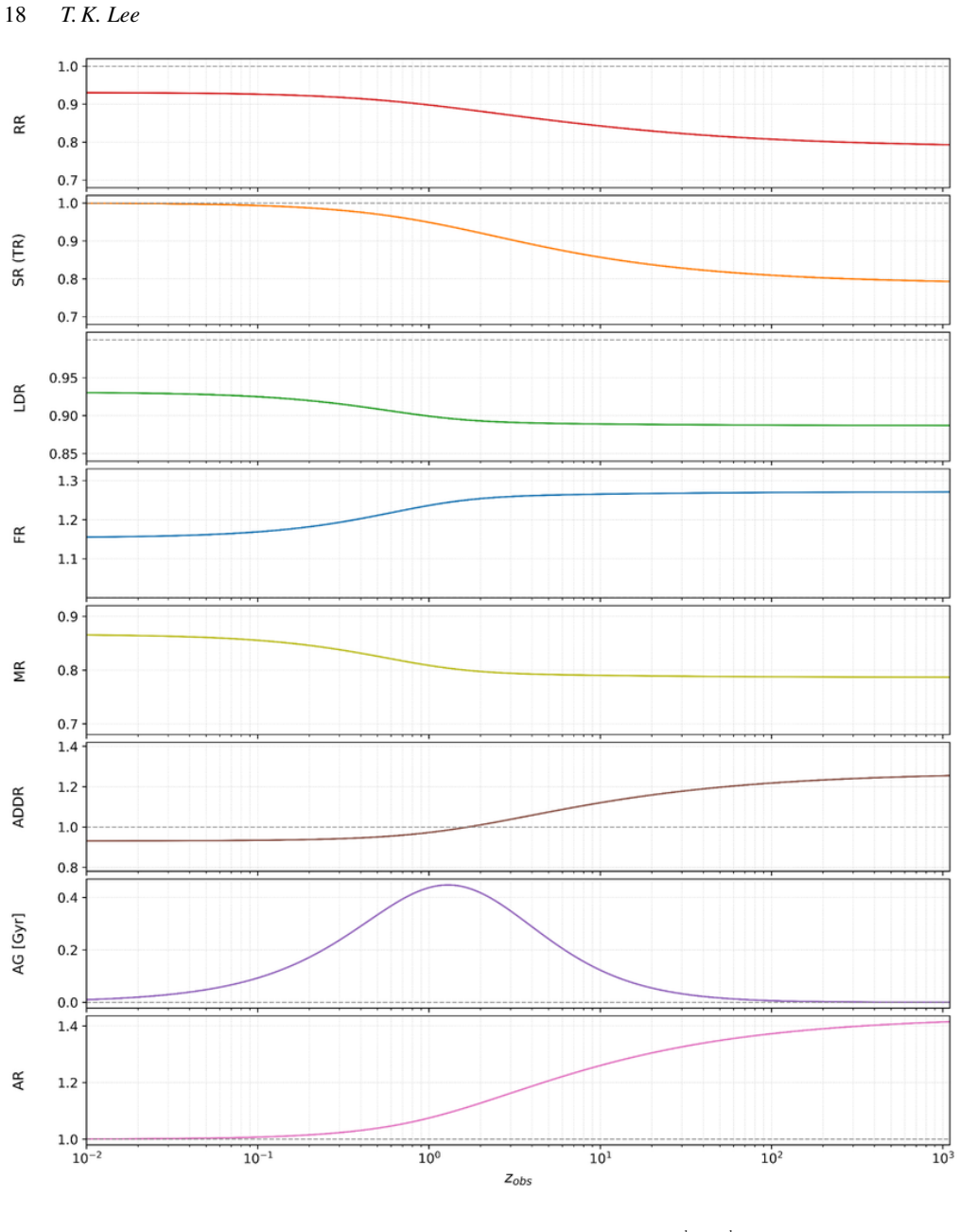
We test an operationally defined redshift duality in which the observed redshift comprises the standard metric-expansion component together with an additional line-of-sight quantum contribution arising from the cumulative conversion of photon energy into effective mass as a function of path length and frequency. Fitting this hybrid model to the Pantheon+SH0ES compilation, we find that the metric-expansion Hubble constant, $H_\Lambda$, is recovered to a value consistent with the Planck baseline of $67.4~\mathrm{km\,s^{-1}\,Mpc^{-1}}$ within $\lesssim 0.33\sigma$. Redshift-binned analyses show that while the flat Lambda cold dark matter ($\Lambda$CDM) model produces an apparent drift in the inferred Hubble parameter across the Hubble flow, the hybrid model restores the constancy of $H_\Lambda$ across redshift bins. The correctional trends of cosmological physical quantities re-inferred under this framework further indicate the potential to alleviate anomalies associated with high-redshift galaxies. These results suggest that redshift duality warrants further consideration in observational processing and inference, while preserving consistency with a Planck-anchored flat $\Lambda$CDM baseline.
Editorial analysis
A structured set of objections, weighed in public.
Referee Report
Summary. The manuscript proposes a hybrid redshift model in which the observed redshift is the sum of the standard metric-expansion component in flat ΛCDM and an additional line-of-sight quantum contribution arising from cumulative photon energy-to-effective-mass conversion (operationally defined as a function of path length and frequency). Fitting this model to the Pantheon+SH0ES compilation recovers a metric-expansion Hubble constant H_Λ consistent with the Planck value of 67.4 km s^{-1} Mpc^{-1} within ≲0.33σ and restores apparent constancy of H_Λ across redshift bins, while suggesting potential alleviation of high-redshift galaxy anomalies.
Significance. If the quantum term could be independently derived or constrained, the framework would offer a way to reconcile local and CMB H0 measurements without altering the underlying ΛCDM cosmology. However, the reported consistency and bin constancy are achieved through fitting of the additional term to the same dataset that exhibits the tension, so the result does not constitute an independent test or prediction.
major comments (2)
- [Abstract] Abstract: the claim that H_Λ is recovered to within ≲0.33σ of the Planck value is obtained by fitting the free parameters of the quantum conversion function to the Pantheon+SH0ES data; without a first-principles derivation that fixes the functional form independently of the Hubble tension, the alignment is produced by construction rather than predicted.
- [Abstract] Abstract (redshift-binned analyses): the restoration of constancy in H_Λ across bins is achieved by the same fitted additive correction that absorbs the apparent drift present in the standard model; this does not demonstrate that the hybrid model predicts constancy but rather that the correction can be chosen to enforce it.
Simulated Author's Rebuttal
We thank the referee for their constructive comments. We address each major comment below. We agree that the reported consistency and bin constancy rely on fitting the quantum correction parameters to the data and will revise the abstract to clarify this.
read point-by-point responses
-
Referee: [Abstract] Abstract: the claim that H_Λ is recovered to within ≲0.33σ of the Planck value is obtained by fitting the free parameters of the quantum conversion function to the Pantheon+SH0ES data; without a first-principles derivation that fixes the functional form independently of the Hubble tension, the alignment is produced by construction rather than predicted.
Authors: We agree that the parameters of the quantum conversion function are determined by fitting to the Pantheon+SH0ES data, so the recovered H_Λ value consistent with Planck is a result of this procedure rather than an a priori prediction. The functional form is postulated from the physical mechanism of cumulative photon energy-to-effective-mass conversion along the line of sight, but we lack an independent first-principles derivation that would fix its parameters without reference to the Hubble tension data. Our analysis shows that this hybrid model permits a Planck-anchored flat ΛCDM metric expansion to fit the observations. We will revise the abstract to state explicitly that the consistency is obtained via the model fit. revision: yes
-
Referee: [Abstract] Abstract (redshift-binned analyses): the restoration of constancy in H_Λ across bins is achieved by the same fitted additive correction that absorbs the apparent drift present in the standard model; this does not demonstrate that the hybrid model predicts constancy but rather that the correction can be chosen to enforce it.
Authors: We agree that the apparent constancy of H_Λ across redshift bins is restored by the fitted additive quantum correction term, which absorbs the drift seen in the standard ΛCDM analysis of the same data. The hybrid model does not independently predict this constancy without the fit; it provides a framework in which the metric-expansion component can remain constant once the quantum contribution is included. We will revise the abstract to clarify that the model accommodates constant H_Λ across bins rather than predicting it from first principles. revision: yes
- The functional form and parameters of the quantum conversion term lack a first-principles derivation and remain operationally defined based on the proposed physical mechanism.
Circularity Check
Fitted operationally-defined quantum redshift term forces H_Λ recovery to Planck value by construction
specific steps
-
fitted input called prediction
[Abstract]
"Fitting this hybrid model to the Pantheon+SH0ES compilation, we find that the metric-expansion Hubble constant, H_Λ, is recovered to a value consistent with the Planck baseline of 67.4 km s^{-1} Mpc^{-1} within ≲0.33σ. Redshift-binned analyses show that while the flat Lambda cold dark matter (ΛCDM) model produces an apparent drift in the inferred Hubble parameter across the Hubble flow, the hybrid model restores the constancy of H_Λ across redshift bins."
The hybrid model adds an 'operationally defined' quantum redshift contribution whose path-length and frequency dependence is fitted to the same dataset; the claimed recovery of H_Λ to the Planck value and the restoration of constancy are therefore direct consequences of that fit rather than a prediction independent of the correction term.
full rationale
The paper's central result—that the hybrid model recovers H_Λ = 67.4 km s^{-1} Mpc^{-1} within 0.33σ and restores binned constancy—is produced by fitting an additional line-of-sight correction term whose functional form is introduced as 'operationally defined' rather than derived from first principles. This matches the fitted_input_called_prediction pattern: the extra degree of freedom is adjusted to the Pantheon+SH0ES data that originally showed the H0 tension, making the reported consistency a direct output of the fit rather than an independent test. No other load-bearing steps (self-citations, uniqueness theorems, or ansatzes) are identifiable from the provided text, so the circularity is localized to this fitting step.
Axiom & Free-Parameter Ledger
free parameters (1)
- parameters of the quantum conversion function
axioms (1)
- ad hoc to paper Observed redshift is the sum of metric-expansion redshift and an independent line-of-sight quantum contribution from photon energy conversion.
invented entities (1)
-
quantum redshift contribution from photon energy-to-mass conversion
no independent evidence
Reference graph
Works this paper leans on
-
[1]
Dark Energy Survey Year 3 results: Cosmological constraints from galaxy clustering and weak lensing. , volume =. 2022 , month = jan, doi =. 2105.13549 , archivePrefix =
Pith/arXiv arXiv 2022
-
[2]
The Dark Energy Survey: Cosmology Results with 1500 New High-redshift Type Ia Supernovae Using the Full 5 yr Data Set. , volume =. 2024 , month = sep, doi =. 2401.02929 , archivePrefix =
Pith/arXiv arXiv 2024
-
[3]
DESI 2024 VI: cosmological constraints from the measurements of baryon acoustic oscillations. , volume =. 2025 , month = feb, doi =. 2404.03002 , archivePrefix =
Pith/arXiv arXiv 2024
-
[4]
Discovery and properties of ultra-high redshift galaxies ( 9 < z < 12 ) in the JWST ERO SMACS 0723 Field. , volume =. 2023 , doi =. 2207.11217 , archivePrefix =
arXiv 2023
-
[5]
On the effect of rotation on populations of classical Cepheids. II. Pulsation analysis for metallicities 0.014, 0.006, and 0.002. , volume =. 2016 , month = jul, doi =. 1604.05691 , archivePrefix =
Pith/arXiv arXiv 2016
-
[6]
Revealing galaxy candidates out to z 16 with JWST observations of the lensing cluster SMACS0723. , volume =. 2023 , month = feb, doi =. 2207.12338 , archivePrefix =
arXiv 2023
-
[7]
Sizes and mass profiles of candidate massive galaxies discovered by JWST at 7<z<9 : evidence for very early formation of the central 100 pc of present-day ellipticals. , volume =. 2023 , month = sep, doi =. 2305.17162 , archivePrefix =
arXiv 2023
-
[8]
Annalen der Physik , volume =
Bestimmung der Absorption des rothen Lichts in farbigen Fl \"u ssigkeiten. Annalen der Physik , volume =. 1852 , doi =
-
[9]
Stellar Mass-to-Light Ratios and the Tully-Fisher Relation. , volume =. 2001 , month = mar, doi =. astro-ph/0011493 , archivePrefix =
Pith/arXiv arXiv 2001
-
[10]
Improved cosmological constraints from a joint analysis of the SDSS-II and SNLS supernova samples. , volume =. 2014 , doi =. 1401.4064 , archivePrefix =
Pith/arXiv arXiv 2014
-
[11]
1975 , isbn =
Bhaskar, Roy , title =. 1975 , isbn =
1975
-
[12]
The Hubble Constant from Infrared Surface Brightness Fluctuation Distances. , volume =. 2021 , month = apr, doi =. 2101.02221 , archivePrefix =
arXiv 2021
-
[13]
1999 , isbn =
Born, Max and Wolf, Emil , title =. 1999 , isbn =
1999
-
[14]
Resolving the gravitational redshift across a millimetre-scale atomic sample. , volume =. 2022 , month = feb, doi =. 2109.12238 , archivePrefix =
arXiv 2022
-
[15]
Stress testing CDM with high-redshift galaxy candidates. Nature Astronomy , volume =. 2023 , month = jun, doi =. 2208.01611 , archivePrefix =
arXiv 2023
-
[16]
, volume =
Type Ia supernovae as standard candles. , volume =. 1992 , doi =
1992
-
[17]
Physical Review , volume =
Collision of Two Light Quanta. Physical Review , volume =. 1934 , month = dec, doi =
1934
-
[18]
The Pantheon+ Analysis: Cosmological Constraints. , volume =. 2022 , month = oct, doi =. 2202.04077 , archivePrefix =
Pith/arXiv arXiv 2022
-
[19]
, volume =
The case for an exponential red shift law. , volume =. 1962 , doi =
1962
-
[20]
The Cosmological Constant Problem: Why it's hard to get Dark Energy from Micro-physics
The Cosmological Constant Problem: Why it's hard to get Dark Energy from Micro-physics. arXiv e-prints , year =. doi:10.48550/arXiv.1309.4133 , bibcode =. 1309.4133 , archivePrefix =
work page internal anchor Pith review Pith/arXiv arXiv doi:10.48550/arxiv.1309.4133
-
[21]
Cosmological Imprint of an Energy Component with General Equation of State. , volume =. 1998 , doi =. astro-ph/9708069 , archivePrefix =
Pith/arXiv arXiv 1998
-
[22]
Accelerating Universes with Scaling Dark Matter. Int. J. Mod. Phys. D , volume =. 2001 , doi =. gr-qc/0009008 , archivePrefix =
Pith/arXiv arXiv 2001
-
[23]
, title =
Collins, Harry M. , title =. 1985 , isbn =
1985
-
[24]
1980 , bibcode =
Theory of Stellar Pulsation. 1980 , bibcode =
1980
-
[25]
Hyper Suprime-Cam Year 3 results: Cosmology from cosmic shear power spectra. , volume =. 2023 , month = dec, doi =. 2304.00701 , archivePrefix =
arXiv 2023
-
[26]
Classical and Quantum Gravity , volume =
In the realm of the Hubble tension---a review of solutions. Classical and Quantum Gravity , volume =. 2021 , month = jul, doi =. 2103.01183 , archivePrefix =
Pith/arXiv arXiv 2021
-
[27]
The evolution of the galaxy UV luminosity function at redshifts z 8 - 15 from deep JWST and ground-based near-infrared imaging. , volume =. 2023 , month = feb, doi =. 2207.12356 , archivePrefix =
arXiv 2023
-
[28]
A ther und Relativit \
\"A ther und Relativit \"a ts-Theorie: Rede gehalten am 5. Mai 1920 an der Reichs-Universit \"a t zu Leiden. 1920 , doi =
1920
-
[29]
The Large Magellanic Cloud galaxy
Empirical instability strip for classical Cepheids I. The Large Magellanic Cloud galaxy. , volume =. 2024 , doi =
2024
-
[30]
On the definition of distance in general relativity
LX. On the definition of distance in general relativity. The London, Edinburgh, and Dublin Philosophical Magazine and Journal of Science , volume =. 1933 , doi =
1933
-
[31]
The Cosmic Microwave Background Spectrum from the Full COBE FIRAS Data Set. , volume =. 1996 , month = dec, doi =. astro-ph/9605054 , archivePrefix =
Pith/arXiv arXiv 1996
-
[32]
The Temperature of the Cosmic Microwave Background. , volume =. 2009 , month = dec, doi =. 0911.1955 , archivePrefix =
Pith/arXiv arXiv 2009
-
[33]
Astrophysical Distance Scale. II. Application of the JAGB Method: A Nearby Galaxy Sample. , volume =. 2020 , doi =. 2005.10793 , archivePrefix =
arXiv 2020
-
[34]
Final Results from the Hubble Space Telescope Key Project to Measure the Hubble Constant. , volume =. 2001 , doi =. astro-ph/0012376 , archivePrefix =
Pith/arXiv arXiv 2001
-
[35]
Carnegie Hubble Program: A Mid-infrared Calibration of the Hubble Constant. , volume =. 2012 , doi =. 1208.3281 , archivePrefix =
Pith/arXiv arXiv 2012
-
[36]
The Carnegie-Chicago Hubble Program. VIII. An Independent Determination of the Hubble Constant Based on the Tip of the Red Giant Branch. , volume =. 2019 , month = sep, doi =. 1907.05922 , archivePrefix =
arXiv 2019
-
[37]
Measurements of the Hubble Constant: Tensions in Perspective. , volume =. 2021 , doi =. 2106.15656 , archivePrefix =
arXiv 2021
-
[38]
Status Report on the Chicago-Carnegie Hubble Program (CCHP): Measurement of the Hubble Constant Using the Hubble and James Webb Space Telescopes. , volume =. 2025 , month = jun, doi =. 2408.06153 , archivePrefix =
arXiv 2025
-
[39]
Cosmic shear with small scales: DES-Y3, KiDS-1000 and HSC-DR1. , volume =. 2024 , month = aug, doi =. 2403.13794 , archivePrefix =
arXiv 2024
-
[40]
A massive galaxy that formed its stars at z 11. , volume =. 2024 , month = apr, doi =. 2308.05606 , archivePrefix =
arXiv 2024
-
[41]
Timescale Stretch Parameterization of Type Ia Supernova B-Band Light Curves. , volume =. 2001 , month = apr, doi =. astro-ph/0104382 , archivePrefix =
Pith/arXiv arXiv 2001
-
[42]
Strong-field Breit-Wheeler pair production in QED_ 2+1. , volume =. 2021 , month = may, doi =. 2103.02290 , archivePrefix =
arXiv 2021
-
[43]
JWST early Universe observations and CDM cosmology. , volume =. 2023 , doi =. 2309.13100 , archivePrefix =
arXiv 2023
-
[44]
SALT2: using distant supernovae to improve the use of type Ia supernovae as distance indicators. , volume =. 2007 , doi =. astro-ph/0701828 , archivePrefix =
Pith/arXiv arXiv 2007
-
[45]
2004 , doi =
Asymptotic Giant Branch Stars. 2004 , doi =
2004
-
[46]
On the High-Velocity Ejecta of the Type Ia Supernova SN 1994D. , volume =. 1999 , doi =. astro-ph/9903333 , archivePrefix =
Pith/arXiv arXiv 1999
-
[47]
KiDS-1000 Cosmology: Multi-probe weak gravitational lensing and spectroscopic galaxy clustering constraints. , volume =. 2021 , doi =. 2007.15632 , archivePrefix =
arXiv 2021
-
[48]
KiDS-450: cosmological parameter constraints from tomographic weak gravitational lensing. , volume =. 2017 , doi =. 1606.05338 , archivePrefix =
Pith/arXiv arXiv 2017
-
[49]
Nature Reviews Materials , volume =
Bound states in the continuum. Nature Reviews Materials , volume =. 2016 , month = sep, doi =
2016
-
[50]
, volume =
Two Methods of Investigating the Nature of the Nebular Red-shift. , volume =. 1935 , doi =
1935
-
[51]
The TRGB-SBF Project. III. Refining the HST Surface Brightness Fluctuation Distance Scale Calibration with JWST. , volume =. 2025 , doi =. 2502.15935 , archivePrefix =
arXiv 2025
-
[52]
Biochemistry , volume =
The Original Michaelis Constant: Translation of the 1913 Michaelis--Menten Paper. Biochemistry , volume =. 2011 , month = sep, doi =
1913
-
[53]
Cosmicflows-4: The Calibration of Optical and Infrared Tully-Fisher Relations. , volume =. 2020 , doi =. 2004.14499 , archivePrefix =
arXiv 2020
-
[54]
A population of red candidate massive galaxies 600 Myr after the Big Bang. , volume =. 2023 , month = apr, doi =. 2207.12446 , archivePrefix =
arXiv 2023
-
[55]
1760 , note =
Photometria sive de mensura et gradibus luminis, colorum et umbrae , address =. 1760 , note =
-
[56]
1984 , isbn =
Electrodynamics of Continuous Media. 1984 , isbn =
1984
-
[57]
Anomalous Flux in the Cosmic Optical Background Detected with New Horizons Observations. , volume =. 2022 , month = mar, doi =. 2202.04273 , archivePrefix =
arXiv 2022
-
[58]
Harvard College Observatory Circular , volume =
Periods of 25 Variable Stars in the Small Magellanic Cloud. Harvard College Observatory Circular , volume =. 1912 , bibcode =
1912
-
[59]
The Chicago-Carnegie Hubble Program: The JWST J-region Asymptotic Giant Branch (JAGB) Extragalactic Distance Scale. , volume =. 2025 , month = may, doi =. 2408.03474 , archivePrefix =
arXiv 2025
-
[60]
Exploring the Expansion History of the Universe. , volume =. 2003 , doi =. astro-ph/0208512 , archivePrefix =
Pith/arXiv arXiv 2003
-
[61]
2004 , doi =
Topological Solitons. 2004 , doi =
2004
-
[62]
The red tail of carbon stars in the LMC: Models meet 2MASS and DENIS observations. , volume =. 2003 , doi =. astro-ph/0302045 , archivePrefix =
Pith/arXiv arXiv 2003
-
[63]
Comptes Rendus Physique , volume =
Everything you always wanted to know about the cosmological constant problem (but were afraid to ask). Comptes Rendus Physique , volume =. 2012 , month = jul, doi =. 1205.3365 , archivePrefix =
Pith/arXiv arXiv 2012
-
[64]
Atomic clock performance beyond the geodetic limit. , volume =. 2018 , month = dec, doi =. 1807.11282 , archivePrefix =
Pith/arXiv arXiv 2018
-
[65]
Biochemische Zeitschrift , volume =
Die Kinetik der Invertinwirkung. Biochemische Zeitschrift , volume =. 1913 , note =
1913
-
[66]
, year = 1999, month = sep, volume =
An Analysis of 17 Years of Voyager Observations of the Diffuse Far-Ultraviolet Radiation Field. , year = 1999, month = sep, volume =. doi:10.1086/307652 , adsurl =
-
[67]
A population of faint, old, and massive quiescent galaxies at 3 < z < 4 revealed by JWST NIRSpec Spectroscopy. Scientific Reports , volume =. 2024 , doi =. 2212.11638 , archivePrefix =
arXiv 2024
-
[68]
EPOCHS VI: the size and shape evolution of galaxies since z 8 with JWST Observations. , volume =. 2024 , month = jan, doi =. 2309.04377 , archivePrefix =
arXiv 2024
-
[69]
Shearing the vacuum---quantum friction. J. Phys.: Condens. Matter , volume =. 1997 , doi =. cond-mat/9707190 , archivePrefix =
Pith/arXiv arXiv 1997
-
[70]
, volume =
The Absolute Magnitudes of Type Ia Supernovae. , volume =. 1993 , doi =
1993
-
[71]
Planck 2018 results. VI. Cosmological parameters. , volume =. 2020 , month = sep, doi =. 1807.06209 , archivePrefix =
Pith/arXiv arXiv 2018
-
[72]
, volume =
Experimental Observation of Optical Bound States in the Continuum. , volume =. 2011 , doi =
2011
-
[73]
, volume =
Stellar evolution models for Z = 0.0001 to 0.03. , volume =. 1998 , month = aug, doi =
1998
-
[74]
An Improved Distance to NGC 4258 and Its Implications for the Hubble Constant. , volume =. 2019 , doi =. 1908.05625 , archivePrefix =
arXiv 2019
-
[75]
Time Dilation from Spectral Feature Age Measurements of Type Ia Supernovae. , volume =. 1997 , month = aug, doi =. astro-ph/9707260 , archivePrefix =
Pith/arXiv arXiv 1997
-
[76]
A 2.4\. , volume =. 2016 , month = jul, doi =. 1604.01424 , archivePrefix =
Pith/arXiv arXiv 2016
-
[77]
A Comprehensive Measurement of the Local Value of the Hubble Constant with 1 km s ^ -1 Mpc ^ -1 Uncertainty from the Hubble Space Telescope and the SH0ES Team. , volume =. 2022 , doi =. 2112.04510 , archivePrefix =
Pith/arXiv arXiv 2022
-
[78]
JWST Observations Reject Unrecognized Crowding of Cepheid Photometry as an Explanation for the Hubble Tension at 8 Confidence. , volume =. 2024 , month = feb, doi =. 2401.04773 , archivePrefix =
arXiv 2024
-
[79]
JWST Validates HST Distance Measurements: Selection of Supernova Subsample Explains Differences in JWST Estimates of Local H_0. , volume =. 2024 , month = dec, doi =. 2408.11770 , archivePrefix =
arXiv 2024
-
[80]
, volume =
Union through UNITY: Cosmology with 2000 SNe Using a Unified Bayesian Framework. , volume =. 2025 , doi =
2000
discussion (0)
Sign in with ORCID, Apple, or X to comment. Anyone can read and Pith papers without signing in.