REVIEW 2 major objections 1 minor 86 references
TimeBlocks: Foundational and Continual Time-Series Blockbase -- Extended Version
T0 review · 2 major / 1 minor · reviewed 2026-06-28 · grok-4.3
Pith's one-line read TimeBlocks assembles lightweight time-series models from a reusable pool of modular blocks selected by routing and keeps a small representative subset for continual calibration.
desk verdict TimeBlocks puts forward a block pool plus routing and StreamCore subset method to build lightweight models for time-series streams. read the letter →
The pith
A machine-rendered reading of the paper's core claim, the machinery that carries it, and where it could break.
The reading
What carries the argument
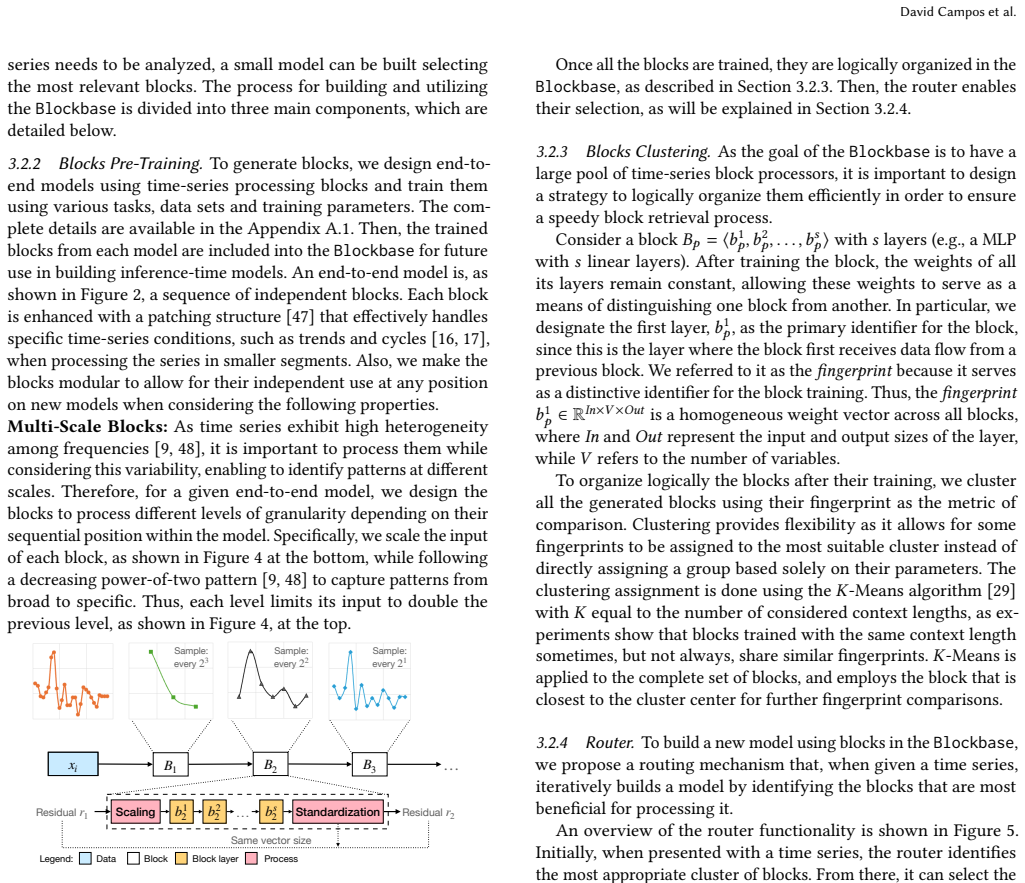
A pool of interchangeable modular model blocks selected iteratively by a routing strategy, together with StreamCore for constructing a representative stream subset.
What would settle it
An experiment on new time-series streams where the routed block models fail to beat the baselines or where accuracy falls steadily as more data arrives despite repeated use of the StreamCore subset.
Extended reading notes
Core claim
TimeBlocks enables versatile time-series processing by maintaining a pool of interchangeable modular model blocks that a routing strategy iteratively selects to construct lightweight accurate models, equipped with StreamCore to build a representative small subset preserving a guaranteed approximation of the stream for continual calibration, outperforming baselines on multiple datasets and tasks.
Load-bearing premise
A routing strategy can reliably pick blocks that yield accurate models for any time-series data, and StreamCore's small subset continues to approximate the full stream well enough that performance does not degrade over time.
Editorial extensions
If this is right
- Models become small enough for real-time responses under strict time and compute limits.
- The same block pool supports multiple tasks by changing which blocks are chosen.
- Continual calibration occurs using only the maintained subset instead of the entire history.
- Models remain deployable in hardware-limited environments where large foundational models cannot run.
- Performance exceeds standard baselines across the tested datasets and tasks.
Reading between the lines
- The block pool could be updated by adding or replacing individual blocks without rebuilding everything.
- Similar routing over modular components might apply to other sequential data such as sensor readings or financial ticks.
- The guaranteed approximation property of the subset could be checked periodically by comparing predictions on held-out recent data.
- Edge devices could host the routing and subset logic locally while occasionally syncing block updates from a central pool.
Editorial analysis
A structured set of objections, weighed in public.
Referee Report
Summary. The manuscript proposes TimeBlocks, a framework that maintains a pool of interchangeable modular model blocks from which a routing strategy iteratively assembles lightweight time-series models tailored to specific data and tasks. It augments this with StreamCore, which constructs a small representative subset of an incoming data stream that preserves a guaranteed approximation, enabling continual model calibration. Experiments across multiple datasets and tasks report that the resulting models outperform existing baselines.
Significance. If the routing mechanism reliably produces accurate models and StreamCore's subset construction maintains its approximation guarantee without performance degradation, the work could enable practical deployment of versatile time-series models in streaming, real-time, and hardware-constrained environments where large offline foundational models are unsuitable.
major comments (2)
- [Abstract] Abstract: the central claim that StreamCore 'preserves a guaranteed approximation of the stream over time' is load-bearing for the continual-calibration contribution, yet the abstract supplies neither the formal statement of the guarantee nor the construction algorithm; without these details the experimental outperformance cannot be assessed for robustness over long streams.
- [Abstract] Abstract: the routing strategy is described only at the level of 'iteratively selects the most suitable blocks'; because this selection process is the mechanism asserted to produce accurate lightweight models for arbitrary time-series data, the absence of selection criteria, objective function, or convergence argument leaves the reliability claim unsupported by the provided description.
minor comments (1)
- [Abstract] Abstract: the experimental study is summarized only as 'on multiple data sets and covering multiple tasks'; adding the number of datasets, tasks, and at least one quantitative performance delta would strengthen the claim of outperformance.
Simulated Author's Rebuttal
We thank the referee for the detailed comments on the abstract. Both points identify areas where the high-level summary can be strengthened without altering the manuscript's core claims. We address each below and will revise the abstract accordingly.
read point-by-point responses
-
Referee: [Abstract] Abstract: the central claim that StreamCore 'preserves a guaranteed approximation of the stream over time' is load-bearing for the continual-calibration contribution, yet the abstract supplies neither the formal statement of the guarantee nor the construction algorithm; without these details the experimental outperformance cannot be assessed for robustness over long streams.
Authors: We agree the abstract should be more informative on this point. In revision we will add a single sentence stating the formal approximation guarantee (e.g., the subset maintains an ε-approximation in a chosen divergence or norm) and briefly name the construction procedure (e.g., the greedy coreset-style selection with periodic refresh). The full proof and algorithm remain in Section 4; the abstract change will not exceed the typical length limit. revision: yes
-
Referee: [Abstract] Abstract: the routing strategy is described only at the level of 'iteratively selects the most suitable blocks'; because this selection process is the mechanism asserted to produce accurate lightweight models for arbitrary time-series data, the absence of selection criteria, objective function, or convergence argument leaves the reliability claim unsupported by the provided description.
Authors: The abstract is intentionally concise, but we accept that a slightly more precise phrasing is warranted. We will revise the sentence to indicate that blocks are chosen by minimizing a task-specific loss (or validation error) over a small candidate pool at each iteration. The concrete objective, stopping criterion, and any convergence properties are already derived in Section 3; the abstract update will reference this mechanism at the same level of detail used for comparable routing methods in the literature. revision: yes
Circularity Check
No significant circularity identified
full rationale
The paper describes a modular block pool, routing strategy, and StreamCore subset construction as a methodological proposal whose performance is asserted via experimental results on external datasets and tasks. No equations, parameter-fitting procedures, or self-citations are presented that reduce any claimed prediction or guarantee to a tautological restatement of the inputs. The central claims rest on empirical outperformance rather than internal definitional closure or load-bearing self-reference.
Assumptions & free parameters
Cite this review
Pith. "Pith review of TimeBlocks: Foundational and Continual Time-Series Blockbase -- Extended Version." pith.science (2026). https://pith.science/paper/DVGJTLVU
@misc{pith2026260602142,
  author       = {Pith},
  title        = {Pith review of: TimeBlocks: Foundational and Continual Time-Series Blockbase -- Extended Version},
  year         = {2026},
  howpublished = {\url{https://pith.science/paper/DVGJTLVU}},
  note         = {Machine review of arXiv:2606.02142}
}
read the original abstract
The ongoing digitization has led to a proliferation of time-series data streams that monitor a variety of processes, from which valuable insights may be obtained. Further, the emergence of successful foundational language models begs the question of whether it is possible to achieve time-series models with the foundational properties of handling multiple tasks, while being sufficiently lightweight to allow real-time data stream processing. Existing foundational time-series models are often large and only effective in offline settings without stringent time and computational constraints, and where repeated model calibration is not needed. However, when applied to data streams, these models are ineffective due to their size and lack of support for continual calibration, which compromise their ability to deliver accurate real-time responses, their durability, and their deployability in hardware-limited settings. We propose TimeBlocks to enable versatile time-series processing by facilitating the efficient building of lightweight models suitable for multiple tasks under variable conditions. In particular, the method maintains a pool of interchangeable and modular model blocks that can be used to construct new time-series models. When presented with specific time-series data, a routing strategy iteratively selects the most suitable blocks to construct a lightweight and accurate model for the data. We equip TimeBlocks with a method called StreamCore to build a representative small subset of the data stream, which preserves a guaranteed approximation of the stream over time, enabling continual model calibration. An experimental study on multiple data sets and covering multiple tasks shows that TimeBlocks enables to build models capable of outperforming existing baselines.
Figures


Figures from the paper (6 more)


Reference graph
Works this paper leans on
-
[1]
Maddix, Hao Wang, Michael W
Abdul Fatir Ansari, Lorenzo Stella, Ali Caner Türkmen, Xiyuan Zhang, Pedro Mercado, Huibin Shen, Oleksandr Shchur, Syama Sundar Rangapuram, Sebastian Pineda-Arango, Shubham Kapoor, Jasper Zschiegner, Danielle C. Maddix, Hao Wang, Michael W. Mahoney, Kari Torkkola, Andrew Gordon Wilson, Michael Bohlke-Schneider, and Bernie Wang. 2024. Chronos: Learning the...
2024
-
[2]
Arjun Ashok, Étienne Marcotte, Valentina Zantedeschi, Nicolas Chapados, and Alexandre Drouin. 2024. TACTiS-2: Better, Faster, Simpler Attentional Copulas for Multivariate Time Series. InICLR
2024
-
[3]
Ran Avnimelech and Nathan Intrator. 1999. Boosted Mixture Of Experts: An Ensemble Learning Scheme.Neural Comput.11, 2 (1999), 483–497
1999
-
[4]
Vladimir Braverman, Dan Feldman, Harry Lang, Daniela Rus, and Adiel Statman
-
[5]
Least-Mean-Squares Coresets for Infinite Streams.IEEE Trans. Knowl. Data Eng.35, 9 (2023), 8699–8712
2023
-
[6]
Pietro Buzzega, Matteo Boschini, Angelo Porrello, Davide Abati, and Simone Calderara. 2020. Dark Experience for General Continual Learning: a Strong, Simple Baseline. InNeurIPS
2020
-
[7]
David Campos, Bin Yang, Tung Kieu, Miao Zhang, Chenjuan Guo, and Chris- tian S. Jensen. 2024. QCore: Data-Efficient, On-Device Continual Calibration for Quantized Models.Proc. VLDB Endow.17, 11 (2024), 2708–2721
2024
-
[8]
David Campos, Miao Zhang, Bin Yang, Tung Kieu, Chenjuan Guo, and Christian S. Jensen. 2023. LightTS: Lightweight Time Series Classification with Adaptive Ensemble Distillation.Proc. ACM Manag. Data1, 2 (2023), 171:1–171:27
2023
Show all 86 references
-
[9]
Rich Caruana, Alexandru Niculescu-Mizil, Geoff Crew, and Alex Ksikes. 2004. Ensemble selection from libraries of models. InICML, Vol. 69
2004
-
[10]
Olivares, Boris N
Cristian Challu, Kin G. Olivares, Boris N. Oreshkin, Federico Garza Ramírez, Max Mergenthaler Canseco, and Artur Dubrawski. 2023. NHITS: Neural Hierar- chical Interpolation for Time Series Forecasting. InAAAI. 6989–6997
2023
-
[11]
Arslan Chaudhry, Marc’Aurelio Ranzato, Marcus Rohrbach, and Mohamed Elho- seiny. 2019. Efficient Lifelong Learning with A-GEM. InICLR
2019
-
[12]
Schneider, Eduard H
Sang Keun Choe, Hwijeen Ahn, Juhan Bae, Kewen Zhao, Minsoo Kang, Youngseog Chung, Adithya Pratapa, Willie Neiswanger, Emma Strubell, Teruko Mitamura, Jeff G. Schneider, Eduard H. Hovy, Roger B. Grosse, and Eric P. Xing
-
[13]
What is Your Data Worth to GPT? LLM-Scale Data Valuation with Influence Functions.CoRRabs/2405.13954 (2024)
2024
-
[14]
Ben Cohen, Emaad Khwaja, Kan Wang, Charles Masson, Elise Ramé, Youssef Dou- bli, and Othmane Abou-Amal. 2024. Toto: Time Series Optimized Transformer for Observability.CoRRabs/2407.07874 (2024)
2024
-
[15]
Vincent Cohen-Addad, Niklas Hjuler, Nikos Parotsidis, David Saulpic, and Chris Schwiegelshohn. 2019. Fully Dynamic Consistent Facility Location. InNeurIPS. 3250–3260. David Campos et al
2019
-
[16]
Abhimanyu Das, Weihao Kong, Rajat Sen, and Yichen Zhou. 2024. A Decoder- only Foundation Model for Time-series Forecasting. InICML, Vol. 235. 10148– 10167
2024
-
[17]
Bagnall, Kaveh Kamgar, Chin-Chia Michael Yeh, Yan Zhu, Shaghayegh Gharghabi, Chotirat Ann Ratanamahatana, and Eamonn J
Hoang Anh Dau, Anthony J. Bagnall, Kaveh Kamgar, Chin-Chia Michael Yeh, Yan Zhu, Shaghayegh Gharghabi, Chotirat Ann Ratanamahatana, and Eamonn J. Keogh. 2019. The UCR time series archive.IEEE CAA J. Autom. Sinica6, 6 (2019), 1293–1305
2019
-
[18]
Vijay Ekambaram, Arindam Jati, Nam Nguyen, Phanwadee Sinthong, and Jayant Kalagnanam. 2023. TSMixer: Lightweight MLP-Mixer Model for Multivariate Time Series Forecasting. InKDD. 459–469
2023
-
[19]
Nguyen, Pankaj Dayama, Chandra Reddy, Wesley M
Vijay Ekambaram, Arindam Jati, Nam H. Nguyen, Pankaj Dayama, Chandra Reddy, Wesley M. Gifford, and Jayant Kalagnanam. 2024. Tiny Time Mixers (TTMs): Fast Pre-trained Models for Enhanced Zero/Few-Shot Forecasting of Multivariate Time Series. InNeurIPS
2024
-
[20]
Schmidt, Jonathan Weber, Geoffrey I
Hassan Ismail Fawaz, Benjamin Lucas, Germain Forestier, Charlotte Pelletier, Daniel F. Schmidt, Jonathan Weber, Geoffrey I. Webb, Lhassane Idoumghar, Pierre- Alain Muller, and François Petitjean. 2020. InceptionTime: Finding AlexNet for time series classification.Data Min. Kno...
2020
-
[21]
Dan Feldman and Michael Langberg. 2011. A unified framework for approximat- ing and clustering data. InSTOC. 569–578
2011
-
[22]
Dan Feldman and Tamir Tassa. 2015. More Constraints, Smaller Coresets: Con- strained Matrix Approximation of Sparse Big Data. InSIGKDD. 249–258
2015
-
[23]
Milton Friedman. 1940. A Comparison of Alternative Tests of Significance for the Problem of $m$ Rankings.Annals of Mathematical Statistics11 (1940), 86–92
1940
-
[24]
Challu, Laurent Callot, Lenon Minorics, and Andrey Kan
Mononito Goswami, Cristian I. Challu, Laurent Callot, Lenon Minorics, and Andrey Kan. 2023. Unsupervised Model Selection for Time Series Anomaly Detection. InICLR
2023
-
[25]
Mononito Goswami, Konrad Szafer, Arjun Choudhry, Yifu Cai, Shuo Li, and Artur Dubrawski. 2024. MOMENT: A Family of Open Time-series Foundation Models. InICML
2024
-
[26]
Nate Gruver, Marc Finzi, Shikai Qiu, and Andrew Gordon Wilson. 2023. Large Language Models Are Zero-Shot Time Series Forecasters. InNeurIPS
2023
-
[27]
Jensen, and Bin Yang
Chenjuan Guo, Christian S. Jensen, and Bin Yang. 2014. Towards Total Traffic Awareness.SIGMOD Rec.43, 3 (2014), 18–23
2014
-
[28]
Sture Holm. 1979. A Simple Sequentially Rejective Multiple Test Procedure. Scandinavian Journal of Statistics6, 2 (1979), 65–70
1979
-
[29]
J. A. Hoogeveen. 1991. Analysis of Christofides’ heuristic: Some paths are more difficult than cycles.Oper. Res. Lett.10, 5 (1991), 291–295
1991
-
[30]
Kyle Hundman, Valentino Constantinou, Christopher Laporte, Ian Colwell, and Tom Söderström. 2018. Detecting Spacecraft Anomalies Using LSTMs and Non- parametric Dynamic Thresholding. InSIGKDD. 387–395
2018
-
[31]
2010.K-Means Clustering
Xin Jin and Jiawei Han. 2010.K-Means Clustering. Springer US, Boston, MA, 563–564
2010
-
[32]
Jeff Johnson, Matthijs Douze, and Hervé Jégou. 2021. Billion-Scale Similarity Search with GPUs.IEEE Trans. Big Data7, 3 (2021), 535–547
2021
-
[33]
Andrej Karpathy. 2019. Multi-task learning in the wilderness. InICML. https: //slideslive.com/38917690/multitask-learning-in-the-wilderness
2019
-
[34]
Chi, Jeffrey Dean, and Neoklis Polyzotis
Tim Kraska, Alex Beutel, Ed H. Chi, Jeffrey Dean, and Neoklis Polyzotis. 2018. The Case for Learned Index Structures. InSIGMOD. 489–504
2018
-
[35]
Max Dupré la Tour, Monika Henzinger, and David Saulpic. 2024. Fully Dynamic k-Means Coreset in Near-Optimal Update Time. InESA (LIPIcs, Vol. 308). 100:1– 100:16
2024
-
[36]
Yuening Li, Zhengzhang Chen, Daochen Zha, Mengnan Du, Jingchao Ni, Denghui Zhang, Haifeng Chen, and Xia Hu. 2022. Towards Learning Disentangled Repre- sentations for Time Series. InSIGKDD. 3270–3278
2022
-
[37]
Yiming Li, Yanyan Shen, and Lei Chen. 2022. Camel: Managing Data for Efficient Stream Learning. InSIGMOD. 1271–1285
2022
-
[38]
Jensen, and Bin Yang
Zhe Li, Xiangfei Qiu, Peng Chen, Yihang Wang, Hanyin Cheng, Yang Shu, Jilin Hu, Chenjuan Guo, Aoying Zhou, Christian S. Jensen, and Bin Yang. 2025. TSFM- Bench: A Comprehensive and Unified Benchmark of Foundation Models for Time Series Forecasting. InKDD. 5595–5606
2025
-
[39]
Jiaming Liang, Lei Cao, Samuel Madden, Zack Ives, and Guoliang Li. 2024. RITA: Group Attention is All You Need for Timeseries Analytics.Proc. ACM Manag. Data2, 1 (2024), 62:1–62:28
2024
-
[40]
Zhiyu Liang, Jianfeng Zhang, Chen Liang, Hongzhi Wang, Zheng Liang, and Lujia Pan. 2023. A Shapelet-based Framework for Unsupervised Multivariate Time Series Representation Learning.Proc. VLDB Endow.17, 3 (2023), 386–399
2023
-
[41]
Ilya Loshchilov and Frank Hutter. 2019. Decoupled Weight Decay Regularization. InICLR
2019
-
[42]
Hua Lu, Bin Yang, and Christian S. Jensen. 2011. Spatio-temporal joins on symbolic indoor tracking data. InICDE. 816–827
2011
-
[43]
Alaa Maalouf, Gilad Eini, Ben Mussay, Dan Feldman, and Margarita Osadchy
-
[44]
Neural Networks Learn
A Unified Approach to Coreset Learning.IEEE Trans. Neural Networks Learn. Syst.35, 5 (2024), 6893–6905
2024
-
[45]
Mathur and Nils Ole Tippenhauer
Aditya P. Mathur and Nils Ole Tippenhauer. 2016. SWaT: a water treatment testbed for research and training on ICS security. InCySWater@CPSWeek. 31–36
2016
-
[46]
Nimrod Megiddo and Kenneth J. Supowit. 1984. On the Complexity of Some Common Geometric Location Problems.SIAM J. Comput.13, 1 (1984), 182–196
1984
-
[47]
Adam Meyerson. 2001. Online Facility Location. InFOCS. 426–431
2001
-
[48]
Bilmes, and Jure Leskovec
Baharan Mirzasoleiman, Jeff A. Bilmes, and Jure Leskovec. 2020. Coresets for Data-efficient Training of Machine Learning Models. InICML, Vol. 119. 6950– 6960
2020
-
[49]
Guanlin Mo, Shihong Song, and Hu Ding. 2024. Towards Metric DBSCAN: Exact, Approximate, and Streaming Algorithms.Proc. ACM Manag. Data2, 3 (2024), 178
2024
-
[50]
Nguyen, Phanwadee Sinthong, and Jayant Kalagnanam
Yuqi Nie, Nam H. Nguyen, Phanwadee Sinthong, and Jayant Kalagnanam. 2023. A Time Series is Worth 64 Words: Long-term Forecasting with Transformers. In ICLR
2023
-
[51]
Oreshkin, Dmitri Carpov, Nicolas Chapados, and Yoshua Bengio
Boris N. Oreshkin, Dmitri Carpov, Nicolas Chapados, and Yoshua Bengio. 2020. N-BEATS: Neural Basis Expansion Analysis for Interpretable Time Series Fore- casting. InICLR
2020
-
[52]
Phillips
Jeff M. Phillips. 2017. Coresets and Sketches. InHandbook of Discrete and Computational Geometry, Third Edition, Csaba D. Toth, Joseph O’Rourke, and Jacob E. Goodman (Eds.). Chapman and Hall/CRC, New York, 1269–1288
2017
-
[53]
Lennart Oswald Purucker, Lennart Schneider, Marie Anastacio, Joeran Beel, Bernd Bischl, and Holger H. Hoos. 2023. Q(D)O-ES: Population-based Quality (Diversity) Optimisation for Post Hoc Ensemble Selection in AutoML. InAutoML (Proceedings of Machine Learning Research, Vol. 224...
2023
-
[54]
Jensen, Zhenli Sheng, and Bin Yang
Xiangfei Qiu, Jilin Hu, Lekui Zhou, Xingjian Wu, Junyang Du, Buang Zhang, Chenjuan Guo, Aoying Zhou, Christian S. Jensen, Zhenli Sheng, and Bin Yang
-
[55]
VLDB Endow.17, 9 (2024), 2363–2377
TFB: Towards Comprehensive and Fair Benchmarking of Time Series Forecasting Methods.Proc. VLDB Endow.17, 9 (2024), 2363–2377
2024
-
[56]
Kashif Rasul, Arjun Ashok, Andrew Robert Williams, Arian Khorasani, George Adamopoulos, Rishika Bhagwatkar, Marin Bilos, Hena Ghonia, Nadhir Vincent Hassen, Anderson Schneider, Sahil Garg, Alexandre Drouin, Nicolas Chapados, Yuriy Nevmyvaka, and Irina Rish. 2023. Lag-Llama: To...
2023
-
[57]
Lei Rui, Xiangdong Huang, Shaoxu Song, Yuyuan Kang, Chen Wang, and Jianmin Wang. 2024. Time Series Representation for Visualization in Apache IoTDB.Proc. ACM Manag. Data2, 1 (2024), 35:1–35:26
2024
-
[58]
Schapire
Robert E. Schapire. 2003.The Boosting Approach to Machine Learning: An Overview. Springer, New York, 149–171
2003
-
[59]
Ya Su, Youjian Zhao, Chenhao Niu, Rong Liu, Wei Sun, and Dan Pei. 2019. Robust Anomaly Detection for Multivariate Time Series through Stochastic Recurrent Neural Network. InSIGKDD. 2828–2837
2019
-
[60]
Hugo Touvron, Thibaut Lavril, Gautier Izacard, Xavier Martinet, Marie-Anne Lachaux, Timothée Lacroix, Baptiste Rozière, Naman Goyal, Eric Hambro, Faisal Azhar, Aurélien Rodriguez, Armand Joulin, Edouard Grave, and Guillaume Lam- ple. 2023. LLaMA: Open and Efficient Foundation ...
2023 arXiv
-
[61]
Murad Tukan, Cenk Baykal, Dan Feldman, and Daniela Rus. 2021. On coresets for support vector machines.Theor. Comput. Sci.890 (2021), 171–191
2021
-
[62]
Zhang, and Jun Zhou
Shiyu Wang, Haixu Wu, Xiaoming Shi, Tengge Hu, Huakun Luo, Lintao Ma, James Y. Zhang, and Jun Zhou. 2024. TimeMixer: Decomposable Multiscale Mixing for Time Series Forecasting. InICLR
2024
-
[63]
Wenxuan Wang, Kai Wu, Yujian Betterest Li, Dan Wang, and Xiaoyu Zhang. 2025. Synthetic Series-Symbol Data Generation for Time Series Foundation Models. In NeurIPS
2025
-
[64]
Yihang Wang, Yuying Qiu, Peng Chen, Yang Shu, Zhongwen Rao, Lujia Pan, Bin Yang, and Chenjuan Guo. 2025. LightGTS: A Lightweight General Time Series Forecasting Model. InICML
2025
-
[65]
Yihang Wang, Yuying Qiu, Peng Chen, Kai Zhao, Yang Shu, Zhongwen Rao, Lujia Pan, Bin Yang, and Chenjuan Guo. 2025. Towards a General Time Series Forecasting Model with Unified Representation and Adaptive Transfer. InICML
2025
-
[66]
Zhiguang Wang, Weizhong Yan, and Tim Oates. 2017. Time series classification from scratch with deep neural networks: A strong baseline. InIJCNN. 1578–1585
2017
-
[67]
Frank Wilcoxon. 1945. Individual Comparisons by Ranking Methods.Biometrics Bulletin1, 6 (1945), 80–83
1945
-
[68]
Gerald Woo, Chenghao Liu, Akshat Kumar, Caiming Xiong, Silvio Savarese, and Doyen Sahoo. 2024. Unified Training of Universal Time Series Forecasting Transformers. InICML, Vol. 235. 53140–53164
2024
-
[69]
Gerald Woo, Chenghao Liu, Akshat Kumar, Caiming Xiong, Silvio Savarese, and Doyen Sahoo. 2024. Unified Training of Universal Time Series Forecasting Transformers. InICML (Proceedings of Machine Learning Research). 53140–53164
2024
-
[70]
Haixu Wu, Tengge Hu, Yong Liu, Hang Zhou, Jianmin Wang, and Mingsheng Long. 2023. TimesNet: Temporal 2D-Variation Modeling for General Time Series Analysis. InICLR
2023
-
[71]
Haixu Wu, Jiehui Xu, Jianmin Wang, and Mingsheng Long. 2021. Autoformer: Decomposition Transformers with Auto-Correlation for Long-Term Series Fore- casting. InNeurIPS. 22419–22430
2021
-
[72]
Xingjian Wu, Jianxin Jin, Wanghui Qiu, Peng Chen, Yang Shu, Bin Yang, and Chenjuan Guo. 2026. Aurora: Towards Universal Generative Multimodal Time Series Forecasting. InICLR
2026
-
[73]
Xingjian Wu, Xiangfei Qiu, Hongfan Gao, Jilin Hu, Bin Yang, and Chenjuan Guo. 2025. K2VAE: A Koopman-Kalman Enhanced Variational AutoEncoder for Probabilistic Time Series Forecasting. InICML. TimeBlocks: Foundational and Continual Time-Series Blockbase—Extended Version
2025
-
[74]
Jiehui Xu, Haixu Wu, Jianmin Wang, and Mingsheng Long. 2022. Anomaly Transformer: Time Series Anomaly Detection with Association Discrepancy. In ICLR
2022
-
[75]
Sean Bin Yang, Jilin Hu, Chenjuan Guo, Bin Yang, and Christian S. Jensen. 2023. LightPath: Lightweight and Scalable Path Representation Learning. InKDD. 2999–3010
2023
-
[76]
Yiyuan Yang, Chaoli Zhang, Tian Zhou, Qingsong Wen, and Liang Sun. 2023. DCdetector: Dual Attention Contrastive Representation Learning for Time Series Anomaly Detection. InKDD. 3033–3045
2023
-
[77]
Zhihan Yue, Yujing Wang, Juanyong Duan, Tianmeng Yang, Congrui Huang, Yunhai Tong, and Bixiong Xu. 2022. TS2Vec: Towards Universal Representation of Time Series. InAAAI. 8980–8987
2022
-
[78]
Ailing Zeng, Muxi Chen, Lei Zhang, and Qiang Xu. 2023. Are Transformers Effective for Time Series Forecasting?. InAAAI. 11121–11128
2023
-
[79]
George Zerveas, Srideepika Jayaraman, Dhaval Patel, Anuradha Bhamidipaty, and Carsten Eickhoff. 2021. A Transformer-based Framework for Multivariate Time Series Representation Learning. InSIGKDD. 2114–2124
2021
-
[80]
Gary Chan
Shuhan Zhong, Sizhe Song, Weipeng Zhuo, Guanyao Li, Yang Liu, and S.-H. Gary Chan. 2024. A Multi-Scale Decomposition MLP-Mixer for Time Series Analysis. Proc. VLDB Endow.17, 7 (2024), 1723–1736
2024
-
[81]
Haoyi Zhou, Shanghang Zhang, Jieqi Peng, Shuai Zhang, Jianxin Li, Hui Xiong, and Wancai Zhang. 2021. Informer: Beyond Efficient Transformer for Long Sequence Time-Series Forecasting. InAAAI. 11106–11115
2021
-
[82]
Tian Zhou, Ziqing Ma, Qingsong Wen, Xue Wang, Liang Sun, and Rong Jin
-
[83]
InICML, Vol
FEDformer: Frequency Enhanced Decomposed Transformer for Long-term Series Forecasting. InICML, Vol. 162. 27268–27286
-
[84]
Tian Zhou, Peisong Niu, Xue Wang, Liang Sun, and Rong Jin. 2023. One Fits All: Power General Time Series Analysis by Pretrained LM. InNeurIPS
2023
-
[85]
Zhao, Andrew M
Yanqi Zhou, Tao Lei, Hanxiao Liu, Nan Du, Yanping Huang, Vincent Y. Zhao, Andrew M. Dai, Zhifeng Chen, Quoc V. Le, and James Laudon. 2022. Mixture-of- Experts with Expert Choice Routing. InNeurIPS
2022
-
[86]
Bhowmick
Rundong Zuo, Guozhong Li, Rui Cao, Byron Choi, Jianliang Xu, and Sourav S. Bhowmick. 2024. DARKER: Efficient Transformer with Data-driven Attention Mechanism for Time Series.Proc. VLDB Endow.17, 11 (2024), 3229–3242. A Appendix A.1 Blocks Pre-Training The process starts when r...
2024
Reviewed June 28, 2026 · model on record in the stance chip above.
Discussion (0). Continue with ORCID to comment.