Spectral suppression of black hole ringdown tails
Pith reviewed 2026-06-28 13:23 UTC · model grok-4.3
The pith
Perturbation sources with a carrier frequency and finite spectral width suppress black hole ringdown tails by an exponential factor set by their product.
A machine-rendered reading of the paper's core claim, the machinery that carries it, and where it could break.
Core claim
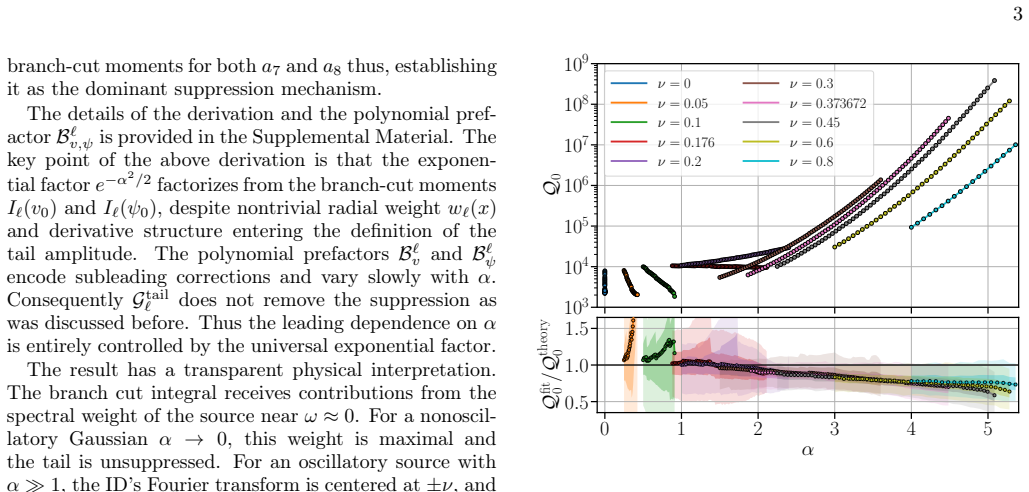
For a generic perturbation with carrier frequency ν and characteristic width σ, the branch-cut excitation coefficient governing the tail is suppressed by α=σν. For a Gaussian pulse, the suppression ∼e^{-α²/2}. This suppression is exact and confirmed by the time domain Regge Wheeler evolutions. Analytic derivations of leading and next-to-leading order tail coefficients agree with numerical fits at the ten percent level. The results explain the lack of tails in quasi-circular mergers and their presence in head-on and eccentric collisions.
What carries the argument
The branch-cut excitation coefficient in the Green's function for the Regge-Wheeler equation, determined by the Fourier transform of the source spectrum at the branch point.
Load-bearing premise
The perturbing source can be characterized by a single carrier frequency and a width whose Fourier transform directly determines the branch-cut coefficient in the solution of the wave equation.
What would settle it
Time-domain numerical integration of the Regge-Wheeler equation driven by a Gaussian pulse whose measured late-time tail amplitude matches the predicted exponential suppression e^{-(σν)^2 / 2}.
Figures

read the original abstract
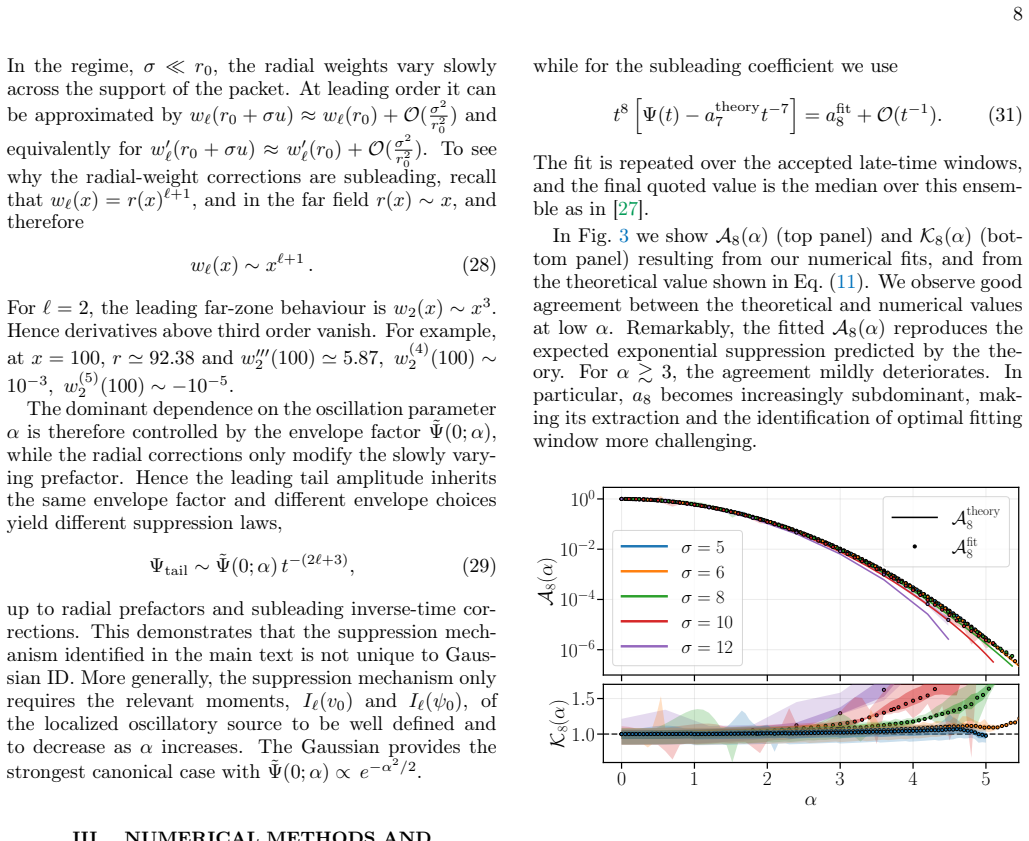
The late-time power law tail predicted by Price's law is a generic feature of black hole perturbation theory, yet it is largely absent in numerical relativity waveforms of binary black hole mergers. We show that this suppression arises from the spectral structure of oscillatory sources. For a generic perturbation with carrier frequency $\nu$ and characteristic width $\sigma$, the branch-cut excitation coefficient governing the tail is suppressed by $\alpha=\sigma\nu$. For a Gaussian pulse, the suppression $\sim e^{-\alpha^2/2}$. This suppression is exact and confirmed by the time domain Regge Wheeler evolutions. The same parameter that controls the transition from broadband to frequency selective black hole response is also responsible for the tail suppression. Moreover, we analytically derive the leading- and next-to-leading-order tail coefficients, finding agreement with numerical fits below the $\sim10\%$ level. Our results provide a first principle explanation for the absence of tails in quasi-circular mergers and their enhancement in head-on and eccentric ones.
Editorial analysis
A structured set of objections, weighed in public.
Referee Report
Summary. The manuscript claims that the absence of late-time power-law tails (Price's law) in numerical relativity waveforms of binary black hole mergers arises from spectral suppression in oscillatory perturbation sources. For a generic source with carrier frequency ν and width σ, the branch-cut excitation coefficient in the Green's function solution to the Regge-Wheeler equation is suppressed by α=σν; for a Gaussian pulse this yields an exact factor ∼e^{-α²/2}. The paper derives leading- and next-to-leading-order analytic expressions for the tail coefficients, reports ∼10% agreement with time-domain Regge-Wheeler evolutions, and argues that the same parameter α governs the transition from broadband to frequency-selective black-hole response, thereby explaining stronger tails in head-on/eccentric mergers versus quasi-circular ones.
Significance. If the central derivation holds, the result supplies a first-principles, frequency-domain explanation for a long-standing discrepancy between perturbation theory and numerical relativity, without introducing new free parameters. The explicit analytic tail coefficients and their direct numerical confirmation constitute a strength that could be tested against existing and future simulations with controlled source spectra.
major comments (2)
- [Abstract / frequency-domain section] Abstract and the frequency-domain analysis: the claim that the suppression is 'exact' and that the branch-cut coefficient is directly proportional to the source Fourier transform evaluated near ω=0 is load-bearing, yet the explicit integral expression for the coefficient (and its reduction to the stated α=σν factor) is not displayed; without it the quantitative 10% agreement cannot be verified independently.
- [Numerical results section] Numerical confirmation paragraph: the reported ∼10% agreement between analytic tail coefficients and time-domain fits is central to validating the suppression mechanism, but the manuscript provides neither the fitting window, the precise definition of the error metric, nor the data-exclusion criteria used in the Regge-Wheeler evolutions; this information is required to assess whether the agreement is robust or sensitive to analysis choices.
minor comments (1)
- [Abstract] The abstract states agreement 'below the ∼10% level' without specifying whether this refers to relative error on the amplitude, on the power-law index, or on both; a brief clarification would improve readability.
Simulated Author's Rebuttal
We thank the referee for their careful reading and constructive comments on our manuscript. We address each major comment below and will revise the manuscript to improve clarity and reproducibility.
read point-by-point responses
-
Referee: [Abstract / frequency-domain section] Abstract and the frequency-domain analysis: the claim that the suppression is 'exact' and that the branch-cut coefficient is directly proportional to the source Fourier transform evaluated near ω=0 is load-bearing, yet the explicit integral expression for the coefficient (and its reduction to the stated α=σν factor) is not displayed; without it the quantitative 10% agreement cannot be verified independently.
Authors: We agree that the explicit integral expression is necessary for independent verification of the suppression factor. In the revised manuscript we will insert the integral definition of the branch-cut excitation coefficient (the source Fourier transform evaluated at ω=0) and explicitly reduce it to the Gaussian factor ∼e^{-α²/2} with α=σν. This addition will make the 'exact' claim for the Gaussian case directly verifiable while preserving the existing analytic and numerical results. revision: yes
-
Referee: [Numerical results section] Numerical confirmation paragraph: the reported ∼10% agreement between analytic tail coefficients and time-domain fits is central to validating the suppression mechanism, but the manuscript provides neither the fitting window, the precise definition of the error metric, nor the data-exclusion criteria used in the Regge-Wheeler evolutions; this information is required to assess whether the agreement is robust or sensitive to analysis choices.
Authors: We acknowledge that the fitting details were omitted. In the revision we will add an appendix (or subsection) that specifies the fitting window (late-time regime after the ringdown has decayed), the error metric (relative difference between analytic coefficient and numerical fit), and the data-exclusion criteria (removal of initial transients and early oscillatory contamination). These additions will allow readers to reproduce and assess the robustness of the reported ∼10% agreement. revision: yes
Circularity Check
No significant circularity; derivation is self-contained from Green's function
full rationale
The central result follows directly from the frequency-domain structure of the Green's function solution to the Regge-Wheeler equation: the branch-cut tail coefficient is proportional to the Fourier transform of the source evaluated near ω=0. For a source characterized by carrier frequency ν and width σ, the factor α=σν (and Gaussian suppression e^{-α²/2}) is an immediate consequence of this proportionality and the source spectrum, without any fitting of tail amplitudes or reduction to the target observable. Analytic leading/next-to-leading coefficients are derived from the same framework and compared to independent time-domain evolutions for validation only. No load-bearing self-citations, ansatzes smuggled via prior work, or fitted inputs renamed as predictions appear in the described chain.
Axiom & Free-Parameter Ledger
axioms (1)
- domain assumption Linear perturbations of a Schwarzschild black hole obey the Regge-Wheeler equation
Reference graph
Works this paper leans on
-
[1]
R. H. Price, Nonspherical perturbations of relativistic gravitational collapse. 1. Scalar and gravitational pertur- bations, Phys. Rev. D5, 2419 (1972)
1972
-
[2]
E.W.Leaver,Spectraldecompositionoftheperturbation responseoftheSchwarzschildgeometry,Phys.Rev.D34, 384 (1986)
1986
-
[3]
C. Gundlach, R. H. Price, and J. Pullin, Late time be- havior of stellar collapse and explosions: 1. Linearized perturbations, Phys. Rev. D49, 883 (1994), arXiv:gr- qc/9307009
arXiv 1994
-
[4]
E. S. C. Ching, P. T. Leung, W. M. Suen, and K. Young, Late time tail of wave propagation on curved space-time, Phys. Rev. Lett.74, 2414 (1995), arXiv:gr-qc/9410044
Pith/arXiv arXiv 1995
-
[5]
E. S. C. Ching, P. T. Leung, W. M. Suen, and K. Young, Wave propagation in gravitational systems: Late time behavior, Phys. Rev. D52, 2118 (1995), arXiv:gr- qc/9507035
arXiv 1995
-
[6]
M. De Amicis, S. Albanesi, and G. Carullo, Inspiral- inherited ringdown tails, Phys. Rev. D110, 104005 (2024), arXiv:2406.17018 [gr-qc]
arXiv 2024
- [7]
-
[8]
L. Barack and A. Ori, Late time decay of scalar pertur- bations outside rotating black holes, Phys. Rev. Lett.82, 4388 (1999), arXiv:gr-qc/9902082
Pith/arXiv arXiv 1999
-
[9]
M. Dafermos and I. Rodnianski, A Proof of Price’s law for the collapse of a selfgravitating scalar field, Invent. Math.162, 381 (2005), arXiv:gr-qc/0309115
Pith/arXiv arXiv 2005
-
[10]
E. Harms, S. Bernuzzi, and B. Brügmann, Numerical so- lution of the 2+1 Teukolsky equation on a hyperboloidal and horizon penetrating foliation of Kerr and applica- tion to late-time decays, Class. Quant. Grav.30, 115013 (2013), arXiv:1301.1591 [gr-qc]
Pith/arXiv arXiv 2013
-
[11]
Zenginoglu, Hyperboloidal foliations and scri-fixing, Class
A. Zenginoglu, Hyperboloidal foliations and scri-fixing, Class. Quantum Grav.25, 145002 (2008)
2008
-
[12]
S. Hod, High order contamination in the tail of gravita- tionalcollapse,Phys.Rev.D60,104053(1999),arXiv:gr- qc/9907044
arXiv 1999
-
[13]
L. Barack, Late time decay of scalar, electromag- netic, and gravitational perturbations outside rotating black holes, Phys. Rev. D61, 024026 (2000), arXiv:gr- qc/9908005
arXiv 2000
-
[14]
L. M. Burko and G. Khanna, Late-time Kerr tails revisited, Class. Quant. Grav.26, 015014 (2009), arXiv:0711.0960 [gr-qc]
Pith/arXiv arXiv 2009
-
[15]
I. Racz and G. Z. Toth, Numerical investigation of the late-time Kerr tails, Class. Quant. Grav.28, 195003 (2011), arXiv:1104.4199 [gr-qc]
Pith/arXiv arXiv 2011
-
[16]
Y. Angelopoulos, S. Aretakis, and D. Gajic, Late-time tails and mode coupling of linear waves on Kerr space- times, Adv. Math.417, 108939 (2023), arXiv:2102.11884 [gr-qc]
arXiv 2023
-
[17]
De Amiciset al., Late-Time Tails in Nonlinear Evo- lutions of Merging Black Holes, Phys
M. De Amiciset al., Late-Time Tails in Nonlinear Evo- lutions of Merging Black Holes, Phys. Rev. Lett.135, 171401 (2025), arXiv:2412.06887 [gr-qc]
arXiv 2025
-
[18]
S. Ma, M. A. Scheel, J. Moxon, K. C. Nelli, N. Deppe, L. E. Kidder, W. Throwe, and N. L. Vu, Merging black holes with Cauchy-characteristic matching: Computa- tion of late-time tails, Phys. Rev. D112, 024003 (2025), arXiv:2412.06906 [gr-qc]
arXiv 2025
-
[19]
V. Cardoso, G. Carullo, M. De Amicis, F. Duque, T. Katagiri, D. Pereniguez, J. Redondo-Yuste, T. F. M. Spieksma, and Z. Zhong, Hushing black holes: Tails in dynamical spacetimes, Phys. Rev. D109, L121502 (2024), arXiv:2405.12290 [gr-qc]
arXiv 2024
-
[20]
A. Ianniccari, L. Lo Bianco, and A. Riotto, The nonlinear tails in black hole ringdown: the scattering perspective, JCAP10, 062, arXiv:2507.17732 [gr-qc]
-
[21]
S. Ling, S. Shah, and S. S. C. Wong, Dynamical nonlinear tailsintheSchwarzschildblackholeringdown,Phys.Rev. D112, 024008 (2025), arXiv:2503.19967 [gr-qc]
arXiv 2025
-
[22]
S. Ling and S. S. C. Wong, Nonlinear tails in the kerr black hole ringdown (2026), arXiv:2603.20379 [gr-qc]
arXiv 2026
-
[23]
R. F. Rosato and P. Pani, Universality of late-time ringdown tails, Phys. Rev. D112, 024080 (2025), arXiv:2505.08877 [gr-qc]
Pith/arXiv arXiv 2025
-
[24]
L. Barack and A. Ori, Mode sum regularization approach for the selfforce in black hole space-time, Phys. Rev. D 61, 061502 (2000), arXiv:gr-qc/9912010
Pith/arXiv arXiv 2000
-
[25]
Andersson, Evolving test fields in a black hole geom- etry, Phys
N. Andersson, Evolving test fields in a black hole geom- etry, Phys. Rev. D55, 468 (1997), arXiv:gr-qc/9607064
Pith/arXiv arXiv 1997
-
[26]
R. H. Price and L. M. Burko, Late time tails from momentarily stationary, compact initial data in Schwarzschild spacetimes, Phys. Rev. D70, 084039 (2004), arXiv:gr-qc/0408077
Pith/arXiv arXiv 2004
-
[27]
A. Svyatkovskyy Kholyavka, J. A. León Vega, S. Gómez Gómez, X. Jiménez Forteza, and S. Datta, 6 Shaping black hole resonances I. Black hole ringdown as a spectral filtering process (2026), arXiv:2605.24704 [gr-qc]
Pith/arXiv arXiv 2026
-
[28]
B. S. DeWitt and R. W. Brehme, Radiation damping in a gravitational field, Annals Phys.9, 220 (1960)
1960
-
[29]
Poisson, Radiative falloff of a scalar field in a weakly curved space-time without symmetries, Phys
E. Poisson, Radiative falloff of a scalar field in a weakly curved space-time without symmetries, Phys. Rev. D66, 044008 (2002), arXiv:gr-qc/0205018
Pith/arXiv arXiv 2002
-
[30]
M. Casals, S. Dolan, A. C. Ottewill, and B. Wardell, Self- Force and Green Function in Schwarzschild spacetime via Quasinormal Modes and Branch Cut, Phys. Rev. D88, 044022 (2013), arXiv:1306.0884 [gr-qc]
Pith/arXiv arXiv 2013
-
[31]
Andersson, Excitation of Schwarzschild black hole quasinormal modes, Phys
N. Andersson, Excitation of Schwarzschild black hole quasinormal modes, Phys. Rev. D51, 353 (1995)
1995
-
[32]
E. Berti and V. Cardoso, Quasinormal ringing of Kerr black holes. I. The Excitation factors, Phys. Rev. D74, 104020 (2006), arXiv:gr-qc/0605118
Pith/arXiv arXiv 2006
-
[33]
E. Berti, V. Cardoso, J. A. Gonzalez, U. Sperhake, M. Hannam, S. Husa, and B. Bruegmann, Inspiral, mergerandringdownofunequalmassblackholebinaries: A Multipolar analysis, Phys. Rev.D76, 064034 (2007), arXiv:gr-qc/0703053 [GR-QC]
Pith/arXiv arXiv 2007
-
[34]
Z. Zhang, E. Berti, and V. Cardoso, Quasinormal ring- ing of Kerr black holes. II. Excitation by particles falling radially with arbitrary energy, Phys. Rev. D88, 044018 (2013), arXiv:1305.4306 [gr-qc]
Pith/arXiv arXiv 2013
-
[35]
N. Oshita, Ease of excitation of black hole ringing: Quan- tifying the importance of overtones by the excitation fac- tors, Phys. Rev. D104, 124032 (2021), arXiv:2109.09757 [gr-qc]
arXiv 2021
-
[36]
R. K. L. Lo, L. Sabani, and V. Cardoso, Quasinormal modes and excitation factors of Kerr black holes, Phys. Rev. D111, 124002 (2025), arXiv:2504.00084 [gr-qc]
arXiv 2025
-
[37]
M. Della Rocca, L. Pezzella, E. Berti, L. Gualtieri, and A. Maselli, Quasinormal ringing of Kerr black holes. III. Excitation coefficients for equatorial inspirals from the innermost stable circular orbit (2025), arXiv:2512.07959 [gr-qc]
arXiv 2025
-
[38]
K.-i. Kubota and H. Motohashi, Resonance in black hole ringdown: Benchmarking quasinormal mode exci- tation and extraction, Phys. Rev. D113, 043053 (2026), arXiv:2509.06411 [gr-qc]
arXiv 2026
-
[39]
UIB Perturbation Theory Group, QNMToolkit,https: //github.com/uib-perturbation-theory/QNMToolkit
-
[40]
L. Barack and C. Cutler, LISA capture sources: Approx- imate waveforms, signal-to-noise ratios, and parameter estimation accuracy, Phys. Rev. D69, 082005 (2004), arXiv:gr-qc/0310125
Pith/arXiv arXiv 2004
-
[41]
S. Drasco and S. A. Hughes, Rotating black hole orbit functionals in the frequency domain, Phys. Rev. D69, 044015 (2004), arXiv:astro-ph/0308479
Pith/arXiv arXiv 2004
-
[42]
S. Drasco and S. A. Hughes, Gravitational wave snap- shots of generic extreme mass ratio inspirals, Phys. Rev. D73, 024027 (2006), [Erratum: Phys.Rev.D 88, 109905 (2013), Erratum: Phys.Rev.D 90, 109905 (2014)], arXiv:gr-qc/0509101
Pith/arXiv arXiv 2006
-
[43]
S. Babak, H. Fang, J. R. Gair, K. Glampedakis, and S. A. Hughes, ’Kludge’ gravitational waveforms for a test-body orbiting a Kerr black hole, Phys. Rev. D75, 024005 (2007), [Erratum: Phys.Rev.D 77, 04990 (2008)], arXiv:gr-qc/0607007
Pith/arXiv arXiv 2007
-
[44]
N. Yunes, K. G. Arun, E. Berti, and C. M. Will, Post-Circular Expansion of Eccentric Binary Inspirals: Fourier-Domain Waveforms in the Stationary Phase Ap- proximation, Phys. Rev. D80, 084001 (2009), [Erratum: Phys.Rev.D 89, 109901 (2014)], arXiv:0906.0313 [gr-qc]
Pith/arXiv arXiv 2009
-
[45]
R. Gold and B. Brügmann, Eccentric black hole merg- ers and zoom-whirl behavior from elliptic inspirals to hyperbolic encounters, Phys. Rev. D88, 064051 (2013), arXiv:1209.4085 [gr-qc]
Pith/arXiv arXiv 2013
-
[46]
E. A. Huertaet al., Physics of eccentric binary black hole mergers: A numerical relativity perspective, Phys. Rev. D100, 064003 (2019), arXiv:1901.07038 [gr-qc]
arXiv 2019
-
[47]
S. A. Hughes, N. Warburton, G. Khanna, A. J. K. Chua, and M. L. Katz, Adiabatic waveforms for extreme mass- ratio inspirals via multivoice decomposition in time and frequency, Phys. Rev. D103, 104014 (2021), [Erratum: Phys.Rev.D 107, 089901 (2023)], arXiv:2102.02713 [gr- qc]
arXiv 2021
-
[48]
T. Islam, G. Khanna, and S. E. Field, Adding higher- order spherical harmonics in nonspinning eccentric bi- nary black hole merger waveform models, Phys. Rev. D 111, 124023 (2025), arXiv:2408.02762 [gr-qc]
Pith/arXiv arXiv 2025
-
[49]
A. Buonanno, G. B. Cook, and F. Pretorius, Inspiral, merger and ring-down of equal-mass black-hole binaries, Phys. Rev.D75, 124018 (2007), arXiv:gr-qc/0610122
Pith/arXiv arXiv 2007
-
[50]
Y. Pan, A. Buonanno, M. Boyle, L. T. Buchman, L. E. Kidder, H. P. Pfeiffer, and M. A. Scheel, Inspiral-merger- ringdown multipolar waveforms of nonspinning black- hole binaries using the effective-one-body formalism, Phys. Rev. D84, 124052 (2011), arXiv:1106.1021 [gr-qc]
Pith/arXiv arXiv 2011
-
[51]
J. Healy, C. O. Lousto, and Y. Zlochower, Nonspinning binary black hole merger scenario revisited, Phys. Rev. D96, 024031 (2017), arXiv:1705.07034 [gr-qc]
Pith/arXiv arXiv 2017
-
[52]
J.HealyandC.O.Lousto,Hangupeffectinunequalmass binary black hole mergers and further studies of their gravitational radiation and remnant properties, Phys. Rev. D97, 084002 (2018), arXiv:1801.08162 [gr-qc]. 7 SUPPLEMENT AL MA TERIAL I. DERIV A TION OF EXPONENTIAL SUPPRESSION We definey=x−r 0 andu=y/σto express the ID from Eq. (1) as, Ψ(u)|t=0 =Ae −u2/2 co...
Pith/arXiv arXiv 2018
discussion (0)
Sign in with ORCID, Apple, or X to comment. Anyone can read and Pith papers without signing in.