Hypernucleus production in p+Au reactions at the FAIR facility
Pith reviewed 2026-06-28 12:18 UTC · model grok-4.3
The pith
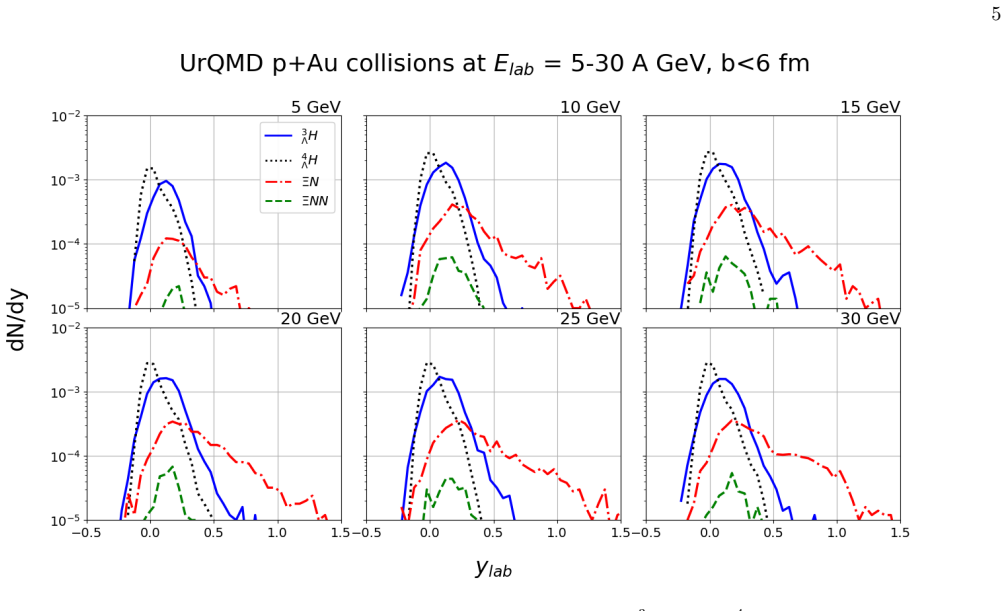
Yields of multi-strange hypernuclei in 5-30 GeV proton-gold collisions are high enough for detection at the CBM experiment at FAIR.
A machine-rendered reading of the paper's core claim, the machinery that carries it, and where it could break.
Core claim
Using the UrQMD model with phase space coalescence, the production of hypernuclei including those containing Xi hyperons is calculated for p+Au at 5-30 GeV, and the rates of novel multi-strange hypernuclei are found to be well within the reach of the CBM-experiment.
What carries the argument
UrQMD transport model combined with a standard phase space coalescence model for forming bound states from produced particles.
If this is right
- Predicted yields and rapidity distributions for 3_Lambda H and 4_Lambda H hypernuclei are within reach of CBM.
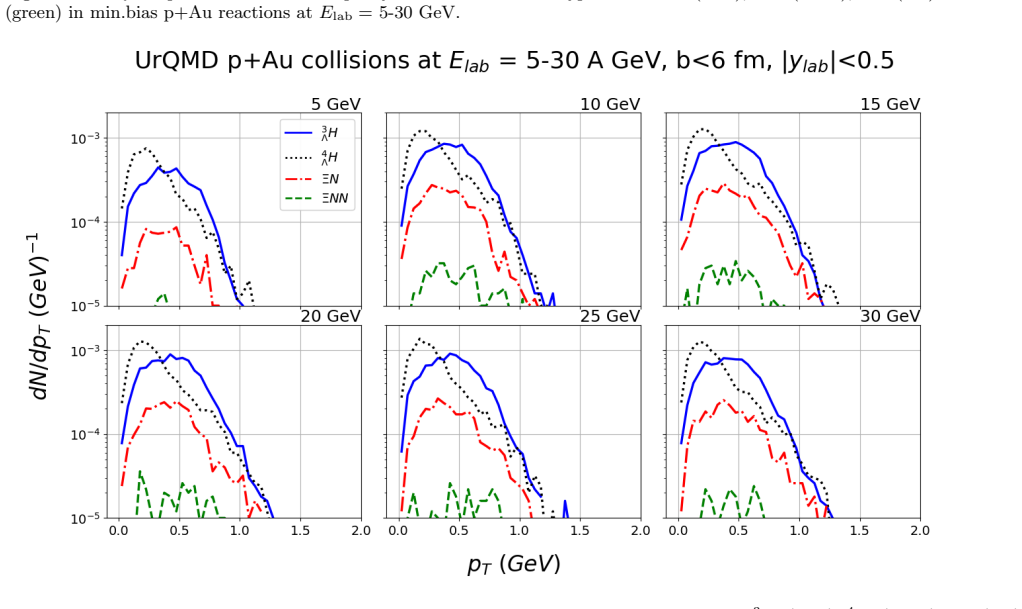
- Transverse momentum distributions for Xi N and Xi NN hypernuclei are provided for experimental planning.
- The CBM experiment can access multi-strange hypernuclei production in this energy regime.
- Starting from single hyperon production, coalescence leads to bound multi-hyperon systems at measurable rates.
Where Pith is reading between the lines
- If the yields are confirmed, it would allow experimental study of interactions between multiple strange particles in nuclear matter.
- Similar simulations could be extended to other collision systems or higher energies to predict additional hypernuclear species.
- The coalescence approach implies that hypernuclei form late in the collision when particles are close in phase space.
Load-bearing premise
The UrQMD transport model with the selected phase-space coalescence parameters correctly predicts the production and binding of hypernuclei in the 5-30 GeV energy range.
What would settle it
An experimental measurement at the CBM facility finding production rates of Xi N or Xi NN hypernuclei much lower than the model's predictions would indicate the claim is incorrect.
Figures
read the original abstract
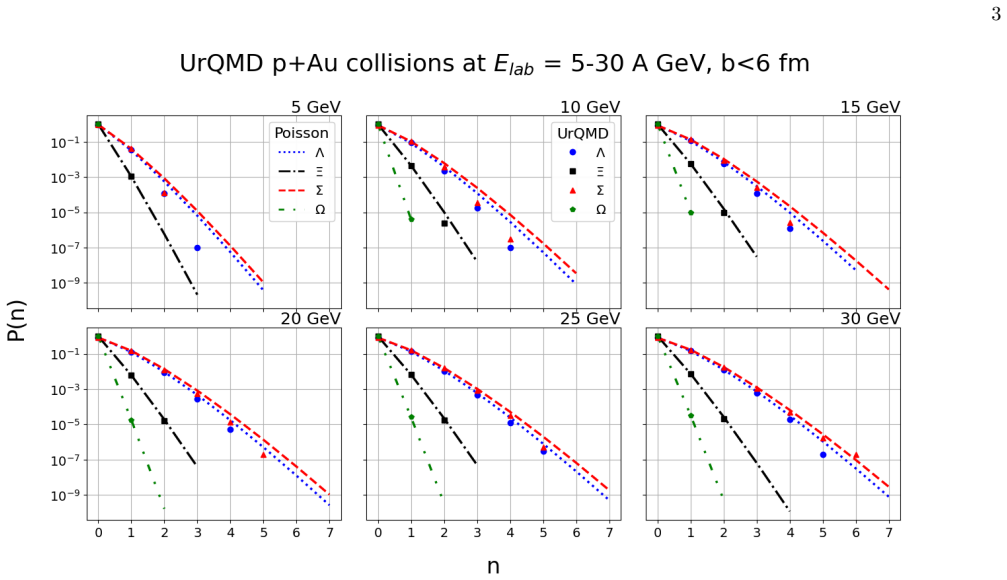
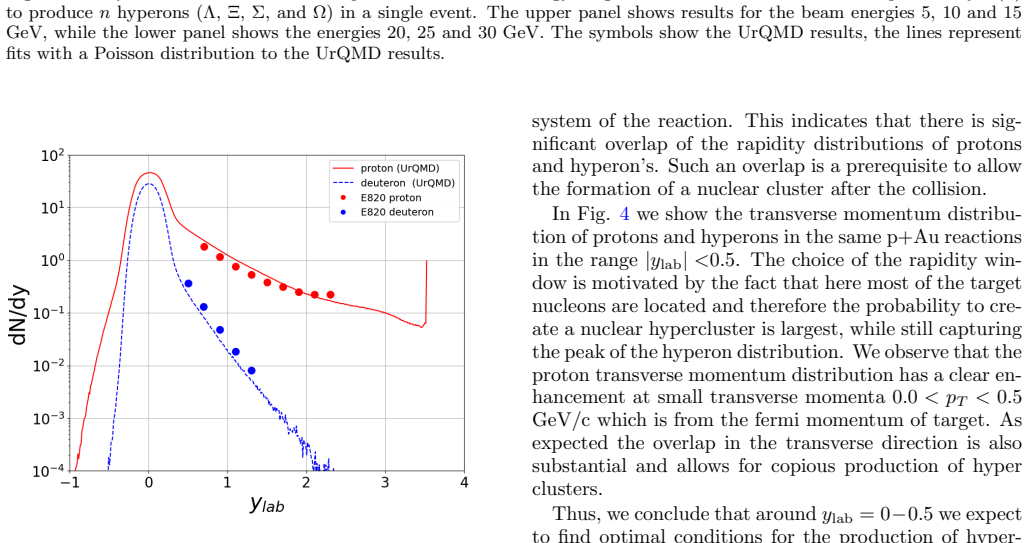
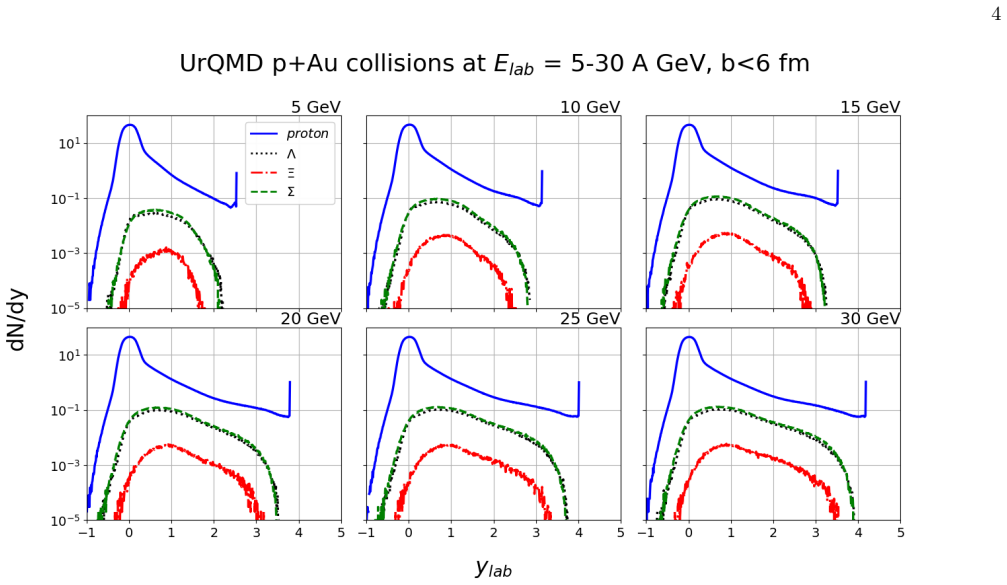
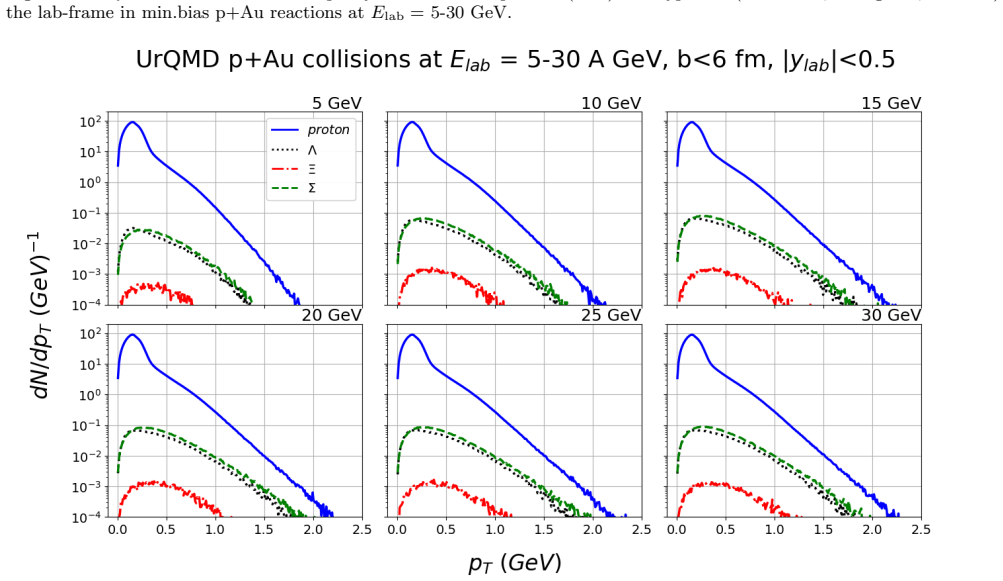
We explore the production of hypernuclei in p+Au reactions using the UrQMD model accompanied by a standard phase space coalescence model. We focus on the proton beam energy range of $E_{\rm lab}= 5 - 30$ GeV as this energy range will be investigated by the CBM-experiment at the upcoming FAIR facility. Starting from proton, $\Lambda$, $\Sigma$, $\Xi$ and $\Omega$ production, we predict the yields, rapidity and transverse momentum distributions of $^{3}_{\Lambda}H$, $^{4}_{\Lambda}H$, $\Xi$N and $\Xi$NN hypernuclei. We conclude that the production rates of novel multi-strange hypernuclei are well within the reach of the CBM-experiment.
Editorial analysis
A structured set of objections, weighed in public.
Referee Report
Summary. The manuscript uses the UrQMD transport model supplemented by a phase-space coalescence prescription to compute yields, rapidity distributions, and transverse-momentum spectra of light hypernuclei (^{3}_ΛH, ^{4}_ΛH) and multi-strange species (ΞN, ΞNN) in p+Au collisions at E_lab = 5–30 GeV. The central claim is that the production rates of the novel multi-strange hypernuclei lie within the reach of the CBM experiment at FAIR.
Significance. If the coalescence implementation is reliable, the work supplies concrete, falsifiable yield estimates that can directly inform beam-time planning and detector optimization for hypernuclear physics at FAIR. The approach re-uses an established transport-plus-coalescence framework without introducing new free parameters, which is a methodological strength.
major comments (3)
- [§2] §2 (Model description): The coalescence parameters (spatial and momentum cut-offs) are stated to be 'standard' and taken from the literature, yet no explicit values are listed for Ξ-containing clusters and no test is shown that the same cuts reproduce measured yields or binding energies of Ξ-hypernuclei in the 5–30 GeV regime.
- [§3.3] §3.3 (Multi-strange yields): The predicted ΞN and ΞNN rates are presented as the basis for the 'well within reach' conclusion, but the exponential sensitivity of coalescence probabilities to the cut-off values means that any mismatch in the underlying baryon phase-space distributions directly scales the quoted numbers; no sensitivity scan or uncertainty band is supplied.
- [§4] §4 (Discussion): No comparison is made between the model output for known single-strange hypernuclei and existing data from p+A or A+A collisions at overlapping energies, leaving the reliability of the extrapolation to multi-strange species untested within the manuscript.
minor comments (2)
- [Abstract and §2] The abstract and §2 refer to a 'standard' coalescence model without citing the specific reference or tabulating the numerical cut-off values used.
- [Figures 4–6] Figure captions for the p_T spectra should state the rapidity window and whether the distributions are normalized per event or per hypernucleus.
Simulated Author's Rebuttal
We thank the referee for the constructive comments that highlight important aspects of model validation and uncertainty quantification. We address each major comment point by point below, indicating planned revisions where appropriate.
read point-by-point responses
-
Referee: §2 (Model description): The coalescence parameters (spatial and momentum cut-offs) are stated to be 'standard' and taken from the literature, yet no explicit values are listed for Ξ-containing clusters and no test is shown that the same cuts reproduce measured yields or binding energies of Ξ-hypernuclei in the 5–30 GeV regime.
Authors: We agree that the explicit parameter values should be stated in the manuscript for clarity. The spatial and momentum cut-offs used are 3.5 fm and 0.3 GeV/c, respectively; these are the standard values employed in our prior UrQMD+coalescence studies and are applied uniformly to all clusters, including ΞN and ΞNN. We will add these values explicitly to the revised §2. Direct tests against measured Ξ-hypernuclei yields or binding energies are not feasible within the present work because no such experimental data exist in the 5–30 GeV regime; the coalescence prescription has, however, been validated for single-strange hypernuclei in earlier publications. revision: partial
-
Referee: §3.3 (Multi-strange yields): The predicted ΞN and ΞNN rates are presented as the basis for the 'well within reach' conclusion, but the exponential sensitivity of coalescence probabilities to the cut-off values means that any mismatch in the underlying baryon phase-space distributions directly scales the quoted numbers; no sensitivity scan or uncertainty band is supplied.
Authors: We acknowledge the exponential sensitivity of the coalescence probabilities. In the revised manuscript we will add a dedicated sensitivity study in which the spatial and momentum cut-offs are varied by ±15 % around the central values; the resulting uncertainty bands will be shown on the ΞN and ΞNN yields and rapidity distributions to quantify the robustness of the 'well within reach' statement. revision: yes
-
Referee: §4 (Discussion): No comparison is made between the model output for known single-strange hypernuclei and existing data from p+A or A+A collisions at overlapping energies, leaving the reliability of the extrapolation to multi-strange species untested within the manuscript.
Authors: We will expand the discussion section to include a direct comparison of our calculated ^{3}_ΛH and ^{4}_ΛH yields and spectra with the limited existing data from p+A and A+A collisions at comparable energies (primarily from AGS and early SPS measurements). This addition will provide an internal consistency check before the extrapolation to multi-strange species is discussed. revision: yes
Circularity Check
No circularity; yields generated from external transport model with literature parameters
full rationale
The paper computes hypernucleus yields by feeding UrQMD particle distributions into a standard phase-space coalescence model whose parameters are drawn from prior literature rather than fitted inside this work. No equation or section reduces a claimed prediction to a quantity defined or calibrated on the target observables within the manuscript itself. The central claim therefore rests on an external simulation chain and does not exhibit any of the enumerated circularity patterns.
Axiom & Free-Parameter Ledger
Reference graph
Works this paper leans on
-
[1]
for charmed nuclei. In Fig. 6 we show UrQMD predictions (min.bias 6 p+Au reactions) for the transverse momentum distri- bution of hypernuclei aty lab <0.5 for the states 3 ΛH, 4 ΛH, ΞN and ΞNN. Here the maximum is found around a pT ≈500MeV, which should be accessible by the exper- iment, even if a lowp T cut is applied to remove target remnants. VI. CONCL...
-
[2]
J. Schaffner, C. B. Dover, A. Gal, C. Greiner, D. J. Mil- lener and H. Stoecker, Annals Phys.235(1994), 35-76 doi:10.1006/aphy.1994.1090
-
[3]
J. Schaffner-Bielich, R. Mattiello and H. Sorge, Phys. Rev. Lett.84(2000), 4305-4308 doi:10.1103/PhysRevLett.84.4305 [arXiv:nucl- th/9908043 [nucl-th]]
-
[4]
S. V. Akkelin, P. Braun-Munzinger and Y. M. Sinyukov, Nucl. Phys. A710(2002), 439-465 doi:10.1016/S0375- 9474(02)01165-X [arXiv:nucl-th/0111050 [nucl-th]]
work page internal anchor Pith review Pith/arXiv arXiv doi:10.1016/s0375- 2002
-
[5]
V. Gaebel, M. Bonne, T. Reichert, A. Burnic, P. Hill- mann and M. Bleicher, Eur. Phys. J. A57(2021) no.2, 55 doi:10.1140/epja/s10050-020-00307-5 [arXiv:2006.12951 [nucl-th]]
-
[6]
P. Braun-Munzinger, J. Cleymans, H. Oeschler and K. Redlich, Nucl. Phys. A697(2002), 902- 912 doi:10.1016/S0375-9474(01)01257-X [arXiv:hep- ph/0106066 [hep-ph]]
-
[7]
S. Acharyaet al.[ALICE], Phys. Rev. Lett.134(2025) no.16, 162301 doi:10.1103/PhysRevLett.134.162301 [arXiv:2410.17769 [nucl-ex]]
-
[8]
Y. He, T. R. Saito, H. Ekawa, A. Kasagi, Y. Gao, E. Liu, K. Nakazawa, C. Rappold, M. Taki and Y. K. Tanaka,et al.Nature Commun.16(2025) no.1, 11084 doi:10.1038/s41467-025-66517-x [arXiv:2505.05802 [nucl-ex]]
-
[9]
Zhou, EPJ Web Conf.364(2026), 11006 doi:10.1051/epjconf/202636411006 [arXiv:2510.23281 [nucl-ex]]
Y. Zhou, EPJ Web Conf.364(2026), 11006 doi:10.1051/epjconf/202636411006 [arXiv:2510.23281 [nucl-ex]]
-
[10]
J. G. Messchendorp, F. Nerling, P. Achenbach, J. Aiche- lin, M. Albaladejo, L. An, K. Aoki, G. Appagere, V. Baru and M. Bashkanov,et al.[arXiv:2512.15986 [hep-ex]]
-
[11]
Y. L. Sun, A. S. Botvina, A. Obertelli, A. Corsi and M. Bleicher, Phys. Rev. C98(2018) no.2, 024903 doi:10.1103/PhysRevC.98.024903 [arXiv:1712.04658 [nucl-th]]
work page internal anchor Pith review Pith/arXiv arXiv doi:10.1103/physrevc.98.024903 2018
-
[12]
L. C. Ji, U. Bonnes, M. Cwiok, M. Duer, A. En- ciu, P. Gasik, J. Hehner, A. Obertelli, S. Ota and V. Panin,et al.Nucl. Instrum. Meth. A 1082(2026), 170999 doi:10.1016/j.nima.2025.170999 [arXiv:2504.10213 [physics.ins-det]]
-
[13]
Challenges in QCD matter physics - The Compressed Baryonic Matter experiment at FAIR
T. Ablyazimovet al.[CBM], Eur. Phys. J. A 53(2017) no.3, 60 doi:10.1140/epja/i2017-12248-y [arXiv:1607.01487 [nucl-ex]]
work page internal anchor Pith review Pith/arXiv arXiv doi:10.1140/epja/i2017-12248-y 2017
-
[14]
Glaessel [CBM], PoSF AIRness2024(2026), 013 doi:10.22323/1.475.0013
S. Glaessel [CBM], PoSF AIRness2024(2026), 013 doi:10.22323/1.475.0013
-
[15]
I. Selyuzhenkov, J. Phys. Conf. Ser.1685(2020) no.1, 012020 doi:10.1088/1742-6596/1685/1/012020
-
[16]
A. S. Botvina, J. Steinheimer, E. Bratkovskaya, M. Ble- icher and J. Pochodzalla, Phys. Lett. B742(2015), 7-14 doi:10.1016/j.physletb.2014.12.060 [arXiv:1412.6665 [nucl-th]]
work page internal anchor Pith review Pith/arXiv arXiv doi:10.1016/j.physletb.2014.12.060 2015
-
[17]
N. Buyukcizmeci, T. Reichert, A. S. Botvina and M. Bleicher, Phys. Rev. C108(2023) no.5, 054904 [erratum: Phys. Rev. C110(2024) no.4, 049901] doi:10.1103/PhysRevC.108.054904 [arXiv:2306.17145 [nucl-th]]
-
[18]
N. Buyukcizmeci, T. Reichert, A. S. Botvina and M. Bleicher, Eur. Phys. J. A61(2025) no.2, 23 doi:10.1140/epja/s10050-025-01489-6 [arXiv:2410.17449 [nucl-th]]
-
[19]
M. M. Nagels, T. A. Rijken and J. J. de Swart, Phys. Rev. D15(1977), 2547 doi:10.1103/PhysRevD.15.2547
-
[20]
E. Friedman and A. Gal, Phys. Lett. B837 (2023), 137669 doi:10.1016/j.physletb.2023.137669 7 [arXiv:2204.02264 [nucl-th]]
-
[21]
G. C. Yong, J. L. Rodr´ ıguez-S´ anchez and Y. Zhang, Phys. Rev. C111(2025) no.5, 054617 doi:10.1103/PhysRevC.111.054617 [arXiv:2502.18086 [nucl-th]]
-
[22]
A. Jinno, K. Murase and Y. Nara, PoSEXA- LEAP2024(2025), 034 doi:10.22323/1.480.0034 [arXiv:2501.09881 [nucl-th]]
-
[23]
N. K. Glendenning, Z. Phys. A326(1987), 57-64
1987
-
[24]
K. A. Maslov, E. E. Kolomeitsev and D. N. Voskre- sensky, Nucl. Phys. A950(2016), 64-109 doi:10.1016/j.nuclphysa.2016.03.011 [arXiv:1509.02538 [astro-ph.HE]]
work page internal anchor Pith review Pith/arXiv arXiv doi:10.1016/j.nuclphysa.2016.03.011 2016
-
[25]
A. Jinno, K. Murase, Y. Nara and A. Ohnishi, Phys. Rev. C108(2023) no.6, 065803 doi:10.1103/PhysRevC.108.065803 [arXiv:2306.17452 [nucl-th]]
-
[26]
H. Kochankovski, G. Lioutas, S. Blacker, A. Bauswein, A. Ramos and L. Tolos, Phys. Rev. D112(2025) no.2, 023014 doi:10.1103/vrnr-lf6k [arXiv:2501.12905 [astro- ph.HE]]
-
[27]
M. Kn¨ oll and R. Roth, Phys. Lett. B872(2026), 140074 doi:10.1016/j.physletb.2025.140074 [arXiv:2501.08013 [nucl-th]]
-
[28]
J. Haidenbauer, U. G. Meißner and A. Nogga, Prog. Part. Nucl. Phys.149(2026), 104242 doi:10.1016/j.ppnp.2026.104242 [arXiv:2508.05243 [nucl-th]]
-
[29]
A. Botvina, M. Bleicher and N. Buyukcizmeci, AIP Conf. Proc.2130(2019) no.1, 040007 doi:10.1063/1.5118404
-
[30]
T. Reichert, J. Steinheimer, V. Vovchenko, B. D¨ onigus and M. Bleicher, Phys. Rev. C107(2023) no.1, 014912 doi:10.1103/PhysRevC.107.014912 [arXiv:2210.11876 [nucl-th]]
-
[31]
G. Balassa and G. Wolf, Eur. Phys. J. A59 (2023) no.4, 89 doi:10.1140/epja/s10050-023-01014-7 [arXiv:2411.08379 [hep-ph]]
-
[32]
E. Bratkovskaya and J. Aichelin, doi:10.1140/epjs/s11734-025-02088-8 [arXiv:2509.09061 [nucl-th]]
-
[33]
D. N. Liu, Y. P. Zheng, W. H. Zhou, J. H. Chen, C. M. Ko, Y. G. Ma, K. J. Sun and S. Zhang, [arXiv:2508.12193 [nucl-th]]
-
[34]
K. J. Sun, D. N. Liu, Y. P. Zheng, J. H. Chen, C. M. Ko and Y. G. Ma, Phys. Rev. Lett.134(2025) no.2, 022301 doi:10.1103/PhysRevLett.134.022301
-
[35]
A. Kittiratpattana, T. Reichert, N. Buyukcizmeci, A. Botvina, A. Limphirat, C. Herold, J. Steinheimer and M. Bleicher, Phys. Rev. C109(2024) no.4, 044913 doi:10.1103/PhysRevC.109.044913 [arXiv:2305.09208 [nucl-th]]
-
[36]
S. A. Bass, M. Belkacem, M. Bleicher, M. Brandstetter, L. Bravina, C. Ernst, L. Gerland, M. Hofmann, S. Hof- mann and J. Konopka,et al.Prog. Part. Nucl. Phys. 41(1998), 255-369 doi:10.1016/S0146-6410(98)00058-1 [arXiv:nucl-th/9803035 [nucl-th]]
work page internal anchor Pith review Pith/arXiv arXiv doi:10.1016/s0146-6410(98)00058-1 1998
-
[37]
M. Bleicher, E. Zabrodin, C. Spieles, S. A. Bass, C. Ernst, S. Soff, L. Bravina, M. Belkacem, H. Weber and H. Stoecker,et al.J. Phys. G25(1999), 1859-1896 doi:10.1088/0954-3899/25/9/308 [arXiv:hep-ph/9909407 [hep-ph]]
work page internal anchor Pith review Pith/arXiv arXiv doi:10.1088/0954-3899/25/9/308 1999
-
[38]
M. Bleicher and E. Bratkovskaya, Prog. Part. Nucl. Phys. 122(2022), 103920 doi:10.1016/j.ppnp.2021.103920
-
[39]
S. Sombun, K. Tomuang, A. Limphirat, P. Hill- mann, C. Herold, J. Steinheimer, Y. Yan and M. Bleicher, Phys. Rev. C99(2019) no.1, 014901 doi:10.1103/PhysRevC.99.014901 [arXiv:1805.11509 [nucl-th]]
-
[40]
V. Kireyeu, G. Coci, S. Glaessel, J. Aichelin, C. Blume and E. Bratkovskaya, Phys. Rev. C109 (2024) no.4, 044906 doi:10.1103/PhysRevC.109.044906 [arXiv:2304.12019 [nucl-th]]
-
[41]
Deuterons at LHC: "snowballs in hell" via hydrodynamics and hadronic afterburner
D. Oliinychenkoet al.[SMASH], Phys. Rev. C99 (2019) no.4, 044907 doi:10.1103/PhysRevC.99.044907 [arXiv:1809.03071 [hep-ph]]
work page internal anchor Pith review Pith/arXiv arXiv doi:10.1103/physrevc.99.044907 2019
-
[42]
T. Abbottet al.[E-802], Phys. Rev. D45(1992), 3906- 3920 doi:10.1103/PhysRevD.45.3906
-
[43]
P. Hillmann, K. K¨ afer, J. Steinheimer, V. Vovchenko and M. Bleicher, J. Phys. G49(2022) no.5, 055107 doi:10.1088/1361-6471/ac5dfc [arXiv:2109.05972 [hep- ph]]
-
[44]
T. Chimruang, C. Herold, A. Limphirat, Y. Yan, J. Stein- heimer, B. D¨ onigus, T. Reichert, V. Vovchenko and M. Bleicher, [arXiv:2602.22676 [hep-ph]]
discussion (0)
Sign in with ORCID, Apple, or X to comment. Anyone can read and Pith papers without signing in.