Quantum Symmetry Restoration and Emergent Effective Deformation in Relativistic Heavy-Ion Collisions
Pith reviewed 2026-06-28 12:08 UTC · model grok-4.3
The pith
Rotational symmetry restoration exponentially suppresses effective nuclear deformation modes in heavy-ion collisions.
A machine-rendered reading of the paper's core claim, the machinery that carries it, and where it could break.
Core claim
Within the localized transported-density approximation and Gaussian Overlap Approximation, rotational symmetry restoration acts as a geometric low-pass filter which exponentially suppresses effective deformation modes. The classical rigid-rotor limit is recovered for large intrinsic angular momentum fluctuations. The construction connects rotational symmetry restoration, collective overlap localization, and the effective deformation geometries of nuclei in high energy collisions.
What carries the argument
Localized transported-density approximation for the collision-channel one-body response, which generates an effective one-body density from rotational overlap localization in the optical limit of the eikonal scattering matrix.
If this is right
- Effective deformation geometries used in collision simulations are quantum-corrected by symmetry restoration effects.
- High-deformation modes are exponentially damped for nuclei whose ground states have limited angular momentum fluctuations.
- The rigid-rotor description of nuclear shape emerges only in the limit of large intrinsic angular momentum fluctuations.
- The framework supplies a microscopic route from rotationally invariant states to the overlap-localized densities employed in eikonal scattering.
Where Pith is reading between the lines
- Models that import classical deformation parameters without accounting for overlap localization may systematically overestimate flow observables sensitive to initial geometry.
- The same filtering mechanism could be examined in other high-energy processes that rely on nuclear overlap, such as photon-nucleus or nucleus-nucleus diffractive scattering.
- Numerical implementation of the Gaussian Overlap heat-kernel representation would allow quantitative estimates of the suppression factor for specific even-even nuclei.
Load-bearing premise
The localized transported-density approximation generates the effective one-body density from rotational overlap localization.
What would settle it
A direct computation or measurement showing that effective deformation parameters extracted from collisions of nuclei with small intrinsic angular momentum fluctuations do not exhibit the predicted exponential suppression.
Figures
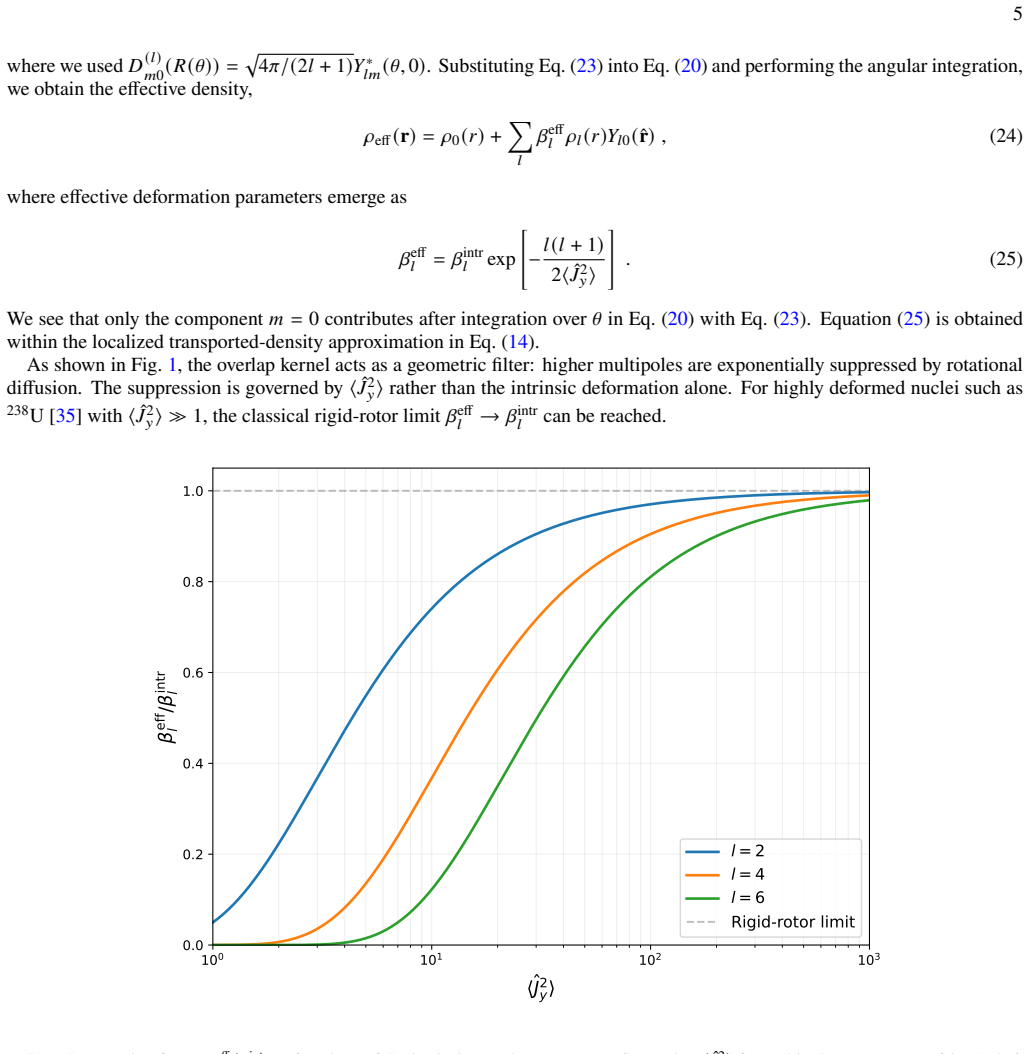
read the original abstract
Classically deformed nuclear geometries are commonly employed in standard descriptions of relativistic collisions between two even-even nuclei, despite the fact that their exact ground states are rotationally invariant $0^+$ states. In this paper, we formulate the collision geometry directly from the eikonal scattering matrix based on a nonorthogonal Generator Coordinate Method construction of rotationally invariant ground states. In the optical limit, using a localized transported-density approximation for the collision-channel one-body response, rotational overlap localization generates an effective one-body density associated with the scattering process. Within this approximation, using the Gaussian Overlap Approximation and its heat-kernel representation, we show that rotational symmetry restoration acts as a geometric low-pass filter which exponentially suppresses effective deformation modes. The classical rigid-rotor limit is recovered for large intrinsic angular momentum fluctuations. We establish a microscopic framework connecting rotational symmetry restoration, collective overlap localization, and the effective deformation geometries of nuclei in high energy collisions.
Editorial analysis
A structured set of objections, weighed in public.
Referee Report
Summary. The manuscript formulates the collision geometry of even-even nuclei in relativistic heavy-ion collisions directly from the eikonal scattering matrix using a nonorthogonal Generator Coordinate Method (GCM) construction of rotationally invariant 0+ ground states. In the optical limit, a localized transported-density approximation generates an effective one-body density from rotational overlap localization; the Gaussian Overlap Approximation (GOA) and its heat-kernel representation are then used to show that rotational symmetry restoration acts as a geometric low-pass filter that exponentially suppresses effective deformation modes. The classical rigid-rotor limit is recovered for large intrinsic angular momentum fluctuations, establishing a microscopic link between symmetry restoration, collective overlap localization, and effective nuclear geometries.
Significance. If the central approximations hold with controlled errors, the work supplies a microscopic, largely parameter-free framework connecting quantum rotational symmetry restoration to the effective deformations employed in high-energy collision modeling. This could systematically improve initial-state descriptions beyond classical rigid-rotor geometries and affect predictions for flow observables and fluctuation-driven phenomena.
major comments (2)
- [optical limit / collision-channel response] Optical-limit section (collision-channel one-body response): The localized transported-density approximation is invoked to obtain the effective one-body density from rotational overlap localization, yet no derivation, error bound, or demonstration of control is provided when the GCM states are exact 0+ angular-momentum eigenstates. This step is load-bearing for the subsequent claim that the GOA heat kernel produces an exponential low-pass filter on deformation modes.
- [GOA heat-kernel representation] GOA heat-kernel paragraph: The exponential suppression of deformation modes is asserted to follow from the heat-kernel representation once the transported-density approximation is applied, but the manuscript does not quantify how higher-order correlations (potentially mixed by the transported-density step) would alter the filter property or the recovery of the rigid-rotor limit.
minor comments (2)
- Notation for the transported density and the overlap kernel should be introduced with explicit definitions before their use in the optical-limit expressions.
- The abstract and introduction would benefit from a brief statement of the range of validity (e.g., for which nuclei or collision energies the approximations are expected to hold).
Simulated Author's Rebuttal
We thank the referee for the careful reading and for recognizing the potential of the framework. We respond to each major comment below and will revise the manuscript to address the points raised.
read point-by-point responses
-
Referee: [optical limit / collision-channel response] Optical-limit section (collision-channel one-body response): The localized transported-density approximation is invoked to obtain the effective one-body density from rotational overlap localization, yet no derivation, error bound, or demonstration of control is provided when the GCM states are exact 0+ angular-momentum eigenstates. This step is load-bearing for the subsequent claim that the GOA heat kernel produces an exponential low-pass filter on deformation modes.
Authors: We agree that the localized transported-density approximation requires a more explicit derivation and error control. In the optical limit the eikonal matrix element reduces to an overlap integral between the two 0+ GCM states; the localized transported-density step follows by saddle-point localization of that overlap around the impact-parameter plane, yielding an effective one-body density. We will insert a dedicated derivation subsection that starts from the exact GCM overlap, applies the localization, and supplies an error bound controlled by the ratio of the collective overlap width to the nuclear radius. This will make the subsequent GOA heat-kernel step fully traceable. revision: yes
-
Referee: [GOA heat-kernel representation] GOA heat-kernel paragraph: The exponential suppression of deformation modes is asserted to follow from the heat-kernel representation once the transported-density approximation is applied, but the manuscript does not quantify how higher-order correlations (potentially mixed by the transported-density step) would alter the filter property or the recovery of the rigid-rotor limit.
Authors: The heat-kernel representation is obtained directly from the GOA quadratic expansion of the overlap; the exponential filter on deformation modes is therefore an exact consequence of that quadratic form. Higher-order anharmonic corrections to the overlap are outside the GOA by construction and would appear as multiplicative corrections to the leading exponential. We will add a paragraph clarifying the regime of validity of the GOA, stating that such corrections modify prefactors but preserve the leading exponential suppression and the asymptotic recovery of the rigid-rotor limit for large intrinsic angular-momentum fluctuations. A quantitative estimate of the size of those corrections would require a beyond-GOA calculation that lies beyond the present scope. revision: partial
Circularity Check
Derivation self-contained under stated approximations; no circularity
full rationale
The paper constructs the effective one-body density and low-pass filter property explicitly from the localized transported-density approximation in the optical limit of the eikonal matrix, followed by the Gaussian Overlap Approximation heat kernel applied to rotationally invariant GCM states. No equation or step reduces the claimed exponential suppression of deformation modes to a fitted parameter, self-citation chain, or input by construction; the result is presented as a direct consequence of the heat-kernel representation within the given approximations. The central claim therefore retains independent content from the stated framework and does not match any enumerated circularity pattern.
Axiom & Free-Parameter Ledger
Reference graph
Works this paper leans on
-
[1]
Ollitrault, Anisotropy as a signature of transverse collective flow, Phys
J.-Y. Ollitrault, Anisotropy as a signature of transverse collective flow, Phys. Rev. D46, 229 (1992)
1992
-
[2]
U. Heinz and R. Snellings, Collective flow and viscosity in relativistic heavy-ion collisions, Ann. Rev. Nucl. Part. Sci.63, 123 (2013), arXiv:1301.2826 [nucl-th]
Pith/arXiv arXiv 2013
-
[3]
L. Pang, Q. Wang, and X.-N. Wang, Effects of initial flow velocity fluctuation in event-by-event (3+1)D hydrodynamics, Phys. Rev. C86, 024911 (2012), arXiv:1205.5019 [nucl-th]
Pith/arXiv arXiv 2012
-
[4]
C. Shen and L. Yan, Recent development of hydrodynamic modeling in heavy-ion collisions, Nucl. Sci. Tech.31, 122 (2020), arXiv:2010.12377 [nucl-th]
arXiv 2020
-
[5]
H.-J. Xu, X. Wang, H. Li, J. Zhao, Z.-W. Lin, C. Shen, and F. Wang, Importance of isobar density distributions on the chiral magnetic effect search, Phys. Rev. Lett.121, 022301 (2018), arXiv:1710.03086 [nucl-th]
Pith/arXiv arXiv 2018
-
[6]
Giacalone, Observability of the origin of deformation in heavy ion collisions, Phys
G. Giacalone, Observability of the origin of deformation in heavy ion collisions, Phys. Rev. Lett.124, 202301 (2020), arXiv:1910.04673 [nucl-th]
arXiv 2020
-
[7]
Jia, Shape of atomic nuclei in heavy ion collisions, Phys
J. Jia, Shape of atomic nuclei in heavy ion collisions, Phys. Rev. C105, 014905 (2022), arXiv:2106.08768 [nucl-th]
arXiv 2022
- [8]
- [9]
-
[10]
H.-j. Xu, J. Zhao, and F. Wang, Hexadecapole Deformation of U238 from Relativistic Heavy-Ion Collisions Using a Nonlinear Response Coefficient, Phys. Rev. Lett.132, 262301 (2024), arXiv:2402.16550 [nucl-th]
arXiv 2024
-
[11]
Y. Li, X. Zhang, G. Giacalone, and J. Yao, Benchmarking Nuclear Matrix Elements of 0𝜈𝛽𝛽Decay with High-Energy Nuclear Collisions, Phys. Rev. Lett.135, 022301 (2025), arXiv:2502.08027 [nucl-th]
arXiv 2025
-
[12]
Imaging nuclear shape through anisotropic and radial flow in high-energy heavy-ion collisions, Rept. Prog. Phys.88, 108601 (2025), arXiv:2506.17785 [nucl-ex]
arXiv 2025
-
[13]
Adamczyket al.(STAR), Azimuthal anisotropy in U+U and Au+Au collisions at RHIC, Phys
L. Adamczyket al.(STAR), Azimuthal anisotropy in U+U and Au+Au collisions at RHIC, Phys. Rev. Lett.115, 222301 (2015), arXiv:1505.07812 [nucl-ex]
Pith/arXiv arXiv 2015
-
[14]
M. I. Abdulhamidet al.(STAR), Imaging shapes of atomic nuclei in high-energy nuclear collisions, Nature635, 67 (2024), arXiv:2401.06625 [nucl-ex]
arXiv 2024
-
[15]
R. J. Glauber, High-energy collision theory, Lectures in Theoretical Physics1, 315 (1959)
1959
-
[16]
R. J. Glauber and G. Matthiae, High-energy scattering of protons by nuclei, Nucl. Phys. B21, 135 (1970)
1970
-
[17]
M. L. Miller, K. Reygers, S. J. Sanders, and P. Steinberg, Glauber modeling in high energy nuclear collisions, Ann. Rev. Nucl. Part. Sci. 57, 205 (2007), arXiv:nucl-ex/0701025
Pith/arXiv arXiv 2007
-
[18]
C. Loizides, J. Nagle, and P. Steinberg, Improved version of the PHOBOS Glauber Monte Carlo, SoftwareX1-2, 13 (2015), arXiv:1408.2549 [nucl-ex]
Pith/arXiv arXiv 2015
-
[19]
J. S. Moreland, J. E. Bernhard, and S. A. Bass, Alternative ansatz to wounded nucleon and binary collision scaling in high-energy nuclear collisions, Phys. Rev. C92, 011901 (2015), arXiv:1412.4708 [nucl-th]
Pith/arXiv arXiv 2015
-
[20]
Q. Y. Shou, Y. G. Ma, P. Sorensen, A. H. Tang, F. Videbæk, and H. Wang, Parameterization of Deformed Nuclei for Glauber Modeling in Relativistic Heavy Ion Collisions, Phys. Lett. B749, 215 (2015), arXiv:1409.8375 [nucl-th]
arXiv 2015
-
[21]
Bohr, On the Quantization of Angular Momenta in Heavy Nuclei, Phys
A. Bohr, On the Quantization of Angular Momenta in Heavy Nuclei, Phys. Rev.81, 134 (1951)
1951
-
[22]
D. L. Hill and J. A. Wheeler, Nuclear constitution and the interpretation of fission phenomena, Phys. Rev.89, 1102 (1953)
1953
-
[23]
J. P. Elliott, Collective motion in the nuclear shell model. 1. Classification schemes for states of mixed configuration, Proc. Roy. Soc. Lond. A245, 128 (1958)
1958
-
[24]
Ring and P
P. Ring and P. Schuck,The Nuclear Many-Body Problem(Springer, Berlin, 1980)
1980
-
[25]
Cline, Nuclear shapes studied by coulomb excitation, Ann
D. Cline, Nuclear shapes studied by coulomb excitation, Ann. Rev. Nucl. Part. Sci.36, 683 (1986)
1986
-
[26]
S. E. Agbemava, A. V. Afanasjev, D. Ray, and P. Ring, Global performance of covariant energy density functionals: ground state observables of even-even nuclei and the estimate of theoretical uncertainties, Phys. Rev. C89, 054320 (2014), arXiv:1404.4901 [nucl-th]
Pith/arXiv arXiv 2014
-
[27]
X. B. Wang, G. X. Dong, Z. C. Gao, Y. S. Chen, and C. W. Shen, Tetrahedral symmetry in the ground state of 16 O, Phys. Lett. B790, 498 (2019)
2019
-
[28]
K. Zhanget al.(DRHBc Mass Table), Nuclear mass table in deformed relativistic Hartree–Bogoliubov theory in continuum, I: Even–even nuclei, Atom. Data Nucl. Data Tabl.144, 101488 (2022), arXiv:2201.03216 [nucl-th]. 9
arXiv 2022
-
[29]
J. A. Sheikh, J. Dobaczewski, P. Ring, L. M. Robledo, and C. Yannouleas, Symmetry restoration in mean-field approaches, J. Phys. G48, 123001 (2021), arXiv:1901.06992 [nucl-th]
arXiv 2021
- [30]
-
[31]
J. Dobaczewski, A. Gade, K. Godbey, R. V. F. Janssens, and W. Nazarewicz, Extraction of ground-state nuclear deformations from ultrarelativistic heavy-ion collisions: Nuclear structure physics context, Phys. Rev. Res.7, 043159 (2025), arXiv:2507.05208 [nucl-th]
arXiv 2025
-
[32]
J.-P. Blaizot, G. Giacalone, and A. Lovato, Nuclear collectivity and the harmonic spectrum of two-body correlations, (2025), arXiv:2512.18926 [nucl-th]
arXiv 2025
-
[33]
S. Bofos, B. Bally, T. Duguet, and M. Frosini, Imaging two-body correlations in atomic nuclei via low- and high-energy processes, (2026), arXiv:2602.09890 [nucl-th]
Pith/arXiv arXiv 2026
-
[34]
S. Bofos, Y. Li, C. Ding, B. Bally, T. Duguet, M. Frosini, and J. Yao, Quantum effects in the quadrupole rotor picture of ultra-relativistic ion-ion collisions, (2026), arXiv:2605.28813 [nucl-th]
Pith/arXiv arXiv 2026
-
[35]
W. Ke, From wave-function to fireball geometry: the role of a restored broken symmetry in ultra-relativistic collisions of deformed nuclei, (2025), arXiv:2509.09549 [nucl-th]
arXiv 2025
-
[36]
Czyz and L
W. Czyz and L. C. Maximon, High-energy, small angle elastic scattering of strongly interacting composite particles, Annals Phys.52, 59 (1969)
1969
-
[37]
S. Zhao, H.-j. Xu, Y. Zhou, Y.-X. Liu, and H. Song, Exploring the Nuclear Shape Phase Transition in Ultra-Relativistic 129Xe+129Xe Collisions at the LHC, Phys. Rev. Lett.133, 192301 (2024), arXiv:2403.07441 [nucl-th]
arXiv 2024
-
[38]
Baranger, Extension of the Shell Model for Heavy Spherical Nuclei, Phys
M. Baranger, Extension of the Shell Model for Heavy Spherical Nuclei, Phys. Rev.122, 992 (1961)
1961
-
[39]
Bender, P.-H
M. Bender, P.-H. Heenen, and P.-G. Reinhard, Self-consistent mean-field models for nuclear structure, Rev. Mod. Phys.75, 121 (2003)
2003
- [40]
-
[41]
R.-j. Wang, S. Pu, and Q. Wang, Lepton pair production in ultraperipheral collisions, Phys. Rev. D104, 056011 (2021), arXiv:2106.05462 [hep-ph]
arXiv 2021
-
[42]
H. M ¨antysaari, F. Salazar, B. Schenke, C. Shen, and W. Zhao, Effects of nuclear structure and quantum interference on diffractive vector meson production in ultraperipheral nuclear collisions, Phys. Rev. C109, 024908 (2024), arXiv:2310.15300 [nucl-th]
arXiv 2024
-
[43]
H. M ¨antysaari, F. Salazar, B. Schenke, C. Shen, and W. Zhao, Spatial imaging of polarized deuterons at the Electron-Ion Collider, Phys. Lett. B858, 139053 (2024), arXiv:2408.13213 [nucl-th]
arXiv 2024
-
[44]
M. Abdallahet al.(STAR), Tomography of ultrarelativistic nuclei with polarized photon-gluon collisions, Sci. Adv.9, eabq3903 (2023), arXiv:2204.01625 [nucl-ex]
arXiv 2023
discussion (0)
Sign in with ORCID, Apple, or X to comment. Anyone can read and Pith papers without signing in.