Thouless Pumping of Large Chern Numbers in Optical Floquet Quasicrystals
Pith reviewed 2026-06-28 11:44 UTC · model grok-4.3
The pith
Cold atoms in a driven quasicrystal realize large Chern numbers that appear directly in Thouless pumping transport.
A machine-rendered reading of the paper's core claim, the machinery that carries it, and where it could break.
Core claim
In the quasienergy spectrum of a Floquet-driven optical quasicrystal, the gap labeling theorem assigns emergent Chern numbers whose magnitudes grow with suitable driving parameters, and these numbers govern the quantized transport observed in Thouless pumping cycles performed at different frequencies and amplitudes.
What carries the argument
Gap labeling theorem applied to the quasienergy spectrum, which labels gaps with integers that equal the Chern numbers and thereby determine the pumped charge per cycle.
If this is right
- Thouless pumping transport directly encodes the Chern numbers assigned by the gap labeling theorem.
- Varying driving frequency and amplitude tunes the Chern numbers visible in the pumping.
- The approach extends topological pumping to regimes with invariants larger than unity.
- Fractional Chern insulating states become experimentally accessible in the same platform.
Where Pith is reading between the lines
- The same driving protocol could be combined with interactions to stabilize fractional states whose filling factors relate to the large Chern numbers.
- If the gap labeling remains valid under weak disorder, the scheme would offer a route to disorder-robust high-Chern transport.
- Extension to two-dimensional quasicrystals would test whether the pumping still quantizes according to the same spectral labels.
Load-bearing premise
The gap labeling theorem applies to the quasienergy gaps of this specific Floquet quasicrystal and that driving parameters exist which produce large Chern numbers without closing gaps or triggering instabilities.
What would settle it
Perform Thouless pumping at a driving frequency and amplitude where gap labeling predicts a Chern number of magnitude greater than one; if the measured displacement per cycle does not equal that integer value, the claim fails.
Figures
read the original abstract
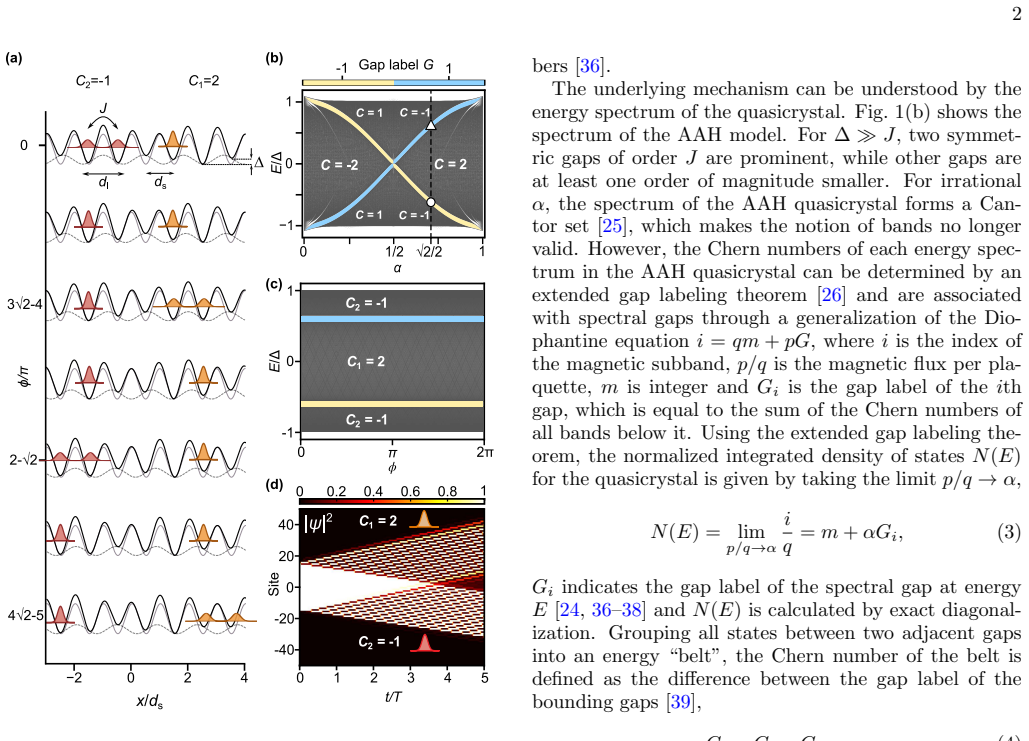
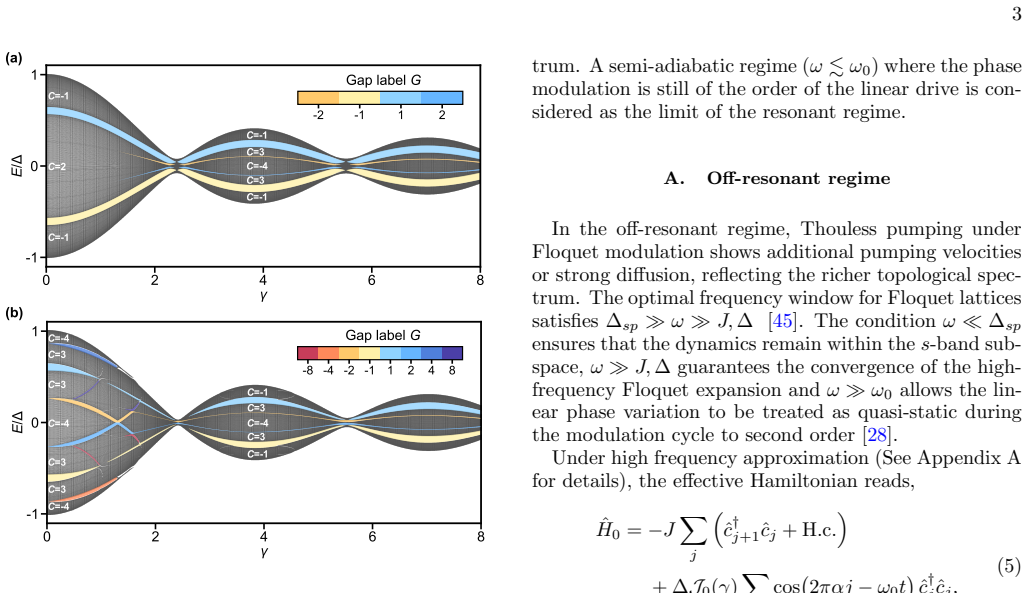
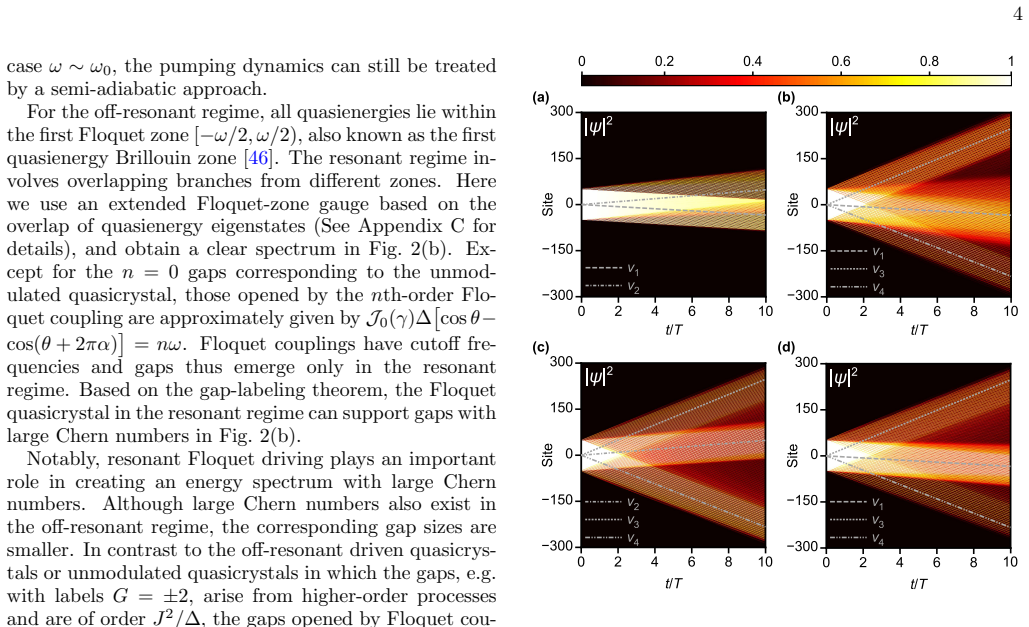
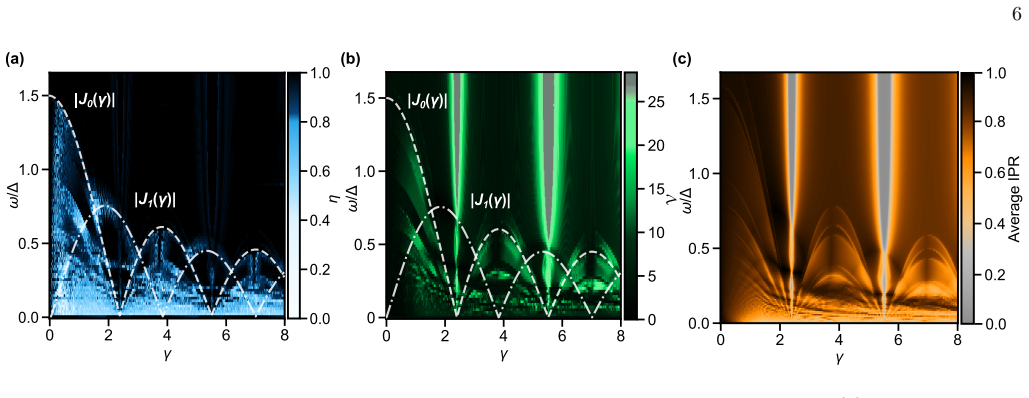
Chern numbers are central to correlated and topological phenomena, yet most topological systems are associated with Chern numbers of order unity. Here we propose a scheme to achieve large Chern numbers in an optical Floquet quasicrystal with cold atoms, which can be directly measured via Thouless pumping. We study the quasienergy spectrum of Floquet quasicrystals and characterize the emergent Chern numbers using gap labeling theorem. We further investigate the Thouless pumping in the Floquet quasicrystal at different driving frequencies and amplitudes, revealing the connection between transport features and the quasienergy spectrum. Our findings open new avenues for exploring rich topological dynamics in Floquet quasicrystals and realizing fractional Chern insulating states.
Editorial analysis
A structured set of objections, weighed in public.
Referee Report
Summary. The manuscript proposes a scheme to realize large Chern numbers in an optical Floquet quasicrystal with cold atoms, characterized by applying the gap labeling theorem to the quasienergy spectrum and directly measurable via Thouless pumping. It examines the quasienergy spectrum under Floquet driving, links transport features in pumping to the spectrum at varying frequencies and amplitudes, and suggests implications for fractional Chern insulators.
Significance. If the gap-labeling characterization and pumping measurements hold, the work would provide a controllable platform for high-Chern-number topology in driven quasicrystals, extending beyond order-unity Chern numbers and enabling studies of rich Floquet topological dynamics.
major comments (2)
- [Abstract / quasienergy spectrum analysis] Abstract and quasienergy-spectrum section: the central claim that emergent Chern numbers are characterized by the gap labeling theorem requires explicit verification that the stroboscopic quasienergy operator inherits the quasiperiodic structure of the static case without resonance-induced gap closures or micromotion effects altering the labeling. The standard gap-labeling theorem applies to static quasiperiodic operators; its direct extension to the Floquet time-evolution operator over one period is not immediate and must be shown for the chosen driving parameters.
- [Thouless pumping investigation] Thouless-pumping investigation section: the reported connection between transport features and the quasienergy spectrum at different driving frequencies/amplitudes lacks quantitative comparison (e.g., extracted Chern numbers from pumping versus gap-labeling integers) or checks against possible dynamical instabilities, which are load-bearing for the claim that large Chern numbers are achieved and measurable.
minor comments (1)
- [Abstract] Abstract: repeated phrasing of 'Floquet quasicrystal' could be streamlined for clarity.
Simulated Author's Rebuttal
We thank the referee for their careful reading of our manuscript and for the constructive comments. We address each major point below and have revised the manuscript to incorporate explicit verifications and quantitative comparisons where needed.
read point-by-point responses
-
Referee: [Abstract / quasienergy spectrum analysis] Abstract and quasienergy-spectrum section: the central claim that emergent Chern numbers are characterized by the gap labeling theorem requires explicit verification that the stroboscopic quasienergy operator inherits the quasiperiodic structure of the static case without resonance-induced gap closures or micromotion effects altering the labeling. The standard gap-labeling theorem applies to static quasiperiodic operators; its direct extension to the Floquet time-evolution operator over one period is not immediate and must be shown for the chosen driving parameters.
Authors: We agree that an explicit justification for applying the gap-labeling theorem to the Floquet quasienergy operator is necessary, as the standard theorem is formulated for static operators. In the revised manuscript we have added a dedicated subsection in the quasienergy-spectrum analysis. There we demonstrate analytically that, for the chosen driving parameters (frequencies and amplitudes selected to lie away from resonances), the stroboscopic time-evolution operator preserves the underlying quasiperiodic spatial structure. We further provide numerical evidence that micromotion-induced corrections do not close the relevant gaps or alter the gap-labeling integers, by comparing the quasienergy spectrum obtained from the full Floquet operator with the spectrum of the effective static-like operator. revision: yes
-
Referee: [Thouless pumping investigation] Thouless-pumping investigation section: the reported connection between transport features and the quasienergy spectrum at different driving frequencies/amplitudes lacks quantitative comparison (e.g., extracted Chern numbers from pumping versus gap-labeling integers) or checks against possible dynamical instabilities, which are load-bearing for the claim that large Chern numbers are achieved and measurable.
Authors: We concur that quantitative validation is essential to substantiate the measurability of the large Chern numbers. In the revised version we have expanded the Thouless-pumping section with new panels that directly extract the Chern numbers from the integrated pumping currents and compare them numerically to the integers obtained from gap labeling; the agreement is shown for multiple driving frequencies and amplitudes. We have also added stability diagnostics, including long-time fidelity evolution and energy absorption rates, confirming the absence of dynamical instabilities within the parameter regime considered. revision: yes
Circularity Check
No circularity; derivation applies external gap-labeling theorem to Floquet spectrum
full rationale
The abstract and available text describe characterizing emergent Chern numbers via the gap labeling theorem applied to the quasienergy spectrum of a Floquet-driven quasicrystal, followed by numerical investigation of Thouless pumping at varying frequencies and amplitudes. No equations or steps reduce by construction to fitted parameters, self-definitions, or self-citation chains. The gap-labeling step is presented as an external mathematical tool rather than derived internally or justified solely by prior author work. The central claim therefore remains independent of its own inputs.
Axiom & Free-Parameter Ledger
axioms (1)
- domain assumption Gap labeling theorem applies to the quasienergy spectrum of Floquet quasicrystals
Reference graph
Works this paper leans on
-
[1]
GAAH model from perturbation theory The potential of a one-dimensional bichromatic optical lattice is given by V(x, ϕ) =V s cos2 πx ds +V l cos2 πx dl − ϕ 2 ,(A1) whereV s andV l are the depths of the short and long lattices andα=d s/dl is the lattice-spacing ratio. In the tight-binding limitV s ≫E r,s, withE r,s the re- coil energy of the short lattice, ...
-
[2]
Equivalence between AAH model and Harper-Hofstadter(HH) model The equivalence between the one-dimensional (1D) Thouless pumping and the two-dimensional (2D) quan- tum Hall effect is established by identifying the pump phaseϕin the AAH model with the quasimomentum along the second dimension of the HH model. The inverse Fourier transform ofH GAAH onϕthen gi...
-
[3]
Landau-Zener tunneling The adiabatic theorem states that when the param- eters are varied infinitely slowly and no level crossing occurs during the evolution, a system initially prepared in an instantaneous eigenstate remains in it. When the adiabatic condition is not strictly satisfied, the system may leak into other states during the evolution, with the...
-
[4]
Effective Floquet Hamiltonian in the off-resonant regime In a periodically driven system, the evolution at integer multiples of the driving periodT ′ is determined by the 8 evolution operator over one period, ˆUF =Texp " −i ˆ T ′ 0 ˆH(t)dt # .(A14) The spectrum of averaged dynamics is equivalently described by the effective Hamiltonian ˆHeff, defined thro...
-
[5]
The system size is chosen so that the wavepacket does not reach the boundaries during the entire simulation time
Time evolution simulation We discretize the total evolution time into small inter- vals of size ∆t=T /Nwith totalNsteps and approxi- mate the evolution operator on each time by |ψ(t+ ∆t)⟩ ≈exp h −i ˆH(t)∆t i |ψ(t)⟩.(B1) Since the tunneling matrix element is time independent, a Trotter decomposition is used to accelerate the time- evolution calculation, re...
-
[6]
U(T ′) = X n e−iϵnT ′ |n⟩⟨n|.(B2) Since the quasienergy is in the exponential, quasiener- gies differing byωare equivalent
Calculation of the Floquet quasienergy spectrum DiagonalizingU(T ′) gives the eigenvalues ofH eff, namely the quasienergiesϵ n, and the corresponding Flo- quet eigenstates|n⟩. U(T ′) = X n e−iϵnT ′ |n⟩⟨n|.(B2) Since the quasienergy is in the exponential, quasiener- gies differing byωare equivalent. This equiva- lence of quasienergies originates from the d...
-
[7]
In typical experiments, the achievable depth of the short lattice is on the order ofV s ∼10, corresponding to a tunneling matrix element of orderJ∼0.01 in units ofE r,s
Floquet modulation and pumping parameters Throughout this work, energies are in units of the recoil energy of the short latticeE r,s, and time is in units of ℏ/Er,s. In typical experiments, the achievable depth of the short lattice is on the order ofV s ∼10, corresponding to a tunneling matrix element of orderJ∼0.01 in units ofE r,s. Accordingly, unless o...
2000
-
[8]
Definingθ j = (2παj−ϕ) mod 2πfor each site, the zeroth-order energy isE (0) j = ∆ cosθj
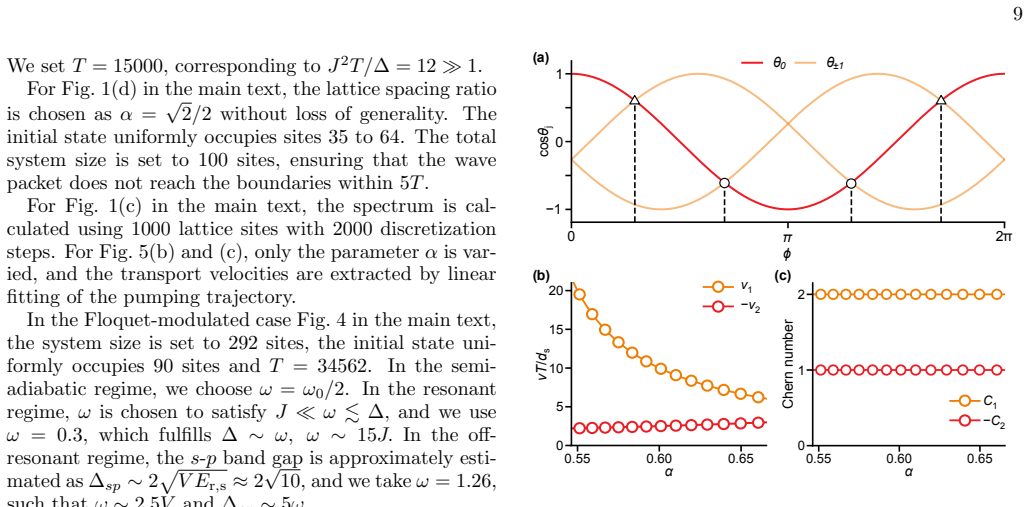
The relationship between pumping velocities and Chern numbers For ∆≫J, the spectrum can be understood by per- turbation theory. Definingθ j = (2παj−ϕ) mod 2πfor each site, the zeroth-order energy isE (0) j = ∆ cosθj. Ac- cording to first-order perturbation theory, the hopping term couples two neighboring states with nearly degen- erate energies cosθ= cos(...
-
[9]
Quasienergies differing byωgenerate the same stroboscopic evolution
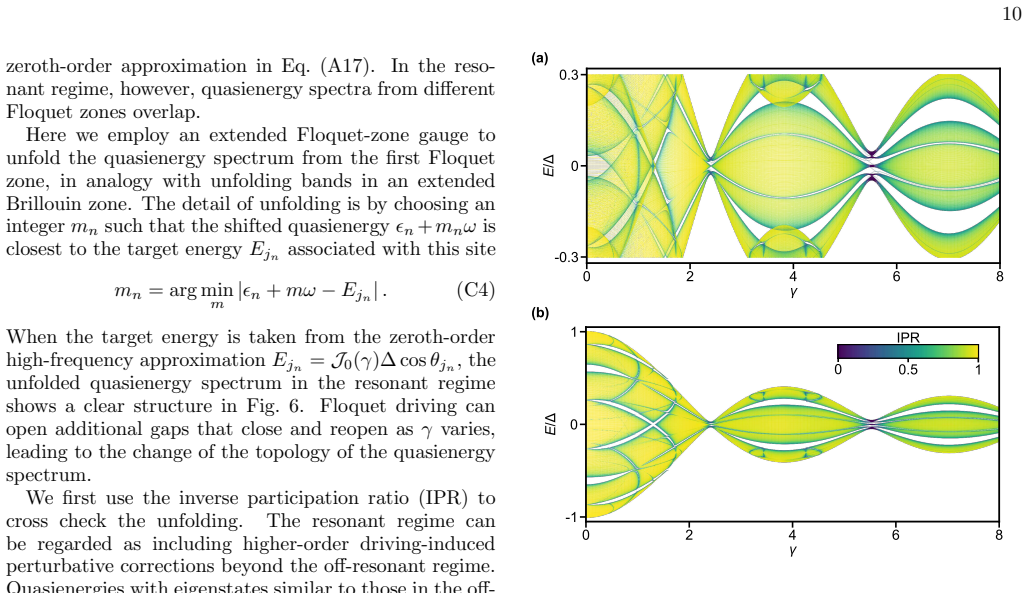
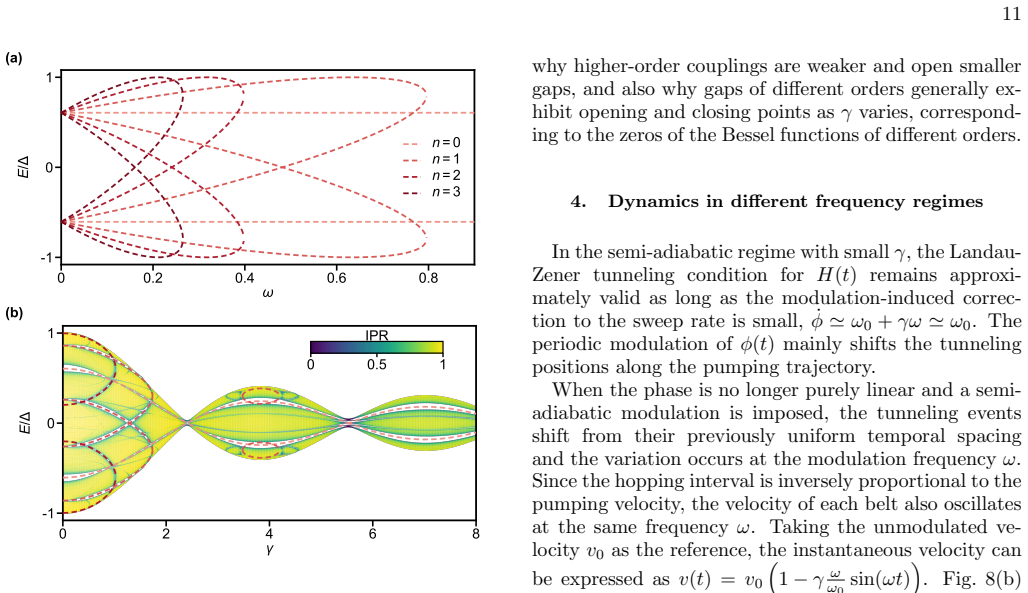
Unfolding Floquet quasi-energy spectrum In a Floquet system, the evolution at integer multi- ples of the driving period has a discrete time period- icity. Quasienergies differing byωgenerate the same stroboscopic evolution. In the off-resonant regime, the first Floquet zone is sufficiently wide, so spectra from different quasienergy zones do not overlap i...
-
[10]
(C1), which corresponds to the condition that two neighboring sites have equal on- site energies
Gap opening in the Floquet quasienergy spectrum In the absence of modulation, the gap-opening posi- tions are determined by Eq. (C1), which corresponds to the condition that two neighboring sites have equal on- site energies. Once Floquet modulation is introduced, neighboring sites whose energy difference equals an inte- ger multiple ofωcan also be couple...
-
[11]
The periodic modulation ofϕ(t) mainly shifts the tunneling positions along the pumping trajectory
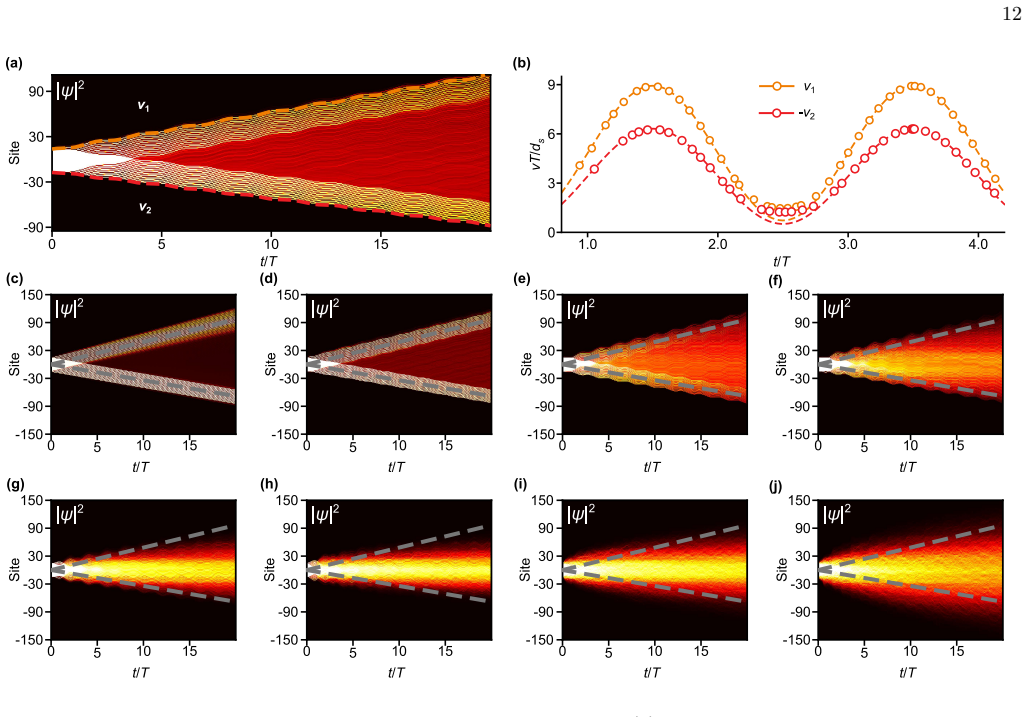
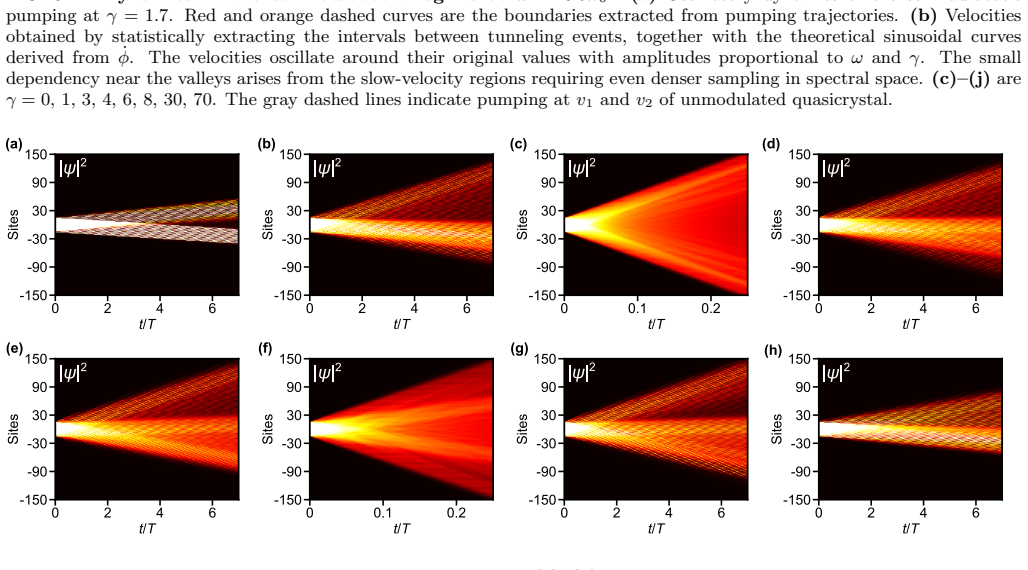
Dynamics in different frequency regimes In the semi-adiabatic regime with smallγ, the Landau- Zener tunneling condition forH(t) remains approxi- mately valid as long as the modulation-induced correc- tion to the sweep rate is small, ˙ϕ≃ω 0 +γω≃ω 0. The periodic modulation ofϕ(t) mainly shifts the tunneling positions along the pumping trajectory. When the ...
-
[12]
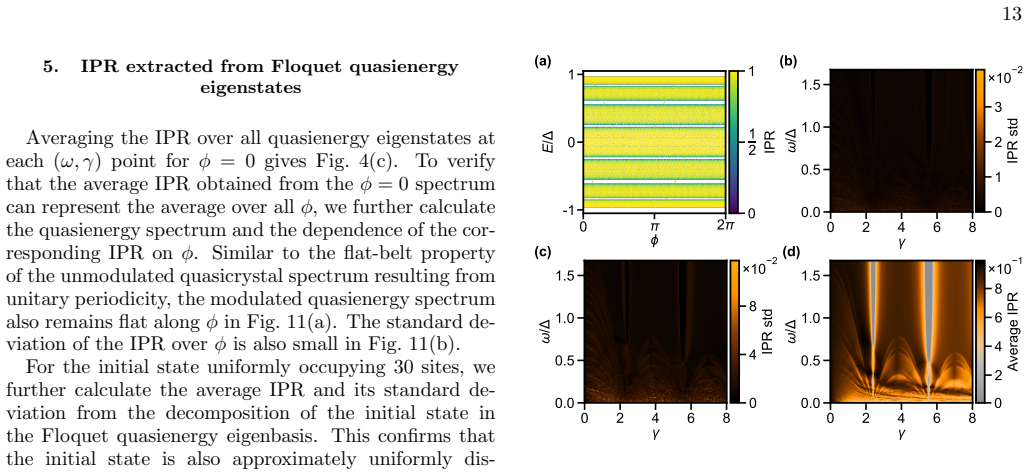
IPR extracted from Floquet quasienergy eigenstates Averaging the IPR over all quasienergy eigenstates at each (ω, γ) point forϕ= 0 gives Fig. 4(c). To verify that the average IPR obtained from theϕ= 0 spectrum can represent the average over allϕ, we further calculate the quasienergy spectrum and the dependence of the cor- responding IPR onϕ. Similar to th...
-
[13]
Thouless, Quantization of particle transport, Physical Review B27, 6083 (1983)
D. Thouless, Quantization of particle transport, Physical Review B27, 6083 (1983)
1983
-
[14]
Y. E. Kraus, Y. Lahini, Z. Ringel, M. Verbin, and O. Zilberberg, Topological states and adiabatic pumping in quasicrystals, Physical Review Letters109, 106402 (2012)
2012
-
[15]
Lohse, C
M. Lohse, C. Schweizer, O. Zilberberg, M. Aidelsburger, and I. Bloch, A Thouless quantum pump with ultracold bosonic atoms in an optical superlattice, Nature Physics 12, 350 (2016)
2016
-
[16]
Nakajima, T
S. Nakajima, T. Tomita, S. Taie, T. Ichinose, H. Ozawa, L. Wang, M. Troyer, and Y. Takahashi, Topological Thouless pumping of ultracold fermions, Nature Physics 12, 296 (2016)
2016
-
[17]
Citro and M
R. Citro and M. Aidelsburger, Thouless pumping and topology, Nature Reviews Physics5, 87 (2023)
2023
-
[18]
Z. Zhu, M. G¨ achter, A.-S. Walter, K. Viebahn, and T. Esslinger, Reversal of quantized Hall drifts at nonin- teracting and interacting topological boundaries, Science 384, 317 (2024)
2024
-
[19]
Y.-F. Zhao, R. Zhang, R. Mei, L.-J. Zhou, H. Yi, Y.- Q. Zhang, J. Yu, R. Xiao, K. Wang, N. Samarth,et al., Tuning the chern number in quantum anomalous Hall insulators, Nature588, 419 (2020)
2020
-
[20]
T. Han, Z. Lu, Y. Yao, J. Yang, J. Seo, C. Yoon, K. Watanabe, T. Taniguchi, L. Fu, F. Zhang,et al., Large quantum anomalous Hall effect in spin-orbit proximitized 14 rhombohedral graphene, Science384, 647 (2024)
2024
-
[21]
X. Wan, Z. Ning, D.-H. Xu, R. Wang, and B. Zheng, Pho- toinduced high-Chern-number quantum anomalous Hall effect from higher-order topological insulators, Physical Review B109, 085148 (2024)
2024
-
[22]
J. Wang, B. Lian, H. Zhang, Y. Xu, and S.-C. Zhang, Quantum anomalous Hall effect with higher plateaus, Physical Review letters111, 136801 (2013)
2013
-
[23]
M¨ oller and N
G. M¨ oller and N. R. Cooper, Fractional Chern insulators in Harper-Hofstadter bands with higher Chern number, Physical Review Letters115, 126401 (2015)
2015
-
[24]
Wang and Z
J. Wang and Z. Liu, Hierarchy of ideal flatbands in chi- ral twisted multilayer graphene models, Physical Review Letters128, 176403 (2022)
2022
-
[25]
Z. Liu, E. J. Bergholtz, H. Fan, and A. M. L¨ auchli, Fractional Chern insulators in topological flat bands with higher Chern number, Physical Review Letters109, 186805 (2012)
2012
-
[26]
Y.-F. Wang, H. Yao, C.-D. Gong, and D. Sheng, Frac- tional quantum Hall effect in topological flat bands with Chern number two, Physical Review B86, 201101 (2012)
2012
-
[27]
Bernevig, L
B. Bernevig, L. Fu, L. Ju, A. MacDonald, K. Mak, and J. Shan, Fractional quantization in insulators from hall to chern, Nature Physics21, 1702 (2025)
2025
-
[28]
Roati, C
G. Roati, C. D’Errico, L. Fallani, M. Fattori, C. Fort, M. Zaccanti, G. Modugno, M. Modugno, and M. In- guscio, Anderson localization of a non-interacting Bose– Einstein condensate, Nature453, 895 (2008)
2008
-
[29]
J.-C. Yu, S. Bhave, L. Reeve, B. Song, and U. Schneider, Observing the two-dimensional Bose glass in an optical quasicrystal, Nature633, 338 (2024)
2024
-
[30]
Y. E. Kraus and O. Zilberberg, Quasiperiodicity and topology transcend dimensions, Nature Physics12, 624 (2016)
2016
-
[31]
Marra and M
P. Marra and M. Nitta, Topologically quantized current in quasiperiodic Thouless pumps, Physical Review Re- search2, 042035 (2020)
2020
-
[32]
Kitaev, Anyons in an exactly solved model and be- yond, Annals of Physics321, 2 (2006)
A. Kitaev, Anyons in an exactly solved model and be- yond, Annals of Physics321, 2 (2006)
2006
-
[33]
Yoshii, S
M. Yoshii, S. Kitamura, and T. Morimoto, Topologi- cal charge pumping in quasiperiodic systems character- ized by the Bott index, Physical Review B104, 155126 (2021)
2021
-
[34]
Aubry and G
S. Aubry and G. Andr´ e, Analyticity breaking and Ander- son localization in incommensurate lattices, Ann. Israel Phys. Soc3, 18 (1980)
1980
-
[35]
Ozawa, H
T. Ozawa, H. M. Price, A. Amo, N. Goldman, M. Hafezi, L. Lu, M. C. Rechtsman, D. Schuster, J. Simon, O. Zil- berberg,et al., Topological photonics, Reviews of Mod- ern Physics91, 015006 (2019)
2019
-
[36]
Bellissard, A
J. Bellissard, A. Bovier, and J.-M. Ghez, Gap labelling theorems for one dimensional discrete Schr¨ odinger oper- ators, Reviews in Mathematical Physics4, 1 (1992)
1992
-
[37]
Avila and S
A. Avila and S. Jitomirskaya, The ten Martini problem, Annals of Mathematics170, 303 (2009)
2009
-
[38]
K. A. Madsen, E. J. Bergholtz, and P. W. Brouwer, Topo- logical equivalence of crystal and quasicrystal band struc- tures, Physical Review B88, 125118 (2013)
2013
-
[39]
Shimasaki, Y
T. Shimasaki, Y. Bai, H. E. Kondakci, P. Dotti, J. E. Pagett, A. R. Dardia, M. Prichard, A. Eckardt, and D. M. Weld, Reversible phasonic control of a quantum phase transition in a quasicrystal, Physical Review Let- ters133, 083405 (2024)
2024
-
[40]
Eckardt, Colloquium: Atomic quantum gases in pe- riodically driven optical lattices, Reviews of Modern Physics89, 011004 (2017)
A. Eckardt, Colloquium: Atomic quantum gases in pe- riodically driven optical lattices, Reviews of Modern Physics89, 011004 (2017)
2017
-
[41]
M. S. Rudner, N. H. Lindner, E. Berg, and M. Levin, Anomalous edge states and the bulk-edge correspondence for periodically driven two-dimensional systems, Physical Review X3, 031005 (2013)
2013
-
[42]
D. R. Hofstadter, Energy levels and wave functions of Bloch electrons in rational and irrational magnetic fields, Physical Review B14, 2239 (1976)
1976
-
[43]
G. Roux, T. Barthel, I. McCulloch, C. Kollath, U. Schollw¨ ock, and T. Giamarchi, Quasiperiodic Bose- Hubbard model and localization in one-dimensional cold atomic gases, Physical Review A78, 023628 (2008)
2008
-
[44]
Zwerger, Mott–Hubbard transition of cold atoms in optical lattices, Journal of Optics B: quantum and semi- classical optics5, S9 (2003)
W. Zwerger, Mott–Hubbard transition of cold atoms in optical lattices, Journal of Optics B: quantum and semi- classical optics5, S9 (2003)
2003
-
[45]
Y. G. Sinai, Anderson localization for one-dimensional difference Schr¨ odinger operator with quasiperiodic po- tential, J. Stat. Phys.46, 10.1007/BF01011146 (1987)
-
[46]
X. Li, Y. Wang, L. Yu, and B. Song, Two-color magneto- optical trapping of ytterbium atoms, Physical Review Applied24, 044039 (2025)
2025
-
[47]
Y. Tao, Y. Wang, L. Yu, and B. Song, Optical transport of cold atoms to quantum degeneracy, arXiv preprint arXiv:2602.14249 10.48550/arXiv.2602.14249 (2026)
-
[48]
Gottlob, D
E. Gottlob, D. S. Borgnia, R.-J. Slager, and U. Schnei- der, Quasiperiodicity protects quantized transport in dis- ordered systems without gaps, PRX Quantum6, 020359 (2025)
2025
-
[49]
I. Dana, Y. Avron, and J. Zak, Quantised Hall conduc- tance in a perfect crystal, Journal of Physics C: Solid State Physics18, L679 (1985)
1985
-
[50]
Dana, Topologically universal spectral hierarchies of quasiperiodic systems, Physical Review B89, 205111 (2014)
I. Dana, Topologically universal spectral hierarchies of quasiperiodic systems, Physical Review B89, 205111 (2014)
2014
-
[51]
D. J. Thouless, M. Kohmoto, M. P. Nightingale, and M. den Nijs, Quantized Hall conductance in a two- dimensional periodic potential, Physical Review Letters 49, 405 (1982)
1982
-
[52]
Lignier, C
H. Lignier, C. Sias, D. Ciampini, Y. Singh, A. Zen- esini, O. Morsch, and E. Arimondo, Dynamical control of matter-wave tunneling in periodic potentials, Physical Review Letters99, 220403 (2007)
2007
-
[53]
Miyake, G
H. Miyake, G. A. Siviloglou, C. J. Kennedy, W. C. Bur- ton, and W. Ketterle, Realizing the Harper Hamiltonian with laser-assisted tunneling in optical lattices, Physical Review Letters111, 185302 (2013)
2013
-
[54]
Aidelsburger, M
M. Aidelsburger, M. Atala, M. Lohse, J. T. Barreiro, B. Paredes, and I. Bloch, Realization of the Hofstadter Hamiltonian with ultracold atoms in optical lattices, Physical Review Letters111, 185301 (2013)
2013
-
[55]
Jotzu, M
G. Jotzu, M. Messer, R. Desbuquois, M. Lebrat, T. Uehlinger, D. Greif, and T. Esslinger, Experimental realization of the topological Haldane model with ultra- cold fermions, Nature515, 237 (2014)
2014
-
[56]
Y. Bai, A. R. Dardia, T. Shimasaki, and D. M. Weld, Ex- ploring light-induced phases of 2D materials in a mod- ulated 1D quasicrystal, Physical Review X16, 011036 (2026)
2026
-
[57]
Sun and A
G. Sun and A. Eckardt, Optimal frequency window for Floquet engineering in optical lattices, Physical Review Research2, 013241 (2020)
2020
-
[58]
Holthaus, Floquet engineering with quasienergy 15 bands of periodically driven optical lattices, Journal of Physics B: Atomic, Molecular and Optical Physics49, 013001 (2016)
M. Holthaus, Floquet engineering with quasienergy 15 bands of periodically driven optical lattices, Journal of Physics B: Atomic, Molecular and Optical Physics49, 013001 (2016)
2016
-
[59]
Zener, Non-adiabatic crossing of energy levels, Pro- ceedings of the Royal Society of London
C. Zener, Non-adiabatic crossing of energy levels, Pro- ceedings of the Royal Society of London. Series A, Con- taining Papers of a Mathematical and Physical Character 137, 696 (1932)
1932
-
[60]
Born and V
M. Born and V. Fock, Beweis des adiabatensatzes, Zeitschrift f¨ ur Physik51, 165 (1928)
1928
-
[61]
Wittig, The landau- zener formula, The Journal of Physical Chemistry B109, 8428 (2005)
C. Wittig, The landau- zener formula, The Journal of Physical Chemistry B109, 8428 (2005)
2005
-
[62]
Goldman and J
N. Goldman and J. Dalibard, Periodically driven quan- tum systems: Effective Hamiltonians and engineered gauge fields, Physical Review X4, 031027 (2014)
2014
-
[63]
Weyl, ¨Uber die gleichverteilung von zahlen mod
H. Weyl, ¨Uber die gleichverteilung von zahlen mod. eins, Mathematische Annalen77, 313 (1916)
1916
discussion (0)
Sign in with ORCID, Apple, or X to comment. Anyone can read and Pith papers without signing in.