New Windows on Heavy Dark Matter: Mineral Melt Modelling and X-Ray Readout for Muscovite Mica
Pith reviewed 2026-06-28 13:32 UTC · model grok-4.3
The pith
Heavy composite dark matter produces melt tracks in muscovite mica detectable by X-ray fluorescence mapping.
A machine-rendered reading of the paper's core claim, the machinery that carries it, and where it could break.
Core claim
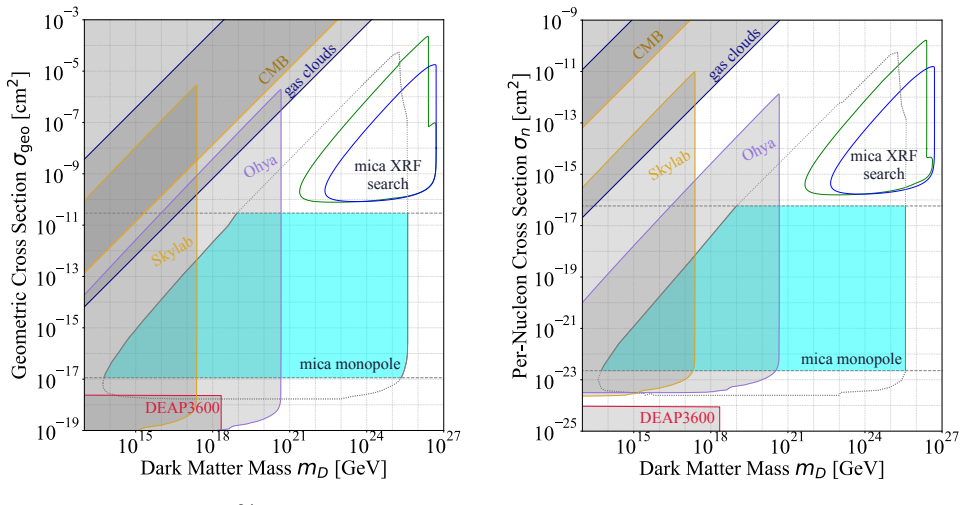
The authors model melt track formation by heavy composite dark matter transiting through mica using a Sedov-Taylor thermal spike formalism, validate the sub-micron regime with SRIM/TRIM simulations that also calibrate phonon efficiency, and demonstrate a novel readout method using rapid X-ray fluorescence mapping with a copper backing contrast technique. They present projected sensitivities for opaque and diffuse composite dark matter, including a sub-melt hole-channel detection mode for large composites substantially attenuated by overburden, and revisit prior dark matter exclusions from etched mica searches, identifying shortcomings.
What carries the argument
Sedov-Taylor thermal spike formalism for modeling melt track formation in mica, validated by SRIM/TRIM simulations of nuclear recoil cascades, paired with X-ray fluorescence mapping using copper backing contrast for readout.
If this is right
- Projected sensitivities for opaque and diffuse composite dark matter are achievable with mica paleodetectors.
- A sub-melt hole-channel detection mode enables searches for large composites substantially attenuated by overburden.
- Shortcomings that compromise the robustness of prior dark matter exclusions from etched mica searches are identified.
- The minimum detectable track size is calibrated using laser-ablated defect regions.
- Phonon efficiency governing local energy deposition is calibrated from the simulations.
Where Pith is reading between the lines
- If track retention holds over geological time, the X-ray readout technique could be applied to other layered minerals for similar rare-event searches.
- Deep underground mica samples could extend the reach to even larger composites by reducing overburden effects further.
- Laboratory exposure of fresh mica sheets to controlled heavy ion beams could directly test the predicted melt track sizes and shapes.
- The framework suggests paleodetectors might complement collider or direct-detection experiments for heavy composite states that interact too weakly for conventional targets.
Load-bearing premise
Muscovite mica retains sub-micron melt tracks from heavy composite dark matter over gigayear timescales without significant annealing, erasure, or background interference.
What would settle it
Direct observation that sub-micron melt tracks in mica anneal or erase at ambient temperatures over timescales much shorter than a gigayear would falsify the retention premise needed for paleodetection.
Figures
read the original abstract
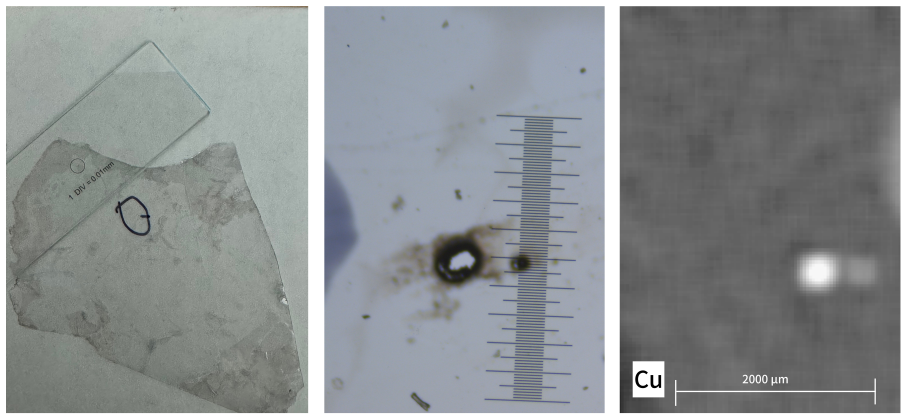
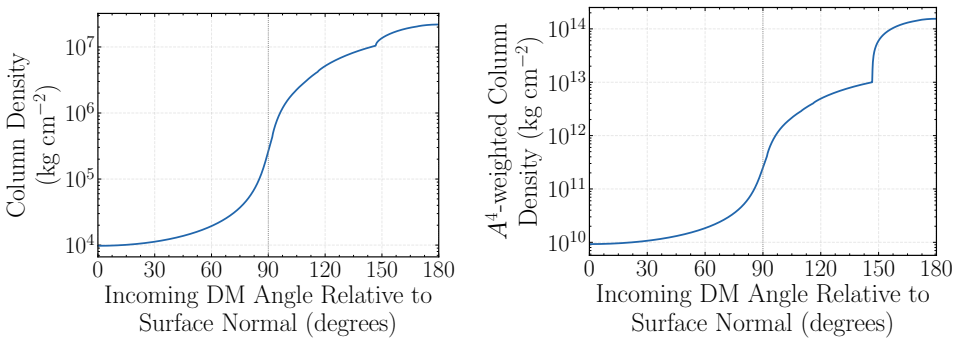
Muscovite mica is a translucent, layered silicate mineral whose basal cleavage, low radiogenic background, gigayear exposures, and demonstrated track retention over geological timescales make it a compelling target for rare particle searches. In this work, we develop a new framework for detecting heavy composite dark matter using muscovite mica as a paleodetector. We model melt track formation by heavy composite dark matter transiting through mica using a Sedov-Taylor thermal spike formalism, and validate the sub-micron regime with SRIM/TRIM simulations of nuclear recoil cascades, which also calibrate the phonon efficiency governing local energy deposition. We demonstrate a novel readout method using rapid X-ray fluorescence mapping with a copper backing contrast technique, capable of identifying micron-scale damage features in cleaved mica sheets over macroscopic scan areas, and calibrate the minimum detectable track size using laser-ablated defect regions. We present projected sensitivities for opaque and diffuse composite dark matter, including a sub-melt hole-channel detection mode for large composites substantially attenuated by overburden. We also revisit prior dark matter exclusions from etched mica searches, identifying shortcomings that compromise the robustness of these constraints.
Editorial analysis
A structured set of objections, weighed in public.
Referee Report
Summary. The manuscript develops a framework for detecting heavy composite dark matter with muscovite mica as a paleodetector. It models melt-track formation via Sedov-Taylor thermal spikes, validates the sub-micron regime with SRIM/TRIM nuclear-recoil simulations that calibrate phonon efficiency, introduces rapid X-ray fluorescence mapping with copper-backing contrast for readout, calibrates the minimum detectable track size with laser-ablated defects, presents projected sensitivities for opaque and diffuse composites (including a sub-melt hole-channel mode for overburden-attenuated particles), and re-examines prior etched-mica exclusions.
Significance. If the long-term retention of sub-micron melt tracks can be established, the combination of Sedov-Taylor modeling, SRIM/TRIM validation, and non-destructive X-ray readout would open a new experimental channel for heavy composite DM that is complementary to existing direct-detection and etched-track searches. The projected sensitivities and the critique of prior exclusions would then constitute a substantive advance, provided the readout threshold and background claims are experimentally anchored.
major comments (1)
- [Abstract / modeling section] Abstract and modeling section: the central sensitivity projections rest on the claim of 'demonstrated track retention over geological timescales,' yet the text calibrates only the initial energy deposition (Sedov-Taylor plus SRIM/TRIM phonon efficiency) and the X-ray detection threshold; no rate equation, diffusion-length bound, or annealing timescale at ambient temperature over ~Gyr is solved or constrained. This assumption is load-bearing for both the opaque and diffuse composite projections and for the sub-melt hole-channel mode.
minor comments (1)
- [Readout method] The manuscript should supply explicit numerical values for the X-ray scan area, spatial resolution, and false-positive rate from the copper-backing contrast technique so that the claimed macroscopic coverage can be evaluated against the projected DM event rates.
Simulated Author's Rebuttal
We thank the referee for the careful and constructive review. The major comment identifies a genuine gap in the presentation of our assumptions, which we address below by committing to a targeted revision.
read point-by-point responses
-
Referee: [Abstract / modeling section] Abstract and modeling section: the central sensitivity projections rest on the claim of 'demonstrated track retention over geological timescales,' yet the text calibrates only the initial energy deposition (Sedov-Taylor plus SRIM/TRIM phonon efficiency) and the X-ray detection threshold; no rate equation, diffusion-length bound, or annealing timescale at ambient temperature over ~Gyr is solved or constrained. This assumption is load-bearing for both the opaque and diffuse composite projections and for the sub-melt hole-channel mode.
Authors: We agree that the manuscript does not derive or constrain annealing timescales, diffusion lengths, or rate equations for the sub-micron melt tracks over Gyr. The phrase 'demonstrated track retention' in the abstract and introduction refers to the well-established geological stability of fission tracks and other radiation damage in muscovite (used in thermochronology), but this does not automatically extend to the thermal-spike melt channels modeled here. We will revise the modeling section to add a short discussion citing existing mica annealing data, provide order-of-magnitude bounds on ambient-temperature diffusion, and explicitly flag the retention assumption as requiring future experimental validation. This will be presented as a limitation rather than a fully solved result. revision: yes
Circularity Check
No circularity; modeling and projections are independent of inputs
full rationale
The paper models melt tracks via Sedov-Taylor formalism, validates sub-micron regime with SRIM/TRIM phonon efficiency and cascade simulations, calibrates X-ray readout threshold on laser-ablated defects, and derives projected sensitivities for opaque/diffuse composites including sub-melt channels. No quoted equation or step reduces a prediction to a fitted parameter by construction, nor does any load-bearing premise collapse to a self-citation chain. Track retention is asserted as previously demonstrated rather than re-derived here, leaving the derivation chain self-contained against external benchmarks.
Axiom & Free-Parameter Ledger
axioms (1)
- domain assumption Muscovite mica retains particle tracks over gigayear timescales
Reference graph
Works this paper leans on
-
[1]
Witten,Cosmic separation of phases,Phys
E. Witten,Cosmic separation of phases,Phys. Rev. D30(1984) 272–285
1984
-
[2]
Farhi and R
E. Farhi and R. L. Jaffe,Strange matter,Phys. Rev. D30(1984) 2379–2390
1984
-
[3]
A. D. Rújula and S. L. Glashow,Nuclearites: A novel form of cosmic radiation,Nature312 (1984) 734–737
1984
-
[4]
M. B. Wise and Y. Zhang,Yukawa Bound States of a Large Number of Fermions,JHEP02 (2015) 023, [1411.1772]
Pith/arXiv arXiv 2015
-
[5]
M. B. Wise and Y. Zhang,Stable Bound States of Asymmetric Dark Matter,Phys. Rev. D 90(2014) 055030, [1407.4121]
Pith/arXiv arXiv 2014
-
[6]
G. Krnjaic and K. Sigurdson,Big Bang Darkleosynthesis,Phys. Lett.B751(2015) 464–468, [1406.1171]
Pith/arXiv arXiv 2015
- [7]
-
[8]
M. I. Gresham, H. K. Lou and K. M. Zurek,Astrophysical Signatures of Asymmetric Dark Matter Bound States,Phys. Rev.D98(2018) 096001, [1805.04512]
Pith/arXiv arXiv 2018
-
[9]
M. I. Gresham, H. K. Lou and K. M. Zurek,Early Universe synthesis of asymmetric dark matter nuggets,Phys. Rev. D97(2018) 036003, [1707.02316]
Pith/arXiv arXiv 2018
-
[10]
D. M. Grabowska, T. Melia and S. Rajendran,Detecting Dark Blobs,Phys. Rev. D98 (2018) 115020, [1807.03788]
Pith/arXiv arXiv 2018
-
[11]
A. Coskuner, D. M. Grabowska, S. Knapen and K. M. Zurek,Direct Detection of Bound States of Asymmetric Dark Matter,Phys. Rev. D100(2019) 035025, [1812.07573]
arXiv 2019
-
[12]
Y. Bai, A. J. Long and S. Lu,Dark Quark Nuggets,Phys. Rev. D99(2019) 055047, [1810.04360]
arXiv 2019
- [13]
-
[14]
J. Bramante, B. Broerman, R. F. Lang and N. Raj,Saturated Overburden Scattering and the Multiscatter Frontier: Discovering Dark Matter at the Planck Mass and Beyond,Phys. Rev.D98(2018) 083516, [1803.08044]
Pith/arXiv arXiv 2018
-
[15]
J. F. Acevedo, J. Bramante and A. Goodman,Nuclear fusion inside dark matter,Phys. Rev. D103(2021) 123022, [2012.10998]
arXiv 2021
-
[16]
J. F. Acevedo, J. Bramante and A. Goodman,Accelerating composite dark matter discovery with nuclear recoils and the Migdal effect,Phys. Rev. D105(2022) 023012, [2108.10889]
arXiv 2022
-
[17]
C. V. Cappiello, J. I. Collar and J. F. Beacom,New experimental constraints in a new landscape for composite dark matter,Phys. Rev. D103(2021) 023019, [2008.10646]
arXiv 2021
- [18]
-
[19]
Z. S. C. Picker,Dark matter hail: Detecting macroscopic dark matter with asteroids, planetary rings, and craters,Phys. Rev. D112(2025) 043028, [2504.07232]
arXiv 2025
-
[20]
DeRocco,Ganymede’s subsurface ocean as a dark matter detector,Phys
W. DeRocco,Ganymede’s subsurface ocean as a dark matter detector,Phys. Rev. D112 (2025) 115023, [2508.00054]
arXiv 2025
-
[21]
Bramante,Very Heavy and Composite Dark Matter: Theory and Experimental Searches, 2602.23708
J. Bramante,Very Heavy and Composite Dark Matter: Theory and Experimental Searches, 2602.23708
-
[22]
Price and M
P. Price and M. Salamon,Search for Supermassive Magnetic Monopoles Using Mica Crystals,Phys. Rev. Lett.56(1986) 1226–1229
1986
-
[23]
Snowden-Ifft, E
D. Snowden-Ifft, E. Freeman and P. Price,Limits on dark matter using ancient mica,Phys. Rev. Lett.74(1995) 4133–4136
1995
-
[24]
J. F. Acevedo, J. Bramante and A. Goodman,Old rocks, new limits: excavated ancient mica searches for dark matter,JCAP11(2023) 085, [2105.06473]
arXiv 2023
-
[25]
D. M. Jacobs, G. D. Starkman and B. W. Lynn,Macro Dark Matter,Mon. Not. Roy. Astron. Soc.450(2015) 3418–3430, [1410.2236]
Pith/arXiv arXiv 2015
-
[26]
S. Baum, A. K. Drukier, K. Freese, M. Górski and P. Stengel,Searching for Dark Matter with Paleo-Detectors,Phys. Lett. B803(2020) 135325, [1806.05991]
arXiv 2020
-
[27]
Ebadi et al.,Ultraheavy dark matter search with electron microscopy of geological quartz, Phys
R. Ebadi et al.,Ultraheavy dark matter search with electron microscopy of geological quartz, Phys. Rev. D104(2021) 015041, [2105.03998]
arXiv 2021
-
[28]
K. Alfonso et al.,Passive low energy nuclear recoil detection with color centers – PALEOCCENE, inSnowmass 2021, 3, 2022.2203.05525
arXiv 2021
-
[29]
Baum et al.,Mineral detection of neutrinos and dark matter
S. Baum et al.,Mineral detection of neutrinos and dark matter. A whitepaper,Phys. Dark Univ.41(2023) 101245, [2301.07118]
arXiv 2023
-
[30]
A. Fung, T. Lucas, L. Balogh, M. Leybourne and A. C. Vincent,Refining the sensitivity of new physics searches with ancient minerals,Phys. Rev. D112(2025) 043040, [2504.08885]. 30
arXiv 2025
-
[31]
G. A. Araujo et al.,Nuclear recoil detection with color centers in bulk lithium fluoride, 2503.20732
-
[32]
A. Calabrese-Day, E. LaVoie-Ingram, K. Ream, H. Ross, J. Spitz, P. Stengel et al.,Toward Neutrino and Dark Matter Detection with Ancient Minerals: TEM Study of Heavy-Ion Tracks in Olivine,2604.09732
-
[33]
S. Hedges and P. Huber,Calorimetric approach to paleo-detection of dark matter, 2605.13659
-
[34]
R. A. Robie, B. S. Hemingway and J. R. Fisher, “Thermodynamic properties of minerals and related substances at 298.15 K and 1 bar (105 pascals) pressure and at higher temperatures.” U.S. Government Printing Office, Bulletin, iii, 456, Jan., 1978. DOI: 10.3133/b1452
-
[35]
Fridleifsson, R
I. Fridleifsson, R. Bertani, E. Huenges, J. Lund, A. Ragnarsson and L. Rybach,The possible role and contribution of geothermal energy to the mitigation of climate change,IPCC Scoping Meeting on Renewable Energy Sources, Proceedings(01, 2008) 59–80
2008
-
[36]
Hofmeister and P
A. Hofmeister and P. Carpenter,Heat transport of micas,Canadian Mineralogist53(May,
-
[37]
J. F. Acevedo, Y. Boukhtouchen, J. Bramante, C. Cappiello, G. Mohlabeng and N. Tyagi, Loosely bound composite dark matter,JCAP03(2025) 013, [2408.03983]
arXiv 2025
-
[38]
Y. Boukhtouchen, J. Bramante, C. Cappiello and M. Diamond,Deconstructive Composite Dark Matter Detection,2512.16043
-
[39]
L. I. Sedov,Similarity and Dimensional Methods in Mechanics. 1959
1959
-
[40]
Y. B. Zel’dovich and Y. P. Raizer,Physics of shock waves and high-temperature hydrodynamic phenomena. 1967
1967
-
[41]
Lindhard, M
J. Lindhard, M. Scharff and H. E. Schiøtt,Range concepts and heavy ion ranges,Mat. Fys. Medd. Dan. Vid. Selsk.33(1963)
1963
-
[42]
Toulemonde, C
M. Toulemonde, C. Dufour, A. Meftah and E. Paumier,Transient thermal processes in heavy ion irradiation of crystalline inorganic insulators,Nuclear Instruments and Methods in Physics Research B166–167(2000) 903–912
2000
-
[43]
Majorowicz, M
J. Majorowicz, M. Polkowski and M. Grad,Thermal properties of the crust and the lithosphere–asthenosphere boundary in the area of poland from the heat flow variability and seismic data,International Journal of Earth Sciences108(2019) 649–672
2019
-
[44]
J. F. Ziegler, M. Ziegler and J. Biersack,Srim – the stopping and range of ions in matter (2010),Nuclear Instruments and Methods in Physics Research Section B: Beam Interactions with Materials and Atoms268(2010) 1818–1823
2010
-
[45]
Ostrouchov, Y
C. Ostrouchov, Y. Zhang and W. J. Weber,pysrim: Automation, analysis, and plotting of srim calculations,Journal of Open Source Software3(2018) 829. 31
2018
-
[46]
M. I. Kaganov, I. M. Lifshitz and L. V. Tanatarov,Relaxation between electrons and the crystalline lattice,Soviet Physics JETP4(1957) 173
1957
-
[47]
Jenkins, R
R. Jenkins, R. Manne, R. Robin and C. Senemaud,Nomenclature, symbols, units and their usage in Spectrochemical Analysis VIII nomenclature system for X-ray spectroscopy,Powder Diffraction6(1991)
1991
-
[48]
Abbas, D
H. Abbas, D. N. Mahato, J. Satti and M. C. A.,measurements and simulations of focused beam for orthovoltage therapy,Med. Phys.41(2014)
2014
-
[49]
J. H. Hubbell and S. M. Seltzer,Tables of X-Ray Mass Attenuation Coefficients and Mass Energy-Absorption Coefficients from 1 keV to 20 MeV for Elements Z = 1 to 92 and 48 Additional Substances of Dosimetric Interest, Tech. Rep. NISTIR 5632, National Institute of Standards and Technology, 1995. 10.18434/T4D01F
-
[50]
Černý and T
P. Černý and T. S. Ercit,The classification of granitic pegmatites revisited,The Canadian Mineralogist43(2005) 2005–2026
2005
-
[51]
T. Rivers,Assembly and preservation of lower, mid, and upper orogenic crust in the Grenville Province—Implications for the evolution of large hot long-duration orogens, Precambrian Research167(2008) 237–259
2008
-
[52]
R. M. Easton,Metamorphism of the Canadian Shield, Ontario, Canada. I. the Superior Province,The Canadian Mineralogist38(2000) 287–317
2000
-
[53]
C. W. Naeser and H. Faul,Fission track annealing in apatite and sphene,Journal of Geophysical Research74(Jan., 1969) 705–710
1969
-
[54]
K. D. Crowley,Thermal significance of fission-track length distributions,Nuclear Tracks and Radiation Measurements10(1985) 311–322
1985
-
[55]
M. H. Dodson,Closure temperature in cooling geochronological and petrological systems, Contributions to Mineralogy and Petrology40(Sept., 1973) 259–274
1973
-
[56]
C. Wang, O. Alard, Y.-J. Lai, S. F. Foley, Y. Liu and J. Hou,Advances in in-situ Rb-Sr dating using LA-ICP-MS/MS: Applications to igneous rocks of all ages and to the identification of unrecognized metamorphic events,Chemical Geology610(2022) 121073
2022
-
[57]
Fleischer, P
R. Fleischer, P. Price, R. Walker and R. Walker,Nuclear tracks in solids: Principles and applications,University of California Press(1975)
1975
- [58]
- [59]
-
[60]
N. Bozorgnia, F. Calore, M. Schaller, M. Lovell, G. Bertone, C. S. Frenk et al.,Simulated Milky Way analogues: implications for dark matter direct searches,JCAP05(2016) 024, [1601.04707]. 32
Pith/arXiv arXiv 2016
-
[62]
A. M. Dziewonski and D. L. Anderson,Preliminary reference earth model,Phys. Earth Planet. Interiors25(1981) 297–356
1981
-
[63]
J. W. Morgan and E. Anders,Chemical composition of earth, venus, and mercury, Proceedings of the National Academy of Sciences77(1980) 6973–6977
1980
-
[64]
McDonough,2.15 - compositional model for the earth’s core, inTreatise on Geochemistry (H
W. McDonough,2.15 - compositional model for the earth’s core, inTreatise on Geochemistry (H. D. Holland and K. K. Turekian, eds.), pp. 547 – 568. Pergamon, Oxford, 2003. DOI
2003
-
[65]
Clarke and H
F. Clarke and H. Washington,The Composition of the Earth’s Crust. No. nos. 126-127 in Geological Survey professional paper. U.S. Government Printing Office, 1924
1924
-
[66]
H. S. Wang, C. H. Lineweaver and T. R. Ireland,The elemental abundances (with uncertainties) of the most earth-like planet,Icarus299(2018) 460 – 474
2018
-
[67]
A. J. Deason, A. Fattahi, V. Belokurov, N. W. Evans, R. J. J. Grand, F. Marinacci et al., The local high-velocity tail and the Galactic escape speed,Mon. Not. Roy. Astron. Soc.485 (2019) 3514–3526, [1901.02016]
Pith/arXiv arXiv 2019
-
[68]
A.-C. Eilers, D. W. Hogg, H.-W. Rix and M. K. Ness,The Circular Velocity Curve of the Milky Way from 5 to 25 kpc,Astrophys. J.871(2019) 120, [1810.09466]
Pith/arXiv arXiv 2019
-
[69]
R. Schönrich, J. Binney and W. Dehnen,Local kinematics and the local standard of rest, Mon. Not. Roy. Astron. Soc.403(2010) 1829–1833, [0912.3693]
Pith/arXiv arXiv 2010
-
[70]
V. Gluscevic and K. K. Boddy,Constraints on Scattering of keV–TeV Dark Matter with Protons in the Early Universe,Phys. Rev. Lett.121(2018) 081301, [1712.07133]
Pith/arXiv arXiv 2018
-
[71]
A. Bhoonah, J. Bramante, S. Schon and N. Song,Detecting composite dark matter with long-range and contact interactions in gas clouds,Phys. Rev. D103(2021) 123026, [2010.07240]
arXiv 2021
-
[72]
A. Bhoonah, J. Bramante, F. Elahi and S. Schon,Galactic Center gas clouds and novel bounds on ultralight dark photon, vector portal, strongly interacting, composite, and super-heavy dark matter,Phys. Rev. D100(2019) 023001, [1812.10919]
Pith/arXiv arXiv 2019
-
[73]
A. Bhoonah, J. Bramante, F. Elahi and S. Schon,Calorimetric Dark Matter Detection With Galactic Center Gas Clouds,Phys. Rev. Lett.121(2018) 131101, [1806.06857]. [74](DEAP Collaboration)‡, DEAPcollaboration, P. Adhikari et al.,First Direct Detection Constraints on Planck-Scale Mass Dark Matter with Multiple-Scatter Signatures Using the DEAP-3600 Detector,...
Pith/arXiv arXiv 2018
-
[74]
A. Bhoonah, J. Bramante, B. Courtman and N. Song,Etched plastic searches for dark matter,Phys. Rev. D103(2021) 103001, [2012.13406]
arXiv 2021
-
[75]
N. Bozorgnia, J. Bramante and A. Buchanan,High mass dark matter searches with the high speed flux from the Large Magellanic Cloud,JCAP04(2026) 065, [2511.21841]. 33
arXiv 2026
-
[76]
J. F. Acevedo, J. Bramante, A. Goodman, J. Kopp and T. Opferkuch,Dark Matter, Destroyer of Worlds: Neutrino, Thermal, and Existential Signatures from Black Holes in the Sun and Earth,JCAP04(2021) 026, [2012.09176]
arXiv 2021
-
[77]
Ray,Celestial objects as strongly-interacting nonannihilating dark matter detectors,Phys
A. Ray,Celestial objects as strongly-interacting nonannihilating dark matter detectors,Phys. Rev. D107(2023) 083012, [2301.03625]
arXiv 2023
-
[78]
S. Bhattacharya, A. L. Miller and A. Ray,Continuous gravitational waves: A new window to look for heavy nonannihilating dark matter,Phys. Rev. D110(2024) 043006, [2403.13886]
arXiv 2024
-
[79]
W. Yuan, R. A. Ketcham, S. Gao, J. Dong, Z. Bao and J. Deng,Annealing behavior of alpha recoil tracks in phlogopite,Chemical Geology266(2009) 343–349
2009
-
[80]
G. A. Wagner and P. Van den Haute,Fission-track dating,Kluwer Academic Publishers (1992) . 34
1992
discussion (0)
Sign in with ORCID, Apple, or X to comment. Anyone can read and Pith papers without signing in.