Quark Stars in Ricci-Determinant Gravity with an Interacting Quark Equation of State
Pith reviewed 2026-06-28 13:10 UTC · model grok-4.3
The pith
Quark stars become less compact in Ricci-determinant gravity than in general relativity.
A machine-rendered reading of the paper's core claim, the machinery that carries it, and where it could break.
Core claim
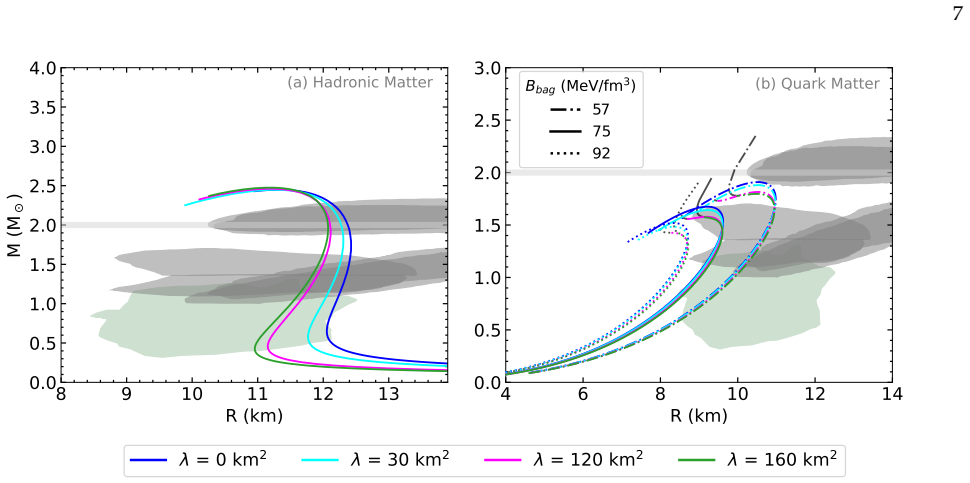
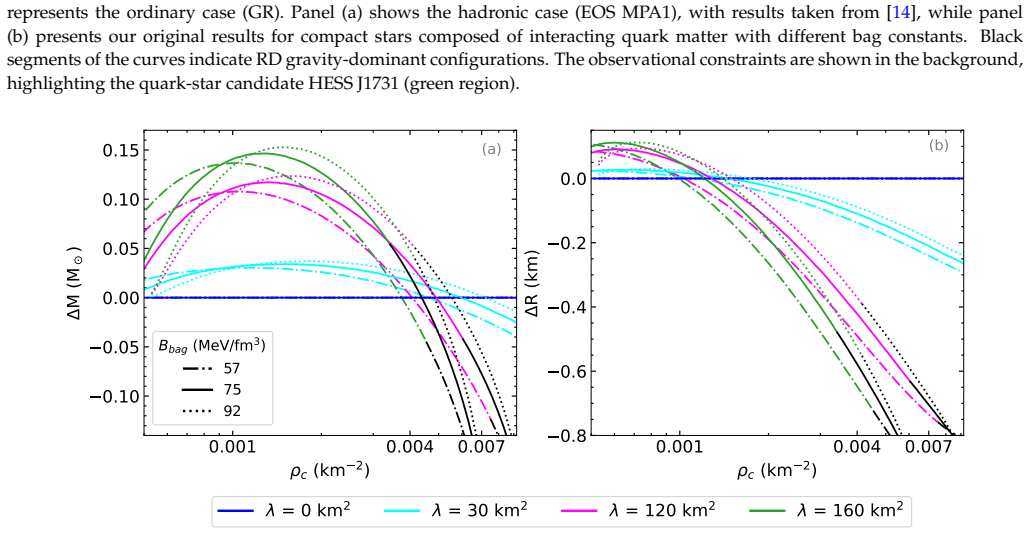
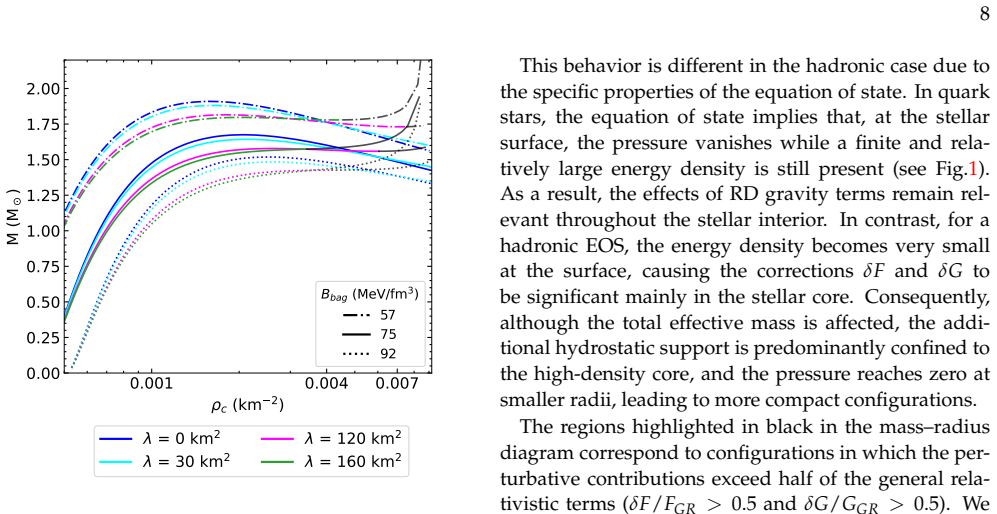
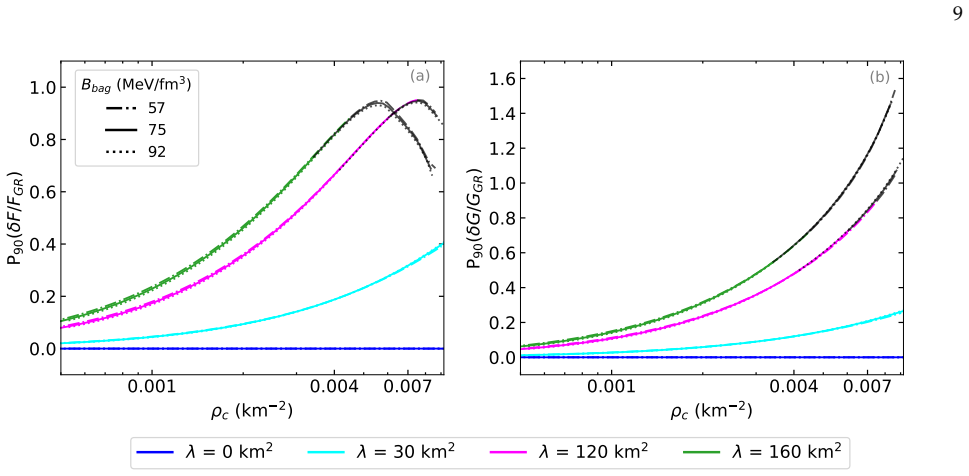
In Ricci-Determinant gravity with an interacting quark equation of state, the model predicts a reduction in the compactness of quark stars. This parameter is also sensitive to gravitational binding-energy analysis, revealing a breakdown of the assumed universality. Furthermore, the formation of objects with high central densities is restricted by the instability conditions that arise when the contribution of perturbative terms exceeds by approximately half the contribution of ordinary GR.
What carries the argument
Relativistic stellar structure equations adapted to Ricci-Determinant gravity that incorporate perturbative corrections to the Einstein equations.
If this is right
- Quark-star compactness decreases relative to general relativity for the same central density.
- Gravitational binding-energy relations lose their universality for quark stars.
- Stable configurations cannot reach the high central densities allowed in general relativity once perturbative terms exceed roughly half the GR contribution.
Where Pith is reading between the lines
- The contrast with hadronic stars indicates that the reduction in compactness depends on the specific equation of state.
- The same perturbative threshold may impose density limits on other compact objects modeled in this gravity theory.
Load-bearing premise
The relativistic stellar structure equations for compact objects derived in the literature apply directly and without modification to the Ricci-Determinant gravity theory when solving for quark-star configurations.
What would settle it
Discovery of a stable quark star whose compactness is not reduced relative to general relativity, or whose central density exceeds the threshold where perturbative terms reach half the GR contribution, would falsify the predicted reduction and instability limit.
Figures


read the original abstract
In the present study, we explore the fundamental properties of static, spherically symmetric quark stars composed of quark matter with an interacting quark equation of state (EoS) within the framework of Ricci-Determinant gravity. To this end, we adopt the relativistic stellar structure equations for compact objects derived in the literature. Our primary objective is to investigate deviations from General Relativity (GR) in key physical characteristics, particularly the mass--radius relation and stability criteria, arising from the free parameters of this extended gravitational theory. We see that, unlike the hadronic case, the model predicts a reduction in the compactness of quark stars. This parameter is also sensitive to gravitational binding-energy analysis, revealing a breakdown of the assumed universality. Furthermore, the formation of objects with high central densities is restricted by the instability conditions that arise when the contribution of perturbative terms exceeds by approximately half the contribution of ordinary GR, indicating a clear limitation in the theory.
Editorial analysis
A structured set of objections, weighed in public.
Referee Report
Summary. The manuscript investigates static, spherically symmetric quark stars with an interacting quark equation of state in Ricci-Determinant gravity. It adopts the relativistic stellar structure equations from the literature to compute mass-radius relations and stability criteria, reporting a reduction in compactness (unlike the hadronic case), sensitivity of compactness to gravitational binding-energy analysis with breakdown of universality, and an instability restricting high central densities when perturbative terms exceed approximately half the GR contribution.
Significance. If the structure equations are valid under the modified action, the work could constrain the free parameters of Ricci-Determinant gravity via compact-object observations and demonstrate qualitative differences from GR for quark stars.
major comments (2)
- [Abstract and stellar structure section] Abstract and the section adopting the stellar structure equations: the hydrostatic equilibrium condition is taken directly from the GR literature without re-derivation from the Ricci-Determinant field equations. In a modified-gravity theory the generalized TOV equation must be obtained from the new metric variation; all reported results on compactness reduction, binding-energy universality breakdown, and the ~half-GR instability threshold rest on this unverified assumption.
- [Abstract and results section] The quantitative claim that instability arises 'when the contribution of perturbative terms exceeds by approximately half the contribution of ordinary GR' is stated without an explicit equation defining the ratio or the threshold; this renders the reported limitation on high central densities non-reproducible from the given text.
minor comments (1)
- [Abstract] The phrasing 'we see that' in the abstract is informal for a journal manuscript.
Simulated Author's Rebuttal
We thank the referee for the detailed review and valuable comments on our manuscript. We address the major comments point by point below.
read point-by-point responses
-
Referee: [Abstract and stellar structure section] Abstract and the section adopting the stellar structure equations: the hydrostatic equilibrium condition is taken directly from the GR literature without re-derivation from the Ricci-Determinant field equations. In a modified-gravity theory the generalized TOV equation must be obtained from the new metric variation; all reported results on compactness reduction, binding-energy universality breakdown, and the ~half-GR instability threshold rest on this unverified assumption.
Authors: The manuscript explicitly states that the relativistic stellar structure equations are adopted from the literature where they were derived for Ricci-Determinant gravity. We will revise the relevant section to include explicit citations to the papers containing the derivation of the generalized TOV equation from the metric variation of the Ricci-Determinant action, making clear that the equations are not taken from the GR literature. revision: yes
-
Referee: [Abstract and results section] The quantitative claim that instability arises 'when the contribution of perturbative terms exceeds by approximately half the contribution of ordinary GR' is stated without an explicit equation defining the ratio or the threshold; this renders the reported limitation on high central densities non-reproducible from the given text.
Authors: We agree that an explicit definition of the ratio and threshold is needed for reproducibility. In the revised manuscript we will insert the precise mathematical definition of the ratio of perturbative gravity terms to the GR contribution together with the numerical threshold value at which the instability condition is applied. revision: yes
Circularity Check
No significant circularity in derivation chain
full rationale
The paper states it adopts the relativistic stellar structure equations from the literature and performs numerical integrations of mass-radius and stability relations using an interacting quark EoS plus free parameters of Ricci-Determinant gravity. The reported outcomes (reduced compactness relative to hadronic case, breakdown of binding-energy universality, instability when perturbative terms exceed ~half the GR contribution) are presented as results of those integrations rather than identities or fits forced by construction. No self-definitional steps, fitted inputs renamed as predictions, or self-citation chains that reduce the central claims to the inputs are exhibited in the quoted abstract or described structure. The derivation chain therefore retains independent numerical content.
Axiom & Free-Parameter Ledger
free parameters (1)
- free parameters of Ricci-Determinant gravity
axioms (1)
- domain assumption relativistic stellar structure equations derived in the literature remain valid without modification in Ricci-Determinant gravity
Reference graph
Works this paper leans on
-
[1]
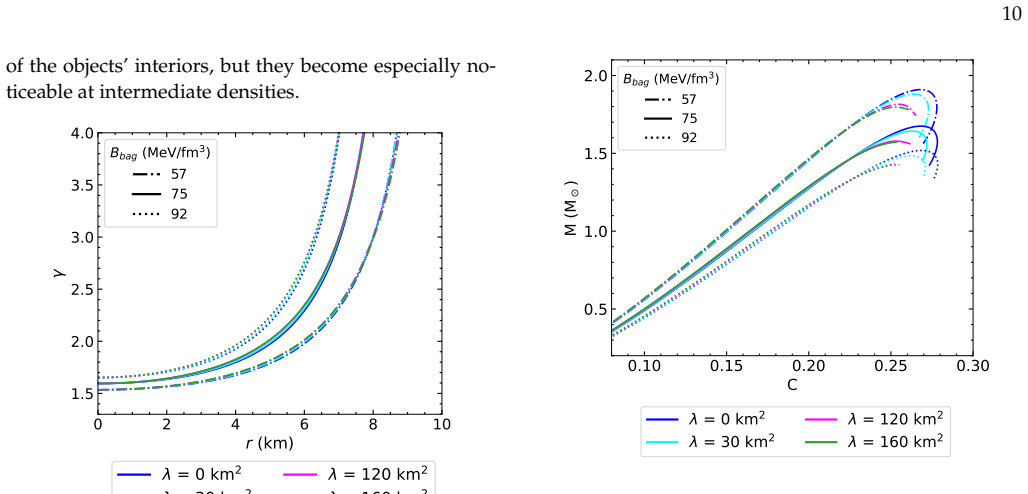
The adiabatic index [76, 77] can be defined as fol- lows: γ= 1+ ρ p ! dp dρ ! . (37) It is important to mention that, for the stability of com- pact relativistic objects, including white dwarfs, NSs, and supermassive stars, the values ofγmust exceed 4/3 at every point within the interior of the configuration [78, 79]. We have illustrated the behavior of t...
2012
-
[2]
P . Collaboration, N. Aghanim, et al., Planck 2018 re- sults. VI. Cosmological parameters, Astron. Astrophys. 641 (2020) A6.arXiv:1807.06209,doi:10.1051/ 0004-6361/201833910
Pith/arXiv arXiv 2018
-
[3]
A. G. Riess, A. V . Filippenko, et al., Observational Evi- dence from Supernovae for an Accelerating Universe and a Cosmological Constant, Astron. J. 116 (1998) 1009–1038. arXiv:astro-ph/9805201,doi:10.1086/300499
work page internal anchor Pith review Pith/arXiv arXiv doi:10.1086/300499 1998
-
[4]
Ishak, Testing General Relativity in Cosmology, Liv- ing Rev
M. Ishak, Testing General Relativity in Cosmology, Liv- ing Rev. Relativ. 22 (1) (2019) 1.arXiv:1806.10122, doi:10.1007/s41114-018-0017-4
-
[5]
Modified Gravity Theories on a Nutshell: Inflation, Bounce and Late-time Evolution
S. Nojiri, S. D. Odintsov, V . K. Oikonomou, Modified gravity theories on a nutshell: Inflation, bounce and late- time evolution, Phys. Rept. 692 (2017) 1–104.arXiv: 1705.11098,doi:10.1016/j.physrep.2017.06. 001
work page internal anchor Pith review Pith/arXiv arXiv doi:10.1016/j.physrep.2017.06 2017
-
[6]
A systematic approach to generalisations of General Relativity and their cosmological implications
L. Heisenberg, A systematic approach to generalisations of General Relativity and their cosmological implications, Phys. Rept. 796 (2019) 1–113.arXiv:1807.01725,doi: 10.1016/j.physrep.2018.11.006
work page internal anchor Pith review Pith/arXiv arXiv doi:10.1016/j.physrep.2018.11.006 2019
-
[7]
Modified Gravity and Cosmology
T. Clifton, P . G. Ferreira, A. Padilla, C. Skordis, Modified Gravity and Cosmology, Phys. Rept. 513 (1-3) (2012) 1– 189.arXiv:1106.2476,doi:10.1016/j.physrep. 2012.01.001
work page internal anchor Pith review Pith/arXiv arXiv doi:10.1016/j.physrep 2012
-
[8]
G. J. Olmo, H. Sanchis-Alepuz, S. Tripathi, Dynamical aspects of generalized Palatini theories of gravity, Phys. Rev. D 80 (2009) 024013.arXiv:0907.2787,doi:10. 1103/PhysRevD.80.024013
Pith/arXiv arXiv 2009
-
[9]
S. Nojiri, S. D. Odintsov, Introduction to modified gravity and gravitational alternative for dark energy, Int. J. Geom. Meth. Mod. Phys. 4 (2007) 115–145.arXiv:hep-th/ 0601213,doi:10.1142/S0219887807001928
-
[10]
G. J. Olmo, Palatini Approach to Modified Gravity: f(R) Theories and Beyond, Int. J. Mod. Phys. D 20 (2011) 413–462.arXiv:1101.3864,doi:10.1142/ S0218271811018925
Pith/arXiv arXiv 2011
-
[11]
Zwiebach, Curvature Squared Terms and String The- ories, Phys
B. Zwiebach, Curvature Squared Terms and String The- ories, Phys. Lett. B 156 (1985) 315–317.doi:10.1016/ 0370-2693(85)91616-8
1985
-
[12]
S. Nojiri, S. D. Odintsov, Modified Gauss–Bonnet theory as gravitational alternative for dark energy, Phys. Lett. B 631 (2005) 1–6.arXiv:hep-th/0508049,doi:10. 1016/j.physletb.2005.10.010
Pith/arXiv arXiv 2005
-
[13]
Eddington's theory of gravity and its progeny
M. Ba ˜nados, P . G. Ferreira, Eddington’s the- ory of gravity and its progeny, Phys. Rev. Lett. 105 (2010) 011101.arXiv:1006.1769,doi: 10.1103/PhysRevLett.105.011101
work page internal anchor Pith review Pith/arXiv arXiv doi:10.1103/physrevlett.105.011101 2010
-
[14]
J. B. Jim ´enez, L. Heisenberg, G. J. Olmo, D. Rubiera- Garcia, Born–Infeld inspired modifications of gravity, Phys. Rept. 727 (2018) 1–129.arXiv:1704.03351,doi: 10.1016/j.physrep.2017.11.001
work page internal anchor Pith review Pith/arXiv arXiv doi:10.1016/j.physrep.2017.11.001 2018
-
[17]
N. K. Glendenning, Prompt subsidence of a proto–neutron star into a black hole, Astrophys. J. 448 (1995) 797–808.doi:10.1086/175999
-
[18]
Z. G. Dai, Q. H. Peng, T. Lu, The conversion of two-flavor to three-flavor quark matter in a supernova core, Astro- phys. J. 440 (1995) 815–822.doi:10.1086/175316
-
[19]
K. S. Cheng, Z. G. Dai, T. Lu, Strange stars and related astrophysical phenomena, Int. J. Mod. Phys. D 7 (1998) 139–172.arXiv:astro-ph/9803034,doi:10.1142/ S0218271898000127
Pith/arXiv arXiv 1998
-
[20]
A. Chodos, R. L. Jaffe, K. Johnson, C. B. Thorn, Baryon Structure in the Bag Theory, Phys. Rev. D 10 (1974) 2599– 2604.doi:10.1103/PhysRevD.10.2599
-
[21]
A. Chodos, R. L. Jaffe, K. Johnson, C. B. Thorn, V . F. Weis- skopf, New extended model of hadrons, Phys. Rev. D 9 (1974) 3471–3495.doi:10.1103/PhysRevD.9.3471
-
[22]
A. Peshier, B. K ¨ampfer, G. Soff, The equation of state of deconfined matter at finite chemical potential in a quasiparticle description, Phys. Rev. C 61 (2000) 045203. arXiv:hep-ph/9911474,doi:10.1103/PhysRevC. 61.045203
work page internal anchor Pith review Pith/arXiv arXiv doi:10.1103/physrevc 2000
-
[23]
E. Farhi, R. L. Jaffe, Strange Matter, Phys. Rev. D 30 (1984) 2379–2390.doi:10.1103/PhysRevD.30.2379
-
[25]
M. G. Alford, K. Rajagopal, F. Wilczek, Color-Flavor Lock- ing and Chiral Symmetry Breaking in High Density QCD, Nucl. Phys. B 537 (1999) 443–458.arXiv:hep-ph/ 9804403,doi:10.1016/S0550-3213(98)00668-3
-
[26]
C. V . Flores, Z. B. Hall, P . Jaikumar, Nonradial oscilla- tion modes of compact stars with a crust, Phys. Rev. C 96 (6) (2017) 065803.arXiv:1708.05991,doi:10. 1103/PhysRevC.96.065803
Pith/arXiv arXiv 2017
-
[27]
M. Alford, M. Braby, M. Paris, S. Reddy, Hybrid stars that masquerade as neutron stars, Astrophys. J. 629 (2) (2005) 969–978.arXiv:nucl-th/0411016,doi:10.1086/ 430902
Pith/arXiv arXiv 2005
- [29]
- [30]
-
[32]
Z. Miao, J.-L. Jiang, A. Li, L.-W. Chen, Bayesian in- ference of strange star equation of state using the GW170817 and GW190425 data, Astrophys. J. Lett. 917 (2) (2021) L22.arXiv:2105.11768,doi:10. 3847/2041-8213/ac0ffb
arXiv 2021
-
[33]
P . T. Oikonomou, C. C. Moustakidis, Color-flavor locked quark stars in light of the compact object in the hess j1731-347 and the gw190814 event, Phys. Rev. D 108 (6) (2023) 063010.arXiv:2307.03918,doi:10.1103/ PhysRevD.108.063010
arXiv 2023
-
[34]
L. L. Lopes, D. P . Menezes, On the Nature of the Mass-Gap Object in the GW190814 Event, Astrophys. J. 936 (1) (2022) 41.arXiv:2207.XXXXX,doi:10.3847/ 1538-4357/ac81c1
2022
-
[35]
E. A. Becerra-Vergara, S. Mojica, F. D. Lora-Clavijo, A. Cruz-Osorio, Anisotropic quark stars with an inter- acting quark equation of state, Phys. Rev. D 100 (10) (2019) 103006.arXiv:1907.11838,doi:10.1103/ PhysRevD.100.103006
arXiv 2019
-
[36]
M. Gammon, S. Rourke, R. B. Mann, Quark stars with a unified interacting equation of state in regularized 4D Einstein-Gauss-Bonnet gravity, Phys. Rev. D 109 (2) (2024) 024026.doi:10.1103/PhysRevD.109.024026
-
[37]
A. Banerjee, T. Tangphati, P . Channuie, Strange quark stars in 4D Einstein–Gauss–Bonnet gravity, Astrophys. J. 909 (1) (2021) 14.arXiv:2102.12508,doi:10.3847/ 1538-4357/abd9f2
arXiv 2021
-
[38]
A. Banerjee, T. Tangphati, D. Samart, P . Channuie, Quark stars in 4D Einstein–Gauss–Bonnet gravity with an interacting quark equation of state, Astrophys. J. 906 (2) (2021) 114.arXiv:2007.06547,doi:10.3847/ 1538-4357/abc8e2
arXiv 2021
-
[39]
J. M. Z. Pretel, A. Banerjee, A. Pradhan, Electrically charged quark stars in 4D Einstein–Gauss–Bonnet grav- ity, Eur. Phys. J. C 82 (2) (2022) 180.arXiv:2201.XXXXX, doi:10.1140/epjc/s10052-022-10166-7
-
[40]
Rinc ´on, G
´A. Rinc ´on, G. Panotopoulos, I. Lopes, Anisotropic quark stars with an interacting quark equation of state within the complexity factor formalism, Universe 9 (2) (2023) 72.arXiv:2301.XXXXX,doi:10.3390/ universe9020072
2023
-
[41]
K. Kim, J. J. Oh, C. Park, E. J. Son, Neutron star struc- ture in ho ˇrava-lifshitz gravity, Phys. Rev. D 103 (4) (2021) 044052.arXiv:2101.XXXX,doi:10.1103/ PhysRevD.103.044052
2021
-
[42]
K. P . Das, U. Debnath, Study of stable dark energy stars in Hoˇrava–Lifshitz gravity, Eur. Phys. J. C 85 (3) (2025) 329. doi:10.1140/epjc/s10052-025-XXXXX-X
-
[43]
H. Azri, S. Nasri, Gravity from the determinant of the energy-momentum: Astrophysical implications, Phys. Lett. B 836 (2023) 137626.arXiv:2211.XXXX,doi: 10.1016/j.physletb.2022.137626
-
[44]
K. P . Das, U. Debnath, Possible formation of Chaplygin dark star in gravity from the determinant of the energy– momentum tensor, Phys. Dark Univ. 48 (2025) 101959. doi:10.1016/j.dark.2025.101959
-
[45]
C. E. Mota, J. M. Z. Pretel, C. O. V . Flores, Neu- tron stars inf(R,L m,T)gravity, Eur. Phys. J. C 84 (7) (2024) 673.arXiv:2404.XXXXX,doi:10.1140/epjc/ s10052-024-13036-5
-
[46]
M. C. Miller, F. K. Lamb, A. J. Dittmann, et al., The radius of PSR J0740+6620 from NICER and XMM-Newton data, Astrophys. J. Lett. 918 (2021) L28.arXiv:2105.06979, doi:10.3847/2041-8213/ac089b
work page internal anchor Pith review Pith/arXiv arXiv doi:10.3847/2041-8213/ac089b 2021
-
[47]
B. P . Abbott, et al., GW170817: Observation of Gravita- tional Waves from a Binary Neutron Star Inspiral, Phys. Rev. Lett. 119 (16) (2017) 161101.arXiv:1710.05832, doi:10.1103/PhysRevLett.119.161101
work page internal anchor Pith review Pith/arXiv arXiv doi:10.1103/physrevlett.119.161101 2017
-
[48]
A. R. Bodmer, Collapsed Nuclei, Phys. Rev. D 4 (1971) 1601–1606.doi:10.1103/PhysRevD.4.1601
-
[49]
Witten, Cosmic Separation of Phases, Phys
E. Witten, Cosmic Separation of Phases, Phys. Rev. D 30 (1984) 272–285.doi:10.1103/PhysRevD.30.272
-
[50]
Terazawa, Quark Matter and Quark Stars, in: 2nd KEK Symposium on Radiation Dosimetry, Tsukuba, Japan, 1979, pp
H. Terazawa, Quark Matter and Quark Stars, in: 2nd KEK Symposium on Radiation Dosimetry, Tsukuba, Japan, 1979, pp. 22–23
1979
-
[51]
Quark matter may not be strange
B. Holdom, J. Ren, C. Zhang, Quark Matter May Not Be Strange, Phys. Rev. Lett. 120 (22) (2018) 222001. arXiv:1707.06610,doi:10.1103/PhysRevLett. 120.222001
work page internal anchor Pith review Pith/arXiv arXiv doi:10.1103/physrevlett 2018
-
[52]
E. S. Fraga, R. D. Pisarski, J. Schaffner-Bielich, Small, dense quark stars from perturbative QCD, Phys. Rev. D 63 (2001) 121702.arXiv:hep-ph/0101143,doi:10. 1103/PhysRevD.63.121702
Pith/arXiv arXiv 2001
-
[53]
E. S. Fraga, A. Kurkela, A. Vuorinen, Interacting quark matter equation of state for compact stars, Astrophys. J. Lett. 781 (2014) L25.arXiv:1311.5154,doi:10. 1088/2041-8205/781/2/L25
Pith/arXiv arXiv 2014
-
[54]
K. Rajagopal, F. Wilczek, Enforced electrical neutrality of the color-flavor locked phase, Phys. Rev. Lett. 86 (2001) 3492–3495.arXiv:hep-ph/0012039,doi:10.1103/ PhysRevLett.86.3492
Pith/arXiv arXiv 2001
-
[55]
G. Lugones, J. E. Horvath, Color flavor locked strange matter, Phys. Rev. D 66 (2002) 074017.arXiv:hep-ph/ 0211070,doi:10.1103/PhysRevD.66.074017
- [56]
-
[57]
Zhang, Gravitational wave echoes from interact- ing quark stars, Phys
C. Zhang, Gravitational wave echoes from interact- ing quark stars, Phys. Rev. D 104 (8) (2021) 083032. arXiv:2107.09654,doi:10.1103/PhysRevD.104. 083032
-
[58]
D. Blaschke, E.-O. Hanu, S. Liebing, Neutron stars with crossover to color superconducting quark matter, Phys. Rev. C 105 (2022) 035804.arXiv:2112.12145,doi:10. 1103/PhysRevC.105.035804
arXiv 2022
-
[59]
D. Blaschke, U. Shukla, O. Ivanytskyi, S. Liebing, Effect of color superconductivity on the mass of hybrid neutron stars in an effective model with perturbative QCD asymp- 15 totics, Phys. Rev. D 107 (6) (2023) 063034.arXiv:2212. 14856,doi:10.1103/PhysRevD.107.063034
- [60]
-
[61]
T. Tangphati, D. J. Gogoi, A. Pradhan, A. Banerjee, In- vestigating stable quark stars in Rastall-Rainbow grav- ity and their compatibility with gravitational wave obser- vations, JHEAp 42 (2024) 12–26.arXiv:2311.16869, doi:10.1016/j.jheap.2024.02.001
-
[62]
W.-L. Yuan, A. Li, Two-flavor Color Superconducting Quark Stars May Not Exist, Astrophys. J. 966 (1) (2024) 3.arXiv:2312.17102,doi:10.3847/1538-4357/ ad2f4e
-
[63]
K. P . Das, P . Bhar, U. Debnath, Anisotropic quark stars with an interacting quark equation of state in extra di- mension, Eur. Phys. J. C 84 (2024) 952.doi:10.1140/ epjc/s10052-024-13234-2
2024
-
[64]
K. P . Das, A. Karmakar, U. Debnath, Color flavor locked strange stars in de Rham–Gabadadze–Tolley like massive gravity, Eur. Phys. J. C 84 (2024) 1213.doi:10.1140/ epjc/s10052-024-13556-1
2024
-
[65]
Analytical models for quark stars
K. Komathiraj, S. D. Maharaj, Analytical models for quark stars, Int. J. Mod. Phys. D 16 (2007) 1803–1811.arXiv: 0712.1278,doi:10.1142/S0218271807010825
work page internal anchor Pith review Pith/arXiv arXiv doi:10.1142/s0218271807010825 2007
-
[66]
Conservation laws in the teleparallel theory with a positive cosmological constant
T. Harko, M. K. Mak, An Exact Anisotropic Quark Star Model, Chin. J. Astron. Astrophys. 2 (2002) 248–259. arXiv:gr-qc/0204015,doi:10.1088/1009-9271/ 2/3/08
work page internal anchor Pith review Pith/arXiv arXiv doi:10.1088/1009-9271/ 2002
-
[67]
D. Deb, S. V . Ketov, P . H. R. S. Moraes, S. K. Maurya, S. Ray, Relativistic model for anisotropic strange stars, Annals Phys. 387 (2017) 239–252.arXiv:1606.00713, doi:10.1016/j.aop.2017.10.011
work page internal anchor Pith review Pith/arXiv arXiv doi:10.1016/j.aop.2017.10.011 2017
-
[68]
H. C. Das, L. L. Lopes, Anisotropic strange stars in the spotlight: unveiling constraints through observa- tional data, Mon. Not. Roy. Astron. Soc. 525 (2023) 3571– 3585.arXiv:2306.00326,doi:10.1093/mnras/ stad2587
-
[69]
L. L. Lopes, H. C. Das, Spherically symmet- ric anisotropic strange stars, Eur. Phys. J. C 84 (2) (2024) 166.arXiv:2312.00310,doi: 10.1140/epjc/s10052-024-12532-7
-
[70]
J. M. Z. Pretel, T. Tangphati, A. Banerjee, A. Pradhan, Effects of anisotropic pressure on interacting quark star structure, Phys. Lett. B 848 (2024) 138375.arXiv:2311. 18770,doi:10.1016/j.physletb.2023.138375
-
[71]
J. Asbell, P . Jaikumar, Oscillation modes of strange quark stars with a strangelet crust, J. Phys. Conf. Ser. 861 (2017) 012029.doi:10.1088/1742-6596/861/1/012029
-
[72]
E. Becerra-Vergara, S. Mojica, F. D. Lora-Clavijo, A. Cruz- Osorio, Anisotropic quark stars with an interacting quark equation of state, Phys. Rev. D 100 (10) (2019) 103006. arXiv:1909.02004,doi:10.1103/PhysRevD.100. 103006
-
[73]
J. Beringer, J.-F. Arguin, R. M. Barnett, K. Copic, O. Dahl, D. E. Groom, C.-J. Lin, J. Lys, H. Murayama, C. G. Wohl, et al., Review of Particle Physics, Phys. Rev. D 86 (1) (2012) 010001.doi:10.1103/PhysRevD.86.010001
-
[75]
D. Blaschke, N. Chamel, Phases of Dense Matter in Com- pact Stars, Astrophys. Space Sci. Libr. 457 (2018) 337. doi:10.1007/978-3-319-97616-7_8
-
[76]
E. S. Fraga, R. D. Pisarski, J. Schaffner-Bielich, Small, dense quark stars from perturbative QCD, Phys. Rev. D 63 (12) (2001) 121702.arXiv:hep-ph/0101143,doi: 10.1103/PhysRevD.63.121702
work page internal anchor Pith review Pith/arXiv arXiv doi:10.1103/physrevd.63.121702 2001
-
[77]
S. Chandrasekhar, Dynamical Instability of Gaseous Masses Approaching the Schwarzschild Limit in Gen- eral Relativity, Phys. Rev. Lett. 12 (1964) 114–116.doi: 10.1103/PhysRevLett.12.114
-
[78]
R. Chan, L. Herrera, N. O. Santos, Dynamical instability for radiating anisotropic collapse, Mon. Not. Roy. Astron. Soc. 265 (1993) 533–544.doi:10.1093/mnras/265.3. 533
-
[79]
E. N. Glass, A. Harpaz, The stability of relativistic gas spheres, Mon. Not. Roy. Astron. Soc. 202 (1983) 159–171. doi:10.1093/mnras/202.1.159
-
[80]
C. C. Moustakidis, The stability of relativistic stars and the role of the adiabatic index, Gen. Rel. Grav. 49 (5) (2017) 68.arXiv:1612.01726,doi:10.1007/ s10714-017-2220-3
Pith/arXiv arXiv 2017
-
[81]
H. A. Buchdahl, General Relativistic Fluid Spheres, Phys. Rev. 116 (1959) 1027–1034.doi:10.1103/PhysRev. 116.1027
-
[82]
R. Jiang, D. Wen, H. Chen, Universal behavior of a com- pact star based upon the gravitational binding energy, Phys. Rev. D 100 (12) (2019) 123010.arXiv:1911. 10935,doi:10.1103/PhysRevD.100.123010
-
[83]
On approximating two distributions from a single complex-valued function
M. Bagchi, The role of binding energy of neutron stars on the accretion driven evolution, Mon. Not. Roy. Astron. Soc. Lett. 413 (2011) L47–L50.arXiv:1101.2006,doi: 10.1111/j.1745-3933.2011.01038.x
work page internal anchor Pith review Pith/arXiv arXiv doi:10.1111/j.1745-3933.2011.01038.x 2011
discussion (0)
Sign in with ORCID, Apple, or X to comment. Anyone can read and Pith papers without signing in.