On-Shell Bootstrap of Loop Inflation Correlators with Spectral Dispersion
Pith reviewed 2026-06-28 13:24 UTC · model grok-4.3
The pith
A new spectral dispersion bootstrap recovers loop cosmological correlators from their on-shell data expressed as sums over quasinormal modes.
A machine-rendered reading of the paper's core claim, the machinery that carries it, and where it could break.
Core claim
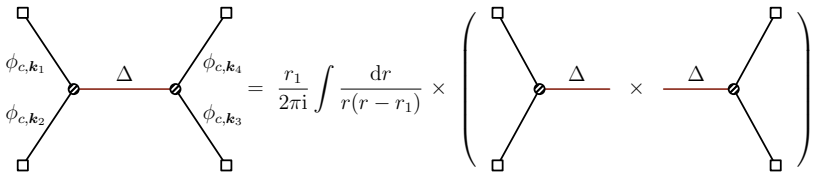
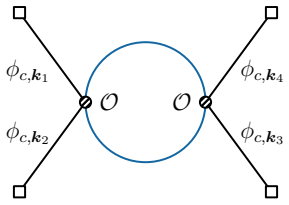
We develop a new bootstrap strategy for cosmological correlators at loop level, which we call spectral dispersion. It is based on two conceptual observations that a correlator can be recovered from its on-shell data, also known as nonlocal signals, by analyticity up to local counterterms, and that the on-shell data for a loop process take the form of a discrete sum over quasinormal modes. Technically, our method combines the dS spectral decomposition with dispersion relations. Using this technique, we bootstrap new results in a simple and intuitive form for 3-point and 4-point correlators with 1-loop massive exchanges of scalar and vector bosons, either directly or derivatively coupled.
What carries the argument
Spectral dispersion, the combination of dS spectral decomposition with dispersion relations that reconstructs correlators from discrete sums over quasinormal modes.
Load-bearing premise
The on-shell data for loop processes with the specified couplings can be expressed exactly as a discrete sum over quasinormal modes without residual contributions that would invalidate the dispersion relation reconstruction.
What would settle it
A direct perturbative calculation of a 3-point or 4-point correlator with 1-loop massive exchange that deviates from the expression obtained via the spectral dispersion bootstrap.
Figures



read the original abstract
We develop a new bootstrap strategy for cosmological correlators at loop level, which we call spectral dispersion. It is based on two conceptual observations that a correlator can be recovered from its on-shell data, also known as nonlocal signals, by analyticity up to local counterterms, and that the on-shell data for a loop process take the form of a discrete sum over quasinormal modes. Technically, our method combines the dS spectral decomposition with dispersion relations. Using this technique, we bootstrap new results in a simple and intuitive form for 3-point and 4-point correlators with 1-loop massive exchanges of scalar and vector bosons, either directly or derivatively coupled. Applications of this bootstrap technique to higher spins and higher-loop banana graphs with dS covariant dispersions but noncovariant couplings are also straightforward.
Editorial analysis
A structured set of objections, weighed in public.
Referee Report
Summary. The paper introduces a 'spectral dispersion' bootstrap technique for loop-level cosmological correlators in de Sitter space. It combines dS spectral decomposition with dispersion relations, claiming that a correlator can be recovered from its on-shell (nonlocal) data via analyticity up to local counterterms, and that the on-shell data for 1-loop processes with scalar/vector exchanges takes the exact form of a discrete sum over quasinormal modes. The method is applied to obtain new explicit results for 3-point and 4-point correlators involving 1-loop massive exchanges, either directly or derivatively coupled, with straightforward extensions noted for higher spins and banana graphs.
Significance. If the central reconstruction holds, the approach offers a structured alternative to direct loop integration for computing nonlocal signals in inflationary correlators, potentially yielding compact expressions for higher-point functions. The explicit use of quasinormal-mode sums and analyticity provides a falsifiable framework that could be tested against known limits or numerical evaluations, representing a technical advance in the bootstrap literature for cosmology.
major comments (2)
- [Section deriving the form of the on-shell data for loop processes] The load-bearing step is the assertion that on-shell data for the loop integrals with the stated scalar and vector couplings reduces exactly to a discrete QNM sum with no residual continuous or non-QNM contributions. This must be demonstrated explicitly (e.g., in the section deriving the on-shell data or the dispersion relation application) because any such residual would invalidate the subsequent analytic reconstruction of the correlators.
- [The applications to 3-point and 4-point correlators] The bootstrap of the 3-point and 4-point results relies on the dispersion relation step being free of additional nonlocal pieces. The manuscript should include a consistency check (e.g., taking a soft limit or comparing to a known tree-level case) showing that the reconstructed correlators match independent calculations where available.
minor comments (1)
- [Introduction] Clarify the precise definition of 'on-shell data' versus 'nonlocal signals' in the introductory paragraphs to avoid potential ambiguity for readers unfamiliar with the dS bootstrap literature.
Simulated Author's Rebuttal
We thank the referee for their careful reading of the manuscript and for the constructive major comments. We address each point below and agree that additional explicit demonstrations and checks will strengthen the presentation.
read point-by-point responses
-
Referee: [Section deriving the form of the on-shell data for loop processes] The load-bearing step is the assertion that on-shell data for the loop integrals with the stated scalar and vector couplings reduces exactly to a discrete QNM sum with no residual continuous or non-QNM contributions. This must be demonstrated explicitly (e.g., in the section deriving the on-shell data or the dispersion relation application) because any such residual would invalidate the subsequent analytic reconstruction of the correlators.
Authors: We agree that an explicit demonstration of the absence of residual continuous or non-QNM contributions is essential. The derivation in the section on the form of the on-shell data proceeds by applying the dS spectral decomposition to the loop integrals for the specified scalar and vector couplings (both direct and derivative). The resulting expression involves a contour integral whose non-QNM contributions cancel identically due to the analytic structure of the propagators and the specific momentum dependence of the vertices, leaving only the discrete sum over quasinormal-mode poles. To address the referee's request, we will add a dedicated subsection with intermediate steps (including explicit residue calculations and cancellation of the continuous spectrum) for both the scalar and vector cases. revision: yes
-
Referee: [The applications to 3-point and 4-point correlators] The bootstrap of the 3-point and 4-point results relies on the dispersion relation step being free of additional nonlocal pieces. The manuscript should include a consistency check (e.g., taking a soft limit or comparing to a known tree-level case) showing that the reconstructed correlators match independent calculations where available.
Authors: We thank the referee for this suggestion. The dispersion relations are constructed such that the on-shell data encode all nonlocal contributions, with local counterterms separated by analyticity. Nevertheless, we agree that an explicit consistency check is useful. In the revised manuscript we will add a soft-limit check on the bootstrapped 3-point correlator, reducing it to the known tree-level result for the corresponding massive exchange and verifying agreement (up to local terms). This will be presented alongside the main 3- and 4-point results. revision: yes
Circularity Check
No circularity: derivation combines standard analyticity with dS spectral decomposition to produce new bootstrap results.
full rationale
The paper states that correlators are recovered from on-shell data via analyticity (up to local counterterms) and that loop on-shell data take the form of discrete QNM sums. These are presented as conceptual observations drawn from dS spectral decomposition and dispersion relations, which are independent of the target 3- and 4-point correlators. The bootstrap then yields explicit new expressions for massive scalar/vector exchanges. No step reduces a claimed prediction to a fitted parameter, self-citation chain, or definitional tautology; the on-shell QNM representation is asserted as an input property of the loop integrals rather than derived from the final correlators themselves. The method is therefore self-contained against external benchmarks of analytic continuation and spectral methods.
Axiom & Free-Parameter Ledger
axioms (2)
- domain assumption A correlator can be recovered from its on-shell data by analyticity up to local counterterms
- domain assumption On-shell data for a loop process take the form of a discrete sum over quasinormal modes
Forward citations
Cited by 1 Pith paper
-
Massive Cosmological Correlators from Flat Space: a Laplace-Space Approach
A Laplace-space representation converts massive single-exchange cosmological correlators in de Sitter into a rapidly convergent series derived from flat-space integrals.
Reference graph
Works this paper leans on
-
[1]
Acoustic signatures in the primary microwave background bispectrum,
E. Komatsu and D. N. Spergel, “Acoustic signatures in the primary microwave background bispectrum,”Phys. Rev. D63(2001) 063002,arXiv:astro-ph/0005036
Pith/arXiv arXiv 2001
-
[2]
Non-Gaussian features of primordial fluctuations in single field inflationary models,
J. M. Maldacena, “Non-Gaussian features of primordial fluctuations in single field inflationary models,”JHEP05(2003) 013,arXiv:astro-ph/0210603
Pith/arXiv arXiv 2003
-
[3]
The Shape of non-Gaussianities,
D. Babich, P. Creminelli, and M. Zaldarriaga, “The Shape of non-Gaussianities,”JCAP 08(2004) 009,arXiv:astro-ph/0405356
Pith/arXiv arXiv 2004
-
[4]
Non-Gaussianity from inflation: Theory and observations,
N. Bartolo, E. Komatsu, S. Matarrese, and A. Riotto, “Non-Gaussianity from inflation: Theory and observations,”Phys. Rept.402(2004) 103–266,arXiv:astro-ph/0406398
Pith/arXiv arXiv 2004
-
[5]
Primordial Non-Gaussianities from Inflation Models,
X. Chen, “Primordial Non-Gaussianities from Inflation Models,”Adv. Astron.2010 (2010) 638979,arXiv:1002.1416 [astro-ph.CO]. [6]SPHERExCollaboration, O. Dor´ eet al., “Cosmology with the SPHEREX All-Sky Spectral Survey,”arXiv:1412.4872 [astro-ph.CO]
Pith/arXiv arXiv 2010
-
[6]
Primordial non-gaussianity from the bispectrum of 21-cm fluctuations in the dark ages,
J. B. Mu˜ noz, Y. Ali-Ha¨ ımoud, and M. Kamionkowski, “Primordial non-gaussianity from the bispectrum of 21-cm fluctuations in the dark ages,”Phys. Rev.D92no. 8, (2015) 083508,arXiv:1506.04152 [astro-ph.CO]
Pith/arXiv arXiv 2015
-
[7]
P. D. Meerburget al., “Primordial Non-Gaussianity,”Bull. Am. Astron. Soc.51no. 3, (2019) 107,arXiv:1903.04409 [astro-ph.CO]. [9]PlanckCollaboration, Y. Akramiet al., “Planck 2018 results. X. Constraints on inflation,”Astron. Astrophys.641(2020) A10,arXiv:1807.06211 [astro-ph.CO]. [10]PlanckCollaboration, Y. Akramiet al., “Planck 2018 results. IX. Constrai...
Pith/arXiv arXiv 2019
-
[8]
S. Ferraro, N. Sailer, A. Slosar, and M. White, “Snowmass2021 Cosmic Frontier White Paper: Cosmology and Fundamental Physics from the three-dimensional Large Scale Structure,”arXiv:2203.07506 [astro-ph.CO]. [13]Snowmass 2021 Cosmic Frontier 5 Topical GroupCollaboration, A. Liu, L. Newburgh, B. Saliwanchik, and A. Slosar, “Snowmass2021 Cosmic Frontier Whit...
arXiv 2021
-
[9]
Inflation: Theory and Observations,
A. Ach´ ucarroet al., “Inflation: Theory and Observations,”arXiv:2203.08128 [astro-ph.CO]
-
[10]
Constraining primordial non-Gaussianity with DESI 2024 LRG and QSO samples,
E. Chaussidonet al., “Constraining primordial non-Gaussianity with DESI 2024 LRG and QSO samples,”JCAP06(2025) 029,arXiv:2411.17623 [astro-ph.CO]. [16]EuclidCollaboration, A. Andrewset al., “Euclid: Field-level inference of primordial non-Gaussianity and cosmic initial conditions,”arXiv:2412.11945 [astro-ph.CO]. [17]Spec-S5Collaboration, R. Besuneret al.,...
arXiv 2024
-
[11]
Large non-Gaussianities with Intermediate Shapes from Quasi-Single Field Inflation,
X. Chen and Y. Wang, “Large non-Gaussianities with Intermediate Shapes from Quasi-Single Field Inflation,”Phys. Rev. D81(2010) 063511,arXiv:0909.0496 [astro-ph.CO]
Pith/arXiv arXiv 2010
-
[12]
Quasi-Single Field Inflation and Non-Gaussianities,
X. Chen and Y. Wang, “Quasi-Single Field Inflation and Non-Gaussianities,”JCAP1004 (2010) 027,arXiv:0911.3380 [hep-th]
Pith/arXiv arXiv 2010
-
[13]
Signatures of Supersymmetry from the Early Universe,
D. Baumann and D. Green, “Signatures of Supersymmetry from the Early Universe,” Phys. Rev.D85(2012) 103520,arXiv:1109.0292 [hep-th]
Pith/arXiv arXiv 2012
-
[14]
Quasi-Single Field Inflation with Large Mass,
X. Chen and Y. Wang, “Quasi-Single Field Inflation with Large Mass,”JCAP1209 (2012) 021,arXiv:1205.0160 [hep-th]
Pith/arXiv arXiv 2012
-
[15]
Effective field theory approach to quasi-single field inflation and effects of heavy fields,
T. Noumi, M. Yamaguchi, and D. Yokoyama, “Effective field theory approach to quasi-single field inflation and effects of heavy fields,”JHEP06(2013) 051, arXiv:1211.1624 [hep-th]
Pith/arXiv arXiv 2013
-
[16]
Cosmological Collider Physics,
N. Arkani-Hamed and J. Maldacena, “Cosmological Collider Physics,”arXiv:1503.08043 [hep-th]
-
[17]
Quantum Primordial Standard Clocks,
X. Chen, M. H. Namjoo, and Y. Wang, “Quantum Primordial Standard Clocks,”JCAP 1602no. 02, (2016) 013,arXiv:1509.03930 [astro-ph.CO]
Pith/arXiv arXiv 2016
-
[18]
Non-Gaussianity as a Particle Detector,
H. Lee, D. Baumann, and G. L. Pimentel, “Non-Gaussianity as a Particle Detector,” JHEP12(2016) 040,arXiv:1607.03735 [hep-th]
Pith/arXiv arXiv 2016
-
[19]
Prospects for Cosmological Collider Physics,
P. D. Meerburg, M. M¨ unchmeyer, J. B. Mu˜ noz, and X. Chen, “Prospects for Cosmological Collider Physics,”JCAP1703no. 03, (2017) 050,arXiv:1610.06559 [astro-ph.CO]
Pith/arXiv arXiv 2017
-
[20]
Standard Model Background of the Cosmological Collider,
X. Chen, Y. Wang, and Z.-Z. Xianyu, “Standard Model Background of the Cosmological Collider,”Phys. Rev. Lett.118no. 26, (2017) 261302,arXiv:1610.06597 [hep-th]. 44
Pith/arXiv arXiv 2017
-
[21]
Standard Model Mass Spectrum in Inflationary Universe,
X. Chen, Y. Wang, and Z.-Z. Xianyu, “Standard Model Mass Spectrum in Inflationary Universe,”JHEP04(2017) 058,arXiv:1612.08122 [hep-th]
Pith/arXiv arXiv 2017
-
[22]
Partially Massless Fields During Inflation,
D. Baumann, G. Goon, H. Lee, and G. L. Pimentel, “Partially Massless Fields During Inflation,”JHEP04(2018) 140,arXiv:1712.06624 [hep-th]
Pith/arXiv arXiv 2018
-
[23]
Neutrino Signatures in Primordial Non-Gaussianities,
X. Chen, Y. Wang, and Z.-Z. Xianyu, “Neutrino Signatures in Primordial Non-Gaussianities,”JHEP09(2018) 022,arXiv:1805.02656 [hep-ph]
Pith/arXiv arXiv 2018
-
[24]
A Cosmological Higgs Collider,
S. Lu, Y. Wang, and Z.-Z. Xianyu, “A Cosmological Higgs Collider,”JHEP02(2020) 011, arXiv:1907.07390 [hep-th]
arXiv 2020
-
[25]
Cosmological Collider Physics and the Curvaton,
S. Kumar and R. Sundrum, “Cosmological Collider Physics and the Curvaton,”JHEP04 (2020) 077,arXiv:1908.11378 [hep-ph]
arXiv 2020
-
[26]
Probing P and CP Violations on the Cosmological Collider,
T. Liu, X. Tong, Y. Wang, and Z.-Z. Xianyu, “Probing P and CP Violations on the Cosmological Collider,”JHEP04(2020) 189,arXiv:1909.01819 [hep-ph]
arXiv 2020
-
[27]
In Search of Large Signals at the Cosmological Collider,
L.-T. Wang and Z.-Z. Xianyu, “In Search of Large Signals at the Cosmological Collider,” JHEP02(2020) 044,arXiv:1910.12876 [hep-ph]
arXiv 2020
-
[28]
Gauge Boson Signals at the Cosmological Collider,
L.-T. Wang and Z.-Z. Xianyu, “Gauge Boson Signals at the Cosmological Collider,”JHEP 11(2020) 082,arXiv:2004.02887 [hep-ph]
arXiv 2020
-
[29]
The Scalar Chemical Potential in Cosmological Collider Physics,
A. Bodas, S. Kumar, and R. Sundrum, “The Scalar Chemical Potential in Cosmological Collider Physics,”JHEP02(2021) 079,arXiv:2010.04727 [hep-ph]
arXiv 2021
-
[30]
Missing scalars at the cosmological collider,
Q. Lu, M. Reece, and Z.-Z. Xianyu, “Missing scalars at the cosmological collider,”JHEP 12(2021) 098,arXiv:2108.11385 [hep-ph]
arXiv 2021
-
[31]
Probing Leptogenesis with the Cosmological Collider,
Y. Cui and Z.-Z. Xianyu, “Probing Leptogenesis with the Cosmological Collider,”Phys. Rev. Lett.129no. 11, (2022) 111301,arXiv:2112.10793 [hep-ph]
arXiv 2022
-
[32]
Large spin-2 signals at the cosmological collider,
X. Tong and Z.-Z. Xianyu, “Large spin-2 signals at the cosmological collider,”JHEP10 (2022) 194,arXiv:2203.06349 [hep-ph]
arXiv 2022
-
[33]
Large-field inflation and the cosmological collider,
M. Reece, L.-T. Wang, and Z.-Z. Xianyu, “Large-field inflation and the cosmological collider,”Phys. Rev. D107no. 10, (2023) L101304,arXiv:2204.11869 [hep-ph]
arXiv 2023
-
[34]
Classical cosmological collider physics and primordial features,
X. Chen, R. Ebadi, and S. Kumar, “Classical cosmological collider physics and primordial features,”JCAP08(2022) 083,arXiv:2205.01107 [hep-ph]
arXiv 2022
-
[35]
Phase information in cosmological collider signals,
Z. Qin and Z.-Z. Xianyu, “Phase information in cosmological collider signals,”JHEP10 (2022) 192,arXiv:2205.01692 [hep-th]
arXiv 2022
-
[36]
An Effective Cosmological Collider,
N. Craig, S. Kumar, and A. McCune, “An Effective Cosmological Collider,” arXiv:2401.10976 [hep-ph]. 45
-
[37]
BOSS Constraints on Massive Particles during Inflation: The Cosmological Collider in Action,
G. Cabass, O. H. E. Philcox, M. M. Ivanov, K. Akitsu, S.-F. Chen, M. Simonovi´ c, and M. Zaldarriaga, “BOSS Constraints on Massive Particles during Inflation: The Cosmological Collider in Action,”arXiv:2404.01894 [astro-ph.CO]
-
[38]
Searching for Cosmological Collider in the Planck CMB Data,
W. Sohn, D.-G. Wang, J. R. Fergusson, and E. P. S. Shellard, “Searching for Cosmological Collider in the Planck CMB Data,”arXiv:2404.07203 [astro-ph.CO]
-
[39]
The exact and approximate tales of boost-breaking cosmological correlators,
Z. Qin, S. Renaux-Petel, X. Tong, D. Werth, and Y. Zhu, “The exact and approximate tales of boost-breaking cosmological correlators,”JCAP09(2025) 058, arXiv:2506.01555 [hep-th]
arXiv 2025
-
[40]
Charged loops at the cosmological collider with chemical potential,
A. Bodas, E. Broadberry, R. Sundrum, and Z. Xu, “Charged loops at the cosmological collider with chemical potential,”JHEP01(2026) 083,arXiv:2507.22978 [hep-ph]
arXiv 2026
-
[41]
D. Anbajagane and H. Lee, “Primordial Physics in the Nonlinear Universe: mapping cosmological collider models to weak-lensing observables,”arXiv:2509.02693 [astro-ph.CO]
-
[42]
Warped dimensions at the cosmological collider,
S. Kumar and M. Nee, “Warped dimensions at the cosmological collider,”JHEP04(2026) 035,arXiv:2510.19900 [hep-ph]
arXiv 2026
-
[43]
Open Effective Field Theory and the Physics of Cosmological Collider Signals,
T. Colas, Z. Qin, and X. Tong, “Open Effective Field Theory and the Physics of Cosmological Collider Signals,”arXiv:2512.07941 [hep-th]
-
[44]
P. Suman, D.-G. Wang, W. Sohn, J. R. Fergusson, and E. P. S. Shellard, “Searching for Cosmological Collider in the Planck CMB Data II: collider templates and Modal analysis,” arXiv:2512.22085 [astro-ph.CO]
-
[45]
Strongly Coupled Sectors in Inflation: Gapped Theories of Unparticles,
Y. Jiang, G. L. Pimentel, and C. Yang, “Strongly Coupled Sectors in Inflation: Gapped Theories of Unparticles,”arXiv:2512.23796 [hep-th]
-
[46]
Amplifying the Cosmological Collider with Ghost Spectators,
M. C. Ferreira, F. T. Falciano, and G. L. Pimentel, “Amplifying the Cosmological Collider with Ghost Spectators,”arXiv:2601.14413 [hep-th]
-
[47]
Extending the Cosmological Collider: New Scaling Regimes and Constraints from BOSS,
D. Green, J. Han, and B. Wallisch, “Extending the Cosmological Collider: New Scaling Regimes and Constraints from BOSS,”arXiv:2602.12232 [astro-ph.CO]
-
[48]
Searching for Unparticles with the Cosmic Microwave Background,
O. H. E. Philcox, G. L. Pimentel, and C. Yang, “Searching for Unparticles with the Cosmic Microwave Background,”arXiv:2603.13486 [astro-ph.CO]
-
[49]
Cosmological Collider Searches beyond the Hubble Scale with Planck Data,
S. Kumar, Q. Lu, Z.-Z. Xianyu, and Y. Zhang, “Cosmological Collider Searches beyond the Hubble Scale with Planck Data,”arXiv:2603.15728 [hep-ph]
-
[50]
What Shape is the Inflationary Bispectrum?,
O. H. E. Philcox, “What Shape is the Inflationary Bispectrum?,”arXiv:2603.17004 [astro-ph.CO]
-
[51]
Cosmological collider signals of modular spontaneous CP breaking,
S. Aoki and A. Strumia, “Cosmological collider signals of modular spontaneous CP breaking,”arXiv:2604.05548 [hep-ph]. 46
-
[52]
S. Kumar, Q. Lu, Z.-Z. Xianyu, and Y. Zhang, “Scalars at the Cosmological Collider: Full Shapes of Tree Diagrams and Bispectrum Searches using Planck Data,” arXiv:2604.07434 [hep-ph]
-
[53]
Cosmological Collider Signatures from Right-Handed Neutrino Loop,
J. You, L. Song, C. Han, H.-J. He, X. Chen, and Z.-Z. Xianyu, “Cosmological Collider Signatures from Right-Handed Neutrino Loop,”arXiv:2605.21419 [hep-ph]
-
[54]
Cosmological Collider in the Grassmannian,
M. Arundine and G. L. Pimentel, “Cosmological Collider in the Grassmannian,” arXiv:2605.21581 [hep-th]
-
[55]
S. Aoki, Z. Qin, M. Yamaguchi, and Y. Zhu, “Fermionic Bubble Loop in Cosmological Collider Revisited: Exact signals from spectral and Mellin-Barnes methods,” arXiv:2605.28054 [hep-th]
-
[56]
Schwinger-Keldysh Diagrammatics for Primordial Perturbations,
X. Chen, Y. Wang, and Z.-Z. Xianyu, “Schwinger-Keldysh Diagrammatics for Primordial Perturbations,”JCAP1712no. 12, (2017) 006,arXiv:1703.10166 [hep-th]
Pith/arXiv arXiv 2017
-
[57]
Quantum contributions to cosmological correlations,
S. Weinberg, “Quantum contributions to cosmological correlations,”Phys. Rev. D72 (2005) 043514,arXiv:hep-th/0506236
Pith/arXiv arXiv 2005
-
[58]
Brownian motion of a quantum oscillator,
J. S. Schwinger, “Brownian motion of a quantum oscillator,”J. Math. Phys.2(1961) 407–432
1961
-
[59]
The Theory of a general quantum system interacting with a linear dissipative system,
R. P. Feynman and F. L. Vernon, Jr., “The Theory of a general quantum system interacting with a linear dissipative system,”Annals Phys.24(1963) 118–173
1963
-
[60]
Diagram technique for nonequilibrium processes,
L. V. Keldysh, “Diagram technique for nonequilibrium processes,”Zh. Eksp. Teor. Fiz.47 (1964) 1515–1527
1964
-
[61]
Snowmass White Paper: The Cosmological Bootstrap,
D. Baumann, D. Green, A. Joyce, E. Pajer, G. L. Pimentel, C. Sleight, and M. Taronna, “Snowmass White Paper: The Cosmological Bootstrap,” in2022 Snowmass Summer Study. 3, 2022.arXiv:2203.08121 [hep-th]
arXiv 2022
-
[62]
The Cosmological Bootstrap: Inflationary Correlators from Symmetries and Singularities,
N. Arkani-Hamed, D. Baumann, H. Lee, and G. L. Pimentel, “The Cosmological Bootstrap: Inflationary Correlators from Symmetries and Singularities,”JHEP04(2020) 105,arXiv:1811.00024 [hep-th]
arXiv 2020
-
[63]
The cosmological bootstrap: weight-shifting operators and scalar seeds,
D. Baumann, C. Duaso Pueyo, A. Joyce, H. Lee, and G. L. Pimentel, “The cosmological bootstrap: weight-shifting operators and scalar seeds,”JHEP12(2020) 204, arXiv:1910.14051 [hep-th]
arXiv 2020
-
[64]
Boostless cosmological collider bootstrap,
G. L. Pimentel and D.-G. Wang, “Boostless cosmological collider bootstrap,”JHEP10 (2022) 177,arXiv:2205.00013 [hep-th]
arXiv 2022
-
[65]
Cosmological bootstrap in slow motion,
S. Jazayeri and S. Renaux-Petel, “Cosmological bootstrap in slow motion,”JHEP12 (2022) 137,arXiv:2205.10340 [hep-th]
arXiv 2022
-
[66]
Helical inflation correlators: partial Mellin-Barnes and bootstrap equations,
Z. Qin and Z.-Z. Xianyu, “Helical inflation correlators: partial Mellin-Barnes and bootstrap equations,”JHEP04(2023) 059,arXiv:2208.13790 [hep-th]. 47
arXiv 2023
-
[67]
Closed-form formulae for inflation correlators,
Z. Qin and Z.-Z. Xianyu, “Closed-form formulae for inflation correlators,”JHEP07 (2023) 001,arXiv:2301.07047 [hep-th]
arXiv 2023
-
[68]
Analytic formulae for inflationary correlators with dynamical mass,
S. Aoki, T. Noumi, F. Sano, and M. Yamaguchi, “Analytic formulae for inflationary correlators with dynamical mass,”JHEP03(2024) 073,arXiv:2312.09642 [hep-th]
arXiv 2024
-
[69]
Cosmological Correlators with Double Massive Exchanges: Bootstrap Equation and Phenomenology,
S. Aoki, L. Pinol, F. Sano, M. Yamaguchi, and Y. Zhu, “Cosmological Correlators with Double Massive Exchanges: Bootstrap Equation and Phenomenology,” arXiv:2404.09547 [hep-th]
-
[70]
Massive Inflationary Amplitudes: Differential Equations and Complete Solutions for General Trees,
H. Liu and Z.-Z. Xianyu, “Massive Inflationary Amplitudes: Differential Equations and Complete Solutions for General Trees,”arXiv:2412.07843 [hep-th]
-
[71]
Massive inflationary amplitudes: new representations and degenerate limits,
Z.-Z. Xianyu and J. Zang, “Massive inflationary amplitudes: new representations and degenerate limits,”JHEP03(2026) 122,arXiv:2511.08677 [hep-th]
arXiv 2026
-
[72]
Differential Equations for Massive Correlators,
D. Baumann, A. Joyce, H. Lee, and K. Salehi Vaziri, “Differential Equations for Massive Correlators,”arXiv:2604.08658 [hep-th]
-
[73]
Cosmological correlators at the loop level,
Z. Qin, “Cosmological correlators at the loop level,”JHEP03(2025) 051, arXiv:2411.13636 [hep-th]
arXiv 2025
-
[74]
Inflation correlators with multiple massive exchanges,
Z.-Z. Xianyu and J. Zang, “Inflation correlators with multiple massive exchanges,”JHEP 03(2024) 070,arXiv:2309.10849 [hep-th]
arXiv 2024
-
[75]
Cosmological Amplitudes in Power-Law FRW Universe,
B. Fan and Z.-Z. Xianyu, “Cosmological Amplitudes in Power-Law FRW Universe,” arXiv:2403.07050 [hep-th]
-
[76]
Anatomy of family trees in cosmological correlators,
B. Fan and Z.-Z. Xianyu, “Anatomy of family trees in cosmological correlators,”JHEP12 (2025) 179,arXiv:2509.02684 [hep-th]
arXiv 2025
-
[77]
The inflationary wavefunction from analyticity and factorization,
D. Meltzer, “The inflationary wavefunction from analyticity and factorization,”JCAP12 no. 12, (2021) 018,arXiv:2107.10266 [hep-th]
arXiv 2021
-
[78]
Dispersive bootstrap of massive inflation correlators,
H. Liu, Z. Qin, and Z.-Z. Xianyu, “Dispersive bootstrap of massive inflation correlators,” JHEP02(2025) 101,arXiv:2407.12299 [hep-th]
arXiv 2025
-
[79]
Spectral representation of cosmological correlators,
D. Werth, “Spectral representation of cosmological correlators,”JHEP12(2024) 017, arXiv:2409.02072 [hep-th]
arXiv 2024
-
[80]
N. Belrhali, A. Poisson, S. Renaux-Petel, and D. Werth, “De Sitter Momentum Space,” arXiv:2601.15228 [hep-th]
discussion (0)
Sign in with ORCID, Apple, or X to comment. Anyone can read and Pith papers without signing in.