Majoron Dark Matter, High-Scale Seesaw, and Leptogenesis
Pith reviewed 2026-06-28 13:21 UTC · model grok-4.3
The pith
In high-scale seesaw models with broken lepton number, the majoron can serve as stable sub-MeV dark matter.
A machine-rendered reading of the paper's core claim, the machinery that carries it, and where it could break.
Core claim
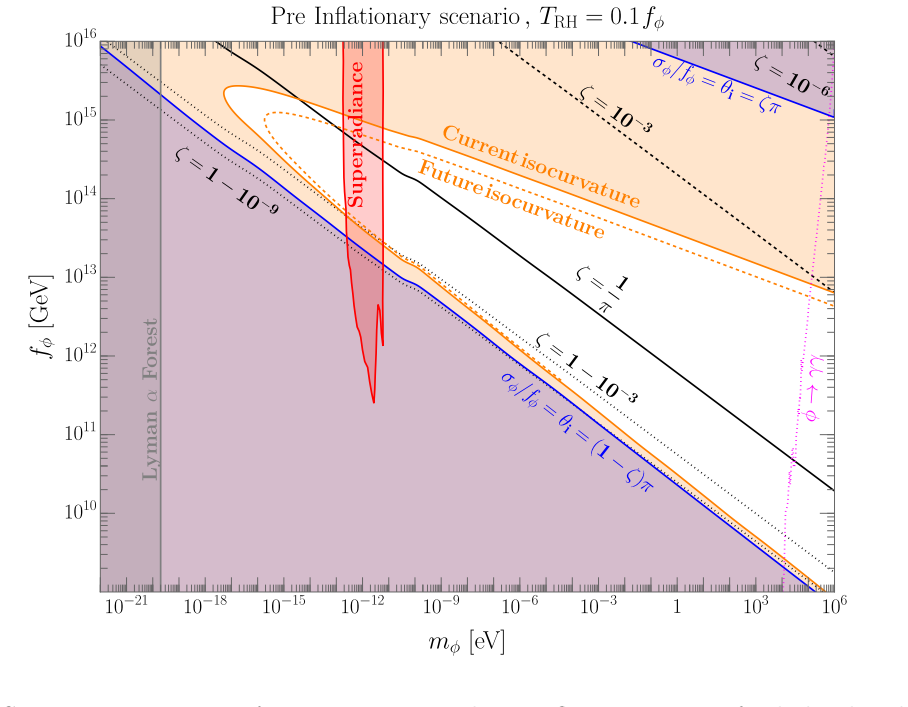
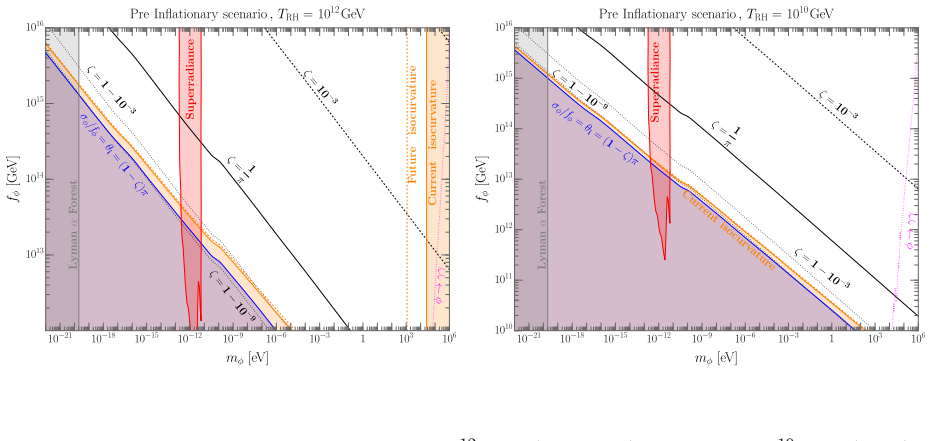
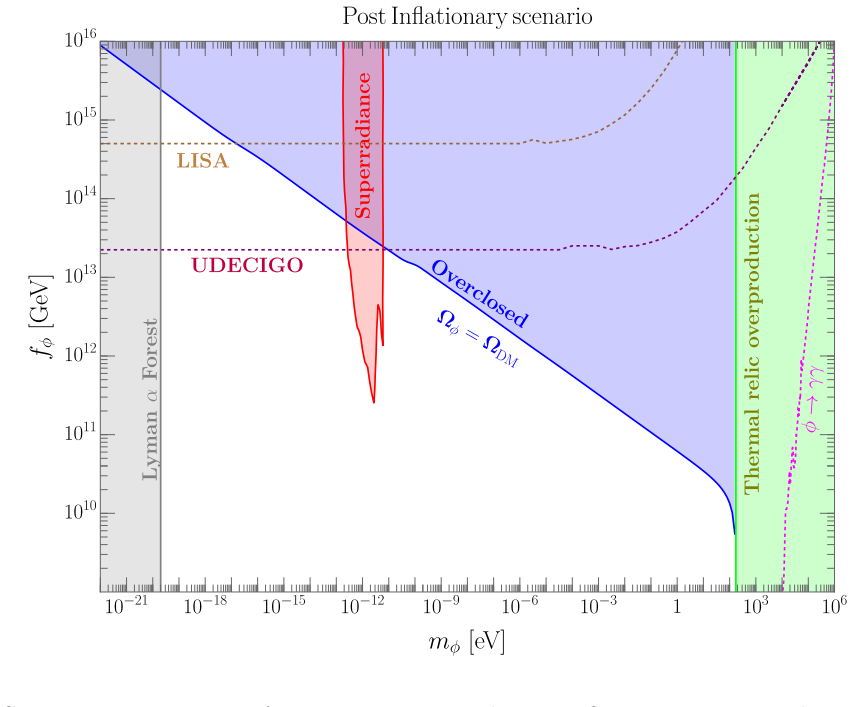
We study the cosmology and observational probes of majoron dark matter in a high-scale seesaw framework with spontaneously broken lepton number. Right-handed neutrinos naturally generate light neutrino masses and can realize thermal leptogenesis, while the associated majoron is a light pseudo-Nambu-Goldstone boson that can be cosmologically stable and serve as a viable dark matter candidate for sub-MeV masses. We analyze both pre-inflationary and post-inflationary histories of lepton number breaking. In the pre-inflationary scenario, majoron dark matter is produced by misalignment and constrained by CMB isocurvature. In the post-inflationary scenario, the majoron abundance receives nontherma
What carries the argument
The majoron, a light pseudo-Nambu-Goldstone boson from spontaneous lepton number breaking, whose abundance is set by misalignment, cosmic string radiation, and domain wall collapse.
If this is right
- Majoron dark matter receives nonthermal contributions from cosmic string radiation and domain wall collapse in post-inflationary breaking.
- CMB isocurvature bounds apply directly to the pre-inflationary breaking case.
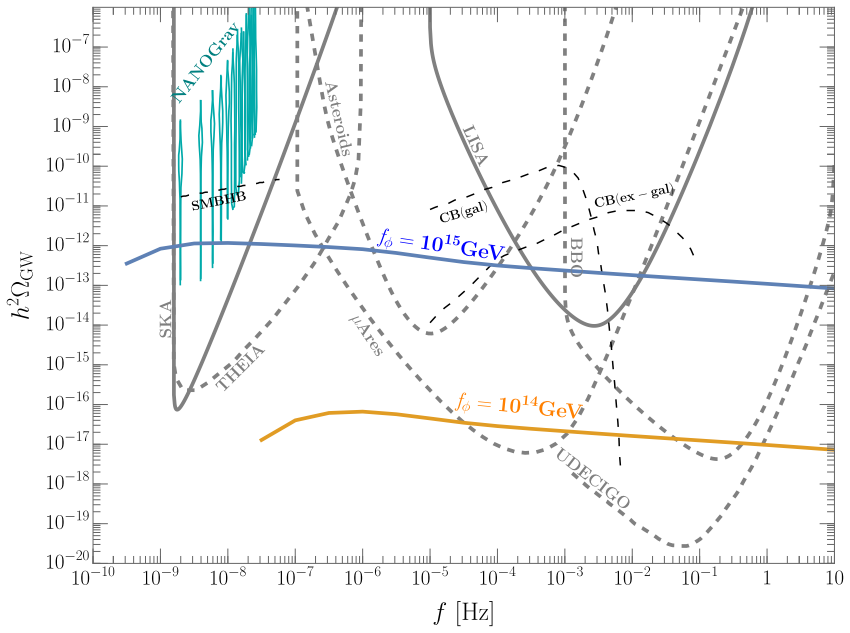
- Future gravitational wave detectors can test the string network contribution to the majoron abundance.
- X-ray, soft gamma-ray, black hole superradiance, and Lyman-alpha observations constrain the viable majoron mass and coupling ranges.
Where Pith is reading between the lines
- If majoron dark matter is detected, its mass and production history would directly constrain the scale of lepton number breaking tied to leptogenesis.
- Non-observation of the predicted gravitational wave signal would force either pre-inflationary breaking or additional suppression mechanisms for the string contribution.
- The same framework could be extended to include other pseudo-Goldstone bosons from different global symmetries to test whether the majoron is unique in serving as dark matter.
Load-bearing premise
Lepton number is spontaneously broken at a high scale such that the majoron remains light, stable, and its abundance is determined by the listed production mechanisms without dominant additional effects.
What would settle it
Observation or non-observation of a stochastic gravitational wave background at frequencies set by the cosmic string network scale in the post-inflationary lepton number breaking scenario would confirm or rule out one of the major production channels.
Figures

read the original abstract
We study the cosmology and observational probes of majoron dark matter in a high-scale seesaw framework with spontaneously broken lepton number. Right-handed neutrinos naturally generate light neutrino masses and can realize thermal leptogenesis, while the associated majoron is a light pseudo-Nambu-Goldstone boson that can be cosmologically stable and serve as a viable dark matter candidate for sub-MeV masses. We analyze both pre-inflationary and post-inflationary histories of lepton number breaking. In the pre-inflationary scenario, majoron dark matter is produced by misalignment and constrained by CMB isocurvature. In the post-inflationary scenario, the majoron abundance receives nonthermal contributions from spatially averaged misalignment, majoron radiation from global cosmic strings, and the collapse of the string-domain wall network, as well as a thermally produced component. This scenario can also be probed by future searches for the stochastic gravitational wave background produced by cosmic strings. We map the viable majoron dark matter parameter space and examine complementary probes from X-ray and soft gamma ray searches for majoron decays to photons, black hole superradiance, and Lyman-$\alpha$ forest observations. These results demonstrate that majoron dark matter offers a distinctive cosmological probe of high-scale lepton number breaking and thermal leptogenesis.
Editorial analysis
A structured set of objections, weighed in public.
Referee Report
Summary. The manuscript studies majoron dark matter in a high-scale seesaw framework with spontaneous lepton-number breaking. Right-handed neutrinos generate light neutrino masses and enable thermal leptogenesis; the associated majoron is treated as a light pseudo-Nambu-Goldstone boson that remains cosmologically stable for sub-MeV masses. Production mechanisms are analyzed in both pre-inflationary (misalignment, CMB isocurvature) and post-inflationary (spatially averaged misalignment, global-string radiation, domain-wall collapse, plus thermal production) scenarios. The viable parameter space is mapped under standard constraints from X-ray/soft-gamma searches, black-hole superradiance, and Lyman-α forest data, with an additional probe via the stochastic gravitational-wave background from cosmic strings.
Significance. If the production calculations and stability assumptions hold, the work supplies a concrete cosmological link between high-scale lepton-number violation, thermal leptogenesis, and observable dark-matter phenomenology, including falsifiable predictions for future gravitational-wave and X-ray searches.
minor comments (1)
- The abstract refers to 'the listed production mechanisms' and 'standard constraints' without specifying the explicit breaking scale or the form of the majoron potential; a dedicated section or appendix deriving the mass and couplings from the high-scale seesaw would clarify the parameter counting.
Simulated Author's Rebuttal
We thank the referee for their summary of the manuscript and for noting its potential significance in connecting high-scale lepton-number violation, thermal leptogenesis, and majoron dark matter phenomenology. We appreciate the recognition of the falsifiable predictions for gravitational-wave and X-ray searches. No specific major comments were raised in the report, so we offer no point-by-point responses below. We remain available to address any further questions or clarifications the referee may wish to provide.
Circularity Check
No significant circularity
full rationale
The paper presents a standard parameter-space analysis of majoron dark matter production via misalignment, cosmic-string radiation, domain-wall collapse, and thermal mechanisms in a high-scale lepton-number-breaking seesaw model. The majoron mass and decay constant are treated as free inputs set by the explicit breaking scale; abundances and constraints (isocurvature, X-ray bounds, superradiance, Lyman-α) are computed from those inputs using conventional cosmological formulas without any step that reduces a claimed prediction back to a fitted quantity or self-citation by construction. No self-definitional relations, fitted-input predictions, or load-bearing self-citations appear in the derivation chain.
Axiom & Free-Parameter Ledger
axioms (2)
- domain assumption Lepton number is spontaneously broken at a high scale in a seesaw framework
- domain assumption The majoron is a pseudo-Nambu-Goldstone boson that can remain cosmologically stable
invented entities (1)
-
majoron dark matter
no independent evidence
Forward citations
Cited by 1 Pith paper
-
Torsional four-fermion interaction for Majorana neutrinos
Torsion-induced four-fermion interactions modify effective masses and mixing parameters for Majorana neutrinos with sterile partners in matter.
Reference graph
Works this paper leans on
-
[1]
1 We further assume the existence of terms that explicitly break lepton number and generate a potential for the majoron field
The complex scalar fieldσis parameterized as σ= fϕ√ 2 eiϕ/fϕ,(2) whereϕis the majoron, the pseudo-Nambu-Goldstone boson associated with spontaneous lepton number breaking. 1 We further assume the existence of terms that explicitly break lepton number and generate a potential for the majoron field. While we are agnostic about their origin, such terms could...
-
[2]
Majorons heavier than the MeV-scale and below the muon mass decay dominantly to electron-positron pairs
larger values that satisfy the perturbativity of the Yukawa couplings, max(y ij)< √ 4π. Majorons heavier than the MeV-scale and below the muon mass decay dominantly to electron-positron pairs. The partial decay rate is given by [22] Γϕ→ee = |gϕee|2mϕ 8π 1− 4m2 e m2 ϕ !1/2 ,(12) whereg ϕee is the one-loop majoron-electron coupling, gϕee = me 8π2v −1 2TrK+K...
-
[3]
(20), in- cluding the factorF(ζ) that accounts for anharmonic effects
Majoron relic abundance The majoron relic abundance due to misalignment production is given in Eq. (20), in- cluding the factorF(ζ) that accounts for anharmonic effects. In this appendix we describe our numerical approach to estimatingF(ζ). The equation of motion for the majoron back- ground,θ 0(t) =ϕ 0(t)/fϕ, in the radiation-dominated epoch (H= 1/(2t)),...
-
[4]
We determineF iso(ζ) numerically using method described below
Majoron isocurvature perturbations The amplitude of the isocurvature power spectrum (25) depends on the anharmonic factor Fiso(ζ). We determineF iso(ζ) numerically using method described below. To compute the isocurvature power spectrum, we consider perturbations of the majoron about its homogeneous, time-dependent background,θ(t,x) =θ 0(t) +θ 1(t,x). Wor...
-
[5]
Minkowski,µ→eγat a Rate of One Out of10 9 Muon Decays?,Phys
P. Minkowski,µ→eγat a Rate of One Out of10 9 Muon Decays?,Phys. Lett. B67(1977) 421
1977
-
[6]
Yanagida,Horizontal gauge symmetry and masses of neutrinos,Conf
T. Yanagida,Horizontal gauge symmetry and masses of neutrinos,Conf. Proc. C7902131 (1979) 95
1979
-
[7]
M. Gell-Mann, P. Ramond and R. Slansky,Complex Spinors and Unified Theories,Conf. Proc. C790927(1979) 315 [1306.4669]
Pith/arXiv arXiv 1979
-
[8]
Glashow,The Future of Elementary Particle Physics,NATO Sci
S.L. Glashow,The Future of Elementary Particle Physics,NATO Sci. Ser. B61(1980) 687
1980
-
[9]
Mohapatra and G
R.N. Mohapatra and G. Senjanovic,Neutrino Mass and Spontaneous Parity Nonconservation,Phys. Rev. Lett.44(1980) 912
1980
-
[10]
Schechter and J.W.F
J. Schechter and J.W.F. Valle,Neutrino Masses in SU(2) x U(1) Theories,Phys. Rev. D 22(1980) 2227
1980
-
[11]
Fukugita and T
M. Fukugita and T. Yanagida,Baryogenesis Without Grand Unification,Phys. Lett. B174 (1986) 45
1986
-
[12]
Chikashige, R.N
Y. Chikashige, R.N. Mohapatra and R.D. Peccei,Spontaneously Broken Lepton Number and Cosmological Constraints on the Neutrino Mass Spectrum,Phys. Rev. Lett.45(1980) 1926
1980
-
[13]
Chikashige, R.N
Y. Chikashige, R.N. Mohapatra and R.D. Peccei,Are There Real Goldstone Bosons Associated with Broken Lepton Number?,Phys. Lett. B98(1981) 265
1981
-
[14]
Gelmini and M
G.B. Gelmini and M. Roncadelli,Left-Handed Neutrino Mass Scale and Spontaneously Broken Lepton Number,Phys. Lett. B99(1981) 411
1981
-
[15]
D.J.E. Marsh,Axion Cosmology,Phys. Rept.643(2016) 1 [1510.07633]. 31
Pith/arXiv arXiv 2016
-
[16]
O’Hare,Cosmology of axion dark matter,PoSCOSMICWISPers(2024) 040 [2403.17697]
C.A.J. O’Hare,Cosmology of axion dark matter,PoSCOSMICWISPers(2024) 040 [2403.17697]
arXiv 2024
-
[17]
E.K. Akhmedov, Z.G. Berezhiani, R.N. Mohapatra and G. Senjanovic,Planck scale effects on the majoron,Phys. Lett. B299(1993) 90 [hep-ph/9209285]
Pith/arXiv arXiv 1993
-
[18]
J.M. Cline, K. Kainulainen and K.A. Olive,Constraints on majoron models, neutrino masses and baryogenesis,Astropart. Phys.1(1993) 387 [hep-ph/9304229]
Pith/arXiv arXiv 1993
-
[19]
I.Z. Rothstein, K.S. Babu and D. Seckel,Planck scale symmetry breaking and majoron physics,Nucl. Phys. B403(1993) 725 [hep-ph/9301213]
Pith/arXiv arXiv 1993
-
[20]
V. Berezinsky and J.W.F. Valle,The KeV majoron as a dark matter particle,Phys. Lett. B 318(1993) 360 [hep-ph/9309214]
Pith/arXiv arXiv 1993
-
[21]
D. Kazanas, R.N. Mohapatra, S. Nasri and V.L. Teplitz,Neutrino mass, dark matter and inflation,Phys. Rev. D70(2004) 033015 [hep-ph/0403291]
Pith/arXiv arXiv 2004
-
[22]
S.M. Boucenna, S. Morisi, Q. Shafi and J.W.F. Valle,Inflation and majoron dark matter in the seesaw mechanism,Phys. Rev. D90(2014) 055023 [1404.3198]
Pith/arXiv arXiv 2014
-
[23]
M. Lattanzi and J.W.F. Valle,Decaying warm dark matter and neutrino masses,Phys. Rev. Lett.99(2007) 121301 [0705.2406]
Pith/arXiv arXiv 2007
-
[24]
F. Bazzocchi, M. Lattanzi, S. Riemer-Sørensen and J.W.F. Valle,X-ray photons from late-decaying majoron dark matter,JCAP08(2008) 013 [0805.2372]
Pith/arXiv arXiv 2008
-
[25]
M. Lattanzi, S. Riemer-Sorensen, M. Tortola and J.W.F. Valle,Updated CMB and x- and γ-ray constraints on Majoron dark matter,Phys. Rev. D88(2013) 063528 [1303.4685]
Pith/arXiv arXiv 2013
-
[26]
C. Garcia-Cely and J. Heeck,Neutrino Lines from Majoron Dark Matter,JHEP05(2017) 102 [1701.07209]
Pith/arXiv arXiv 2017
-
[27]
McKeen,Cosmic neutrino background search experiments as decaying dark matter detectors,Phys
D. McKeen,Cosmic neutrino background search experiments as decaying dark matter detectors,Phys. Rev. D100(2019) 015028 [1812.08178]
Pith/arXiv arXiv 2019
-
[28]
J.N. Esteves, F.R. Joaquim, A.S. Joshipura, J.C. Romao, M.A. Tortola and J.W.F. Valle, A4-based neutrino masses with Majoron decaying dark matter,Phys. Rev. D82(2010) 073008 [1007.0898]
Pith/arXiv arXiv 2010
-
[29]
J. Heeck and D. Teresi,Cold keV dark matter from decays and scatterings,Phys. Rev. D96 (2017) 035018 [1706.09909]
Pith/arXiv arXiv 2017
-
[30]
S.K. Manna and A. Sil,Majorons revisited: Light dark matter as a FIMP,Phys. Rev. D 108(2023) 075026 [2212.08404]. 32
arXiv 2023
- [31]
-
[32]
M. Reig, J.W.F. Valle and M. Yamada,Light majoron cold dark matter from topological defects and the formation of boson stars,JCAP09(2019) 029 [1905.01287]
arXiv 2019
-
[33]
P.-H. Gu, E. Ma and U. Sarkar,Pseudo-Majoron as Dark Matter,Phys. Lett. B690(2010) 145 [1004.1919]
Pith/arXiv arXiv 2010
-
[34]
M. Frigerio, T. Hambye and E. Masso,Sub-GeV dark matter as pseudo-Goldstone from the seesaw scale,Phys. Rev. X1(2011) 021026 [1107.4564]
Pith/arXiv arXiv 2011
-
[35]
F.S. Queiroz and K. Sinha,The Poker Face of the Majoron Dark Matter Model: LUX to keV Line,Phys. Lett. B735(2014) 69 [1404.1400]
Pith/arXiv arXiv 2014
-
[36]
M. Ibe and K. Kaneta,Spontaneous thermal Leptogenesis via Majoron oscillation,Phys. Rev. D92(2015) 035019 [1504.04125]
Pith/arXiv arXiv 2015
-
[37]
N. Rojas, R.A. Lineros and F. Gonzalez-Canales,Majoron Dark Matter From a Spontaneous Inverse Seesaw Model,1703.03416
-
[38]
B. Shakya and J.D. Wells,Exotic Sterile Neutrinos and Pseudo-Goldstone Phenomenology, JHEP02(2019) 174 [1801.02640]
Pith/arXiv arXiv 2019
-
[39]
T. Brune and H. P¨ as,Massive Majorons and constraints on the Majoron-neutrino coupling, Phys. Rev. D99(2019) 096005 [1808.08158]
Pith/arXiv arXiv 2019
-
[40]
J. Heeck and H.H. Patel,Majoron at two loops,Phys. Rev. D100(2019) 095015 [1909.02029]
arXiv 2019
- [41]
-
[42]
A. de Giorgi, L. Merlo, X. Ponce D´ ıaz and S. Rigolin,The minimal massive Majoron Seesaw Model,JHEP03(2024) 094 [2312.13417]
arXiv 2024
-
[43]
K. Akita and M. Niibo,Updated constraints and future prospects on majoron dark matter, JHEP07(2023) 132 [2304.04430]
arXiv 2023
- [44]
-
[45]
R. Alonso and A. Urbano,Wormholes and masses for Goldstone bosons,JHEP02(2019) 136 [1706.07415]
Pith/arXiv arXiv 2019
-
[46]
Sikivie,Of Axions, Domain Walls and the Early Universe,Phys
P. Sikivie,Of Axions, Domain Walls and the Early Universe,Phys. Rev. Lett.48(1982) 33 1156
1982
-
[47]
Vilenkin and A.E
A. Vilenkin and A.E. Everett,Cosmic Strings and Domain Walls in Models with Goldstone and PseudoGoldstone Bosons,Phys. Rev. Lett.48(1982) 1867
1982
-
[48]
S. Chang, C. Hagmann and P. Sikivie,Studies of the motion and decay of axion walls bounded by strings,Phys. Rev. D59(1999) 023505 [hep-ph/9807374]
Pith/arXiv arXiv 1999
-
[49]
T. Hiramatsu, M. Kawasaki, K. Saikawa and T. Sekiguchi,Production of dark matter axions from collapse of string-wall systems,Phys. Rev. D85(2012) 105020 [1202.5851]
Pith/arXiv arXiv 2012
-
[50]
Z. Maki, M. Nakagawa and S. Sakata,Remarks on the unified model of elementary particles,Prog. Theor. Phys.28(1962) 870
1962
-
[51]
Pontecorvo,Neutrino Experiments and the Problem of Conservation of Leptonic Charge, Sov
B. Pontecorvo,Neutrino Experiments and the Problem of Conservation of Leptonic Charge, Sov. Phys. JETP26(1968) 984
1968
-
[52]
J.A. Casas and A. Ibarra,Oscillating neutrinos andµ→e, γ,Nucl. Phys. B618(2001) 171 [hep-ph/0103065]
Pith/arXiv arXiv 2001
-
[53]
W. Buchmuller, P. Di Bari and M. Plumacher,Leptogenesis for pedestrians,Annals Phys. 315(2005) 305 [hep-ph/0401240]. [50]Planckcollaboration,Planck 2018 results. VI. Cosmological parameters,Astron. Astrophys.641(2020) A6 [1807.06209]
Pith/arXiv arXiv 2005
- [54]
-
[55]
L. Covi, E. Roulet and F. Vissani,CP violating decays in leptogenesis scenarios,Phys. Lett. B384(1996) 169 [hep-ph/9605319]
Pith/arXiv arXiv 1996
-
[56]
S. Davidson and A. Ibarra,A Lower bound on the right-handed neutrino mass from leptogenesis,Phys. Lett. B535(2002) 25 [hep-ph/0202239]
Pith/arXiv arXiv 2002
-
[57]
I. Esteban, M.C. Gonzalez-Garcia, M. Maltoni, I. Martinez-Soler, J.P. Pinheiro and T. Schwetz,NuFit-6.0: updated global analysis of three-flavor neutrino oscillations,JHEP 12(2024) 216 [2410.05380]
Pith/arXiv arXiv 2024
-
[58]
E. Nardi, Y. Nir, E. Roulet and J. Racker,The Importance of flavor in leptogenesis,JHEP 01(2006) 164 [hep-ph/0601084]
Pith/arXiv arXiv 2006
-
[59]
A. Abada, S. Davidson, A. Ibarra, F.X. Josse-Michaux, M. Losada and A. Riotto,Flavour Matters in Leptogenesis,JHEP09(2006) 010 [hep-ph/0605281]. 34
Pith/arXiv arXiv 2006
-
[60]
G.F. Giudice, A. Notari, M. Raidal, A. Riotto and A. Strumia,Towards a complete theory of thermal leptogenesis in the SM and MSSM,Nucl. Phys. B685(2004) 89 [hep-ph/0310123]
Pith/arXiv arXiv 2004
-
[61]
A. Pilaftsis and T.E.J. Underwood,Resonant leptogenesis,Nucl. Phys. B692(2004) 303 [hep-ph/0309342]. [59]Particle Data Groupcollaboration,Review of particle physics,Phys. Rev. D110(2024) 030001
Pith/arXiv arXiv 2004
-
[62]
D. Naredo-Tuero, M. Escudero, E. Fern´ andez-Mart´ ınez, X. Marcano and V. Poulin,Critical look at the cosmological neutrino mass bound,Phys. Rev. D110(2024) 123537 [2407.13831]
arXiv 2024
-
[63]
P. De la Torre Luque, S. Balaji and J. Silk,New 511 keV line data provides strongest sub-GeV dark matter constraints,2312.04907
-
[64]
C.A. Arg¨ uelles, D. Delgado, A. Friedlander, A. Kheirandish, I. Safa, A.C. Vincent et al., Dark matter decay to neutrinos,Phys. Rev. D108(2023) 123021 [2210.01303]
arXiv 2023
-
[65]
Linde,Inflation and Axion Cosmology,Phys
A.D. Linde,Inflation and Axion Cosmology,Phys. Lett. B201(1988) 437
1988
-
[66]
F. Wilczek,A Model of anthropic reasoning, addressing the dark to ordinary matter coincidence,hep-ph/0408167
-
[67]
M. Tegmark, A. Aguirre, M. Rees and F. Wilczek,Dimensionless constants, cosmology and other dark matters,Phys. Rev. D73(2006) 023505 [astro-ph/0511774]
Pith/arXiv arXiv 2006
-
[68]
M.P. Hertzberg, M. Tegmark and F. Wilczek,Axion Cosmology and the Energy Scale of Inflation,Phys. Rev. D78(2008) 083507 [0807.1726]
Pith/arXiv arXiv 2008
-
[69]
F. Takahashi and W. Yin,QCD axion on hilltop by a phase shift ofπ,JHEP10(2019) 120 [1908.06071]
arXiv 2019
-
[70]
R.T. Co, E. Gonzalez and K. Harigaya,Axion Misalignment Driven to the Hilltop,JHEP 05(2019) 163 [1812.11192]
Pith/arXiv arXiv 2019
-
[71]
R.T. Co, E. Gonzalez and K. Harigaya,Axion Misalignment Driven to the Bottom,JHEP 05(2019) 162 [1812.11186]
Pith/arXiv arXiv 2019
-
[72]
R.T. Co, L.J. Hall and K. Harigaya,Axion Kinetic Misalignment Mechanism,Phys. Rev. Lett.124(2020) 251802 [1910.14152]
arXiv 2020
-
[73]
Starobinsky,STOCHASTIC DE SITTER (INFLATIONARY) STAGE IN THE EARLY UNIVERSE,Lect
A.A. Starobinsky,STOCHASTIC DE SITTER (INFLATIONARY) STAGE IN THE EARLY UNIVERSE,Lect. Notes Phys.246(1986) 107. 35
1986
-
[74]
A.A. Starobinsky and J. Yokoyama,Equilibrium state of a selfinteracting scalar field in the De Sitter background,Phys. Rev. D50(1994) 6357 [astro-ph/9407016]
Pith/arXiv arXiv 1994
-
[75]
P.W. Graham and A. Scherlis,Stochastic axion scenario,Phys. Rev. D98(2018) 035017 [1805.07362]
Pith/arXiv arXiv 2018
-
[76]
F. Takahashi, W. Yin and A.H. Guth,QCD axion window and low-scale inflation,Phys. Rev. D98(2018) 015042 [1805.08763]
Pith/arXiv arXiv 2018
-
[77]
T. Kobayashi, R. Kurematsu and F. Takahashi,Isocurvature Constraints and Anharmonic Effects on QCD Axion Dark Matter,JCAP09(2013) 032 [1304.0922]
Pith/arXiv arXiv 2013
-
[78]
I.J. Allali, P. Chakraborty, J. Fan and M. Reece,Axion Perturbations: A General Analytical Treatment,2510.07371. [77]Planckcollaboration,Planck 2018 results. X. Constraints on inflation,Astron. Astrophys. 641(2020) A10 [1807.06211]. [78]CMB-S4collaboration,CMB-S4 Science Book, First Edition,1610.02743
arXiv 2018
-
[79]
L. Bouchet, E. Jourdain, J.P. Roques, A. Strong, R. Diehl, F. Lebrun et al.,INTEGRAL SPI All-Sky View in Soft Gamma Rays: Study of Point Source and Galactic Diffuse Emissions,Astrophys. J.679(2008) 1315 [0801.2086]
Pith/arXiv arXiv 2008
-
[80]
L. Bouchet, A.W. Strong, T.A. Porter, I.V. Moskalenko, E. Jourdain and J.-P. Roques, Diffuse emission measurement with INTEGRAL/SPI as indirect probe of cosmic-ray electrons and positrons,Astrophys. J.739(2011) 29 [1107.0200]
Pith/arXiv arXiv 2011
discussion (0)
Sign in with ORCID, Apple, or X to comment. Anyone can read and Pith papers without signing in.