On vacua and bounded masses in the general 2HDM
Pith reviewed 2026-06-28 13:18 UTC · model grok-4.3
The pith
In the general two-Higgs-doublet model, two local minima in the scalar potential bound all scalar masses under perturbativity constraints on the quartics.
A machine-rendered reading of the paper's core claim, the machinery that carries it, and where it could break.
Core claim
For potentials with two local minima, the masses of all the scalars are bounded if the dimensionless quartic couplings obey perturbativity constraints. This holds in the general 2HDM with spontaneous electroweak symmetry breaking.
What carries the argument
The two-local-minima scalar potential under perturbativity constraints on quartic couplings.
If this is right
- The decoupling limit with heavy scalars is excluded for two-minima potentials.
- All scalar masses are upper-bounded by a scale set by the perturbativity of the quartics.
- Phenomenological studies of multi-vacua 2HDMs must account for these mass limits.
- The result applies specifically when the potential has exactly two minima.
Where Pith is reading between the lines
- This could limit the ability of two-minima 2HDMs to address certain hierarchy problems or dark matter candidates requiring heavy mediators.
- Future work might explore how adding higher-dimensional operators affects the mass bounds.
- Direct searches at colliders could probe the predicted mass range to test the claim.
Load-bearing premise
The scalar potential is assumed to allow exactly two local minima while still breaking electroweak symmetry spontaneously, and the perturbativity bounds on quartics are taken as the relevant cutoff for the theory remaining valid.
What would settle it
Constructing an explicit example of a two-minima potential in the general 2HDM with perturbative quartics but at least one scalar mass larger than the perturbativity-imposed bound would falsify the claim.
Figures

read the original abstract
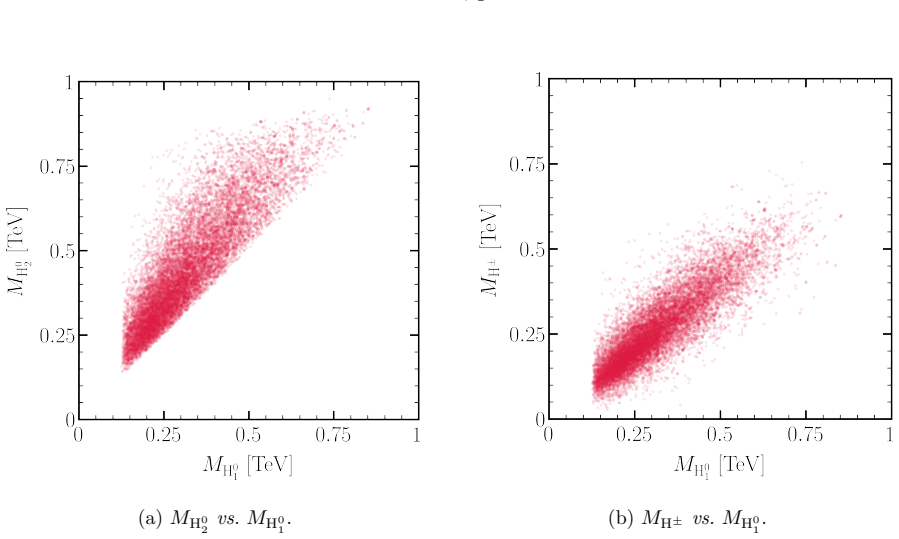
Two Higgs doublets models with a scalar potential that breaks electroweak symmetry spontaneously can have either one or two local minima. While potentials with one minimum can have a decoupling regime where all the new scalars are heavy, we show that, for potentials with $two$ local minima, the masses of all the scalars are bounded if the dimensionless quartic couplings obey perturbativity constraints.
Editorial analysis
A structured set of objections, weighed in public.
Referee Report
Summary. The manuscript studies the general two-Higgs-doublet model (2HDM) scalar potential that spontaneously breaks electroweak symmetry. It distinguishes the case of a single local minimum, which permits a decoupling regime with arbitrarily heavy new scalars, from the case of two coexisting local minima, for which all scalar masses are bounded once the dimensionless quartic couplings are required to obey perturbativity constraints.
Significance. If the central result holds, the work supplies a useful structural constraint on the 2HDM: the two-minimum vacuum configuration cannot accommodate heavy scalars while remaining perturbative. This limits the viable parameter space for such models and has direct implications for collider phenomenology and theoretical consistency checks.
minor comments (1)
- The abstract states the central claim clearly but does not indicate the technical approach (analytic relations among parameters, numerical scans, or both) used to establish the mass bounds; a short clarifying sentence would improve readability.
Simulated Author's Rebuttal
We thank the referee for their positive summary of our manuscript, which correctly captures the distinction between single-minimum and two-minimum vacua in the general 2HDM and the resulting bound on scalar masses under perturbativity. The recommendation for minor revision is noted; however, no specific major comments were provided in the report.
Circularity Check
No significant circularity; derivation self-contained from potential vacuum structure
full rationale
The abstract states that potentials with two local minima (both breaking EW symmetry) imply bounded scalar masses under quartic perturbativity, presented as a consequence of the relations among quadratic and quartic parameters enforced by the coexistence of minima. No equations, self-citations, fitted parameters renamed as predictions, or ansatze are quoted that reduce the bounding result to its own inputs by construction. The claim rests on direct analysis of the 2HDM potential's vacuum structure rather than tautological redefinition or external self-referential theorems. This is the expected non-finding for a paper whose central result follows from the stated assumptions without circular reduction.
Axiom & Free-Parameter Ledger
axioms (1)
- domain assumption The scalar potential in the general 2HDM breaks electroweak symmetry spontaneously and can possess one or two local minima.
Reference graph
Works this paper leans on
-
[1]
(5) to (7), while Im (µ 2
through eqs. (5) to (7), while Im (µ 2
-
[2]
the Higgs
is free. The mass terms for the charged ⃗C† = (C + 1 ,C + 2 ) and neutral fields ⃗NT = (R 1,R 2,I 1,I 2) are −LMass = ⃗C† M2 ± ⃗C+ 1 2 ⃗NT M2 0 ⃗N,(8) where M 2 ± is the 2×2 hermitian charged mass matrix and M 2 0 is the 4×4 real symmetric neutral mass matrix. M 2 ± and M 2 0 have null eigenvalues corresponding to the would-be Goldstone bosons, with eigen...
-
[3]
with U= 1 v v1 −v2 v2 v1 .(12) From the diagonalization, or computing directly Tr M2 ± , one obtains the mass of the charged scalar M 2 H± =µ 2 1 +µ 2 2 +λ 1v2 1 +λ 2v2 2 + 1 2 λ3v2 + Re (λ6 +λ 7)eiθ v1v2 ,(13) expressed for simplicity in terms ofµ 2 1 +µ 2 2 as the free quadratic parameter left; one can equivalently expressM 2 H±, for example, in ...
-
[4]
(15) From eqs
+ (λ3 +λ 4)v2 + 4Re (λ6 +λ 7)eiθ v1v2 . (15) From eqs. (13) and (15), it is clear that giving masses to the new scalars much larger than the electroweak scalev EW, requiresµ 2 1 +µ 2 2 ≫v 2 EW. The sole use of the stationarity conditions in eqs. (5) to (7) does not appear to bar that possibility, and thus a decoupling regime for (all) the new scalars is p...
-
[5]
This is achieved by minimizing and/or randomly probing that, for a fixed valuev 2 1 +v 2 2 ̸= 0, V4(v1, v2, θ)≡ V 4(⟨Φ1⟩,⟨Φ 2⟩)>0
We generate random values of all quartic parameters and check whether the quartic part of the potential is bounded from below. This is achieved by minimizing and/or randomly probing that, for a fixed valuev 2 1 +v 2 2 ̸= 0, V4(v1, v2, θ)≡ V 4(⟨Φ1⟩,⟨Φ 2⟩)>0. If the set of generatedλ’s does not fulfill the condition, it is rejected, and the process is restarted
-
[6]
We generate random values of the quadratic parameters; V(v1, v2, θ) is now completely defined, and we proceed repeatedly (e.g.30 times) to minimize it numerically, with different random starting values of{v 1, v2, θ}
-
[7]
the same
The resulting list of minima is filtered, eliminating repeated minima (and potentials without spontaneous symmetry breaking). Specifically we compute the real vectors ⃗B= (⟨Φ 1⟩†⟨Φ1⟩,⟨Φ 2⟩†⟨Φ2⟩, 1 2 ⟨Φ1⟩†⟨Φ2⟩+ 1 2 ⟨Φ2⟩†⟨Φ1⟩, i 2 ⟨Φ1⟩†⟨Φ2⟩ − i 2 ⟨Φ2⟩†⟨Φ1⟩) for two candidate minima, ⃗BMin 1, ⃗BMin 2, and ⃗∆ = ⃗BMin 1 − ⃗BMin 2: if ⃗∆· ⃗∆<(Tolerance) 2, both...
-
[8]
In case the potential has two minima, we choose the deepest one as the vacuum
-
[9]
We now proceed with parameter redefinitions to obtain appropriate electroweak sym- metry breaking vevs. For a vacuum with⟨Φ 1⟩= v1,0√ 2 ( 0 1 ),⟨Φ 2⟩= v2,0eiθ0 √ 2 ( 0 1 ), all quadratic parameters are rescaled as µ2 a, µ2 ab 7→ v2 EW v2 0 µ2 a, µ2 ab , v 2 0 ≡v 2 1,0 +v 2 2,0 .(16) The vacuum of the resulting potential is now⟨Φ 1⟩= v1√ 2 ( 0 1 ),⟨Φ 2⟩= v...
-
[10]
We compute the mass matrices and their eigenvalues. As a check, there should be one null eigenvalue — within numerical precision — in each M 2 ± and M 2 0 corresponding to the would-be Goldstone bosons, and the remaining eigenvalues should be positive. 6 Withm 2 0 the smallest non-vanishing eigenvalue of M 2 0, we now rescale all parameters µ2 a, µ2 ab, λ...
-
[11]
We now check that perturbative unitarity conditions, as discussed in [20], are fulfilled; if not, that potential is rejected and the process is restarted
-
[12]
allowed regions
As additional checks, (i) two different parametrizations for the minimization of V(v1, v2, θ) are separately used, in terms of{v 1, v2, θ}and in terms of{v, v2 v1 , θ}, and, also separately, (ii) a random unitary rotation of the{Φ 1,Φ 2}basis is performed before minimization (with all parameters in the potential accordingly transformed). The results of al...
-
[13]
(18) with µ2 d1,2 = 1 2 µ2 1 +µ 2 2 ± p (µ2 1 −µ 2 2)2 + 4|µ2 12|2
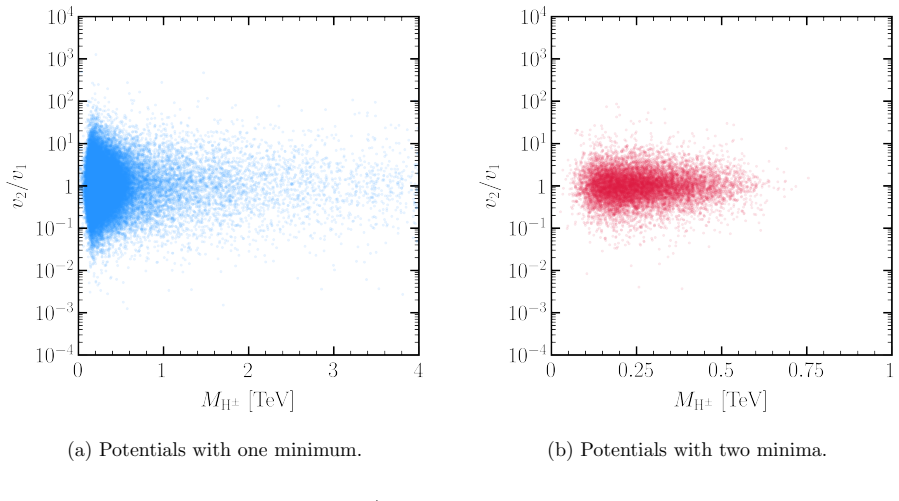
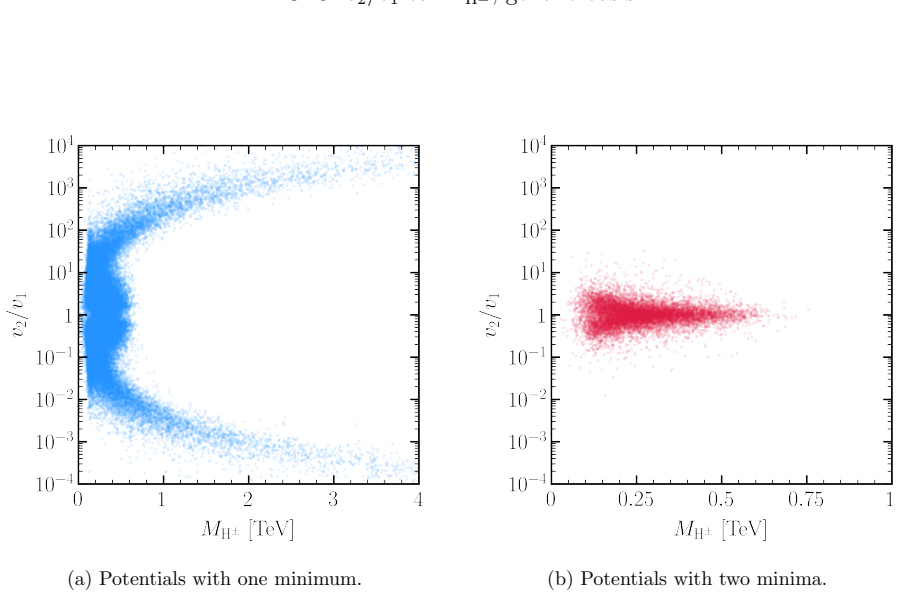
= (Φ′† 1 ,Φ ′† 2 )U †, withU ∈U(2), such that V2 = Φ′† 1 Φ′† 2 µ2 d1 0 0µ 2 d2 Φ′ 1 Φ′ 2 ,(19) that is, one can diagonalize the hermitian matrix of quadratic parameters in eq. (18) with µ2 d1,2 = 1 2 µ2 1 +µ 2 2 ± p (µ2 1 −µ 2 2)2 + 4|µ2 12|2 . We show in fig. 4 the ratio of vevsvs.M H± in that basis for both classes of potentials. Two relev...
-
[14]
and Im (µ2 12): Re µ2 12 = 1 sin(θ′ −θ) ([E] cosθ ′ −[E ′] cosθ),(21) Im µ2 12 = 1 sin(θ′ −θ) ([E′] sinθ−[E] sinθ ′),(22) where [E] = Im λ5ei2θ v1v2 + 1 2Im (λ6v2 1 +λ 7v2 2)eiθ ,(23) [E′] = Im λ5ei2θ′ v′ 1v′ 2 + 1 2Im (λ6v′2 1 +λ 7v′2 2 )eiθ′ .(24) It is then clear that nowallquadratic parameters are bounded by perturbativity require- ments on theλ’s, an...
-
[15]
Weinberg, Phys
S. Weinberg, Phys. Rev. Lett.36, 294 (1976)
1976
-
[16]
H. D. Politzer and S. Wolfram, Phys. Lett. B82, 242 (1979), [Erratum: Phys.Lett.B 83, 421 (1979)]
1979
-
[17]
Cabibbo, L
N. Cabibbo, L. Maiani, G. Parisi, and R. Petronzio, Nucl. Phys. B158, 295 (1979)
1979
-
[18]
R. F. Dashen and H. Neuberger, Phys. Rev. Lett.50, 1897 (1983)
1983
-
[19]
D. J. E. Callaway, Nucl. Phys. B233, 189 (1984)
1984
-
[20]
B. W. Lee, C. Quigg, and H. B. Thacker, Phys. Rev. D16, 1519 (1977)
1977
-
[21]
B. W. Lee, C. Quigg, and H. B. Thacker, Phys. Rev. Lett.38, 883 (1977)
1977
-
[22]
D. A. Dicus and V. S. Mathur, Phys. Rev. D7, 3111 (1973)
1973
-
[23]
H. A. Weldon, Phys. Lett. B146, 59 (1984). 13
1984
-
[24]
Langacker and H
P. Langacker and H. A. Weldon, Phys. Rev. Lett.52, 1377 (1984)
1984
-
[25]
D. Comelli and J. R. Espinosa, Phys. Lett. B388, 793 (1996), arXiv:hep-ph/9607400
Pith/arXiv arXiv 1996
-
[26]
J. R. Espinosa, Surveys High Energ. Phys.10, 279 (1997), arXiv:hep-ph/9606316
Pith/arXiv arXiv 1997
-
[27]
I. P. Ivanov, Prog. Part. Nucl. Phys.95, 160 (2017), arXiv:1702.03776 [hep-ph]
Pith/arXiv arXiv 2017
-
[28]
T. D. Lee, Phys. Rev. D8, 1226 (1973)
1973
-
[29]
T. D. Lee, Phys. Rept.9, 143 (1974)
1974
-
[30]
Huffel and G
H. Huffel and G. Pocsik, Z. Phys. C8, 13 (1981)
1981
-
[31]
Casalbuoni, D
R. Casalbuoni, D. Dominici, F. Feruglio, and R. Gatto, Nucl. Phys. B299, 117 (1988)
1988
-
[32]
Maalampi, J
J. Maalampi, J. Sirkka, and I. Vilja, Phys. Lett. B265, 371 (1991)
1991
-
[33]
S. Kanemura, T. Kubota, and E. Takasugi, Phys. Lett. B313, 155 (1993), arXiv:hep- ph/9303263
arXiv 1993
-
[34]
I. F. Ginzburg and I. P. Ivanov, Phys. Rev. D72, 115010 (2005), arXiv:hep-ph/0508020
Pith/arXiv arXiv 2005
-
[35]
J. Horejsi and M. Kladiva, Eur. Phys. J. C46, 81 (2006), arXiv:hep-ph/0510154
Pith/arXiv arXiv 2006
-
[36]
S. Kanemura and K. Yagyu, Phys. Lett. B751, 289 (2015), arXiv:1509.06060 [hep-ph]
Pith/arXiv arXiv 2015
- [37]
- [38]
-
[39]
U. Nierste, M. Tabet, and R. Ziegler, Phys. Rev. Lett.125, 031801 (2020), arXiv:1912.11501 [hep-ph]
arXiv 2020
- [40]
-
[41]
I. P. Ivanov, Phys. Rev. D77, 015017 (2008), arXiv:0710.3490 [hep-ph]
Pith/arXiv arXiv 2008
-
[42]
H. E. Haber and Y. Nir, Nucl. Phys. B335, 363 (1990)
1990
-
[43]
J. F. Gunion and H. E. Haber, Phys. Rev. D67, 075019 (2003), arXiv:hep-ph/0207010
Pith/arXiv arXiv 2003
-
[44]
F. J. Botella and J. P. Silva, Phys. Rev. D51, 3870 (1995), arXiv:hep-ph/9411288
Pith/arXiv arXiv 1995
-
[45]
A. Barroso, P. M. Ferreira, R. Santos, and J. P. Silva, Phys. Rev. D74, 085016 (2006), arXiv:hep-ph/0608282
Pith/arXiv arXiv 2006
-
[46]
A. Barroso, P. M. Ferreira, and R. Santos, Phys. Lett. B652, 181 (2007), arXiv:hep- ph/0702098
arXiv 2007
-
[47]
I. P. Ivanov, Phys. Rev. D75, 035001 (2007), [Erratum: Phys.Rev.D 76, 039902 (2007)], arXiv:hep-ph/0609018. 14
Pith/arXiv arXiv 2007
-
[48]
I. F. Ginzburg and K. A. Kanishev, Phys. Rev. D76, 095013 (2007), arXiv:0704.3664 [hep-ph]
Pith/arXiv arXiv 2007
-
[49]
H. E. Haber and D. O’Neil, Phys. Rev. D74, 015018 (2006), [Erratum: Phys.Rev.D 74, 059905 (2006)], arXiv:hep-ph/0602242. 15
Pith/arXiv arXiv 2006
discussion (0)
Sign in with ORCID, Apple, or X to comment. Anyone can read and Pith papers without signing in.