Resonant delay in a stationary quantum clock: Lifting the threshold mask
Pith reviewed 2026-06-28 14:02 UTC · model grok-4.3
The pith
Subtracting a universal low-energy term from the stationary quantum clock isolates resonant delay near transmission resonances.
A machine-rendered reading of the paper's core claim, the machinery that carries it, and where it could break.
Core claim
For real compactly supported one-dimensional potentials the raw stationary Peres clock generically contains a universal 1/sqrt(E) continuum-edge term whose coefficient is fixed by low-energy scattering data. For the attractive square well this threshold singularity is inherited from the vanishing exterior momentum and the associated scattering matching, rather than from resonant delay itself. The threshold-subtracted clock observable removes the universal low-energy term and isolates the resonant contribution. Comparison with the dwell time and the transmission Wigner phase delay shows that the threshold-subtracted clock acquires the expected local Lorentzian form near isolated transmission
What carries the argument
The threshold-subtracted clock observable obtained by removing the universal 1/sqrt(E) continuum-edge term from the energy derivative of the transmission phase shift.
If this is right
- Near isolated transmission resonances the subtracted clock time matches the Lorentzian shape seen in the dwell time and Wigner phase delay.
- At the continuum edge the resonant peak height scales only as the square root of the detuning ε while the unsubtracted background scales as ε to the minus three-halves.
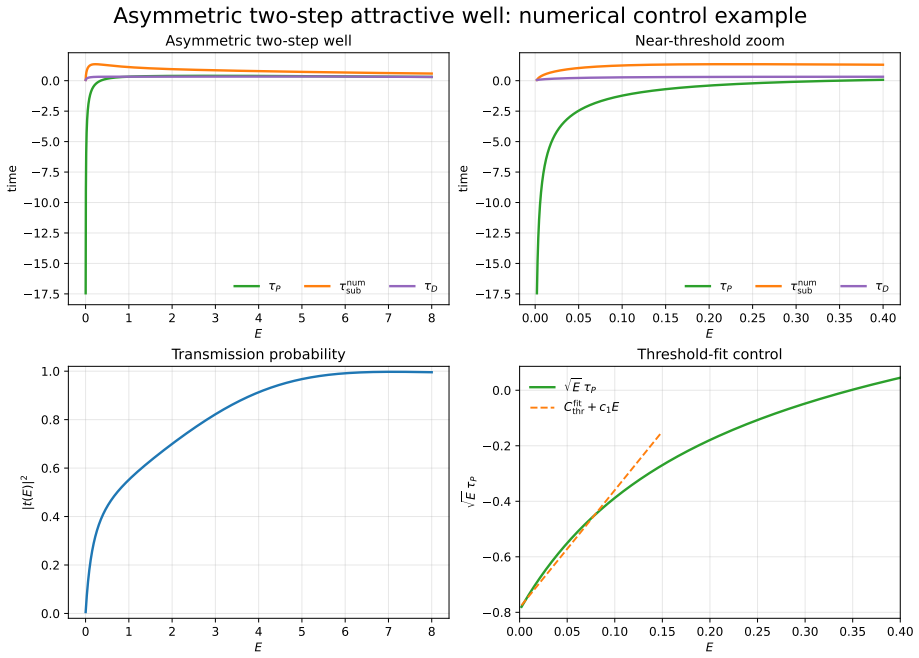
- The same subtraction isolates resonant delay for both a symmetric barrier-well-barrier cavity and a numerical asymmetric two-step attractive well.
- The method separates universal threshold kinematics from pole-sensitive resonant delay for any real compactly supported one-dimensional potential away from zero-energy exceptional tuning.
Where Pith is reading between the lines
- The subtraction procedure could be tested numerically on potentials with multiple overlapping resonances to check whether the Lorentzian form survives.
- If the same threshold term appears in other clock definitions, the subtraction might produce consistent resonant times across different transit-time observables.
- The approach suggests examining whether analogous universal kinematic terms exist at higher thresholds or in multichannel scattering.
Load-bearing premise
That the universal 1/sqrt(E) continuum-edge term is produced entirely by vanishing exterior momentum and scattering matching for real compactly supported potentials and contains no resonant contribution.
What would settle it
An explicit calculation for a potential with an isolated resonance in which the subtracted clock time near that resonance fails to take the local Lorentzian form or exhibits growth rates different from ε^{-1/2} for the peak and ε^{-3/2} for the background.
Figures

read the original abstract
Quantum transit times have a long history of inequivalent definitions, including phase times, dwell times, and quantum-clock constructions. In this context we revisit the Salecker--Wigner--Peres stationary quantum clock as a phase-sensitive scattering observable, with clock time defined by the energy derivative of the transmission phase shift across the interaction region. For real compactly supported one-dimensional potentials, we show that the raw stationary Peres clock generically contains a universal \(1/\sqrt{E}\) continuum-edge term whose coefficient is fixed by low-energy scattering data. For the attractive square well, this threshold singularity is inherited from the vanishing exterior momentum and the associated scattering matching, rather than from resonant delay itself. We derive the exact stationary clock time for the square well and introduce a new threshold-subtracted clock observable. Away from exceptional zero-energy tuning, the subtraction removes the universal low-energy term and isolates the resonant contribution. Comparison with the dwell time and the transmission Wigner phase delay shows that the threshold-subtracted clock acquires the expected local Lorentzian form near isolated transmission resonances. Near the continuum edge, if \(\varepsilon\) denotes the detuning from threshold, the resonant peak grows only as \(\varepsilon^{-1/2}\), whereas the unsubtracted threshold background grows as \(\varepsilon^{-3/2}\). A symmetric barrier--well--barrier cavity and a numerical asymmetric two-step attractive well provide complementary controls. The result is a new threshold-subtracted stationary-clock candidate that separates universal threshold kinematics from pole-sensitive resonant delay.
Editorial analysis
A structured set of objections, weighed in public.
Referee Report
Summary. The manuscript analyzes the Salecker-Wigner-Peres stationary quantum clock as a phase-sensitive scattering observable in one dimension. It shows that for real compactly supported potentials the raw clock time (energy derivative of the transmission phase) contains a universal 1/sqrt(E) continuum-edge term fixed solely by low-energy scattering data and exterior momentum vanishing. For the attractive square well an exact closed-form expression is derived; a threshold-subtracted clock is then defined by removing this term. The subtracted observable is shown to reduce to a local Lorentzian near isolated transmission resonances and to scale as ε^{-1/2} near threshold (while the unsubtracted background scales as ε^{-3/2}). Comparisons are made to the dwell time and transmission Wigner phase delay; symmetric barrier-well-barrier and asymmetric two-step wells serve as controls. The exceptional zero-energy tuning case is excluded.
Significance. If the derivations hold, the work supplies a concrete, parameter-free subtraction that isolates resonant delay from universal threshold kinematics in a stationary clock observable. The exact square-well calculation, the explicit scaling near threshold, and the side-by-side comparison with dwell and Wigner times constitute reproducible, falsifiable content. This separation addresses a persistent ambiguity in quantum transit-time definitions and may be useful for interpreting resonant scattering in both theory and experiment.
minor comments (3)
- [§3] §3 (square-well derivation): the final expression for the subtracted clock time is given only after several pages of algebra; inserting an intermediate boxed result immediately after the phase-shift derivative would improve readability.
- [Figure 4] Figure 4 (asymmetric well): the resonance peaks are plotted without error bands or explicit numerical convergence checks; adding a short statement on discretization parameters would strengthen the control.
- [Abstract] Abstract, last sentence: the phrase 'pole-sensitive resonant delay' is introduced without prior definition; a parenthetical gloss linking it to the transmission poles would clarify the claim for readers outside the subfield.
Simulated Author's Rebuttal
We thank the referee for the detailed and positive summary of our work on the threshold-subtracted stationary Peres clock. The recommendation for minor revision is noted. No specific major comments were listed in the report, so we have no individual points requiring point-by-point rebuttal at this stage. We are prepared to address any minor issues or clarifications that may arise in a revised version.
Circularity Check
No significant circularity
full rationale
The paper derives the universal 1/sqrt(E) threshold term via low-energy scattering asymptotics and explicit square-well matching conditions, then defines the subtracted observable directly from the phase-derivative definition of clock time minus that term. All central results (Lorentzian form near resonances, scaling as epsilon^{-1/2}) follow from these explicit calculations and standard comparisons to dwell time and Wigner delay, without any reduction to fitted parameters, self-citations, or ansatzes. The derivation chain is self-contained against external scattering benchmarks.
Axiom & Free-Parameter Ledger
axioms (1)
- domain assumption Clock time is defined by the energy derivative of the transmission phase shift across the interaction region.
invented entities (1)
-
threshold-subtracted clock observable
no independent evidence
Reference graph
Works this paper leans on
-
[1]
Transfer matrix representation Consider −ψ′′(x) +V(x)ψ(x) =k 2ψ(x), k >0,(A1) withVreal and supported in[0,L]. Letu(x,k)andv(x,k)be the fundamental solutions on[0,L]determined by u(0,k) = 1, u ′(0,k) = 0, v(0,k) = 0, v ′(0,k) = 1.(A2) The transfer matrix across the support is T(k) := u(L,k)v(L,k) u′(L,k)v ′(L,k) = A(k)B(k) C(k)D(k) .(A3...
-
[2]
Evenness and the zero-energy criterion Since the equation depends onkonly throughk 2, the transfer-matrix entries are even functions ofk. Hence, ask→0, A(k) =A 0 +A 2k2 +A 4k4 +O(k 6), B(k) =B 0 +B 2k2 +B 4k4 +O(k 6), C(k) =C 0 +C 2k2 +C 4k4 +O(k 6), D(k) =D 0 +D 2k2 +D 4k4 +O(k 6),(A7) with all coefficients real becauseVis real. The generic/exceptional d...
-
[3]
In this case the denominator∆(k)has a nonzero real constant term, so the leading threshold phase is controlled by the ratio of theO(k)imaginary term to this constant term
Generic sector Assume first thatC0̸= 0. In this case the denominator∆(k)has a nonzero real constant term, so the leading threshold phase is controlled by the ratio of theO(k)imaginary term to this constant term. Introduce the real combinations S0 :=A 0 +D 0, S 2 :=A 2 +D 2, R 2 :=B 0−C2.(A11) Using (A7) in (A6) gives ∆(k) =−C0 +iS 0k+R 2k2 +iS 2k3 +O(k 4)...
-
[4]
Exceptional sector Now assumeC 0 = 0. Evaluating (A4) atk= 0gives A0D0 = 1.(A25) SinceA 0 andD 0 are real, this implies A0 +D 0̸= 0.(A26) Introduce the real combinations S0 :=A 0 +D 0, S 2 :=A 2 +D 2, R 2 :=B 0−C2, R 4 :=B 2−C4.(A27) Then (A6) gives ∆(k) =iS 0k+R 2k2 +iS 2k3 +R 4k4 +O(k 5).(A28) Factor out the linear term: ∆(k) =iS 0k [ 1−iak+bk2−ick3 +O(...
-
[5]
The square-well formulas in the main text are obtained by evaluating the corresponding transfer-matrix coefficients explicitly for that model
Conclusion Equations (A24) and (A38) establish the generic and exceptional1/ √ Ethreshold laws for the stationary Peres clock and justify the subtraction τsub(E) :=τP (E) + ℓthr√ E (A39) in the generic sector. The square-well formulas in the main text are obtained by evaluating the corresponding transfer-matrix coefficients explicitly for that model. Rema...
-
[6]
E. H. Hauge and J. A. Stövneng, Tunneling times: A critical review, Reviews of Modern Physics61, 917 (1989)
1989
-
[7]
Büttiker and R
M. Büttiker and R. Landauer, Traversal time for tunneling, Physical Review Letters49, 1739 (1982)
1982
-
[8]
Landauer and T
R. Landauer and T. Martin, Barrier interaction time in tunneling, Rev. Mod. Phys.66, 217 (1994)
1994
-
[9]
Muga and C
J. Muga and C. Leavens, Arrival time in quantum mechanics, Physics Reports338, 353 (2000)
2000
-
[10]
H. G. Winful, Tunneling time, the Hartman effect, and superluminality: A proposed resolution of an old paradox, Physics Reports436, 1 (2006). 27
2006
-
[11]
G. E. Field, On the status of quantum tunnelling time, Eur. J. Phil. Sci.12, 57 (2022)
2022
-
[12]
Salecker and E
H. Salecker and E. P. Wigner, Quantum limitations of the measurement of space-time dis- tances, Physical Review109, 571 (1958)
1958
-
[13]
Peres, Measurement of time by quantum clocks, American Journal of Physics48, 552 (1980)
A. Peres, Measurement of time by quantum clocks, American Journal of Physics48, 552 (1980)
1980
-
[14]
Büttiker, Larmor precession and the traversal time for tunneling, Phys
M. Büttiker, Larmor precession and the traversal time for tunneling, Phys. Rev. B27, 6178 (1983)
1983
-
[15]
tunneling time problem
C. R. Leavens, Application of the quantum clock of salecker and wigner to the “tunneling time problem”, Solid State Communications86, 781 (1993)
1993
-
[16]
P. C. W. Davies, Quantum tunneling time, American Journal of Physics73, 23 (2005)
2005
-
[17]
M. Calçada, J. T. Lunardi, and L. A. Manzoni, Salecker-wigner-peres clock and double-barrier tunneling, Physical Review A79, 012110 (2009), arXiv:0901.0508 [quant-ph]
Pith/arXiv arXiv 2009
-
[18]
J. T. Lunardi, L. A. Manzoni, and A. T. Nystrom, Salecker-wigner-peres clock and average tunneling times, Physics Letters A375, 415 (2011), arXiv:1108.3037 [quant-ph]
Pith/arXiv arXiv 2011
-
[19]
Sokolovski, The salecker-Wigner-Peres clock, Feynman paths, and a tunnelling time that should not exist, Physical Review A96, 022120 (2017)
D. Sokolovski, The salecker-Wigner-Peres clock, Feynman paths, and a tunnelling time that should not exist, Physical Review A96, 022120 (2017)
2017
-
[20]
N. G. Kelkar, Quantum reflection and dwell times of metastable states, Physical Review Letters99, 210403 (2007)
2007
-
[21]
F. T. Smith, Lifetime matrix in collision theory, Physical Review118, 349 (1960)
1960
-
[22]
E. P. Wigner, Lower limit for the energy derivative of the scattering phase shift, Physical Review98, 145 (1955)
1955
-
[23]
T. E. Hartman, Tunneling of a wave packet, Journal of Applied Physics33, 3427 (1962). 28
1962
discussion (0)
Sign in with ORCID, Apple, or X to comment. Anyone can read and Pith papers without signing in.