Magnetized bottom-up thermalization in heavy-ion collisions
Pith reviewed 2026-06-28 13:22 UTC · model grok-4.3
The pith
A strong magnetic field allows gluon decay into quark-antiquark pairs to occur early in the bottom-up thermalization of heavy-ion collisions.
A machine-rendered reading of the paper's core claim, the machinery that carries it, and where it could break.
Core claim
For magnetic fields with |eB| approaching Q_s², the gluon decay channel g → q + q-bar becomes important already in the earliest stages of bottom-up evolution, thereby populating the hard quark sector, modifying the chemical composition of the pre-equilibrium matter, and supplying an additional pathway toward chemical equilibration.
What carries the argument
The magnetic-field-induced gluon decay into a quark-antiquark pair (g → q + q-bar), an inelastic channel that becomes kinematically allowed or enhanced and competes with standard processes when the field is sufficiently strong.
If this is right
- The hard quark sector becomes populated earlier than in the standard scenario.
- The chemical composition of the pre-equilibrium matter is altered by the additional quark production.
- An extra pathway opens that can accelerate chemical equilibration.
- Back-reaction effects such as quark-antiquark annihilation and depletion of the hard-gluon sector may occur.
- Early quark production can feed back on the electromagnetic conductivity of the medium.
Where Pith is reading between the lines
- Models of heavy-ion collisions that omit the magnetic field may systematically underestimate the early quark content when noncentral events are considered.
- The mechanism suggests that electromagnetic probes sensitive to early-stage chemistry could differ between central and peripheral collisions in ways not captured by field-free simulations.
- Quantitative predictions require embedding the field evolution into existing bottom-up frameworks to test sensitivity to the field's decay time.
Load-bearing premise
The magnetic field must remain strong enough and persist long enough in the relevant spacetime region for the gluon decay channel to compete before other equilibration processes take over.
What would settle it
Observation that the early quark-to-gluon ratio and chemical equilibration timescale show no measurable difference between collisions with strong versus weak magnetic fields would falsify the claim that the decay channel matters.
Figures
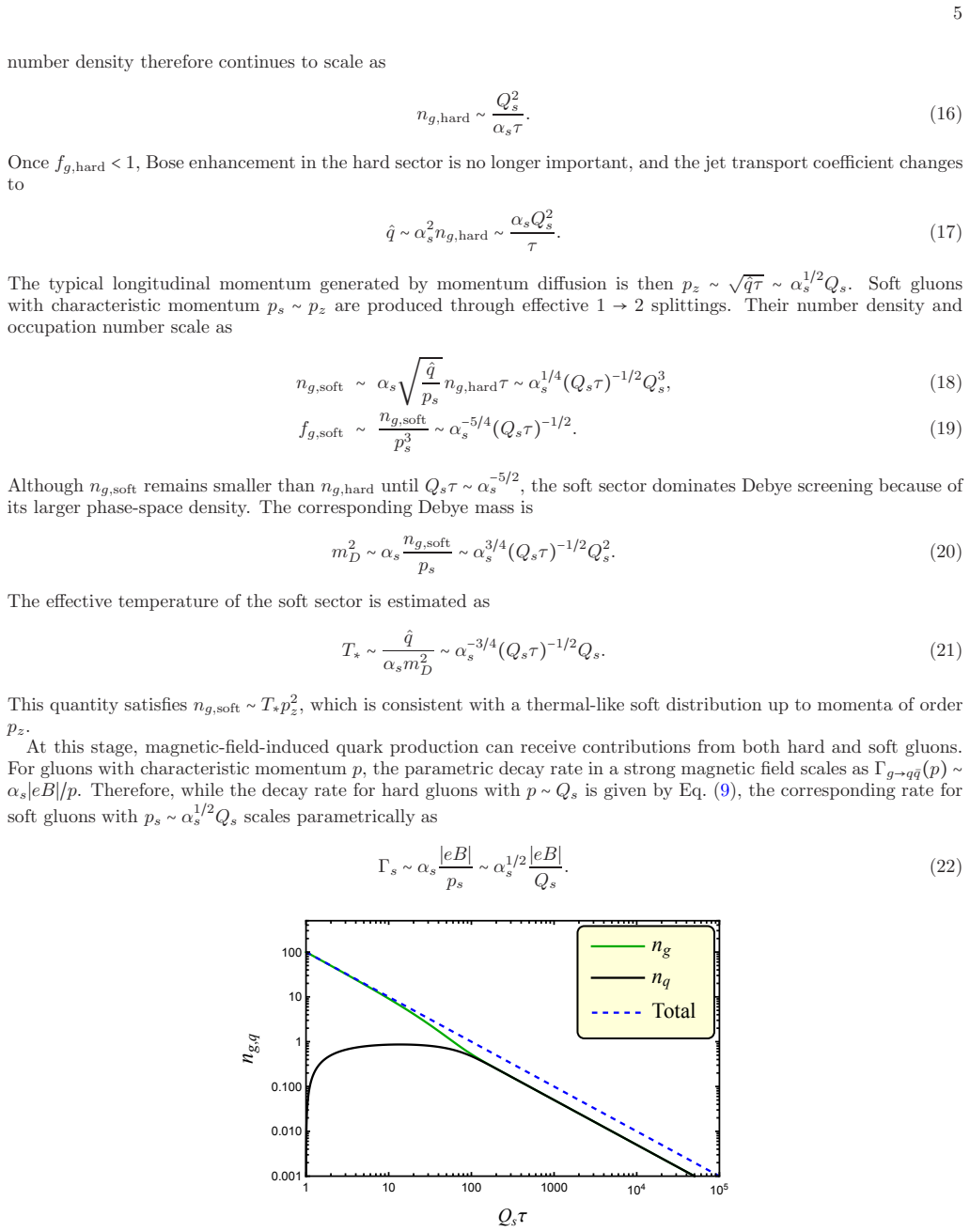
read the original abstract
We investigate how a strong magnetic field generated in noncentral heavy-ion collisions may modify the bottom-up equilibration scenario. In the conventional weak-coupling picture, the earliest stages of the evolution are dominated by overoccupied gluons, while quark production is parametrically delayed. In a background magnetic field, however, additional inelastic channels become kinematically allowed or enhanced, most notably gluon decay into quark-antiquark pairs, $g\to q+\bar q$. Using parametric estimates, we show that for sufficiently strong fields, with $|eB|$ approaching the saturation scale squared, $Q_s^2$, magnetic-field-induced quark production can become important during the earliest stages of bottom-up evolution. This mechanism can populate the hard quark sector, modify the chemical composition of the pre-equilibrium matter, and provide an additional pathway toward chemical equilibration. We also discuss possible back-reaction effects, including quark-antiquark annihilation, depletion of the hard-gluon sector, and the potential feedback of early quark production on the electromagnetic conductivity of the medium. This exploratory study of a magnetically assisted bottom-up scenario provides a natural extension of the standard framework, with qualitative predictions that depend sensitively on the lifetime and spacetime profile of the magnetic field.
Editorial analysis
A structured set of objections, weighed in public.
Referee Report
Summary. The manuscript investigates modifications to the conventional bottom-up thermalization scenario in heavy-ion collisions arising from strong magnetic fields generated in non-central collisions. It claims that for |eB| approaching Q_s^2, the additional channel g → q + qbar becomes parametrically competitive with standard 2→2 and 2→3 gluon processes during the earliest overoccupied-gluon stage, thereby populating the hard quark sector, altering the chemical composition, and offering an extra route to chemical equilibration. The analysis relies on order-of-magnitude parametric estimates of the new decay rate versus existing processes; back-reaction effects (annihilation, gluon depletion, conductivity feedback) are discussed qualitatively. All predictions are stated to depend sensitively on the lifetime and spacetime profile of the magnetic field.
Significance. If the parametric estimates hold, the work supplies a natural and timely extension of the standard weak-coupling bottom-up framework by incorporating magnetic-field-induced quark production. It correctly identifies a previously neglected inelastic channel that can compete when |eB| ~ Q_s^2 and flags the controlling role of B-field dynamics, thereby opening a concrete avenue for future quantitative studies of pre-equilibrium electromagnetism and chemistry in non-central collisions. The exploratory character is appropriately emphasized; credit is due for the transparent conditional formulation and the absence of hidden parameters or circular reasoning in the counting.
minor comments (3)
- [Abstract] Abstract and introductory paragraphs: the phrase 'using parametric estimates' is repeated without a dedicated subsection or appendix that tabulates the explicit rate expressions (e.g., the magnetic-field-modified g→q qbar width versus the standard gluon splitting rates). Adding such a compact table or set of equations would make the central comparison reproducible.
- The discussion of back-reaction (quark-antiquark annihilation and gluon depletion) is presented at the same parametric level as the production channel; a short paragraph clarifying whether these processes remain sub-dominant under the same |eB| ~ Q_s^2 assumption would improve internal consistency.
- No figure or plot is referenced that visualizes the parametric competition as a function of |eB|/Q_s^2 or proper time; inclusion of even a schematic plot would aid readability without altering the exploratory scope.
Simulated Author's Rebuttal
We thank the referee for the positive evaluation of our manuscript and the recommendation for minor revision. The report provides a clear summary of our work but does not raise any specific major comments requiring a point-by-point response.
Circularity Check
No significant circularity; parametric estimates are independent
full rationale
The paper performs order-of-magnitude parametric estimates comparing the rate of gluon decay into quark-antiquark pairs in a magnetic field against standard gluon scattering processes in the bottom-up scenario. These estimates draw on established weak-coupling QCD and QED in background fields without introducing fitted parameters, self-defined quantities, or load-bearing self-citations that reduce the central claim to its inputs. The conclusion remains conditional on external inputs (magnetic field strength and lifetime) that are explicitly flagged rather than derived internally. No step equates a prediction to a fit or renames a result by construction.
Axiom & Free-Parameter Ledger
Reference graph
Works this paper leans on
-
[1]
(24) This form should be understood as a parametric implementation of ch emical back reaction rather than as a substitute for a full kinetic treatment
to vanish once the soft sector reaches chemical saturation, we obtain γs ∼Γ s neq g, soft /par⟩nl⟩ft.alt2neq q, soft/par⟩nright.alt2 2 . (24) This form should be understood as a parametric implementation of ch emical back reaction rather than as a substitute for a full kinetic treatment. Neglecting the annihilation term for the purpose of a simple estimat...
-
[2]
R. Baier, A. H. Mueller, D. Schiff, and D. T. Son, ’Bottom up ’ thermalization in heavy ion collisions, Phys. Lett. B 502, 51 (2001) , arXiv:hep-ph/0009237
Pith/arXiv arXiv 2001
-
[3]
E. V. Shuryak, Two stage equilibration in high-energy he avy ion collisions, Phys. Rev. Lett. 68, 3270 (1992)
1992
-
[4]
Mrowczynski, Plasma instability at the initial stage of ultrarelativistic heavy ion collisions, Phys
S. Mrowczynski, Plasma instability at the initial stage of ultrarelativistic heavy ion collisions, Phys. Lett. B 314, 118 (1993)
1993
-
[5]
P. B. Arnold, G. D. Moore, and L. G. Yaffe, Effective kinetic theory for high temperature gauge theories, JHEP 01, 030 , arXiv:hep-ph/0209353
-
[6]
P. Romatschke and M. Strickland, Collective modes of an a nisotropic quark gluon plasma, Phys. Rev. D 68, 036004 (2003) , arXiv:hep-ph/0304092
Pith/arXiv arXiv 2003
-
[7]
Z.-W. Lin, C. M. Ko, B.-A. Li, B. Zhang, and S. Pal, A Multi- phase transport model for relativistic heavy ion collision s, Phys. Rev. C 72, 064901 (2005) , arXiv:nucl-th/0411110
Pith/arXiv arXiv 2005
-
[8]
A. Rebhan, P. Romatschke, and M. Strickland, Hard-loop d ynamics of non-Abelian plasma instabilities, Phys. Rev. Lett. 94, 102303 (2005) , arXiv:hep-ph/0412016
Pith/arXiv arXiv 2005
-
[9]
A. H. Mueller, A. I. Shoshi, and S. M. H. Wong, A Possible mo dified ’bottom-up’ thermalization in heavy ion collisions, Phys. Lett. B 632, 257 (2006) , arXiv:hep-ph/0505164
Pith/arXiv arXiv 2006
-
[10]
P. M. Chesler and L. G. Yaffe, Horizon formation and far-fr om-equilibrium isotropization in supersymmetric Yang-Mi lls plasma, Phys. Rev. Lett. 102, 211601 (2009) , arXiv:0812.2053 [hep-th]
Pith/arXiv arXiv 2009
-
[11]
M. P. Heller, R. A. Janik, and P. Witaszczyk, The charact eristics of thermalization of boost-invariant plasma from holog- raphy, Phys. Rev. Lett. 108, 201602 (2012) , arXiv:1103.3452 [hep-th]
Pith/arXiv arXiv 2012
-
[12]
E. Caceres, A. Kundu, and D.-L. Yang, Jet Quenching and H olographic Thermalization with a Chemical Potential, JHEP 03, 073 , arXiv:1212.5728 [hep-th]
-
[13]
L. Keegan, A. Kurkela, P. Romatschke, W. van der Schee, a nd Y. Zhu, Weak and strong coupling equilibration in nonabel ian gauge theories, JHEP 04, 031 , arXiv:1512.05347 [hep-th]
-
[14]
A. Kurkela and A. Mazeliauskas, Chemical equilibratio n in weakly coupled QCD, Phys. Rev. D 99, 054018 (2019) , arXiv:1811.03068 [hep-ph]
Pith/arXiv arXiv 2019
- [15]
-
[16]
P. B. Arnold, J. Lenaghan, and G. D. Moore, QCD plasma ins tabilities and bottom up thermalization, JHEP 08, 002 , arXiv:hep-ph/0307325
-
[17]
Gelis, Initial state and thermalization in the Color Glass Condensate framework, Int
F. Gelis, Initial state and thermalization in the Color Glass Condensate framework, Int. J. Mod. Phys. E 24, 1530008 (2015) , arXiv:1508.07974 [hep-ph]
Pith/arXiv arXiv 2015
-
[18]
S. Mrowczynski, B. Schenke, and M. Strickland, Color in stabilities in the quark–gluon plasma, Phys. Rept. 682, 1 (2017) , arXiv:1603.08946 [hep-ph]
Pith/arXiv arXiv 2017
-
[19]
W. Busza, K. Rajagopal, and W. van der Schee, Heavy Ion Co llisions: The Big Picture, and the Big Questions, Ann. Rev. Nucl. Part. Sci. 68, 339 (2018) , arXiv:1802.04801 [hep-ph] . 10
Pith/arXiv arXiv 2018
-
[20]
S. Schlichting and D. Teaney, The First fm/c of Heavy-Io n Collisions, Ann. Rev. Nucl. Part. Sci. 69, 447 (2019) , arXiv:1908.02113 [nucl-th]
arXiv 2019
-
[21]
V. Skokov, A. Y. Illarionov, and V. Toneev, Estimate of t he magnetic field strength in heavy-ion collisions, Int. J. Mod. Phys. A 24, 5925 (2009) , arXiv:0907.1396 [nucl-th]
Pith/arXiv arXiv 2009
-
[22]
V. Voronyuk, V. D. Toneev, W. Cassing, E. L. Bratkovskay a, V. P. Konchakovski, and S. A. Voloshin, (Electro-)Magnet ic field evolution in relativistic heavy-ion collisions, Phys. Rev. C 83, 054911 (2011) , arXiv:1103.4239 [nucl-th]
Pith/arXiv arXiv 2011
-
[23]
W.-T. Deng and X.-G. Huang, Event-by-event generation of electromagnetic fields in heavy-ion collisions, Phys. Rev. C 85, 044907 (2012) , arXiv:1201.5108 [nucl-th]
Pith/arXiv arXiv 2012
-
[24]
J. Bloczynski, X.-G. Huang, X. Zhang, and J. Liao, Azimu thally fluctuating magnetic field and its impacts on observab les in heavy-ion collisions, Phys. Lett. B 718, 1529 (2013) , arXiv:1209.6594 [nucl-th]
Pith/arXiv arXiv 2013
-
[25]
K. Tuchin, Particle production in strong electromagne tic fields in relativistic heavy-ion collisions, Adv. High Energy Phys. 2013, 490495 (2013) , arXiv:1301.0099 [hep-ph]
Pith/arXiv arXiv 2013
-
[26]
X.-G. Huang, Electromagnetic fields and anomalous tran sports in heavy-ion collisions — A pedagogical review, Rept. Prog. Phys. 79, 076302 (2016) , arXiv:1509.04073 [nucl-th]
Pith/arXiv arXiv 2016
-
[27]
Erber, High-energy electromagnetic conversion pro cesses in intense magnetic fields, Rev
T. Erber, High-energy electromagnetic conversion pro cesses in intense magnetic fields, Rev. Mod. Phys. 38, 626 (1966)
1966
-
[28]
X. Wang, I. A. Shovkovy, L. Yu, and M. Huang, Ellipticity of photon emission from strongly magnetized hot QCD plasma, Phys. Rev. D 102, 076010 (2020) , arXiv:2006.16254 [hep-ph]
arXiv 2020
-
[29]
X. Wang and I. Shovkovy, Polarization tensor of magneti zed quark-gluon plasma at nonzero baryon density, Eur. Phys. J. C 81, 901 (2021) , arXiv:2106.09029 [nucl-th]
arXiv 2021
-
[30]
S. Chen, J. Zhao, and P. Zhuang, Gluon decay into heavy qu ark pair under a strong magnetic field, EPJ Web Conf. 316, 04017 (2025) , arXiv:2407.03586 [hep-ph]
arXiv 2025
-
[31]
R. Ghosh and I. A. Shovkovy, Fermion self-energy and dam ping rate in a hot magnetized plasma, Phys. Rev. D 109, 096018 (2024) , arXiv:2402.04307 [hep-ph]
arXiv 2024
-
[32]
Z. Xu and C. Greiner, Thermalization of gluons in ultrar elativistic heavy ion collisions by including three-body i nteractions in a parton cascade, Phys. Rev. C 71, 064901 (2005) , arXiv:hep-ph/0406278
Pith/arXiv arXiv 2005
-
[33]
K. A. Mamo and H.-U. Yee, Thermalization of Quark-Gluon Plasma in Magnetic Field at Strong Coupling, Phys. Rev. D 92, 105005 (2015) , arXiv:1505.01183 [hep-ph]
Pith/arXiv arXiv 2015
-
[34]
C. Cartwright and M. Kaminski, Correlations far from eq uilibrium in charged strongly coupled fluids subjected to a s trong magnetic field, JHEP 09, 072 , arXiv:1904.11507 [hep-th]
arXiv 1904
-
[35]
J. F. Fuini and L. G. Yaffe, Far-from-equilibrium dynami cs of a strongly coupled non-Abelian plasma with non-zero ch arge density or external magnetic field, JHEP 07, 116 , arXiv:1503.07148 [hep-th]
-
[36]
F. Gelis, E. Iancu, J. Jalilian-Marian, and R. Venugopa lan, The Color Glass Condensate, Ann. Rev. Nucl. Part. Sci. 60, 463 (2010) , arXiv:1002.0333 [hep-ph]
Pith/arXiv arXiv 2010
-
[37]
S. B. Cabodevila, C. A. Salgado, and B. Wu, Quark product ion and thermalization of the quark-gluon plasma, JHEP 06, 145 , arXiv:2311.07450 [hep-ph]
-
[38]
S. Barrera Cabodevila, X. Du, C. A. Salgado, and B. Wu, Qu ark production in the bottom-up thermalization, Phys. Lett. B 871, 139987 (2025) , arXiv:2503.24291 [hep-ph]
arXiv 2025
-
[39]
J.-P. Blaizot, B. Wu, and L. Yan, Quark production, Bose –Einstein condensates and thermalization of the quark–glu on plasma, Nucl. Phys. A 930, 139 (2014) , arXiv:1402.5049 [hep-ph]
Pith/arXiv arXiv 2014
-
[40]
S. Barrera Cabodevila, C. A. Salgado, and B. Wu, Thermal ization of gluons in spatially homogeneous systems, Phys. Lett. B 834, 137491 (2022) , arXiv:2206.12376 [hep-ph]
arXiv 2022
-
[41]
A. Kurkela and G. D. Moore, Thermalization in Weakly Cou pled Nonabelian Plasmas, JHEP 12, 044 , arXiv:1107.5050 [hep-ph]
discussion (0)
Sign in with ORCID, Apple, or X to comment. Anyone can read and Pith papers without signing in.