Boosted dark matter via semi-annihilation in a radiative neutrino mass model
Pith reviewed 2026-06-28 13:15 UTC · model grok-4.3
The pith
In a model connecting semi-annihilating dark matter to two-loop neutrino masses, the mediator must have a mass of order 1 MeV to produce a detectable scattering cross section.
A machine-rendered reading of the paper's core claim, the machinery that carries it, and where it could break.
Core claim
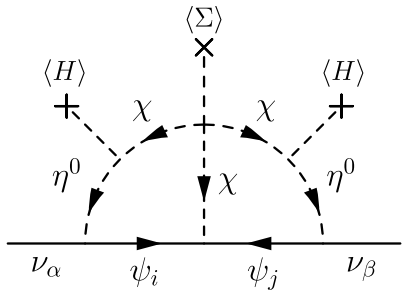
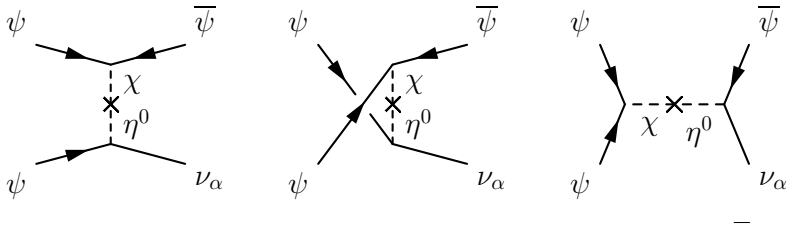
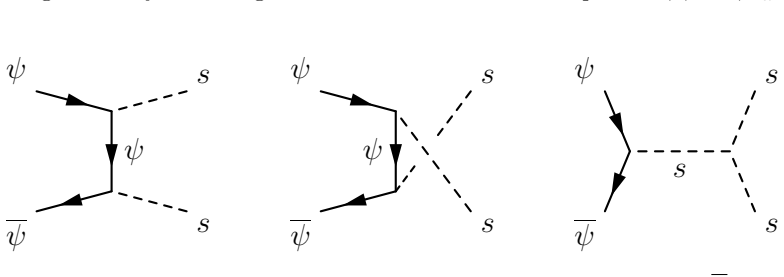
A Dirac fermion dark matter candidate semi-annihilates into a pair consisting of an anti-dark matter particle and a neutrino, while small neutrino masses are generated at the two-loop level. With relevant constraints applied, the mediator mass must be O(1) MeV to enhance the elastic scattering cross section with protons to O(10^{-36}) cm², which would allow detection in experiments such as DUNE and DARWIN.
What carries the argument
The semi-annihilation process producing boosted dark matter, combined with the two-loop radiative generation of neutrino masses and a light mediator that boosts the scattering cross section.
If this is right
- The boosted dark matter provides a distinctive experimental signature of non-minimal dark sectors.
- The two-loop mechanism accounts for the observed small neutrino masses.
- Relic density and other bounds can be satisfied in the identified parameter space.
- Future direct detection and neutrino experiments can probe the predicted cross section.
Where Pith is reading between the lines
- Models with other n to m annihilation processes could be built in a similar radiative framework.
- The O(1) MeV mediator scale might affect early universe cosmology in ways not detailed here.
- Additional predictions for processes like muon decay or flavor violation could be derived from the same particle content.
Load-bearing premise
A viable region of parameter space exists that simultaneously satisfies the semi-annihilation rate, the observed relic density, the two-loop neutrino mass generation, and all collider and cosmological bounds while tuning the mediator mass to the value needed for the quoted cross section.
What would settle it
Finding that no parameter values allow the mediator mass near 1 MeV while producing the correct neutrino masses and relic density, or that DUNE and DARWIN see no events at the predicted rate despite sufficient exposure.
Figures


read the original abstract
Dark matter particles can be accelerated by annihilation processes such as semi-annihilations and $n \to m$ ($n > m$) processes when the dark sector is non-minimally extended. Such boosted dark matter can provide a distinctive signature of a non-minimal dark sector, and its experimental detectability has been explored in a model-independent manner in previous work. In this work, we construct an explicit model of boosted dark matter originating from semi-annihilations. A Dirac fermion is identified as the dark matter candidate, which semi-annihilates into a pair of an anti-dark matter particle and a neutrino. The small neutrino masses are also radiatively generated at the two-loop level. Taking into account the relevant experimental and theoretical constraints, we find that the mass of the mediator needs to be $\mathcal{O}(1)~\mathrm{MeV}$ for the elastic scattering with protons, so that the cross section is enhanced to $\mathcal{O}(10^{-36})~\mathrm{cm}^2$, allowing detection in future experiments such as DUNE and DARWIN.
Editorial analysis
A structured set of objections, weighed in public.
Referee Report
Summary. The paper constructs an explicit model with a Dirac fermion dark matter candidate that semi-annihilates into an anti-DM particle and a neutrino, while generating small neutrino masses radiatively at two loops. After incorporating experimental and theoretical constraints, the authors conclude that the mediator mass must be O(1) MeV to produce an elastic DM-proton scattering cross section of O(10^{-36}) cm², enabling detection in future experiments such as DUNE and DARWIN.
Significance. If the joint consistency of relic density, neutrino mass generation, and bounds can be demonstrated, the work supplies a concrete UV-complete realization of boosted dark matter via semi-annihilation that also addresses neutrino masses, extending model-independent studies with a specific, testable prediction for direct detection.
major comments (2)
- [Abstract] Abstract: the central claim that constraints have been taken into account and require the mediator mass to be O(1) MeV for the quoted cross section is load-bearing, yet the manuscript supplies no benchmark points, parameter scan, or explicit derivation showing that the semi-annihilation rate yielding the observed relic density, the two-loop neutrino mass ~0.05 eV, and the required mediator mass can be satisfied simultaneously without violating collider or cosmological bounds.
- [DM phenomenology / constraints section] DM phenomenology and constraints section (likely §4–5): the mediator mass is presented as a requirement derived from the target cross section rather than an independent outcome of the model; without a concrete check (e.g., a table of viable points or scan results) this choice risks circularity with the detection goal.
Simulated Author's Rebuttal
We thank the referee for the careful reading of our manuscript and the constructive comments. We address the major points below and will incorporate revisions to strengthen the presentation of our results.
read point-by-point responses
-
Referee: [Abstract] Abstract: the central claim that constraints have been taken into account and require the mediator mass to be O(1) MeV for the quoted cross section is load-bearing, yet the manuscript supplies no benchmark points, parameter scan, or explicit derivation showing that the semi-annihilation rate yielding the observed relic density, the two-loop neutrino mass ~0.05 eV, and the required mediator mass can be satisfied simultaneously without violating collider or cosmological bounds.
Authors: We agree that explicit benchmark points would strengthen the central claim. While the model parameters were chosen to simultaneously satisfy the relic density via semi-annihilation, the two-loop neutrino mass formula, and experimental bounds (including collider and cosmological constraints), these were not tabulated in the original submission. In the revised manuscript we will add a table of viable benchmark points (with mediator mass O(1) MeV) that explicitly verify all conditions are met without violation of bounds. revision: yes
-
Referee: [DM phenomenology / constraints section] DM phenomenology and constraints section (likely §4–5): the mediator mass is presented as a requirement derived from the target cross section rather than an independent outcome of the model; without a concrete check (e.g., a table of viable points or scan results) this choice risks circularity with the detection goal.
Authors: We acknowledge the risk of perceived circularity in the presentation. The mediator mass emerges from requiring the semi-annihilation cross section to yield the observed relic density while producing a sufficiently large DM-proton scattering cross section; it is not chosen solely for detectability. We will revise the relevant section to include explicit benchmark points demonstrating that the mass scale is fixed by the combined relic-density and neutrino-mass requirements before discussing detection prospects, thereby removing any appearance of circularity. revision: yes
Circularity Check
No significant circularity; parameter requirements derived from external constraints
full rationale
The abstract states that after taking into account experimental and theoretical constraints, the mediator mass must be O(1) MeV to reach the quoted cross section. This is presented as a derived requirement rather than a self-definitional fit, a renamed prediction, or a load-bearing self-citation. No equations, ansatze, or uniqueness theorems are exhibited that reduce the central claim to its own inputs by construction. The model combines semi-annihilation, two-loop neutrino masses, and boosted DM scattering as independent elements whose joint viability is asserted after constraints; the provided text supplies no reduction showing any step is forced by definition or prior self-citation. This is the normal non-circular outcome for a model-building paper.
Axiom & Free-Parameter Ledger
free parameters (1)
- mediator mass =
O(1) MeV
axioms (2)
- domain assumption Quantum field theory loop calculations correctly generate neutrino masses at two loops in the extended sector.
- domain assumption Standard cosmological and collider constraints apply to the new particles and interactions.
invented entities (2)
-
Dirac fermion dark matter candidate
no independent evidence
-
Mediator particle
no independent evidence
Reference graph
Works this paper leans on
-
[1]
Hambye,Hidden vector dark matter, JHEP01(2009) 028[arXiv:0811.0172]
T. Hambye,Hidden vector dark matter, JHEP01(2009) 028[arXiv:0811.0172]
Pith/arXiv arXiv 2009
-
[2]
F. D’Eramo and J. Thaler,Semi-annihilation of Dark Matter, JHEP06(2010) 109 [arXiv:1003.5912]
Pith/arXiv arXiv 2010
-
[3]
Y. Hochberg, E. Kuflik, T. Volansky, and J. G. Wacker,Mechanism for Thermal Relic Dark Matter of Strongly Interacting Massive Particles, Phys. Rev. Lett.113 (2014) 171301[arXiv:1402.5143]
Pith/arXiv arXiv 2014
-
[4]
K. Agashe, Y. Cui, L. Necib, and J. Thaler,(In)direct Detection of Boosted Dark Matter, JCAP10(2014) 062[arXiv:1405.7370]
Pith/arXiv arXiv 2014
-
[5]
D. Kim, J.-C. Park, and S. Shin,Dark Matter “Collider” from Inelastic Boosted Dark Matter, Phys. Rev. Lett.119(2017) 161801[arXiv:1612.06867]
Pith/arXiv arXiv 2017
-
[6]
Toma,Distinctive signals of boosted dark matter from its semiannihilation, Phys
T. Toma,Distinctive signals of boosted dark matter from its semiannihilation, Phys. Rev. D105(2022) 043007[arXiv:2109.05911]
arXiv 2022
-
[7]
M. Aoki and T. Toma,Simultaneous detection of boosted dark matter and neutrinos from the semi-annihilation at DUNE, JCAP02(2024) 033[arXiv:2309.00395]
arXiv 2024
-
[8]
B. Betancourt Kamenetskaia, M. Fujiwara, A. Ibarra, and T. Toma,Boosted dark matter from semi-annihilations in the galactic center, Phys. Lett. B864(2025) 139425[arXiv:2501.12117]. 14
arXiv 2025
-
[9]
B. Betancourt Kamenetskaia, M. Fujiwara, A. Ibarra, and T. Toma,Dark matter spikes with strongly self-interacting particles, JCAP09(2025) 074 [arXiv:2506.12642]
arXiv 2025
-
[10]
Ma,Z(3) Dark Matter and Two-Loop Neutrino Mass, Phys
E. Ma,Z(3) Dark Matter and Two-Loop Neutrino Mass, Phys. Lett. B662(2008) 49–52[arXiv:0708.3371]
Pith/arXiv arXiv 2008
-
[11]
S.-Y. Ho, T. Toma, and K. Tsumura,SystematicU(1)B−Lextensions of loop-induced neutrino mass models with dark matter, Phys. Rev. D94(2016) 033007[arXiv:1604.07894]
Pith/arXiv arXiv 2016
-
[12]
A. Ibarra, H. M. Lee, S. López Gehler, W.-I. Park, and M. Pato,Gamma-ray boxes from axion-mediated dark matter, JCAP05(2013) 016[arXiv:1303.6632]. [Erratum: JCAP 03, E01 (2016)]
Pith/arXiv arXiv 2013
-
[13]
M. Aoki and T. Toma,Impact of semi-annihilation ofZ3 symmetric dark matter with radiative neutrino masses, JCAP09(2014) 016[arXiv:1405.5870]
Pith/arXiv arXiv 2014
-
[14]
M. Agostini, G. Benato, J. A. Detwiler, J. Menéndez, and F. Vissani,Toward the discovery of matter creation with neutrinolessββdecay, Rev. Mod. Phys.95(2023) 025002[arXiv:2202.01787]. [15]MEG IICollaboration,A search forµ +→e+γwith the first dataset of the MEG II experiment, Eur. Phys. J. C84(2024) 216[arXiv:2310.12614]. [Erratum: Eur.Phys.J.C 84, 1042 (2024)]
arXiv 2023
-
[15]
E. Ma and M. Raidal,Neutrino mass, muon anomalous magnetic moment, and lepton flavor nonconservation, Phys. Rev. Lett.87(2001) 011802 [hep-ph/0102255]. [Erratum: Phys.Rev.Lett. 87, 159901 (2001)]
Pith/arXiv arXiv 2001
-
[16]
T. Toma and A. Vicente,Lepton Flavor Violation in the Scotogenic Model, JHEP 01(2014) 160[arXiv:1312.2840]
Pith/arXiv arXiv 2014
-
[17]
R. Barbieri, L. J. Hall, and V. S. Rychkov,Improved naturalness with a heavy Higgs: An Alternative road to LHC physics, Phys. Rev. D74(2006) 015007 [hep-ph/0603188]. [19]ALEPH, DELPHI, L3, OPAL, SLD, LEP Electroweak Working Group, SLD Electroweak Group, SLD Heavy Flavour GroupCollaboration, Precision electroweak measurements on theZresonance, Phys. Rept.4...
Pith/arXiv arXiv 2006
-
[18]
Goudzovskiet al.,New physics searches at kaon and hyperon factories, Rept
E. Goudzovskiet al.,New physics searches at kaon and hyperon factories, Rept. Prog. Phys.86(2023) 016201[arXiv:2201.07805]. [21]NA62Collaboration,Measurement of the very rare K +→π+ννdecay, JHEP06 (2021) 093[arXiv:2103.15389]. [22]PlanckCollaboration,Planck 2018 results. VI. Cosmological parameters, Astron. Astrophys.641(2020) A6[arXiv:1807.06209]. [Errat...
arXiv 2023
-
[19]
A. Belyaev, N. D. Christensen, and A. Pukhov,CalcHEP 3.4 for collider physics within and beyond the Standard Model, Comput. Phys. Commun.184(2013) 1729–1769[arXiv:1207.6082]
Pith/arXiv arXiv 2013
-
[20]
A. Alloul, N. D. Christensen, C. Degrande, C. Duhr, and B. Fuks,FeynRules 2.0 - A complete toolbox for tree-level phenomenology, Comput. Phys. Commun.185 (2014) 2250–2300[arXiv:1310.1921]
Pith/arXiv arXiv 2014
-
[21]
Alguero,et al.,micrOMEGAs 6.0: N-component dark matter, Comput
G. Alguero,et al.,micrOMEGAs 6.0: N-component dark matter, Comput. Phys. Commun.299(2024) 109133[arXiv:2312.14894]
arXiv 2024
-
[22]
T. Binder, T. Bringmann, M. Gustafsson, and A. Hryczuk,Dark matter relic abundance beyond kinetic equilibrium, Eur. Phys. J. C81(2021) 577 [arXiv:2103.01944]. [27]XENONCollaboration,First Dark Matter Search with Nuclear Recoils from the XENONnT Experiment, Phys. Rev. Lett.131(2023) 041003[arXiv:2303.14729]. [28]DARWINCollaboration,DARWIN: towards the ulti...
arXiv 2021
-
[23]
N. F. Bell, M. J. Dolan, and S. Robles,Searching for Sub-GeV Dark Matter in the Galactic Centre using Hyper-Kamiokande, JCAP09(2020) 019 [arXiv:2005.01950]
arXiv 2020
-
[24]
C. A. Argüelles,et al.,Dark matter annihilation to neutrinos, Rev. Mod. Phys.93 (2021) 035007[arXiv:1912.09486]. [32]XENONCollaboration,Light Dark Matter Search with Ionization Signals in XENON1T, Phys. Rev. Lett.123(2019) 251801[arXiv:1907.11485]. [33]DAMICCollaboration,Constraints on Light Dark Matter Particles Interacting with Electrons from DAMIC at S...
arXiv 2021
discussion (0)
Sign in with ORCID, Apple, or X to comment. Anyone can read and Pith papers without signing in.