Short-Acquisition Contrast-Free Super-Resolution Microvascular Imaging in Rabbit Kidney
Pith reviewed 2026-06-28 12:42 UTC · model grok-4.3
The pith
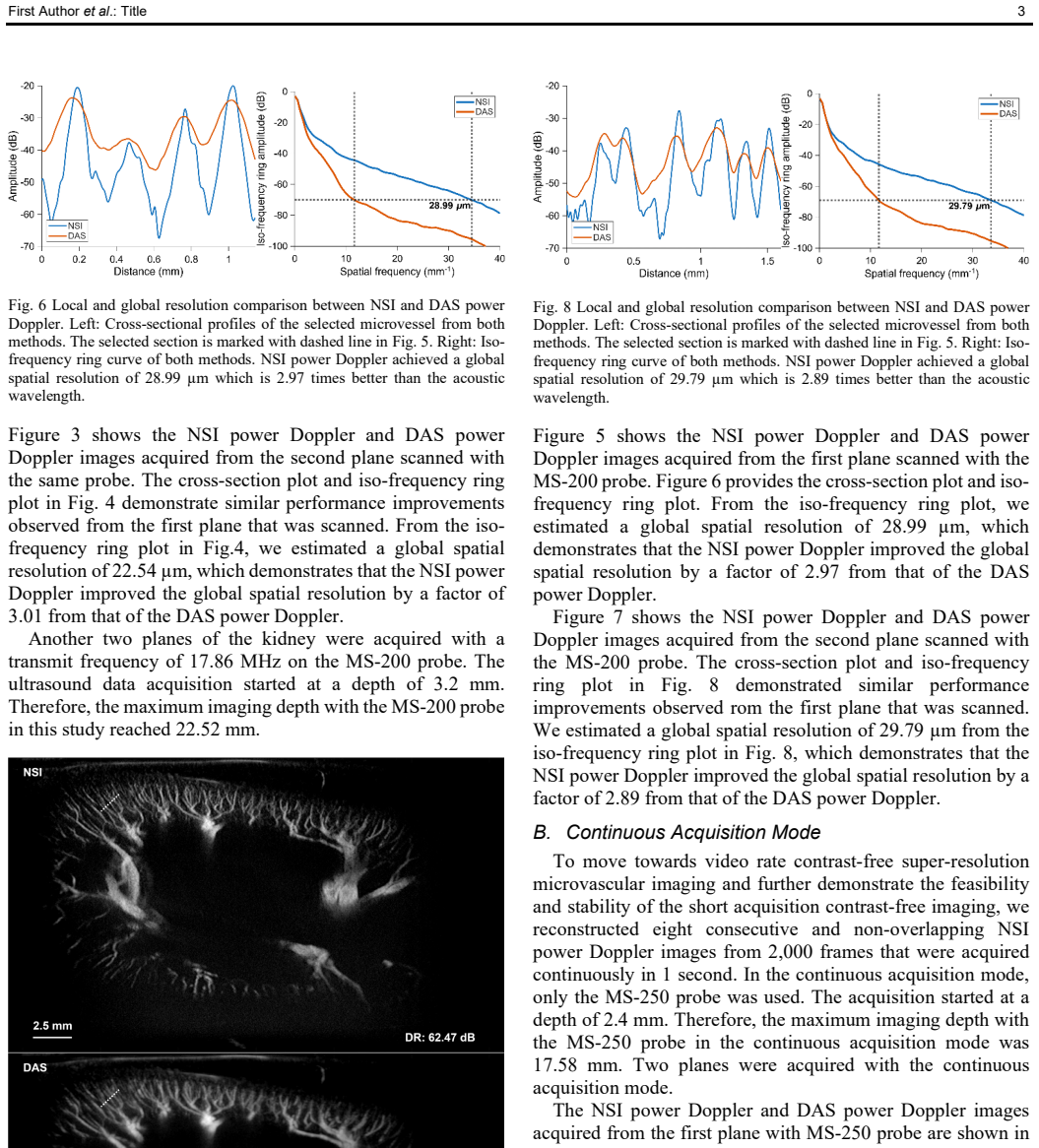
Nonlinear beamforming on native blood flow enables contrast-free super-resolution ultrasound imaging with 22 micrometer resolution at 8 frames per second.
A machine-rendered reading of the paper's core claim, the machinery that carries it, and where it could break.
Core claim
The authors claim that nonlinear beamforming of backscatter signals from native blood flow in ultrafast ultrasound data allows reconstruction of super-resolution microvascular images without contrast agents, achieving 22.2 micrometer global spatial resolution and 8 frames per second frame rate from 125 milliseconds of in vivo data per image in a rabbit kidney model, representing a three-fold improvement over conventional power Doppler imaging.
What carries the argument
Nonlinear beamforming of backscatter signals from native blood flow to create localized point sources for super-resolution reconstruction.
If this is right
- Improved microvascular contrast and finer vessel delineation without microbubble injection.
- High frame rate imaging suitable for dynamic in vivo assessment.
- Three-fold better spatial resolution than power Doppler with same acquisition duration.
- Practical pathway toward clinical translation of super-resolution ultrasound.
Where Pith is reading between the lines
- The technique may apply to human subjects if tissue motion can be compensated.
- It could enable real-time monitoring of microvascular changes during procedures.
- Comparison with other super-resolution methods might reveal trade-offs in resolution versus acquisition speed.
- Integration with existing ultrasound systems could accelerate adoption.
Load-bearing premise
That nonlinear beamforming alone on native blood flow backscatter produces sufficient localized point sources for accurate super-resolution without contrast agents or explicit handling of motion and clutter artifacts.
What would settle it
Observing whether the super-resolved vessel maps align with independent measurements from contrast-enhanced ultrasound localization microscopy performed on the same rabbit kidney under identical conditions.
Figures
read the original abstract
Ultrasound localization microscopy (ULM) enables micrometer-scale microvascular imaging by localizing and tracking intravascular microbubbles, but its dependence on exogenous contrast agents and long acquisition times limits clinical translation. This study presents a high-frame-rate contrast-free super-resolution ultrasound microvascular imaging method based on high-frequency ultrafast ultrasound and nonlinear beamforming of backscatter signals from native blood flow. Using only 125 milliseconds of in vivo ultrafast data per image, the proposed method achieved an imaging frame rate of 8 frames/s in a rabbit kidney model. The reconstructed microvascular images resolved vessels with a global spatial resolution of 22.2 um over a field of view of 23.04 x 15.18 mm2, where the wavelength of ultrasound was 67.5 um. This corresponds to a three-fold improvement over conventional power Doppler imaging under the same acquisition duration. Compared with conventional flow imaging, the proposed method provided improved microvascular contrast and finer vessel delineation without microbubble injection. These results demonstrate a practical pathway toward high frame rate, contrast-free super-resolution ultrasound imaging for microvascular assessment.
Editorial analysis
A structured set of objections, weighed in public.
Referee Report
Summary. The manuscript describes a contrast-free super-resolution microvascular imaging technique using high-frequency ultrafast ultrasound and nonlinear beamforming applied to backscatter signals from native blood flow. In a rabbit kidney in vivo model, it reports achieving an 8 frames/s imaging rate with only 125 ms acquisition per image, a spatial resolution of 22.2 μm (compared to 67.5 μm ultrasound wavelength) over a 23.04 x 15.18 mm² field of view, representing a three-fold improvement over conventional power Doppler imaging under the same conditions, with improved contrast and vessel delineation without microbubble injection.
Significance. If the central assumption holds—that nonlinear beamforming can generate sufficient localized point sources from native blood backscatter for super-resolution reconstruction without contrast agents or significant artifacts—this work could provide a practical approach to high-frame-rate, short-acquisition super-resolution ultrasound imaging, potentially facilitating clinical translation by eliminating the need for exogenous contrast and long acquisition times associated with traditional ultrasound localization microscopy.
major comments (2)
- [Abstract] Abstract: the reported quantitative outcomes (22.2 μm global resolution, 8 frames/s rate, three-fold improvement over power Doppler) are supplied without error bars, statistical tests, motion-correction details, or full method equations, preventing verification that the data support the central claim without post-hoc choices.
- [Methods] Methods (implied by abstract description): the assumption that nonlinear beamforming of native blood backscatter alone yields usable localized point sources is presented without explicit validation against tissue clutter artifacts or motion, which is load-bearing for the contrast-free claim.
minor comments (1)
- [Abstract] Abstract: the field of view is written as 23.04 x 15.18 mm2; ensure consistent superscript notation for squared units across the manuscript.
Simulated Author's Rebuttal
We thank the referee for their detailed review and constructive comments on our manuscript. We provide point-by-point responses to the major comments below. Where the comments identify areas for improvement in reporting, we have made or will make revisions to enhance clarity and verifiability of our results.
read point-by-point responses
-
Referee: [Abstract] Abstract: the reported quantitative outcomes (22.2 μm global resolution, 8 frames/s rate, three-fold improvement over power Doppler) are supplied without error bars, statistical tests, motion-correction details, or full method equations, preventing verification that the data support the central claim without post-hoc choices.
Authors: We agree that the abstract, due to its concise nature, does not include error bars or full statistical details. The reported resolution of 22.2 μm represents the mean value obtained from multiple vessel cross-sections in the reconstructed images, with the variability and calculation method detailed in the Results and Methods sections of the full manuscript. The 8 frames/s rate follows directly from the 125 ms acquisition per frame. The three-fold improvement is calculated from the ratio of resolutions measured in the same dataset for the proposed method versus power Doppler. Motion-correction is described in the Methods, and the nonlinear beamforming equations are provided there as well. To improve verifiability, we will revise the abstract to include a statement referencing the supporting analyses in the main text and note that error estimates are available in the supplementary materials or results. This addresses the concern without post-hoc choices, as all metrics are pre-defined in the analysis pipeline. revision: yes
-
Referee: [Methods] Methods (implied by abstract description): the assumption that nonlinear beamforming of native blood backscatter alone yields usable localized point sources is presented without explicit validation against tissue clutter artifacts or motion, which is load-bearing for the contrast-free claim.
Authors: The assumption is supported by the in vivo results presented, where the method produces microvascular images with superior contrast and resolution compared to power Doppler without the use of contrast agents. The Methods section includes the application of clutter rejection techniques prior to beamforming and a description of the motion compensation strategy used. We acknowledge that more explicit validation, such as controlled experiments quantifying the contribution of clutter or residual motion artifacts, would further substantiate the claim. We will revise the manuscript to include additional discussion or a supplementary analysis addressing potential artifacts from tissue clutter and motion, thereby strengthening the contrast-free aspect of the work. revision: yes
Circularity Check
No significant circularity
full rationale
The paper presents an experimental demonstration of a contrast-free super-resolution ultrasound imaging method using in vivo data from a rabbit kidney model. No derivation chain, equations, or first-principles predictions are described that reduce reported outcomes (e.g., 22.2 um resolution or 8 frames/s rate) to fitted parameters or self-referential definitions from the same inputs. The work relies on empirical acquisition and reconstruction rather than any of the enumerated circular patterns such as self-definitional claims, fitted inputs renamed as predictions, or load-bearing self-citations. The central results are framed as measured performance improvements over conventional power Doppler under identical conditions, making the derivation self-contained against external benchmarks.
Axiom & Free-Parameter Ledger
Reference graph
Works this paper leans on
-
[1]
C. Errico et al., “Ultrafast ultrasound localization microscopy for deep super-resolution vascular First Author et al.: Title 3 imaging,” Nature, vol. 527, no. 7579, pp. 499–502, Nov. 2015, doi: 10.1038/nature16066
-
[2]
In Vivo Acoustic Super- Resolution and Super-Resolved Velocity Mapping Using Microbubbles,
K. Christensen-Jeffries, R. J. Browning, M.-X. Tang, C. Dunsby, and R. J. Eckersley, “In Vivo Acoustic Super- Resolution and Super-Resolved Velocity Mapping Using Microbubbles,” IEEE Trans. Med. Imaging, vol. 34, no. 2, pp. 433–440, Feb. 2015, doi: 10.1109/TMI.2014.2359650
-
[3]
P. Song et al., “Improved Super-Resolution Ultrasound Microvessel Imaging With Spatiotemporal Nonlocal Means Filtering and Bipartite Graph-Based Microbubble Tracking,” IEEE Trans. Ultrason. Ferroelectr. Freq. Control, vol. 65, no. 2, pp. 149–167, Feb. 2018, doi: 10.1109/TUFFC.2017.2778941
-
[4]
Q. Chen, J. Yu, B. M. Rush, S. D. Stocker, R. J. Tan, and K. Kim, “Ultrasound super-resolution imaging provides a noninvasive assessment of renal microvasculature changes during mouse acute kidney injury,” Kidney Int., vol. 98, no. 2, pp. 355–365, Aug. 2020, doi: 10.1016/j.kint.2020.02.011
-
[5]
C. Huang et al., “Super-resolution ultrasound localization microscopy based on a high frame-rate clinical ultrasound scanner: an in-human feasibility study,” Phys. Med. Biol., vol. 66, no. 8, p. 08NT01, Apr. 2021, doi: 10.1088/1361-6560/abef45
-
[6]
Doppler Slicing for Ultrasound Super-Resolution Without Contrast Agents,
A. Bar-Zion, O. Solomon, C. Rabut, D. Maresca, Y. C. Eldar, and M. G. Shapiro, “Doppler Slicing for Ultrasound Super-Resolution Without Contrast Agents,” Nov. 20, 2021, bioRxiv. doi: 10.1101/2021.11.19.469083
-
[7]
Contrast-Free Super-Resolution Power Doppler (CS-PD) Based on Deep Neural Networks,
Q. You et al., “Contrast-Free Super-Resolution Power Doppler (CS-PD) Based on Deep Neural Networks,” IEEE Trans. Ultrason. Ferroelectr. Freq. Control, vol. 70, no. 10, pp. 1355–1368, Oct. 2023, doi: 10.1109/TUFFC.2023.3304527
-
[8]
Super-Resolution Ultrasound Imaging Using the Erythrocytes—Part I: Density Images,
J. Arendt Jensen et al., “Super-Resolution Ultrasound Imaging Using the Erythrocytes—Part I: Density Images,” IEEE Trans. Ultrason. Ferroelectr. Freq. Control, vol. 71, no. 8, pp. 925–944, Aug. 2024, doi: 10.1109/TUFFC.2024.3411711
-
[9]
Super-Resolution Ultrasound Imaging Using the Erythrocytes—Part II: Velocity Images,
M. A. Naji et al., “Super-Resolution Ultrasound Imaging Using the Erythrocytes—Part II: Velocity Images,” IEEE Trans. Ultrason. Ferroelectr. Freq. Control, vol. 71, no. 8, pp. 945–959, Aug. 2024, doi: 10.1109/TUFFC.2024.3411795
-
[10]
M. Amin Naji et al., “Human lymph node microvascular imaging using a fast contrast-free super- resolution ultrasound technique,” Sci. Rep., vol. 15, no. 1, p. 23061, Jul. 2025, doi: 10.1038/s41598-025-08483- 4
-
[11]
Real- Time Super-Resolution Ultrasound Imaging using the Erythrocytes,
S. K. Præsius, L. T. Jørgensen, and J. A. Jensen, “Real- Time Super-Resolution Ultrasound Imaging using the Erythrocytes,” IEEE Trans. Ultrason., pp. 1–1, 2026, doi: 10.1109/TUSON.2026.3683326
-
[12]
Contrast-Free Super-Resolution microvascular imaging through high frequency ultrasound imaging,
C.-W. Li et al., “Contrast-Free Super-Resolution microvascular imaging through high frequency ultrasound imaging,” Ultrasonics, vol. 159, p. 107843, Mar. 2026, doi: 10.1016/j.ultras.2025.107843
-
[13]
A. Agarwal, J. Reeg, A. S. Podkowa, and M. L. Oelze, “Improving Spatial Resolution Using Incoherent Subtraction of Receive Beams Having Different Apodizations,” IEEE Trans. Ultrason. Ferroelectr. Freq. Control, vol. 66, no. 1, pp. 5–17, Jan. 2019, doi: 10.1109/TUFFC.2018.2876285
-
[14]
High-Resolution Power Doppler Using Null Subtraction Imaging,
Z. Kou, M. R. Lowerison, Q. You, Y. Wang, P. Song, and M. L. Oelze, “High-Resolution Power Doppler Using Null Subtraction Imaging,” IEEE Trans. Med. Imaging, vol. 43, no. 9, pp. 3060–3071, Sep. 2024, doi: 10.1109/TMI.2024.3383768
-
[15]
Eigen-based clutter filter design for ultrasound color flow imaging: a review,
A. C. H. Yu and L. Lovstakken, “Eigen-based clutter filter design for ultrasound color flow imaging: a review,” IEEE Trans. Ultrason. Ferroelectr. Freq. Control, vol. 57, no. 5, pp. 1096–1111, May 2010, doi: 10.1109/TUFFC.2010.1521
discussion (0)
Sign in with ORCID, Apple, or X to comment. Anyone can read and Pith papers without signing in.