The Pion Gravitational Form Factors and the Trace Anomaly in QCD Factorization
Pith reviewed 2026-06-28 09:46 UTC · model grok-4.3
The pith
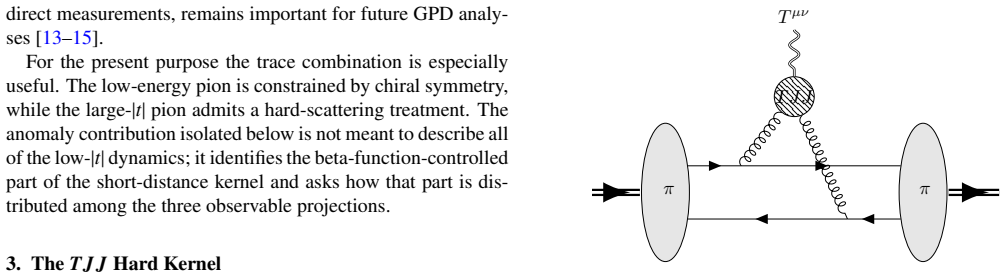
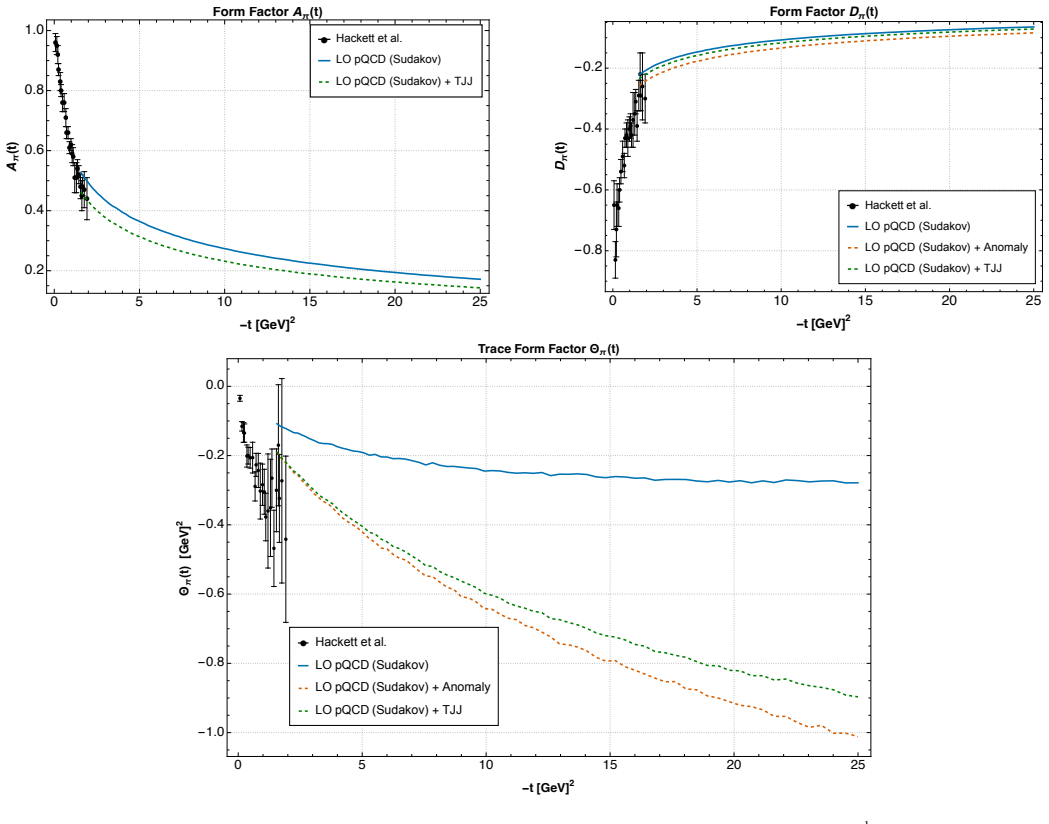
The trace anomaly from the non-Abelian TJJ vertex contributes to the pion gravitational form factors, canceling in A_π(Q²) but dominating the trace form factor.
A machine-rendered reading of the paper's core claim, the machinery that carries it, and where it could break.
Core claim
The calculation shows that the trace anomaly component generated by the non-Abelian TJJ vertex cancels when isolated in the form factor A_π(Q²), while the full TJJ insertion lowers the leading-order curve at small momentum transfer squared Q². The anomaly is important in D_π(Q²) and supplies the dominant TJJ contribution to the trace form factor. This refined projection hierarchy is obtained after matching the Sudakov-improved factorization result to lattice QCD data.
What carries the argument
The non-Abelian TJJ vertex that generates the trace-anomaly component of the gravitational form factor.
Load-bearing premise
The anomaly form factor is correctly given by the momentum-space conformal field theory suggestion and the perturbative dilaton sum rule.
What would settle it
A lattice QCD calculation at small Q² that finds no lowering of the leading-order curve once the full TJJ insertion is included, or that shows the anomaly does not dominate the trace form factor, would falsify the reported hierarchy.
Figures
read the original abstract
We study the pion gravitational form factor in QCD factorization, focusing on the trace-anomaly component generated by the non-Abelian \(TJJ\) vertex. The calculation combines a Sudakov-resummation-improved pion hard kernel with the anomaly form factor suggested by momentum-space conformal field theory and by the perturbative dilaton sum rule. Comparison with lattice QCD data shows a refined projection hierarchy: the isolated anomaly cancels in the form factor \(A_\pi(Q^2)\), while the full \(TJJ\) insertion lowers the leading-order curve at small momentum transfer squared \(Q^2\); the anomaly is important in \(D_\pi(Q^2)\), and it gives the dominant \(TJJ\) contribution to the trace form factor.
Editorial analysis
A structured set of objections, weighed in public.
Referee Report
Summary. The manuscript examines the pion gravitational form factors in QCD factorization, with emphasis on the trace-anomaly contribution arising from the non-Abelian TJJ vertex. It combines a Sudakov-resummation-improved hard kernel with an anomaly form factor taken from momentum-space conformal field theory and the perturbative dilaton sum rule. Lattice comparisons are reported to establish a refined hierarchy: the isolated anomaly cancels in A_π(Q²), the full TJJ insertion lowers the leading-order result at small Q², the anomaly is important for D_π(Q²), and it supplies the dominant TJJ piece of the trace form factor.
Significance. If the external anomaly form factor accurately encodes the relevant TJJ matrix element, the work would clarify how the QCD trace anomaly projects onto hadronic gravitational form factors and would supply a concrete factorization-based interpretation of existing lattice data.
major comments (1)
- [Abstract] Abstract: the central hierarchy (cancellation of the isolated anomaly in A_π(Q²), lowering by the full TJJ insertion at small Q², importance in D_π(Q²), and dominance in the trace form factor) is obtained only after inserting an anomaly form factor taken from prior CFT and dilaton-sum-rule suggestions. No derivation or error control of this input is performed inside the QCD factorization framework itself; if the imported form factor deviates from the true non-Abelian TJJ contribution in the pion channel, every reported projection fails. This assumption is therefore load-bearing and requires explicit justification or independent lattice validation.
Simulated Author's Rebuttal
We thank the referee for the careful reading and the constructive comment on our manuscript. We respond to the major point below.
read point-by-point responses
-
Referee: [Abstract] Abstract: the central hierarchy (cancellation of the isolated anomaly in A_π(Q²), lowering by the full TJJ insertion at small Q², importance in D_π(Q²), and dominance in the trace form factor) is obtained only after inserting an anomaly form factor taken from prior CFT and dilaton-sum-rule suggestions. No derivation or error control of this input is performed inside the QCD factorization framework itself; if the imported form factor deviates from the true non-Abelian TJJ contribution in the pion channel, every reported projection fails. This assumption is therefore load-bearing and requires explicit justification or independent lattice validation.
Authors: We agree that the anomaly form factor is an external input adopted from momentum-space CFT and the perturbative dilaton sum rule, with no derivation or error control performed inside the QCD factorization framework. The factorization method is applied to the Sudakov-improved hard kernel for the pion, while the trace-anomaly piece is matched from these external calculations because a self-contained derivation of the non-Abelian TJJ matrix element within the same framework is not available. The lattice comparisons test the combined predictions rather than isolating the input. We will revise the manuscript (partial revision) to state the external origin more explicitly in the abstract and main text and to discuss the associated assumptions and uncertainties. revision: partial
Circularity Check
No significant circularity: anomaly form factor imported from external CFT/dilaton suggestions; results benchmarked against lattice QCD
full rationale
The derivation imports the anomaly form factor as an external input suggested by momentum-space conformal field theory and the perturbative dilaton sum rule, then inserts it into a Sudakov-resummation-improved factorization kernel to obtain A_π(Q²), D_π(Q²) and the trace form factor. These are compared directly to lattice QCD data, which serves as an independent external benchmark. No equation or step reduces the output to the input by construction, no fitted parameter is relabeled as a prediction, and no load-bearing premise rests on a self-citation chain. The central hierarchy claim therefore remains falsifiable against the lattice results rather than tautological.
Axiom & Free-Parameter Ledger
axioms (1)
- domain assumption The anomaly form factor is given by momentum-space conformal field theory and the perturbative dilaton sum rule.
Reference graph
Works this paper leans on
-
[1]
Ji, Gauge-Invariant Decomposition of Nucleon Spin, Phys
X. Ji, Gauge-Invariant Decomposition of Nucleon Spin, Phys. Rev. Lett. 78 (1997) 610–613.arXiv:hep-ph/9603249,doi:10.1103/ PhysRevLett.78.610
Pith/arXiv arXiv 1997
-
[2]
A. V . Radyushkin, Asymmetric gluon distributions and hard diffractive electroproduction, Phys. Lett. B 385 (1996) 333–342.arXiv:hep-ph/ 9604317,doi:10.1016/0370-2693(96)00528-X
-
[3]
A. V . Radyushkin, Scaling Limit of Deeply Virtual Compton Scattering, Phys. Lett. B 380 (1996) 417–425.arXiv:hep-ph/9605431,doi:10. 1016/0370-2693(96)00932-8
Pith/arXiv arXiv 1996
-
[4]
Virtual Compton Scattering off the nucleon
M. Vanderhaeghen, P. A. M. Guichon, M. Guidal, Hard electroproduc- tion of photons and mesons on the nucleon, Phys. Rev. Lett. 80 (1998) 5064–5067.arXiv:hep-ph/9806305,doi:10.1103/PhysRevLett. 80.5064
work page internal anchor Pith review Pith/arXiv arXiv doi:10.1103/physrevlett 1998
-
[5]
V . D. Burkert, L. Elouadrhiri, F. X. Girod, The pressure distribution in- side the proton, Nature 557 (7705) (2018) 396–399.doi:10.1038/ s41586-018-0060-z
2018
-
[6]
B. Duran, et al., Determining the gluonic gravitational form factors of the proton, Nature 615 (7954) (2023) 813–816.arXiv:2207.05212, doi:10.1038/s41586-023-05730-4
-
[7]
D. C. Hackett, P. R. Oare, D. A. Pefkou, P. E. Shanahan, Gravitational form factors of the pion from lattice QCD, Phys. Rev. D 108 (11) (2023) 114504.arXiv:2307.11707,doi:10.1103/PhysRevD.108.114504
-
[8]
X.-B. Tong, J.-P. Ma, F. Yuan, Gluon gravitational form factors at large momentum transfer, Phys. Lett. B 823 (2021) 136751.arXiv:2101. 02395,doi:10.1016/j.physletb.2021.136751
-
[9]
X.-B. Tong, J.-P. Ma, F. Yuan, Perturbative calculations of gravitational form factors at large momentum transfer, JHEP 10 (2022) 046.arXiv: 2203.13493,doi:10.1007/JHEP10(2022)046
-
[10]
Implications of conformal invariance in momentum space
A. Bzowski, P. McFadden, K. Skenderis, Implications of conformal in- variance in momentum space, JHEP 03 (2014) 111.arXiv:1304.7760, doi:10.1007/JHEP03(2014)111
work page internal anchor Pith review Pith/arXiv arXiv doi:10.1007/jhep03(2014)111 2014
-
[11]
C. Corianò, S. Lionetti, D. Melle, R. Tommasi, The Gravitational Form Factors of Hadrons from CFT in Momentum Space and the Dilaton in Perturbative QCD, Eur. Phys. J. C 85 (5) (2025) 498.arXiv:2409. 05609,doi:10.1140/epjc/s10052-025-14104-1
-
[12]
C. Corianò, S. Lionetti, D. Melle, R. Tommasi, The Gravitational Form Factor of the Pion and Proton and the Conformal Anomaly, EPJ Web Conf. 314 (2024) 00030.arXiv:2409.19586,doi:10.1051/ epjconf/202431400030
arXiv 2024
-
[13]
S. Kumano, Q.-T. Song, O. V . Teryaev, Hadron tomography by general- ized distribution amplitudes in pion-pair production processγ ∗γ→π 0π0 and gravitational form factors for pion, Phys. Rev. D 97 (1) (2018) 014020.arXiv:1711.08088,doi:10.1103/PhysRevD.97.014020
work page internal anchor Pith review Pith/arXiv arXiv doi:10.1103/physrevd.97.014020 2018
-
[15]
Study of $\pi^0$ pair production in single-tag two-photon collisions
M. Masuda, et al., Study ofπ 0 pair production in single-tag two-photon collisions, Phys. Rev. D 93 (3) (2016) 032003.arXiv:1508.06757, doi:10.1103/PhysRevD.93.032003
work page internal anchor Pith review Pith/arXiv arXiv doi:10.1103/physrevd.93.032003 2016
-
[16]
A. V . Efremov, A. V . Radyushkin, Factorization and asymptotical be- havior of pion form factor in qcd, Phys. Lett. B 94 (1980) 245.doi: 10.1016/0370-2693(80)90869-2
-
[17]
G. P. Lepage, S. J. Brodsky, Exclusive processes in perturbative quan- tum chromodynamics, Phys. Rev. D 22 (1980) 2157.doi:10.1103/ PhysRevD.22.2157
1980
-
[18]
C. Corianò, S. Lionetti, D. Melle, L. Torcellini, A dilaton sum rule for the conformal anomaly form factor in QCD at orderα s, Eur. Phys. J. C 85 (9) (2025) 983.arXiv:2504.01904,doi:10.1140/epjc/ s10052-025-14686-w
-
[19]
The Trace Anomaly and Massless Scalar Degrees of Freedom in Gravity
M. Giannotti, E. Mottola, The Trace Anomaly and Massless Scalar De- grees of Freedom in Gravity, Phys. Rev. D79 (2009) 045014.arXiv: 0812.0351,doi:10.1103/PhysRevD.79.045014
work page internal anchor Pith review Pith/arXiv arXiv doi:10.1103/physrevd.79.045014 2009
-
[20]
R. Armillis, C. Corianò, L. Delle Rose, Conformal Anomalies and the Gravitational Effective Action: TheT J JCorrelator for a Dirac Fermion, Phys. Rev. D81 (2010) 085001.arXiv:0910.3381,doi:10.1103/ PhysRevD.81.085001
Pith/arXiv arXiv 2010
-
[21]
Trace Anomaly, Massless Scalars and the Gravitational Coupling of QCD
R. Armillis, C. Corianò, L. Delle Rose, Trace Anomaly, Massless Scalars and the Gravitational Coupling of QCD, Phys. Rev. D82 (2010) 064023. arXiv:1005.4173,doi:10.1103/PhysRevD.82.064023
work page internal anchor Pith review Pith/arXiv arXiv doi:10.1103/physrevd.82.064023 2010
-
[22]
C. Coriano, L. Delle Rose, E. Mottola, M. Serino, Graviton Vertices and the Mapping of Anomalous Correlators to Momentum Space for a Gen- eral Conformal Field Theory, JHEP 08 (2012) 147.arXiv:1203.1339, doi:10.1007/JHEP08(2012)147
work page internal anchor Pith review Pith/arXiv arXiv doi:10.1007/jhep08(2012)147 2012
-
[23]
C. Corianò, A. Costantini, L. Delle Rose, M. Serino, Superconformal sum rules and the spectral density flow of the composite dilaton (ADD) multiplet inN=1 theories, JHEP 06 (2014) 136.arXiv:1402.6369, doi:10.1007/JHEP06(2014)136
work page internal anchor Pith review Pith/arXiv arXiv doi:10.1007/jhep06(2014)136 2014
-
[24]
Renormalization, Conformal Ward Identities and the Origin of a Conformal Anomaly Pole
C. Corianò, M. M. Maglio, Renormalization, Conformal Ward Identi- ties and the Origin of a Conformal Anomaly Pole, Phys. Lett. B781 (2018) 283–289.arXiv:1802.01501,doi:10.1016/j.physletb. 2018.04.003
work page internal anchor Pith review Pith/arXiv arXiv doi:10.1016/j.physletb 2018
-
[25]
C. Corianò, M. M. Maglio, Conformal field theory in momentum space and anomaly actions in gravity: The analysis of three- and four-point function, Phys. Rept. 952 (2022) 2198.arXiv:2005.06873,doi:10. 1016/j.physrep.2021.11.005
arXiv 2022
-
[26]
Exact Correlators from Conformal Ward Identities in Momentum Space and the Perturbative $TJJ$ Vertex
C. Corianò, M. M. Maglio, Exact Correlators from Conformal Ward Identities in Momentum Space and the PerturbativeT J JVertex, Nucl. Phys. B938 (2019) 440–522.arXiv:1802.07675,doi:10.1016/j. nuclphysb.2018.11.016
work page internal anchor Pith review Pith/arXiv arXiv doi:10.1016/j 2019
-
[27]
C. Corianò, S. Lionetti, D. Melle, L. Torcellini, Anomaly-mediated Scalar Gravitational Interactions and the Coupling of Conformal Sectors, arXiv preprint (3 2026).arXiv:2603.28966
arXiv 2026
-
[28]
Mottola, Scalar Gravitational Waves in the Effective Theory of Gravity, ArXiv e-prints (Jun
E. Mottola, Scalar Gravitational Waves in the Effective Theory of Gravity, ArXiv e-prints (Jun. 2016).arXiv:1606.09220
Pith/arXiv arXiv 2016
-
[29]
J. Botts, G. Sterman, Hard elastic scattering in qcd: Leading behavior, Nucl. Phys. B 325 (1989) 62.doi:10.1016/0550-3213(89)90372-6. 5
-
[30]
H.-n. Li, G. Sterman, The perturbative pion form factor with su- dakov suppression, Nucl. Phys. B 381 (1992) 129.doi:10.1016/ 0550-3213(92)90643-P
1992
-
[31]
Sterman, Summation of large corrections to short distance hadronic cross-sections, Nucl
G. Sterman, Summation of large corrections to short distance hadronic cross-sections, Nucl. Phys. B 281 (1987) 310.doi:10.1016/ 0550-3213(87)90258-6
1987
-
[32]
W.-Y . Liu, E. Shuryak, I. Zahed, Pion gravitational form factors in the QCD instanton vacuum II, arXiv preprint (5 2024).arXiv:2405.16269. 6
arXiv 2024
discussion (0)
Sign in with ORCID, Apple, or X to comment. Anyone can read and Pith papers without signing in.