Quantum Optimization Algorithms for Strongly Correlated Many-Body Systems
Pith reviewed 2026-06-28 10:04 UTC · model grok-4.3
The pith
Feedback-based quantum algorithms provide more robust trajectories for optimizing strongly correlated many-body systems than gradient-based variational methods.
A machine-rendered reading of the paper's core claim, the machinery that carries it, and where it could break.
Core claim
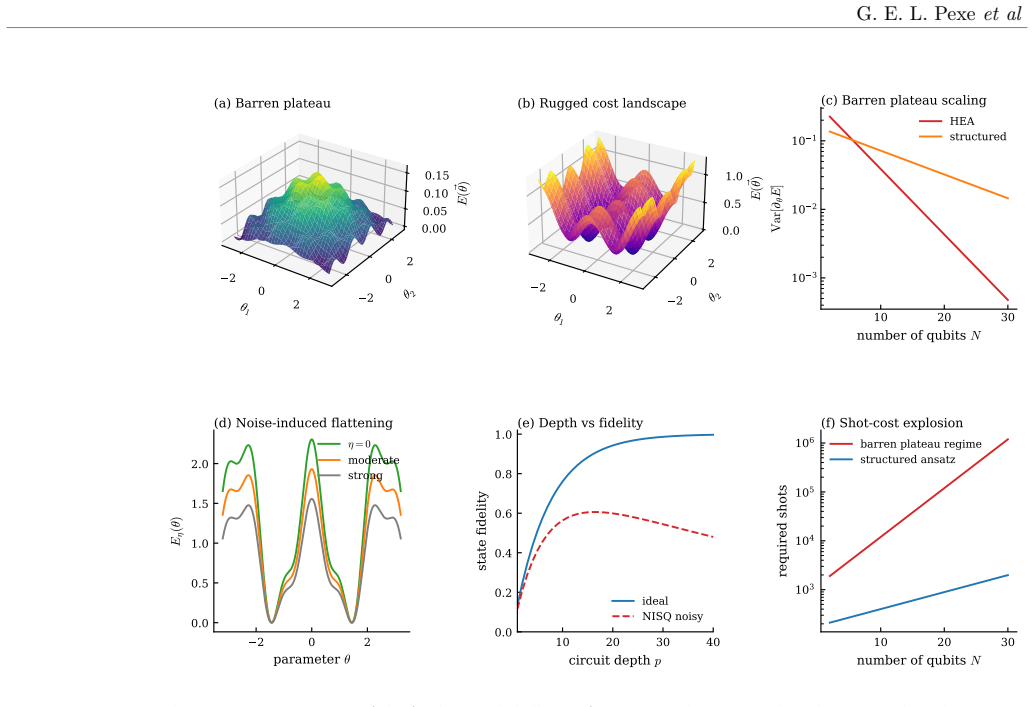
Deterministic feedback-guided methods provide geometrically more robust trajectories for navigating the energy landscape of strongly correlated many-body systems, in contrast to traditional variational quantum algorithms that are hampered by expressibility- and noise-induced barren plateaus.
What carries the argument
Feedback-based Quantum Algorithms like FALQON that use deterministic feedback to steer the variational parameters through the energy landscape.
If this is right
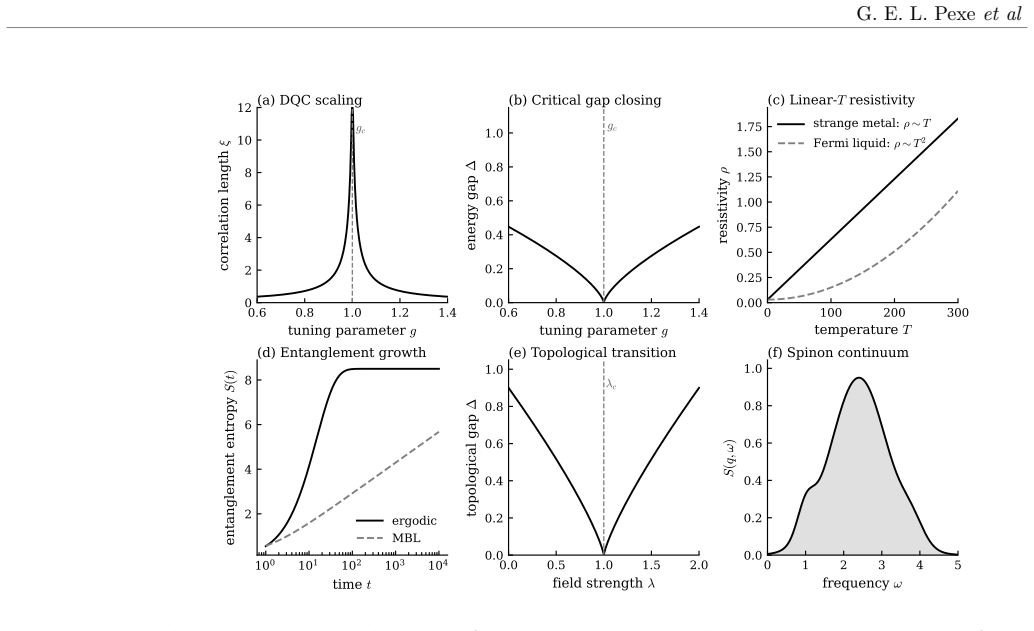
- These methods are applicable to studying deconfined quantum criticality, strange metals, many-body localization, topological phase transitions, and quantum spin liquids.
- Hybridization with physics-informed circuit co-design will be essential for advancing toward fault tolerance.
- Feedback methods mitigate the impact of barren plateaus that compromise gradient-based optimization in NISQ devices.
Where Pith is reading between the lines
- If feedback methods prove superior, they could enable quantum simulations of systems currently intractable due to the fermionic sign problem.
- Comparing performance on benchmark many-body models would test the geometric robustness claim directly.
- Physics-informed co-design might generalize to other quantum algorithms beyond optimization.
Load-bearing premise
That barren plateaus can be mitigated by feedback guidance and circuit co-design without introducing equivalent or worse optimization failures as systems scale.
What would settle it
Numerical simulations or experiments on a small many-body system like the transverse-field Ising model where FALQON fails to outperform VQE in convergence rate or final energy accuracy under realistic noise.
Figures

read the original abstract
This perspective article analyzes the potential and critical challenges of employing quantum optimization algorithms to investigate phase transitions in quantum many-body systems during the Noisy Intermediate-Scale Quantum era. The simulation of strongly correlated systems is frequently intractable on classical computers due to the exponential growth of the Hilbert space and the fermionic sign problem. In this context, we review and compare the performance of traditional Variational Quantum Algorithms, such as the Variational Quantum Eigensolver and the Quantum Approximate Optimization Algorithm, against emerging heuristic approaches, specifically Feedback-based Quantum Algorithms, such as FALQON. We explore the applicability of these methods in the study of open phenomena in condensed matter physics, including Deconfined Quantum Criticality, strange metals, Many-Body Localization, topological phase transitions, and quantum spin liquids. We discuss how fundamental operational bottlenecks, notably expressibility- and noise-induced barren plateaus, severely compromise gradient-based optimization. We conclude that deterministic feedback-guided methods provide geometrically more robust trajectories for navigating the energy landscape of these systems, arguing that further advancement in the field will rely on deep hybridization and physics-informed circuit co-design towards fault tolerance.
Editorial analysis
A structured set of objections, weighed in public.
Referee Report
Summary. This perspective article analyzes the potential and critical challenges of employing quantum optimization algorithms to investigate phase transitions in quantum many-body systems during the NISQ era. It reviews and compares traditional variational quantum algorithms (VQE, QAOA) against feedback-based approaches such as FALQON, highlighting expressibility- and noise-induced barren plateaus as key bottlenecks for the former. The manuscript discusses applicability to condensed-matter phenomena including Deconfined Quantum Criticality, strange metals, Many-Body Localization, topological phase transitions, and quantum spin liquids. It concludes that deterministic feedback-guided methods provide geometrically more robust trajectories for navigating the energy landscape, with further progress depending on deep hybridization and physics-informed circuit co-design toward fault tolerance.
Significance. As an interpretive synthesis of existing literature rather than a source of new derivations or benchmarks, the paper offers a timely perspective that correctly identifies barren plateaus as a central limitation of gradient-based VQAs and frames feedback methods as a promising alternative based on reviewed performance comparisons. It appropriately presents hybridization as a future direction rather than a premise required for its current claims. The stress-test concern regarding new failure modes in hybridization does not undermine the manuscript because the text positions it explicitly as an open research avenue. The significance therefore lies in guiding the community toward robust optimization strategies for strongly correlated systems, provided the literature synthesis is accurate.
minor comments (2)
- [Abstract] Abstract: the phrase 'reviewed performance comparisons for general cases' is used in the conclusion but the abstract does not indicate which specific comparisons or systems are synthesized to support the geometric-robustness claim.
- The manuscript would benefit from an explicit statement in the introduction or conclusion clarifying that the central claim is an extrapolation from general-case literature rather than a new quantitative result internal to the paper.
Simulated Author's Rebuttal
We thank the referee for their positive and accurate summary of our perspective article, as well as for the recommendation of minor revision. The assessment correctly identifies the manuscript as an interpretive synthesis focused on barren plateaus and the potential of feedback-based methods. No specific major comments were provided in the report.
Circularity Check
No significant circularity: qualitative review with no derivations
full rationale
The manuscript is a perspective/review article that synthesizes existing literature on VQAs versus feedback-based methods such as FALQON. No new mathematical derivations, equations, fitted parameters, or self-referential predictions appear in the abstract or described content. The central conclusion—that deterministic feedback-guided methods provide geometrically more robust trajectories—is presented as an interpretive synthesis of reviewed performance comparisons rather than a result derived internally via equations or self-citation chains. No load-bearing steps reduce to inputs by construction, satisfying the criteria for a score of 0 with an empty steps array.
Axiom & Free-Parameter Ledger
Reference graph
Works this paper leans on
-
[1]
Feynman R P 1982International Journal of Theoretical Physics21467–488
-
[2]
Lloyd S 1996Science2731073–1078
-
[3]
Troyer M and Wiese U J 2005Physical Review Letters94ISSN 1079-7114 URL http://dx.doi.org/10.1103/PhysRevLett.94.170201
-
[4]
Schollw¨ ock U 2011Annals of Physics32696–192 ISSN 0003-4916 URL http://dx.doi.org/10.1016/j.aop.2010.09.012
-
[5]
Or´ us R 2014Annals of Physics349117–158 ISSN 0003-4916 URL http://dx.doi.org/10.1016/j.aop.2014.06.013
-
[6]
Preskill J 2018Quantum279 ISSN 2521-327X URL http://dx.doi.org/10.22331/q-2018-08-06-79
work page internal anchor Pith review doi:10.22331/q-2018-08-06-79 2018
-
[7]
Peruzzo A, McClean J, Shadbolt P, Yung M H, Zhou X Q, Love P J, Aspuru-Guzik A and O’Brien J L 2014Nature Communications5ISSN 2041-1723 URL http://dx.doi.org/10.1038/ncomms5213
-
[8]
Farhi E, Goldstone J and Gutmann S 2014arXiv preprint arXiv:1411.4028
-
[9]
Cerezo M, Arrasmith A, Babbush R, Benjamin S C, Endo S, Fujii K, McClean J R, Mitarai K, Yuan X, Cincio L and Coles P J 2021Nature Reviews Physics3625–644 ISSN 2522-5820 URL http://dx.doi.org/10.1038/s42254-021-00348-9
-
[10]
Magann A B, Rudinger K M, Grace M D and Sarovar M 2022Phys. Rev. Lett.129(25) 250502 URLhttps://link.aps.org/doi/10.1103/PhysRevLett.129.250502
-
[11]
Tang H L, Shkolnikov V, Barron G S, Grimsley H R, Mayhall N J, Barnes E and Economou S E 2021PRX Quantum2ISSN 2691-3399 URL http://dx.doi.org/10.1103/PRXQuantum.2.020310
-
[12]
Grimsley H R, Economou S E, Barnes E and Mayhall N J 2019Nature Communications10 ISSN 2041-1723 URLhttp://dx.doi.org/10.1038/s41467-019-10988-2
-
[13]
Nakanishi K M, Mitarai K and Fujii K 2019Physical Review Research1ISSN 2643-1564 URL http://dx.doi.org/10.1103/PhysRevResearch.1.033062
-
[14]
McClean J R, Boixo S, Smelyanskiy V N, Babbush R and Neven H 2018Nature Communications9ISSN 2041-1723 URLhttp://dx.doi.org/10.1038/s41467-018-07090-4
-
[15]
Tilly J, Chen H, Cao S, Picozzi D, Setia K, Li Y, Grant E, Wossnig L, Rungger I, Booth G H and Tennyson J 2022Physics Reports9861–128 ISSN 0370-1573 URL http://dx.doi.org/10.1016/j.physrep.2022.08.003 11 G. E. L. Pexeet al
-
[16]
Bravyi S, Kliesch A, Koenig R and Tang E 2020Physical Review Letters125ISSN 1079-7114 URLhttp://dx.doi.org/10.1103/PhysRevLett.125.260505
-
[17]
Herrman R, Lotshaw P C, Ostrowski J, Humble T S and Siopsis G 2021 Multi-angle quantum approximate optimization algorithm (Preprint2109.11455) URL https://arxiv.org/abs/2109.11455
arXiv 2021
-
[18]
Wurtz J and Love P 2021Physical Review A103042612
-
[19]
Pexe G E L, Rattighieri L A M, Malvezzi A L and Fanchini F F 2024Phys. Rev. B110(22) 224422 URLhttps://link.aps.org/doi/10.1103/PhysRevB.110.224422
-
[20]
Rattighieri L A M, Pexe G E L, Bernardo B L and Fanchini F F 2025Phys. Rev. A112(4) 042607 URLhttps://link.aps.org/doi/10.1103/qc91-5mj2
-
[21]
Long T N V, Tran L N and Ho L B 2025 Imaginary-time-enhanced feedback-based quantum algorithms for universal ground-state preparation (Preprint2512.13044) URL https://arxiv.org/abs/2512.13044
arXiv 2025
-
[22]
Senthil T, Vishwanath A, Balents L, Sachdev S and Fisher M P A 2004Science3031490–1494
-
[23]
Sandvik A W 2007Physical Review Letters98ISSN 1079-7114 URL http://dx.doi.org/10.1103/PhysRevLett.98.227202
-
[24]
Shao H, Guo W and Sandvik A W 2016Science352213–216 ISSN 1095-9203 URL http://dx.doi.org/10.1126/science.aad5007
-
[25]
Sachdev S and Ye J 1993Physical Review Letters703339–3342 ISSN 0031-9007 URL http://dx.doi.org/10.1103/PhysRevLett.70.3339
-
[26]
Altland A and Sonner J 2026 Quantum chaos and the holographic principle (Preprint 2604.12784) URLhttps://arxiv.org/abs/2604.12784
Pith/arXiv arXiv 2026
-
[27]
Yuan X, Endo S, Zhao Q, Li Y and Benjamin S C 2019Quantum3191 ISSN 2521-327X URL http://dx.doi.org/10.22331/q-2019-10-07-191
-
[28]
Maldacena J, Shenker S H and Stanford D 2016Journal of High Energy Physics2016ISSN 1029-8479 URLhttp://dx.doi.org/10.1007/JHEP08(2016)106
-
[29]
Abanin D A, Altman E, Bloch I and Serbyn M 2019Reviews of Modern Physics91ISSN 1539-0756 URLhttp://dx.doi.org/10.1103/RevModPhys.91.021001
-
[30]
De Roeck W and Huveneers F 2017Physical Review B95ISSN 2469-9969 URL http://dx.doi.org/10.1103/PhysRevB.95.155129
-
[31]
Higgott O, Wang D and Brierley S 2019Quantum3156 ISSN 2521-327X URL http://dx.doi.org/10.22331/q-2019-07-01-156
-
[32]
Kitaev A 2003Annals of Physics3032–30 ISSN 0003-4916 URL http://dx.doi.org/10.1016/S0003-4916(02)00018-0
work page internal anchor Pith review doi:10.1016/s0003-4916(02)00018-0
-
[33]
Kitaev A and Preskill J 2006Physical Review Letters96ISSN 1079-7114 URL http://dx.doi.org/10.1103/PhysRevLett.96.110404
-
[34]
Trebst S, Werner P, Troyer M, Shtengel K and Nayak C 2007Physical Review Letters98ISSN 1079-7114 URLhttp://dx.doi.org/10.1103/PhysRevLett.98.070602
-
[35]
Savary L and Balents L 2016Reports on Progress in Physics80016502 ISSN 1361-6633 URL http://dx.doi.org/10.1088/0034-4885/80/1/016502
-
[36]
Huang H Y, Kueng R and Preskill J 2020Nature Physics161050–1057 ISSN 1745-2481 URL http://dx.doi.org/10.1038/s41567-020-0932-7
-
[37]
Chiesa A, Tacchino F, Grossi M, Santini P, Tavernelli I, Gerace D and Carretta S 2019Nature Physics15455–459 ISSN 1745-2481 URLhttp://dx.doi.org/10.1038/s41567-019-0437-4
-
[38]
Holmes Z, Sharma K, Cerezo M and Coles P J 2022PRX Quantum3(1) 010313 URL https://link.aps.org/doi/10.1103/PRXQuantum.3.010313 12 G. E. L. Pexeet al
-
[39]
Bittel L and Kliesch M 2021Phys. Rev. Lett.127(12) 120502 URL https://link.aps.org/doi/10.1103/PhysRevLett.127.120502
-
[40]
Larsen J B, Grace M D, Baczewski A D and Magann A B 2024Phys. Rev. Res.6(3) 033336 URLhttps://link.aps.org/doi/10.1103/PhysRevResearch.6.033336
-
[41]
Wang S, Fontana E, Cerezo M, Sharma K, Sone A, Cincio L and Coles P J 2021Nature Communications12ISSN 2041-1723 URL http://dx.doi.org/10.1038/s41467-021-27045-6
-
[42]
Cai Z, Babbush R, Benjamin S C, Endo S, Huggins W J, Li Y, McClean J R and O’Brien T E 2023Rev. Mod. Phys.95(4) 045005 URL https://link.aps.org/doi/10.1103/RevModPhys.95.045005 13
discussion (0)
Sign in with ORCID, Apple, or X to comment. Anyone can read and Pith papers without signing in.