APIC: Amortized Physics-Informed Calibration using Neural Processes
Pith reviewed 2026-06-28 11:01 UTC · model grok-4.3
The pith
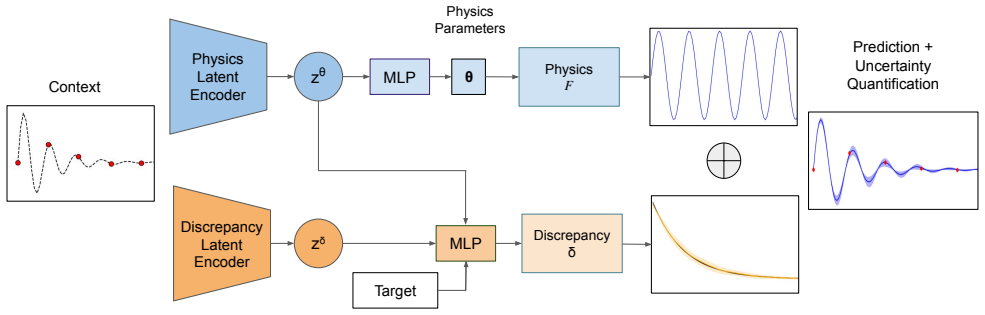
APIC uses Neural Processes to amortize Kennedy-O'Hagan calibration across families of related physical systems, separating instance-specific parameters from shared model discrepancies.
A machine-rendered reading of the paper's core claim, the machinery that carries it, and where it could break.
Core claim
APIC employs a two-branch latent architecture within Neural Processes to disentangle instance-specific physical parameters from shared state-dependent structural discrepancies, enabling scalable Bayesian calibration of physics models with misspecifications by integrating differentiable physics into the amortized inference process.
What carries the argument
The two-branch latent architecture of the Neural Process, which separates instance-specific physical parameters from shared state-dependent structural discrepancies while embedding differentiable physics.
If this is right
- New realizations can be calibrated rapidly without retraining the model on each one.
- Uncertainty in both parameters and discrepancy estimates is obtained during inference.
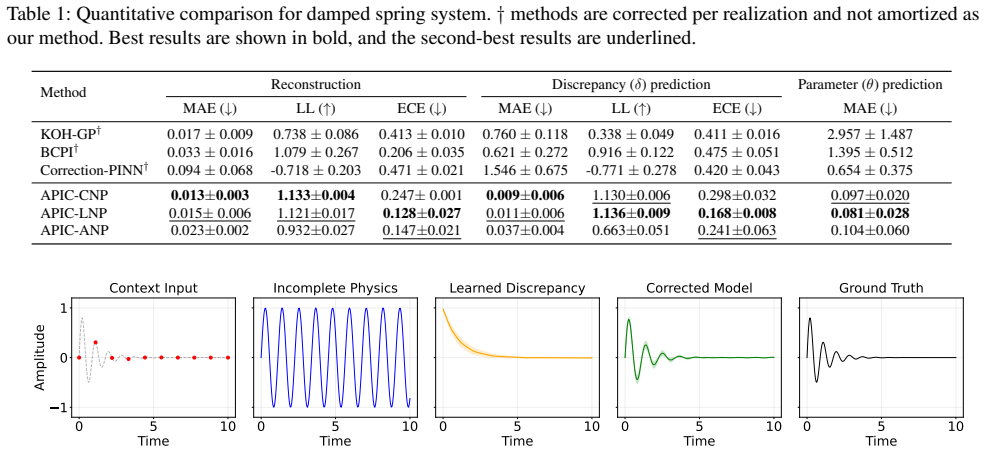
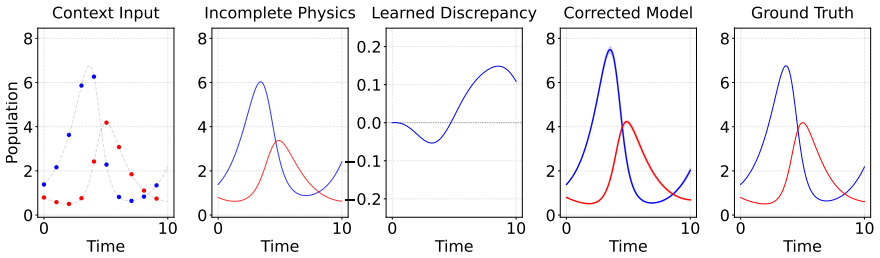
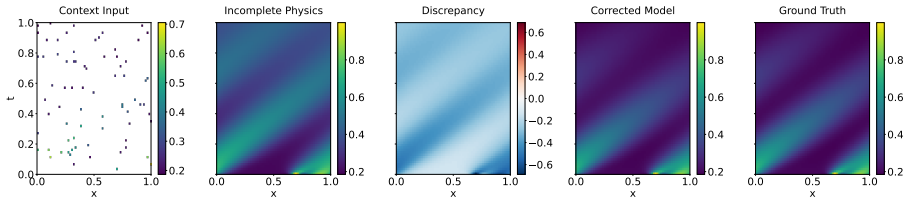
- Parameter recovery improves relative to non-amortized calibration baselines on the tested oscillator, Lotka-Volterra, and advection-diffusion problems.
- The shared discrepancy component is recovered consistently across realizations even when physics is misspecified.
Where Pith is reading between the lines
- The same amortized structure could be applied to other families of inverse problems where simulations are expensive but many related instances exist.
- Real-time parameter tracking becomes feasible in settings such as sensor networks or control systems that generate repeated observations of similar dynamics.
- The approach implicitly treats discrepancy modeling as a meta-learning task over populations of physical systems.
Load-bearing premise
The two-branch latent architecture can reliably disentangle instance-specific physical parameters from shared state-dependent structural discrepancies without additional labels or assumptions on the discrepancy form.
What would settle it
A test case in which the discrepancy structure changes across instances in a manner not capturable by a single shared state-dependent function, causing the method to produce inconsistent parameter estimates or fail to identify the discrepancy.
Figures
read the original abstract
Physics models are inherently imperfect due to misspecified or missing mechanisms, resulting in systematic discrepancies between model predictions and real-world observations. The Kennedy-O'Hagan (KOH) framework addresses this issue through explicit discrepancy modeling. However, its non-amortized, per-instance formulation limits scalability across families of related systems. We introduce Amortized Physics-Informed Calibration (APIC), a population-level extension of KOH that leverages Neural Processes to perform scalable Bayesian inference across realizations. Our framework employs a two-branch latent architecture to disentangle instance-specific physical parameters from shared, state-dependent structural discrepancies. By integrating differentiable physics into an amortized inference backbone, APIC enables rapid calibration of unseen realizations from sparse observations while quantifying uncertainty. Experiments on the damped spring oscillator, the Lotka-Volterra system, and the advection-diffusion PDE with misspecified physics demonstrate improved parameter recovery and consistent identification of the systemic discrepancy structure compared to other calibration approaches.
Editorial analysis
A structured set of objections, weighed in public.
Referee Report
Summary. The paper introduces Amortized Physics-Informed Calibration (APIC) as a population-level extension of the Kennedy-O'Hagan framework. It uses Neural Processes with a two-branch latent architecture to perform amortized Bayesian inference that disentangles instance-specific physical parameters from shared state-dependent structural discrepancies in misspecified physics models. The method integrates differentiable physics into the inference backbone to enable rapid calibration of unseen realizations from sparse observations with uncertainty quantification. Experiments on the damped spring oscillator, Lotka-Volterra system, and advection-diffusion PDE are reported to show improved parameter recovery and consistent discrepancy identification relative to other calibration approaches.
Significance. If the two-branch architecture reliably achieves the claimed disentanglement, the work would offer a scalable alternative to per-instance KOH calibration, with potential impact on scientific machine learning tasks involving families of related physical systems. The amortized formulation and uncertainty quantification are strengths, but the significance hinges on whether the separation of latents is demonstrated beyond the reported experiments.
major comments (2)
- [Method (two-branch latent architecture)] The central claim that the two-branch latent architecture disentangles instance-specific physical parameters from shared discrepancies (abstract and method description) lacks an identifiability analysis, auxiliary loss, or theoretical guarantee. Standard NP encoders produce entangled representations; without explicit inductive bias or supervision, the branches can trade off information under sparse observations and misspecified physics, which directly undermines the reported parameter recovery results.
- [Experiments] The experiments claim improved parameter recovery and consistent discrepancy identification, but without details on how separation is verified (e.g., latent traversal, ablation on branch usage, or comparison to entangled baselines), it is unclear whether the performance gains arise from true disentanglement or from the amortized fitting process itself.
minor comments (2)
- [Method] Notation for the two latent branches and their conditioning on observations vs. states should be clarified with explicit equations to avoid ambiguity in the amortized inference procedure.
- [Method] The paper should include a clear statement of the precise form of the discrepancy function and how it is parameterized within the NP decoder.
Simulated Author's Rebuttal
We thank the referee for the constructive feedback on our manuscript. We address the major comments point-by-point below and propose revisions to strengthen the claims regarding disentanglement.
read point-by-point responses
-
Referee: [Method (two-branch latent architecture)] The central claim that the two-branch latent architecture disentangles instance-specific physical parameters from shared discrepancies (abstract and method description) lacks an identifiability analysis, auxiliary loss, or theoretical guarantee. Standard NP encoders produce entangled representations; without explicit inductive bias or supervision, the branches can trade off information under sparse observations and misspecified physics, which directly undermines the reported parameter recovery results.
Authors: We agree that a formal identifiability analysis is absent from the current manuscript. The two-branch design is intended to provide an inductive bias by routing instance-specific information through one latent branch and state-dependent discrepancy through the other, with the physics model applied only to the parameter branch. However, without additional supervision or loss terms, complete separation is not guaranteed. In the revision, we will add an explicit comparison to an entangled single-branch baseline to quantify the benefit of the architecture. We will also discuss the limitations of relying on architectural separation without theoretical guarantees. revision: partial
-
Referee: [Experiments] The experiments claim improved parameter recovery and consistent discrepancy identification, but without details on how separation is verified (e.g., latent traversal, ablation on branch usage, or comparison to entangled baselines), it is unclear whether the performance gains arise from true disentanglement or from the amortized fitting process itself.
Authors: We acknowledge the need for more rigorous verification of the disentanglement. The current experiments demonstrate improved parameter recovery and discrepancy identification compared to baselines, but do not include ablations on the branch architecture. We will revise the experimental section to include: (1) an ablation study using a single latent branch (entangled) model, (2) qualitative analysis of the latent representations (e.g., how the discrepancy latent varies with state), and (3) sensitivity analysis under sparse observations. This will help clarify whether the gains stem from the disentanglement. revision: yes
Circularity Check
No significant circularity in derivation chain
full rationale
The paper introduces APIC as an amortized extension of the Kennedy-O'Hagan framework via Neural Processes and a two-branch latent architecture for disentangling parameters from discrepancies. The abstract and description present this as a proposed architecture whose performance is evaluated on experiments with damped spring, Lotka-Volterra, and advection-diffusion systems. No quoted equations, self-citations, or fitted inputs reduce the central claims (rapid calibration, uncertainty quantification, or disentanglement) to tautological re-expressions of the inputs by construction. The architecture is offered as an inductive choice rather than derived from prior results that presuppose the target outcome. This is the common case of a self-contained methodological contribution.
Axiom & Free-Parameter Ledger
axioms (2)
- domain assumption Physics models are inherently imperfect due to misspecified or missing mechanisms
- domain assumption Neural Processes can perform scalable Bayesian inference across a population of related systems
invented entities (1)
-
two-branch latent architecture
no independent evidence
Reference graph
Works this paper leans on
-
[1]
Zur Elektrodynamik bewegter Körper
Albert Einstein. Zur Elektrodynamik bewegter Körper. Annalen der Physik. 1905
1905
-
[2]
The \ Companion
Michel Goossens and Frank Mittelbach and Alexander Samarin. The \ Companion. 1993
1993
-
[3]
WIREs Computational Statistics , volume =
Sung, Chih-Li and Tuo, Rui , title =. WIREs Computational Statistics , volume =. doi:https://doi.org/10.1002/wics.1645 , url =. https://wires.onlinelibrary.wiley.com/doi/pdf/10.1002/wics.1645 , abstract =
-
[4]
and O'Hagan, Anthony , title =
Kennedy, Marc C. and O'Hagan, Anthony , title =. Journal of the Royal Statistical Society: Series B (Statistical Methodology) , volume =. doi:https://doi.org/10.1111/1467-9868.00294 , url =. https://rss.onlinelibrary.wiley.com/doi/pdf/10.1111/1467-9868.00294 , abstract =
-
[5]
Spitieris, Michail and Steinsland, Ingelin , title =. J. Mach. Learn. Res. , month = jan, articleno =. 2023 , issue_date =
2023
-
[6]
Correcting model misspecification in physics-informed neural networks (PINNs) , journal =
Zongren Zou and Xuhui Meng and George Em Karniadakis , keywords =. Correcting model misspecification in physics-informed neural networks (PINNs) , journal =. 2024 , issn =. doi:https://doi.org/10.1016/j.jcp.2024.112918 , url =
-
[7]
Learning about physical parameters: the importance of model discrepancy , volume =
Brynjarsdottir, Jenny and O'Hagan, Anthony , year =. Learning about physical parameters: the importance of model discrepancy , volume =. Inverse Problems , doi =
-
[8]
M. J. Bayarri and J. O. Berger and J. Cafeo and G. Garcia-Donato and F. Liu and J. Palomo and R. J. Parthasarathy and R. Paulo and J. Sacks and D. Walsh , journal =. Computer Model Validation with Functional Output , urldate =
-
[9]
Rui Tuo and C. F. Jeff Wu , journal =. EFFICIENT CALIBRATION FOR IMPERFECT COMPUTER MODELS , urldate =
-
[10]
doi: 10.1080/01621459.2016.1211016
Matthew Plumlee , title =. Journal of the American Statistical Association , volume =. 2017 , publisher =. doi:10.1080/01621459.2016.1211016 , URL =
-
[11]
Higdon, Dave and Kennedy, Marc and Cavendish, James C. and Cafeo, John A. and Ryne, Robert D. , title =. SIAM Journal on Scientific Computing , volume =. 2004 , doi =. https://doi.org/10.1137/S1064827503426693 , abstract =
-
[12]
2023 , journal =
Gradient Statistics-Based Multi-Objective Optimization in Physics-Informed Neural Networks , author =. 2023 , journal =
2023
-
[13]
Functional Tensor Decompositions for Physics-Informed Neural Networks , author =. 2024 , booktitle =. doi:10.1007/978-3-031-78389-0_3 , numpages =
-
[14]
2025 , journal =
F-INR: Functional tensor decomposition for implicit neural representations , author =. 2025 , journal =
2025
-
[15]
2017 , month =
Physics Informed Deep Learning (Part II): Data-driven Discovery of Nonlinear Partial Differential Equations , author =. 2017 , month =
2017
-
[16]
Journal of Computational Physics , publisher =
Physics-informed neural networks: A deep learning framework for solving forward and inverse problems involving nonlinear partial differential equations , author =. Journal of Computational Physics , publisher =. 2019 , month =
2019
-
[17]
Liu Yang and Xuhui Meng and George Em Karniadakis , keywords =. B-PINNs: Bayesian physics-informed neural networks for forward and inverse PDE problems with noisy data , journal =. 2021 , issn =. doi:https://doi.org/10.1016/j.jcp.2020.109913 , url =
-
[18]
Proceedings of The 25th International Conference on Artificial Intelligence and Statistics , pages =
Physics Informed Deep Kernel Learning , author =. Proceedings of The 25th International Conference on Artificial Intelligence and Statistics , pages =. 2022 , editor =
2022
-
[19]
Proceedings of the National Academy of Science , keywords =
Kyle Cranmer and Johann Brehmer and Gilles Louppe , title =. Proceedings of the National Academy of Sciences , volume =. 2020 , doi =. https://www.pnas.org/doi/pdf/10.1073/pnas.1912789117 , abstract =
-
[20]
Training deep neural density estimators to identify mechanistic models of neural dynamics , author =. eLife , issn =. doi:10.7554/eLife.56261 , url =
-
[21]
ArXiv , year=
Fourier Neural Operator for Parametric Partial Differential Equations , author=. ArXiv , year=
-
[22]
doi:10.1038/s42256-021-00302-5 Lu Lu, Raphaël Pestourie, Steven G
Lu, Lu and Jin, Pengzhan and Pang, Guofei and Zhang, Zhongqiang and Karniadakis, George Em , title=. Nature Machine Intelligence , year=. doi:10.1038/s42256-021-00302-5 , url=
-
[23]
Rasmussen, Carl Edward and Williams, Christopher K. I. , biburl =
-
[24]
2023 , eprint=
The Neural Process Family: Survey, Applications and Perspectives , author=. 2023 , eprint=
2023
-
[25]
NIPS-W , year=
Automatic differentiation in PyTorch , author=. NIPS-W , year=
-
[26]
Annual Review of Condensed Matter Physics , volume=
Machine learning for climate physics and simulations , author=. Annual Review of Condensed Matter Physics , volume=. 2025 , publisher=
2025
-
[27]
arXiv preprint arXiv:1807.01622 , year=
Neural processes , author=. arXiv preprint arXiv:1807.01622 , year=
-
[28]
International conference on machine learning , pages=
Conditional neural processes , author=. International conference on machine learning , pages=. 2018 , organization=
2018
-
[29]
arXiv preprint arXiv:1901.05761 , year=
Attentive neural processes , author=. arXiv preprint arXiv:1901.05761 , year=
Pith/arXiv arXiv 1901
-
[30]
arXiv preprint arXiv:2508.18903 , year=
Distance-informed neural processes , author=. arXiv preprint arXiv:2508.18903 , year=
-
[31]
Scientific Reports , volume=
Neural fields for rapid aircraft aerodynamics simulations , author=. Scientific Reports , volume=. 2024 , publisher=
2024
-
[32]
International conference on machine learning , pages=
Accurate uncertainties for deep learning using calibrated regression , author=. International conference on machine learning , pages=. 2018 , organization=
2018
-
[33]
Advances in Neural Information Processing Systems , volume=
Physics-integrated variational autoencoders for robust and interpretable generative modeling , author=. Advances in Neural Information Processing Systems , volume=
-
[34]
arXiv preprint arXiv:1910.13556 , year=
Convolutional conditional neural processes , author=. arXiv preprint arXiv:1910.13556 , year=
arXiv 1910
-
[35]
Nature , volume=
Deep learning and process understanding for data-driven Earth system science , author=. Nature , volume=. 2019 , publisher=
2019
-
[36]
Advances in neural information processing systems , volume=
Improved training of wasserstein gans , author=. Advances in neural information processing systems , volume=
-
[37]
arXiv preprint arXiv:1705.10941 , year=
Spectral norm regularization for improving the generalizability of deep learning , author=. arXiv preprint arXiv:1705.10941 , year=
-
[38]
Journal of Advances in Modeling Earth Systems , volume=
Atmospheric transport modeling of CO2 with neural networks , author=. Journal of Advances in Modeling Earth Systems , volume=. 2025 , publisher=
2025
discussion (0)
Sign in with ORCID, Apple, or X to comment. Anyone can read and Pith papers without signing in.