Non-Wellfounded and Cyclic Proofs for LTL: A Syntactic Correspondence with Linear Nested Sequents
Pith reviewed 2026-06-28 07:59 UTC · model grok-4.3
The pith
Non-wellfounded LTL proofs in linear nested sequents normalize to a saturation-recurrence form that yields cyclic proofs.
A machine-rendered reading of the paper's core claim, the machinery that carries it, and where it could break.
Core claim
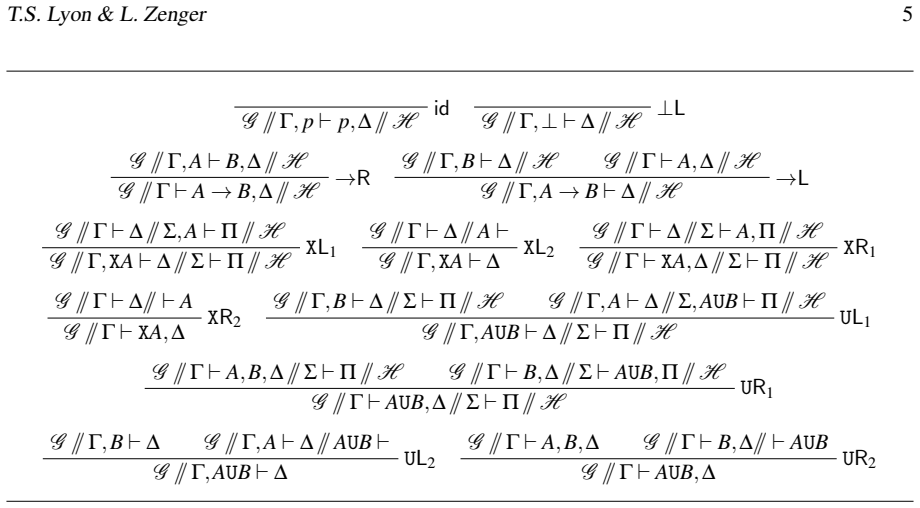
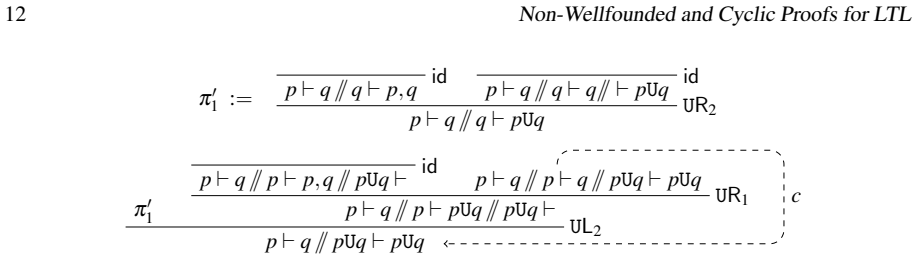
Non-wellfounded linear nested sequent proofs for LTL are complete relative to a normal form that exhibits saturation recurrence; this normal form permits systematic extraction of cyclic proofs, while a dedicated forward-shifting procedure on rule applications reconstructs non-wellfounded proofs from cyclic ones, yielding a syntactic correspondence between the two notions of proof.
What carries the argument
Saturation recurrence: a property of normalized non-wellfounded linear nested sequent derivations that marks repeated saturation points and thereby enables systematic extraction of cycles.
If this is right
- Every valid LTL sequent possesses a non-wellfounded linear nested sequent proof that can be brought into saturation-recurrence normal form.
- Cyclic linear nested sequent proofs for LTL can be read off directly from the normalized non-wellfounded derivations.
- The forward-shifting procedure converts any cyclic proof back into a non-wellfounded one without changing its validity status.
- The same cycle-recognition and unraveling methods apply to any expressive multisequent calculus that supports linear nesting.
Where Pith is reading between the lines
- The normalization and shifting techniques may extend to other modal or temporal logics once their linear nested sequent rules are fixed.
- Automated proof search could alternate between the cyclic and non-wellfounded representations using the correspondence as a bridge.
- If saturation recurrence can be decided algorithmically, it would give a decision procedure for the existence of cyclic proofs in this setting.
Load-bearing premise
Every valid non-wellfounded linear nested sequent proof for LTL admits a normalization that produces saturation recurrence, and the forward-shifting procedure never adds or removes derivability.
What would settle it
An LTL formula that possesses a valid non-wellfounded linear nested sequent proof yet cannot be normalized to any derivation exhibiting saturation recurrence, or for which the shifting procedure produces an invalid result.
Figures

read the original abstract
We introduce and investigate non-wellfounded and cyclic linear nested sequent calculi, and, as a case study, develop such systems for linear temporal logic (LTL). The paper addresses two central problems, which we call 'cycle recognition' and 'unraveling.' Cycle recognition concerns identifying cycles in non-wellfounded proofs in order to extract corresponding cyclic proofs, while unraveling studies the converse transformation, from cyclic proofs to non-wellfounded ones. Although these processes are well understood for Gentzen sequents, they have received little attention for more expressive sequent formalisms and become more challenging in the linear nested sequent setting. To address cycle recognition, we show the completeness of non-wellfounded proofs relative to a particular normal form exhibiting a property we call 'saturation recurrence,' which enables the systematic extraction of cyclic proofs. To address unraveling, we introduce a specialized procedure that shifts rule applications forward along linear nested sequents, allowing non-wellfounded proofs to be reconstructed from cyclic ones. Overall, our work provides new proof-theoretic techniques for cycle recognition and unraveling in expressive multisequent formalisms.
Editorial analysis
A structured set of objections, weighed in public.
Referee Report
Summary. The paper introduces non-wellfounded and cyclic linear nested sequent calculi for LTL. It addresses cycle recognition by proving completeness of non-wellfounded proofs relative to a saturation-recurrence normal form that permits systematic extraction of cyclic proofs, and addresses unraveling by defining a forward-shifting procedure that reconstructs non-wellfounded proofs from cyclic ones along linear nested sequents.
Significance. If the syntactic correspondence holds, the work supplies explicit, constructive procedures that extend Gentzen-style cycle recognition and unraveling results to linear nested sequents. This is a targeted advance in proof theory for temporal logics, providing new tools for handling non-wellfounded and cyclic derivations in a more expressive formalism.
minor comments (3)
- [§3] §3 (or the section defining the linear nested sequent calculus): the notation for nested sequents and the precise statement of the saturation recurrence property would benefit from an additional worked example involving nested Until formulas to illustrate the normal-form condition.
- [§5] The forward-shifting procedure (likely §5): while the high-level description is clear, the preservation argument for derivability under shifting would be easier to follow if the inductive cases were enumerated explicitly rather than summarized.
- References: the manuscript cites prior Gentzen results but should add a pointer to any existing work on cyclic proofs in nested sequents for other modal or temporal logics to better situate the novelty.
Simulated Author's Rebuttal
We thank the referee for the positive summary of our paper and the recommendation of minor revision. The referee's description accurately reflects our contributions on cycle recognition via saturation recurrence and the unraveling shift procedure for linear nested sequents in LTL.
Circularity Check
No significant circularity in derivation chain
full rationale
The paper presents explicit syntactic procedures for normalizing non-wellfounded linear nested sequent proofs to a saturation-recurrence form and for forward-shifting rule applications to reconstruct non-wellfounded proofs from cyclic ones. These constructions are described as operating directly on the sequent structures and rule applications without reducing the claimed completeness or correspondence to quantities defined from the target result itself. Prior Gentzen-style results are invoked as external foundations rather than as self-citations that bear the load of the central claims. No self-definitional equations, fitted inputs renamed as predictions, or ansatzes smuggled via citation appear in the abstract or argument structure.
Axiom & Free-Parameter Ledger
axioms (1)
- domain assumption Standard sequent rules and LTL semantics are taken as given from prior literature.
Reference graph
Works this paper leans on
-
[1]
Leigh & Lukas Zenger (2023):Ill-Founded Proof Systems for Intuitionistic Linear-Time Temporal Logic
Bahareh Afshari, Lide Grotenhuis, Graham E. Leigh & Lukas Zenger (2023):Ill-Founded Proof Systems for Intuitionistic Linear-Time Temporal Logic. In:Automated Reasoning with Analytic Tableaux and Related Methods, 14278, pp. 223–241
2023
-
[2]
Leigh (2017):Cut-free completeness for modal mu-calculus
Bahareh Afshari & Graham E. Leigh (2017):Cut-free completeness for modal mu-calculus. In: 2017 32nd Annual ACM/IEEE Symposium on Logic in Computer Science (LICS), pp. 1–12, doi:10.1109/LICS.2017.8005088
-
[3]
Leigh (2022):Lyndon Interpolation for Modalµ-Calculus
Bahareh Afshari & Graham E. Leigh (2022):Lyndon Interpolation for Modalµ-Calculus. In Aybüke Özgün & Yulia Zinova, editors:Language, Logic, and Computation, Springer International Publishing, Cham, pp. 197–213
2022
-
[4]
Aguilera & Leonardo Pacheco (2025):Intuitionistic Gödel-Löb without Sharps.ACM Trans
Juan P. Aguilera & Leonardo Pacheco (2025):Intuitionistic Gödel-Löb without Sharps.ACM Trans. Comput. Logic26(4), doi:10.1145/3748649. Available athttps://doi.org/10.1145/3748649
-
[5]
R. Alonderis, R. Pliuškevi ˇcius, A. Pliuškeviˇcien˙e & H. Giedra (2020):Loop-Type Sequent Calculi for Tem- poral Logic.Journal of Automated Reasoning64(8), pp. 1663–1684, doi:10.1007/s10817-020-09544-1. Available athttps://doi.org/10.1007/s10817-020-09544-1
-
[6]
In Wilfrid Hodges, Martin Hyland, Charles Steinhorn & John Truss, editors:Logic: From Foundations to Applications: European Logic Colloquium, Clarendon Press, USA, p
Arnon Avron (1996):The Method of Hypersequents in the Proof Theory of Propositional Non-Classical Log- ics. In Wilfrid Hodges, Martin Hyland, Charles Steinhorn & John Truss, editors:Logic: From Foundations to Applications: European Logic Colloquium, Clarendon Press, USA, p. 1–32
1996
-
[7]
Bianca Boretti (2008):Proof Analysis in Temporal Logic. Ph.D. thesis, University of Milan
2008
-
[8]
Kai Brünnler (2009):Deep sequent systems for modal logic.Arch. Math. Log.48(6), pp. 551–577, doi:10.1007/s00153-009-0137-3. Available athttps://doi.org/10.1007/s00153-009-0137-3
-
[9]
216–225, doi:https://doi.org/10.1016/j.jlap.2008.02.004
Kai Brünnler & Martin Lange (2008):Cut-free sequent systems for temporal logic.The Journal of Logic and Algebraic Programming76(2), pp. 216–225, doi:https://doi.org/10.1016/j.jlap.2008.02.004. Available athttps://www.sciencedirect.com/science/article/pii/S1567832608000167. Logic and Infor- mation: From Logic to Constructive Reasoning
-
[10]
Anupam Das, Iris van der Giessen & Sonia Marin (2024):Intuitionistic Gödel-Löb Logic, à la Simp- son: Labelled Systems and Birelational Semantics. In Aniello Murano & Alexandra Silva, editors:32nd EACSL Annual Conference on Computer Science Logic (CSL 2024),Leibniz International Proceedings in Informatics (LIPIcs)288, Schloss Dagstuhl – Leibniz-Zentrum fü...
-
[11]
Journal of Automated Reasoning67(3), p
Anupam Das & Marianna Girlando (2023):Cyclic Hypersequent System for Transitive Closure Logic. Journal of Automated Reasoning67(3), p. 27, doi:10.1007/s10817-023-09675-1. Available athttps: //doi.org/10.1007/s10817-023-09675-1
-
[12]
Simon Docherty & Reuben N. S. Rowe (2019):A Non-wellfounded, Labelled Proof System for Proposi- tional Dynamic Logic. In Serenella Cerrito & Andrei Popescu, editors:Automated Reasoning with Analytic Tableaux and Related Methods, Springer International Publishing, Cham, pp. 335–352
2019
-
[13]
Jérôme Fortier & Luigi Santocanale (2013):Cuts for circular proofs: semantics and cut-elimination. In Simona Ronchi Della Rocca, editor:Computer Science Logic 2013 (CSL 2013),Leibniz International Pro- ceedings in Informatics (LIPIcs)23, Schloss Dagstuhl – Leibniz-Zentrum für Informatik, Dagstuhl, Germany, pp. 248–262, doi:10.4230/LIPIcs.CSL.2013.248. Ava...
-
[14]
Ioannis Kokkinis & Thomas Studer (2016):Cyclic proofs for linear temporal logic.Concepts of Proof in Mathematics, Philosophy, and Computer Science6, p. 171
2016
-
[15]
In Hans De Nivelle, editor: Automated Reasoning with Analytic Tableaux and Related Methods,Lecture Notes in Computer Science 9323, Springer, Cham, pp
Björn Lellmann (2015):Linear Nested Sequents, 2-Sequents and Hypersequents. In Hans De Nivelle, editor: Automated Reasoning with Analytic Tableaux and Related Methods,Lecture Notes in Computer Science 9323, Springer, Cham, pp. 135–150. 16Non-Wellfounded and Cyclic Proofs for LTL
2015
-
[16]
Tim S. Lyon, Agata Ciabattoni, Didier Galmiche, Marianna Girlando, Dominique Larchey-Wendling, Daniel Méry, Nicola Olivetti & Revantha Ramanayake (2025):Internal and External Calculi: Ordering the Jungle without Being Lost in Translations.Bulletin of the Section of Logic54(1), p. 59–151, doi:10.18778/0138- 0680.2025.02. Available athttps://czasopisma.uni....
-
[17]
Andrea Masini (1992):2-sequent calculus: A proof theory of modalities.Annals of Pure and Applied Logic 58(3), pp. 229–246
1992
-
[18]
Andrea Masini (1993):2-sequent calculus: Intuitionism and natural deduction.Journal of Logic and Com- putation3(5), pp. 533–562
1993
-
[19]
Guillermo Menéndez Turata (2024):Cyclic proof systems for modal fixpoint logics. Ph.D. thesis, Universiteit van Amsterdam
2024
-
[20]
G. E. Mints (1978):Finite investigations of transfinite derivations.Journal of Soviet Mathematics10(4), pp. 548–596, doi:10.1007/BF01091743. Available athttps://doi.org/10.1007/BF01091743
-
[21]
In Egon Börger, Hans Kleine Büning & Michael M
Barbara Paech (1989):Gentzen-Systems for propositional temporal logics. In Egon Börger, Hans Kleine Büning & Michael M. Richter, editors:CSL ’88, Springer Berlin Heidelberg, Berlin, Heidelberg, pp. 240– 253
1989
-
[22]
The temporal logic of programs
Amir Pnueli (1977):The Temporal Logic of Programs. In:18th Annual Symposium on Foundations of Computer Science, pp. 46–57, doi:10.1109/SFCS.1977.32
-
[23]
Garrel Pottinger (1983):Uniform, cut-free formulations of T, S4 and S5.Journal of Symbolic Logic48(3), p. 900
1983
-
[24]
In Anupam Das & Sara Negri, editors:Automated Reasoning with Analytic Tableaux and Related Methods, Springer International Publishing, Cham, pp
Jan Rooduijn (2021):Cyclic Hypersequent Calculi for Some Modal Logics with the Master Modality. In Anupam Das & Sara Negri, editors:Automated Reasoning with Analytic Tableaux and Related Methods, Springer International Publishing, Cham, pp. 354–370
2021
-
[25]
Jan Rooduijn (2024):Fragments and frame classes: Towards a uniform proof theory for modal fixed point logics. Ph.D. thesis, Universiteit van Amsterdam
2024
-
[26]
Jan Rooduijn & Lukas Zenger (2022):An analytic proof system for common knowledge logic over S5.In David Fernández-Duque, Alessandra Palmigiano & Sophie Pinchinat, editors:Advances in Modal Logic 14, College Publications
2022
-
[27]
D. S. Shamkanov (2014):Circular proofs for the Gödel-Löb provability logic.Mathematical Notes96(3), pp. 575–585
2014
-
[28]
Alex K Simpson (1994):The proof theory and semantics of intuitionistic modal logic. Ph.D. thesis, University of Edinburgh. College of Science and Engineering. School of Informatics
1994
-
[29]
Springer Science & Business Media
Luca Viganò (2000):Labelled Non-Classical Logics. Springer Science & Business Media
2000
discussion (0)
Sign in with ORCID, Apple, or X to comment. Anyone can read and Pith papers without signing in.