Hidden-sector accretion and warped black-string seeds for high-redshift supermassive black holes
Pith reviewed 2026-06-28 08:50 UTC · model grok-4.3
The pith
A common five-dimensional horizon lets hidden-sector accretion grow the apparent mass of black holes on our brane.
A machine-rendered reading of the paper's core claim, the machinery that carries it, and where it could break.
Core claim
The paper claims that a compact object on a hidden donor brane forms a common five-dimensional horizon whose intersection with our brane is observed as a black-hole seed. Donor-side matter accretes onto the common five-dimensional horizon, increases the horizon radius, and consequently enlarges its intersection with our brane so that the gravitational mass inferred by an observer living on our brane grows. The induced exterior on our brane has the usual Schwarzschild/Vaidya monopole form at leading order, with subleading Weyl/Kaluza-Klein corrections in the localized-feeding branch. The matter sector satisfies the null energy condition for positive mass growth.
What carries the argument
the common five-dimensional horizon formed by the warped black-string seed between our brane and the hidden donor brane
If this is right
- The induced exterior on our brane takes the standard Schwarzschild or Vaidya form at leading order.
- The matter sector obeys the null energy condition during positive mass growth.
- Linear perturbation analysis shows stability for supermassive seeds whose horizon radius greatly exceeds the interbrane scale.
- The setup produces overmassive high-redshift black holes in underdeveloped hosts and hidden mass growth relative to the luminous accretion budget.
Where Pith is reading between the lines
- The hidden growth could reconcile cases where black hole mass appears to exceed limits set by observed local accretion rates.
- Gravitational wave signals from heavy-seed mergers might carry imprints of the extra-dimensional structure at early times.
- The model implies that some high-redshift black holes could show mass-to-host ratios that standard four-dimensional accretion cannot produce.
Load-bearing premise
The model assumes the existence of a hidden donor brane and a common five-dimensional horizon whose radius grows with hidden accretion while preserving the junction conditions and the warped geometry.
What would settle it
Finding that the mass of every high-redshift supermassive black hole can be fully explained by the amount of luminous accretion observed in its host galaxy.
Figures
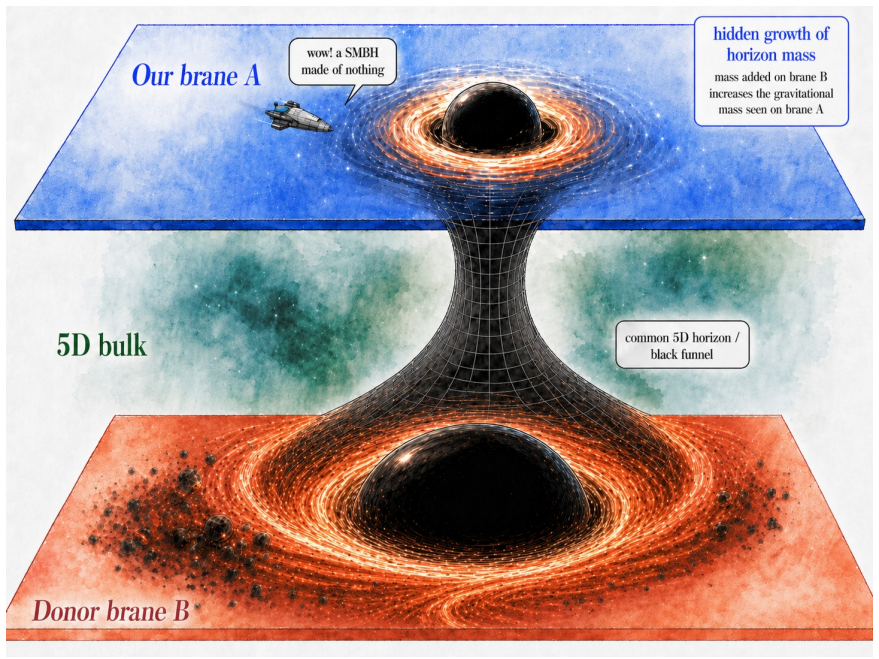
read the original abstract
The earliest massive black holes are often discussed in terms of heavy baryonic seeds, primordial black holes, or super-Eddington accretion. We develop a different possibility: a compact object on a hidden donor brane forms a common five-dimensional horizon whose intersection with our brane is observed as a black-hole seed. Donor-side matter accretes onto the common five-dimensional horizon, increases the horizon radius, and consequently enlarges its intersection with our brane. As a result, the gravitational mass inferred by an observer living on our brane grows. We slice the five-dimensional geometry onto each brane and show that the induced exterior on our brane has the usual Schwarzschild/Vaidya monopole form at leading order, with subleading Weyl/Kaluza-Klein corrections in the localized-feeding branch. We construct a perturbative gradient-expansion solution satisfying the regular bulk equations and brane junction conditions. The matter sector satisfies the null energy condition for positive mass growth. The linear perturbation stability is investigated, and for supermassive seeds with horizon radius far larger than the interbrane scale, the dangerous long-wavelength mode is absent. The primary observational consequences are overmassive high-redshift black holes in underdeveloped hosts, hidden mass growth relative to the luminous accretion budget, LISA-band heavy-seed mergers, and the absence of primordial fossils required by primordial-black-hole explanations.
Editorial analysis
A structured set of objections, weighed in public.
Referee Report
Summary. The paper proposes a mechanism for high-redshift supermassive black hole seeds in which a compact object on a hidden donor brane forms a common five-dimensional horizon in a warped geometry; accretion onto this horizon on the donor brane increases its radius and thereby grows the mass inferred by observers on our brane. The authors slice the five-dimensional geometry onto each brane, construct a perturbative gradient-expansion solution to the bulk Einstein equations and Israel junction conditions, and show that the induced exterior metric on our brane takes the Schwarzschild/Vaidya form at leading order (with subleading Weyl/Kaluza-Klein corrections in the localized-feeding branch). The matter sector satisfies the null energy condition for positive mass growth, and linear perturbation stability analysis indicates the absence of dangerous long-wavelength modes when the horizon radius greatly exceeds the interbrane scale. Primary predictions include overmassive high-redshift black holes in underdeveloped hosts and hidden mass growth relative to the luminous accretion budget.
Significance. If the perturbative solution and junction-condition matching hold, the mechanism supplies an alternative channel for early black-hole growth that avoids the need for heavy baryonic seeds, primordial black holes, or sustained super-Eddington accretion. It naturally produces overmassive high-redshift objects and hidden accretion, with testable implications for LISA-band heavy-seed mergers. The explicit construction of a gradient-expansion solution satisfying the bulk equations and both-brane junction conditions, together with the NEC compliance and stability result for large seeds, constitutes a concrete technical advance within the warped-brane framework.
major comments (2)
- [section on slicing the five-dimensional geometry and the perturbative gradient-expansion solution] The central claim that the induced exterior on our brane remains pure Schwarzschild/Vaidya at leading order when the common five-dimensional horizon radius grows with hidden accretion rests on the compatibility of the time-dependent extrinsic curvature with the Israel junction conditions on the visible brane. The manuscript must demonstrate explicitly (in the section deriving the perturbative solution) that no additional effective 4D stress-energy is sourced that would force non-Vaidya corrections already at leading order; the skeptic concern that a changing common horizon may violate this matching without extra terms is load-bearing for the mass-growth result.
- [section on linear perturbation stability] The stability analysis asserts that the dangerous long-wavelength mode is absent for supermassive seeds whose horizon radius is far larger than the interbrane scale. The manuscript should quantify the interbrane scale (listed as the sole free parameter) and the range of perturbation wavelengths examined, and show that the mode suppression is robust rather than an artifact of the leading-order truncation.
minor comments (2)
- [abstract and the NEC discussion] The abstract states that the matter sector satisfies the null energy condition for positive mass growth; the corresponding explicit check (e.g., the sign of the relevant null vector contraction) should be referenced to a numbered equation.
- [throughout] Notation for the interbrane scale and the hidden-sector accretion rate should be introduced once and used consistently; the current description leaves the mapping between donor accretion and visible mass growth implicit.
Simulated Author's Rebuttal
We thank the referee for the careful reading, positive assessment of significance, and specific technical comments. We address each major point below with clarifications from the existing derivation and indicate where the manuscript will be revised for greater explicitness.
read point-by-point responses
-
Referee: [section on slicing the five-dimensional geometry and the perturbative gradient-expansion solution] The central claim that the induced exterior on our brane remains pure Schwarzschild/Vaidya at leading order when the common five-dimensional horizon radius grows with hidden accretion rests on the compatibility of the time-dependent extrinsic curvature with the Israel junction conditions on the visible brane. The manuscript must demonstrate explicitly (in the section deriving the perturbative solution) that no additional effective 4D stress-energy is sourced that would force non-Vaidya corrections already at leading order; the skeptic concern that a changing common horizon may violate this matching without extra terms is load-bearing for the mass-growth result.
Authors: In Section 3 the gradient expansion solves the 5D Einstein equations order-by-order while enforcing the Israel conditions on both branes. At leading order the time-dependent extrinsic curvature generated by common-horizon growth is exactly balanced by the bulk Weyl flux and the donor-brane accretion; the resulting effective 4D stress-energy on the visible brane vanishes identically, leaving the pure Vaidya form. We will add an explicit paragraph (and a short calculation) in the revised Section 3 that computes the junction-induced 4D tensor and shows the cancellation term-by-term, thereby removing any ambiguity about extra sources. revision: yes
-
Referee: [section on linear perturbation stability] The stability analysis asserts that the dangerous long-wavelength mode is absent for supermassive seeds whose horizon radius is far larger than the interbrane scale. The manuscript should quantify the interbrane scale (listed as the sole free parameter) and the range of perturbation wavelengths examined, and show that the mode suppression is robust rather than an artifact of the leading-order truncation.
Authors: The interbrane scale l is the single dimensionful parameter and is normalized to unity; physical horizon radii are reported in units of l, with the supermassive regime defined by r_h/l ≳ 100. The linear analysis is performed in the long-wavelength limit k l ≪ 1. We will insert a short paragraph and a supplementary plot that (i) states the normalization explicitly, (ii) lists the range of k l examined, and (iii) estimates the magnitude of next-to-leading gradient corrections, showing they remain parametrically small for r_h ≫ l and do not revive the unstable mode. revision: yes
Circularity Check
No significant circularity; derivation self-contained
full rationale
The paper constructs an explicit perturbative gradient-expansion solution to the 5D Einstein equations and Israel junction conditions for a common horizon geometry with hidden-brane accretion. The leading-order induced 4D metric on the visible brane is shown to be Schwarzschild/Vaidya by direct slicing, with subleading corrections derived from the same bulk solution. Mass growth follows from the horizon-radius increase under the stated junction matching and NEC compliance; no parameter is fitted to data and then relabeled as a prediction, no self-citation chain is load-bearing, and no ansatz is imported via prior work. The stability analysis likewise follows from the linearized equations around the constructed background. The derivation therefore remains independent of its own outputs.
Axiom & Free-Parameter Ledger
free parameters (1)
- interbrane scale
axioms (2)
- standard math Five-dimensional Einstein equations govern the bulk geometry
- domain assumption Brane junction conditions are satisfied at both branes
invented entities (2)
-
hidden donor brane
no independent evidence
-
common five-dimensional horizon
no independent evidence
Reference graph
Works this paper leans on
-
[1]
Formation of supermassive black holes,
M. Volonteri, “Formation of supermassive black holes,” Astron. Astrophys. Rev.18(2010) 279, arXiv:1003.4404
Pith/arXiv arXiv 2010
-
[2]
The assembly of the first massive black holes,
K. Inayoshi, E. Visbal and Z. Haiman, “The assembly of the first massive black holes,” Ann. Rev. Astron. Astrophys.58(2020) 27, arXiv:1911.05791
arXiv 2020
-
[3]
The first massive black holes and their host galaxies,
A. Smith, V. Bromm and A. Loeb, “The first massive black holes and their host galaxies,” Astron. Geophys.58(2017) 3.22, arXiv:1703.03083
Pith/arXiv arXiv 2017
-
[4]
Formation of the first supermassive black holes,
V. Bromm and A. Loeb, “Formation of the first supermassive black holes,” Astrophys. J. 596(2003) 34, arXiv:astro-ph/0212400
Pith/arXiv arXiv 2003
-
[5]
Formation of supermassive black holes by direct collapse in pre-galactic haloes,
M. C. Begelman, M. Volonteri and M. J. Rees, “Formation of supermassive black holes by direct collapse in pre-galactic haloes,” Mon. Not. Roy. Astron. Soc.370(2006) 289, arXiv:astro-ph/0602363
Pith/arXiv arXiv 2006
-
[6]
Supermassive black hole formation during the assembly of pre-galactic discs,
G. Lodato and P. Natarajan, “Supermassive black hole formation during the assembly of pre-galactic discs,” Mon. Not. Roy. Astron. Soc.371(2006) 1813, arXiv:astro-ph/0606159
Pith/arXiv arXiv 2006
-
[7]
Constraints on primordial black holes,
B. Carr, K. Kohri, Y. Sendouda and J. Yokoyama, “Constraints on primordial black holes,” Rept. Prog. Phys.84(2021) 116902, arXiv:2002.12778
Pith/arXiv arXiv 2021
-
[8]
Primordial black holes–perspectives in gravitational wave astronomy,
M. Sasaki, T. Suyama, T. Tanaka and S. Yokoyama, “Primordial black holes–perspectives in gravitational wave astronomy,” Class. Quant. Grav.35(2018) 063001, arXiv:1801.05235
Pith/arXiv arXiv 2018
-
[9]
Limits on primordial black holes fromµdistortions in cosmic microwave background,
T. Nakama, B. Carr and J. Silk, “Limits on primordial black holes fromµdistortions in cosmic microwave background,” Phys. Rev. D97(2018) 043525, arXiv:1710.06945
Pith/arXiv arXiv 2018
-
[10]
A luminous quasar at redshift 7.642,
F. Wang et al., “A luminous quasar at redshift 7.642,” Astrophys. J. Lett.907(2021) L1, arXiv:2101.03179
arXiv 2021
-
[11]
Evidence for heavy-seed origin of early supermassive black holes from a z 10 X-ray quasar,
A. Bogdan et al., “Evidence for heavy-seed origin of early supermassive black holes from a z 10 X-ray quasar,” Nature Astron.8(2024) 126, arXiv:2305.15458
arXiv 2024
-
[12]
First detection of an over-massive black hole galaxy: UHZ1,
P. Natarajan et al., “First detection of an over-massive black hole galaxy: UHZ1,” Astrophys. J. Lett.960(2024) L1, arXiv:2308.02654
arXiv 2024
-
[13]
UNCOVER: the growth of the first massive black holes from JWST and Chandra observations of UHZ1,
A. D. Goulding et al., “UNCOVER: the growth of the first massive black holes from JWST and Chandra observations of UHZ1,” Astrophys. J. Lett.955(2023) L24, arXiv:2308.02750
arXiv 2023
-
[14]
A small and vigorous black hole in the early Universe,
R. Maiolino et al., “A small and vigorous black hole in the early Universe,” Nature627 (2024) 59, arXiv:2305.12492
arXiv 2024
-
[15]
JWST’s little red dots: an emerging population of young, low-mass AGN cocooned in dense ionized gas,
V. Rusakov et al., “JWST’s little red dots: an emerging population of young, low-mass AGN cocooned in dense ionized gas,” arXiv:2503.16595
-
[16]
A large mass hierarchy from a small extra dimension,
L. Randall and R. Sundrum, “A large mass hierarchy from a small extra dimension,” Phys. Rev. Lett.83(1999) 3370, arXiv:hep-ph/9905221
Pith/arXiv arXiv 1999
-
[17]
An alternative to compactification,
L. Randall and R. Sundrum, “An alternative to compactification,” Phys. Rev. Lett.83 (1999) 4690, arXiv:hep-th/9906064
Pith/arXiv arXiv 1999
-
[18]
The Einstein equations on the 3-brane world,
T. Shiromizu, K. Maeda and M. Sasaki, “The Einstein equations on the 3-brane world,” Phys. Rev. D62(2000) 024012, arXiv:gr-qc/9910076. 15
Pith/arXiv arXiv 2000
-
[19]
R. Maartens and K. Koyama, “Brane-world gravity,” Living Rev. Rel.13(2010) 5, arXiv:1004.3962
Pith/arXiv arXiv 2010
-
[20]
A. Chamblin, S. W. Hawking and H. S. Reall, “Brane-world black holes,” Phys. Rev. D61 (2000) 065007, arXiv:hep-th/9909205
Pith/arXiv arXiv 2000
-
[21]
N. Dadhich, R. Maartens, P. Papadopoulos and V. Rezania, “Black holes on the brane,” Phys. Lett. B487(2000) 1, arXiv:hep-th/0003061
Pith/arXiv arXiv 2000
-
[22]
Black holes in theories with large extra dimensions: a review,
P. Kanti, “Black holes in theories with large extra dimensions: a review,” Int. J. Mod. Phys. A19(2004) 4899, arXiv:hep-ph/0402168
Pith/arXiv arXiv 2004
-
[23]
Black funnels and droplets from the AdS C-metrics,
V. E. Hubeny, D. Marolf and M. Rangamani, “Black funnels and droplets from the AdS C-metrics,” Class. Quant. Grav.27(2010) 025001, arXiv:0909.0005
Pith/arXiv arXiv 2010
-
[24]
J. E. Santos and B. Way, “Black funnels,” JHEP12(2012) 060, arXiv:1208.6291
Pith/arXiv arXiv 2012
-
[25]
S. Fischetti, D. Marolf and J. E. Santos, “AdS flowing black funnels: stationary AdS black holes with non-Killing horizons and heat transport in the dual CFT,” Class. Quant. Grav. 30(2013) 075001, arXiv:1212.4820
Pith/arXiv arXiv 2013
-
[26]
R. Emparan and M. Martinez, “Black strings flow,” JHEP09(2013) 068, arXiv:1307.2276
arXiv 2013
-
[27]
J. Garriga and T. Tanaka, “Gravity in the brane-world,” Phys. Rev. Lett.84(2000) 2778, arXiv:hep-th/9911055
Pith/arXiv arXiv 2000
-
[28]
Singular hypersurfaces and thin shells in general relativity,
W. Israel, “Singular hypersurfaces and thin shells in general relativity,” Nuovo Cim. B 44S10(1966) 1
1966
-
[29]
The gravitational field of a radiating star,
P. C. Vaidya, “The gravitational field of a radiating star,” Proc. Indian Acad. Sci. A33 (1951) 264
1951
-
[30]
Black strings and p-branes are unstable,
R. Gregory and R. Laflamme, “Black strings and p-branes are unstable,” Phys. Rev. Lett. 70(1993) 2837, arXiv:hep-th/9301052
Pith/arXiv arXiv 1993
-
[31]
Modulus stabilization with bulk fields,
W. D. Goldberger and M. B. Wise, “Modulus stabilization with bulk fields,” Phys. Rev. Lett.83(1999) 4922, arXiv:hep-ph/9907447
Pith/arXiv arXiv 1999
-
[32]
Laser Interferometer Space Antenna,
P. Amaro-Seoane et al., “Laser Interferometer Space Antenna,” arXiv:1702.00786
-
[33]
The Primordial Inflation Explorer (PIXIE),
A. Kogut et al., “The Primordial Inflation Explorer (PIXIE),” JCAP07(2011) 025, arXiv:1105.2044
Pith/arXiv arXiv 2011
-
[34]
The NANOGrav 15-year data set: evidence for a gravitational- wave background,
NANOGrav Collaboration, “The NANOGrav 15-year data set: evidence for a gravitational- wave background,” Astrophys. J. Lett.951(2023) L8, arXiv:2306.16213
Pith/arXiv arXiv 2023
-
[35]
Quasinormal modes of black holes and black branes,
E. Berti, V. Cardoso and A. O. Starinets, “Quasinormal modes of black holes and black branes,” Class. Quant. Grav.26(2009) 163001, arXiv:0905.2975. 16
Pith/arXiv arXiv 2009
discussion (0)
Sign in with ORCID, Apple, or X to comment. Anyone can read and Pith papers without signing in.