Gravitino Freeze-In Dark Matter with an Additional Scalar Field
Pith reviewed 2026-06-28 09:34 UTC · model grok-4.3
The pith
An extra scalar field with matter-like equation of state dilutes gravitino freeze-in abundance and raises the maximum allowed reheating temperature.
A machine-rendered reading of the paper's core claim, the machinery that carries it, and where it could break.
Core claim
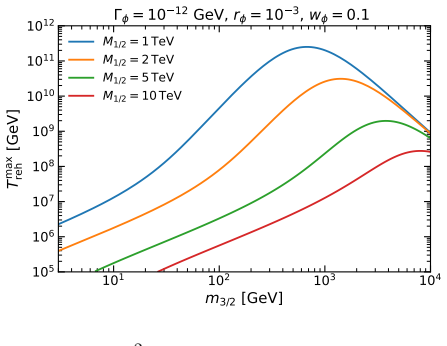
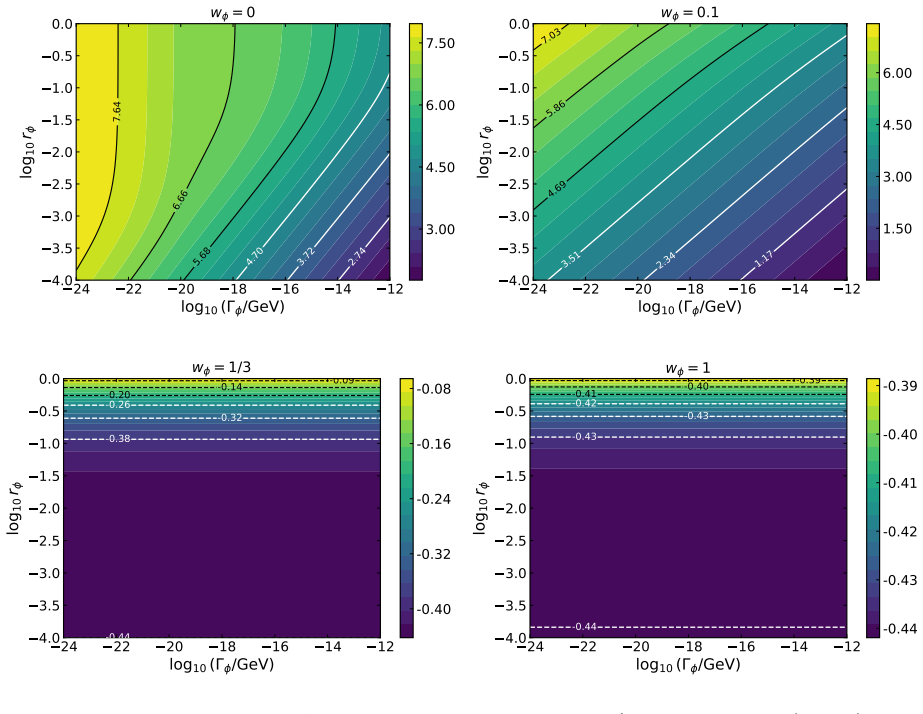
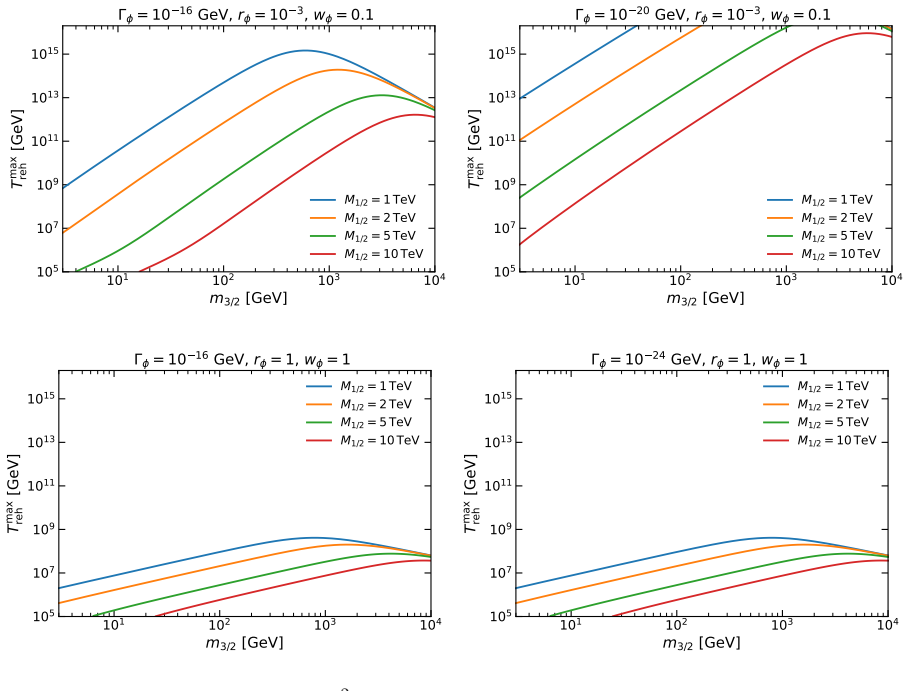
For a matter-like equation of state the extra scalar field induces a substantial dilution of the gravitino abundance, allowing significantly larger values of the reheating temperature; for a kination-like equation of state the abundance is instead enhanced and the maximum reheating temperature is reduced.
What carries the argument
An additional scalar field whose energy density and equation of state are arranged to dominate or modify the expansion rate between reheating and the gravitino freeze-in epoch.
If this is right
- Higher reheating temperatures become viable for gravitino freeze-in while still reproducing the correct dark-matter density.
- The tension between prospective gluino-mass lower bounds and the high reheating temperatures demanded by thermal leptogenesis is relaxed.
- The same scalar-field component with kination-like equation of state instead tightens the upper bound on reheating temperature.
Where Pith is reading between the lines
- The dilution mechanism could be tested by searching for other light relics whose freeze-in or freeze-out would be affected by the same modified expansion history.
- If the scalar field decays or oscillates after the gravitino freeze-in epoch, its late-time behavior must be checked against big-bang nucleosynthesis bounds.
- Similar dilution effects might apply to other freeze-in candidates whose production occurs after reheating.
Load-bearing premise
An extra scalar field exists whose energy density and equation of state can be chosen to affect the expansion history between reheating and freeze-in without creating other cosmological problems.
What would settle it
A future collider measurement of the gluino mass that exceeds the value compatible with the observed dark-matter density at the reheating temperature required by leptogenesis, even after the dilution effect is included.
Figures


read the original abstract
The gravitino is a prominent example of a freeze-in dark matter candidate. Its relic abundance depends on the reheating temperature and on supersymmetry-breaking parameters, that is the universal gaugino mass, $M_{1/2}$, and the gravitino mass, $m_{3/2}$. As a consequence, the reheating temperature consistent with the observed dark matter abundance exhibits a maximum value, $T_{\rm reh}^{\rm reak}$, which decreases as $M_{1/2}$ increases. This behavior gives rise to a tension between prospective lower bounds on the gluino mass from future collider searches and the high reheating temperatures required for successful thermal leptogenesis. In this work, we investigate a nonstandard cosmological scenario in which the thermal bath is supplemented by an additional scalar field. We show that, for a matter-like equation of state, this component can induce a substantial dilution of the gravitino abundance, thereby allowing significantly larger values of the reheating temperature. In contrast, for a kination-like equation of state, the gravitino abundance is enhanced rather than diluted, leading to a reduction of the maximum allowed reheating temperature.
Editorial analysis
A structured set of objections, weighed in public.
Referee Report
Summary. The manuscript examines gravitino freeze-in dark matter in a non-standard cosmology supplemented by an additional scalar field. It claims that a matter-like equation of state for the scalar dilutes the gravitino relic abundance, permitting significantly higher reheating temperatures consistent with the observed DM density, while a kination-like equation of state enhances the abundance and lowers the maximum allowed T_reh. This is presented as a way to ease tension between collider bounds on the gluino and the high T_reh needed for thermal leptogenesis.
Significance. If the dilution calculation holds under the stated assumptions, the work provides a concrete mechanism to relax the upper bound on T_reh in gravitino DM models without altering SUSY parameters. The approach follows the standard modified Boltzmann-equation treatment of non-standard expansion histories and supplies explicit comparisons between matter-like and kination-like cases.
major comments (2)
- [§3.1, Eq. (12)] §3.1, Eq. (12): the modified Hubble rate used to integrate the gravitino yield assumes the scalar energy density dominates and redshifts exactly as a^{-3} from reheating until freeze-in, but the paper does not demonstrate that this domination can be maintained without the scalar decaying or thermalizing, which directly affects whether the dilution factor is realized.
- [§4.2, Figure 4] §4.2, Figure 4: the reported increase in maximum T_reh for matter-like EOS reaches factors of several hundred, yet the contours are shown only for fixed M_{1/2} and m_{3/2}; the dependence on the scalar's initial energy density fraction is not scanned, leaving the robustness of the 'substantial dilution' claim unclear.
minor comments (2)
- [§2] Notation for the scalar energy density ho_φ is introduced without an explicit definition of its initial value at reheating; a short equation or table entry would clarify the parameter.
- [Introduction] The abstract states the dilution effect but the main text should cross-reference the specific numerical results (e.g., the factor by which T_reh increases) already in the introduction.
Simulated Author's Rebuttal
We thank the referee for the constructive comments on our manuscript. We address each major point below and indicate planned revisions where appropriate.
read point-by-point responses
-
Referee: [§3.1, Eq. (12)] §3.1, Eq. (12): the modified Hubble rate used to integrate the gravitino yield assumes the scalar energy density dominates and redshifts exactly as a^{-3} from reheating until freeze-in, but the paper does not demonstrate that this domination can be maintained without the scalar decaying or thermalizing, which directly affects whether the dilution factor is realized.
Authors: We agree that explicit justification is needed for the scalar to remain dominant and non-interacting until after gravitino freeze-in. Our setup assumes a decoupled scalar with lifetime longer than the freeze-in timescale, consistent with standard early-matter-domination treatments. We will revise §3.1 to add a short paragraph stating the required lower bound on the scalar lifetime (τ ≳ 10^{-2} s for typical freeze-in temperatures) and the condition that its coupling to the thermal bath is sufficiently weak to prevent thermalization. revision: yes
-
Referee: [§4.2, Figure 4] §4.2, Figure 4: the reported increase in maximum T_reh for matter-like EOS reaches factors of several hundred, yet the contours are shown only for fixed M_{1/2} and m_{3/2}; the dependence on the scalar's initial energy density fraction is not scanned, leaving the robustness of the 'substantial dilution' claim unclear.
Authors: Figure 4 uses a representative initial scalar energy-density fraction (Ω_φ^0 ≈ 1 at reheating) that produces full domination. The dilution factor scales linearly with this fraction, so the largest T_reh enhancement occurs precisely when domination is achieved. While a full scan over the initial fraction was not included, the qualitative result is robust above the threshold for domination. We will add a short discussion of this scaling and a supplementary plot showing T_reh^max versus initial fraction in the revised version. revision: partial
Circularity Check
No significant circularity; derivation self-contained
full rationale
The paper introduces an additional scalar field with adjustable energy density and equation of state as an external input to modify the post-reheating expansion history. The central result follows from solving the modified Boltzmann equation for gravitino freeze-in under this altered cosmology; the dilution effect is computed directly from the new dynamics rather than by re-expressing any fitted parameter or prior result as a prediction. No self-definitional steps, fitted-input predictions, or load-bearing self-citations appear in the abstract or model setup. The derivation remains independent of its own outputs.
Axiom & Free-Parameter Ledger
axioms (1)
- domain assumption Gravitino relic density is computed via standard freeze-in production modified only by an extra dilution factor from the scalar.
invented entities (1)
-
additional scalar field
no independent evidence
Reference graph
Works this paper leans on
-
[1]
Determination of Dark Matter Properties at High-Energy Colliders
E. A. Baltz, M. Battaglia, M. E. Peskin and T. Wizansky, “Determination of dark matter properties at high-energy colliders,” Phys. Rev. D74(2006), 103521 doi:10.1103/PhysRevD.74.103521 [arXiv:hep-ph/0602187 [hep-ph]]
work page internal anchor Pith review Pith/arXiv arXiv doi:10.1103/physrevd.74.103521 2006
-
[2]
WISPedia – the WISPs Encyclopedia
Conrado Albertus et al. WISPedia – the WISPs Encyclopedia. 2 2026
2026
-
[3]
Freeze-In Production of FIMP Dark Matter
L. J. Hall, K. Jedamzik, J. March-Russell and S. M. West, “Freeze-In Produc- tion of FIMP Dark Matter,” JHEP03(2010), 080 doi:10.1007/JHEP03(2010)080 [arXiv:0911.1120 [hep-ph]]
work page internal anchor Pith review Pith/arXiv arXiv doi:10.1007/jhep03(2010)080 2010
-
[4]
F. Elahi, C. Kolda and J. Unwin, “UltraViolet Freeze-in,” JHEP03(2015), 048 doi:10.1007/JHEP03(2015)048 [arXiv:1410.6157 [hep-ph]]
work page internal anchor Pith review Pith/arXiv arXiv doi:10.1007/jhep03(2015)048 2015
-
[5]
Ultraviolet Freeze-in and Non- Standard Cosmologies,
N. Bernal, F. Elahi, C. Maldonado and J. Unwin, “Ultraviolet Freeze-in and Non- Standard Cosmologies,” JCAP11(2019), 026 doi:10.1088/1475-7516/2019/11/026 [arXiv:1909.07992 [hep-ph]]
-
[6]
G. B´ elanger, F. Boudjema, A. Goudelis, A. Pukhov and B. Zaldivar, “micrOMEGAs5.0 : Freeze-in,” Comput. Phys. Commun.231(2018), 173-186 doi:10.1016/j.cpc.2018.04.027 [arXiv:1801.03509 [hep-ph]]
work page internal anchor Pith review Pith/arXiv arXiv doi:10.1016/j.cpc.2018.04.027 2018
-
[9]
Gravitino production after in- flation,
R. Kallosh, L. Kofman, A. D. Linde and A. Van Proeyen, “Gravitino production after in- flation,” Phys. Rev. D61(2000), 103503 doi:10.1103/PhysRevD.61.103503 [arXiv:hep- th/9907124 [hep-th]]
-
[10]
Thermal and Non-Thermal Production of Gravitinos in the Early Universe
G. F. Giudice, A. Riotto and I. Tkachev, “Thermal and nonthermal production of grav- itinos in the early universe,” JHEP11(1999), 036 doi:10.1088/1126-6708/1999/11/036 [arXiv:hep-ph/9911302 [hep-ph]]
work page internal anchor Pith review Pith/arXiv arXiv doi:10.1088/1126-6708/1999/11/036 1999
-
[11]
Nonthermal production of gravitinos and inflatinos
H. P. Nilles, M. Peloso and L. Sorbo, “Nonthermal production of gravitinos and inflatinos,” Phys. Rev. Lett.87(2001), 051302 doi:10.1103/PhysRevLett.87.051302 [arXiv:hep-ph/0102264 [hep-ph]]
work page internal anchor Pith review Pith/arXiv arXiv doi:10.1103/physrevlett.87.051302 2001
-
[12]
Gravitino overproduction in inflaton decay,
M. Kawasaki, F. Takahashi and T. T. Yanagida, “Gravitino overproduction in inflaton decay,” Phys. Lett. B638(2006), 8-12 doi:10.1016/j.physletb.2006.05.037 [arXiv:hep- ph/0603265 [hep-ph]]. 21
-
[13]
Inflaton Decay through Supergravity Effects
M. Endo, M. Kawasaki, F. Takahashi and T. T. Yanagida, “Inflaton de- cay through supergravity effects,” Phys. Lett. B642(2006), 518-524 doi:10.1016/j.physletb.2006.09.044 [arXiv:hep-ph/0607170 [hep-ph]]
work page internal anchor Pith review Pith/arXiv arXiv doi:10.1016/j.physletb.2006.09.044 2006
-
[14]
E. Dudas, Y. Mambrini and K. Olive, “Case for an EeV Gravitino,” Phys. Rev. Lett. 119(2017) no.5, 051801 doi:10.1103/PhysRevLett.119.051801 [arXiv:1704.03008 [hep- ph]]
work page internal anchor Pith review Pith/arXiv arXiv doi:10.1103/physrevlett.119.051801 2017
-
[15]
Radiative Production of Non-thermal Dark Matter
K. Kaneta, Y. Mambrini and K. A. Olive, “Radiative production of nonthermal dark matter,” Phys. Rev. D99(2019) no.6, 063508 doi:10.1103/PhysRevD.99.063508 [arXiv:1901.04449 [hep-ph]]
work page internal anchor Pith review Pith/arXiv arXiv doi:10.1103/physrevd.99.063508 2019
-
[16]
Inflation Can Save the Gravitino,
J. R. Ellis, A. D. Linde and D. V. Nanopoulos, “Inflation Can Save the Gravitino,” Phys. Lett. B118(1982), 59-64 doi:10.1016/0370-2693(82)90601-3
-
[17]
D. V. Nanopoulos, K. A. Olive and M. Srednicki, “After Primordial Inflation,” Phys. Lett. B127(1983), 30-34 doi:10.1016/0370-2693(83)91624-6
-
[18]
Enhancement of the Dark Matter Abundance Before Reheating: Applications to Gravitino Dark Matter
M. A. G. Garcia, Y. Mambrini, K. A. Olive and M. Peloso, “Enhancement of the Dark Matter Abundance Before Reheating: Applications to Gravitino Dark Matter,” Phys. Rev. D96(2017) no.10, 103510 doi:10.1103/PhysRevD.96.103510 [arXiv:1709.01549 [hep-ph]]
work page internal anchor Pith review Pith/arXiv arXiv doi:10.1103/physrevd.96.103510 2017
-
[19]
Gravitational pro- duction of spin-3/2 particles during reheating,
K. Kaneta, W. Ke, Y. Mambrini, K. A. Olive and S. Verner, “Gravitational pro- duction of spin-3/2 particles during reheating,” Phys. Rev. D108(2023) no.11, 11 doi:10.1103/PhysRevD.108.115027 [arXiv:2309.15146 [hep-ph]]
-
[20]
Gravitino thermal production re- visited,
H. Eberl, I. D. Gialamas and V. C. Spanos, “Gravitino thermal production re- visited,” Phys. Rev. D103(2021) no.7, 075025 doi:10.1103/PhysRevD.103.075025 [arXiv:2010.14621 [hep-ph]]
-
[22]
Thermal production of gravitinos
V. S. Rychkov and A. Strumia, “Thermal production of gravitinos,” Phys. Rev. D75 (2007), 075011 doi:10.1103/PhysRevD.75.075011 [arXiv:hep-ph/0701104 [hep-ph]]
work page internal anchor Pith review Pith/arXiv arXiv doi:10.1103/physrevd.75.075011 2007
-
[23]
Cosmological Constraints on the Scale of Supersymmetry Breaking,
S. Weinberg, “Cosmological Constraints on the Scale of Supersymmetry Breaking,” Phys. Rev. Lett.48(1982), 1303 doi:10.1103/PhysRevLett.48.1303
-
[24]
Cosmological Gravitino Regeneration and Decay,
J. R. Ellis, J. E. Kim and D. V. Nanopoulos, “Cosmological Gravitino Regeneration and Decay,” Phys. Lett. B145(1984), 181-186 doi:10.1016/0370-2693(84)90334-4
-
[25]
Is It Easy to Save the Gravitino?,
M. Y. Khlopov and A. D. Linde, “Is It Easy to Save the Gravitino?,” Phys. Lett. B138 (1984), 265-268 doi:10.1016/0370-2693(84)91656-3 22
-
[26]
Cosmological constraints on the light stable gravitino,
T. Moroi, H. Murayama and M. Yamaguchi, “Cosmological constraints on the light stable gravitino,” Phys. Lett. B303(1993), 289-294 doi:10.1016/0370-2693(93)91434- O
-
[27]
Gravitino Production in the Inflationary Universe and the Effects on Big-Bang Nucleosynthesis
M. Kawasaki and T. Moroi, “Gravitino production in the inflationary universe and the effects on big bang nucleosynthesis,” Prog. Theor. Phys.93(1995), 879-900 doi:10.1143/PTP.93.879 [arXiv:hep-ph/9403364 [hep-ph]]
work page internal anchor Pith review Pith/arXiv arXiv doi:10.1143/ptp.93.879 1995
-
[28]
Effects of the gravitino on the inflationary universe,
T. Moroi, “Effects of the gravitino on the inflationary universe,” [arXiv:hep-ph/9503210 [hep-ph]]
-
[29]
On the Thermal Regeneration Rate for Light Gravitinos in the Early Universe
J. R. Ellis, D. V. Nanopoulos, K. A. Olive and S. J. Rey, “On the thermal regenera- tion rate for light gravitinos in the early universe,” Astropart. Phys.4(1996), 371-386 doi:10.1016/0927-6505(96)00006-0 [arXiv:hep-ph/9505438 [hep-ph]]
work page internal anchor Pith review Pith/arXiv arXiv doi:10.1016/0927-6505(96)00006-0 1996
-
[30]
Baryon asymmetry and dark mat- ter,
M. Bolz, W. Buchmuller and M. Plumacher, “Baryon asymmetry and dark mat- ter,” Phys. Lett. B443(1998), 209-213 doi:10.1016/S0370-2693(98)01342-2 [arXiv:hep- ph/9809381 [hep-ph]]
-
[31]
Thermal Production of Gravitinos
M. Bolz, A. Brandenburg and W. Buchmuller, “Thermal production of gravitinos,” Nucl. Phys. B606(2001), 518-544 [erratum: Nucl. Phys. B790(2008), 336-337] doi:10.1016/S0550-3213(01)00132-8 [arXiv:hep-ph/0012052 [hep-ph]]
work page internal anchor Pith review Pith/arXiv arXiv doi:10.1016/s0550-3213(01)00132-8 2001
-
[32]
Gravitino Dark Matter and Cosmological Constraints
F. D. Steffen, “Gravitino dark matter and cosmological constraints,” JCAP09(2006), 001 doi:10.1088/1475-7516/2006/09/001 [arXiv:hep-ph/0605306 [hep-ph]]
work page internal anchor Pith review Pith/arXiv arXiv doi:10.1088/1475-7516/2006/09/001 2006
-
[33]
Thermal gravitino production and collider tests of lepto- genesis,
J. Pradler and F. D. Steffen, “Thermal gravitino production and collider tests of lepto- genesis,” Phys. Rev. D75(2007), 023509 doi:10.1103/PhysRevD.75.023509 [arXiv:hep- ph/0608344 [hep-ph]]
-
[34]
Constraints on the Reheating Temperature in Gravitino Dark Matter Scenarios
J. Pradler and F. D. Steffen, “Constraints on the Reheating Temperature in Gravitino Dark Matter Scenarios,” Phys. Lett. B648(2007), 224-235 doi:10.1016/j.physletb.2007.02.072 [arXiv:hep-ph/0612291 [hep-ph]]
work page internal anchor Pith review Pith/arXiv arXiv doi:10.1016/j.physletb.2007.02.072 2007
-
[35]
Electroweak Contributions to Thermal Gravitino Production,
J. Pradler, “Electroweak Contributions to Thermal Gravitino Production,” [arXiv:0708.2786 [hep-ph]]
-
[36]
C. Cheung, G. Elor and L. Hall, “Gravitino Freeze-In,” Phys. Rev. D84(2011), 115021 doi:10.1103/PhysRevD.84.115021 [arXiv:1103.4394 [hep-ph]]
work page internal anchor Pith review Pith/arXiv arXiv doi:10.1103/physrevd.84.115021 2011
-
[37]
H. Eberl, I. D. Gialamas and V. C. Spanos, “Gravitino Thermal Production,” doi:10.31526/acp.bsm-2021.3 [arXiv:2107.09319 [hep-ph]]
-
[38]
M. Aaboudet al.[ATLAS], “Search for supersymmetry in final states with missing transverse momentum and multipleb-jets in proton-proton collisions at √s= 13 23 TeV with the ATLAS detector,” JHEP06(2018), 107 doi:10.1007/JHEP06(2018)107 [arXiv:1711.01901 [hep-ex]]
work page internal anchor Pith review Pith/arXiv arXiv doi:10.1007/jhep06(2018)107 2018
-
[39]
T. Collaborationet al.[CMS], “Search for supersymmetry in proton-proton collisions at 13 TeV in final states with jets and missing transverse momentum,” JHEP10(2019), 244 doi:10.1007/JHEP10(2019)244 [arXiv:1908.04722 [hep-ex]]
-
[40]
Baryogenesis through leptoge- nesis,
R. Barbieri, P. Creminelli, A. Strumia and N. Tetradis, “Baryogenesis through leptoge- nesis,” Nucl. Phys. B575(2000), 61-77 doi:10.1016/S0550-3213(00)00011-0 [arXiv:hep- ph/9911315 [hep-ph]]
-
[41]
Flavour Matters in Leptogenesis
A. Abada, S. Davidson, A. Ibarra, F. X. Josse-Michaux, M. Losada and A. Ri- otto, “Flavour Matters in Leptogenesis,” JHEP09(2006), 010 doi:10.1088/1126- 6708/2006/09/010 [arXiv:hep-ph/0605281 [hep-ph]]
work page internal anchor Pith review Pith/arXiv arXiv doi:10.1088/1126- 2006
-
[42]
W. Buchmuller, P. Di Bari and M. Plumacher, “Leptogenesis for pedestrians,” Annals Phys.315(2005), 305-351 doi:10.1016/j.aop.2004.02.003 [arXiv:hep-ph/0401240 [hep- ph]]
work page internal anchor Pith review Pith/arXiv arXiv doi:10.1016/j.aop.2004.02.003 2005
-
[43]
S. Davidson, E. Nardi and Y. Nir, “Leptogenesis,” Phys. Rept.466(2008), 105-177 doi:10.1016/j.physrep.2008.06.002 [arXiv:0802.2962 [hep-ph]]
work page internal anchor Pith review Pith/arXiv arXiv doi:10.1016/j.physrep.2008.06.002 2008
-
[44]
A lower bound on the right-handed neutrino mass from leptogenesis
S. Davidson and A. Ibarra, “A Lower bound on the right-handed neutrino mass from leptogenesis,” Phys. Lett. B535(2002), 25-32 doi:10.1016/S0370-2693(02)01735-5 [arXiv:hep-ph/0202239 [hep-ph]]
work page internal anchor Pith review Pith/arXiv arXiv doi:10.1016/s0370-2693(02)01735-5 2002
-
[45]
Smoothly evolving Supercritical-String Dark Energy relaxes Supersymmetric-Dark-Matter Constraints
A. B. Lahanas, N. E. Mavromatos and D. V. Nanopoulos, “Smoothly evolving supercritical-string dark energy relaxes supersymmetric-dark-matter constraints,” Phys. Lett. B649(2007), 83-90 doi:10.1016/j.physletb.2007.03.058 [arXiv:hep-ph/0612152 [hep-ph]]
work page internal anchor Pith review Pith/arXiv arXiv doi:10.1016/j.physletb.2007.03.058 2007
-
[46]
Dilaton dominance in the early Universe dilutes Dark Matter relic abundances
A. B. Lahanas, “Dilaton dominance in the early Universe dilutes Dark Matter relic abundances,” Phys. Rev. D83(2011), 103523 doi:10.1103/PhysRevD.83.103523 [arXiv:1102.4277 [hep-ph]]
work page internal anchor Pith review Pith/arXiv arXiv doi:10.1103/physrevd.83.103523 2011
-
[47]
Dilaton dominance relaxes LHC and cosmological constraints in supersymmetric models
A. B. Lahanas and V. C. Spanos, “Dilaton dominance relaxes LHC and cosmological constraints in supersymmetric models,” JHEP06(2012), 089 doi:10.1007/JHEP06(2012)089 [arXiv:1201.2601 [hep-ph]]
work page internal anchor Pith review Pith/arXiv arXiv doi:10.1007/jhep06(2012)089 2012
-
[48]
Quintessential Kination and Thermal Production of Gravitinos and Axinos
M. E. Gomez, S. Lola, C. Pallis and J. Rodriguez-Quintero, “Quintessential Ki- nation and Thermal Production of Gravitinos and Axinos,” JCAP01(2009), 027 doi:10.1088/1475-7516/2009/01/027 [arXiv:0809.1859 [hep-ph]]
work page internal anchor Pith review Pith/arXiv arXiv doi:10.1088/1475-7516/2009/01/027 2009
-
[49]
Gravitino or Axino Dark Matter with Reheat Temperature as high as $10^{16}$ GeV
R. T. Co, F. D’Eramo and L. J. Hall, “Gravitino or Axino Dark Matter with Reheat Temperature as high as 1016 GeV,” JHEP03(2017), 005 doi:10.1007/JHEP03(2017)005 [arXiv:1611.05028 [hep-ph]]. 24
work page internal anchor Pith review Pith/arXiv arXiv doi:10.1007/jhep03(2017)005 2017
-
[50]
Saxion Cosmology for Thermalized Gravitino Dark Matter
R. T. Co, F. D’Eramo, L. J. Hall and K. Harigaya, “Saxion Cosmology for Ther- malized Gravitino Dark Matter,” JHEP07(2017), 125 doi:10.1007/JHEP07(2017)125 [arXiv:1703.09796 [hep-ph]]
work page internal anchor Pith review Pith/arXiv arXiv doi:10.1007/jhep07(2017)125 2017
-
[51]
The Road to No Scale Supergravity,
A. B. Lahanas and D. V. Nanopoulos, “The Road to No Scale Supergravity,” Phys. Rept.145(1987), 1 doi:10.1016/0370-1573(87)90034-2
-
[52]
Phenomenological Aspects of No-Scale Inflation Models
J. Ellis, M. A. G. Garcia, D. V. Nanopoulos and K. A. Olive, “Phenomenologi- cal Aspects of No-Scale Inflation Models,” JCAP10(2015), 003 doi:10.1088/1475- 7516/2015/10/003 [arXiv:1503.08867 [hep-ph]]
work page internal anchor Pith review Pith/arXiv arXiv doi:10.1088/1475- 2015
-
[53]
Creation of universes from nothing,
G. D. Coughlan, W. Fischler, E. W. Kolb, S. Raby and G. G. Ross, “Cosmological Problems for the Polonyi Potential,” Phys. Lett. B131(1983), 59-64 doi:10.1016/0370- 2693(83)91091-2
-
[54]
B. de Carlos, J. A. Casas, F. Quevedo and E. Roulet, “Model independent properties and cosmological implications of the dilaton and moduli sectors of 4-d strings,” Phys. Lett. B318(1993), 447-456 doi:10.1016/0370-2693(93)91538-X [arXiv:hep-ph/9308325 [hep-ph]]
work page internal anchor Pith review Pith/arXiv arXiv doi:10.1016/0370-2693(93)91538-x 1993
-
[55]
Baryogenesis from Flat Directions of the Supersymmetric Standard Model
M. Dine, L. Randall and S. D. Thomas, “Baryogenesis from flat directions of the su- persymmetric standard model,” Nucl. Phys. B458(1996), 291-326 doi:10.1016/0550- 3213(95)00538-2 [arXiv:hep-ph/9507453 [hep-ph]]
work page internal anchor Pith review Pith/arXiv arXiv doi:10.1016/0550- 1996
-
[56]
Planck 2018 results. VI. Cosmological parameters
N. Aghanimet al.[Planck], “Planck 2018 results. VI. Cosmological parameters,” Astron. Astrophys.641(2020), A6 [erratum: Astron. Astrophys.652(2021), C4] doi:10.1051/0004-6361/201833910 [arXiv:1807.06209 [astro-ph.CO]]
work page internal anchor Pith review Pith/arXiv arXiv doi:10.1051/0004-6361/201833910 2018
-
[57]
The CMSSM survives Planck, the LHC, LUX-ZEPLIN, Fermi-LAT, H.E.S.S. and IceCube,
J. Ellis, K. A. Olive, V. C. Spanos and I. D. Stamou, “The CMSSM survives Planck, the LHC, LUX-ZEPLIN, Fermi-LAT, H.E.S.S. and IceCube,” Eur. Phys. J. C83(2023) no.3, 246 doi:10.1140/epjc/s10052-023-11405-1 [arXiv:2210.16337 [hep-ph]]
-
[58]
Freeze- in baryogenesis and early matter domination,
I. Dalianis, A. Goudelis, D. Karamitros, P. Papachristou and V. C. Spanos, “Freeze- in baryogenesis and early matter domination,” Phys. Rev. D108(2023) no.5, 055038 doi:10.1103/PhysRevD.108.055038 [arXiv:2304.07345 [hep-ph]]. 25
discussion (0)
Sign in with ORCID, Apple, or X to comment. Anyone can read and Pith papers without signing in.