The Polymorphic Chiral Anomaly
Pith reviewed 2026-06-28 09:22 UTC · model grok-4.3
The pith
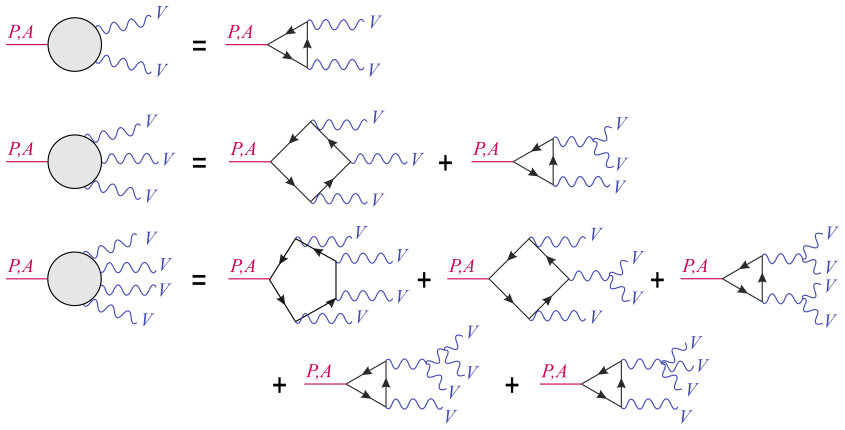
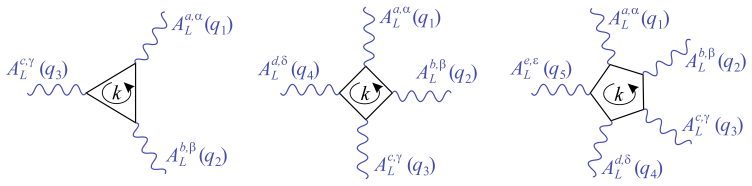
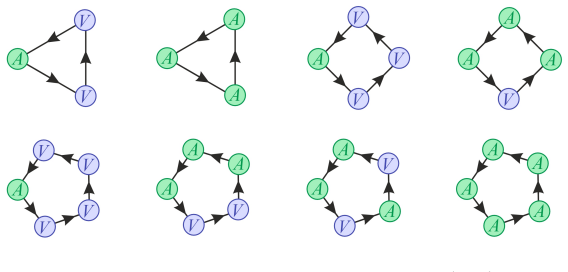
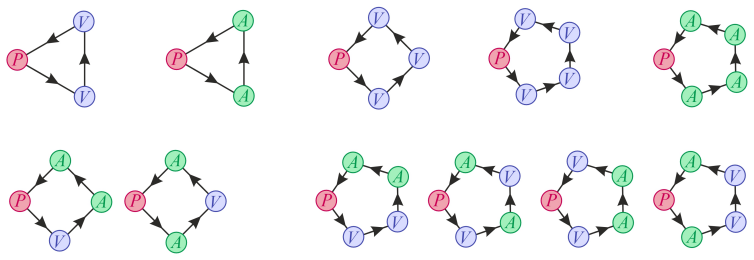
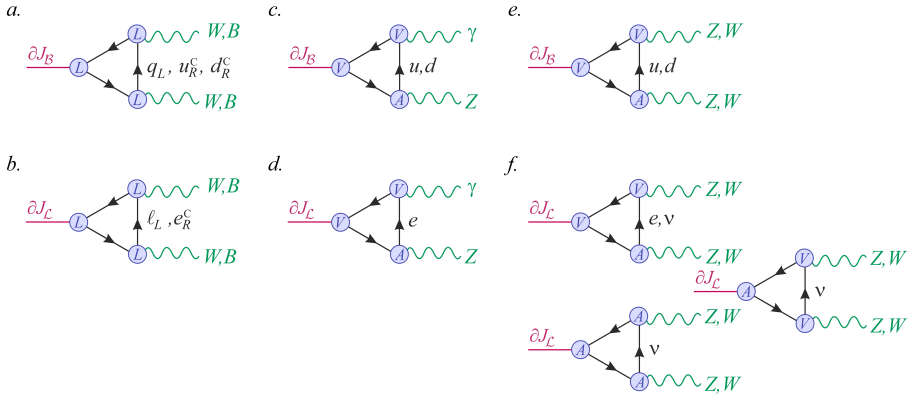
A single master expression for the chiral anomaly incorporates triangle, box, and pentagon diagrams and generates all its traditional forms.
A machine-rendered reading of the paper's core claim, the machinery that carries it, and where it could break.
Core claim
There is a novel expression for the fully generic chiral anomaly, derived with either massive or massless fermions, that incorporates not only the standard triangle but also the box and pentagon diagrams. From this master expression, the various traditional forms of the anomaly are then transparently derived.
What carries the argument
The master expression for the generic chiral anomaly that includes higher-order diagrams to unify all forms.
If this is right
- All traditional realizations of the chiral anomaly follow directly from one expression without extra adjustments.
- Topological aspects of each form can be described bypassing differential language except for Stokes' theorem.
- Phenomenological applications gain from this simplified and unified view of the anomaly.
- The provided FeynCalc implementation enables straightforward reproduction of all results.
Where Pith is reading between the lines
- This unified expression may simplify anomaly calculations in extended particle physics models with additional fermions.
- Connections to numerical methods like lattice simulations could provide independent checks of the master formula.
- Future work might explore applications to gravitational anomalies or other higher-dimensional effects.
Load-bearing premise
That a single master expression exists from which all traditional forms of the anomaly follow transparently without additional diagram-specific adjustments or regularization choices.
What would settle it
Demonstrating that the master expression does not yield the expected result for the covariant anomaly in a specific regularization scheme would falsify the claim.
Figures







read the original abstract
The chiral anomaly famously manifests in a rich variety of forms, from abelian and singlet to consistent or covariant. In this paper, all these realizations are described in detail, along with their properties and phenomenological applications. Central to this presentation is a novel expression for the fully generic chiral anomaly, derived with either massive or massless fermions, that incorporates not only the standard triangle but also the box and pentagon diagrams. From this master expression, the various traditional forms of the anomaly are then transparently derived. This provides a powerful tool, technically and conceptually, driving two further objectives. First, the topological aspects of each form are dutifully described while bypassing the differential language entirely, save for Stokes' theorem. Second, to make sure anyone interested can truly reproduce all the results in a reasonable amount of time, a FeynCalc implementation of the relevant calculations is provided. Ultimately, this simplified and unified description of all the forms of the chiral anomaly highlights the underlying conceptual beauty, and offers a comprehensive grasp of the physics at play.
Editorial analysis
A structured set of objections, weighed in public.
Referee Report
Summary. The paper presents a unified treatment of the chiral anomaly in its various forms (abelian/singlet, consistent/covariant) by introducing a novel master expression valid for both massive and massless fermions. This expression incorporates the triangle diagram along with box and pentagon contributions; all standard realizations are then derived from it. Topological properties are discussed using only Stokes' theorem, and a FeynCalc implementation is supplied to enable reproduction of the results.
Significance. If the central claim holds—that a single master expression yields all anomaly forms transparently without hidden regulator dependence or diagram-by-diagram adjustments—it would provide a conceptually clarifying and computationally practical framework for the chiral anomaly, with the supplied code strengthening reproducibility.
major comments (2)
- [Abstract] The central claim (abstract) that the master expression supports all listed forms without additional diagram-specific adjustments or regularization choices cannot be assessed: no explicit form of the master expression, no derivation, and no reduction steps to the triangle/box/pentagon cases are visible in the manuscript.
- [Abstract] The assertion that the master expression is derived independently (rather than defined to reproduce the target results) is not demonstrated; this directly affects the circularity concern raised for the polymorphic claim.
Simulated Author's Rebuttal
We thank the referee for their report and the opportunity to clarify our manuscript. We address the two major comments point by point below. Both comments concern the visibility and independence of the master expression; we agree that the abstract would benefit from greater explicitness and will revise accordingly while preserving the existing derivations in the body of the paper.
read point-by-point responses
-
Referee: [Abstract] The central claim (abstract) that the master expression supports all listed forms without additional diagram-specific adjustments or regularization choices cannot be assessed: no explicit form of the master expression, no derivation, and no reduction steps to the triangle/box/pentagon cases are visible in the manuscript.
Authors: The explicit master expression, its derivation from the triangle, box and pentagon diagrams (for both massive and massless fermions), and the subsequent reductions to the abelian, singlet, consistent and covariant forms are all contained in Sections 3–5 of the manuscript. The abstract summarizes these results without displaying the formula itself. We accept that this makes the central claim harder to assess from the abstract alone and will revise the abstract to include a compact schematic form of the master expression together with explicit section references. revision: yes
-
Referee: [Abstract] The assertion that the master expression is derived independently (rather than defined to reproduce the target results) is not demonstrated; this directly affects the circularity concern raised for the polymorphic claim.
Authors: The master expression is obtained by direct evaluation of the relevant Feynman diagrams using standard techniques, without presupposing the final anomaly coefficients or forms; the known limits are recovered only after the calculation is complete. We acknowledge that the independence of this derivation is not stated with sufficient prominence in the abstract or introduction. We will add a short clarifying paragraph (or subsection) that outlines the logical order of the calculation and emphasizes that the master expression is not constructed to match the target results a priori. revision: yes
Circularity Check
No circularity: master expression presented as independently derived
full rationale
The provided abstract and description state that the novel generic expression is 'derived with either massive or massless fermions' and that traditional forms 'are then transparently derived' from it. No equations, self-citations, or fitting procedures are quoted that would reduce the master expression to the target anomaly forms by construction. The derivation chain is described as self-contained, with the master expression as the starting point rather than a post-hoc combination or fit. This matches the default expectation of no significant circularity.
Axiom & Free-Parameter Ledger
Reference graph
Works this paper leans on
-
[1]
E. Noether, Gott. Nachr.1918(1918), 235-257 doi: 10.1080/00411457108231446 [arXiv:physics/0503066 [physics]]
work page internal anchor Pith review Pith/arXiv arXiv doi:10.1080/00411457108231446 1918
-
[2]
S. L. Adler, Phys. Rev.177(1969), 2426-2438 doi: 10.1103/PhysRev.177.2426
-
[3]
J. S. Bell and R. Jackiw, Nuovo Cim. A60(1969), 47-61 doi: 10.1007/BF02823296
-
[4]
S. R. Coleman and R. Jackiw, Annals Phys.67(1971), 552-598 doi: 10.1016/0003- 4916(71)90153-9 86
-
[5]
D. M. Capper and M. J. Duff, Nuovo Cim. A23(1974), 173-183 doi: 10.1007/BF02748300
-
[6]
E. Witten, Phys. Lett. B117(1982), 324-328 doi: 10.1016/0370-2693(82)90728-6
-
[8]
A. N. Redlich, Phys. Rev. D29(1984), 2366-2374 doi: 10.1103/PhysRevD.29.2366
-
[10]
F. D. M. Haldane, Phys. Rev. Lett.61(1988), 2015-2018 doi: 10.1103/PhysRevLett.61.2015
-
[12]
J. Preskill, S. P. Trivedi, F. Wilczek and M. B. Wise, Nucl. Phys. B363(1991), 207-220 doi: 10.1016/0550-3213(91)90241-O
-
[13]
Note on Discrete Gauge Anomalies
T. Banks and M. Dine, Phys. Rev. D45(1992), 1424-1427 doi: 10.1103/PhysRevD.45.1424 [arXiv:hep-th/9109045 [hep-th]]
work page internal anchor Pith review Pith/arXiv arXiv doi:10.1103/physrevd.45.1424 1992
-
[14]
D. Gaiotto, A. Kapustin, N. Seiberg and B. Willett, JHEP02(2015), 172 doi: 10.1007/JHEP02(2015)172 [arXiv:1412.5148 [hep-th]]
work page internal anchor Pith review Pith/arXiv arXiv doi:10.1007/jhep02(2015)172 2015
-
[15]
Theta, Time Reversal, and Temperature
D. Gaiotto, A. Kapustin, Z. Komargodski and N. Seiberg, JHEP05(2017), 091 doi: 10.1007/JHEP05(2017)091 [arXiv:1703.00501 [hep-th]]
work page internal anchor Pith review Pith/arXiv arXiv doi:10.1007/jhep05(2017)091 2017
- [16]
-
[17]
G. ’t Hooft, in NATO Sci. Ser. B59(1980), 135-157 doi: 10.1007/978-1-4684-7571-5
-
[18]
J. A. Harvey, [arXiv:hep-th/0509097 [hep-th]]
- [19]
-
[20]
G. ’t Hooft, Phys. Rev. Lett.37(1976), 8-11 doi: 10.1103/PhysRevLett.37.8
-
[21]
S. S. Chern and J. Simons, Annals Math.99(1974), 48-69 doi: 10.2307/1971013
-
[22]
A. A. Belavin, A. M. Polyakov, A. S. Schwartz and Y. S. Tyupkin, Phys. Lett. B59(1975), 85-87 doi: 10.1016/0370-2693(75)90163-X
-
[23]
C. G. Callan, Jr., R. F. Dashen and D. J. Gross, Phys. Lett. B63(1976), 334-340 doi: 10.1016/0370-2693(76)90277-X
-
[25]
M. F. Atiyah and I. M. Singer, Annals Math.87(1968), 484-530 doi: 10.2307/1970715
-
[26]
J. Wess and B. Zumino, Phys. Lett. B37(1971), 95-97 doi: 10.1016/0370-2693(71)90582-X 87
-
[27]
Zumino, UCB-PTH-83-16
B. Zumino, UCB-PTH-83-16
-
[28]
Stora, LAPP-TH-94
R. Stora, LAPP-TH-94
-
[29]
W. A. Bardeen, Phys. Rev.184(1969), 1848-1857 doi: 10.1103/PhysRev.184.1848
-
[30]
E. Witten, Nucl. Phys. B223(1983), 422-432 doi: 10.1016/0550-3213(83)90063-9
-
[31]
T. H. R. Skyrme, Nucl. Phys.31(1962), 556-569 doi: 10.1016/0029-5582(62)90775-7
-
[34]
Gowers (Editor), Princeton University Press, 2008, ISBN:978-0691118802
Terence Tao, in The Princeton Companion to Mathematics, T. Gowers (Editor), Princeton University Press, 2008, ISBN:978-0691118802
2008
-
[35]
R. Mertig, M. Bohm and A. Denner, Comput. Phys. Commun.64(1991), 345-359 doi: 10.1016/0010-4655(91)90130-D
-
[36]
New Developments in FeynCalc 9.0
V. Shtabovenko, R. Mertig and F. Orellana, Comput. Phys. Commun.207(2016), 432-444 doi: 10.1016/j.cpc.2016.06.008 [arXiv:1601.01167 [hep-ph]]
work page internal anchor Pith review Pith/arXiv arXiv doi:10.1016/j.cpc.2016.06.008 2016
-
[37]
V. Shtabovenko, R. Mertig and F. Orellana, Comput. Phys. Commun.256(2020), 107478 doi: 10.1016/j.cpc.2020.107478 [arXiv:2001.04407 [hep-ph]]
-
[38]
V. Shtabovenko, R. Mertig and F. Orellana, Comput. Phys. Commun.306(2025), 109357 doi: 10.1016/j.cpc.2024.109357 [arXiv:2312.14089 [hep-ph]]
-
[39]
D. G. Sutherland, Nucl. Phys. B2(1967), 433-440 doi: 10.1016/0550-3213(67)90180-0
-
[40]
M. Veltman, Proc. Roy. Soc. Lond. A301(1967) no.1465, 107-112 doi: 10.1098/rspa.1967.0193
-
[41]
Weyl and Dirac semimetals in three-dimensional solids,
W. Pauli and F. Villars, Rev. Mod. Phys.21(1949), 434-444 doi: 10.1103/RevMod- Phys.21.434
-
[43]
S. Weinberg, Cambridge University Press, 2013, ISBN 978-1-139-63247-8, 978-0-521-67054-8, 978-0-521-55002-4 doi: 10.1017/CBO9781139644174
-
[44]
J. Steinberger, Phys. Rev.76(1949), 1180-1186 doi: 10.1103/PhysRev.76.1180
-
[45]
J. S. Schwinger, Phys. Rev.82(1951), 664-679 doi: 10.1103/PhysRev.82.664
-
[47]
Gravitational Anomalies and Thermal Hall effect in Topological Insulators
M. Stone, Phys. Rev. B85(2012), 184503 doi: 10.1103/PhysRevB.85.184503 [arXiv:1201.4095 [cond-mat.mes-hall]]
work page internal anchor Pith review Pith/arXiv arXiv doi:10.1103/physrevb.85.184503 2012
-
[48]
J. Baez and J. P. Muniain, World Scientific Publishing Company, 1994, doi:10.1142/2324
-
[49]
S. R. Coleman, Subnucl. Ser.15(1979), 805 HUTP-78-A004
1979
-
[50]
V. V. Khoze, [arXiv:2512.06827 [hep-ph]]
-
[51]
G. ’t Hooft, Phys. Rev. D14(1976), 3432-3450 [erratum: Phys. Rev. D18(1978), 2199] doi: 10.1103/PhysRevD.14.3432
- [52]
-
[53]
M. A. Shifman, A. I. Vainshtein and V. I. Zakharov, Nucl. Phys. B163(1980), 46-56 doi: 10.1016/0550-3213(80)90389-2
-
[54]
Proton stability from a fourth family
C. Smith, Phys. Rev. D85(2012), 036005 doi: 10.1103/PhysRevD.85.036005 [arXiv:1105.1723 [hep-ph]]
work page internal anchor Pith review Pith/arXiv arXiv doi:10.1103/physrevd.85.036005 2012
-
[55]
V. A. Rubakov and M. E. Shaposhnikov, Usp. Fiz. Nauk166(1996), 493-537 doi: 10.1070/PU1996v039n05ABEH000145 [arXiv:hep-ph/9603208 [hep-ph]]
work page internal anchor Pith review Pith/arXiv arXiv doi:10.1070/pu1996v039n05abeh000145 1996
-
[56]
M. Luscher, Phys. Lett. B78(1978), 465-467 doi: 10.1016/0370-2693(78)90487-2
-
[57]
C. Plantier and C. Smith, Phys. Rev. D112(2025) no.7, 075043 doi: 10.1103/yfh1-zms8 [arXiv:2506.04795 [hep-ph]]
-
[58]
G. Veneziano, Nucl. Phys. B159(1979), 213-224 doi: 10.1016/0550-3213(79)90332-8
-
[59]
E. Witten, Nucl. Phys. B156(1979), 269-283 doi: 10.1016/0550-3213(79)90031-2
-
[61]
C. Rosenzweig, J. Schechter and C. G. Trahern, Phys. Rev. D21(1980), 3388 doi: 10.1103/PhysRevD.21.3388
-
[62]
Spontaneous $CP$ breaking in QCD and the axion potential: an effective Lagrangian approach
P. Di Vecchia, G. Rossi, G. Veneziano and S. Yankielowicz, JHEP12(2017), 104 doi: 10.1007/JHEP12(2017)104 [arXiv:1709.00731 [hep-th]]
work page internal anchor Pith review Pith/arXiv arXiv doi:10.1007/jhep12(2017)104 2017
-
[63]
W. H. Furry, Phys. Rev.51(1937), 125-129 doi: 10.1103/PhysRev.51.125
-
[65]
M. S. Chanowitz, M. Furman and I. Hinchliffe, Nucl. Phys. B159(1979), 225-243 doi: 10.1016/0550-3213(79)90333-X
-
[67]
J. Novotny, Czech. J. Phys.44(1994), 633-661 doi: 10.1007/BF01694837 89
-
[68]
P. Breitenlohner and D. Maison, Commun. Math. Phys.52(1977), 11-38 doi: 10.1007/BF01609069
-
[69]
P. Dittner, Commun. Math. Phys.22(1971), 238-252 doi: 10.1007/BF01877709
-
[72]
K. Nishijima and R. Sasaki, Prog. Theor. Phys.53(1975), 261 doi: 10.1143/PTP.53.261
-
[73]
Y. Frishman, A. Schwimmer, T. Banks and S. Yankielowicz, Nucl. Phys. B177(1981), 157-171 doi: 10.1016/0550-3213(81)90268-6
-
[74]
J. Horejsi, Phys. Rev. D32(1985), 1029 doi: 10.1103/PhysRevD.32.1029
- [75]
-
[76]
R. A. Bertlmann, Oxford University Press, 1996, ISBN:978-0-198-50762-8
1996
-
[77]
B. L. Ioffe, Int. J. Mod. Phys. A21(2006), 6249-6266 doi: 10.1142/S0217751X06035051 [arXiv:hep-ph/0611026 [hep-ph]]
work page internal anchor Pith review Pith/arXiv arXiv doi:10.1142/s0217751x06035051 2006
-
[80]
J. Manes, R. Stora and B. Zumino, Commun. Math. Phys.102(1985), 157 doi: 10.1007/BF01208825
-
[81]
J. S. Schwinger, Phys. Rev.125(1962), 397-398 doi: 10.1103/PhysRev.125.397
-
[82]
J. S. Schwinger, Phys. Rev.128(1962), 2425-2429 doi: 10.1103/PhysRev.128.2425
-
[83]
N. S. Manton, Annals Phys.159(1985), 220-251 doi: 10.1016/0003-4916(85)90199-X
-
[84]
J. E. Hetrick and Y. Hosotani, Phys. Rev. D38(1988), 2621 doi: 10.1103/PhysRevD.38.2621
-
[85]
Tong, Lectures on Gauge Theory, DAMTP Cambridge, https://www.damtp.cam.ac.uk/user/tong/gaugetheory.html
D. Tong, Lectures on Gauge Theory, DAMTP Cambridge, https://www.damtp.cam.ac.uk/user/tong/gaugetheory.html
-
[86]
A. Aurilia, H. Nicolai and P. K. Townsend, Nucl. Phys. B176(1980), 509-522 doi: 10.1016/0550-3213(80)90466-6
-
[87]
R. Jackiw, Rev. Mod. Phys.49(1977), 681-706 doi: 10.1103/RevModPhys.49.681
-
[88]
H. Georgi and S. L. Glashow, Phys. Rev. D6(1972), 429 doi: 10.1103/PhysRevD.6.429
-
[89]
Georgi, Front
H. Georgi, Front. Phys.54(1982), 1-255
1982
-
[90]
A. Abbas, Phys. Lett. B238(1990), 344 doi: 10.1016/0370-2693(90)91746-X 90
-
[91]
R. Slansky, Phys. Rept.79(1981), 1-128 doi: 10.1016/0370-1573(81)90092-2
-
[92]
FeynHelpers: Connecting FeynCalc to FIRE and Package-X
V. Shtabovenko, Comput. Phys. Commun.218(2017), 48-65 doi: 10.1016/j.cpc.2017.04.014 [arXiv:1611.06793 [physics.comp-ph]]
work page internal anchor Pith review Pith/arXiv arXiv doi:10.1016/j.cpc.2017.04.014 2017
-
[93]
H. H. Patel, Comput. Phys. Commun.218(2017), 66-70 doi: 10.1016/j.cpc.2017.04.015 [arXiv:1612.00009 [hep-ph]]
work page internal anchor Pith review Pith/arXiv arXiv doi:10.1016/j.cpc.2017.04.015 2017
-
[94]
R. W. Brown, C. C. Shih and B. L. Young, Phys. Rev.186(1969), 1491-1504 doi: 10.1103/PhysRev.186.1491
-
[95]
R. Banerjee and H. Banerjee, Z. Phys. C39(1988), 89 doi: 10.1007/BF01560396
discussion (0)
Sign in with ORCID, Apple, or X to comment. Anyone can read and Pith papers without signing in.