Certifying coherence in quantum devices under classical control
Pith reviewed 2026-06-28 09:56 UTC · model grok-4.3
The pith
A hierarchy of semidefinite programs fully characterises coherence in quantum devices even when hidden classical parameters affect the preparation.
A machine-rendered reading of the paper's core claim, the machinery that carries it, and where it could break.
Core claim
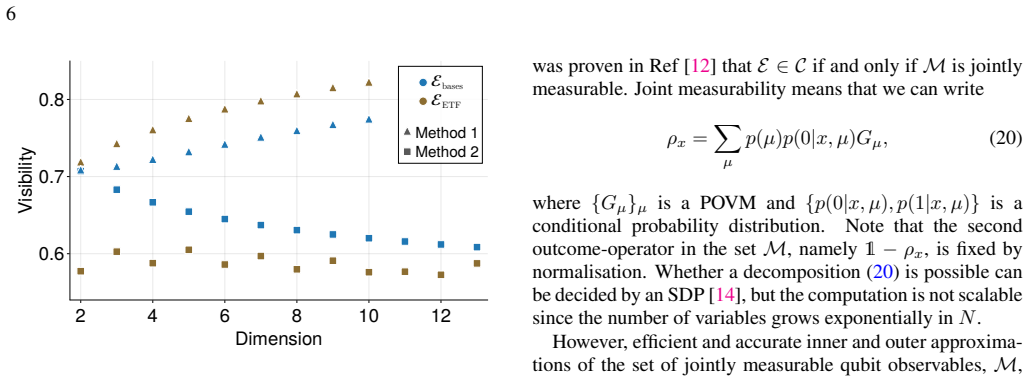
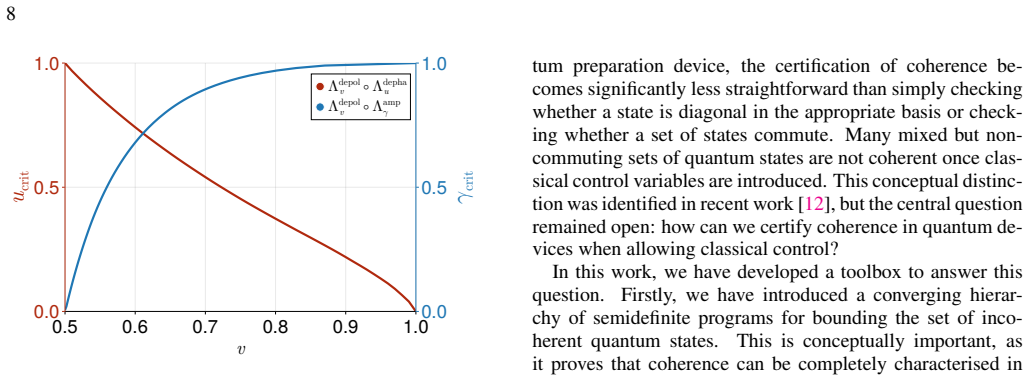
We prove that coherence can be fully characterised through a hierarchy of semidefinite programs. We introduce a practical semidefinite programming approach that achieves useful accuracy while remaining computationally efficient even for preparation devices generating many, potentially high-dimensional, quantum states. For the important special case of qubits, we further exploit conceptual connections with the theory of joint measurability to obtain highly accurate coherence characterisation that scales to more than one thousand qubits. Finally, we apply these methods to determine whether quantum channels are able to preserve coherence or are inherently coherence-breaking.
What carries the argument
Hierarchy of semidefinite programs that characterises coherence under the model of hidden classical control on the preparation device.
If this is right
- Coherence certification becomes possible in experiments where the preparation device is subject to inaccessible classical parameters.
- Computationally tractable programs suffice for accurate certification when many states are generated.
- For qubit systems the method scales to more than one thousand states while retaining high accuracy.
- Quantum channels can be classified as coherence-preserving or coherence-breaking using the same programs.
Where Pith is reading between the lines
- The same hierarchy structure could be examined for certifying other quantum resources such as entanglement when similar control limitations apply.
- Protocol designers might incorporate these certification tests to verify superposition under realistic device constraints.
- Numerical checks on small known coherent states could confirm convergence of the hierarchy in practice.
Load-bearing premise
The model of hidden classical control correctly describes the experimental scenario in which the experimenter lacks access to some classical parameters that affect state preparation.
What would settle it
A concrete set of quantum states prepared under a known hidden classical control for which the SDP hierarchy returns a value strictly different from the true coherence measure computed by other means would falsify the claim of full characterisation.
Figures

read the original abstract
Quantum states that do not commute exhibit coherence, but only when the device preparing them is assumed to be unaffected by classical parameters inaccessible to the experimenter. Such hidden classical control arises both in fundamental tests of quantum phenomena and in quantum information protocols that operate under limited control assumptions. Here, we address the problem of coherence certification by developing complete and practically efficient methods. First, we prove that coherence can be fully characterised through a hierarchy of semidefinite programs. Second, we introduce a practical semidefinite programming approach that achieves useful accuracy while remaining computationally efficient even for preparation devices generating many, potentially high-dimensional, quantum states. For the important special case of qubits, we further exploit conceptual connections with the theory of joint measurability to obtain highly accurate coherence characterisation that scales to more than one thousand qubits. Finally, we apply these methods to determine whether quantum channels are able to preserve coherence or are inherently coherence-breaking. Together, these results provide a powerful toolbox for analysing quantum superposition in the presence of hidden classical control.
Editorial analysis
A structured set of objections, weighed in public.
Referee Report
Summary. The paper claims to fully characterize quantum coherence in preparation devices subject to hidden classical control (inaccessible classical parameters) via a complete hierarchy of semidefinite programs, supplemented by a practical SDP method for efficiency with many/high-dimensional states, an exact joint-measurability method for qubits that scales beyond 1000 qubits, and an application determining whether quantum channels preserve or break coherence.
Significance. If the central claims hold, the work supplies a complete, computationally tractable toolbox for coherence certification under realistic limited-control assumptions relevant to both foundational tests and quantum information protocols. The SDP hierarchy provides a parameter-free complete characterization, the qubit reduction offers an exact scalable alternative, and the channel application extends the framework; these are concrete strengths for the field.
minor comments (3)
- The abstract states that the practical SDP 'achieves useful accuracy' but does not quantify the accuracy metric or the number/dimensions of states used in the reported examples; adding a brief numerical summary would improve clarity without altering the central claims.
- Section introducing the hidden-classical-control model would benefit from an explicit early definition of the inaccessible parameter set (e.g., a short paragraph or equation) to aid readers unfamiliar with the modeling choice.
- In the qubit joint-measurability reduction, the scaling claim to 'more than one thousand qubits' should be accompanied by a brief statement of the computational resources or time required for the largest case to substantiate practicality.
Simulated Author's Rebuttal
We thank the referee for their positive assessment of the manuscript, accurate summary of our contributions, and recommendation of minor revision. No specific major comments were provided in the report.
Circularity Check
No significant circularity
full rationale
The paper's central claim is a mathematical proof that coherence under hidden classical control is fully characterized by an SDP hierarchy, derived from standard semidefinite programming and joint-measurability theory. No equations or steps in the provided abstract reduce any prediction or result to a fitted parameter, self-definition, or self-citation chain; the modeling assumptions are explicitly declared upfront rather than smuggled in. The qubit reduction and channel analysis are presented as derived methods, not renamings or ansatzes justified only by prior author work. The derivation chain is self-contained against external benchmarks of SDP completeness and joint measurability, with no load-bearing self-referential steps.
Axiom & Free-Parameter Ledger
Forward citations
Cited by 1 Pith paper
-
Semidefinite-programming hierarchies for classically simulable state families
A complete SDP hierarchy is constructed for classically simulable state families by reformulating the problem as feasibility over deterministic response functions and rank-one projective POVMs.
Reference graph
Works this paper leans on
-
[1]
To this end, we have considered a polyhedron whoseN= 1012vertices define the states of the set for which we want to test coherence
We can verify this up to high accuracy with the linear programming relaxations. To this end, we have considered a polyhedron whoseN= 1012vertices define the states of the set for which we want to test coherence. The re- laxations are based on a second polyhedron with 220 vertices, used as inner approximation of the Bloch sphere, from which we obtain upper...
2023
-
[2]
Baumgratz, M
T. Baumgratz, M. Cramer, and M. B. Plenio, Quantifying co- herence, Phys. Rev. Lett.113, 140401 (2014)
2014
-
[3]
Streltsov, G
A. Streltsov, G. Adesso, and M. B. Plenio, Colloquium: Quan- tum coherence as a resource, Rev. Mod. Phys.89, 041003 (2017)
2017
-
[4]
Designolle, R
S. Designolle, R. Uola, K. Luoma, and N. Brunner, Set coher- ence: Basis-independent quantification of quantum coherence, Phys. Rev. Lett.126, 220404 (2021)
2021
-
[5]
Brunner, D
N. Brunner, D. Cavalcanti, S. Pironio, V . Scarani, and S. Wehner, Bell nonlocality, Rev. Mod. Phys.86, 419 (2014)
2014
-
[6]
R. Uola, A. C. S. Costa, H. C. Nguyen, and O. Gühne, Quantum steering, Rev. Mod. Phys.92, 015001 (2020)
2020
-
[7]
J. B. Brask, N. Brunner, J. Pauwels, D. Rusca, and A. Tavakoli, Quantum correlations in prepare-and-measure sce- narios and their semi-device-independent applications (2026), arXiv:2603.23604 [quant-ph]
arXiv 2026
-
[8]
Buhrman, R
H. Buhrman, R. Cleve, S. Massar, and R. de Wolf, Nonlocal- ity and communication complexity, Rev. Mod. Phys.82, 665 (2010)
2010
-
[9]
Pironio, M
S. Pironio, M. Navascués, and A. Acín, Convergent relaxations of polynomial optimization problems with noncommuting vari- ables, SIAM Journal on Optimization20, 2157–2180 (2010)
2010
-
[10]
L. K. Shalm, Y . Zhang, J. C. Bienfang, C. Schlager, M. J. Stevens, M. D. Mazurek, C. Abellán, W. Amaya, M. W. Mitchell, M. A. Alhejji, H. Fu, J. Ornstein, R. P. Mirin, S. W. Nam, and E. Knill, Device-independent randomness expansion with entangled photons, Nature Physics17, 452 (2021)
2021
-
[11]
Bowles, M
J. Bowles, M. T. Quintino, and N. Brunner, Certifying the di- mension of classical and quantum systems in a prepare-and- measure scenario with independent devices, Phys. Rev. Lett. 112, 140407 (2014)
2014
-
[12]
J. I. de Vicente, Shared randomness and device-independent di- mension witnessing, Phys. Rev. A95, 012340 (2017)
2017
-
[13]
Cobucci, A
G. Cobucci, A. Bernal, M. J. Renner, and A. Tavakoli, Opera- tionally classical simulation of quantum states, Nature Commu- nications17, 1104 (2026)
2026
-
[14]
Tavakoli, A
A. Tavakoli, A. Pozas-Kerstjens, P. Brown, and M. Araújo, Semidefinite programming relaxations for quantum correla- tions, Rev. Mod. Phys.96, 045006 (2024)
2024
-
[15]
Gühne, E
O. Gühne, E. Haapasalo, T. Kraft, J.-P. Pellonpää, and R. Uola, Colloquium: Incompatible measurements in quantum informa- tion science, Rev. Mod. Phys.95, 011003 (2023)
2023
-
[16]
M. F. Pusey,Is quantum steering spooky?, Ph.D. thesis, Impe- rial College London (2013)
2013
-
[17]
N. D’Alessandro, C. R. i Carceller, and A. Tavakoli, Semidef- inite block-matrix relaxations for computing quantum correla- tions (2026), arXiv:2603.19388 [quant-ph]
arXiv 2026
-
[18]
Pironio, A
S. Pironio, A. Acín, S. Massar, A. B. de la Giroday, D. N. Mat- sukevich, P. Maunz, S. Olmschenk, D. Hayes, L. Luo, T. A. Manning, and C. Monroe, Random numbers certified by bell’s theorem, Nature464, 1021 (2010)
2010
-
[19]
Brunner, M
N. Brunner, M. Navascués, and T. Vértesi, Dimension witnesses and quantum state discrimination, Phys. Rev. Lett.110, 150501 (2013)
2013
-
[20]
Tavakoli, D
A. Tavakoli, D. Rosset, and M.-O. Renou, Enabling computa- tion of correlation bounds for finite-dimensional quantum sys- tems via symmetrization, Phys. Rev. Lett.122, 070501 (2019)
2019
-
[21]
J. M. Renes, R. Blume-Kohout, A. J. Scott, and C. M. Caves, Symmetric informationally complete quantum measurements, Journal of Mathematical Physics45, 2171–2180 (2004)
2004
-
[23]
L. E. A. Porto, S. Designolle, S. Pokutta, and M. T. Quintino, Measurement incompatibility and quantum steering via linear programming (2025), arXiv:2506.03045 [quant-ph]
Pith/arXiv arXiv 2025
-
[24]
M. T. Quintino, T. Vértesi, and N. Brunner, Joint measura- bility, einstein-podolsky-rosen steering, and bell nonlocality, Phys. Rev. Lett.113, 160402 (2014)
2014
-
[25]
R. Uola, T. Moroder, and O. Gühne, Joint measurability of generalized measurements implies classicality, Phys. Rev. Lett. 113, 160403 (2014)
2014
-
[26]
H. M. Wiseman, S. J. Jones, and A. C. Doherty, Steering, entan- glement, nonlocality, and the einstein-podolsky-rosen paradox, Phys. Rev. Lett.98, 140402 (2007)
2007
-
[27]
Y .-C. Liu, J. Halbey, S. Pokutta, and S. Designolle, A uni- fied toolbox for multipartite entanglement certification (2025), arXiv:2507.17435 [quant-ph]
arXiv 2025
-
[28]
https://github.com/nicoljno/coherencecertification
-
[29]
Choi, Completely positive linear maps on complex ma- trices, Linear Algebra and its Applications10, 285 (1975)
M.-D. Choi, Completely positive linear maps on complex ma- trices, Linear Algebra and its Applications10, 285 (1975)
1975
-
[30]
Jamiołkowski, Linear transformations which preserve trace and positive semidefiniteness of operators, Reports on Mathe- matical Physics3, 275 (1972)
A. Jamiołkowski, Linear transformations which preserve trace and positive semidefiniteness of operators, Reports on Mathe- matical Physics3, 275 (1972)
1972
-
[31]
com/Nicoljno/CoherenceCertification
Coherence certification codes (2026),https://github. com/Nicoljno/CoherenceCertification
2026
-
[32]
S. Chessa and V . Giovannetti, Quantum capacity analysis of multi-level amplitude damping channels, Communications Physics4, 10.1038/s42005-021-00524-4 (2021)
-
[33]
Horodecki and P
M. Horodecki and P. Horodecki, Reduction criterion of separa- bility and limits for a class of distillation protocols, Phys. Rev. A59, 4206 (1999)
1999
-
[34]
Skrzypczyk and D
P. Skrzypczyk and D. Cavalcanti,Semidefinite Programming in Quantum Information Science(IOP Publishing, 2023)
2023
-
[35]
J. W. Iverson, J. Jasper, and D. G. Mixon, More on the opti- mal arrangement of2dlines inC d (2024), arXiv:2410.17379 [math.MG]
arXiv 2024
-
[36]
J. M. Renes, Equiangular tight frames from paley tournaments, Linear Algebra and its Applications426, 497 (2007). Appendix A: Complete hierarchy for coherent sets We give a detailed outlined of the SDP relaxation hierarchy discussed in section III A and prove that it converges to the incoherent setC. The conceptual idea behind the hierarchy is the followi...
2007
-
[37]
We denote the corresponding solution of levelmby{ ˜Ox1...xm}N+1 x1...xm=1
There exists a complete hierarchy to decide the existence of a decomposition (A8) for a given POVM. We denote the corresponding solution of levelmby{ ˜Ox1...xm}N+1 x1...xm=1
-
[38]
From the solution of the POVM hierarchy, we can extract a decomposition ofE
-
[39]
Together, the three results imply the claim, as existence of theO x1...xm for allmimply via 3
From a solution{O x1...xm }N x1...xm=1 of them’th level of the hierarchy in Eq (A6), we can construct a solution { ˜Ox1...xm }N+1 x1...xm=1 for them’th level of the POVM hierarchy. Together, the three results imply the claim, as existence of theO x1...xm for allmimply via 3. the existence of corresponding ˜Ox1...xm, which implies via 1. the existence of a...
-
[40]
, ψn]to be the matrix whosei-th column isψ i Definition 1.The set{ψ i}n i=1 ⊂C d is called ad×nequiangular tight frame(ETF) if it is both tight and equiangular
Definitions and notation Let{ψ i}n i=1 be pure states in ad-dimensional Hilbert space and considerΨ = [ψ 1, . . . , ψn]to be the matrix whosei-th column isψ i Definition 1.The set{ψ i}n i=1 ⊂C d is called ad×nequiangular tight frame(ETF) if it is both tight and equiangular. Tightness means thatΨΨ ∗ = n d 1d, while equiangularity means that there exists a ...
-
[41]
It follows fromDefinition 3that any symmetric conference matrix has eigenvalues in± √n−1
Paley equiangular tight frames The first family of ETFs is constructed from conference matrices. It follows fromDefinition 3that any symmetric conference matrix has eigenvalues in± √n−1. Sincetr(C sym) = 0, each eigenvalue has multiplicity n 2 . Hence,1 n + 1√n−1 Csym is the Gramm matrix of a real n 2 ×nETF. By a similar argument1+ i√n−1 Cskew is the Gram...
-
[42]
To obtain ETFs of size2din these remaining dimensions, we use the doubling construction described in [34]
ETF through doubling The previous example covers all cases in the main text except ford= 8andd= 11. To obtain ETFs of size2din these remaining dimensions, we use the doubling construction described in [34]. More precisely, we consider that ifSis the signature matrix of ad×nETF withn= 2d+kandk∈ {−1,0,1}it is possible to takec= (n−2d) q n−1 d(n−d) andβ=−c+ε...
discussion (0)
Sign in with ORCID, Apple, or X to comment. Anyone can read and Pith papers without signing in.