REVIEW 2 major objections 2 minor 44 references
AmbientEye: A Dataset for Pupil Segmentation under Natural Ambient Infrared Illumination
T0 review · 2 major / 2 minor · reviewed 2026-06-28 · grok-4.3
Pith's one-line read Pupil segmentation accuracy drops from 0.928 to 0.767 when moving from controlled active IR to natural ambient sunlight alone.
desk verdict AmbientEye is a solid dataset release for ambient IR pupil segmentation with real practical value, but the annotation quality lacks the checks needed to fully trust the reported performance drop. read the letter →
The pith
A machine-rendered reading of the paper's core claim, the machinery that carries it, and where it could break.
The reading
What carries the argument
The AmbientEye dataset of 2,606,225 eye images captured outdoors under passive natural sunlight with off-axis IR cameras and SAM2-plus-human annotations.
What would settle it
Re-annotating a random subset of AmbientEye images with an entirely independent annotation protocol and then re-running the same segmentation algorithm to check whether the 0.767 score changes by more than a few points.
Extended reading notes
Core claim
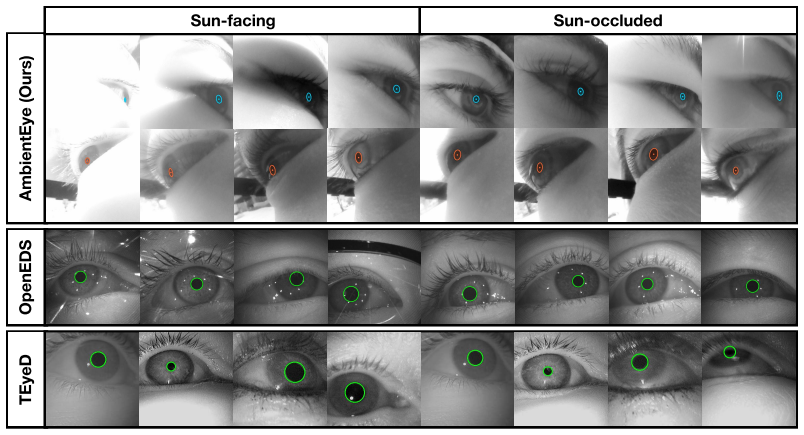
AmbientEye supplies the first large-scale benchmark for pupil segmentation under natural ambient infrared illumination from sunlight alone. Images were gathered outdoors from a diverse participant pool using two camera configurations and two sun positions. Annotations combine SAM2 output with human refinement. When a state-of-the-art pupil segmentation algorithm is evaluated on AmbientEye, its score falls from 0.928 on prior controlled-IR collections to 0.767, establishing the dataset as a reference point for this unconstrained outdoor scenario.
Load-bearing premise
The combination of SAM2 automatic segmentation followed by human annotator refinement produces annotations of sufficient quality and consistency to serve as a reliable benchmark standard for the new ambient illumination domain.
Editorial extensions
If this is right
- Existing pupil segmentation methods developed for controlled active-IR settings do not transfer directly to outdoor ambient conditions.
- Reliable pupil detection for all-day outdoor use will require algorithms explicitly designed for variable natural sunlight.
- AmbientEye provides the first public reference for measuring progress on passive-IR eye tracking.
- Power savings from removing active IR illuminators remain out of reach until segmentation robustness improves.
Reading between the lines
- Smart-glasses battery life could increase if methods close the performance gap, because active IR sources consume significant power.
- Outdoor augmented-reality applications that rely on gaze may need hybrid active-plus-passive systems until ambient-only solutions mature.
- The dataset's scale and participant diversity suggest it can also support training new models that generalize across skin tones and lighting angles.
Editorial analysis
A structured set of objections, weighed in public.
Referee Report
Summary. The manuscript introduces AmbientEye, a dataset of 2,606,225 eye images captured outdoors from 35 participants across 19 countries under natural sunlight (two off-axis camera setups and two sun-orientation conditions). Pupil annotations are produced via SAM2 automatic segmentation followed by human refinement. A state-of-the-art pupil segmentation algorithm is benchmarked, yielding 0.767 performance on AmbientEye versus 0.928 on prior controlled-IR datasets; the gap is presented as evidence that ambient illumination constitutes a distinct practical challenge for eye tracking.
Significance. If the ground-truth annotations are shown to be reliable and consistent, the work supplies the first large-scale benchmark for passive-IR pupil segmentation in unconstrained outdoor settings. This directly addresses power-consumption barriers for all-day smart-glasses eye tracking and supplies a falsifiable testbed for future algorithms under variable sunlight and reflections.
major comments (2)
- [§3 (Dataset Creation / Annotation)] §3 (Dataset Creation / Annotation): The central empirical claim rests on the 0.767 figure being a valid measure of algorithmic difficulty rather than annotation noise. The description states only that annotations result from 'SAM2 automatic segmentation, followed by refinement by human annotators' with no inter-annotator agreement statistics, expert validation against ophthalmologists, or quantitative analysis of residual SAM2 errors under off-axis sunlight and corneal reflections. This omission directly affects whether the reported performance gap can be interpreted as domain difficulty.
- [§4 (Benchmarking and Results)] §4 (Benchmarking and Results): The comparison to the 0.928 controlled-IR baseline is load-bearing for the 'distinct challenge' conclusion, yet no statistical test of the gap, participant-level variance, or exclusion-criteria justification is supplied. Without these, the headline drop cannot be assessed for robustness.
minor comments (2)
- [Abstract] Abstract: The phrase 'high-quality pupil annotation' is used without supporting metrics; this should be qualified or moved to the methods section.
- [Tables/Figures] Table/Figure captions: Ensure all reported metrics (e.g., IoU or Dice) are explicitly defined and that the exact evaluation protocol on prior datasets is stated for reproducibility.
Simulated Author's Rebuttal
We thank the referee for their constructive comments. We address each major comment below and indicate the revisions that will be incorporated into the next manuscript version.
read point-by-point responses
-
Referee: [§3 (Dataset Creation / Annotation)] §3 (Dataset Creation / Annotation): The central empirical claim rests on the 0.767 figure being a valid measure of algorithmic difficulty rather than annotation noise. The description states only that annotations result from 'SAM2 automatic segmentation, followed by refinement by human annotators' with no inter-annotator agreement statistics, expert validation against ophthalmologists, or quantitative analysis of residual SAM2 errors under off-axis sunlight and corneal reflections. This omission directly affects whether the reported performance gap can be interpreted as domain difficulty.
Authors: We agree that quantitative validation of the annotations is important for interpreting the performance numbers. In the revised manuscript we will add (i) inter-annotator agreement (mean Dice score) computed on a random subset of 10 000 images that were independently refined by two human annotators and (ii) a breakdown of the fraction of images in which the SAM2 initialization was substantially edited by humans, stratified by sun-orientation condition. We will not add ophthalmologist validation because the annotations concern geometric pupil boundaries in infrared imagery rather than clinical diagnosis; we will explicitly state this scope limitation. These additions directly address the concern about annotation noise versus domain difficulty. revision: partial
-
Referee: [§4 (Benchmarking and Results)] §4 (Benchmarking and Results): The comparison to the 0.928 controlled-IR baseline is load-bearing for the 'distinct challenge' conclusion, yet no statistical test of the gap, participant-level variance, or exclusion-criteria justification is supplied. Without these, the headline drop cannot be assessed for robustness.
Authors: We concur that additional statistical reporting is needed. The revised manuscript will include (i) a Wilcoxon signed-rank test comparing per-image IoU on AmbientEye versus the controlled-IR datasets, (ii) participant-level mean IoU and standard deviation across the 35 subjects to quantify variance, and (iii) an explicit description of the exclusion criteria (images removed for severe motion blur, extreme head pose, or hardware failure) together with the number of frames excluded per condition. These changes will allow readers to evaluate the robustness of the reported performance gap. revision: yes
Circularity Check
No circularity: empirical dataset release with external benchmarks
full rationale
The paper introduces AmbientEye as a new dataset and reports benchmark results on pupil segmentation. No derivations, equations, fitted parameters, or predictions are present in the provided text. The performance comparison (0.928 on controlled IR vs. 0.767 on AmbientEye) is a direct empirical measurement against external datasets, with no self-referential reduction or load-bearing self-citation. Annotation process is described but does not involve any claimed derivation chain. This is a standard dataset paper with no internal circularity.
Assumptions & free parameters
Cite this review
Pith. "Pith review of AmbientEye: A Dataset for Pupil Segmentation under Natural Ambient Infrared Illumination." pith.science (2026). https://pith.science/paper/3BTBGMSK
@misc{pith2026260603774,
  author       = {Pith},
  title        = {Pith review of: AmbientEye: A Dataset for Pupil Segmentation under Natural Ambient Infrared Illumination},
  year         = {2026},
  howpublished = {\url{https://pith.science/paper/3BTBGMSK}},
  note         = {Machine review of arXiv:2606.03774}
}
read the original abstract
Eye tracking is essential for smart glasses, as it provides insight into user attention for ambient intelligence applications. However, most existing eye-tracking systems rely on active infrared (IR) illumination, creating practical barriers to all-day outdoor use due to power consumption. In this paper, we investigate whether passive IR cameras alone, without any active IR light source, can enable reliable pupil detection in unconstrained outdoor environments, where ambient sunlight serves as the sole illumination source. To support this investigation, we introduce AmbientEye, a large-scale dataset of 2,606,225 eye images collected from 35 participants from 19 countries. It is captured outdoors under natural sunlight with two off-axis camera configurations and two sun-orientation conditions. We provide high-quality pupil annotation through SAM2 automatic segmentation, followed by refinement by human annotators. We benchmark a state-of-the-art pupil segmentation algorithm on our dataset and compare its performance with that on existing datasets under controlled IR illumination. Results reveal a substantial drop in pupil segmentation performance from 0.928 on controlled IR datasets to 0.767 on AmbientEye. This performance gap highlights the challenge of the ambient-light setting. This positions AmbientEye as a first benchmark for an unexplored and highly practical eye-tracking scenario.
Figures


Figures from the paper (5 more)


Reference graph
Works this paper leans on
-
[1]
Ego4d: Around the world in 3,000 hours of egocentric video
Kristen Grauman, Andrew Westbury, Eugene Byrne, Zachary Chavis, Antonino Furnari, Rohit Girdhar, Jackson Hamburger, Hao Jiang, Miao Liu, Xingyu Liu, et al. Ego4d: Around the world in 3,000 hours of egocentric video. InProceedings of the IEEE/CVF conference on computer vision and pattern recognition, pages 18995–19012, 2022
2022
-
[2]
Springer Science & Business Media, 2006
Emile HL Aarts and José Luis Encarnação.True visions: The emergence of ambient intelligence. Springer Science & Business Media, 2006
2006
-
[3]
Advantages of eye-gaze over head-gaze- based selection in virtual and augmented reality under varying field of views
Jonas Blattgerste, Patrick Renner, and Thies Pfeiffer. Advantages of eye-gaze over head-gaze- based selection in virtual and augmented reality under varying field of views. InProceedings of the workshop on communication by gaze interaction, pages 1–9, 2018
2018
-
[4]
The eye in extended reality: A survey on gaze interaction and eye tracking in head-worn extended reality.ACM Computing Surveys (CSUR), 55(3):1–39, 2022
Alexander Plopski, Teresa Hirzle, Nahal Norouzi, Long Qian, Gerd Bruder, and Tobias Langlotz. The eye in extended reality: A survey on gaze interaction and eye tracking in head-worn extended reality.ACM Computing Surveys (CSUR), 55(3):1–39, 2022. 9
2022
-
[5]
Strategies for enhancing automatic fixation detection in head-mounted eye tracking.Behavior Research Methods, 56(6):6276–6298, 2024
Michael Drews and Kai Dierkes. Strategies for enhancing automatic fixation detection in head-mounted eye tracking.Behavior Research Methods, 56(6):6276–6298, 2024
2024
-
[6]
A dual mobile eye tracking study on natural eye contact during live interactions.Scientific Reports, 13(1):11385, 2023
Florence Mayrand, Francesca Capozzi, and Jelena Ristic. A dual mobile eye tracking study on natural eye contact during live interactions.Scientific Reports, 13(1):11385, 2023
2023
-
[7]
Robert Konrad, Nitish Padmanaban, J Gabriel Buckmaster, Kevin C Boyle, and Gordon Wet- zstein. Gazegpt: Augmenting human capabilities using gaze-contingent contextual ai for smart eyewear.arXiv preprint arXiv:2401.17217, 2024
-
[8]
Rethinking Eye-blink: Assessing Task Difficulty through Physiological Rep- resentation of Spontaneous Blinking
Youngjun Cho. Rethinking Eye-blink: Assessing Task Difficulty through Physiological Rep- resentation of Spontaneous Blinking. InProceedings of the 2021 CHI Conference on Human Factors in Computing Systems, CHI ’21, pages 1–12. Association for Computing Machinery, 2021
2021
Show all 44 references
-
[9]
Tobii glasses x
Tobii Inc. Tobii glasses x. https://www.tobii.com/products/eye-trackers/wearables/tobii-glasses- x, 2025
2025
-
[10]
Pupil neon
Pupil Labs Inc. Pupil neon. https://pupil-labs.com/products/neon, 2023
2023
-
[11]
Aria gen 2 pilot dataset.arXiv preprint arXiv:2510.16134, 2025
Chen Kong, James Fort, Aria Kang, Jonathan Wittmer, Simon Green, Tianwei Shen, Yipu Zhao, Cheng Peng, Gustavo Solaira, Andrew Berkovich, et al. Aria gen 2 pilot dataset.arXiv preprint arXiv:2510.16134, 2025
2025
-
[12]
Pure: Robust pupil detection for real-time pervasive eye tracking.Computer Vision and Image Understanding, 170:40–50, 2018
Thiago Santini, Wolfgang Fuhl, and Enkelejda Kasneci. Pure: Robust pupil detection for real-time pervasive eye tracking.Computer Vision and Image Understanding, 170:40–50, 2018
2018
-
[13]
Pupil detection for head-mounted eye tracking in the wild: an evaluation of the state of the art.Machine Vision and Applications, 27(8):1275–1288, 2016
Wolfgang Fuhl, Marc Tonsen, Andreas Bulling, and Enkelejda Kasneci. Pupil detection for head-mounted eye tracking in the wild: an evaluation of the state of the art.Machine Vision and Applications, 27(8):1275–1288, 2016
2016
-
[14]
Purest: Robust pupil tracking for real-time pervasive eye tracking
Thiago Santini, Wolfgang Fuhl, and Enkelejda Kasneci. Purest: Robust pupil tracking for real-time pervasive eye tracking. InProceedings of the 2018 ACM symposium on eye tracking research & applications, pages 1–5, 2018
2018
-
[15]
Enhancing mobile eye-tracking in extreme urban lighting con- ditions.Bulletin of the Polish Academy of Sciences Technical Sciences, pages e152709–e152709, 2025
Marta Rusnak, Zofia Koszewicz, Franciszek Hackemer, Izabela Garaszczuk, Andrew T Duchowski, and Rafał Karnicki. Enhancing mobile eye-tracking in extreme urban lighting con- ditions.Bulletin of the Polish Academy of Sciences Technical Sciences, pages e152709–e152709, 2025
2025
-
[16]
Energy-aware benchmarking of wearable eye trackers
Marco Carminati, Filippo Melloni, Giulio Marano, Alberto Pettenella, Daniele Bani, Daniele Maria Crafa, Andrea Aspesi, Andrew Duchowski, Tommaso Ongarello, and Luca Merigo. Energy-aware benchmarking of wearable eye trackers. InProceedings of the 2025 Symposium on Eye Tracking ...
2025
-
[17]
Sfh 4050
OSRAM. Sfh 4050. https://look.ams-osram.com/m/282343c3fb0dbd0c/original/SFH-4050.pdf
-
[18]
Omni Vision. Ov6211. https://www.ovt.com/products/ov6211/
-
[19]
It starts with iGaze: Visual attention driven networking with smart glasses
Lan Zhang, Xiang-Yang Li, Wenchao Huang, Kebin Liu, Shuwei Zong, Xuesi Jian, Puchun Feng, Taeho Jung, and Yunhao Liu. It starts with iGaze: Visual attention driven networking with smart glasses. InProceedings of the 20th Annual International Conference on Mobile Computing and ...
2014
-
[20]
iShadow: Design of a wearable, real-time mobile gaze tracker
Addison Mayberry, Pan Hu, Benjamin Marlin, Christopher Salthouse, and Deepak Ganesan. iShadow: Design of a wearable, real-time mobile gaze tracker. InProceedings of the 12th Annual International Conference on Mobile Systems, Applications, and Services, pages 82–94, Bretton Woo...
2014
-
[21]
Marlin, and Christopher Salthouse
Addison Mayberry, Yamin Tun, Pan Hu, Duncan Smith-Freedman, Deepak Ganesan, Ben- jamin M. Marlin, and Christopher Salthouse. CIDER: Enabling Robustness-Power Tradeoffs on a Computational Eyeglass. InProceedings of the 21st Annual International Conference on Mobile Computing an...
2015
-
[22]
Battery-Free Eye Tracker on Glasses
Tianxing Li and Xia Zhou. Battery-Free Eye Tracker on Glasses. InProceedings of the 24th Annual International Conference on Mobile Computing and Networking, pages 67–82, New Delhi India, October 2018. ACM
2018
-
[23]
Marc Tonsen, Julian Steil, Yusuke Sugano, and Andreas Bulling. InvisibleEye: Mobile Eye Tracking Using Multiple Low-Resolution Cameras and Learning-Based Gaze Estimation.Pro- ceedings of the ACM on Interactive, Mobile, Wearable and Ubiquitous Technologies, 1(3):1–21, September 2017
2017
-
[24]
GazeTrak: Exploring Acoustic-based Eye Tracking on a Glass Frame
Ke Li, Ruidong Zhang, Boao Chen, Siyuan Chen, Sicheng Yin, Saif Mahmud, Qikang Liang, Francois Guimbretiere, and Cheng Zhang. GazeTrak: Exploring Acoustic-based Eye Tracking on a Glass Frame. InProceedings of the 30th Annual International Conference on Mobile Computing and Net...
2024
-
[25]
Wearable EOG goggles: Eye-based interaction in everyday environments
Andreas Bulling, Daniel Roggen, and Gerhard Tröster. Wearable EOG goggles: Eye-based interaction in everyday environments. InCHI ’09 Extended Abstracts on Human Factors in Computing Systems, CHI EA ’09, pages 3259–3264. Association for Computing Machinery, 2009
2009
-
[26]
Sam 2: Segment anything in images and videos.arXiv preprint arXiv:2408.00714, 2024
Nikhila Ravi, Valentin Gabeur, Yuan-Ting Hu, Ronghang Hu, Chaitanya Ryali, Tengyu Ma, Haitham Khedr, Roman Rädle, Chloe Rolland, Laura Gustafson, et al. Sam 2: Segment anything in images and videos.arXiv preprint arXiv:2408.00714, 2024
2024 arXiv
-
[27]
Robust real-time pupil tracking in highly off-axis images
Lech ´Swirski, Andreas Bulling, and Neil Dodgson. Robust real-time pupil tracking in highly off-axis images. InProceedings of the Symposium on Eye Tracking Research and Applications (ETRA), pages 173–176. ACM, 2012
2012
-
[28]
ExCuSe: Robust pupil detection in real-world scenarios
Wolfgang Fuhl, Thomas Kübler, Katrin Sippel, Wolfgang Rosenstiel, and Enkelejda Kasneci. ExCuSe: Robust pupil detection in real-world scenarios. InProceedings of the International Conference on Computer Analysis of Images and Patterns (CAIP), pages 39–51. Springer, 2015
2015
-
[29]
Santini, Thomas Kübler, and Enkelejda Kasneci
Wolfgang Fuhl, Thiago C. Santini, Thomas Kübler, and Enkelejda Kasneci. ElSe: Ellipse selection for robust pupil detection in real-world environments. InProceedings of the Symposium on Eye Tracking Research and Applications (ETRA), pages 123–130. ACM, 2016
2016
-
[30]
Labelled pupils in the wild: A dataset for studying pupil detection in unconstrained environments
Marc Tonsen, Xucong Zhang, Yusuke Sugano, and Andreas Bulling. Labelled pupils in the wild: A dataset for studying pupil detection in unconstrained environments. InProceedings of the Symposium on Eye Tracking Research and Applications (ETRA), pages 139–142. ACM, 2016
2016
-
[31]
Nvgaze: An anatomically-informed dataset for low-latency, near-eye gaze estimation
Joohwan Kim, Michael Stengel, Alexander Majercik, Shalini De Mello, David Dunn, Samuli Laine, Morgan McGuire, and David Luebke. Nvgaze: An anatomically-informed dataset for low-latency, near-eye gaze estimation. InCHI, pages 1–12, 2019
2019
-
[32]
Garbin, Yiru Shen, Immo Schuetz, Robert Cavin, Gregory Hughes, and Sachin S
Stephan J. Garbin, Yiru Shen, Immo Schuetz, Robert Cavin, Gregory Hughes, and Sachin S. Talathi. OpenEDS: Open eye dataset.arXiv preprint arXiv:1905.03702, 2019
1905 arXiv
-
[33]
Magiceyes: A large scale eye gaze estimation dataset for mixed reality.arXiv preprint arXiv:2003.08806, 2020
Zhengyang Wu, Srivignesh Rajendran, Tarrence van As, Joelle Zimmermann, Vijay Badri- narayanan, and Andrew Rabinovich. Magiceyes: A large scale eye gaze estimation dataset for mixed reality.arXiv preprint arXiv:2003.08806, 2020
2003
-
[34]
TEyeD: Over 20 million real-world eye images with pupil, eyelid, and iris 2d and 3d segmentations, 2d and 3d landmarks, 3d eyeball, gaze vector, and eye movement types
Wolfgang Fuhl, Gjergji Kasneci, and Enkelejda Kasneci. TEyeD: Over 20 million real-world eye images with pupil, eyelid, and iris 2d and 3d segmentations, 2d and 3d landmarks, 3d eyeball, gaze vector, and eye movement types. In2021 IEEE International Symposium on Mixed and Augm...
2021
-
[35]
Pupilnet v2
Wolfgang Fuhl, Thiago Santini, Gjergji Kasneci, Wolfgang Rosenstiel, and Enkelejda Kasneci. Pupilnet v2. 0: Convolutional neural networks for cpu based real time robust pupil detection. arXiv preprint arXiv:1711.00112, 2017. 11
2017 arXiv
-
[36]
Deepvog: Open-source pupil segmentation and gaze estimation in neuroscience using deep learning.Journal of neuroscience methods, 324:108307, 2019
Yuk-Hoi Yiu, Moustafa Aboulatta, Theresa Raiser, Leoni Ophey, Virginia L Flanagin, Peter Zu Eulenburg, and Seyed-Ahmad Ahmadi. Deepvog: Open-source pupil segmentation and gaze estimation in neuroscience using deep learning.Journal of neuroscience methods, 324:108307, 2019
2019
-
[37]
Chaudhary, Rakshit Kothari, Manoj Acharya, Shusil Dangi, Nitinraj Nair, Reynold Bailey, Christopher Kanan, Gabriel Diaz, and Jeff B
Aayush K. Chaudhary, Rakshit Kothari, Manoj Acharya, Shusil Dangi, Nitinraj Nair, Reynold Bailey, Christopher Kanan, Gabriel Diaz, and Jeff B. Pelz. RITnet: Real-time semantic segmentation of the eye for gaze tracking. InProceedings of the IEEE/CVF International Conference on ...
2019
-
[38]
Kothari, Aayush K
Rakshit S. Kothari, Aayush K. Chaudhary, Reynold J. Bailey, Jeff B. Pelz, and Gabriel J. Diaz. EllSeg: An ellipse segmentation framework for robust gaze tracking.IEEE Transactions on Visualization and Computer Graphics, 27(5):2757–2767, 2021
2021
-
[39]
Robust real-time pupil tracking in highly off-axis images
Lech ´Swirski, Andreas Bulling, and Neil Dodgson. Robust real-time pupil tracking in highly off-axis images. InProceedings of the symposium on eye tracking research and applications, pages 173–176, 2012
2012
-
[40]
Project aria: A new tool for egocentric multi-modal ai research, 2023
Jakob Engel, Kiran Somasundaram, Michael Goesele, Albert Sun, Alexander Gamino, Andrew Turner, Arjang Talattof, Arnie Yuan, Bilal Souti, Brighid Meredith, Cheng Peng, Chris Sweeney, Cole Wilson, Dan Barnes, Daniel DeTone, David Caruso, Derek Valleroy, Dinesh Ginjupalli, Duncan...
2023
-
[41]
A high-level description and performance evaluation of pupil invisible.arXiv preprint arXiv:2009.00508, 2020
Marc Tonsen, Chris Kay Baumann, and Kai Dierkes. A high-level description and performance evaluation of pupil invisible.arXiv preprint arXiv:2009.00508, 2020
2009
-
[42]
Niehorster, Marco Carminati, and Enkelejda Kasneci
Virmarie Maquiling, Sean Anthony Byrne, Diederick C. Niehorster, Marco Carminati, and Enkelejda Kasneci. Zero-shot pupil segmentation with sam 2: A case study of over 14 million images.Proc. ACM Comput. Graph. Interact. Tech., 8(2), May 2025
2025
-
[43]
In the eye of the beholder: A survey of gaze tracking techniques.Pattern Recognition, 132:108944, 2022
Jiahui Liu, Jiannan Chi, Huijie Yang, and Xucheng Yin. In the eye of the beholder: A survey of gaze tracking techniques.Pattern Recognition, 132:108944, 2022
2022
-
[44]
Rit-eyes: Realistically rendered eye images for eye-tracking applications
Nitinraj Nair, Aayush Kumar Chaudhary, Rakshit Sunil Kothari, Gabriel Jacob Diaz, Jeff B Pelz, and Reynold Bailey. Rit-eyes: Realistically rendered eye images for eye-tracking applications. InACM Symposium on Eye Tracking Research and Applications, pages 1–3, 2020. 12
2020
Reviewed June 28, 2026 · model on record in the stance chip above.
Discussion (0). Continue with ORCID to comment.