SPLIT-PINN: Separable Probability Learning Technique via Physics-Informed Neural Networks for High-Dimensional Probabilistic Modeling
Pith reviewed 2026-06-30 12:53 UTC · model grok-4.3
The pith
A neural network infers an unknown drift field in a Liouville equation from data to predict how probability distributions of material states evolve in polycrystals.
A machine-rendered reading of the paper's core claim, the machinery that carries it, and where it could break.
Core claim
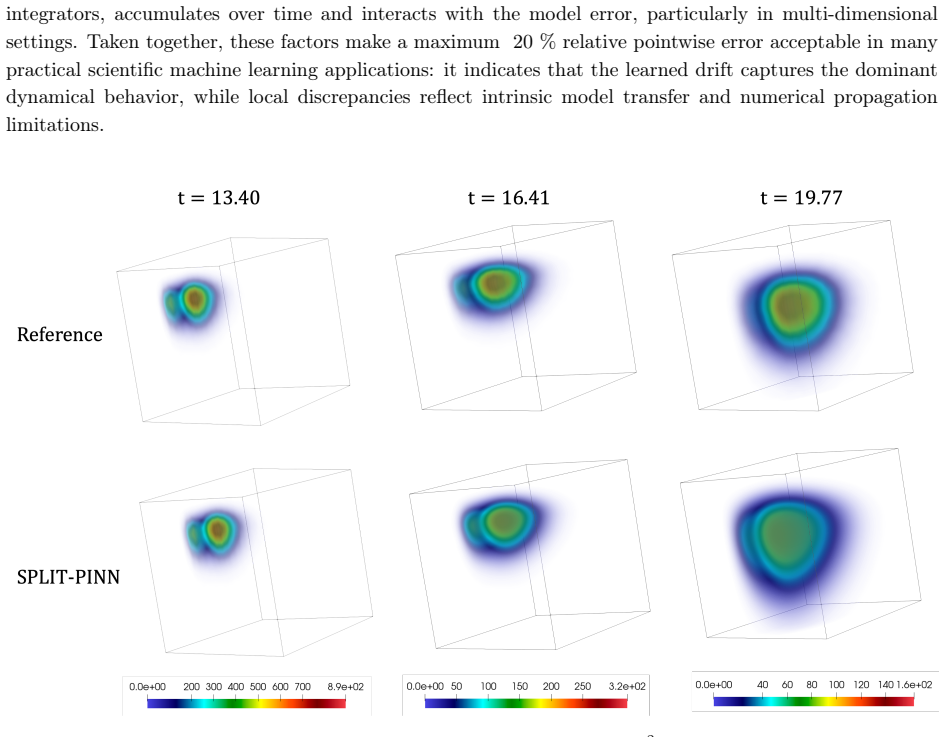
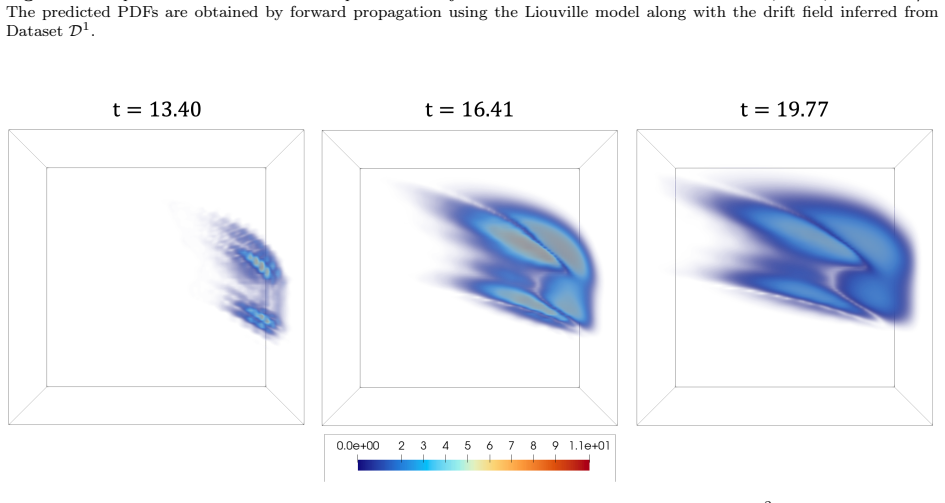
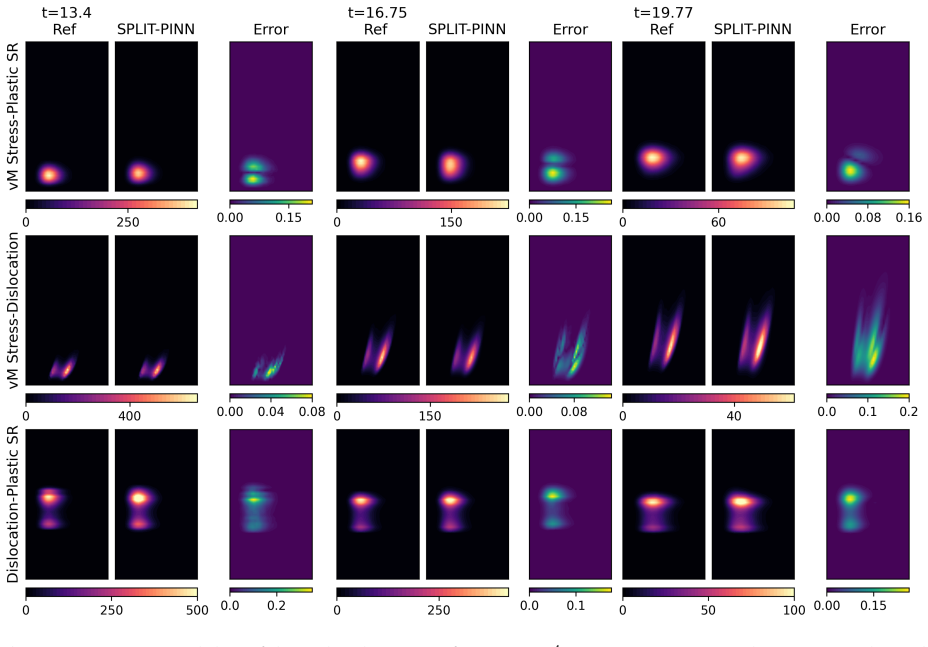
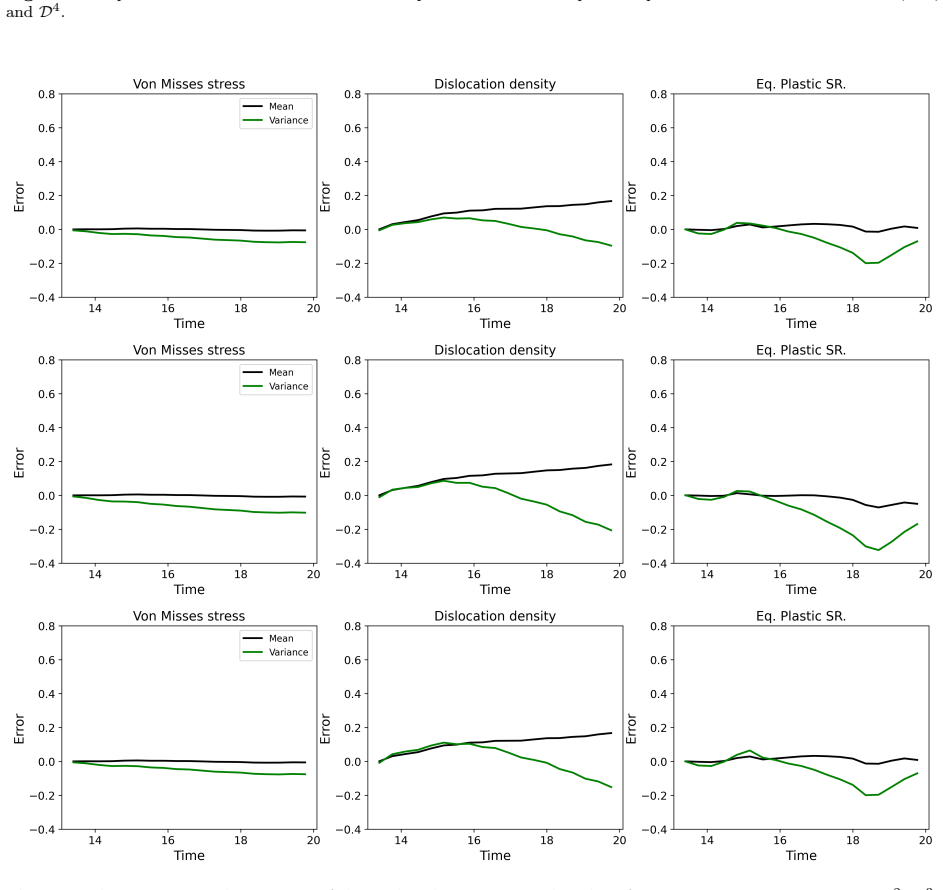
The learned Liouville model, trained on a single dataset, is subsequently used in forward predictions of the temporal evolution of joint and marginal PDFs for multiple unseen polycrystal realizations. Quantitative comparisons with reference PDFs demonstrate that the proposed framework yields accurate and robust probabilistic predictions and generalizes effectively across datasets.
What carries the argument
SPLIT-PINN, which recovers the drift term of a high-dimensional Liouville equation via marginal-correction drift decomposition, orthogonality constraints, and residual-based adaptive training inside a physics-informed neural network.
If this is right
- The inferred drift field produces accurate forward predictions of PDF evolution on polycrystal realizations never seen during training.
- Joint and marginal PDFs of von Mises stress, dislocation density, and plastic strain rate can be forecasted from a single training dataset.
- The framework supplies a statistical description of microstructural state variability that can be inserted into larger-scale material models.
- No restrictive parametric form for the drift is required; the neural network learns it directly from data while respecting the transport equation.
Where Pith is reading between the lines
- The same decomposition and training strategy could be tested on other high-dimensional conservation laws that lack closed-form drift expressions.
- If the learned drift remains stable under modest changes in initial PDF shape, the approach might serve as a surrogate for ensemble averaging in uncertainty-quantification studies.
- Extension to experimental time-series data would require only that the observed state fields can be cast as evolving PDFs.
- The orthogonality constraints may also regularize related inverse problems in which a transport velocity must be recovered from noisy density measurements.
Load-bearing premise
The combination of marginal-correction drift decomposition, orthogonality constraints, and residual-based adaptive training is sufficient to make the inverse recovery of the drift field well-posed, stable, and physically consistent in high-dimensional transport problems.
What would settle it
Run the trained model on a new set of polycrystal realizations and measure whether the predicted joint and marginal PDFs deviate systematically from the reference PDFs computed directly from those realizations.
Figures









read the original abstract
We present a probabilistic modeling framework for incorporating small-scale spatial heterogeneity into macroscopic descriptions of material behavior for polycrystalline metallic materials. Spatially heterogeneous material state fields are represented using probability density functions (PDFs), providing a principled statistical description of microstructural variability and state evolution across different computational polycrystalline realizations. The framework is built on the inverse identification of a probabilistic transport model, formulated as a Liouville equation with an unknown drift term. To enable accurate, stable, and interpretable inference of this drift field in high-dimensional, transport-dominated settings, we develop a Separable Probability Learning Technique via Physics-Informed Neural Networks (SPLIT-PINN). This method incorporates a marginal-correction drift decomposition, orthogonality constraints, and residual-based adaptive training to enhance well-posedness, numerical stability, and physical consistency without imposing restrictive parametric assumptions. Using SPLIT-PINN, the drift field governing the temporal evolution of joint state PDFs is inferred directly from data. After benchmark validation, the framework is applied to physical computational datasets describing the evolution of polycrystalline microstructural states, including von Mises stress, dislocation density, and equivalent plastic strain rate. The learned Liouville model, trained on a single dataset, is subsequently used in forward predictions of the temporal evolution of joint and marginal PDFs for multiple unseen polycrystal realizations. Quantitative comparisons with reference PDFs demonstrate that the proposed framework yields accurate and robust probabilistic predictions and generalizes effectively across datasets.
Editorial analysis
A structured set of objections, weighed in public.
Referee Report
Summary. The manuscript introduces SPLIT-PINN, a physics-informed neural network framework for inverse identification of an unknown drift term in a Liouville equation governing the evolution of joint probability density functions (PDFs) of microstructural state variables (von Mises stress, dislocation density, equivalent plastic strain rate) in polycrystalline materials. The approach employs a marginal-correction drift decomposition, orthogonality constraints, and residual-based adaptive training to infer the drift from a single training dataset without restrictive parametric forms; the resulting model is then applied to forward prediction of joint and marginal PDF evolution on multiple unseen polycrystal realizations, with claims of accurate, robust, and generalizable performance after benchmark validation.
Significance. If the central claims hold, the work would offer a non-parametric route to data-driven probabilistic transport models for high-dimensional microstructural evolution, potentially enabling more reliable incorporation of spatial heterogeneity into macroscopic material descriptions. The provision of machine-checked elements or reproducible code is not mentioned.
major comments (2)
- [Abstract / Method description] The central claim of accurate forward PDF predictions on unseen realizations after single-dataset training rests on the inverse problem for the drift being rendered well-posed and stable by the marginal-correction decomposition plus orthogonality constraints. No theorem, condition-number bound, or systematic ablation is supplied to demonstrate that these additions suppress spurious modes or restore uniqueness when the transport term dominates in high dimensions (classically an ill-posed setting). This is load-bearing for the generalization result.
- [Abstract] The abstract asserts quantitative agreement with reference PDFs and effective generalization across datasets, yet supplies no error metrics, data-exclusion rules, implementation details, or explicit form of the Liouville equation and decomposition. Without these, the soundness of the physical-consistency claims cannot be verified.
minor comments (2)
- [Abstract] The abstract is dense and would benefit from a concise statement of the Liouville equation and the precise form of the marginal-correction decomposition.
- [Introduction] Notation for joint versus marginal PDFs and for the drift field should be introduced with explicit symbols early in the text.
Simulated Author's Rebuttal
We thank the referee for the detailed review and valuable feedback on our manuscript. We address each major comment below and outline the revisions we plan to make.
read point-by-point responses
-
Referee: [Abstract / Method description] The central claim of accurate forward PDF predictions on unseen realizations after single-dataset training rests on the inverse problem for the drift being rendered well-posed and stable by the marginal-correction decomposition plus orthogonality constraints. No theorem, condition-number bound, or systematic ablation is supplied to demonstrate that these additions suppress spurious modes or restore uniqueness when the transport term dominates in high dimensions (classically an ill-posed setting). This is load-bearing for the generalization result.
Authors: We agree that a formal theorem establishing well-posedness would strengthen the theoretical foundation. The manuscript instead demonstrates stability and generalization through extensive numerical benchmarks and forward predictions on multiple unseen realizations, showing that the marginal-correction decomposition combined with orthogonality constraints and adaptive training yields consistent results without parametric assumptions. We will add a dedicated discussion subsection with additional ablation experiments quantifying the contribution of each constraint to suppressing non-physical modes. revision: partial
-
Referee: [Abstract] The abstract asserts quantitative agreement with reference PDFs and effective generalization across datasets, yet supplies no error metrics, data-exclusion rules, implementation details, or explicit form of the Liouville equation and decomposition. Without these, the soundness of the physical-consistency claims cannot be verified.
Authors: The abstract provides a concise overview, while the explicit Liouville equation, decomposition, error metrics, and implementation details appear in Sections 2–4. To improve standalone readability we will revise the abstract to include representative quantitative error values and a brief statement of the equation form, respecting length constraints. revision: yes
Circularity Check
No significant circularity detected.
full rationale
The provided abstract and context describe a standard data-driven workflow: the drift term in the Liouville equation is inferred from training data via SPLIT-PINN (incorporating marginal-correction decomposition, orthogonality constraints, and residual-adaptive training), after which the resulting model is applied to forward evolution on unseen polycrystal realizations with quantitative comparison to reference PDFs. This does not reduce to a self-definitional loop, fitted-input-renamed-as-prediction, or self-citation chain by the paper's own statements. No equations or citations are supplied that would exhibit the central claim being equivalent to its inputs by construction. The emphasis on generalization across datasets indicates an independent test rather than tautology. The well-posedness assumption is presented as an enabling technique but is not shown to be circular.
Axiom & Free-Parameter Ledger
axioms (1)
- domain assumption The evolution of joint state PDFs is governed by a Liouville equation with unknown drift term
Reference graph
Works this paper leans on
-
[1]
Structural Safety , volume=
The principle of preservation of probability and the generalized density evolution equation , author=. Structural Safety , volume=. 2008 , publisher=
2008
-
[2]
International Journal for Numerical Methods in Engineering , volume=
Higher-order generalized- methods for parabolic problems , author=. International Journal for Numerical Methods in Engineering , volume=. 2024 , publisher=
2024
-
[3]
IEEE Transactions on Pattern Analysis and Machine Intelligence , year=
PC-SRGAN: Physically Consistent Super-Resolution Generative Adversarial Network for General Transient Simulations , author=. IEEE Transactions on Pattern Analysis and Machine Intelligence , year=
-
[4]
Acta materialia , volume=
Overview of constitutive laws, kinematics, homogenization and multiscale methods in crystal plasticity finite-element modeling: Theory, experiments, applications , author=. Acta materialia , volume=. 2010 , publisher=
2010
-
[5]
2021 , publisher=
Weinan, E and Han, Jiequn and Jentzen, Arnulf , journal=. 2021 , publisher=
2021
-
[6]
Proceedings of the National Academy of Sciences , volume=
Solving high-dimensional partial differential equations using deep learning , author=. Proceedings of the National Academy of Sciences , volume=. 2018 , publisher=
2018
-
[7]
Acta Numerica , volume=
Numerical methods for kinetic equations , author=. Acta Numerica , volume=. 2014 , publisher=
2014
-
[8]
Journal of Computational Physics , volume=
Numerical methods for high-dimensional probability density function equations , author=. Journal of Computational Physics , volume=. 2016 , publisher=
2016
-
[9]
I: Theory , author=
Variational assimilation of meteorological observations with the adjoint vorticity equation. I: Theory , author=. Quarterly Journal of the Royal Meteorological Society , volume=. 1987 , publisher=
1987
-
[10]
2005 , publisher=
Inverse problem theory and methods for model parameter estimation , author=. 2005 , publisher=
2005
-
[11]
2003 , publisher=
Atmospheric modeling, data assimilation and predictability , author=. 2003 , publisher=
2003
-
[12]
Artificial intelligence and statistics , pages=
The loss surfaces of multilayer networks , author=. Artificial intelligence and statistics , pages=. 2015 , organization=
2015
-
[13]
2008 , publisher=
Multiscale methods: averaging and homogenization , author=. 2008 , publisher=
2008
-
[14]
Advances in physics , volume=
Scale invariance in plastic flow of crystalline solids , author=. Advances in physics , volume=. 2006 , publisher=
2006
-
[15]
2015 , publisher=
Hierarchical materials informatics: novel analytics for materials data , author=. 2015 , publisher=
2015
-
[16]
Physical review E , volume=
Generalized thermodynamics and Fokker-Planck equations: Applications to stellar dynamics and two-dimensional turbulence , author=. Physical review E , volume=. 2003 , publisher=
2003
-
[17]
Nonlinear Dynamics , volume=
Chaotic motion and stochastic excitation , author=. Nonlinear Dynamics , volume=. 1994 , publisher=
1994
-
[18]
The Fokker-Planck equation: methods of solution and applications , pages=
Fokker-planck equation , author=. The Fokker-Planck equation: methods of solution and applications , pages=. 1989 , publisher=
1989
-
[19]
2004 , publisher=
Handbook of stochastic methods , author=. 2004 , publisher=
2004
-
[20]
Physical review letters , volume=
Description of a turbulent cascade by a Fokker-Planck equation , author=. Physical review letters , volume=. 1997 , publisher=
1997
-
[21]
2010 , publisher=
An introduction to stochastic modeling , author=. 2010 , publisher=
2010
-
[22]
2006 , publisher=
Nano mechanics and materials: theory, multiscale methods and applications , author=. 2006 , publisher=
2006
-
[23]
2006 , publisher=
Computational Inelasticity , author=. 2006 , publisher=
2006
-
[24]
Thermodynamics and kinetics of slip , author=
-
[25]
1994 , publisher=
Mechanics of solid materials , author=. 1994 , publisher=
1994
-
[26]
2020 , publisher=
Mechanics of materials , author=. 2020 , publisher=
2020
-
[27]
Advanced theory and applications , year=
Probabilistic structural dynamics , author=. Advanced theory and applications , year=
-
[28]
2013 , publisher=
Chaos, fractals, and noise: stochastic aspects of dynamics , author=. 2013 , publisher=
2013
-
[29]
2002 , publisher=
Nonlinear systems , author=. 2002 , publisher=
2002
-
[30]
Part I: Theory , author=
The Liouville equation and its potential usefulness for the prediction of forecast skill. Part I: Theory , author=. Monthly Weather Review , volume=
-
[31]
SIAM journal on numerical analysis , volume=
On the construction and comparison of difference schemes , author=. SIAM journal on numerical analysis , volume=. 1968 , publisher=
1968
-
[32]
2002 , publisher=
Finite volume methods for hyperbolic problems , author=. 2002 , publisher=
2002
-
[33]
IEEE transactions on knowledge and data engineering , volume=
A survey on multi-task learning , author=. IEEE transactions on knowledge and data engineering , volume=. 2021 , publisher=
2021
-
[34]
arXiv preprint arXiv:2009.09796 , year=
Multi-task learning with deep neural networks: A survey , author=. arXiv preprint arXiv:2009.09796 , year=
-
[35]
2024 IEEE 7th Information Technology, Networking, Electronic and Automation Control Conference (ITNEC) , volume=
Multi-Task Learning Enhanced Physics-Informed Neural Network for Solving Fluid-Structure Interaction Equations , author=. 2024 IEEE 7th Information Technology, Networking, Electronic and Automation Control Conference (ITNEC) , volume=. 2024 , organization=
2024
-
[36]
Computer Methods in Applied Mechanics and Engineering , volume=
Adaptive task decomposition physics-informed neural networks , author=. Computer Methods in Applied Mechanics and Engineering , volume=. 2024 , publisher=
2024
-
[37]
Journal of Computational Physics , volume=
Multi-head physics-informed neural networks for learning functional priors and uncertainty quantification , author=. Journal of Computational Physics , volume=. 2025 , publisher=
2025
-
[38]
Computer Methods in Applied Mechanics and Engineering , volume=
A comprehensive study of non-adaptive and residual-based adaptive sampling for physics-informed neural networks , author=. Computer Methods in Applied Mechanics and Engineering , volume=. 2023 , publisher=
2023
-
[39]
Inverse and Ill-posed Problems , year=
Inverse and ill-posed problems: theory and applications , author=. Inverse and Ill-posed Problems , year=
-
[40]
SIAM Journal on Scientific Computing , volume=
Solving Inverse Stochastic Problems from Discrete Particle Observations Using the Fokker--Planck Equation and Physics-Informed Neural Networks , author=. SIAM Journal on Scientific Computing , volume=. 2021 , publisher=
2021
-
[41]
Chen, Xiao-Xuan and Zhang, Pin and Yin, Zhen-Yu , journal =. Physics-. 2024 , month =. doi:10.1080/17499518.2024.2315301 , issn =
-
[42]
Mohammad-Djafari, Ali , journal =. Bayesian. doi:10.48550/ARXIV.2502.13827 , year =
-
[43]
Farea, Amer and Yli-Harja, Olli and Emmert-Streib, Frank , journal =. Understanding. 2024 , month =. doi:10.3390/ai5030074 , issn =
-
[44]
Bischof, Rafael and Kraus, Michael A. , journal =. Multi-. 2025 , month =. doi:10.1016/j.cma.2025.117914 , issn =
-
[45]
Lu, Lu and Meng, Xuhui and Mao, Zhiping and Karniadakis, George Em , journal =. DeepXDE: A. 2021 , month =. doi:10.1137/19m1274067 , issn =
-
[46]
Cuomo, Salvatore and Di Cola, Vincenzo Schiano and Giampaolo, Fabio and Rozza, Gianluigi and Raissi, Maziar and Piccialli, Francesco , journal =. Scientific. 2022 , month =. doi:10.1007/s10915-022-01939-z , issn =
-
[47]
Shukla, Khemraj and Xu, Mengjia and Trask, Nathaniel and Karniadakis, George E. , journal =. Scalable algorithms for physics-informed neural and graph networks , url =. 2022 , publisher =. doi:10.1017/dce.2022.24 , issn =
-
[48]
Zhao, Chi and Zhang, Feifei and Lou, Wenqiang and Wang, Xi and Yang, Jianyong , journal =. A comprehensive review of advances in physics-informed neural networks and their applications in complex fluid dynamics , url =. 2024 , month =. doi:10.1063/5.0226562 , issn =
-
[49]
Huang, Bin and Wang, Jianhui , journal =. Applications of. 2023 , month =. doi:10.1109/tpwrs.2022.3162473 , issn =
-
[50]
Toscano, Juan Diego and Oommen, Vivek and Varghese, Alan John and Zou, Zongren and Daryakenari, Nazanin Ahmadi and Wu, Chenxi and Karniadakis, George Em , journal =. From. doi:10.48550/ARXIV.2410.13228 , year =
-
[51]
Nature Reviews Physics , volume=
Physics-informed machine learning , author=. Nature Reviews Physics , volume=. 2021 , publisher=
2021
-
[52]
Journal of Computational physics , volume=
Physics-informed neural networks: A deep learning framework for solving forward and inverse problems involving nonlinear partial differential equations , author=. Journal of Computational physics , volume=. 2019 , publisher=
2019
-
[53]
Journal of Computational Physics , volume=
Physics-informed neural networks with adaptive localized artificial viscosity , author=. Journal of Computational Physics , volume=. 2023 , publisher=
2023
-
[54]
Matemati
Finite difference method for numerical computation of discontinuous solutions of the equations of fluid dynamics , author=. Matemati
-
[55]
Computers & Fluids , volume=
Locally adaptive artificial viscosity strategies for Lagrangian hydrodynamics , author=. Computers & Fluids , volume=. 2020 , publisher=
2020
-
[56]
Journal of Scientific Computing , volume=
Discontinuity computing using physics-informed neural networks , author=. Journal of Scientific Computing , volume=. 2024 , publisher=
2024
-
[57]
Proceedings of the IEEE conference on computer vision and pattern recognition , pages=
Aggregated residual transformations for deep neural networks , author=. Proceedings of the IEEE conference on computer vision and pattern recognition , pages=
-
[58]
Scholarpedia , volume=
Runge-kutta methods , author=. Scholarpedia , volume=
-
[59]
Journal of Machine Learning Research , volume=
Normalizing flows for probabilistic modeling and inference , author=. Journal of Machine Learning Research , volume=
-
[60]
Journal of Computational Physics , volume=
When and why PINNs fail to train: A neural tangent kernel perspective , author=. Journal of Computational Physics , volume=. 2022 , publisher=
2022
-
[61]
Strain localization and dynamic recrystallization in polycrystalline metals: Thermodynamic theory and simulation framework , journal =. 2019 , issn =. doi:https://doi.org/10.1016/j.ijplas.2019.03.005 , url =
-
[62]
Three-dimensional explicit finite element formulation for shear localization with global tracking of embedded weak discontinuities , journal =. 2019 , issn =. doi:https://doi.org/10.1016/j.cma.2019.05.011 , url =
-
[63]
Modeling and simulation framework for dynamic strain localization in elasto-viscoplastic metallic materials subject to large deformations , journal =. 2017 , issn =. doi:https://doi.org/10.1016/j.ijplas.2016.09.009 , url =
-
[64]
A comparative study of shear band tracking strategies in three-dimensional finite elements with embedded weak discontinuities , journal =. 2019 , issn =. doi:https://doi.org/10.1016/j.finel.2018.11.001 , url =
-
[65]
C.A. Bronkhorst and H. Cho and P.W. Marcy and S.A. Local micro-mechanical stress conditions leading to pore nucleation during dynamic loading , journal =. 2021 , issn =. doi:https://doi.org/10.1016/j.ijplas.2020.102903 , url =
-
[66]
Statistical evaluation of microscale stress conditions leading to void nucleation in the weak shock regime , journal =. 2025 , issn =. doi:https://doi.org/10.1016/j.ijplas.2025.104318 , url =
-
[67]
2009 , publisher=
Stochastic methods , author=. 2009 , publisher=
2009
-
[68]
International Journal of Solids and Structures , author =
Anomalous plasticity of body-centered-cubic crystals with non-. International Journal of Solids and Structures , author =. 2018 , pages =. doi:10.1016/j.ijsolstr.2018.01.029 , language =
-
[69]
International Journal of Plasticity , author =
Deformation, dislocation evolution and the non-. International Journal of Plasticity , author =. 2023 , keywords =. doi:10.1016/j.ijplas.2023.103529 , urldate =
-
[70]
2014 , doi =
A Digital Representation Environment for the Analysis of Microstructure in 3D , journal =. 2014 , doi =
2014
-
[71]
Dunham and Yinling Zhang and Nan Chen and Coleman Alleman and Curt A
Samuel D. Dunham and Yinling Zhang and Nan Chen and Coleman Alleman and Curt A. Bronkhorst , keywords =. Attribution of heterogeneous stress distributions in low-grain polycrystals under conditions leading to damage , journal =. 2025 , issn =. doi:https://doi.org/10.1016/j.ijplas.2025.104258 , url =
-
[72]
Learning dislocation dynamics mobility laws from large-scale MD simulations , volume =
Bertin, Nicolas and Bulatov, Vasily and Zhou, Fei , year =. Learning dislocation dynamics mobility laws from large-scale MD simulations , volume =. npj Computational Materials , doi =
-
[73]
Nicolas Bertin and Wei Cai and Sylvie Aubry and Athanasios Arsenlis and Vasily V. Bulatov , keywords =. Enhanced mobility of dislocation network nodes and its effect on dislocation multiplication and strain hardening , journal =. 2024 , issn =. doi:https://doi.org/10.1016/j.actamat.2024.119884 , url =
-
[74]
Bertin, N and Aubry, S and Arsenlis, A and Cai, W , title =. 2019 , month =. doi:10.1088/1361-651X/ab3a03 , url =
-
[75]
Arsenlis, A and Cai, W and Tang, M and Rhee, M and Oppelstrup, T and Hommes, G and Pierce, T G and Bulatov, V V , title =. 2007 , month =. doi:10.1088/0965-0393/15/6/001 , url =
-
[76]
Blaschke and Saryu Fensin and Darby J
Khanh Dang and Daniel N. Blaschke and Saryu Fensin and Darby J. Luscher , keywords =. Limiting velocities and transonic dislocations in Mg , journal =. 2022 , issn =. doi:https://doi.org/10.1016/j.commatsci.2022.111786 , url =
-
[77]
Ronan Madec and Ladislas P. Kubin , keywords =. Dislocation strengthening in FCC metals and in BCC metals at high temperatures , journal =. 2017 , issn =. doi:https://doi.org/10.1016/j.actamat.2016.12.040 , url =
-
[78]
R. Gröger and A.G. Bailey and V. Vitek , keywords =. Multiscale modeling of plastic deformation of molybdenum and tungsten: I. Atomistic studies of the core structure and glide of 1/2〈111〉 screw dislocations at 0K , journal =. 2008 , issn =. doi:https://doi.org/10.1016/j.actamat.2008.07.018 , url =
-
[79]
R. Gröger and V. Racherla and J.L. Bassani and V. Vitek , keywords =. Multiscale modeling of plastic deformation of molybdenum and tungsten: II. Yield criterion for single crystals based on atomistic studies of glide of 1/2〈111〉 screw dislocations , journal =. 2008 , issn =. doi:https://doi.org/10.1016/j.actamat.2008.07.037 , url =
-
[80]
B. Devincre and L. Kubin and T. Hoc , keywords =. Physical analyses of crystal plasticity by DD simulations , journal =. 2006 , note =. doi:https://doi.org/10.1016/j.scriptamat.2005.10.066 , url =
discussion (0)
Sign in with ORCID, Apple, or X to comment. Anyone can read and Pith papers without signing in.