Novel Aspects of IEEE SA P3109 Arithmetic Formats for Machine Learning
Pith reviewed 2026-06-28 15:53 UTC · model grok-4.3
The pith
IEEE P3109 defines a family of parameterized binary floating-point formats that decode to closed extended reals for exception-free machine learning operations.
A machine-rendered reading of the paper's core claim, the machinery that carries it, and where it could break.
Core claim
The IEEE P3109 draft standard defines a parameterized family of binary floating-point formats and associated operations, with a focus on facilitating machine learning. These formats allow efficient and consistent representation of values in a small number of bits. The defined formats are parameterized over width and precision in bits, signedness, and the presence of infinities. Operations are defined by decoding floating-point values to the set of closed extended reals. Explicit treatment of NaN and infinite operands ensures that only real arithmetic is invoked in operation definitions. Extensive rounding and saturation modes are defined; stochastic rounding is included. Operations are excep
What carries the argument
Parameterized binary floating-point formats decoded to closed extended reals, with kappa-approximation as the measure for approximate implementations.
If this is right
- Formats support consistent low-bit representations for machine learning workloads without vendor-specific exceptions.
- Exception-free operations improve throughput by eliminating the need for separate exception handling paths.
- Block operations with a shared scale factor can be implemented uniformly from the scalar definitions.
- Vendors gain a standardized way to specify and compare approximate implementations using kappa-approximation.
- Formal specification allows mechanical verification of standard functions and arithmetic properties.
Where Pith is reading between the lines
- The uniform block-scale treatment could simplify software libraries that already use blocked quantization for neural-network inference.
- Kappa-approximation may serve as a common yardstick when comparing hardware from different vendors on the same P3109 parameters.
- Because operations stay within real arithmetic after NaN handling, the design may reduce the surface area for numerical surprises in trained models.
- The exception-free contract could encourage hardware designers to expose the full set of rounding modes without performance penalty.
Load-bearing premise
Explicit treatment of NaN and infinite operands ensures that only real arithmetic is invoked in operation definitions, enabling exception-free operations communicated only through return values.
What would settle it
A concrete implementation of any P3109 format that requires non-real arithmetic steps when NaN or infinity operands appear, or that produces inconsistent results for the same input across different width or precision parameters.
Figures
read the original abstract
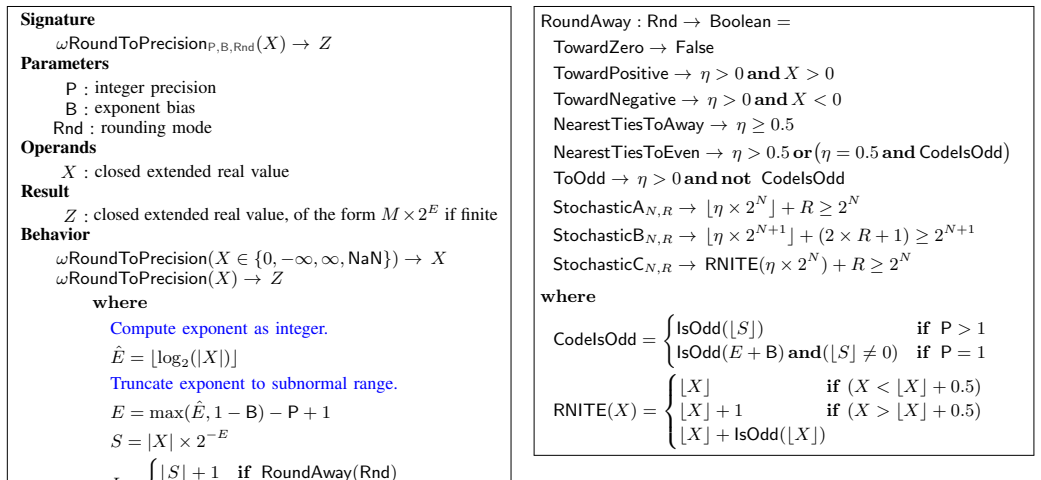
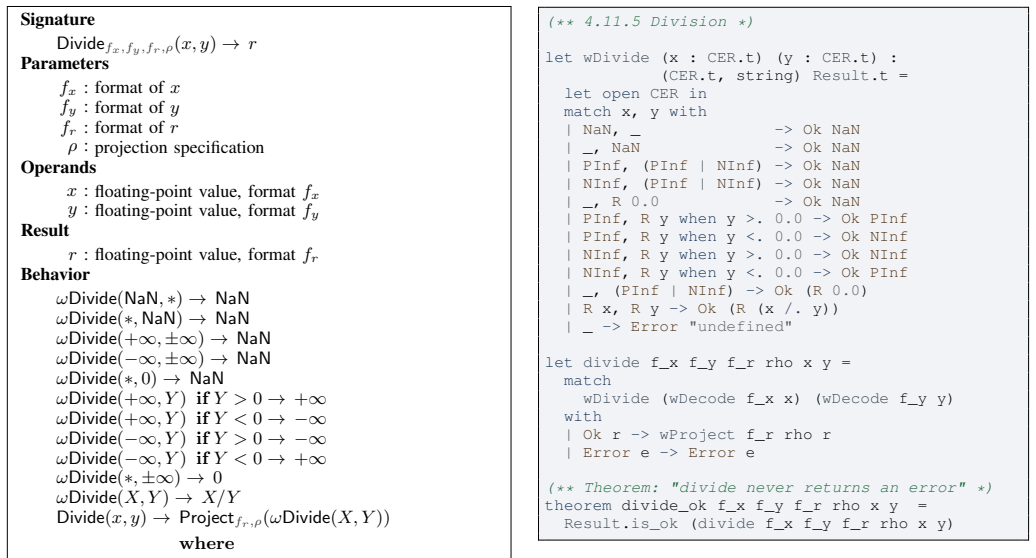
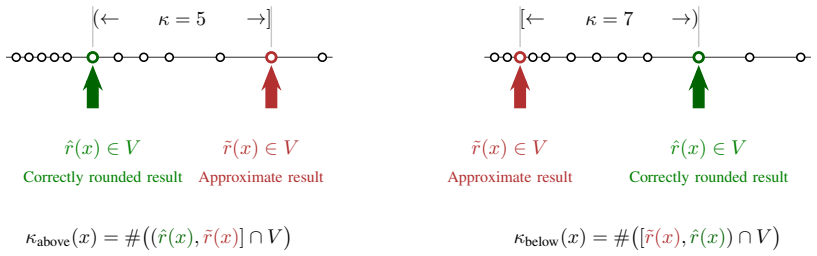
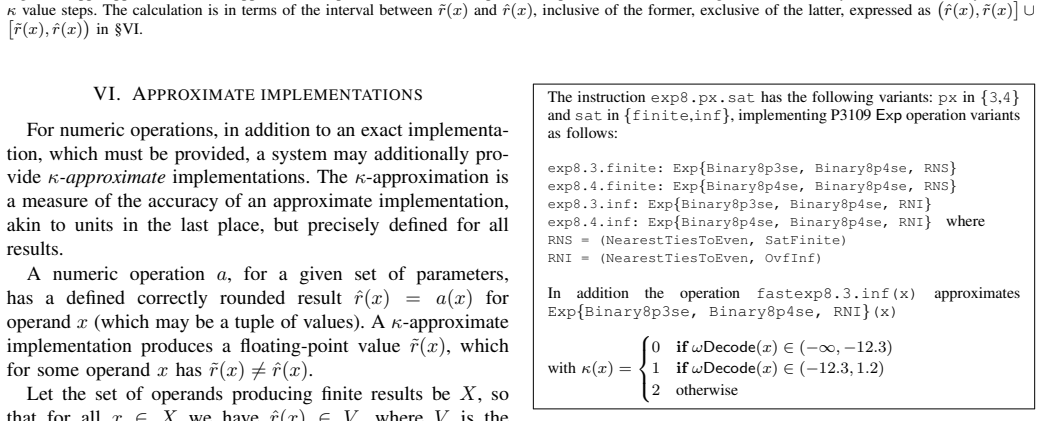
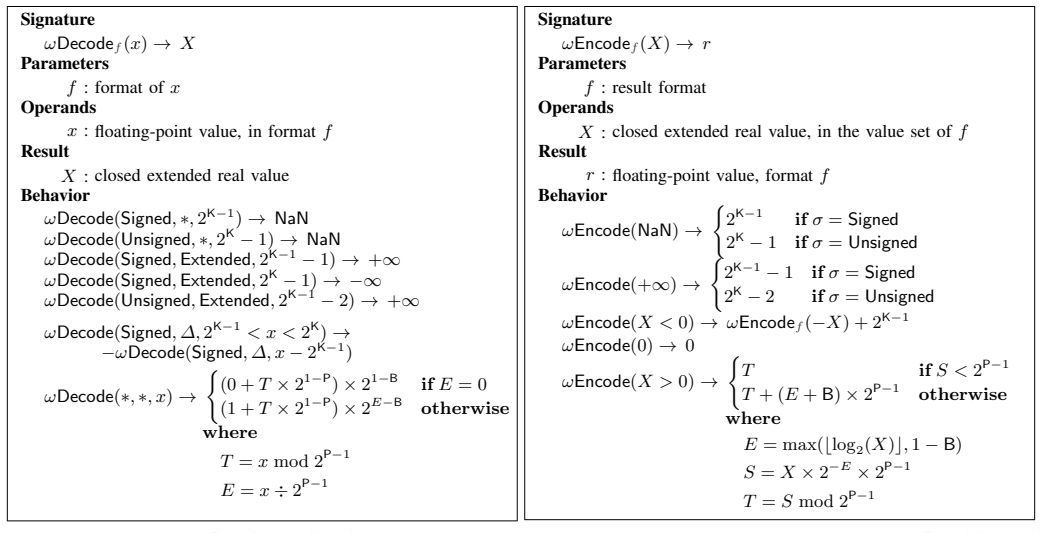
The IEEE P3109 draft standard defines a parameterized family of binary floating-point formats and associated operations, with a focus on facilitating machine learning. These formats allow efficient and consistent representation of values in a small number of bits. The defined formats are parameterized over width and precision in bits, signedness, and the presence of infinities. Operations are defined by decoding floating-point values to the set of closed extended reals: the reals augmented with positive and negative infinity and NaN (Not a Number). Explicit treatment of NaN and infinite operands ensures that only real arithmetic is invoked in operation definitions. Extensive rounding and saturation modes are defined; stochastic rounding is included. Operations are exception-free, accelerating throughput, with exceptional situations communicated through return values, e.g., NaN. Operations on blocks of values sharing a common scale factor are defined in terms of the underlying operations in a uniform manner. System vendors may describe approximate implementations via a novel scale-invariant measure, akin to units in the last place, called kappa-approximation. Standard function definitions and various other properties are mechanically verified and generated using formal specifications.
Editorial analysis
A structured set of objections, weighed in public.
Referee Report
Summary. The manuscript describes novel aspects of the IEEE SA P3109 draft standard, which defines a parameterized family of binary floating-point formats (over width, precision, signedness, and presence of infinities) and associated operations optimized for machine learning. Formats decode to the closed extended reals; NaN and infinity operands are handled explicitly so that only real arithmetic is invoked. Operations are exception-free (exceptions communicated only via return values such as NaN), support extensive rounding modes including stochastic rounding, define block operations with shared scale factors, introduce a scale-invariant kappa-approximation measure for approximate implementations, and include mechanically verified standard-function definitions generated from formal specifications.
Significance. If the described constructions hold, the paper supplies a formal, mechanically verified basis for consistent low-precision arithmetic in ML hardware and software. The exception-free semantics, closed-extended-real decoding, and kappa-approximation constitute concrete, reusable contributions that could improve portability and performance analysis. Explicit credit is due for the mechanical verification step, which supplies independent, reproducible evidence for the function definitions and properties.
minor comments (2)
- [Abstract / Introduction] The abstract and introduction should more explicitly distinguish which elements are direct restatements of the P3109 draft versus which are novel interpretive or presentational contributions of the manuscript itself.
- [Kappa-approximation section] Notation for the kappa-approximation (scale-invariant ulp-like measure) is introduced without a dedicated equation or definition block; a numbered definition would improve traceability when the measure is later used to characterize vendor implementations.
Simulated Author's Rebuttal
We thank the referee for the detailed summary of our manuscript and the positive assessment of its significance. The recommendation for minor revision is noted. However, the report lists no specific major comments.
Circularity Check
No significant circularity; definitional content of draft standard
full rationale
The paper defines a parameterized family of binary floating-point formats and operations directly from the IEEE P3109 draft specifications. Decoding to closed extended reals, explicit NaN/inf handling, exception-free semantics, kappa-approximation, and mechanical verification are presented as definitional constructions rather than derived claims. No equations reduce a 'prediction' to a fitted input by construction, no load-bearing self-citations justify central premises, and no ansatz or uniqueness theorem is smuggled in. The content is self-contained against external benchmarks as a standard specification, with the reader's assessment of score 1.0 aligning with minor or absent circularity.
Axiom & Free-Parameter Ledger
Forward citations
Cited by 2 Pith papers
-
GoldenFloat: A Phi-Derived Static-Split Floating-Point Family from GF4 to GF1024 with a Lucas-Exact Integer Identity
GoldenFloat introduces a phi-derived rule for setting exponent and fraction widths across floating-point formats from 4 to 1024 bits, backed by open RTL generator, Lucas-exact accumulator, and FPGA implementation.
-
An 83-Format Numeric Catalog with Bit-Exact Conformance Vectors: A Vendor-Neutral Reference for FP8, BF16, MXFP4, and Microscaling Formats
An 83-format numeric catalog with bit-exact conformance vectors and IEEE P3109 cross-walk serving as a vendor-neutral reference for FP8, BF16, MXFP4, and microscaling formats.
Reference graph
Works this paper leans on
-
[1]
Cloud TPU: Machine learning accelerators for training and inference,
N. P. Jouppi, C. Young, N. Patil, D. Patterson, G. Agrawal, R. Bajwa, S. Bates, S. Bhatia, N. Boden, A. Borchers,et al., “Cloud TPU: Machine learning accelerators for training and inference,”IEEE Micro, vol. 38, no. 2, pp. 39–47, 2018
2018
-
[2]
8-bit numerical formats for deep neural networks,
B. Noune, P. Jones, D. Justus, D. Masters, and C. Luschi, “8-bit numerical formats for deep neural networks,”arXiv:2206.02915, 2022
arXiv 2022
-
[3]
FP8 formats for deep learning,
P. Micikevicius, S. Narang, J. Alben, G. Diamos, E. Elsen, D. Garcia, B. Ginsburg, M. Houston, O. Kuchaiev, G. Venkatesh, and H. Wu, “FP8 formats for deep learning,”arXiv:2209.05433, 2022
Pith/arXiv arXiv 2022
-
[4]
OCP 8-bit floating point specification (OFP8) revision 1.0,
P. Micikevicius, S. Oberman, P. Dubey, M. Cornea, A. Rodriguez, I. Bratt, R. Grisenthwaite, N. Jouppi, C. Chou, A. Huffman, M. Schulte, R. Wittig, D. Jani, and S. Deng, “OCP 8-bit floating point specification (OFP8) revision 1.0,” tech. rep., opencompute.org, 2023
2023
-
[5]
Tesla Dojo Technology: A guide to Tesla’s configurable floating point formats and arithmetic,
Tesla, Inc., “Tesla Dojo Technology: A guide to Tesla’s configurable floating point formats and arithmetic,” 2023
2023
-
[6]
P3109 standard for arithmetic formats for machine learning
IEEE, “P3109 standard for arithmetic formats for machine learning.” https://standards.ieee.org/ieee/3109/11165/
-
[7]
Interim report,
P3109 Working Group, “Interim report,” 2026. https://github.com/ P3109/Public
2026
-
[8]
OCP microscaling formats (mx) specification version 1.0
Open Compute Project, “OCP microscaling formats (mx) specification version 1.0.” Open Compute Project Foundation, 2023
2023
-
[9]
Branch cuts for complex elementary functions or much ado about nothing’s sign bit,
W. Kahan, “Branch cuts for complex elementary functions or much ado about nothing’s sign bit,”Institute of Mathematics and its Applications Conference, 1987
1987
-
[10]
Augmenting a programming language with complex arithmetic,
W. Kahan and J. W. Thomas, “Augmenting a programming language with complex arithmetic,” tech. rep., EECS Department, University of California, Berkeley, 1991
1991
-
[11]
Jax: Lax function_float_to_int_for_sort
Google, “Jax: Lax function_float_to_int_for_sort.”https:// github.com/google/jax path jax/ src/lax/lax.py#L3934, Commit fc5960f2 (accessed 2026-02-13), 2023
2026
-
[12]
Adaptive loss scaling for mixed precision training,
R. Zhao, B. V ogel, and T. Ahmed, “Adaptive loss scaling for mixed precision training,”arXiv:1910.12385, 2019
arXiv 1910
-
[13]
On stochastic rounding with few random bits,
A. W. Fitzgibbon and S. Felix, “On stochastic rounding with few random bits,” in32nd Symp. on Comput. Arithmetic, ARITH 2025, pp. 133–140, IEEE, 2025
2025
-
[14]
ImandraX documentation: The IML Language
Imandra, Inc., “ImandraX documentation: The IML Language.” https://imandrax.dev/docs/language (accessed 2026-05-17)
2026
-
[15]
Formal verification of the IEEE P3109 standard,
C. M. Wintersteiger, “Formal verification of the IEEE P3109 standard,” 2025. https://github.com/imandra-ai/ieee-p3109
2025
-
[16]
Formal verification of the IEEE P3109 standard for binary floating-point formats for machine learning,
C. M. Wintersteiger, “Formal verification of the IEEE P3109 standard for binary floating-point formats for machine learning,” in32nd Symp. on Comput. Arithmetic, ARITH 2025, IEEE, 2025
2025
-
[17]
FLoPS: Semantics, operations, and properties of P3109 floating-point representations in Lean,
T.-C. Chang, S. Park, J. P. Lim, and S. Nagarakatte, “FLoPS: Semantics, operations, and properties of P3109 floating-point representations in Lean,”arXiv:2602.15965, 2026
Pith/arXiv arXiv 2026
discussion (0)
Sign in with ORCID, Apple, or X to comment. Anyone can read and Pith papers without signing in.