Quantum circuit partition as a maze: emerging percolation transition via path finding
Pith reviewed 2026-06-28 09:49 UTC · model grok-4.3
The pith
A percolation phase transition in a CNOT maze separates partitionable quantum circuits from nonpartitionable ones.
A machine-rendered reading of the paper's core claim, the machinery that carries it, and where it could break.
Core claim
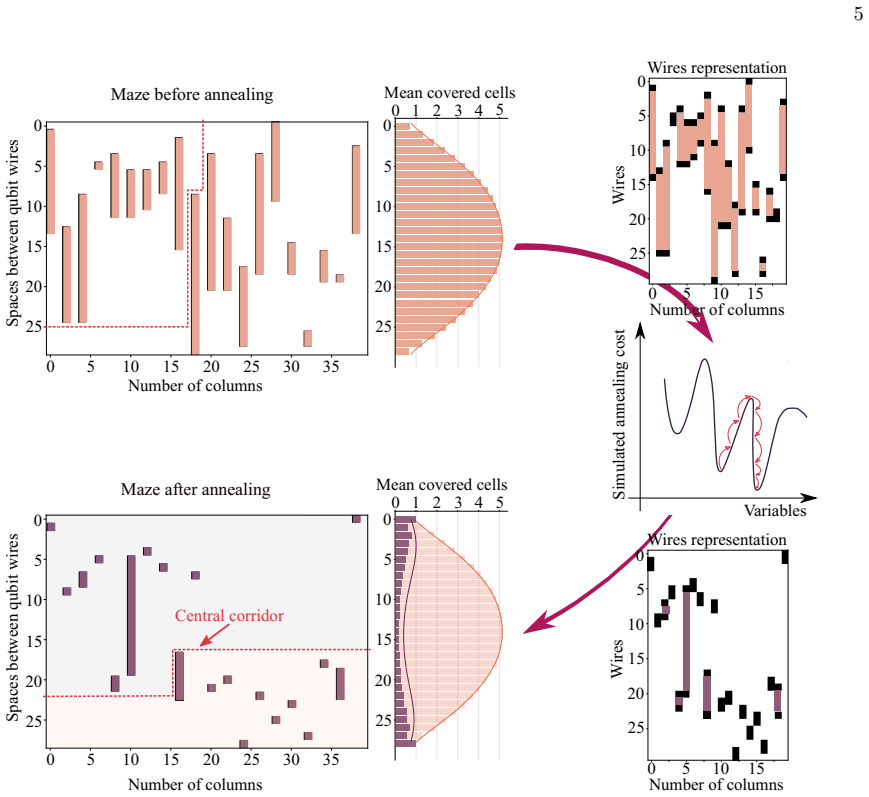
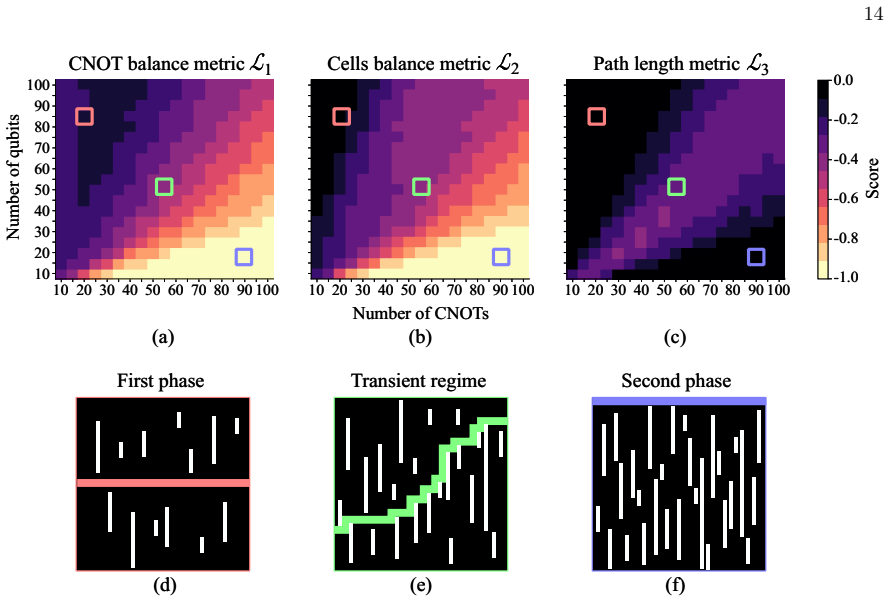
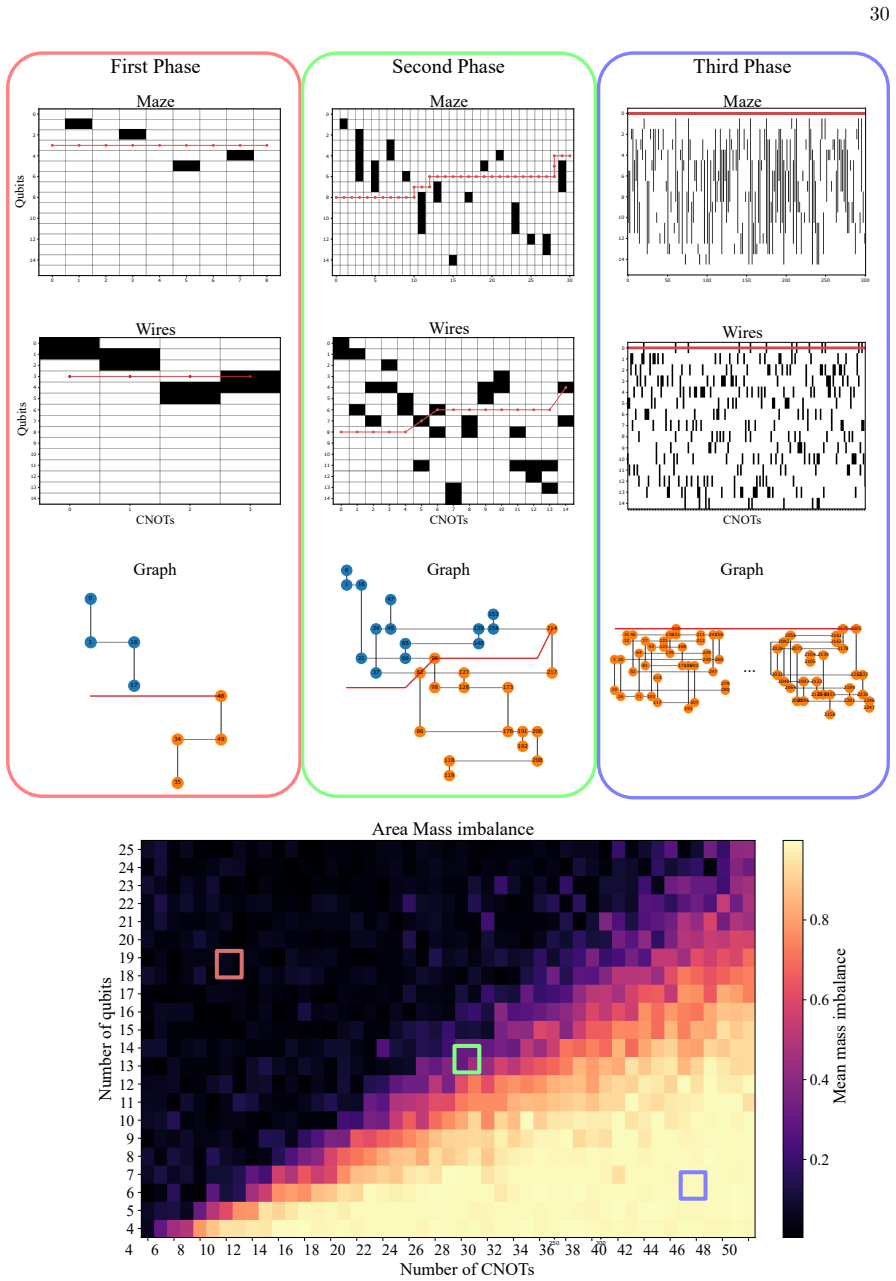
Formalizing circuit partitioning as a cutting path through a maze of CNOT walls shows that the existence of the path separates quantum circuits into two classes via a percolation phase transition. The transition distinguishes a partitionable regime from a nonpartitionable one that arises from qubit permutations generated by simulated annealing. Partitioning into two CNOT clusters becomes possible when the number of CNOTs is almost equal to the number of qubits, yielding a scalable criterion for identifying whether such a partition exists.
What carries the argument
Maze representation of the circuit in which CNOT gates are walls and a cutting path is sought; percolation transition in path existence under qubit permutations generated by simulated annealing.
If this is right
- Partitioning into two CNOT clusters is feasible precisely when the CNOT count is nearly equal to the qubit count.
- The percolation criterion supplies a practical test for deciding whether a circuit can be split without removing CNOT gates.
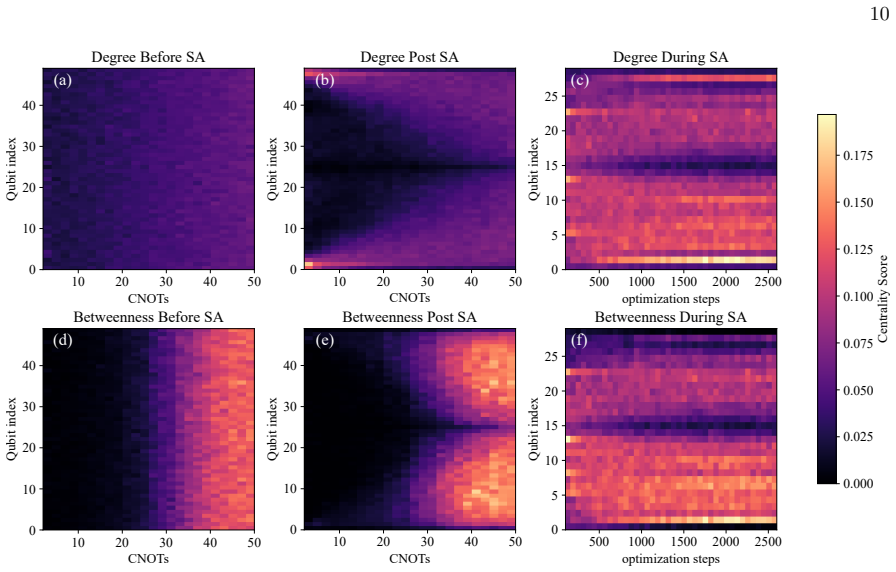
- Network-science analysis of the CNOT cluster under permutations reveals how the transition organizes the gate structure.
- The same maze model can be used to guide algorithmic development for parallel circuit optimization across devices.
Where Pith is reading between the lines
- The maze-path criterion might extend directly to deciding multi-way partitions by checking for multiple disjoint cutting paths.
- Similar percolation signatures could appear in other quantum resource-allocation tasks that involve gate clustering.
- Hardware experiments that attempt to partition real circuits near the reported CNOT-qubit ratio would test the criterion's utility beyond simulation.
Load-bearing premise
Representing CNOT gates as maze walls and generating permutations via simulated annealing captures the essential structure that produces a genuine percolation transition.
What would settle it
If varying the CNOT-to-qubit ratio or replacing simulated annealing with another permutation generator eliminates the sharp change in partitionability, the claimed percolation transition is falsified.
Figures


read the original abstract
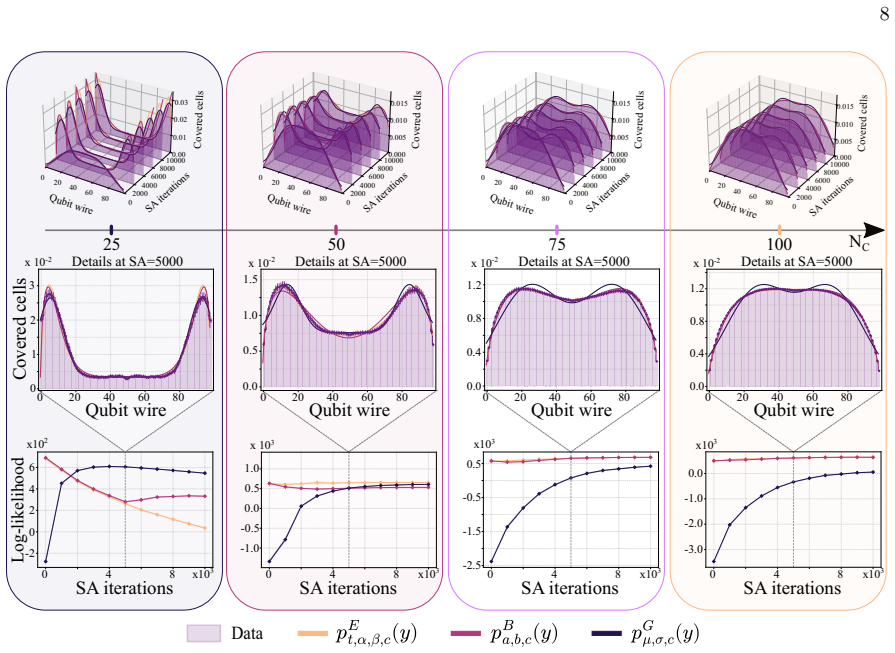
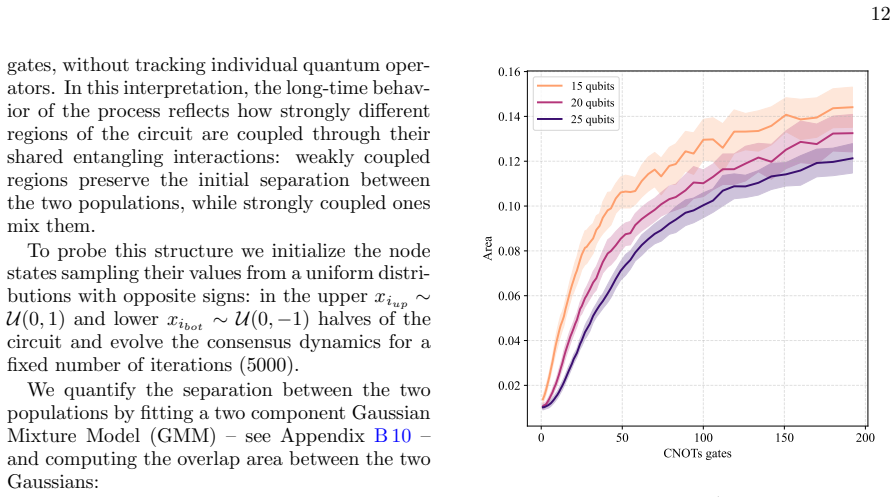
In quantum circuit optimization, circuit partitioning enables the optimization process to be parallelized across multiple devices. Each device is responsible for either reducing the number of selected gates or simplifying the local circuit structure. Most existing approaches to circuit partitioning are quantum-distribution-oriented and rely on splitting CNOT gates by introducing mid-circuit measurements and qubit resets. Currently, there is no criterion to determine how a circuit can be optimally partitioned without removing the CNOT gates for circuit optimization purposes. To address this challenge, we formalize the partition problem as a cutting path through a maze, where the CNOT gates represent the walls. We show that the existence of such a path separates quantum circuits into two classes through a percolation phase transition. In particular, it distinguishes a partitionable regime from a nonpartitionable one, arising from qubit permutations. Such permutations are generated by simulated annealing. We analyze its effect on the CNOT cluster from the perspective of network science and distribution analysis. Our results show that partitioning into two CNOT clusters is possible when the number of CNOTs is almost equal to the number of qubits. Based on this observation, we provide a scalable and practical criterion for identifying whether such a partition exists. Overall, our framework provides theoretical and numerical insight into circuit partitioning within quantum circuit optimization, forming the basis for algorithmic development.
Editorial analysis
A structured set of objections, weighed in public.
Referee Report
Summary. The paper formalizes the quantum circuit partitioning problem as finding a cutting path through a maze in which CNOT gates represent walls. It claims that the existence of such a path induces a percolation phase transition that separates circuits into partitionable and non-partitionable regimes, with the transition arising from qubit permutations generated by simulated annealing. A scalable criterion is proposed: partitioning into two CNOT clusters is possible when the number of CNOTs is nearly equal to the number of qubits. The work analyzes the CNOT cluster using tools from network science and distribution analysis.
Significance. If the maze-to-partition mapping is shown to be equivalent to a valid non-destructive cut that preserves the ability to optimize sub-circuits independently, the percolation criterion could supply a practical, non-destructive test for partitionability and thereby support parallel circuit optimization. The network-science perspective on CNOT connectivity is a potentially useful angle, though its impact depends on the rigor of the claimed equivalence and the robustness of the simulated-annealing results.
major comments (2)
- [Formalization of the partition problem (as described in the abstract and method)] The manuscript provides no derivation establishing that connectivity of a path through the CNOT-wall maze corresponds exactly to a valid non-destructive partition that permits independent optimization of the resulting sub-circuits while preserving commutation and entanglement structure. This equivalence is load-bearing for the central claim that the path separates partitionable from non-partitionable regimes.
- [Analysis of simulated-annealing permutations and CNOT-cluster statistics] The percolation threshold is reported exclusively for qubit permutations obtained via simulated annealing; no comparison is given to exhaustive enumeration or to alternative search heuristics on identical circuit instances. Without such controls it is impossible to determine whether the observed transition reflects the true structural boundary or an artifact of the heuristic search.
minor comments (1)
- [Abstract] The abstract states the transition and the CNOT-qubit-ratio criterion but supplies neither equations nor derivation steps, making the central claim difficult to verify from the summary alone.
Simulated Author's Rebuttal
We thank the referee for their constructive comments on our manuscript. We address each major comment below and outline the revisions we will make.
read point-by-point responses
-
Referee: [Formalization of the partition problem (as described in the abstract and method)] The manuscript provides no derivation establishing that connectivity of a path through the CNOT-wall maze corresponds exactly to a valid non-destructive partition that permits independent optimization of the resulting sub-circuits while preserving commutation and entanglement structure. This equivalence is load-bearing for the central claim that the path separates partitionable from non-partitionable regimes.
Authors: We agree that an explicit derivation is necessary to establish the equivalence between a valid maze path and a non-destructive partition. In the revised manuscript we will add a dedicated subsection deriving this correspondence from the definitions of circuit partitioning, showing step-by-step how a cutting path through CNOT walls yields sub-circuits whose independent optimization preserves commutation relations and entanglement structure. revision: yes
-
Referee: [Analysis of simulated-annealing permutations and CNOT-cluster statistics] The percolation threshold is reported exclusively for qubit permutations obtained via simulated annealing; no comparison is given to exhaustive enumeration or to alternative search heuristics on identical circuit instances. Without such controls it is impossible to determine whether the observed transition reflects the true structural boundary or an artifact of the heuristic search.
Authors: The referee correctly notes the absence of controls. While simulated annealing enables scalability, we will add a new subsection comparing results on small circuits (up to 10 qubits) against exhaustive enumeration and alternative heuristics such as greedy search. These controls will confirm whether the percolation transition is structural. revision: yes
Circularity Check
No significant circularity; derivation self-contained
full rationale
The paper formalizes circuit partitioning as a maze-cutting path with CNOTs as walls and reports an observed percolation transition under simulated-annealing permutations, followed by a numerical criterion based on CNOT-to-qubit count. No equations, self-citations, or steps in the abstract reduce the claimed transition or partitionability criterion to a fitted input, self-definition, or prior author result by construction. The mapping and transition analysis are presented as independent numerical and network-science observations rather than tautological renamings or load-bearing self-references.
Axiom & Free-Parameter Ledger
free parameters (1)
- CNOT-qubit ratio threshold =
approximately 1
Reference graph
Works this paper leans on
-
[1]
B. P. Lanyon, J. D. Whitfield, G. G. Gillett, et al., Towards quantum chemistry on a quan- tum computer, Nature chemistry2, 106 (2010)
2010
-
[2]
J. Liu, M. Liu, J.-P. Liu,et al., Towards prov- ably efficient quantum algorithms for large-scale machine-learning models, Nature Communica- tions15, 434 (2024)
2024
- [3]
-
[4]
Ruane, E
J. Ruane, E. Kiesow, J. Galatsanos,et al.,The Quantum Index Report 2025, Tech. Rep. (MIT Initiative on the Digital Economy, Massachusetts Institute of Technology, Cambridge, MA, 2025)
2025
-
[5]
Y. Nam, N. J. Ross, Y. Su,et al., Automated optimization of large quantum circuits with con- tinuous parameters, npj Quantum Information 4, 23 (2018)
2018
-
[6]
F. J. Ruiz, T. Laakkonen, J. Bausch,et al., Quantum circuit optimization with alphatensor, Nature Machine Intelligence7, 374 (2025)
2025
-
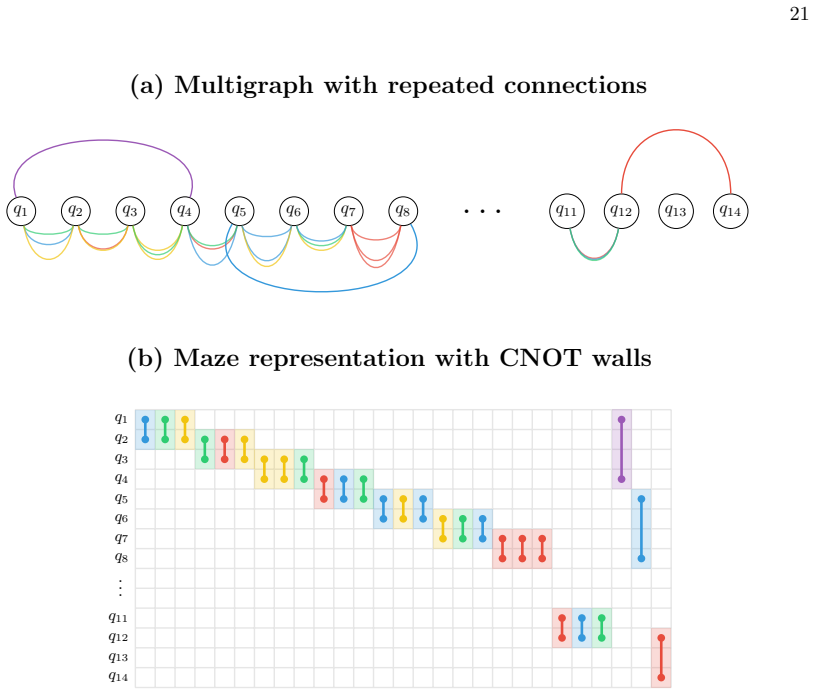
[7]
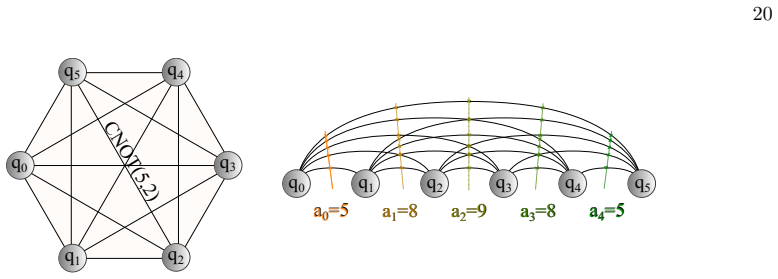
Acharya, D
R. Acharya, D. A. Abanin, L. Aghababaie-Beni, et al., Quantum error correction below the sur- face code threshold, Nature638, 920 (2025)
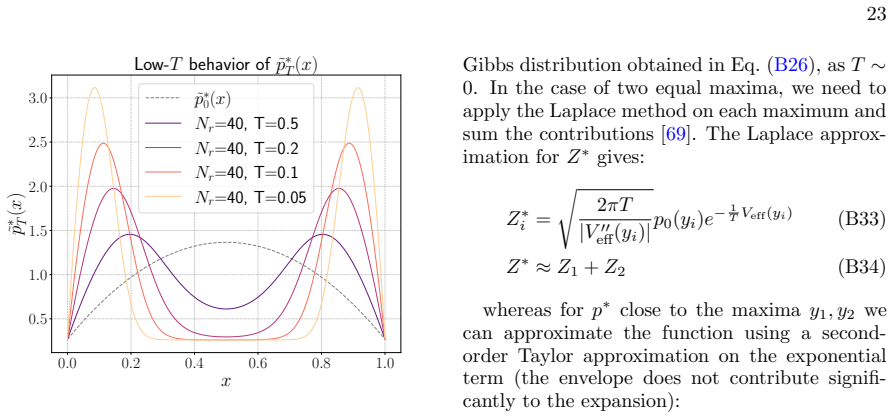
2025
- [8]
-
[9]
V. V. Sivak, A. Eickbusch, B. Royer,et al., Real- time quantum error correction beyond break- even, Nature616, 5055 (2023)
2023
-
[10]
Younis, C
E. Younis, C. C. Iancu, W. Lavrijsen,et al., Berkeley quantum synthesis toolkit (bqskit) v1, [Computer Software]https://doi.org/10. 11578/dc.20210603.2(2021)
2021
-
[11]
Ender, R
K. Ender, R. ter Hoeven, B. E. Niehoff,et al., Parity quantum optimization: Compiler, Quan- tum7, 950 (2023)
2023
-
[12]
J. Nemirovsky, M. Chuchem, and Y. Shapira, Efficient compilation of quantum circuits us- ing multi-qubit gates (2025), arXiv:2501.17246 [quant-ph]
-
[13]
Kissinger and J
A. Kissinger and J. van de Wetering, Pyzx: Large scale automated diagrammatic reasoning, Electronic Proceedings in Theoretical Computer Science318, 229241 (2020)
2020
-
[14]
Preti, M
F. Preti, M. Schilling, S. Jerbi,et al., Hybrid discrete-continuous compilation of trapped-ion quantum circuits with deep reinforcement learn- ing, Quantum8, 1343 (2024)
2024
- [15]
-
[16]
L. Moro, M. G. A. Paris, M. Restelli, and E. Prati, Quantum compiling by deep reinforce- ment learning, Communications Physics4, 178 (2021)
2021
- [17]
- [18]
-
[19]
Corli and E
S. Corli and E. Prati, Measurement-based quan- tum compiling via gauge invariance, Physical Re- view Applied25, 044068 (2026)
2026
-
[20]
Corli and E
S. Corli and E. Prati, Gauge freedom in mea- surement based quantum compiling, inJournal of Physics: Conference Series, Vol. 3017 (IOP Publishing, 2025) p. 012043
2025
-
[21]
M. Amy, D. Maslov, and M. Mosca, Polynomial- time t-depth optimization of clifford+t circuits via matroid partitioning, IEEE Transactions on Computer-Aided Design of Integrated Circuits and Systems33, 14761489 (2014)
2014
-
[22]
Akahoshi, K
Y. Akahoshi, K. Maruyama, H. Oshima,et al., Partially fault-tolerant quantum computing ar- chitecture with error-corrected clifford gates and space-time efficient analog rotations, PRX quan- tum5, 010337 (2024)
2024
-
[23]
A. Xu, A. Molavi, S. Tannu, and A. Albargh- outhi, Optimizing quantum circuits, fast and slow, inProceedings of the 30th ACM Interna- tional Conference on Architectural Support for Programming Languages and Operating Systems, Volume 1(2025) pp. 777–793
2025
-
[24]
An Efficient Methodology for Mapping Quantum Circuits to the IBM QX Architectures
A. Zulehner, A. Paler, and R. Wille, An efficient methodology for mapping quantum circuits to the ibm qx architectures (2018), arXiv:1712.04722 [quant-ph]
work page internal anchor Pith review Pith/arXiv arXiv 2018
-
[25]
M. Y. Siraichi, V. F. d. Santos, C. Collange, and F. M. Q. Pereira, Qubit allocation, inProceedings of the 2018 International Symposium on Code Generation and Optimization, CGO ’18 (Associ- ation for Computing Machinery, New York, NY, USA, 2018) p. 113125
2018
- [26]
-
[27]
M. Tejedor, B. Casas, J. Conejero,et al., Dis- tributed quantum circuit cutting for hybrid quantum-classical high-performance computing (2025), arXiv:2505.01184 [cs.DC]
- [28]
-
[29]
Burt, K.-C
F. Burt, K.-C. Chen, and K. K. Leung, A mul- tilevel framework for partitioning quantum cir- cuits, Quantum10, 1984 (2026)
1984
-
[30]
Skinner, J
B. Skinner, J. Ruhman, and A. Nahum, Measurement-induced phase transitions in the dynamics of entanglement, Phys. Rev. X9, 17 031009 (2019)
2019
-
[31]
Y. Li, X. Chen, and M. P. A. Fisher, Quan- tum zeno effect and the many-body entangle- ment transition, Phys. Rev. B98, 205136 (2018)
2018
-
[32]
Jian, Y.-Z
C.-M. Jian, Y.-Z. You, R. Vasseur, and A. W. W. Ludwig, Measurement-induced criticality in ran- dom quantum circuits, Phys. Rev. B101, 104302 (2020)
2020
-
[33]
Nahum, S
A. Nahum, S. Roy, B. Skinner, and J. Ruhman, Measurement and entanglement phase transi- tions in all-to-all quantum circuits, on quan- tum trees, and in landau-ginsburg theory, PRX Quantum2(2021)
2021
-
[34]
Lavasani, Y
A. Lavasani, Y. Alavirad, and M. Barkeshli, Topological order and criticality in monitored random quantum circuits, Physical Review Let- ters127(2021)
2021
-
[35]
Buznach Ahituv, D
E. Buznach Ahituv, D. Chowdhury, and J. Ruh- man, Unveiling a hidden percolation transition in monitored clifford circuits: Inroads from zx calculus, Phys. Rev. Lett.135, 050402 (2025)
2025
-
[36]
S¨ underhauf, D
C. S¨ underhauf, D. P´ erez-Garc´ ıa, D. A. Huse, et al., Localization with random time-periodic quantum circuits, Physical Review B98, 134204 (2018)
2018
-
[37]
Fault-Tolerant Quantum Computation With Constant Error Rate
D. Aharonov and M. Ben-Or, Fault-tolerant quantum computation with constant error rate (1999), arXiv:quant-ph/9906129 [quant-ph]
work page internal anchor Pith review Pith/arXiv arXiv 1999
-
[38]
Kitaev, Fault-tolerant quantum computation by anyons, Annals of Physics303, 2 (2003)
A. Kitaev, Fault-tolerant quantum computation by anyons, Annals of Physics303, 2 (2003)
2003
-
[39]
Y. Li, X. Chen, and M. P. Fisher, Quantum zeno effect and the many-body entanglement transi- tion, Physical Review B98, 205136 (2018)
2018
-
[40]
S. Choi, Y. Bao, X.-L. Qi, and E. Altman, Quan- tum error correction in scrambling dynamics and measurement-induced phase transition, Physical Review Letters125, 030505 (2020)
2020
-
[41]
Zabalo, M
A. Zabalo, M. J. Gullans, J. H. Wilson,et al., Critical properties of the measurement-induced transition in random quantum circuits, Physical Review B101, 060301 (2020)
2020
-
[42]
Jonay, V
C. Jonay, V. Khemani, and M. Ippoliti, Triuni- tary quantum circuits, Physical Review Research 3, 043046 (2021)
2021
-
[43]
Lavasani, Y
A. Lavasani, Y. Alavirad, and M. Barkeshli, Measurement-induced topological entanglement transitions in symmetric random quantum cir- cuits, Nature Physics17, 342 (2021)
2021
-
[44]
Z. V. Djordjevic, H. E. Stanley, and A. Mar- golina, Site percolation threshold for honeycomb and square lattices, Journal of Physics A: Math- ematical and General15, L405 (1982)
1982
-
[45]
Erd˝ os, A
P. Erd˝ os, A. R´ enyi,et al., On the evolution of random graphs, Publications of the (1960)
1960
-
[46]
Bollobs, A probabilistic proof of an asymp- totic formula for the number of labelled regular graphs, European Journal of Combinatorics1, 311 (1980)
B. Bollobs, A probabilistic proof of an asymp- totic formula for the number of labelled regular graphs, European Journal of Combinatorics1, 311 (1980)
1980
-
[47]
Barabasi and R
A.-L. Barabasi and R. Albert, Emergence of scal- ing in random networks, Science286, 509512 (1999)
1999
-
[48]
Barabsi and M
A.-L. Barabsi and M. Psfai,Network science (Cambridge University Press, Cambridge, 2016)
2016
-
[49]
C. Beaudoin, K. Phalak, and S. Ghosh, Alt- graph: Redesigning quantum circuits using gen- erative graph models for efficient optimization (2024), arXiv:2403.12979 [quant-ph]
-
[50]
Mazzarella, A
L. Mazzarella, A. Sarlette, and F. Ticozzi, Con- sensus for quantum networks: Symmetry from gossip interactions, IEEE Transactions on Auto- matic Control60, 158172 (2015)
2015
-
[51]
Ticozzi, Symmetrizing quantum dynamics be- yond gossip-type algorithms, Automatica74, 3846 (2016)
F. Ticozzi, Symmetrizing quantum dynamics be- yond gossip-type algorithms, Automatica74, 3846 (2016)
2016
-
[52]
Huang, H
Y. Huang, H. Wang, X.-L. Ren, and L. L, Iden- tifying key players in complex networks via net- work entanglement, Communications Physics7, 19 (2024)
2024
-
[53]
A. Javadi-Abhari, M. Treinish, K. Krsulich, et al., Quantum computing with qiskit (2024), arXiv:2405.08810 [quant-ph]
work page internal anchor Pith review Pith/arXiv arXiv 2024
-
[54]
O. Daei, K. Navi, and M. Zomorodi-Moghadam, Optimized quantum circuit partitioning, Inter- national Journal of Theoretical Physics59, 38043820 (2020)
2020
-
[55]
Kirkpatrick, C
S. Kirkpatrick, C. D. Gelatt Jr, and M. P. Vec- chi, Optimization by simulated annealing, Sci- ence220, 671 (1983)
1983
-
[56]
Storn and K
R. Storn and K. Price, Differential evolution – a simple and efficient heuristic for global optimiza- tion over continuous spaces, Journal of Global Optimization11, 341 (1997)
1997
-
[57]
Barthelemy, Betweenness centrality in large complex networks, The European physical jour- nal B38, 163 (2004)
M. Barthelemy, Betweenness centrality in large complex networks, The European physical jour- nal B38, 163 (2004)
2004
-
[58]
M. H. DeGroot, Reaching a consensus, Journal of the American Statistical Association69, 118 (1974)
1974
-
[59]
S. T. Rachev and L. Ruschendorf,Mass Trans- portation Problems, 1998th ed., Probability and Its Applications (Springer, New York, NY, 1998)
1998
-
[60]
Hagberg, P
A. Hagberg, P. J. Swart, and D. A. Schult,Ex- ploring network structure, dynamics, and func- tion using NetworkX, Tech. Rep. (Los Alamos National Laboratory (LANL), 2007)
2007
-
[61]
Gommers, P
R. Gommers, P. Virtanen, M. Haberland,et al., scipy/scipy: Scipy 1.15. 0 (2024)
2024
-
[62]
Efthymiou, S
S. Efthymiou, S. Ramos-Calderer, C. Bravo- Prieto,et al., Qibo: a framework for quantum simulation with hardware acceleration, Quantum Science and Technology7, 015018 (2021)
2021
-
[63]
Erd¨ os and A
P. Erd¨ os and A. R´ enyi, On random graphs i, Publicationes Mathematicae Debrecen6, 290 (1959)
1959
-
[64]
Bullo,Lectures on Network Systems(Creates- pace Independent Publishing Platform, North Charleston, SC, 2018)
F. Bullo,Lectures on Network Systems(Creates- pace Independent Publishing Platform, North Charleston, SC, 2018)
2018
-
[65]
Espaol, Statistical mechanics of coarse- graining (2004) pp
P. Espaol, Statistical mechanics of coarse- graining (2004) pp. 2256–2256
2004
-
[66]
Castiglione, M
P. Castiglione, M. Falcioni, A. Lesne, and A. Vulpiani,Chaos and Coarse Graining in Sta- tistical Mechanics(Cambridge University Press, 2008)
2008
-
[67]
S. Thaler, M. Stupp, and J. Zavadlav, Deep coarse-grained potentials via relative entropy minimization, The Journal of Chemical Physics 18 157, 10.1063/5.0124538 (2022)
-
[68]
R. W. Butler,Saddlepoint Approximations with Applications, Cambridge Series in Statistical and Probabilistic Mathematics (Cambridge Univer- sity Press, 2007)
2007
-
[69]
Majdalani, Lecture on the laplace method, ac- cessed: 2026-03-30
J. Majdalani, Lecture on the laplace method, ac- cessed: 2026-03-30
2026
-
[70]
Bishop,Pattern Recognition and Machine Learning(Springer, 2006)
C. Bishop,Pattern Recognition and Machine Learning(Springer, 2006)
2006
-
[71]
G. K. Brennen, An observable measure of entan- glement for pure states of multi-qubit systems, arXiv preprint (2003), arXiv:0305094
2003
-
[72]
D. A. Meyer and N. R. Wallach, Global entan- glement in multiparticle systems, arXiv preprint (2001), arXiv:arXiv:0108104
2001
-
[73]
Sauer, J
A. Sauer, J. Z. Bernd, H. J. Moreno, and G. Al- ber, Entanglement in bipartite quantum sys- tems: Euclidean volume ratios and detectability by bell inequalities, Journal of Physics A: Math- ematical and Theoretical54, 495302 (2021)
2021
-
[74]
A. A. Mele, Introduction to haar measure tools in quantum information: A beginner’s tutorial, Quantum8, 1340 (2024). Appendix A: Preliminaries
2024
-
[75]
Abbreviations and notation For clarity, the main abbreviations and math- ematical symbols adopted in this work are sum- marized below: Notation Wwire representation Mmaze representation Nq number of qubits Nc number of CNOT gates NMC number of columns inM NW C number of columns inW NSA simulated annealing steps Table I: Main abbreviations and mathematical...
-
[76]
These gates enable the manipulation of qubits and the imple- mentation of complex quantum algorithms
Universal Set of Quantum Logic Gates In this work, we employ a universal set of quan- tum logic gates, which are fundamental building blocks for quantum computation. These gates enable the manipulation of qubits and the imple- mentation of complex quantum algorithms. The gates used in this study are summarized in Ta- ble II. Table II: Universal Set of Qua...
-
[77]
Mathematical structure of the CNOT graph The structure of the maze is generated by ran- domly connecting a control qubitiwith a target qubitjfor 1≤i, j≤n. This is equivalent to generating a random graph, where the connec- tions (the CNOTs) are drawn uniformly over the set of possible connections between available ver- tices (the circuit wires). Since the ...
-
[78]
Consequently, before SA is applied, the graph representing the CNOT circuit is, on av- erage, fully connected, as depicted in Figure 7
Analytical derivation of walls distribution before simulated annealing effect CNOT gates are sampled uniformly across qubits. Consequently, before SA is applied, the graph representing the CNOT circuit is, on av- erage, fully connected, as depicted in Figure 7. This observation can be exploited to derive an analytical expression for the distribution of th...
-
[79]
The binary matrix corre- sponds to the random sampling of CNOT gates between qubits 1≤i, j≤N q and for a number of CNOTsN q, described by the probability distri- butionP
Interpretation of the cost function We assume that the maze is described by a bi- nary matrixM ∼ P. The binary matrix corre- sponds to the random sampling of CNOT gates between qubits 1≤i, j≤N q and for a number of CNOTsN q, described by the probability distri- butionP. We assume that each row of the maze contains only one CNOT gate. We start from the cos...
-
[80]
This is the same limit used to derive the asymptotic profile of the wall distri- bution, i.e., the Beta distribution Beta(y,2,2) = h0(y) = 6y(1−y)
A simplified coarse-graining procedure of the maze We want now to analyze the solution provided by the SA algorithm in the limit of large numbers of qubitsN q ≫1. This is the same limit used to derive the asymptotic profile of the wall distri- bution, i.e., the Beta distribution Beta(y,2,2) = h0(y) = 6y(1−y). We use then a coarse-graining procedure on the...
discussion (0)
Sign in with ORCID, Apple, or X to comment. Anyone can read and Pith papers without signing in.