A cryogenic gas target for high-intensity radioactive ion beam production at HIRFL-RIBLL
Pith reviewed 2026-06-28 07:42 UTC · model grok-4.3
The pith
A cryogenic gas target at RIBLL produces high-intensity radioactive ion beams with purities up to 99 percent.
A machine-rendered reading of the paper's core claim, the machinery that carries it, and where it could break.
Core claim
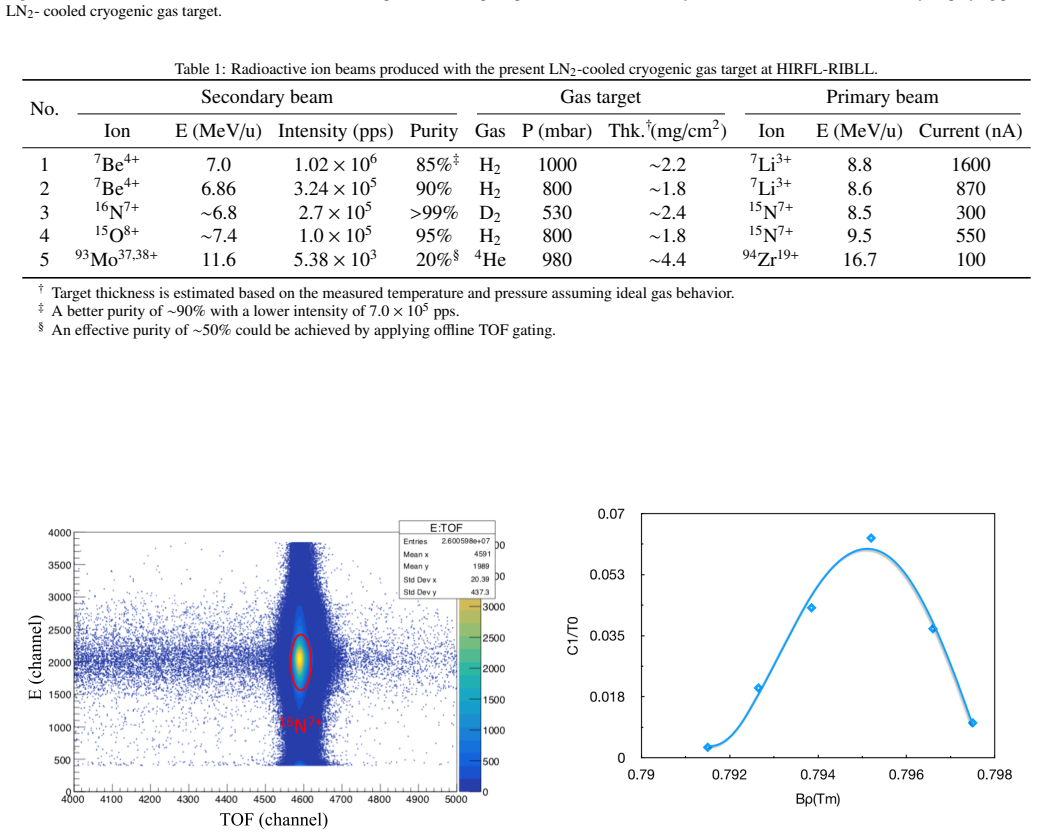
The central claim is that the cryogenic gas target system successfully produced 7Be via 1H(7Li,n)7Be at 1.02 imes10^6 pps and 85% purity, 16N via 2H(15N,p)16N at 2.7 imes10^5 pps and 99% purity, 15O via 1H(15N,n)15O at 1 imes10^5 pps and 95% purity, plus a 93mMo isomer beam via 4He(94Zr,5n) at 5.38 imes10^3 pps and 20% purity that can reach ~50% with offline TOF gating.
What carries the argument
The liquid-nitrogen-cooled cryogenic gas target cell that maintains H2, D2, or 4He at 82-86 K and up to 1000 mbar for inverse kinematics production of secondary RIBs.
If this is right
- A wider range of high-intensity secondary RIBs becomes accessible at the facility.
- Low- and medium-energy experiments in nuclear astrophysics and reaction mechanisms can use the new beams.
- Isomer beams such as 93mMo can be produced and purified further with timing methods.
- The same target approach supports production of additional light-element RIBs through similar reactions.
Where Pith is reading between the lines
- The design could be replicated or adapted at other RIB facilities to increase secondary beam options.
- Combining the target with online timing detectors might routinely improve purity for short-lived or isomeric species.
- If the cooling system scales without loss of stability, it could support higher primary beam currents and thus even greater secondary intensities.
Load-bearing premise
The target maintains stable low temperature, pressure, and gas purity when exposed to high-intensity primary beams during actual operation.
What would settle it
Direct measurements showing that beam intensities or purities fall substantially below the reported values, or that target temperature and pressure become unstable, when primary beam intensity is raised to operational levels.
Figures




read the original abstract
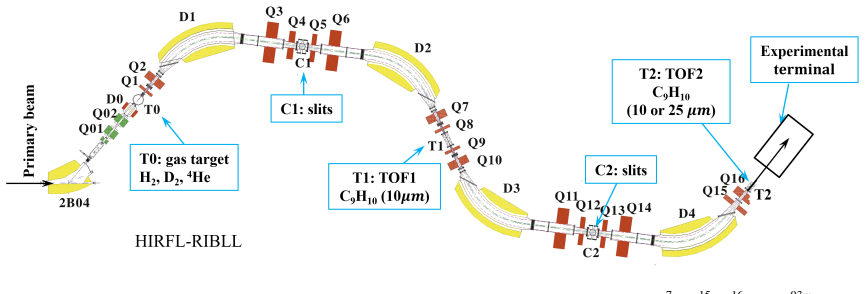
A liquid-nitrogen-cooled cryogenic gas target system has been developed and installed for radioactive ion beam (RIB) production at the Radioactive Ion Beam Line in Lanzhou (RIBLL). Light-element gases ($\mathrm{H}_2$, $\mathrm{D}_2$, and $^4\mathrm{He}$) filled in the target cell were cooled to cryogenic temperatures, with the gas-cell outlet temperature typically monitored at 82--86 K during beam irradiation and operating pressures up to 1000 mbar. The system was used to produce $^{7}\mathrm{Be}$, $^{16}\mathrm{N}$, and $^{15}\mathrm{O}$ RIBs via the $^{1}\mathrm{H}(^{7}\mathrm{Li}, ^{7}\mathrm{Be})n$, $^{2}\mathrm{H}(^{15}\mathrm{N}, ^{16}\mathrm{N})p$, and $^{1}\mathrm{H}(^{15}\mathrm{N}, ^{15}\mathrm{O})n$ inverse kinematics reactions, yielding purities of 85\%, 99\%, and 95\%, with intensities of $1.02\times10^{6}$, $2.7\times10^{5}$, and $1.0\times10^{5}$ pps, respectively. A $^{93m}\mathrm{Mo}$ isomer beam was also produced via the $\mathrm{^4He(^{94}Zr,} 5n)^{93m}\mathrm{Mo}$ reaction, achieving an intensity of $5.38\times10^{3}$ pps and a purity of 20\% (which can be further improved to $\sim$50\% with offline time-of-flight gating). By delivering a broader range of high-intensity secondary RIBs, this setup establishes a robust platform at RIBLL for low- and medium-energy nuclear astrophysics and reaction studies.
Editorial analysis
A structured set of objections, weighed in public.
Referee Report
Summary. The manuscript describes the design, installation, and operation of a liquid-nitrogen-cooled cryogenic gas target (82–86 K, ≤1000 mbar) at the RIBLL facility. It reports the successful production of 7Be, 16N, and 15O radioactive ion beams via inverse-kinematics reactions on H2/D2 targets, together with a 93mMo isomer beam on a 4He target, giving concrete intensities (1.02×10^6, 2.7×10^5, 1×10^5, and 5.38×10^3 pps) and purities (85 %, 99 %, 95 %, and 20 %).
Significance. If the performance metrics are substantiated, the target provides a practical route to higher-intensity light-element RIBs at HIRFL, directly enabling new low- and medium-energy experiments in nuclear astrophysics and reaction studies. The reported purities and intensities constitute concrete, falsifiable benchmarks for similar cryogenic-target developments.
major comments (2)
- [Abstract/Results] Abstract and Results section: the central claim that the quoted beam intensities and purities were achieved requires that the target cell maintained stable temperature, pressure, and gas density under the high-intensity primary beams; no time-series temperature/pressure records, heat-load calculations, or beam-on stability metrics are supplied to support this.
- [Results] Results section: the 93mMo production is stated to reach 20 % purity (improvable to ~50 % with offline TOF gating), yet no raw TOF spectra, gating efficiency, or background-subtraction procedure is shown, leaving the purity figure unsupported.
minor comments (2)
- [Methods] The operating pressure range is given as “up to 1000 mbar” without stating the actual pressures used for each reaction; adding a table of run conditions would improve reproducibility.
- [Abstract] Notation: the reaction 1H(15N,n)15O is written without the conventional superscript for the outgoing neutron; consistent use of standard nuclear-reaction notation is recommended.
Simulated Author's Rebuttal
We thank the referee for the positive assessment of the work's significance and for the constructive major comments. We address each point below and will revise the manuscript to incorporate additional supporting data and clarifications.
read point-by-point responses
-
Referee: [Abstract/Results] Abstract and Results section: the central claim that the quoted beam intensities and purities were achieved requires that the target cell maintained stable temperature, pressure, and gas density under the high-intensity primary beams; no time-series temperature/pressure records, heat-load calculations, or beam-on stability metrics are supplied to support this.
Authors: We agree that explicit evidence of target stability is necessary to substantiate the reported intensities and purities. In the revised manuscript we will add time-series temperature and pressure records recorded during the beam-on periods, together with heat-load calculations for the primary beam intensities used. These data demonstrate that the cell remained within the stated 82–86 K and ≤1000 mbar range with no measurable drift, confirming stable gas density throughout the production runs. revision: yes
-
Referee: [Results] Results section: the 93mMo production is stated to reach 20 % purity (improvable to ~50 % with offline TOF gating), yet no raw TOF spectra, gating efficiency, or background-subtraction procedure is shown, leaving the purity figure unsupported.
Authors: The referee is correct that the 20 % purity claim for 93mMo lacks supporting figures. We will include the raw TOF spectra in the revised Results section, describe the offline gating window and its efficiency, and detail the background-subtraction method used to arrive at the quoted purity. This will also clarify how the purity can be improved to ~50 % with the same gating procedure. revision: yes
Circularity Check
No derivation chain or predictions present
full rationale
This is an experimental instrumentation paper reporting construction of a cryogenic target and measured RIB production metrics (intensities, purities) from specific reactions. No equations, fitted parameters, predictions, or theoretical derivations appear in the abstract or described content. All results are direct experimental outcomes rather than outputs derived from inputs by construction, self-citation, or ansatz. The report is therefore self-contained with no circular steps.
discussion (0)
Sign in with ORCID, Apple, or X to comment. Anyone can read and Pith papers without signing in.